B2B Go-To-Market Strategy: The 2026 Playbook for GTM Teams
A practical 2026 guide to building a B2B go-to-market strategy: pick the right GTM motion, define your ICP, align teams, and choose the data tools that make it work.
A B2B go-to-market strategy is the plan that decides who you sell to, how you reach them, and what has to be true across product, marketing, sales, and success for revenue to actually show up. Get it right and every dollar of pipeline spend compounds. Get it wrong and you burn budget chasing accounts that were never going to buy.
This is the 2026 playbook: the motions that work now, a step-by-step framework you can run this quarter, and the data layer that separates teams who hit plan from teams who guess.
TL;DR#
- A B2B go to market strategy answers four questions: who is the buyer, what is the offer, which motion reaches them, and how teams stay aligned around the same numbers.
- The four dominant 2026 motions are sales-led, product-led (PLG), marketing-led, and community/ecosystem-led — most winning companies run a hybrid.
- Your Ideal Customer Profile (ICP) and clean contact data are the foundation. Bad data quietly kills good strategy.
- RevOps alignment — shared definitions, one pipeline model, one source of truth — is the difference between a deck and a working machine.
- Tools matter, but only after the strategy. Start with ICP, then layer enrichment, prospecting, and outreach.
What is a B2B go-to-market strategy?#
Think of a go-to-market strategy like a flight plan. The destination (revenue target) is fixed, but the route, the fuel, and the crew assignments all have to be decided before takeoff. A B2B GTM strategy is that flight plan for bringing a product to market and turning prospects into paying, retained customers.
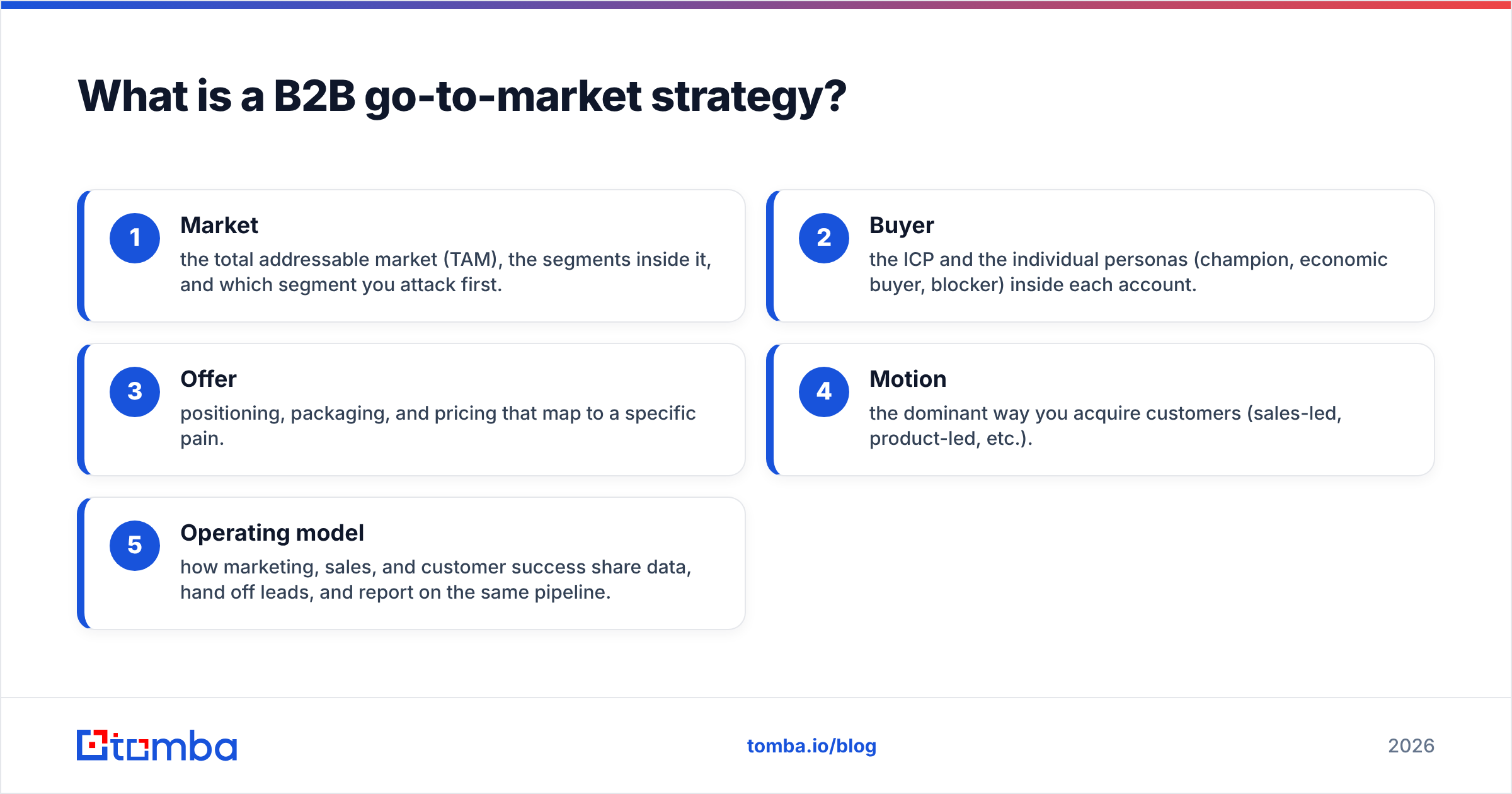
Technically, it's the coordinated set of decisions across five layers:
- Market — the total addressable market (TAM), the segments inside it, and which segment you attack first.
- Buyer — the ICP and the individual personas (champion, economic buyer, blocker) inside each account.
- Offer — positioning, packaging, and pricing that map to a specific pain.
- Motion — the dominant way you acquire customers (sales-led, product-led, etc.).
- Operating model — how marketing, sales, and customer success share data, hand off leads, and report on the same pipeline.
A common mistake is treating GTM as "marketing plus a sales team." It's broader. RevOps — revenue operations — is the connective tissue that keeps all five layers pointed at the same goal.
)
Which go-to-market motion is right for you?#
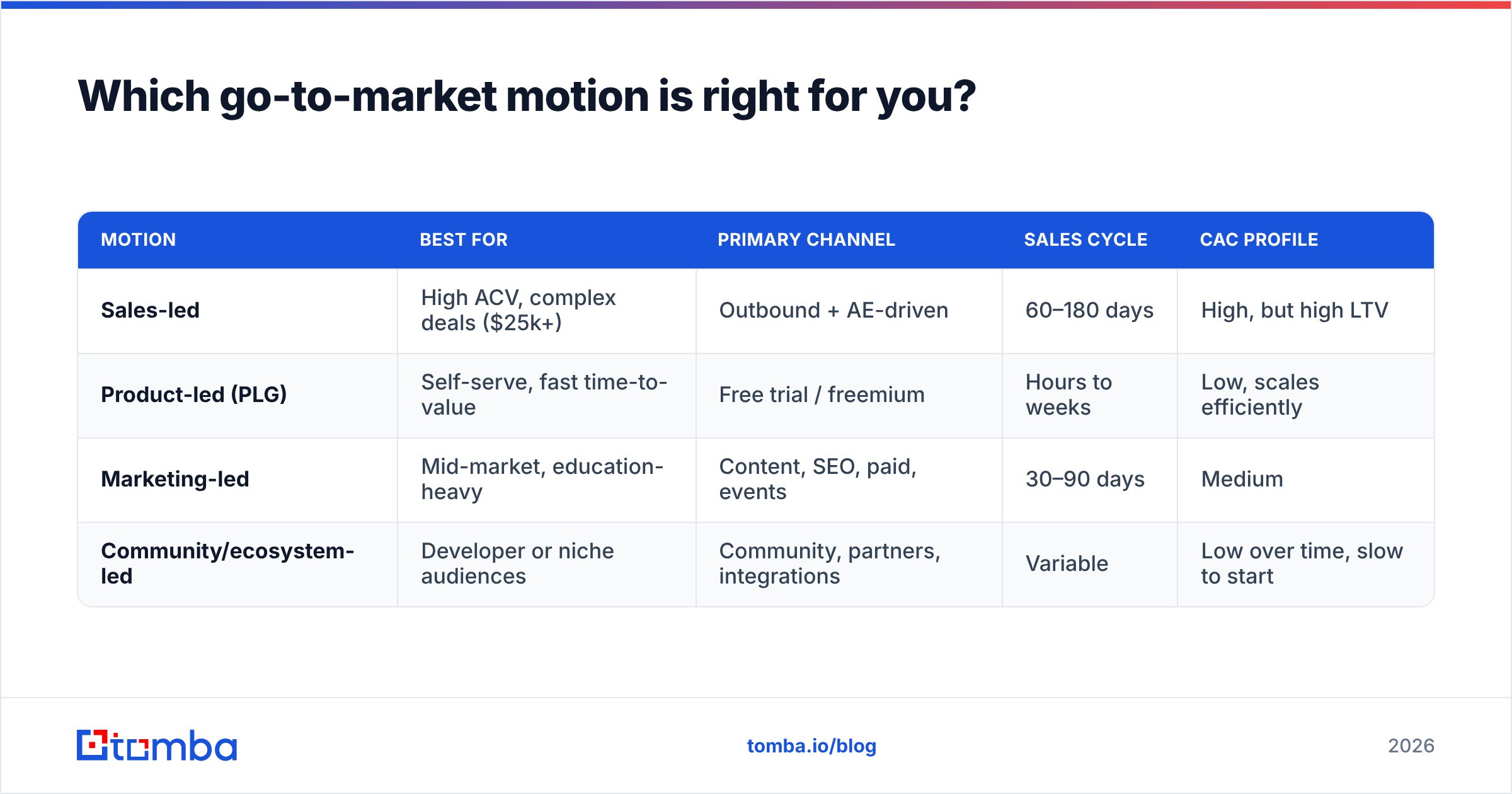
The motion is the engine. Most teams default to whatever the founders did at their last company, which is rarely the right answer. Here's how the four main motions compare in 2026.
| Motion | Best for | Primary channel | Sales cycle | CAC profile |
|---|---|---|---|---|
| Sales-led | High ACV, complex deals ($25k+) | Outbound + AE-driven | 60–180 days | High, but high LTV |
| Product-led (PLG) | Self-serve, fast time-to-value | Free trial / freemium | Hours to weeks | Low, scales efficiently |
| Marketing-led | Mid-market, education-heavy | Content, SEO, paid, events | 30–90 days | Medium |
| Community/ecosystem-led | Developer or niche audiences | Community, partners, integrations | Variable | Low over time, slow to start |
A few rules of thumb:
- If your annual contract value is below ~$5k, a heavy outbound sales motion usually loses money. Lean PLG or marketing-led.
- If buyers need approval from 6+ stakeholders (typical enterprise software), sales-led is non-negotiable — but feed it with marketing air cover.
- Hybrid is the norm. A classic 2026 stack is PLG for top-of-funnel signups, then a sales-led "PLG-to-enterprise" overlay that targets accounts showing high product usage.
Gartner research consistently shows B2B buyers now spend only a fraction of the deal cycle talking to sales reps — most of the journey is self-directed. That shift is exactly why pure single-motion strategies underperform.
How do you define your Ideal Customer Profile (ICP)?#
Your ICP is the single highest-leverage decision in the whole strategy. A sharp ICP makes every downstream activity cheaper: better ad targeting, higher reply rates, shorter sales cycles, lower churn.
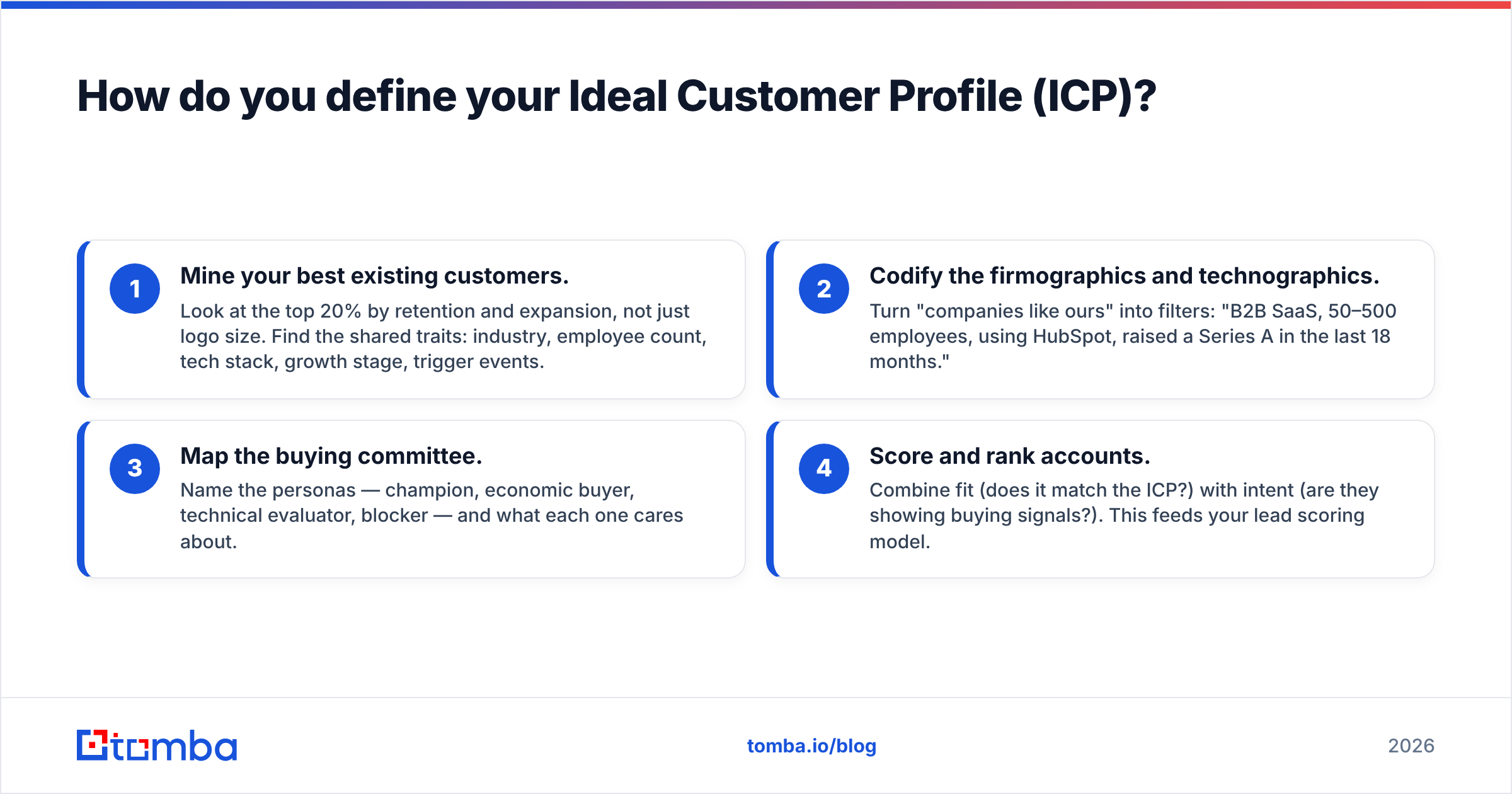
Build it in four steps:
- Mine your best existing customers. Look at the top 20% by retention and expansion, not just logo size. Find the shared traits: industry, employee count, tech stack, growth stage, trigger events.
- Codify the firmographics and technographics. Turn "companies like ours" into filters: "B2B SaaS, 50–500 employees, using HubSpot, raised a Series A in the last 18 months."
- Map the buying committee. Name the personas — champion, economic buyer, technical evaluator, blocker — and what each one cares about.
- Score and rank accounts. Combine fit (does it match the ICP?) with intent (are they showing buying signals?). This feeds your lead scoring model.
The hard part isn't defining the ICP on paper — it's operationalizing it. You need accurate firmographic and contact data to find every account that matches. This is where most GTM strategies quietly break: the list looks great in a slide, but the email and phone data behind it is stale or missing. Clean data enrichment turns a theoretical ICP into a reachable target list.
What does a step-by-step GTM framework look like?#
Here's a framework you can actually run, not just admire. Each phase has an owner and an exit criterion.
- Phase 1 — Segment and size. Define TAM, SAM, and the beachhead segment. Exit: a named segment with a defensible "why now."
- Phase 2 — Position and package. Write the value proposition for that segment and decide pricing tiers. Exit: a one-sentence positioning statement your reps can repeat.
- Phase 3 — Build the target list. Use domain search and enrichment to assemble accounts and verified contacts that match the ICP. Exit: a scored, deduplicated list with reachable decision-makers.
- Phase 4 — Choose and instrument the motion. Pick the channel mix, set up the tooling, and define the lead-to-revenue stages. Exit: one pipeline model everyone agrees on.
- Phase 5 — Launch and measure. Run the motion, track leading indicators (reply rate, demo rate, win rate), and review weekly. Exit: a feedback loop that updates the ICP and messaging.
- Phase 6 — Scale what works. Double down on the channels and segments with the best CAC payback; cut the rest. Exit: a repeatable, forecastable revenue engine.
Notice that Phase 3 sits before you build the motion. You cannot pressure-test positioning or pick a channel until you know exactly who you're reaching and that you can reach them.
How do you align teams around the strategy?#
A go-to-market strategy is only as strong as the alignment behind it. Marketing celebrating MQLs while sales complains about lead quality is the oldest dysfunction in B2B — and it's a definitions problem, not an effort problem.
Three alignment fundamentals:
- One source of truth. Marketing, sales, and CS work from the same CRM data. When a rep enriches a record, marketing sees it. HubSpot's research on sales and marketing alignment ties tight alignment directly to revenue growth.
- Shared SLAs. Marketing commits to a volume and quality of leads; sales commits to working them within a set time. Both numbers are written down.
- A single funnel model. Everyone uses the same stage names and the same definition of a qualified lead. No parallel spreadsheets.
When alignment is real, handoffs stop leaking pipeline. When it isn't, the best strategy in the world dies in the gap between a "marketing qualified" and a "sales accepted" lead.
)
Which tools power a modern B2B GTM strategy?#
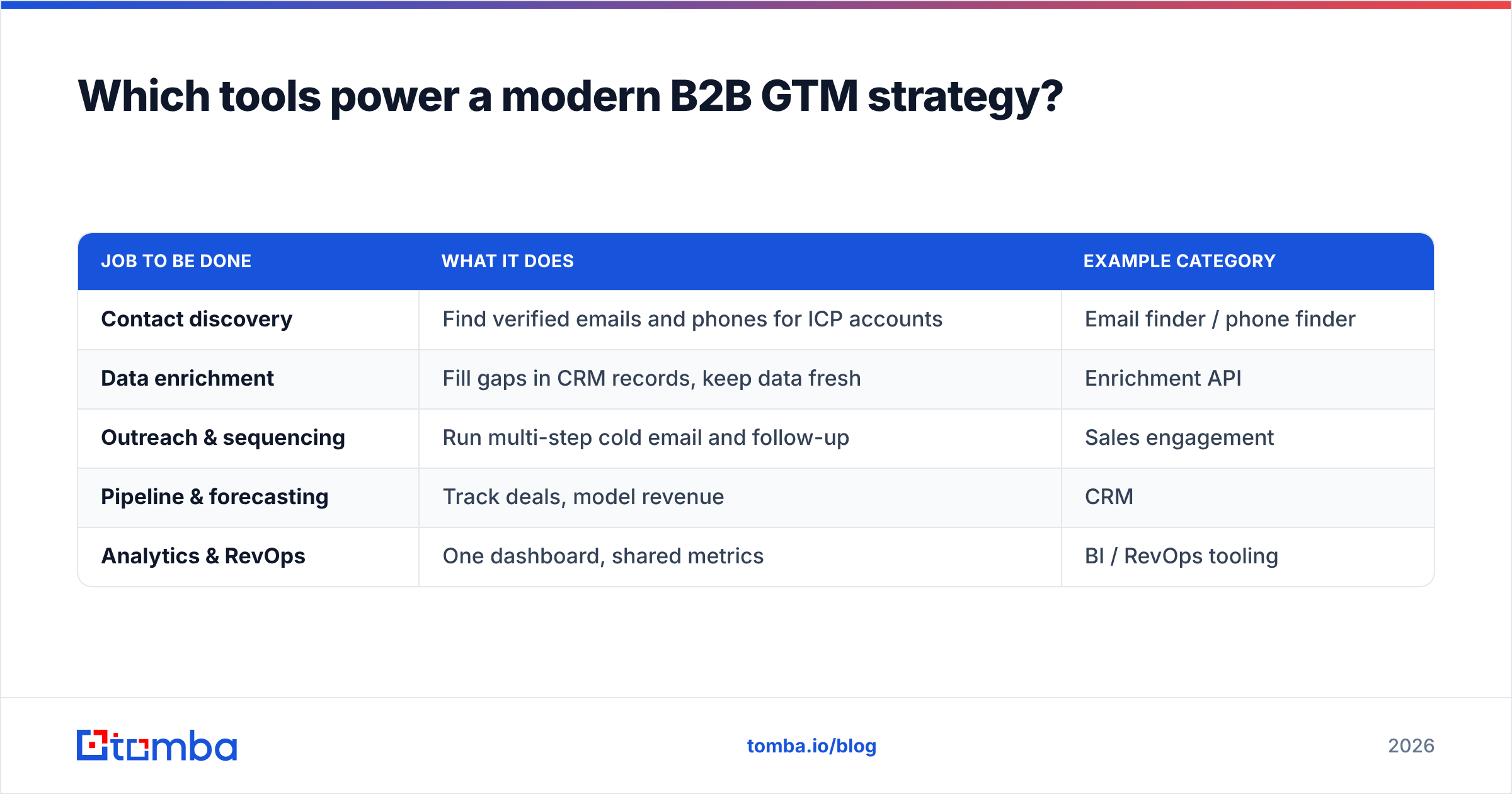
Tools follow strategy — never the reverse. But once your ICP and motion are set, the right stack removes friction at every stage. A lean, effective 2026 GTM stack covers five jobs:
| Job to be done | What it does | Example category |
|---|---|---|
| Contact discovery | Find verified emails and phones for ICP accounts | Email finder / phone finder |
| Data enrichment | Fill gaps in CRM records, keep data fresh | Enrichment API |
| Outreach & sequencing | Run multi-step cold email and follow-up | Sales engagement |
| Pipeline & forecasting | Track deals, model revenue | CRM |
| Analytics & RevOps | One dashboard, shared metrics | BI / RevOps tooling |
For the discovery and enrichment layer — the part that turns your ICP into a working list — accuracy is everything. Sending sequences to bad addresses tanks your sender reputation and wastes rep time. That's why a verified email finder paired with an email verifier belongs at the front of the stack, before a single message goes out.
If you're choosing between platforms, evaluate on three axes: data accuracy and coverage, how cleanly it integrates with your CRM, and price per usable record. A cheap tool with 60% deliverability is more expensive than a precise one once you count wasted sends and burned domains. Cross-reference real user reviews on G2 before committing budget.
What metrics tell you the strategy is working?#
Watch leading indicators weekly and lagging indicators monthly. The leading ones tell you whether to course-correct now; the lagging ones tell you whether the strategy paid off.
- Leading: reply rate, meeting-booked rate, pipeline created, ICP match rate of new accounts.
- Lagging: win rate, CAC payback period, net revenue retention (NRR), average sales cycle length.
A healthy 2026 B2B benchmark to anchor against: CAC payback under ~12 months and NRR above 100%. If your payback is creeping past 18 months, the problem is usually upstream — a fuzzy ICP or the wrong motion — not the closing team.
Common GTM mistakes to avoid#
- Boiling the ocean. Targeting "all SaaS companies" instead of a beachhead segment. Narrow wins.
- Skipping data hygiene. Launching outbound on an unverified list. Verify first, send second.
- Motion mismatch. Forcing a high-touch sales motion onto a low-ACV product.
- No feedback loop. Treating the GTM plan as a fixed document instead of a living model updated by real results.
- Tool-first thinking. Buying a 12-tool stack before the ICP is clear. Strategy first, then tooling.
Frequently asked questions#
How long does it take to see results from a new GTM strategy? For a sales-led motion, expect a full sales cycle (60–180 days) before win-rate data is meaningful. PLG and marketing-led motions surface leading indicators within weeks.
Do I need a different strategy for each segment? You need a different motion mix and messaging per segment, but the underlying framework — segment, position, list, launch, measure — stays the same.
What's the single most overlooked part of B2B GTM? Contact data quality. Teams obsess over messaging and ignore that half their list bounces. Fix the foundation and everything above it performs better.
Build the data foundation your GTM strategy needs#
A strategy is only as good as the accounts you can actually reach. Tomba sits at the front of your go-to-market engine: use the Tomba Email Finder to turn your ICP into a list of verified, decision-maker emails — by name, company, or domain — then enrich and verify before you ever hit send. Start free with 25 searches a month, scale to the Starter plan at $49/mo as your pipeline grows, and check the full Tomba pricing when you're ready to power the whole motion. Get the data right, and the rest of the strategy finally has something solid to stand on.
// get started
Find, verify and enrich your first contacts today
Start on the free plan with 25 searches a month, then scale when your team is ready.
Free plan · No credit card required · GDPR & CCPA
// about the author