B2B Go-To-Market Strategy Template: The 2026 Playbook
A practical B2B go-to-market strategy template for 2026 — ICP, positioning, channels, metrics, and a fill-in framework you can ship this quarter.
A go-to-market strategy is the difference between a product that sells and a product that just exists. Yet most B2B teams treat GTM as a slide deck nobody reads after the kickoff. This template fixes that — it gives you a single, fill-in framework that turns "we should do outbound" into a concrete, measurable plan.
TL;DR#
- A B2B go-to-market strategy template forces you to define five things before you spend a dollar: ICP, positioning, channels, motion, and metrics.
- Start with the ICP, not the product. Everything downstream — messaging, channel mix, sales motion — derives from who you're selling to.
- Pick one primary motion (product-led, sales-led, or marketing-led) instead of doing all three badly.
- Tie every section to a number. A GTM plan without targets is a wish list.
- Clean contact data is the fuel. The best plan stalls if your prospect list is full of bounces — which is where tools like the Tomba Email Finder earn their keep.
What is a B2B go-to-market strategy?#
A go-to-market (GTM) strategy is your plan for how you reach customers and win revenue — think of it as the flight plan a pilot files before takeoff. The plane (your product) can fly, but without the plan you don't know the route, the fuel needed, or where you land.
Technically, a B2B GTM strategy answers: who you sell to, what you say to them, how you reach them, how they buy, and how you measure success. It sits above tactics. A cold email is a tactic; the decision to lead with outbound to mid-market RevOps leaders is strategy.
The mistake teams make is jumping to tactics — "let's run LinkedIn ads" — without the strategy layer. That's how budgets evaporate. A template keeps you honest by making you fill in the strategic boxes first.

What are the core components of a GTM template?#
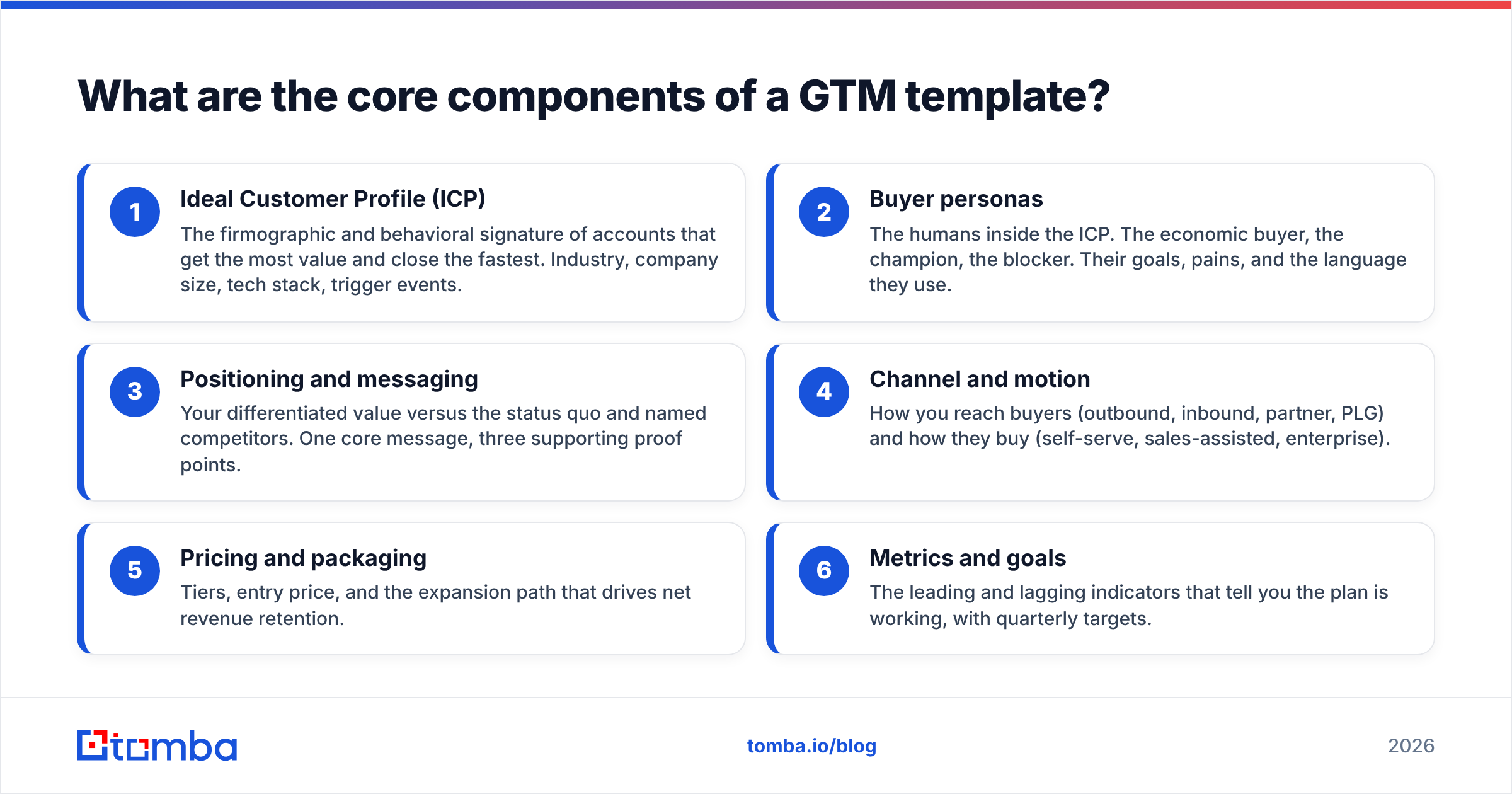
Every usable B2B go-to-market strategy template has the same backbone. Fill these six sections in order — each one feeds the next.
- Ideal Customer Profile (ICP) — The firmographic and behavioral signature of accounts that get the most value and close the fastest. Industry, company size, tech stack, trigger events.
- Buyer personas — The humans inside the ICP. The economic buyer, the champion, the blocker. Their goals, pains, and the language they use.
- Positioning and messaging — Your differentiated value versus the status quo and named competitors. One core message, three supporting proof points.
- Channel and motion — How you reach buyers (outbound, inbound, partner, PLG) and how they buy (self-serve, sales-assisted, enterprise).
- Pricing and packaging — Tiers, entry price, and the expansion path that drives net revenue retention.
- Metrics and goals — The leading and lagging indicators that tell you the plan is working, with quarterly targets.
This isn't theory. HubSpot's GTM research and most modern RevOps playbooks converge on this same skeleton — the order matters because positioning you write before nailing the ICP is positioning you'll rewrite.
How do you define your ICP and personas?#
Start with your best current customers, not your dream customers. Pull the accounts with the highest retention, fastest sales cycles, and biggest expansion — then find what they share.
A sharp ICP reads like a filter, not a wish. "B2B SaaS companies, 50–500 employees, US/EU, using Salesforce, with a dedicated RevOps hire" is usable. "Growing tech companies" is not — you can't build a target list from it.
Once the ICP is set, layer personas on top. For each, capture the trigger (what makes them look), the pain (what keeps them up), and the proof they need (what makes them believe you). This becomes the raw material for every email and call.
Building the actual account and contact list is where execution lives. You can map a company's people and email patterns fast with domain search, then enrich the rows you keep with data enrichment so your CRM isn't full of blanks. Garbage targeting data produces garbage pipeline — no template survives a bad list.
Which go-to-market motion should you choose?#
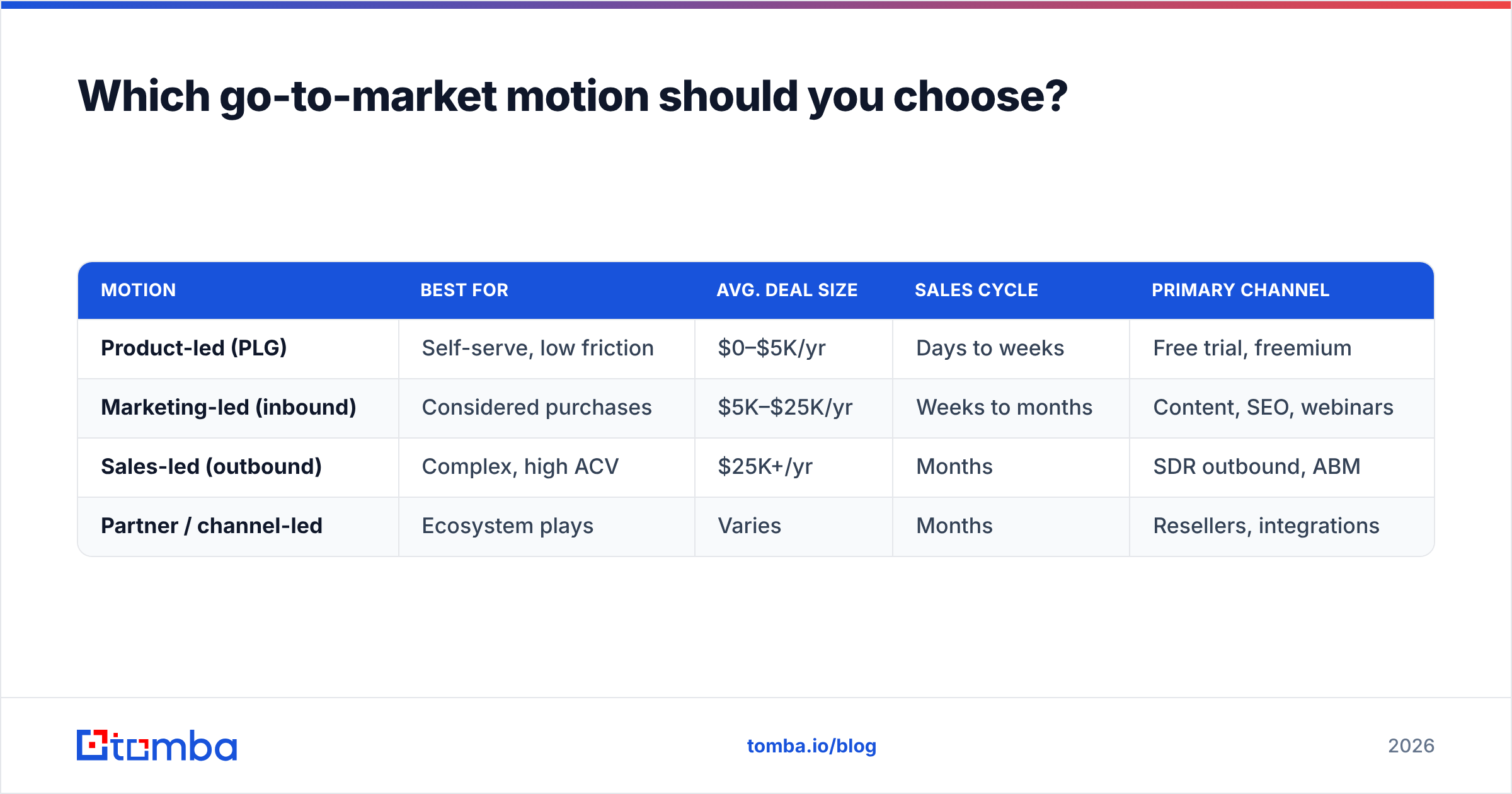
Choose one primary motion and make the others support it. Running product-led, sales-led, and marketing-led at full intensity simultaneously is how seed-stage teams burn out. Match the motion to your price point and buyer.
| Motion | Best for | Avg. deal size | Sales cycle | Primary channel |
|---|---|---|---|---|
| Product-led (PLG) | Self-serve, low friction | $0–$5K/yr | Days to weeks | Free trial, freemium |
| Marketing-led (inbound) | Considered purchases | $5K–$25K/yr | Weeks to months | Content, SEO, webinars |
| Sales-led (outbound) | Complex, high ACV | $25K+/yr | Months | SDR outbound, ABM |
| Partner / channel-led | Ecosystem plays | Varies | Months | Resellers, integrations |
The price-to-motion rule of thumb: if your annual contract value can't fund a salesperson chasing it, you need PLG or inbound to do the heavy lifting. A $99/month tool sold by an SDR loses money on the first call.
Most successful B2B companies blend motions over time — PLG to acquire, sales-led to expand. But at any given quarter, one motion should own the majority of your pipeline target so you can actually learn what works.
How do you build the channel and outreach plan?#
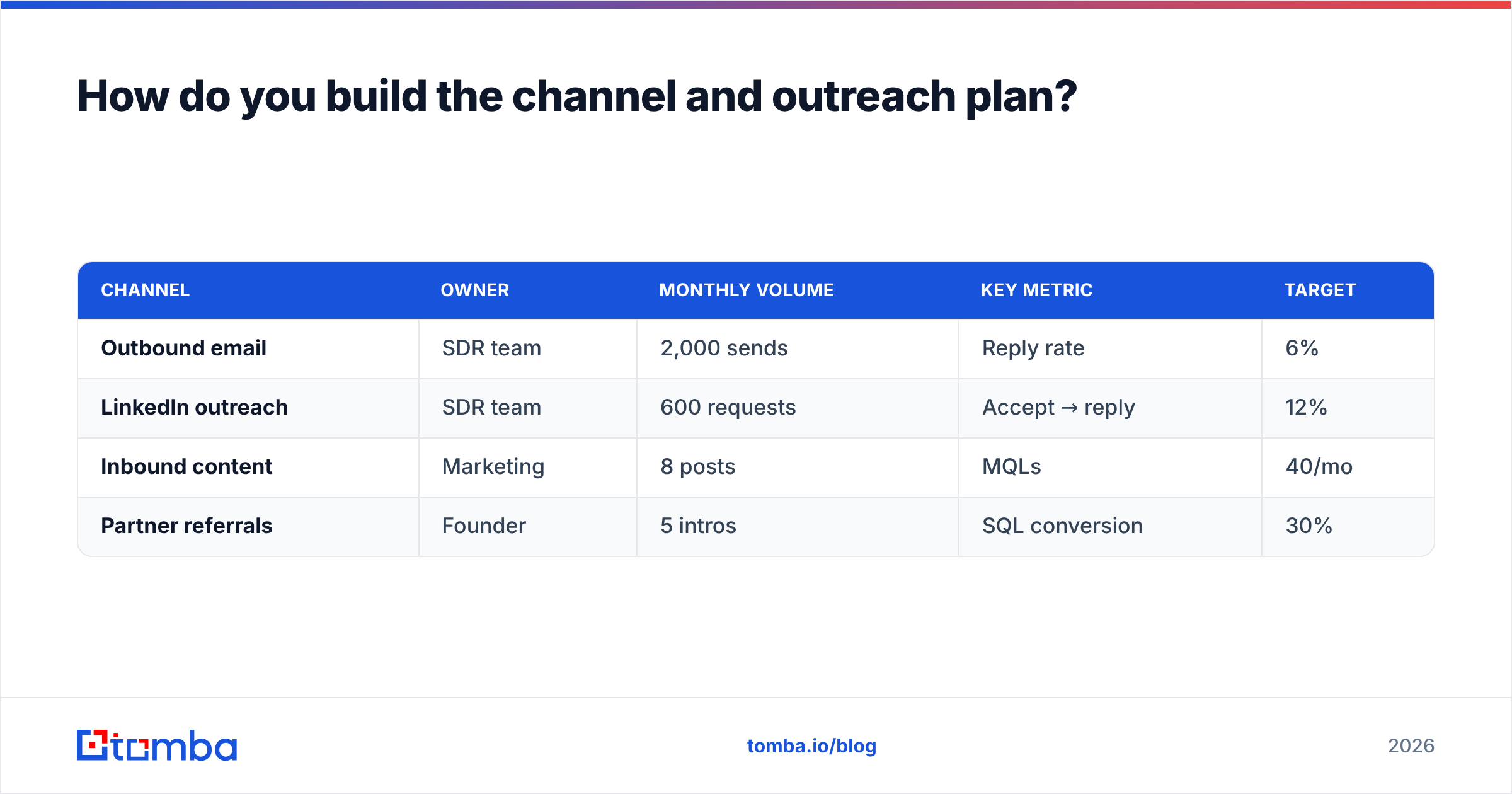
Pick two or three channels, not ten. Each channel needs an owner, a budget, a target volume, and a conversion assumption you can test. Spreading thin across every channel guarantees you learn nothing from any of them.
For a sales-led motion, outbound is usually the engine. That means a repeatable sequence: find the contact, verify the email, personalize the opener, and follow up. The find-and-verify step is non-negotiable — sending to unverified addresses tanks your email deliverability and burns the domain you spent months warming.
Here's a channel plan skeleton you can drop into the template:
| Channel | Owner | Monthly volume | Key metric | Target |
|---|---|---|---|---|
| Outbound email | SDR team | 2,000 sends | Reply rate | 6% |
| LinkedIn outreach | SDR team | 600 requests | Accept → reply | 12% |
| Inbound content | Marketing | 8 posts | MQLs | 40/mo |
| Partner referrals | Founder | 5 intros | SQL conversion | 30% |
Before any of those sends go out, validate the list. Run addresses through an email verifier to strip bounces, and check catch-all domains separately since they need different handling. A 2% bounce rate is the line most inbox providers watch — cross it and your placement collapses regardless of how good the copy is.
What does positioning and messaging look like in the template?#
Positioning is the answer to "why you, why now, versus what they do today." Write it as a single sentence your whole team can repeat, then back it with proof.
A simple, durable format:
- For [ICP segment]
- who [trigger / pain],
- our product [category]
- delivers [primary outcome]
- unlike [status quo or named competitor]
- because [your defensible reason to believe].
Worked example: "For RevOps leaders at 50–500-person SaaS companies who waste hours chasing bad contact data, Tomba is an email-finder and enrichment platform that delivers verified contacts in seconds — unlike scraping LinkedIn by hand — because it cross-checks every address against live mail-server signals."
That sentence then cascades. Your subject lines, ad headlines, and sales decks all ladder up to the "delivers" and "unlike" clauses. If a piece of copy doesn't reinforce your positioning, cut it.
How do you set GTM metrics and goals?#
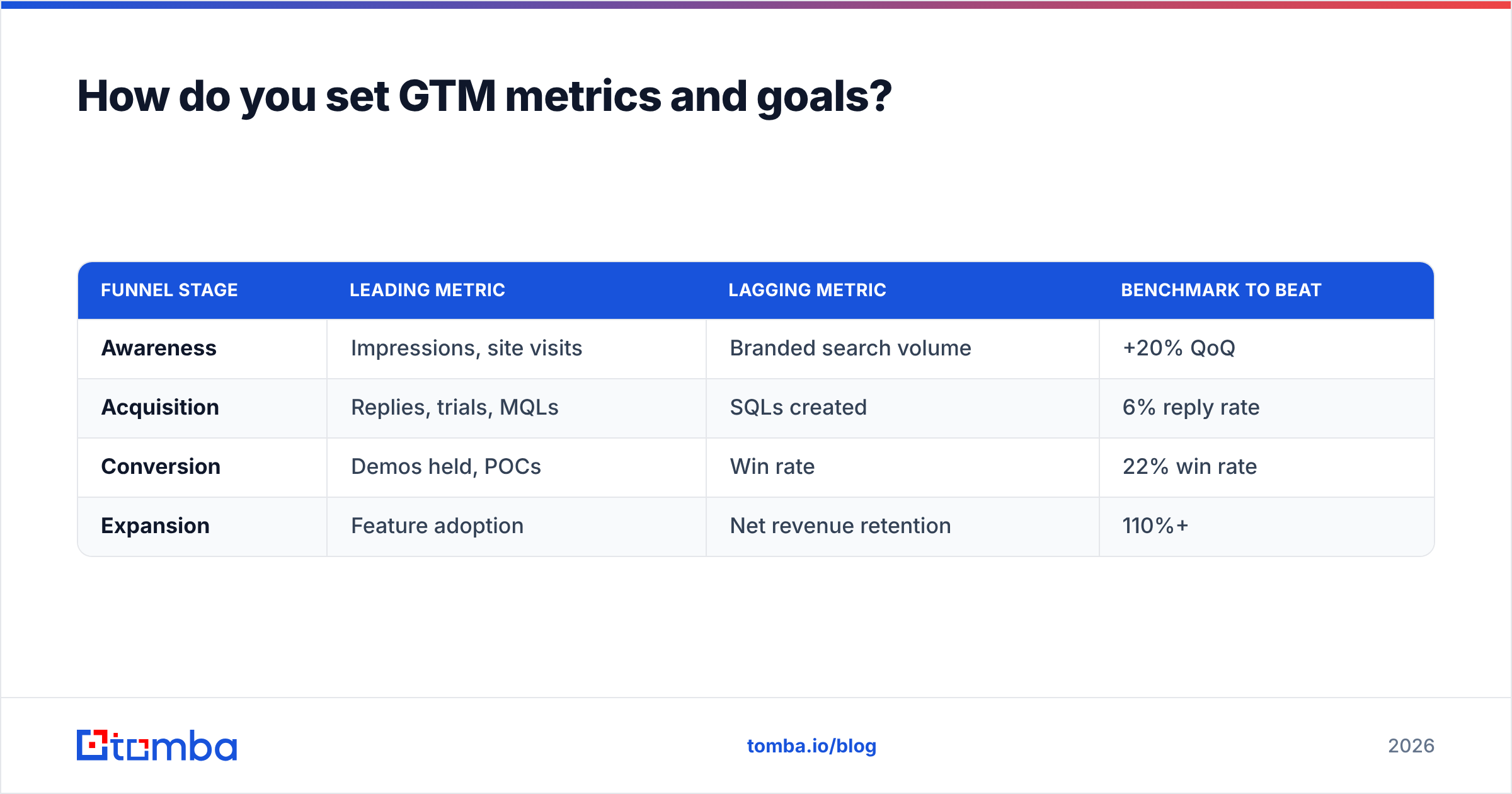
Tie every section of the plan to a leading and a lagging indicator. Leading indicators (sends, demos booked, trials started) tell you this week; lagging indicators (closed revenue, NRR) confirm next quarter. A GTM template with no numbers is just vocabulary.
| Funnel stage | Leading metric | Lagging metric | Benchmark to beat |
|---|---|---|---|
| Awareness | Impressions, site visits | Branded search volume | +20% QoQ |
| Acquisition | Replies, trials, MQLs | SQLs created | 6% reply rate |
| Conversion | Demos held, POCs | Win rate | 22% win rate |
| Expansion | Feature adoption | Net revenue retention | 110%+ |
Pull your benchmark numbers from credible third parties — G2's category data and analyst reports give you a defensible baseline instead of made-up targets. Then beat them, not by guessing, but by improving the one stage where you leak the most.
Review the metrics monthly and the whole strategy quarterly. GTM is not "set and forget" — it's a hypothesis you test. The template is the lab notebook.
A fill-in-the-blanks GTM template you can copy#
Paste this into a doc and replace the brackets. It's deliberately one page — if your GTM strategy doesn't fit on a page, nobody will use it.
- ICP: We sell to [industry] companies, [size] employees, in [region], using [tech], showing [trigger].
- Primary persona: [Title], who cares about [goal] and struggles with [pain].
- Positioning: For [ICP] who [pain], we are the [category] that [outcome], unlike [alternative], because [reason].
- Primary motion: [PLG / inbound / outbound / partner], because our ACV is [$X].
- Top channels: [Channel 1], [Channel 2], [Channel 3] — each with an owner and a monthly volume target.
- Pricing: Entry at [$X], expansion via [lever]. (See how a clean tier ladder reads on the Tomba pricing page.)
- 90-day goal: [Number] of [pipeline / revenue / activated accounts].
- North-star metric: [The single number the whole team rallies behind].
Fill those eight lines honestly and you have a real B2B go-to-market strategy — not a deck, a plan.
What are the most common GTM mistakes to avoid?#
- Vague ICP. "Anyone who needs our product" is not a target. Narrow until it hurts, then narrow again.
- Too many motions at once. Pick one primary engine per quarter.
- No data hygiene. The cleanest strategy fails on a list full of bounces and outdated titles.
- Tactics before strategy. Buying an ads budget before defining positioning is lighting money on fire.
- No review cadence. A GTM plan you don't revisit monthly is a fossil by week three.
The data-hygiene point deserves emphasis because it's the silent killer. You can nail every strategic box and still miss the number because your SDRs are emailing dead inboxes. That's a solved problem — find verified contacts at the source instead of discovering the bounces after you've already torched your sender reputation.
Where does Tomba fit in your GTM stack?#
Once your strategy is set, the daily grind is finding and reaching the right people — and that's exactly what Tomba is built for. Use the Tomba Email Finder to turn a target account list into verified, deliverable contacts: search by domain, name, or company, verify before you send, and enrich the rows your CRM is missing.
It plugs into the outbound motion most B2B GTM plans depend on. Free tier covers 25 searches a month so you can test it against your ICP today; paid plans start at $49/month when you're ready to scale the list. A great go-to-market strategy template tells you who to reach — Tomba makes sure the message actually lands in their inbox.
Build the plan. Clean the list. Then go win the quarter.
// get started
Find, verify and enrich your first contacts today
Start on the free plan with 25 searches a month, then scale when your team is ready.
Free plan · No credit card required · GDPR & CCPA
// about the author