B2B Growth Hacking Strategy: The 2026 Playbook That Scales
Most B2B growth hacks are recycled B2C tricks that die on contact with a 9-month sales cycle. Here is a 2026 framework that actually compounds pipeline.
You have read the same ten growth-hacking listicles everyone else has. "Run a viral giveaway." "Add a referral loop." "Post on Product Hunt." Then you tried them against a B2B motion with a six-figure ACV and a nine-month sales cycle, and nothing happened. That is not your fault. Most "growth hacking" advice is B2C engagement tactics wearing a B2B costume.
A real b2b growth hacking strategy is different. It is the discipline of finding repeatable, often unconventional, experiments that compound pipeline — measured in qualified meetings and revenue, not likes. This playbook lays out how to build one in 2026.
TL;DR#
- Growth hacking in B2B means engineering compounding loops, not chasing one-off viral spikes. Optimize for qualified pipeline, not traffic.
- Data quality is the unfair advantage. Most "hacks" fail because the underlying contact data is wrong; accurate targeting beats clever copy every time.
- Run experiments as a portfolio — high-velocity tests on channel, offer, and audience, scored by a single North Star (pipeline per week).
- Three loops outperform one-off tactics: product-led signups, content-to-capture, and outbound-to-referral.
- Tooling matters less than sequencing. Find, verify, enrich, then personalize — in that order — and protect your sender reputation throughout.
What is a B2B growth hacking strategy, really?#
A b2b growth hacking strategy is a system for running cheap, fast experiments across acquisition channels to find the few that scale profitably — then pouring fuel on them.
Think of it like a restaurant testing dishes before printing the menu. You do not bet the whole kitchen on one entrée. You run small plates, watch what sells, and promote the winners. In B2B, the "small plates" are micro-campaigns: a new audience segment, a new hook, a new channel. The "menu" is your repeatable go-to-market motion.
The difference between B2C and B2B growth hacking comes down to three constraints:
- Buying committees, not buyers. You are persuading 6–10 people, not one impulse shopper. A hack that wins one champion still has to survive procurement.
- Long, non-linear cycles. Attribution is messy. A "viral" spike that does not produce a meeting in 90 days is just noise.
- Small, high-value audiences. You might have only 4,000 accounts that matter. Precision beats reach. One wrong email domain wastes a slot you cannot refill.
That third point is why data sits at the center of every serious B2B growth program. You cannot growth-hack your way out of a list where 30% of the emails bounce.
How is growth hacking different from normal B2B marketing?#
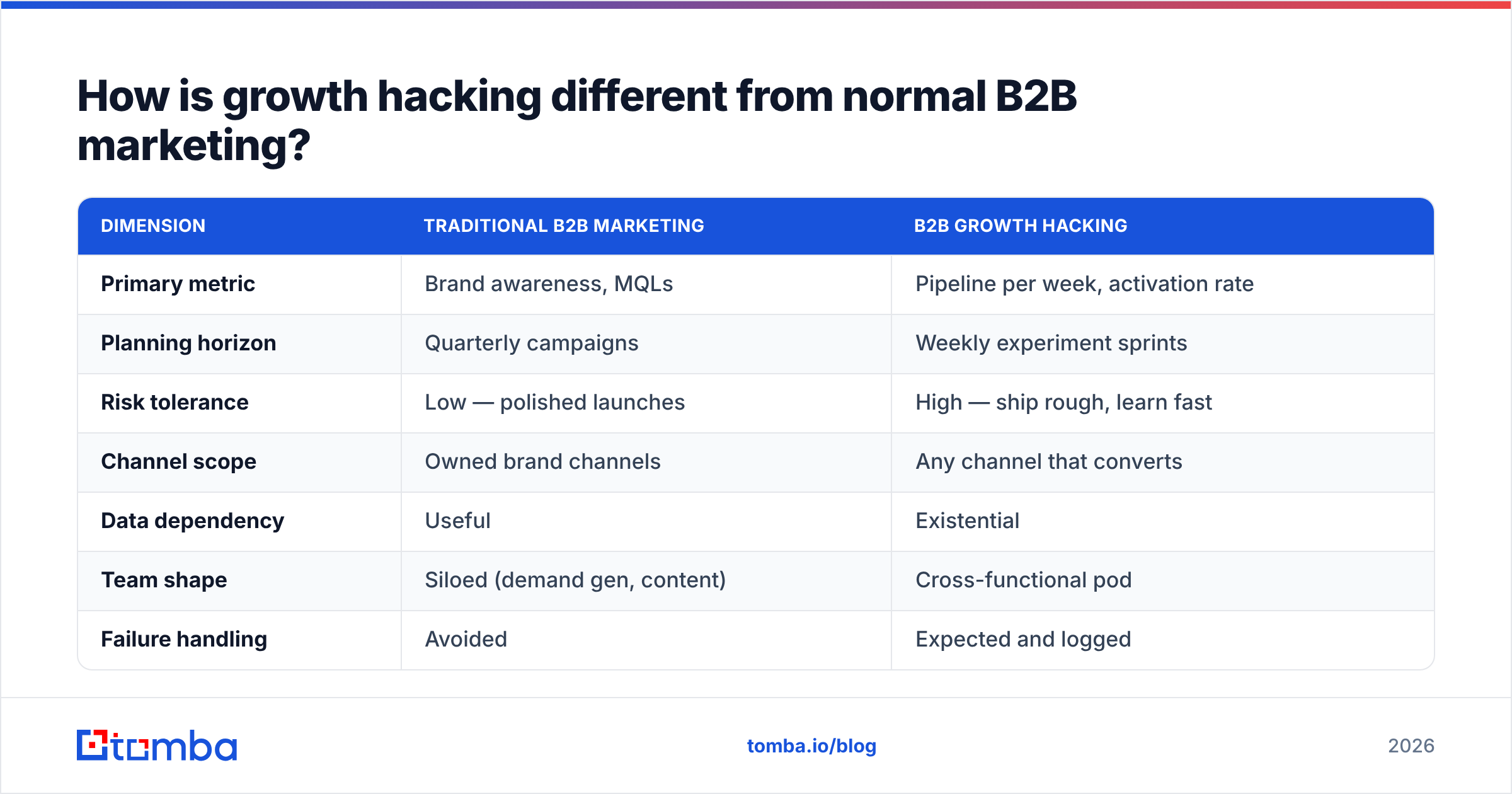
The honest answer: growth hacking is normal marketing with a faster feedback loop and less respect for departmental boundaries. A growth team will touch product, sales, and marketing in the same week if that is where the next experiment lives.
Here is how the mindsets compare:
| Dimension | Traditional B2B Marketing | B2B Growth Hacking |
|---|---|---|
| Primary metric | Brand awareness, MQLs | Pipeline per week, activation rate |
| Planning horizon | Quarterly campaigns | Weekly experiment sprints |
| Risk tolerance | Low — polished launches | High — ship rough, learn fast |
| Channel scope | Owned brand channels | Any channel that converts |
| Data dependency | Useful | Existential |
| Team shape | Siloed (demand gen, content) | Cross-functional pod |
| Failure handling | Avoided | Expected and logged |
Neither is "better." Traditional marketing builds the brand equity that makes hacks land. Growth hacking finds the channels worth investing that equity into. You need both, but if you are early-stage or pipeline-starved, the experimental loop is where you start.
What are the core growth loops in B2B?#
Stop thinking in funnels. Funnels leak and end. Loops compound — the output of one cycle becomes the input of the next. Three loops carry most B2B growth in 2026.
1. The product-led loop. A free tool or freemium tier brings users in, they hit a value moment, and their usage either invites teammates or generates a buying signal your sales team acts on. Tomba's own free email checker is an example of a top-of-funnel utility that pulls in exactly the audience that later needs a paid plan.
2. The content-to-capture loop. You publish a genuinely useful asset, it ranks or gets shared, and a fraction of readers convert into your database. The loop closes when that audience's engagement data tells you what to publish next. This is slow to start and nearly impossible for competitors to copy once it runs.
3. The outbound-to-referral loop. Targeted outreach books meetings, happy customers refer peers, and referrals shorten the next cycle's sales velocity. This loop lives or dies on contact accuracy — which is where most teams quietly fail.
Every one of these loops assumes you can reach the right person. That assumption breaks more often than anyone admits.
Why does data quality decide whether your growth hacks work?#
Because a brilliant experiment aimed at the wrong inbox produces zero signal — and worse, it poisons your future ability to send.
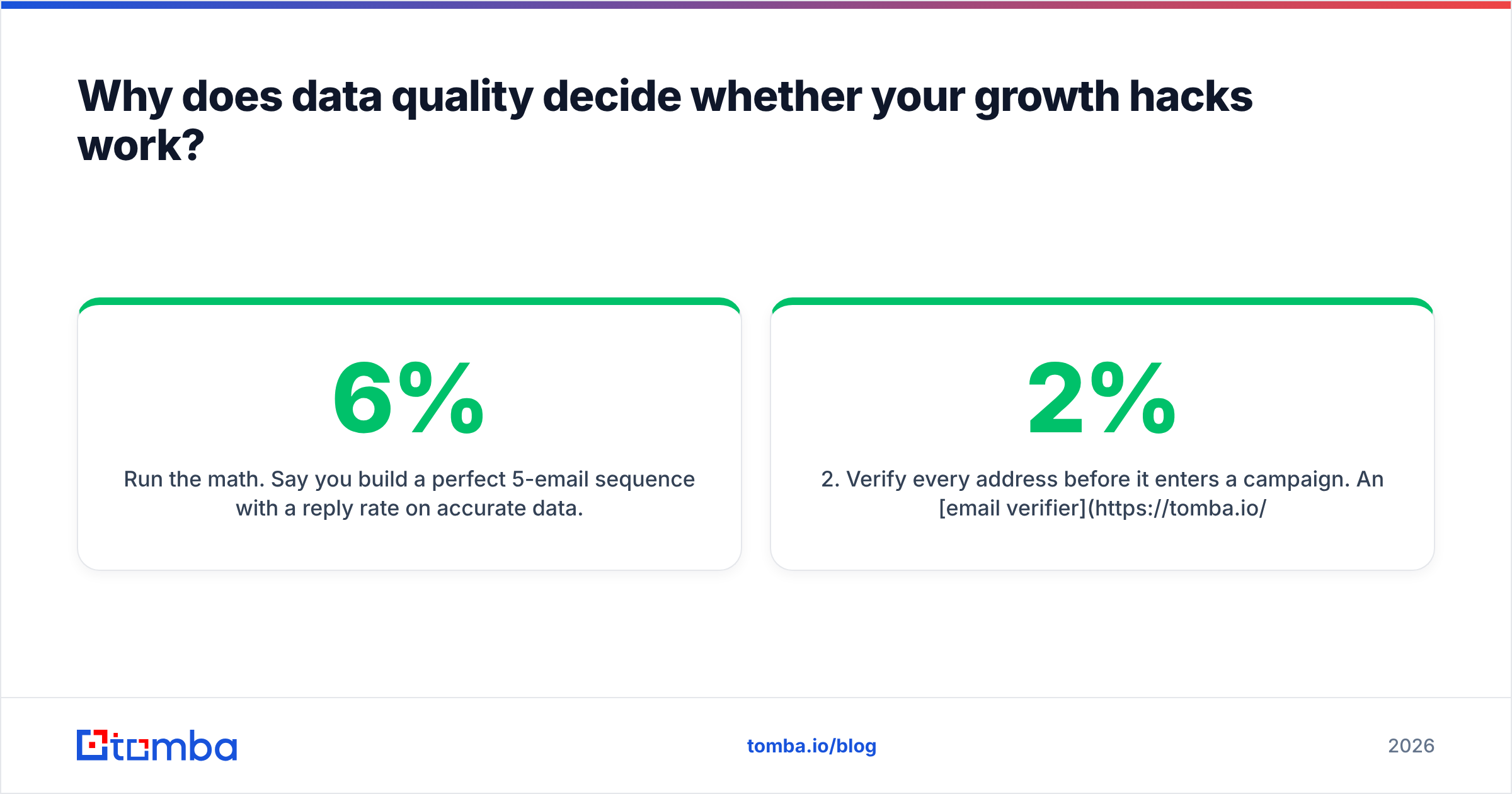
Run the math. Say you build a perfect 5-email sequence with a 6% reply rate on accurate data. Now feed it a list where 25% of addresses are invalid or catch-all. Your bounce rate spikes, mailbox providers flag you as a spammer, and your deliverability collapses across every campaign — including the clean ones. One bad list can taint a whole sending domain. Protecting sender reputation is not a deliverability footnote; it is a growth constraint.
The fix is a sequence, not a single tool:
- Find the right contacts — by company, role, or domain. A domain search turns a target account list into named decision-makers.
- Verify every address before it enters a campaign. An email verifier strips out invalid and risky addresses so your bounce rate stays under 2%.
- Enrich the records with firmographic and role data so personalization is possible at scale.
- Personalize and send — only now, with clean data underneath.
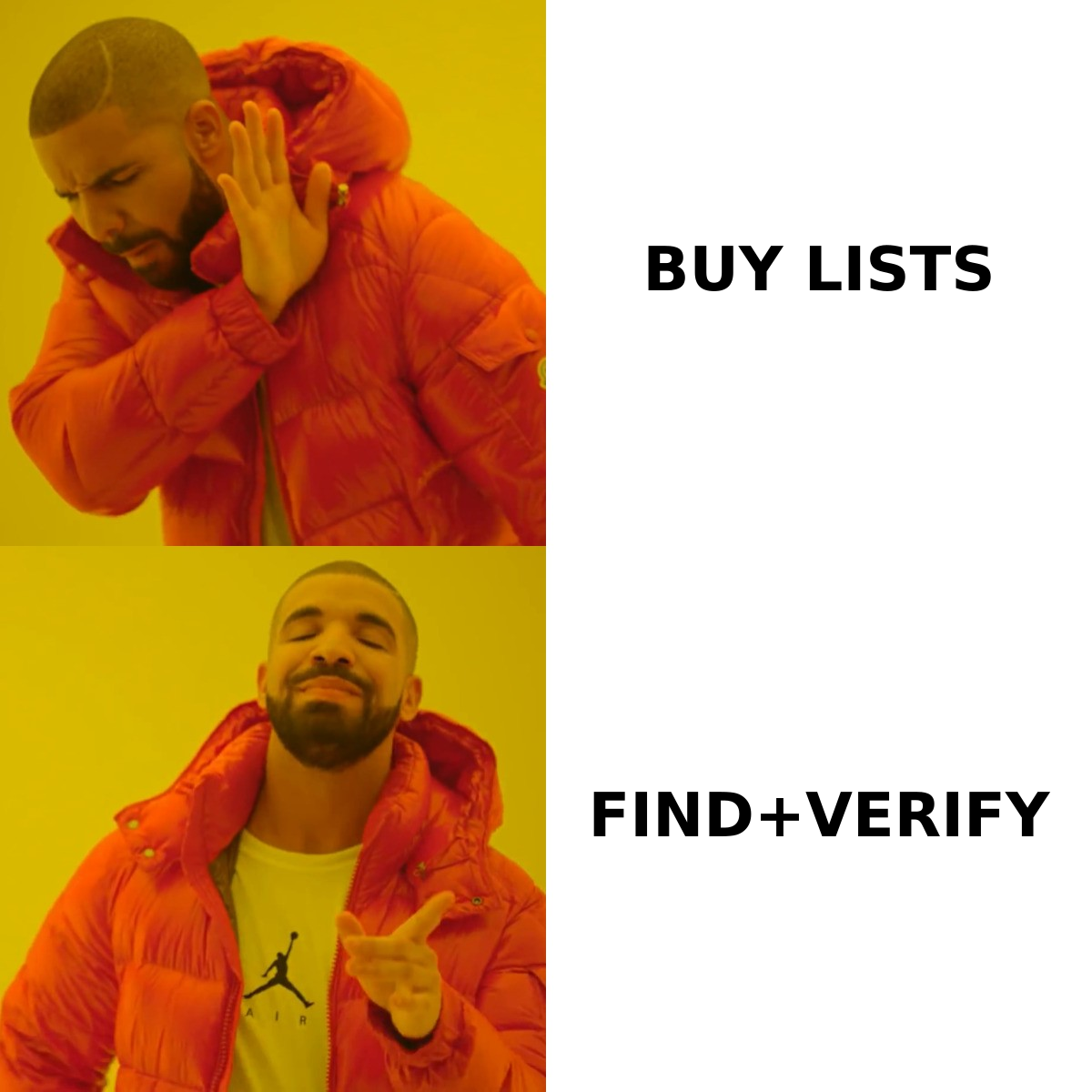
Teams that skip steps 2 and 3 are not growth hacking. They are spray-and-pray with extra steps.
What does a 2026 B2B growth hacking strategy look like in practice?#
Here is a concrete 90-day sequence you can run with a small team. It assumes you have a defined ICP and a working offer.
Days 1–15: Instrument and baseline. Pick one North Star metric — net new pipeline per week — and one guardrail metric (bounce rate or CAC). You cannot improve what you do not measure. Set up clean tracking on every channel before you touch a single tactic.
Days 16–45: Build the target universe. Assemble your account list, then convert accounts into verified contacts. This is the step most teams rush. Use a bulk email finder to go from a list of 2,000 target domains to verified, role-matched contacts, and enrich them with data enrichment so your messaging can reference real context.
Days 46–75: Run a portfolio of experiments. Launch 6–10 small tests across channel, offer, and audience simultaneously. Keep each test cheap enough that a failure costs a day, not a quarter. Score weekly.
Days 76–90: Double down and kill. Cut the bottom half. Reallocate budget to the top two or three. Document why each test won or lost — that log is the real asset you are building.
The point is rhythm. A b2b growth hacking strategy is not a single clever move; it is a machine for finding clever moves faster than competitors can copy them.
Which growth experiments actually move B2B pipeline?#
Not all hacks are created equal. Below are tactics that consistently produce qualified meetings in 2026, ranked loosely by effort-to-impact.
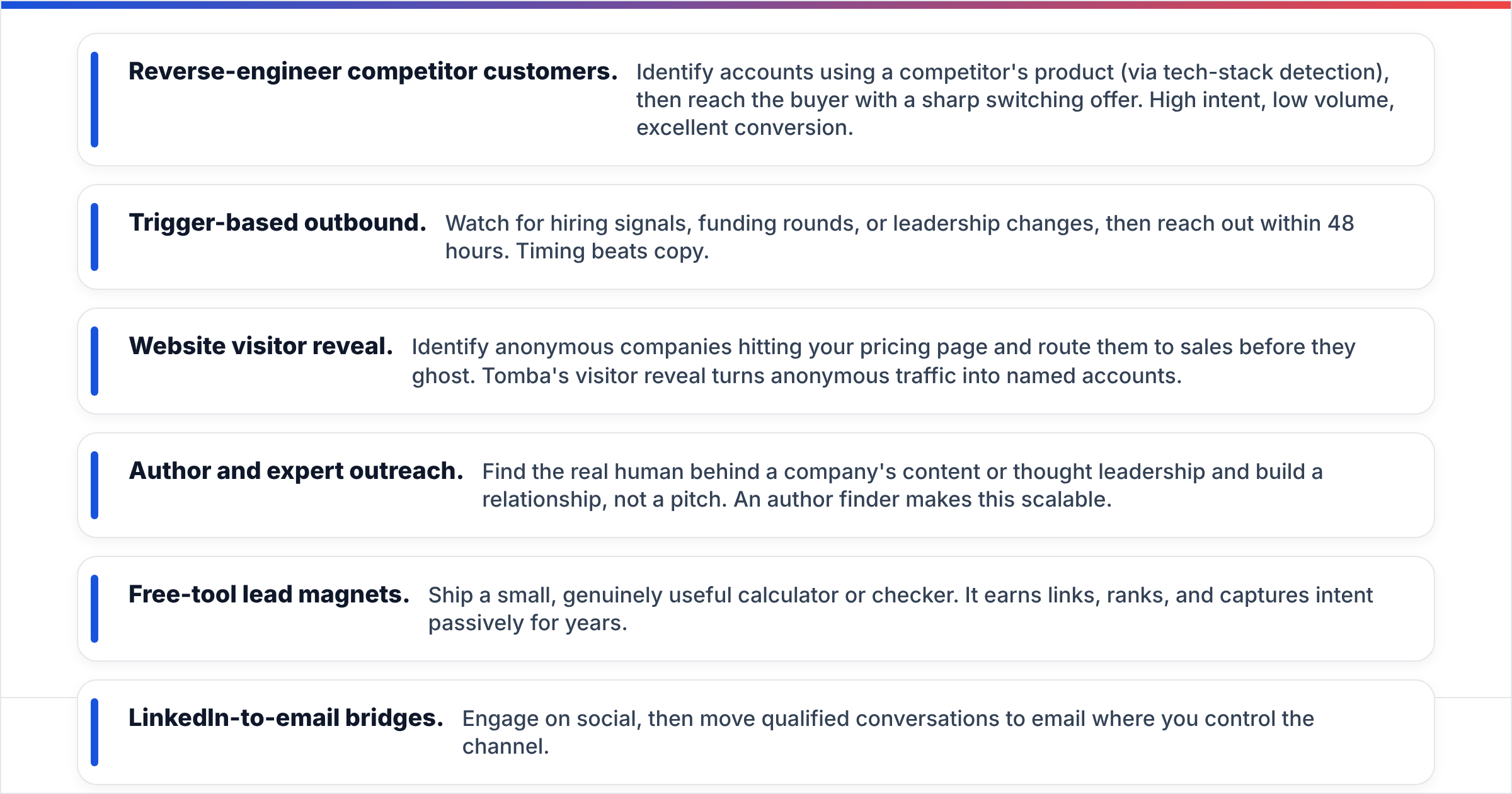
- Reverse-engineer competitor customers. Identify accounts using a competitor's product (via tech-stack detection), then reach the buyer with a sharp switching offer. High intent, low volume, excellent conversion.
- Trigger-based outbound. Watch for hiring signals, funding rounds, or leadership changes, then reach out within 48 hours. Timing beats copy.
- Website visitor reveal. Identify anonymous companies hitting your pricing page and route them to sales before they ghost. Tomba's visitor reveal turns anonymous traffic into named accounts.
- Author and expert outreach. Find the real human behind a company's content or thought leadership and build a relationship, not a pitch. An author finder makes this scalable.
- Free-tool lead magnets. Ship a small, genuinely useful calculator or checker. It earns links, ranks, and captures intent passively for years.
- LinkedIn-to-email bridges. Engage on social, then move qualified conversations to email where you control the channel.
Notice the pattern: every high-yield tactic depends on reaching a specific, correct person at the right moment. Reach and timing are the two levers. Data quality is what makes both possible.
How do you choose tools for a growth stack without overspending?#
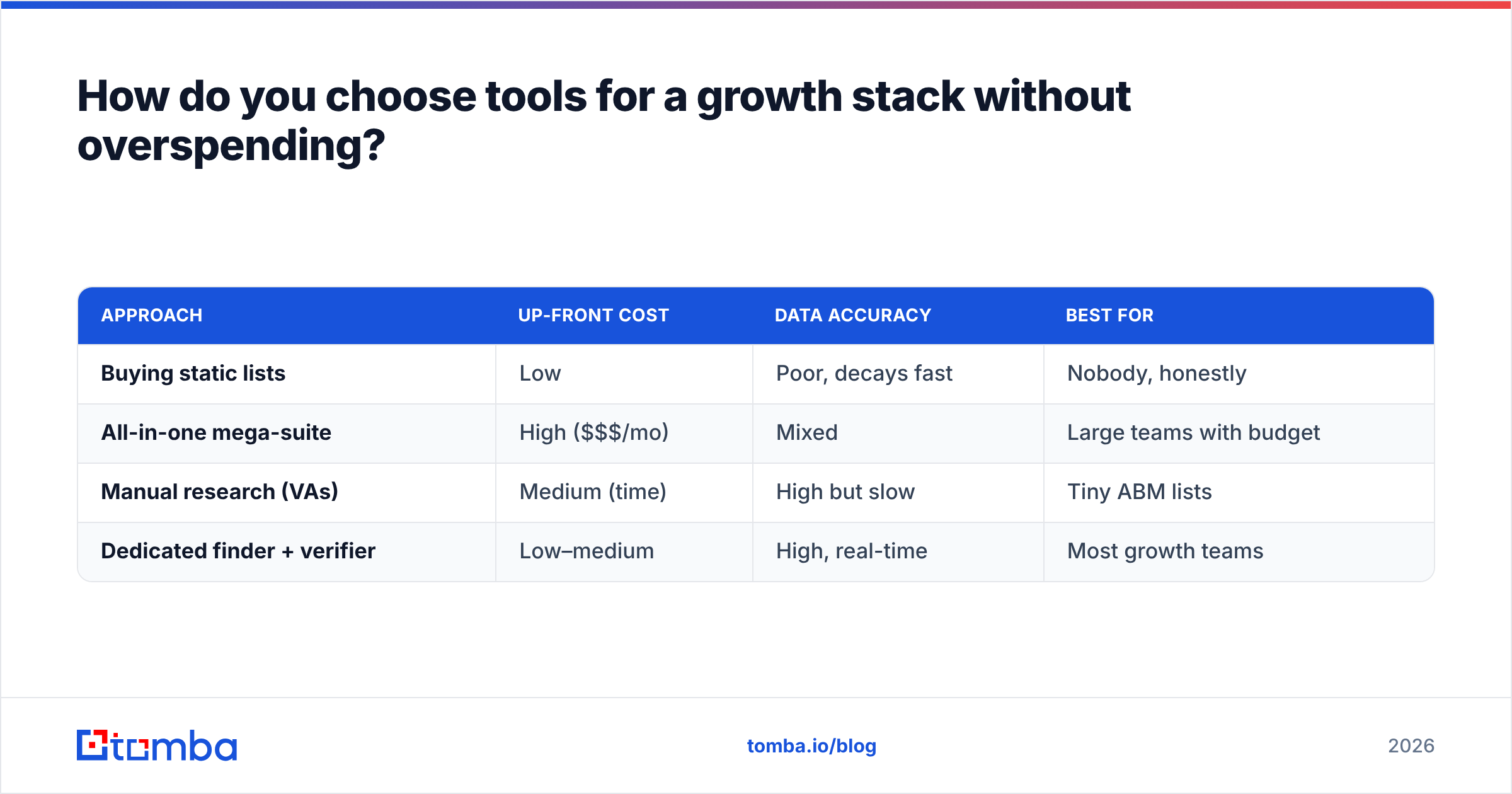
Buy for the sequence — find, verify, enrich, send — not for the logo. A common mistake is paying for an all-in-one platform that does ten things poorly when you need three things done well. Here is how the data layer compares across approaches:
| Approach | Up-front cost | Data accuracy | Best for |
|---|---|---|---|
| Buying static lists | Low | Poor, decays fast | Nobody, honestly |
| All-in-one mega-suite | High ($$$/mo) | Mixed | Large teams with budget |
| Manual research (VAs) | Medium (time) | High but slow | Tiny ABM lists |
| Dedicated finder + verifier | Low–medium | High, real-time | Most growth teams |
For most growth teams, a dedicated finder-plus-verifier wins on cost and accuracy. Tomba pricing starts with a free tier of 25 searches per month, then $49/mo for Starter, $99/mo for Growth, and $249/mo for Pro — predictable enough to model into your CAC without committing to an enterprise contract before you have proven the loop.
Whatever you choose, validate the vendor's accuracy claims against industry review sources like G2 and Capterra rather than taking marketing copy at face value. And if you are coordinating outbound with your CRM, lean on native HubSpot or Salesforce integrations so enriched data flows automatically instead of dying in a CSV.
How do you measure a growth hacking program so it survives scrutiny?#
Pick one North Star and defend it ruthlessly. Vanity metrics are the enemy of every growth program because they let a failing strategy look successful.
Tie every experiment to one of three numbers:
- Pipeline created per week — your North Star. Everything serves this.
- Activation or reply rate — your leading indicator. It moves before pipeline does.
- Cost per qualified meeting — your efficiency guardrail. It tells you when a "winning" hack is quietly bankrupting you.
Report these weekly, not quarterly. The whole advantage of growth hacking is speed of learning; a quarterly review throws that advantage away. When a test wins, write down why in one sentence. When it loses, do the same. Over a year, that log becomes a proprietary map of what works in your market — something no competitor can buy.
Frequently asked questions#
Is growth hacking still relevant in B2B in 2026? Yes, more than ever — but the definition has matured. It is no longer about gimmicks. It is about running disciplined experiments on accurate data faster than your competitors. The teams winning in 2026 treat growth as an engineering problem, not a marketing stunt.
What is the single biggest reason B2B growth hacks fail? Bad data. A clever campaign aimed at invalid or wrong-role contacts produces no signal and damages your deliverability. Fix the data layer before you optimize copy.
How big does my team need to be? A two-person pod — one focused on demand and one on data and tooling — can run a full experiment portfolio. Growth hacking rewards focus and rhythm, not headcount.
How is this different from demand generation? Demand gen reliably scales known channels. Growth hacking finds the next channel worth scaling. Demand gen is exploitation; growth hacking is exploration. Mature programs run both.
Start with the layer everything else depends on#
Every loop, experiment, and channel in this playbook assumes one thing: you can reach the right person at the right company with an address that actually works. Get that wrong and the cleverest strategy collapses into bounces and burned domains.
Start there. Use the Tomba Email Finder to turn your target account list into verified, role-matched contacts, then verify and enrich before a single send. Begin on the free tier, prove one loop, and scale the data layer only as fast as your pipeline grows. The growth hacks are easy to copy. The data discipline underneath them is your moat.
Ready to find emails that actually work?
Join 150,000+ professionals who stopped guessing and started sending. Free credits on signup — no credit card required.
Get the Tomba newsletter
Practical outbound tactics and product updates — once every two weeks.
About the author