B2B Ideal Customer Profile: A Step-by-Step 2026 Guide
Your B2B ideal customer profile decides who you target, what you say, and whether outbound works at all. Here's how to build one that actually filters your pipeline in 2026.
Most B2B teams think they have an ideal customer profile. What they actually have is a vague memory of two good deals and a wishlist of logos they would love to land. That gap is why outbound underperforms, why marketing and sales argue about lead quality, and why your reps burn hours chasing accounts that were never going to buy.
A real B2B ideal customer profile (ICP) is a tight, evidence-based description of the company that gets the most value from your product and gives you the most value back. Get it right and everything downstream — targeting, messaging, scoring, forecasting — gets easier. Get it wrong and you scale the wrong motion.
TL;DR#
- A B2B ideal customer profile describes the company you sell to (firmographics, tech stack, intent), not the individual — that's a buyer persona.
- Build it from your best existing customers, not from aspiration: pull your top accounts by retention, expansion, and margin, then find what they share.
- Combine firmographic, technographic, and behavioral/intent signals — any single dimension is too blunt to filter a pipeline.
- Operationalize it: turn the ICP into list-building filters, lead-scoring rules, and disqualification criteria your reps actually use.
- Review it quarterly. Markets shift, your product matures, and a 2024 ICP will quietly stop matching reality by 2026.
What is a B2B ideal customer profile?#
A B2B ideal customer profile is a description of the type of company that is the best possible fit for what you sell. It answers one question: if you could only sell to companies that look like this, would your win rate, deal size, and retention all go up?
Think of it like a dating filter rather than a single date. You are not describing one company you closed last quarter. You are describing the repeatable pattern — industry, size, structure, technology, and behavior — that predicts a fast close and a long, profitable relationship.
The ICP is distinct from two things people constantly confuse it with:
- Buyer persona — describes the person (the VP of Sales, the RevOps manager): their goals, objections, and how they buy. The ICP describes the account; the persona describes who inside it you talk to.
- Total addressable market (TAM) — the entire universe of companies who could theoretically buy. Your ICP is a deliberately narrow slice of TAM where you win disproportionately.
HubSpot frames the ICP as the foundation that makes targeting and qualification consistent across teams, and that framing holds up: it's less a marketing artifact and more an operating filter. For a deeper taxonomy of related terms, the B2B glossary is a useful cross-reference.

What goes into a B2B ideal customer profile?#
A useful ICP layers three categories of signal. Each one filters out a different kind of bad-fit account.
- Firmographic attributes — the company's static facts: industry/vertical, employee count, revenue band, geography, funding stage, and growth rate. This is the coarsest filter and the easiest to source.
- Technographic attributes — the tools the company already runs. If you integrate with Salesforce, companies on Salesforce convert far better than companies on a homegrown CRM. Tech stack is often a stronger predictor than headcount.
- Behavioral and intent signals — what the account is doing right now: hiring for relevant roles, researching your category, visiting your pricing page, or expanding into a new market. Intent turns a static profile into a timing signal.
- Operational and economic fit — sales cycle length, willingness to pay, support burden, and contract size. A company can match every firmographic box and still be a bad ICP fit if it negotiates you to the floor and floods support.
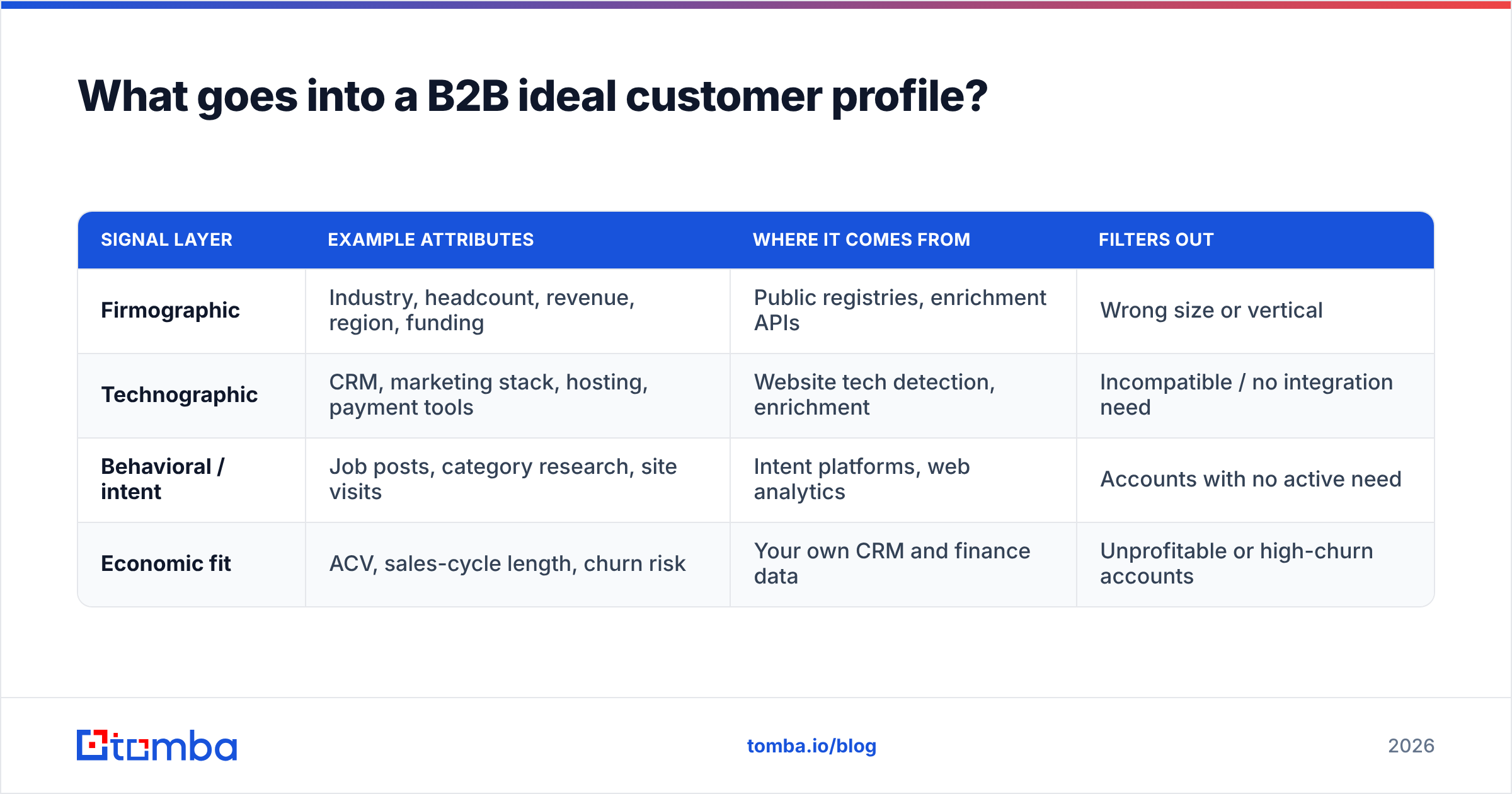
Here's how those layers compare in practice:
| Signal layer | Example attributes | Where it comes from | Filters out |
|---|---|---|---|
| Firmographic | Industry, headcount, revenue, region, funding | Public registries, enrichment APIs | Wrong size or vertical |
| Technographic | CRM, marketing stack, hosting, payment tools | Website tech detection, enrichment | Incompatible / no integration need |
| Behavioral / intent | Job posts, category research, site visits | Intent platforms, web analytics | Accounts with no active need |
| Economic fit | ACV, sales-cycle length, churn risk | Your own CRM and finance data | Unprofitable or high-churn accounts |
You do not need all four perfect on day one. Start with firmographics and economic fit from your own closed-won data, then layer technographic and intent signals as your data sources mature.
How do you build a B2B ideal customer profile step by step?#
The single biggest mistake is building the ICP from aspiration — the logos on the whiteboard you wish you'd land. Build it from evidence instead.
Step 1: Mine your best existing customers#
Pull a list of your strongest accounts. "Strongest" is not "biggest logo" — rank by a blend of retention length, net revenue retention/expansion, gross margin, and how fast they closed. Twenty to fifty accounts is plenty for a first pass. These are your ground truth.
Step 2: Find the shared attributes#
For each account, record firmographics, tech stack, and how they entered your funnel. Look for clustering. You'll often find something non-obvious: maybe your best customers aren't the enterprise accounts at all but the 50–200 employee companies who just raised a Series B and already run a specific CRM. Use data enrichment to backfill missing attributes so you're pattern-matching on complete records, not guesses.
Step 3: Identify the anti-patterns#
Just as important: list your worst accounts — the ones that churned fast, never adopted, or drained support. What do they share? Disqualification criteria are half of a good ICP. "We do not sell to sub-10-person agencies" saves more rep time than any positive filter.
Step 4: Write it down as filters, not prose#
A paragraph nobody reads is useless. Express the ICP as concrete, queryable criteria:
ICP: B2B SaaS companies, 50–500 employees, $5M–$50M revenue, in North America or Western Europe, running HubSpot or Salesforce, that have posted a revenue/sales-ops role in the last 90 days. Disqualify: agencies, sub-25 headcount, no CRM in place.
Step 5: Validate against pipeline#
Run your existing open pipeline through the new ICP. What percentage of active deals match? If most of your pipeline fails your own ICP, either your ICP is wrong or your targeting has drifted — both are worth knowing before you scale spend.
Gartner's research on go-to-market repeatedly lands on the same point: alignment around who you sell to is the precondition for predictable revenue, not a nice-to-have.
How do you turn an ICP into actual pipeline?#
A profile that lives in a slide deck changes nothing. The ICP earns its keep when it becomes the input to three machines.
1. List building. Your ICP filters become your prospecting query. Instead of scraping a generic list, you search by the exact firmographic and technographic criteria you defined. A domain search against companies that match your profile turns the ICP into a named-account list with verified contacts attached, rather than a vague "mid-market SaaS" wish.
2. Lead scoring. Each ICP attribute becomes a weighted scoring rule. Matches the size band? +20. Runs a competing tool you replace? +30. Agency? Auto-disqualify. This is where lead scoring stops being arbitrary and starts reflecting real fit.
3. Routing and messaging. Tier-1 ICP accounts get a human SDR and a tailored sequence; tier-3 gets nurture. The persona inside each ICP account dictates the message angle.

To populate any of these you need accurate contact data at the companies your ICP describes. That's the bridge from strategy to outbound — and where finding verified work emails by company and role with an email finder closes the loop between "who we want" and "who we email."
ICP vs buyer persona vs TAM: what's the difference?#
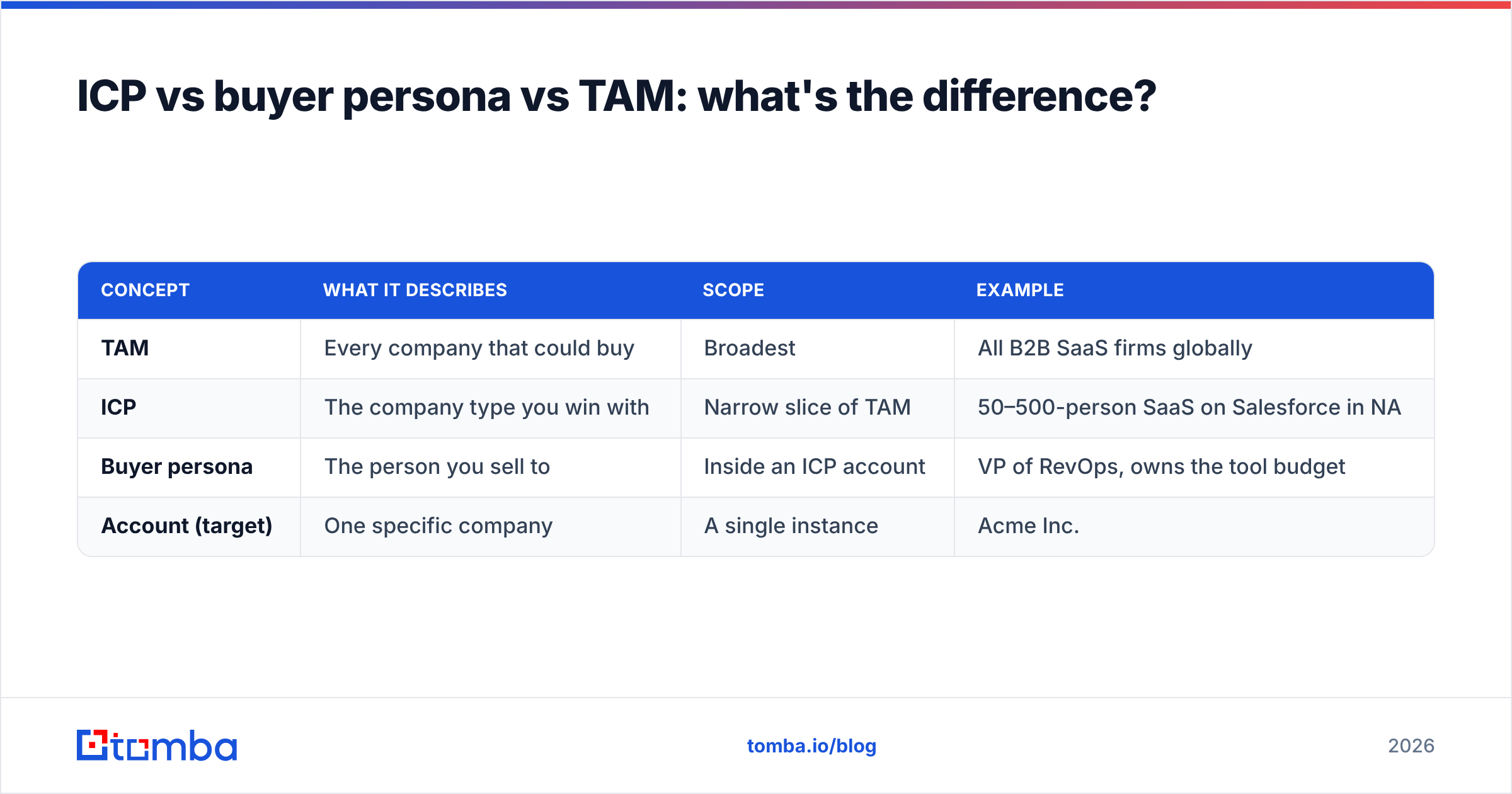
These three get used interchangeably and it causes real confusion in planning meetings. Here's the clean separation.
| Concept | What it describes | Scope | Example |
|---|---|---|---|
| TAM | Every company that could buy | Broadest | All B2B SaaS firms globally |
| ICP | The company type you win with | Narrow slice of TAM | 50–500-person SaaS on Salesforce in NA |
| Buyer persona | The person you sell to | Inside an ICP account | VP of RevOps, owns the tool budget |
| Account (target) | One specific company | A single instance | Acme Inc. |
The practical rule: TAM sizes the market, ICP focuses your spend, personas shape your message, accounts are what you actually work. You need all four, but they answer different questions and shouldn't be merged into one fuzzy document.
What are the most common ICP mistakes?#
Even teams that build an ICP often build a weak one. Watch for these.
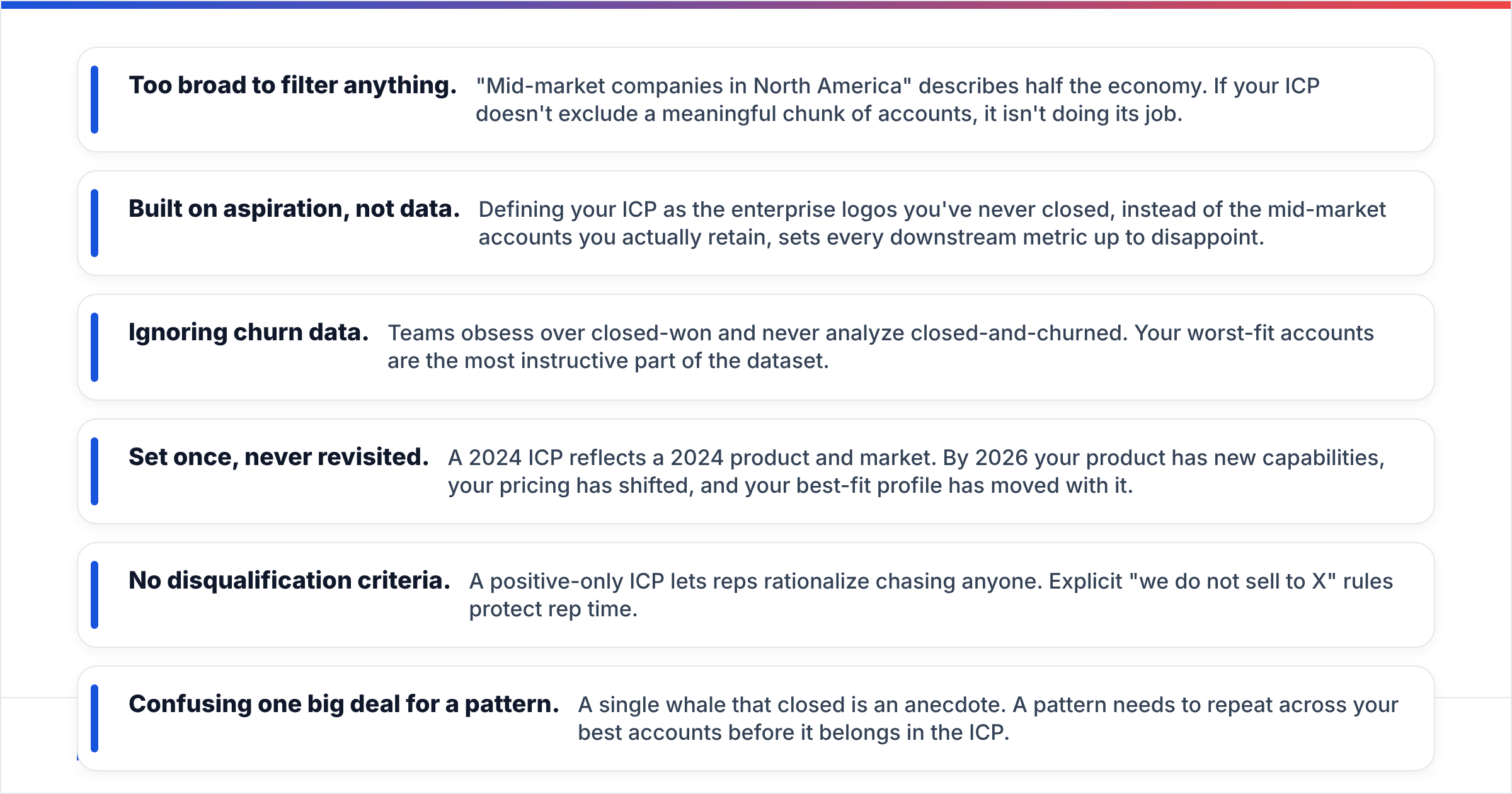
- Too broad to filter anything. "Mid-market companies in North America" describes half the economy. If your ICP doesn't exclude a meaningful chunk of accounts, it isn't doing its job.
- Built on aspiration, not data. Defining your ICP as the enterprise logos you've never closed, instead of the mid-market accounts you actually retain, sets every downstream metric up to disappoint.
- Ignoring churn data. Teams obsess over closed-won and never analyze closed-and-churned. Your worst-fit accounts are the most instructive part of the dataset.
- Set once, never revisited. A 2024 ICP reflects a 2024 product and market. By 2026 your product has new capabilities, your pricing has shifted, and your best-fit profile has moved with it.
- No disqualification criteria. A positive-only ICP lets reps rationalize chasing anyone. Explicit "we do not sell to X" rules protect rep time.
- Confusing one big deal for a pattern. A single whale that closed is an anecdote. A pattern needs to repeat across your best accounts before it belongs in the ICP.
G2's buyer-behavior data consistently shows that fit-based targeting outperforms volume-based outreach on both conversion and retention — the opposite of the spray-and-pray reflex most teams default to under quota pressure.
How often should you update your B2B ideal customer profile?#
Treat the ICP as a living document on a quarterly review cadence, with a deeper annual rebuild.
Each quarter, re-pull your best and worst accounts from the trailing period and check whether the pattern still holds. New product capabilities open new segments; pricing changes alter which companies are economically viable; a new competitor can shift which tech-stack signals matter. Once a year, rebuild from scratch rather than editing — assumptions calcify, and a clean rebuild surfaces drift you'd otherwise rationalize away.
A good trigger for an off-cycle review: when your win rate inside your stated ICP starts diverging from your overall win rate. That divergence means your real best-fit segment has moved and your written ICP hasn't caught up.
How does data quality affect your ICP?#
Your ICP is only as good as the data you match against it. A profile that says "companies running Salesforce that raised funding in the last 12 months" is worthless if your records don't contain tech stack or funding fields, or if the contact data is stale.
This is where most ICP projects quietly fail — not in the strategy, but in execution against dirty data. Three things matter:
- Coverage — do your records include the firmographic and technographic fields your ICP filters on? Thin records can't be scored.
- Accuracy — are the company facts and contact emails current? Outreach to a verified, ICP-matched contact converts; outreach to a bounced address from a wrong-fit account wastes a touch and dents your sender reputation.
- Freshness — funding rounds, headcount, and tooling change monthly. An ICP that depends on intent and growth signals needs data refreshed on a similar cadence.
A reliable B2B database and enrichment layer is what makes an ICP operational rather than theoretical. You can see where the data comes from before you commit a workflow to it — provenance matters when your scoring depends on it.
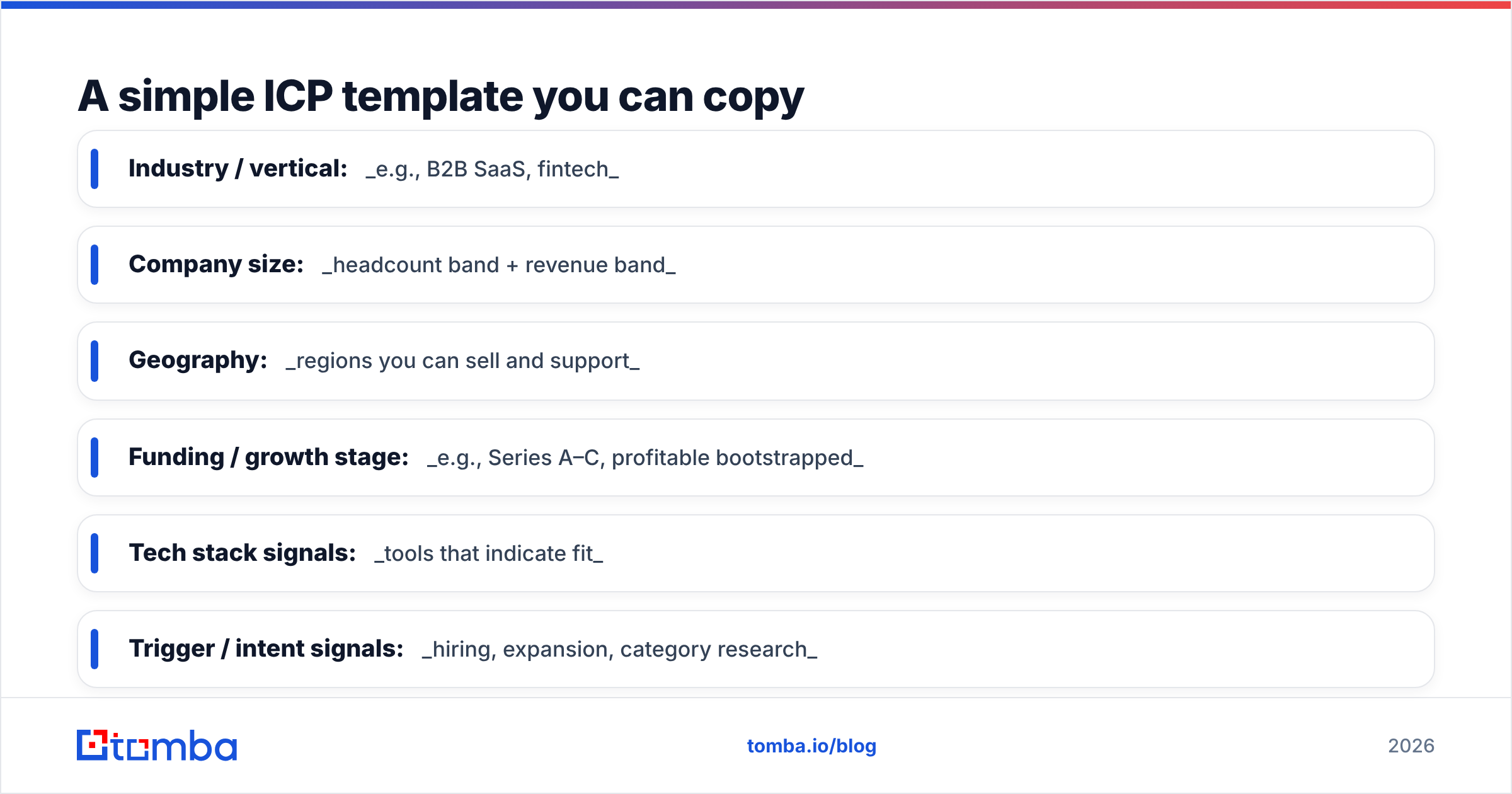
A simple ICP template you can copy#
Use this as a starting structure and fill each field from your own closed-won analysis:
- Industry / vertical: e.g., B2B SaaS, fintech
- Company size: headcount band + revenue band
- Geography: regions you can sell and support
- Funding / growth stage: e.g., Series A–C, profitable bootstrapped
- Tech stack signals: tools that indicate fit
- Trigger / intent signals: hiring, expansion, category research
- Economic fit: target ACV, acceptable sales-cycle length
- Disqualifiers: explicit do-not-target rules
- Primary persona(s): titles who own the decision and budget
Keep it to one page. If it doesn't fit on one page, it's a strategy document, not a filter.
The bottom line#
A B2B ideal customer profile is not a branding exercise — it's the filter that decides where your team spends its scarcest resource, attention. Build it from your best and worst real accounts, express it as concrete firmographic, technographic, and intent filters, wire it into list-building and scoring, and revisit it every quarter. The teams that win in 2026 aren't the ones contacting the most companies; they're the ones contacting the right ones.
Once your ICP is defined, the next move is filling the pipeline with companies that match it. The Tomba Email Finder turns your ICP filters into verified, named contacts by domain, company, and role — so you spend your outreach budget only on accounts that fit. Start free with 25 searches, then scale on a plan (Starter is $49/mo) when your ICP-matched list outgrows the free tier.
// get started
Find, verify and enrich your first contacts today
Start on the free plan with 25 searches a month, then scale when your team is ready.
Free plan · No credit card required · GDPR & CCPA
// about the author