B2B Inbound Marketing in 2026: The Complete Playbook
A practical 2026 guide to B2B inbound marketing: the funnel, the channels, the tooling, and how to turn anonymous traffic into pipeline you can close.
TL;DR
- B2B inbound marketing earns attention with useful content and lets buyers come to you, instead of interrupting them with cold blasts — but in 2026 it only works when paired with fast lead enrichment and routing.
- The funnel has four stages: attract, convert, close, delight. Most teams over-invest in "attract" and starve the convert-and-close mechanics that actually produce revenue.
- SEO, long-form content, and gated assets remain the highest-leverage channels; AI search (AEO/GEO) is now a real traffic source you must structure content for.
- The biggest leak is anonymous traffic: 95%+ of visitors never fill out a form. Visitor identification and enrichment close that gap.
- Measure pipeline and revenue, not vanity traffic. CAC, MQL→SQL rate, and content-attributed pipeline are the numbers that matter.
What is B2B inbound marketing?#
B2B inbound marketing is the practice of attracting business buyers by publishing content they actively search for, then converting that earned attention into pipeline. Think of it like running a great reference library next to a busy street: instead of shouting at people walking by (outbound), you stock the shelves with exactly what they need, and the right people walk in on their own.
The technical version: you create assets mapped to buyer intent — blog posts, comparison guides, calculators, webinars, templates — rank or distribute them where buyers look, capture contact details when interest is high, and hand qualified leads to sales. The "inbound" label, popularized by HubSpot, contrasts with outbound interruption like cold calls and paid lists.
In a B2B context, the difference from B2C inbound is the buying committee. You are rarely marketing to one person. You are marketing to a champion, an economic buyer, a technical evaluator, and a procurement gatekeeper — often 6 to 10 people per deal. Your content has to serve all of them, and your enrichment has to identify all of them.

How does the B2B inbound marketing funnel work?#
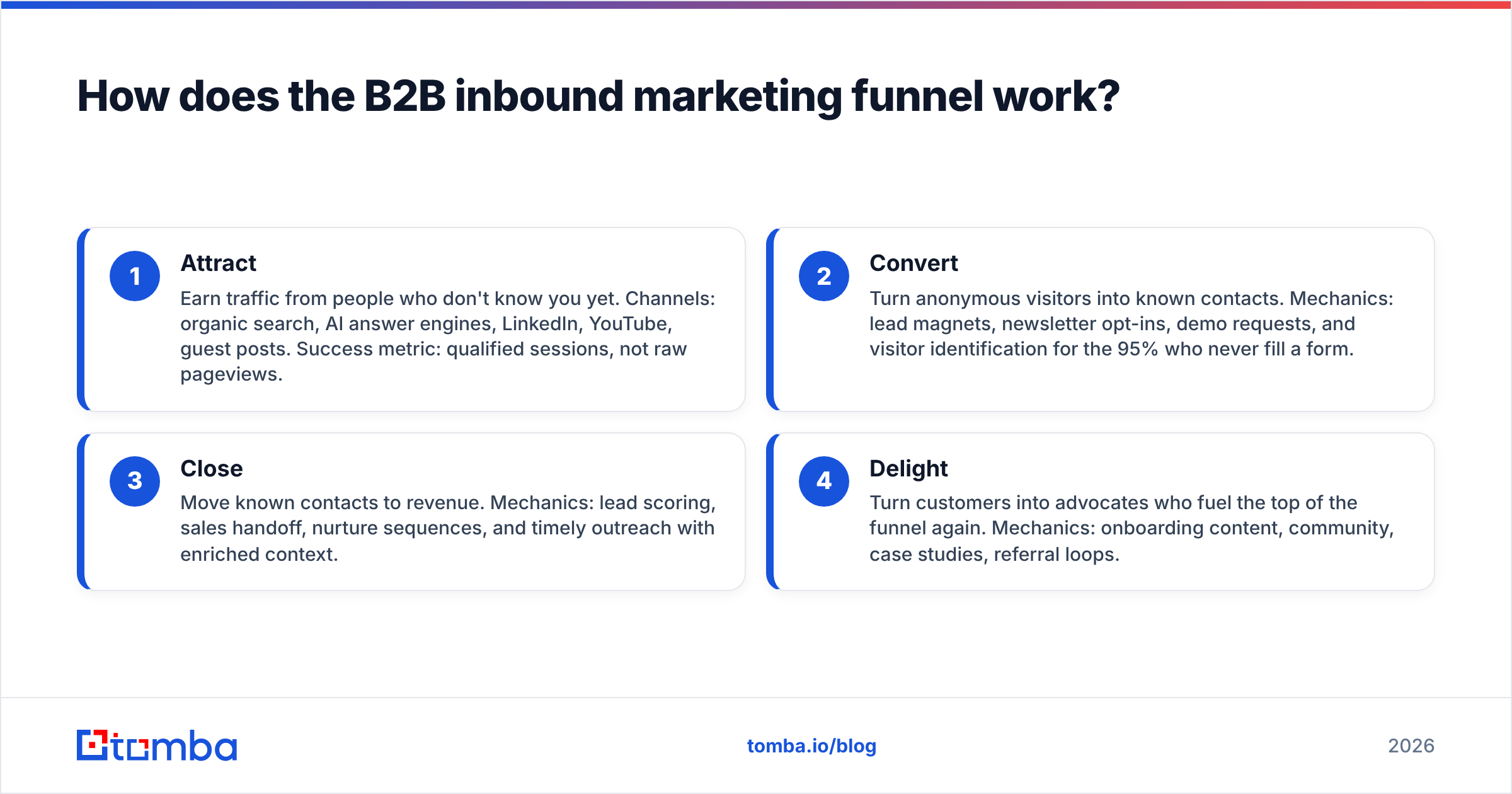
The classic inbound funnel has four stages, each with a distinct job. Getting the handoffs right between them matters more than perfecting any single stage.
- Attract — Earn traffic from people who don't know you yet. Channels: organic search, AI answer engines, LinkedIn, YouTube, guest posts. Success metric: qualified sessions, not raw pageviews.
- Convert — Turn anonymous visitors into known contacts. Mechanics: lead magnets, newsletter opt-ins, demo requests, and visitor identification for the 95% who never fill a form.
- Close — Move known contacts to revenue. Mechanics: lead scoring, sales handoff, nurture sequences, and timely outreach with enriched context.
- Delight — Turn customers into advocates who fuel the top of the funnel again. Mechanics: onboarding content, community, case studies, referral loops.
The leak that kills most programs sits between Attract and Convert. You can rank #1 and still generate zero pipeline if you have no mechanism to identify and enrich the traffic. This is where a website visitor reveal tool and data enrichment earn their keep — they convert anonymous demand into named accounts your sales team can actually work.
Inbound vs outbound: which is better for B2B?#
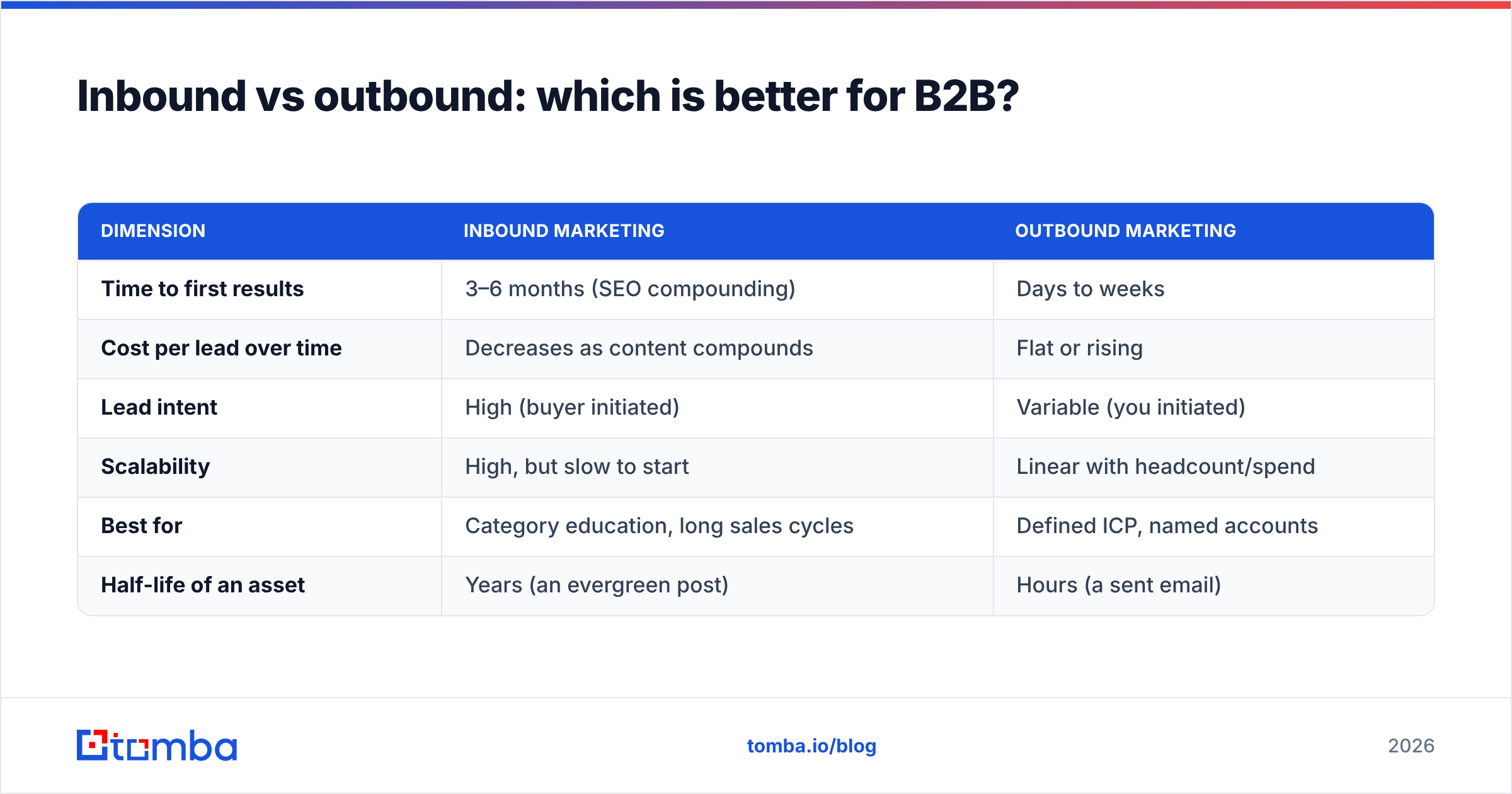
Neither wins outright. The honest answer is that modern B2B teams run them together — inbound builds the brand and demand that makes outbound land, and outbound accelerates the accounts inbound surfaces. Here's how they compare on the dimensions that matter for budgeting.
| Dimension | Inbound marketing | Outbound marketing |
|---|---|---|
| Time to first results | 3–6 months (SEO compounding) | Days to weeks |
| Cost per lead over time | Decreases as content compounds | Flat or rising |
| Lead intent | High (buyer initiated) | Variable (you initiated) |
| Scalability | High, but slow to start | Linear with headcount/spend |
| Best for | Category education, long sales cycles | Defined ICP, named accounts |
| Half-life of an asset | Years (an evergreen post) | Hours (a sent email) |
A useful rule: use inbound to own the questions your buyers ask before they know vendors exist, and use outbound to reach the specific accounts you've decided to win. When inbound surfaces an in-market account through visitor identification, outbound should close the loop within hours — speed-to-lead is one of the strongest predictors of win rate.
What channels drive B2B inbound marketing in 2026?#
The channel mix shifted as AI search matured. Buyers now get answers from ChatGPT, Perplexity, and Google's AI overviews before they ever click a blue link. That changes how you structure content, not whether content matters.
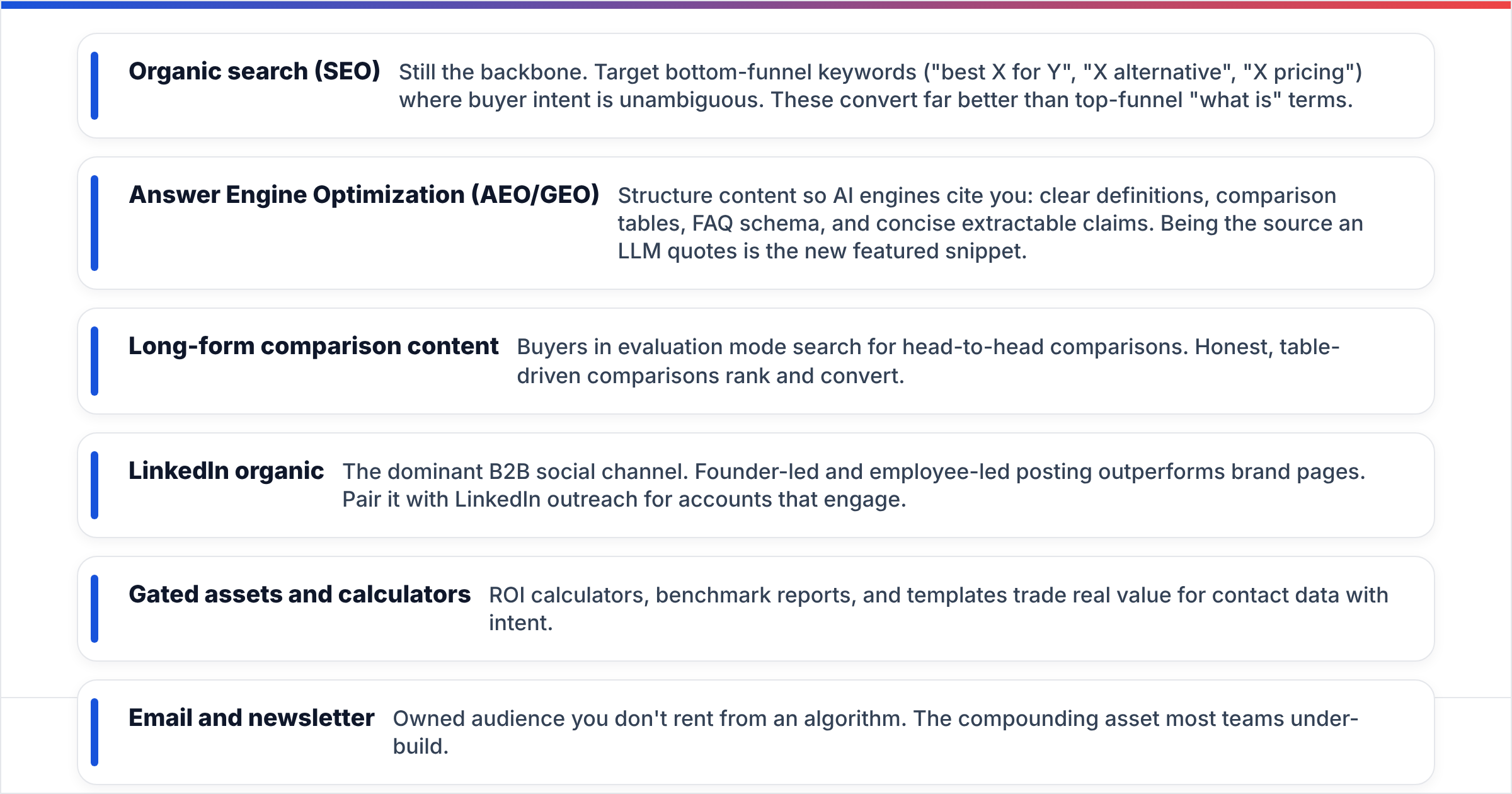
- Organic search (SEO) — Still the backbone. Target bottom-funnel keywords ("best X for Y", "X alternative", "X pricing") where buyer intent is unambiguous. These convert far better than top-funnel "what is" terms.
- Answer Engine Optimization (AEO/GEO) — Structure content so AI engines cite you: clear definitions, comparison tables, FAQ schema, and concise extractable claims. Being the source an LLM quotes is the new featured snippet.
- Long-form comparison content — Buyers in evaluation mode search for head-to-head comparisons. Honest, table-driven comparisons rank and convert.
- LinkedIn organic — The dominant B2B social channel. Founder-led and employee-led posting outperforms brand pages. Pair it with LinkedIn outreach for accounts that engage.
- Gated assets and calculators — ROI calculators, benchmark reports, and templates trade real value for contact data with intent.
- Email and newsletter — Owned audience you don't rent from an algorithm. The compounding asset most teams under-build.
How do you turn inbound traffic into qualified pipeline?#
Conclusion first: capture intent, enrich the record immediately, score it, and route it to sales before the interest cools. The mechanics in order:
1. Capture more than the form fill. Forms convert a few percent of visitors. The rest leave anonymously. Identify the companies behind that traffic, then prioritize accounts that match your ICP. Even a company name plus firmographics lets you build a target list from people already interested in you.
2. Enrich on capture. A raw email or a company domain is a thin lead. Enrich it with role, seniority, company size, tech stack, and verified contact details so sales gets context, not just a name. A domain search turns "acme.com visited your pricing page" into the named decision-makers at Acme and their verified emails.
3. Verify before you send. Inbound lists go stale fast — people change jobs, emails bounce, and bounces wreck your sender reputation. Run captured addresses through an email verifier so your nurture sequences actually land. Deliverability is a prerequisite, not an afterthought; if you're unsure where you stand, the sender reputation basics are worth a refresher.
4. Score and route. Not every lead deserves a sales call. Combine behavioral signals (visited pricing, downloaded a bottom-funnel asset) with fit signals (ICP match) to define a marketing qualified lead. Route MQLs that clear the bar straight to a rep; nurture the rest.
5. Close the loop fast. A lead that requested a demo at 2pm and gets contacted the next morning is a different lead. Speed compounds. Enriched, verified, routed-in-minutes is the standard to aim for.
Which tools do you need for a B2B inbound stack?#
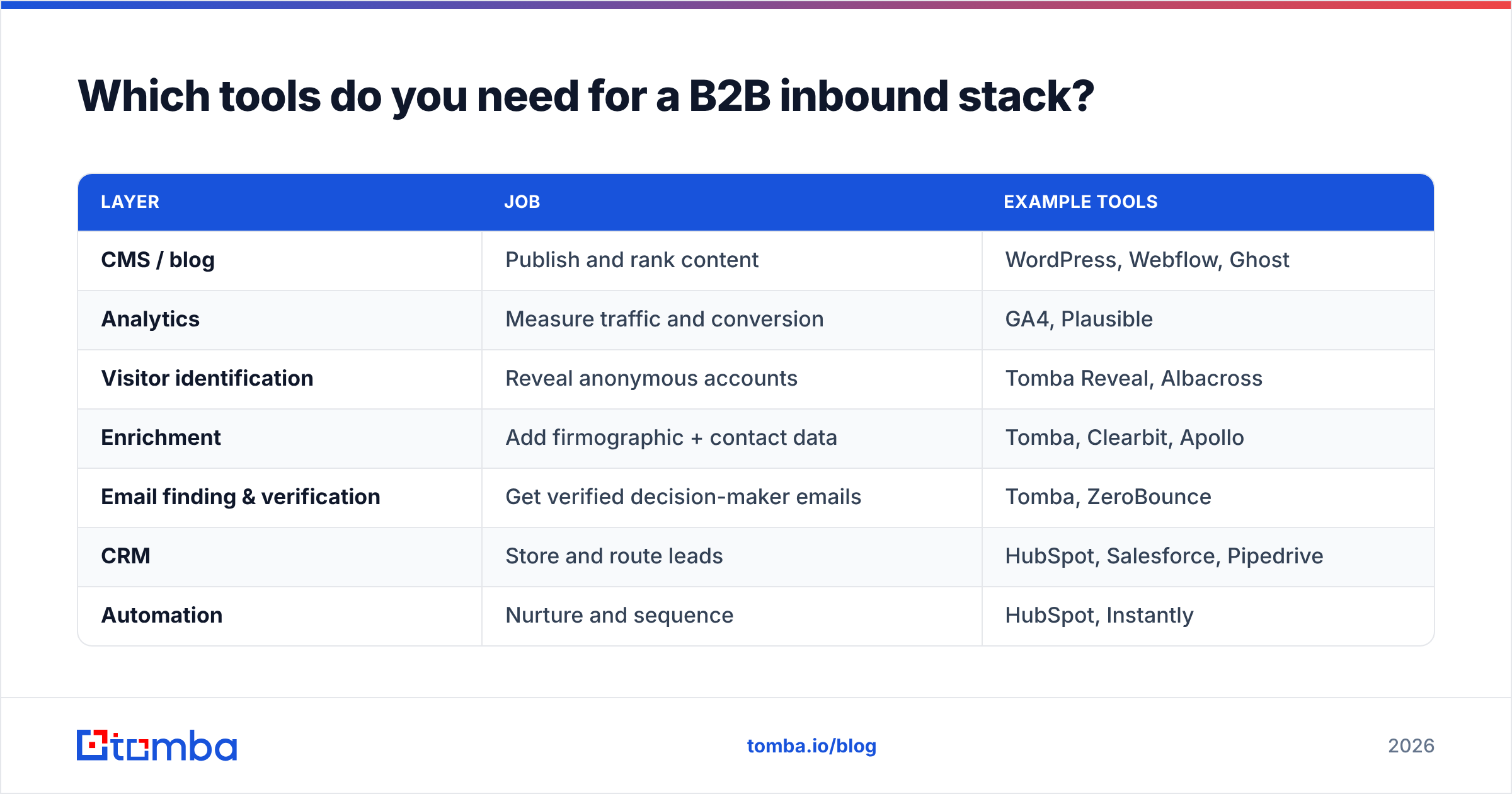
You can start lean and add layers as volume grows. Here's a pragmatic stack by function, with where Tomba fits.
| Layer | Job | Example tools |
|---|---|---|
| CMS / blog | Publish and rank content | WordPress, Webflow, Ghost |
| Analytics | Measure traffic and conversion | GA4, Plausible |
| Visitor identification | Reveal anonymous accounts | Tomba Reveal, Albacross |
| Enrichment | Add firmographic + contact data | Tomba, Clearbit, Apollo |
| Email finding & verification | Get verified decision-maker emails | Tomba, ZeroBounce |
| CRM | Store and route leads | HubSpot, Salesforce, Pipedrive |
| Automation | Nurture and sequence | HubSpot, Instantly |
The reason enrichment and verification sit in the middle is that they're the connective tissue: they take the raw signal from your content engine and make it usable by sales. Tomba covers the enrichment and email-finding layers, and its HubSpot integration and Salesforce integration push verified, enriched records straight into your CRM so reps work clean data. For repeatable workflows, the Tomba API lets you enrich every new inbound lead automatically at the moment of capture.
If you're comparing data vendors specifically, look at G2's marketing analytics category for peer-reviewed options rather than trusting any single vendor's claims — including ours.
What metrics actually prove inbound ROI?#
Stop reporting traffic to your CFO. Report pipeline and efficiency. The metrics that survive scrutiny:
- Content-attributed pipeline — Dollar value of opportunities that touched an inbound asset. This is the headline number.
- CAC by channel — Fully-loaded cost to acquire a customer through inbound vs paid vs outbound. Inbound should trend down over time.
- MQL→SQL conversion rate — Measures lead quality, not just quantity. A falling rate means your scoring or targeting drifted.
- Organic-sourced revenue — Revenue traced to organic search and AI citations. The compounding asset.
- Speed-to-lead — Median time from inbound signal to first sales touch. Shorter is almost always better.
- Lead-to-customer rate — The full-funnel efficiency number that ties everything together.
A practical benchmark: if your inbound CAC isn't lower than your outbound CAC within 12–18 months, your content isn't targeting bottom-funnel intent — or you're losing qualified traffic to the anonymous-visitor leak. Track response rate on your nurture sequences too; a low rate usually points to a deliverability or data-quality problem upstream, not a copy problem.
How long does B2B inbound marketing take to work?#
Expect 3 to 6 months before SEO compounds into meaningful traffic, and 6 to 12 months before inbound is a reliable pipeline source. That lag is why teams quit early — and why the ones who don't build a durable moat competitors can't buy their way past overnight.
You can shorten the lag two ways. First, publish bottom-funnel comparison and alternative content immediately; it ranks faster and converts harder than top-funnel education. Second, don't wait for forms — turn the traffic you already have into named accounts from day one with enrichment and visitor identification. That converts the "we're getting traffic but no leads" phase from a six-month dead zone into an active pipeline source.
Getting started#
Pick one bottom-funnel keyword your buyers search, write the most useful, honest, table-driven asset on the internet for it, and put a capture-plus-enrichment mechanism behind it. Then repeat weekly. Inbound is a compounding game won by consistency, not by any single viral post.
When you're ready to stop losing anonymous traffic, the Tomba Email Finder turns the companies visiting your content into verified, enriched contacts your sales team can actually reach. Start free with 25 searches a month, and scale on the Starter plan at $49/mo once inbound is producing pipeline worth chasing. Your content earns the attention — Tomba makes sure it turns into revenue.
// get started
Find, verify and enrich your first contacts today
Start on the free plan with 25 searches a month, then scale when your team is ready.
Free plan · No credit card required · GDPR & CCPA
// about the author