B2B Influencer Marketing in 2026: The Complete Playbook
B2B influencer marketing now drives pipeline, not just impressions. Here's how to pick creators, structure deals, and prove ROI in 2026 — without wasting budget.
B2B influencer marketing stopped being a "nice to have" the moment buyers started trusting practitioners more than brands. In 2026, the most efficient pipeline in many B2B categories comes from a niche creator with 9,000 engaged followers — not a Super Bowl-sized awareness play. This guide shows you how to run it like a revenue program, not a vanity project.
TL;DR#
- B2B influencer marketing means partnering with credible practitioners (consultants, analysts, operators, micro-creators) to reach a buying audience that already trusts them.
- Reach is the wrong metric. Relevance, audience overlap with your ICP, and engaged comments matter far more than follower count.
- Micro and "nano" creators (1K–25K followers) usually outperform mega-influencers on cost-per-qualified-lead in B2B.
- You still need clean contact data. Influence creates demand; your team converts it — which means accurate email and phone data to follow up fast.
- Measure pipeline, not impressions. Track assisted opportunities, demo requests, and influenced revenue, not just likes.
What is B2B influencer marketing?#
B2B influencer marketing is the practice of partnering with trusted voices in a professional niche to influence how business buyers research, shortlist, and choose vendors. Think of it like a contractor asking a respected job-site foreman which power tools to buy — the foreman's word carries more weight than any billboard, because they use the gear every day and have nothing to gain by lying.
Unlike B2C influencer marketing, which leans on lifestyle reach and aspiration, B2B influence is built on demonstrated expertise. The "influencer" might be a fractional CFO posting SaaS spend breakdowns, a security engineer reviewing tools on a newsletter, or a RevOps leader running a 12,000-member Slack community. Their audience is small but dense with decision-makers.
The buyer behavior driving this is well documented: most of the B2B buying journey now happens in "dark social" — private communities, DMs, podcasts, and feeds — before a prospect ever fills out a form. Gartner has repeatedly found that buyers spend only a sliver of their journey talking to sales reps, and a growing share of that independent research is shaped by peers and creators rather than vendor websites. (See Gartner's B2B buying research for the underlying data.)
So the core concept of B2B influencer marketing comes down to a few moving parts you need to get right.
What are the core components of a B2B influencer program?#
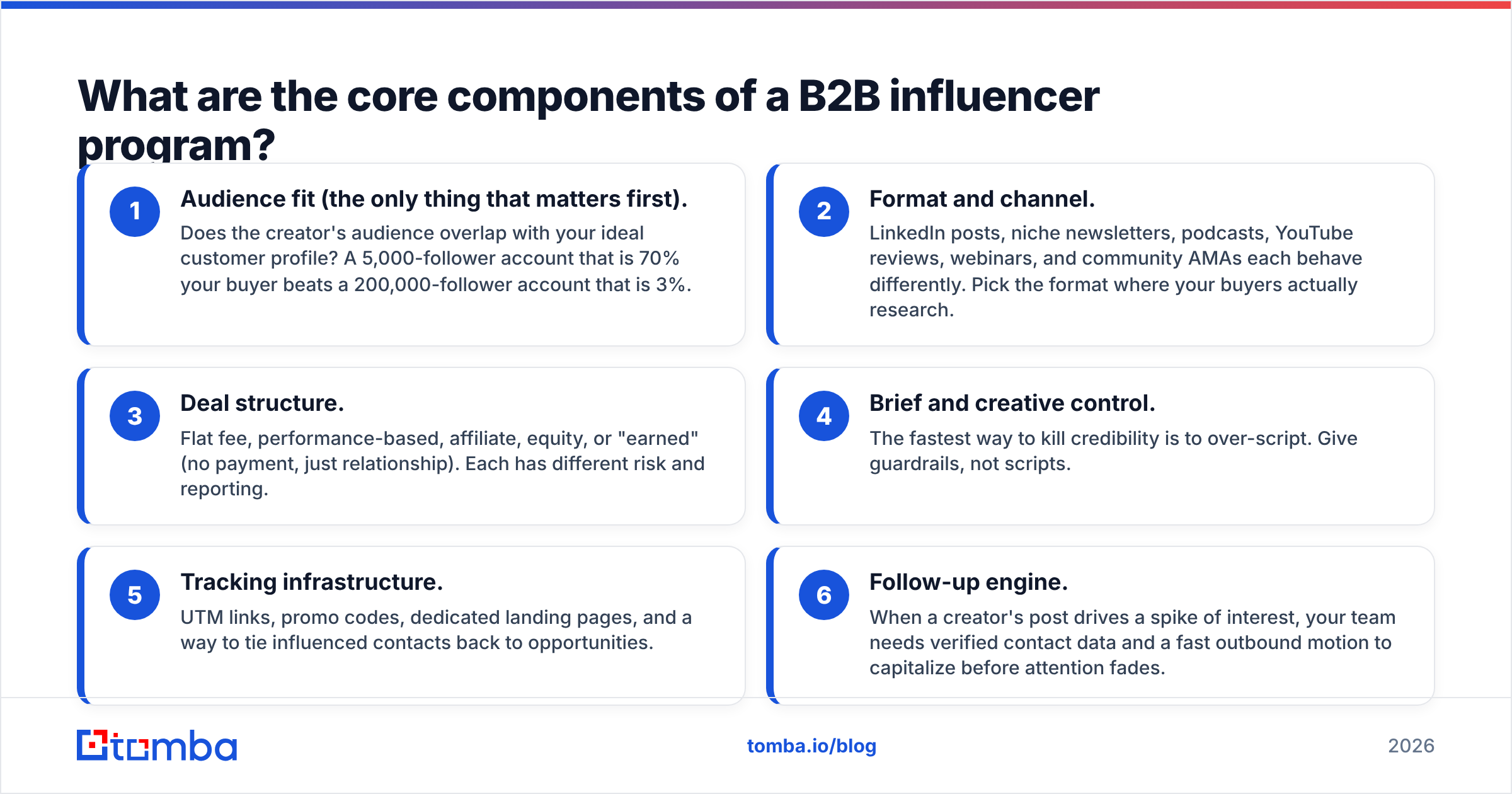
Before you spend a dollar, map the program against these six building blocks. Skipping any one of them is how budgets quietly disappear.
- Audience fit (the only thing that matters first). Does the creator's audience overlap with your ideal customer profile? A 5,000-follower account that is 70% your buyer beats a 200,000-follower account that is 3%.
- Format and channel. LinkedIn posts, niche newsletters, podcasts, YouTube reviews, webinars, and community AMAs each behave differently. Pick the format where your buyers actually research.
- Deal structure. Flat fee, performance-based, affiliate, equity, or "earned" (no payment, just relationship). Each has different risk and reporting.
- Brief and creative control. The fastest way to kill credibility is to over-script. Give guardrails, not scripts.
- Tracking infrastructure. UTM links, promo codes, dedicated landing pages, and a way to tie influenced contacts back to opportunities.
- Follow-up engine. When a creator's post drives a spike of interest, your team needs verified contact data and a fast outbound motion to capitalize before attention fades.
That last point is where most programs leak. A great post creates a wave of curious buyers — but if you can't identify them and reach them with accurate data, the wave breaks on the beach. Tools like a reliable email finder and data enrichment turn anonymous interest into a contactable pipeline.
Is B2B influencer marketing better than paid ads?#
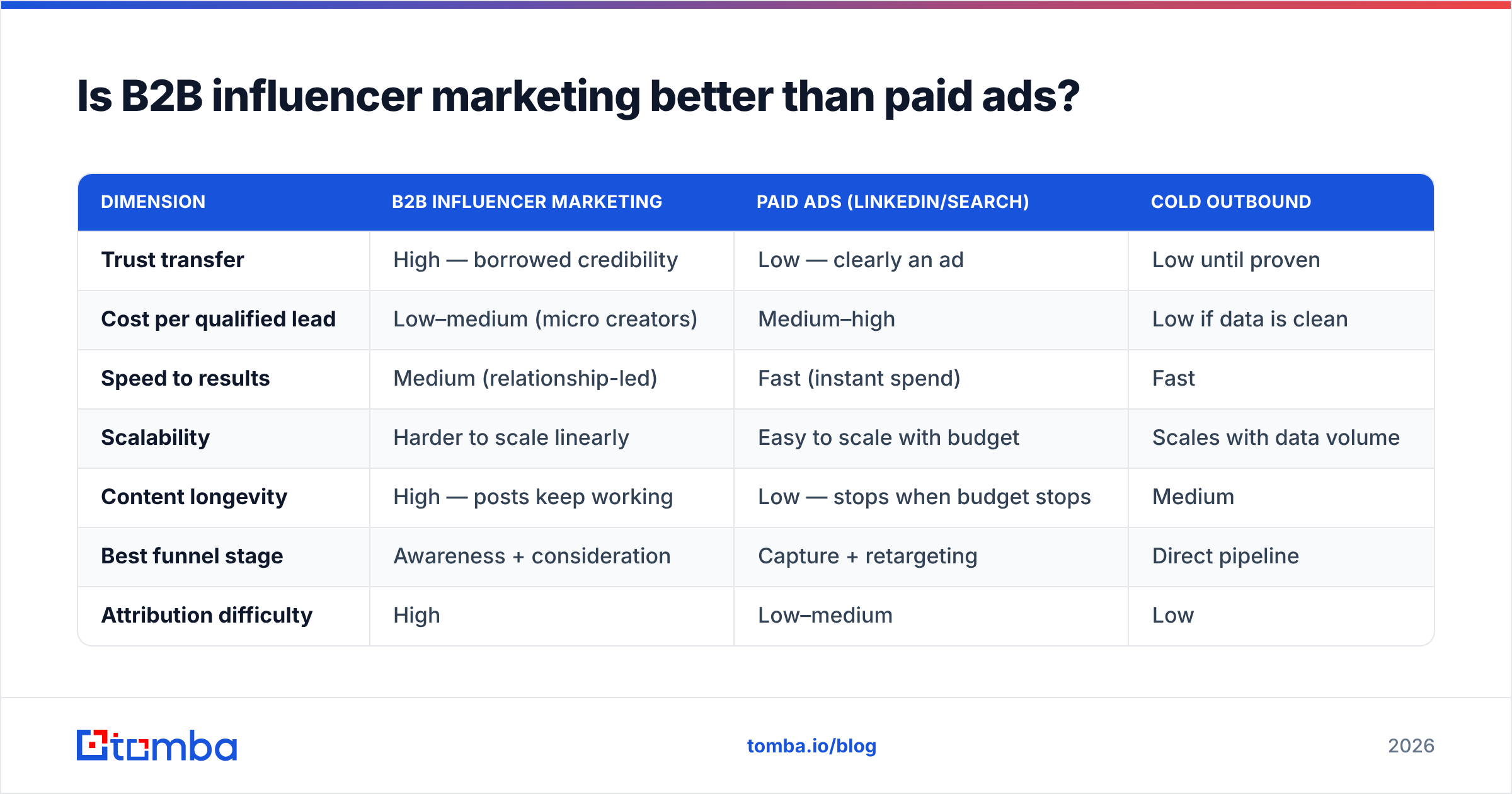
It depends on your funnel stage — and the honest answer is that the two work best together, not in opposition. Paid ads buy attention; influencers borrow trust. Here is how they compare across the dimensions that decide budget.
| Dimension | B2B Influencer Marketing | Paid Ads (LinkedIn/Search) | Cold Outbound |
|---|---|---|---|
| Trust transfer | High — borrowed credibility | Low — clearly an ad | Low until proven |
| Cost per qualified lead | Low–medium (micro creators) | Medium–high | Low if data is clean |
| Speed to results | Medium (relationship-led) | Fast (instant spend) | Fast |
| Scalability | Harder to scale linearly | Easy to scale with budget | Scales with data volume |
| Content longevity | High — posts keep working | Low — stops when budget stops | Medium |
| Best funnel stage | Awareness + consideration | Capture + retargeting | Direct pipeline |
| Attribution difficulty | High | Low–medium | Low |
The pattern most efficient teams land on: use influencers to create demand and shape preference, use paid to capture and retarget that warmed audience, and use cold email plus calls to convert the named accounts that engaged. Influence without a conversion motion is just brand awareness you can't bank.
How do you find the right B2B influencers?#
Start narrow and work from your buyers outward, not from follower counts inward.
Ask your customers. The single best source: survey or interview recent closed-won accounts and ask who they follow, which newsletters they read, and which communities they trust. These are your highest-fit creators by definition.
Mine engagement, not reach. On LinkedIn, look at who your ICP comments on and shares. A creator whose comment section is full of your target titles is worth ten with bigger but irrelevant audiences.
Check the niche infrastructure. Newsletters (via their sponsorship pages), niche podcasts, Slack/Discord/Circle communities, and YouTube channels covering your category. Many list audience demographics in media kits.
Vet for authenticity. Before outreach, confirm the audience is real and relevant: engagement rate (comments-to-followers), audience seniority, and whether past sponsorships felt native or bolted-on. Capterra and G2 reviews can also surface practitioners who already write publicly about your category.
Once you have a shortlist, you need to actually reach the decision-maker behind the account. That is a data problem. A domain search against a creator's company or a quick lookup in the Tomba Email Finder gets you a verified business email instead of a generic contact form that goes nowhere.
How should you structure influencer deals in B2B?#
Match the deal structure to your goal and your tolerance for ambiguity. Here is the practical breakdown.
- Flat-fee sponsorship. Best for predictable awareness (newsletter placement, podcast read). You pay for reach regardless of outcome — simple, but you carry the performance risk.
- Performance / affiliate. The creator earns per signup, demo, or closed deal via a tracked code or Airtable- or CRM-connected link. Lower upfront risk, but top creators often decline pure performance deals unless your conversion is proven.
- Hybrid (base + bonus). A modest flat fee plus performance upside. This is the sweet spot for most mid-market B2B programs — it respects the creator's time while keeping incentives aligned.
- Advisory / equity. For long-term, deeply embedded creator partners (think a category expert who becomes a public advocate). Highest commitment, highest trust payoff.
- Earned / relationship. No payment — you give the creator genuinely useful access (data, early features, research) and they cover you because it's valuable to their audience. Cheapest and most credible when it works.
Whatever you choose, put deliverables, usage rights, disclosure requirements (the FTC requires clear sponsorship disclosure — see the FTC endorsement guides), and an exclusivity window in writing. Disclosure isn't optional, and audiences respect creators more when sponsorships are transparent anyway.
How do you measure B2B influencer marketing ROI?#
Measure pipeline and influenced revenue — not impressions — and accept that B2B attribution will always be partly directional.
Build your measurement in three layers:
- Hard-tracked conversions. UTM links, unique promo codes, and dedicated landing pages capture the clearly attributable signups and demos. This is your floor, not your ceiling.
- Self-reported attribution. Add "How did you hear about us?" to demo forms. In dark-social-heavy B2B, this often reveals 2–5x more influencer impact than UTMs alone.
- Influenced pipeline. Tag opportunities that touched a creator campaign (engaged with the post, joined the community, downloaded the co-created asset) and report influenced pipeline and win rate alongside last-touch numbers.
To make layers 2 and 3 real, you need to connect named engagers to CRM records. Enrich inbound contacts and engaged accounts with firmographic data so you can tell whether a creator is driving your ICP or just noise. Pushing that enriched data into your stack — via the HubSpot integration or a Salesforce integration — keeps influence attribution living in the same system as the rest of your pipeline. Track your response rate on follow-up to the creator's audience to see how warm the influence actually made them.
What mistakes kill B2B influencer programs?#
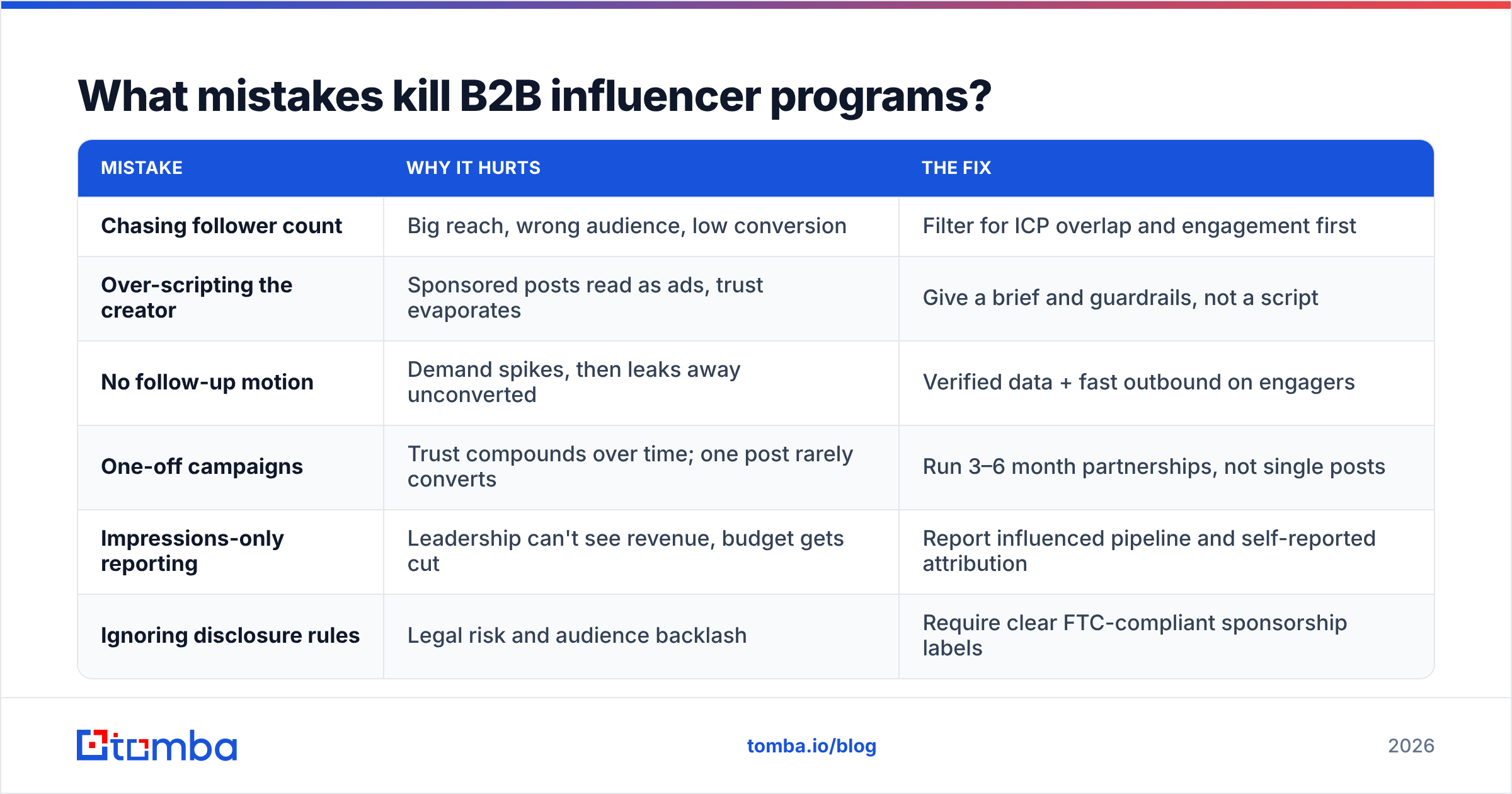
Most failures are predictable. Avoid these and you're ahead of the majority of teams.
| Mistake | Why it hurts | The fix |
|---|---|---|
| Chasing follower count | Big reach, wrong audience, low conversion | Filter for ICP overlap and engagement first |
| Over-scripting the creator | Sponsored posts read as ads, trust evaporates | Give a brief and guardrails, not a script |
| No follow-up motion | Demand spikes, then leaks away unconverted | Verified data + fast outbound on engagers |
| One-off campaigns | Trust compounds over time; one post rarely converts | Run 3–6 month partnerships, not single posts |
| Impressions-only reporting | Leadership can't see revenue, budget gets cut | Report influenced pipeline and self-reported attribution |
| Ignoring disclosure rules | Legal risk and audience backlash | Require clear FTC-compliant sponsorship labels |
The recurring theme: B2B influence is a relationship and conversion game, not a media-buy. The creators get you in the room; clean data and a tight follow-up motion close the deal.
How does data quality fit into influencer marketing?#
Influence creates a list of warm, interested people — and a warm list is only valuable if you can reach the right person at the right address. When a creator's post sends a hundred curious buyers to your site, half will never fill out a form. To work those accounts, you reverse-engineer the company, find the decision-maker, and verify the email before you send.
This is exactly where an accurate email finder and an email verifier earn their keep: they keep your follow-up out of spam folders and your sender reputation intact, so the goodwill the creator built doesn't get torched by bounced cold emails. For teams running creator programs at scale, the bulk email finder turns a list of engaged companies into a contactable pipeline in one pass. Pricing scales with volume — see Tomba pricing for where the free tier (25 searches/mo) ends and the $49/mo Starter plan begins.
Frequently asked questions#
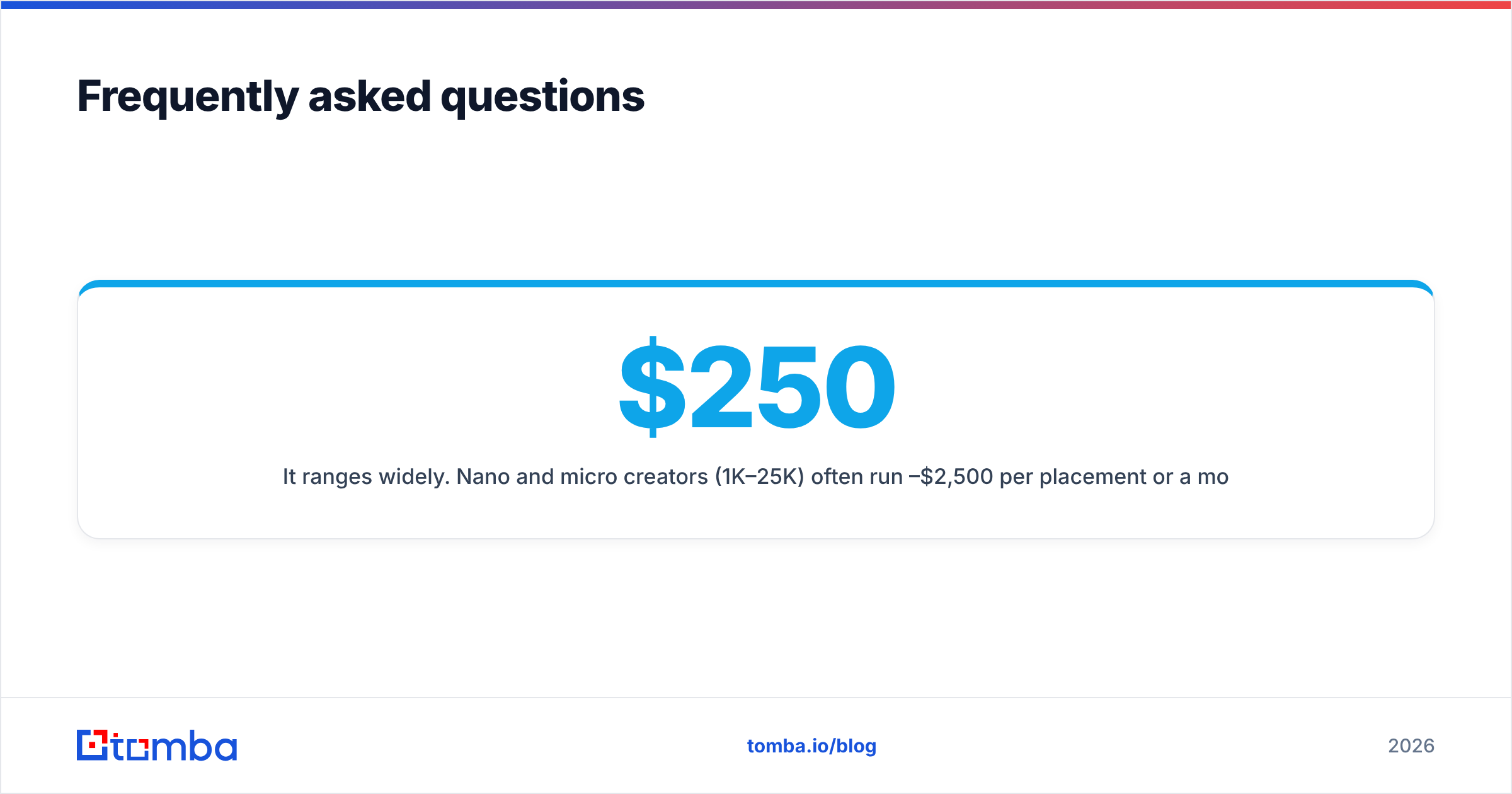
How much does B2B influencer marketing cost in 2026? It ranges widely. Nano and micro creators (1K–25K) often run $250–$2,500 per placement or a modest hybrid fee; established niche newsletters and podcasts can run $1,000–$10,000+ per slot. Performance and earned deals can cost far less upfront. Start small, prove a repeatable motion, then scale spend toward the creators with the best cost-per-qualified-opportunity.
Do I need a big budget to start? No. The most efficient B2B influencer marketing usually starts with two or three high-fit micro creators and a clear follow-up process. A single well-matched practitioner with an engaged audience can outperform a five-figure mega-deal.
What channels work best for B2B? LinkedIn, niche newsletters, vertical podcasts, YouTube reviews, and private communities. The right channel is wherever your specific buyer does their independent research — confirm it by asking your closed-won customers.
How is this different from social selling? Social selling is your own reps building relationships and authority directly. Influencer marketing borrows someone else's established trust. The strongest programs run both — your reps engage in the same communities where your creator partners are active.
The bottom line#
B2B influencer marketing in 2026 works when you treat it as a pipeline program: pick creators by ICP fit, structure deals around aligned incentives, measure influenced revenue, and — most importantly — convert the demand you create with fast, accurate follow-up. The creators open the door. Your data and outreach walk through it.
If you want the conversion half handled, start with the Tomba Email Finder. Turn the engaged accounts your creator partners send you into verified, contactable decision-makers — so every wave of influence actually lands in pipeline instead of breaking on the beach. Spin up the free tier, find your first 25 buyers this week, and scale from there.
// get started
Find, verify and enrich your first contacts today
Start on the free plan with 25 searches a month, then scale when your team is ready.
Free plan · No credit card required · GDPR & CCPA
// about the author