B2B Inside Sales vs Outside Sales: Full 2026 Guide
Inside sales runs from a desk; outside sales closes in the field. Here's how the two B2B models compare on cost, cycle length, close rates, and tooling — and how to decide which mix fits your pipeline in 2026.
TL;DR
- Inside sales sells remotely — phone, email, video, and chat — from a central office or home desk. Outside sales (field sales) meets prospects in person at offices, sites, and events.
- Inside sales is cheaper per rep, scales fast, and fits high-volume, lower-ticket deals. Outside sales costs more, moves slower, and wins large, complex, relationship-driven contracts.
- The hard line between them is gone. Most B2B teams in 2026 run a hybrid model where field reps work remotely between visits and inside reps occasionally fly out for strategic deals.
- The deciding factors are average deal size, sales cycle length, buyer expectations, and territory — not personal preference.
- Both models live or die on contact data quality. Bad emails and dead phone numbers waste the cheapest model and the most expensive one alike.
What is the difference between inside sales and outside sales?#
The short answer: location and how the rep reaches the buyer. Inside sales reps sell from a desk using digital channels. Outside sales reps sell face-to-face in the buyer's world.
Think of it like two ways to run a restaurant. Inside sales is the busy delivery kitchen — high throughput, tight margins, lots of orders handled per hour from one location. Outside sales is the chef who visits a client's home to cook a custom tasting menu — fewer covers, higher price, and a relationship that closes the next booking. Neither is "better." They serve different appetites.
Here is the core distinction broken down:
- Inside sales — where: A central office or remote home setup. The rep almost never meets the buyer in person.
- Inside sales — how: Phone, email, video calls, LinkedIn, live chat, and product demos screen-shared in real time.
- Outside sales — where: The prospect's office, a job site, a trade show, or a steak dinner. The rep travels.
- Outside sales — how: In-person meetings, on-site demos, conference networking, and long relationship cycles.
- Inside sales — best deals: Higher volume, shorter cycles, transactional or mid-market SaaS, deals under roughly $50k ACV.
- Outside sales — best deals: Six- and seven-figure enterprise contracts, manufacturing, medical devices, and anything with a long committee-driven buying process.
How do inside sales and outside sales compare head-to-head?#
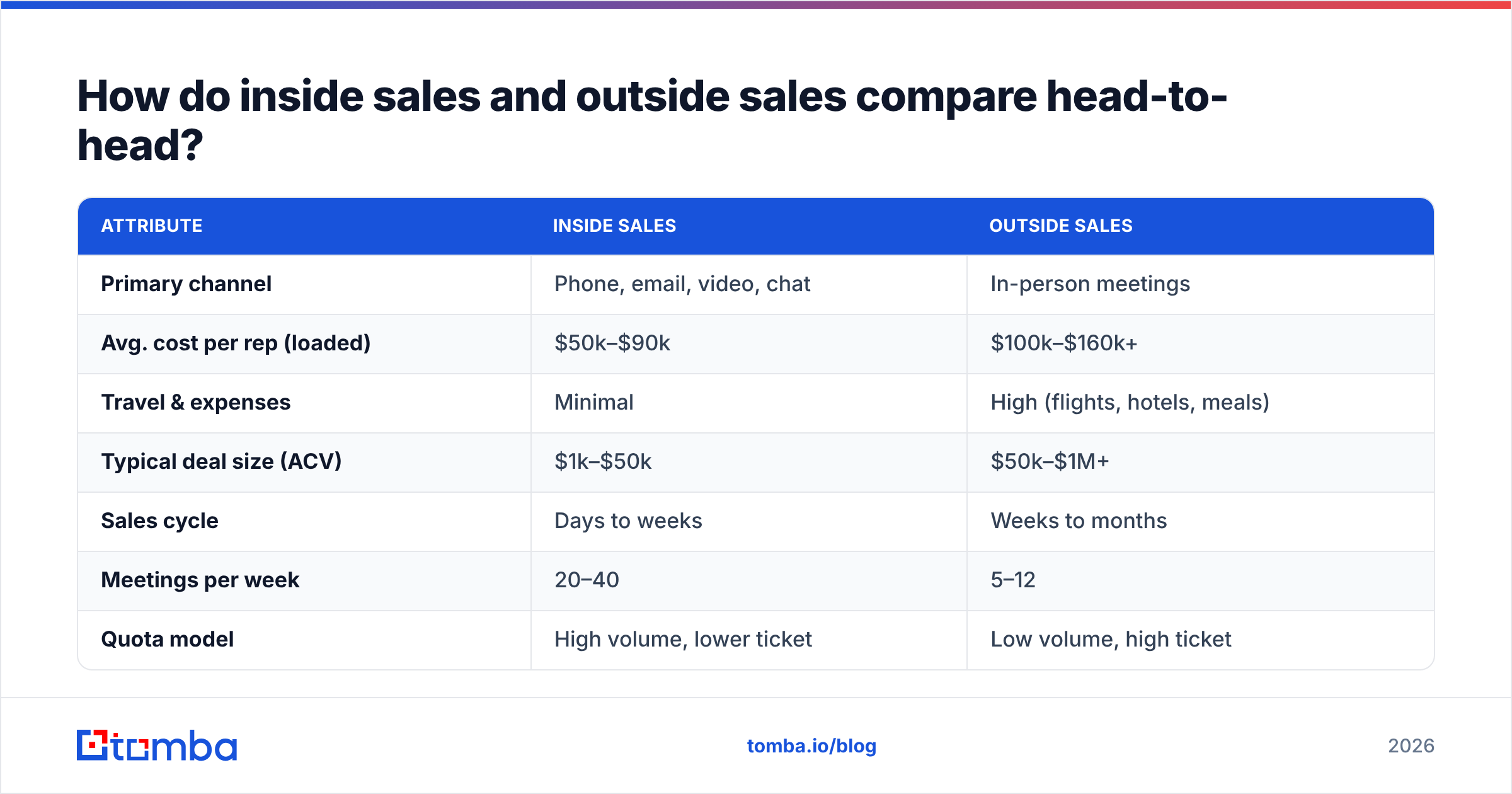
The trade-offs are easiest to see side by side. The numbers below reflect commonly cited industry ranges in 2026 — treat them as benchmarks to calibrate against your own pipeline, not hard rules.
| Attribute | Inside Sales | Outside Sales |
|---|---|---|
| Primary channel | Phone, email, video, chat | In-person meetings |
| Avg. cost per rep (loaded) | $50k–$90k | $100k–$160k+ |
| Travel & expenses | Minimal | High (flights, hotels, meals) |
| Typical deal size (ACV) | $1k–$50k | $50k–$1M+ |
| Sales cycle | Days to weeks | Weeks to months |
| Meetings per week | 20–40 | 5–12 |
| Quota model | High volume, lower ticket | Low volume, high ticket |
| Ramp time | 1–3 months | 3–6+ months |
| Scalability | Fast — add a seat, a headset, data | Slow — territory + travel bound |
| Best fit | SMB, mid-market, SaaS, repeatable | Enterprise, complex, regulated |
Two patterns jump out. First, inside sales wins on cost efficiency and scale: you can double an inside team in a quarter, and a rep can touch dozens of accounts a day. Second, outside sales wins on deal size and trust: when a buyer is signing a $400k contract that touches five departments, a handshake and a whiteboard session still close business that no email sequence can.
According to HubSpot's sales research, inside sales has grown faster than field sales for over a decade, accelerated by video selling and remote buying habits. But the same research consistently shows enterprise buyers still expect in-person contact at the late, high-stakes stages.
Is inside sales better than outside sales?#
Neither is universally better — the right choice is dictated by your deal economics. The simplest test: divide your customer acquisition cost tolerance by your average deal size.
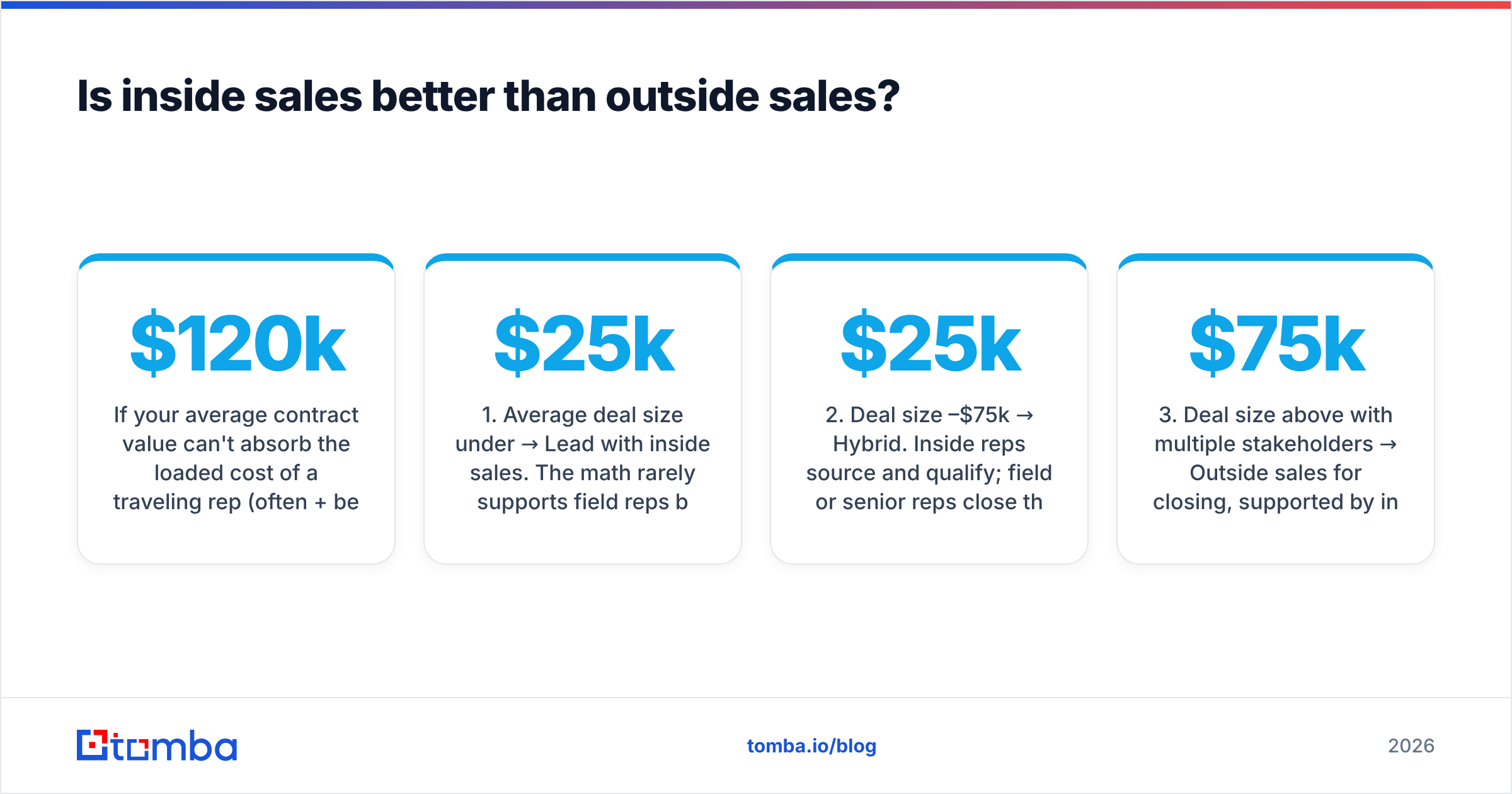
If your average contract value can't absorb the loaded cost of a traveling rep (often $120k+ before commission), outside sales will quietly destroy your margins. If your deals are large, strategic, and lost to competitors who "showed up," an all-remote team will cap your win rate.
Use this decision framework:
- Average deal size under $25k → Lead with inside sales. The math rarely supports field reps below this line.
- Deal size $25k–$75k → Hybrid. Inside reps source and qualify; field or senior reps close the biggest accounts.
- Deal size above $75k with multiple stakeholders → Outside sales for closing, supported by inside SDRs for pipeline.
- Highly technical or regulated product → Outside or hybrid, because demos and trust matter more than touch volume.
- Self-serve or PLG motion → Inside sales only, focused on expansion and high-intent inbound.
Gartner's research on B2B buying reinforces this: buyers now spend most of their journey in digital and self-directed channels, which favors inside sales for early stages — but reserve human, often in-person, interaction for the moments of highest risk and highest spend.
What does each model actually cost?#
Cost is where the decision gets concrete. An inside rep needs a laptop, a CRM seat, a phone system, and good data. An outside rep needs all of that plus a car, flights, hotels, client dinners, and far more management overhead per dollar of pipeline.
But cheaper per rep doesn't always mean cheaper per dollar of revenue. A single outside rep closing three $300k deals a year can out-earn a five-person inside team on transactional contracts. The right metric is cost as a percentage of revenue closed, not cost per head.
This is also where data spend hides. Both models burn budget on dialing wrong numbers and emailing dead inboxes. A field rep who flies to a meeting booked off a stale contact record just spent $800 to learn the buyer left the company. Clean data — verified emails, current direct-dial B2B phone numbers, and enriched account profiles — is the cheapest performance upgrade either model can buy. Routing leads through data enrichment before a rep ever touches them protects the expensive hours on both sides.
Why are most B2B teams going hybrid in 2026?#
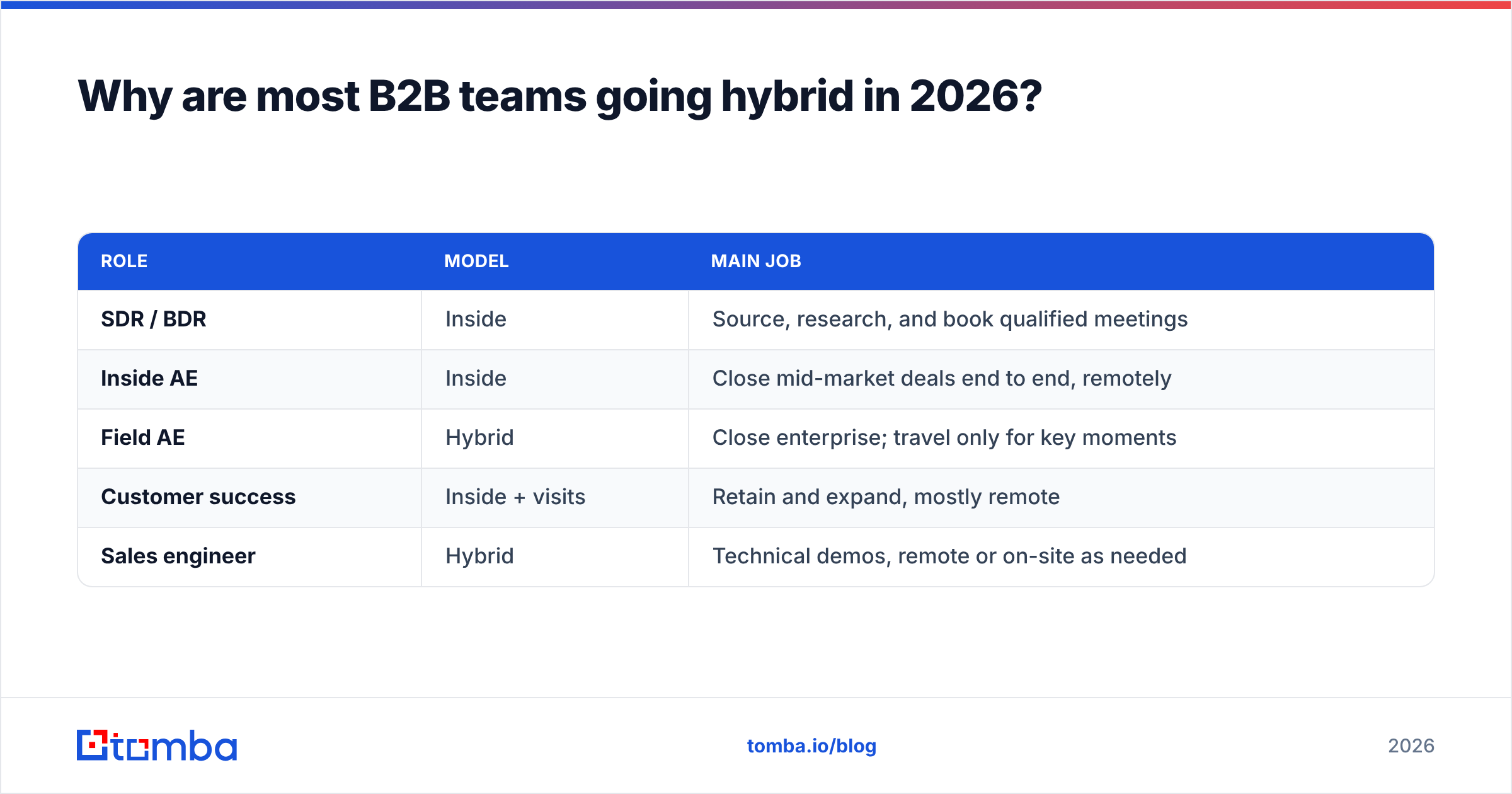
Because the wall between the two models collapsed. The pandemic normalized closing six-figure deals over video, and buyers got comfortable signing without a single in-person meeting. At the same time, the best field reps realized they could prospect, qualify, and run early demos remotely — saving travel for moments that truly need it.
The modern hybrid structure usually looks like this:
| Role | Model | Main job |
|---|---|---|
| SDR / BDR | Inside | Source, research, and book qualified meetings |
| Inside AE | Inside | Close mid-market deals end to end, remotely |
| Field AE | Hybrid | Close enterprise; travel only for key moments |
| Customer success | Inside + visits | Retain and expand, mostly remote |
| Sales engineer | Hybrid | Technical demos, remote or on-site as needed |
In this setup, inside and outside are not separate teams — they are stages of one motion. An SDR builds a contact list and verifies it, an inside AE runs discovery on video, and a field AE flies in only for the final negotiation. The handoffs are where deals leak, so a shared CRM and a single source of contact truth matter more than ever. (If "CRM" still feels fuzzy, here's a plain-English take on what a CRM is.)
Salesforce's State of Sales reporting has tracked this convergence for years: top teams blend channels per deal stage rather than assigning reps to a fixed "inside" or "outside" identity.
What skills and tools does each model need?#
The skill profiles diverge more than people expect, and hiring for the wrong one is a common, expensive mistake.
Inside sales reps need:
- High activity tolerance — comfort making 40+ touches a day without burning out.
- Crisp written communication — email and chat are the primary channel, so copy quality directly drives reply rates.
- Tech fluency — CRM, sequencing tools, dialers, and video platforms are the whole job.
- Fast qualification — the ability to disqualify quickly and protect time for real opportunities.
Outside sales reps need:
- Relationship depth — reading a room, building executive trust, and managing long buying committees.
- Negotiation stamina — multi-month cycles with procurement, legal, and security reviews.
- Travel discipline — self-management on the road with no daily office structure.
- Storytelling — translating product value into a boardroom narrative.
On tooling, both models start from the same foundation: a verified list of who to contact and how. That's where an email finder and a fast email verifier earn their place in the stack. Inside teams feed that data straight into sequencers and dialers; outside teams use it to prep account research before a flight. You can compare what that data infrastructure costs against your seat count on the Tomba pricing page — for most teams it's a rounding error next to a single wasted field visit.
For the tooling category landscape across vendors, third-party directories like G2's sales software grids are a useful neutral reference before you commit budget.
How do you decide which model fits your business?#
Run your own numbers against four questions, in order:
- What's your average contract value? This single number eliminates most options. Low ACV pushes you toward inside; high ACV toward outside.
- How complex is the buying decision? One-person purchases suit inside sales. Multi-stakeholder, multi-month decisions reward in-person trust-building.
- Where are your buyers, and do they expect visits? Some industries — manufacturing, healthcare systems, government — still expect a rep on-site. SaaS and tech rarely do.
- How fast do you need to scale? If you need to triple headcount in two quarters, inside sales is the only realistic path. Field hiring and ramp can't keep up.
Once you've answered those, you'll usually land on a hybrid blend with a clear center of gravity. A SaaS startup selling $8k annual subscriptions should be 90% inside. A medical-equipment vendor selling $600k systems should be 80% outside with inside SDR support. Most B2B companies sit somewhere between, leaning inside for efficiency and reserving field selling for the deals that pay for the airfare.
Whatever blend you choose, the constraint is the same: your reps can only sell to contacts they can actually reach. The cheapest inside seat and the most expensive field rep both stall on a bad phone number or a bounced email.
Frequently asked questions#
Is inside sales the same as telemarketing? No. Telemarketing is typically high-volume, scripted, often B2C outreach. Inside sales is a consultative B2B motion that uses remote channels to manage full sales cycles, including discovery, demos, and complex closes.
Can outside sales reps work remotely? Increasingly, yes. Modern "outside" reps do most prospecting and early-stage selling remotely and reserve travel for high-value moments. The pure travel-every-day field rep is now rare outside specific industries.
Which model has higher close rates? Per opportunity, outside sales usually closes a higher percentage because of stronger relationships and qualified, high-intent deals. Per dollar spent and per hour worked, inside sales is typically more efficient. Compare them on revenue per cost, not raw close rate.
Do I have to pick just one? No — and most successful B2B teams don't. The dominant 2026 pattern is a hybrid pipeline where inside roles generate and qualify, and field roles close the largest, most strategic accounts.
The bottom line#
Inside sales and outside sales aren't rivals — they're tools for different jobs. Inside sales gives you speed, scale, and efficiency for repeatable mid-market deals. Outside sales gives you the trust and presence that win complex, high-value contracts. The smartest 2026 teams stop arguing about which is better and instead assign the right motion to each deal stage.
But every motion shares one bottleneck: accurate contact data. Before you decide how your reps reach buyers, make sure they can reach them at all. Tomba's Email Finder gives inside and outside teams the same verified foundation — accurate professional emails by name, company, or domain — so your cheapest dials and your most expensive field visits both land on a real person. Start free with 25 searches a month, then scale on a plan that matches your team. Whatever model you run, build it on data you can trust.
// get started
Find, verify and enrich your first contacts today
Start on the free plan with 25 searches a month, then scale when your team is ready.
Free plan · No credit card required · GDPR & CCPA
// about the author