B2B Intent Data in 2026: The Complete Guide for GTM Teams
What B2B intent data actually is, where it comes from, how to score it, and how to turn buying signals into pipeline without burning your sender reputation.
placeholder
TL;DR
- B2B intent data is behavioral signal — content consumption, search, review-site activity — that suggests an account is actively researching a problem you solve.
- It splits into first-party (your own site/product), second-party (a partner's), and third-party (aggregated across the web). Each has different accuracy and freshness.
- Intent without contact data is a dead end. You still need accurate emails, phones, and enriched records to act on a spike.
- Scoring matters more than raw volume: a "surge" on a generic keyword from a 12-person company is noise; a sustained spike on a bottom-funnel topic from an ICP-fit account is a meeting.
- Used well, intent data shortens sales cycles and lifts reply rates. Used lazily, it just adds another column nobody trusts.
What is B2B intent data?#
B2B intent data is the digital body language of a buying committee. It's the trail of clicks, searches, downloads, and page views that, in aggregate, signals an account is researching a category — ideally yours.
Think of it like a smoke detector for demand. The detector doesn't tell you the house is on fire; it tells you there's enough smoke that you should walk over and check. Intent data works the same way: a research spike isn't a guaranteed deal, but it's a reason to prioritize one account over the 5,000 others sitting cold in your CRM.
The signal comes in many shapes — whitepaper downloads, pricing-page visits, competitor comparison searches, G2 category browsing, webinar registrations, and job postings that hint at a new initiative. On its own, each event is weak. Stacked together over a short window, they form a pattern strong enough to act on.
The catch most teams miss: intent tells you who is in-market, not how to reach them. A surging account is useless until you have a verified contact, a title, and a channel. That's why intent programs live or die on the quality of the data enrichment layer sitting underneath them.
Where does B2B intent data come from?#
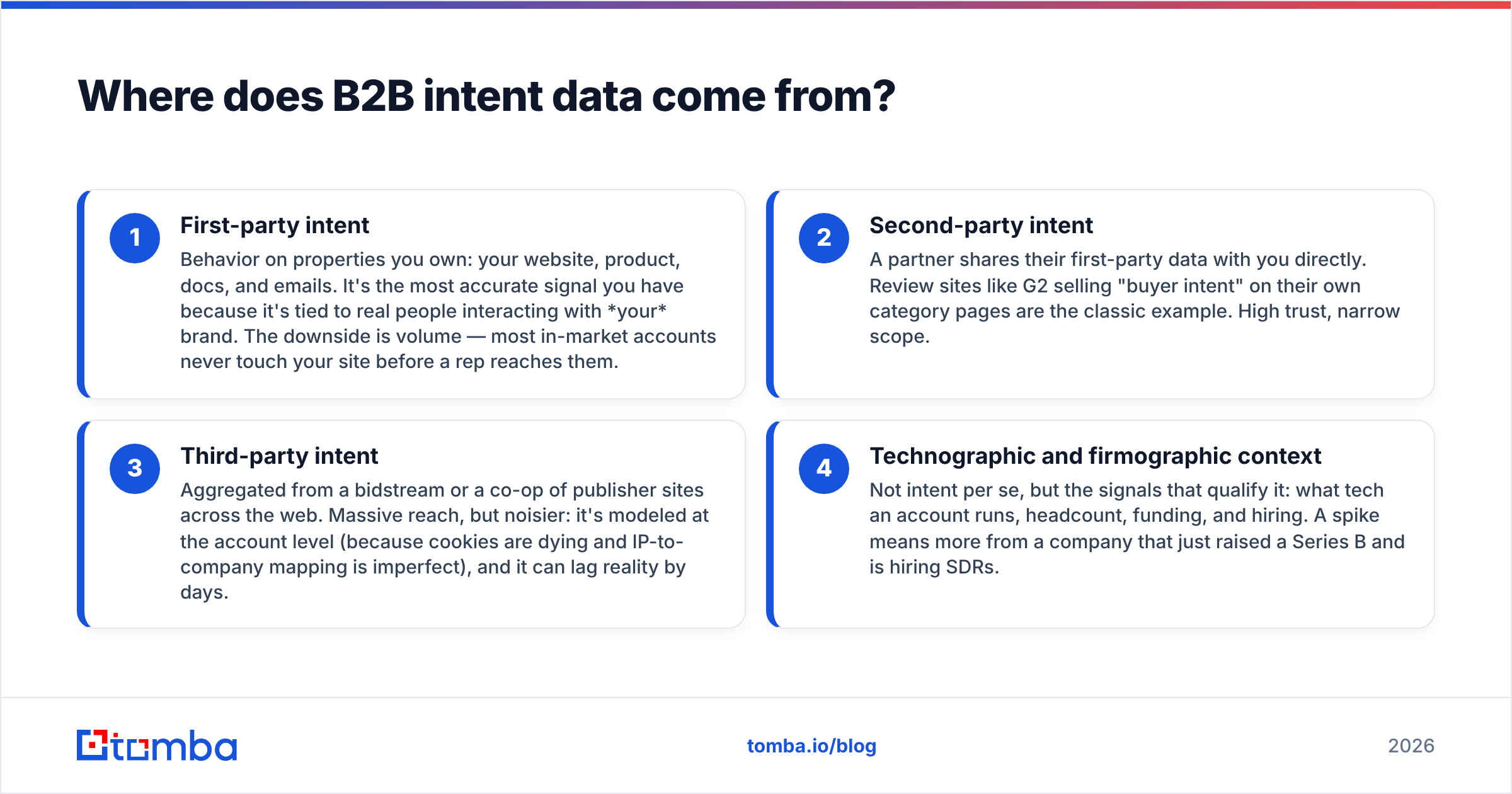
There are three sources, and the difference between them determines how much you should trust a signal.
- First-party intent — Behavior on properties you own: your website, product, docs, and emails. It's the most accurate signal you have because it's tied to real people interacting with your brand. The downside is volume — most in-market accounts never touch your site before a rep reaches them.
- Second-party intent — A partner shares their first-party data with you directly. Review sites like G2 selling "buyer intent" on their own category pages are the classic example. High trust, narrow scope.
- Third-party intent — Aggregated from a bidstream or a co-op of publisher sites across the web. Massive reach, but noisier: it's modeled at the account level (because cookies are dying and IP-to-company mapping is imperfect), and it can lag reality by days.
- Technographic and firmographic context — Not intent per se, but the signals that qualify it: what tech an account runs, headcount, funding, and hiring. A spike means more from a company that just raised a Series B and is hiring SDRs.
A healthy program blends all of these. Third-party tells you which accounts woke up this week; first-party confirms intent when they hit your site; enrichment and a clean B2B database turn an anonymous surging account into a named person you can email.
How is intent data different from lead scoring?#
They're cousins, not twins. Lead scoring grades a known contact based on who they are and what they've done with you. Intent data surfaces accounts — often before any contact is known — based on behavior across the web.
The most common mistake is treating an account-level surge as if it were a person-level intent score. A spike on "data warehouse migration" tells you the company is researching; it doesn't tell you whether your champion or a curious intern triggered it. You bridge that gap with prospecting: identify the buying committee, then verify reachability.
This is also where deanonymization fits. Tools that handle website visitor reveal convert your own anonymous first-party traffic into named accounts — arguably the highest-intent signal available, because those people chose to visit you.
What are the main B2B intent data providers in 2026?#
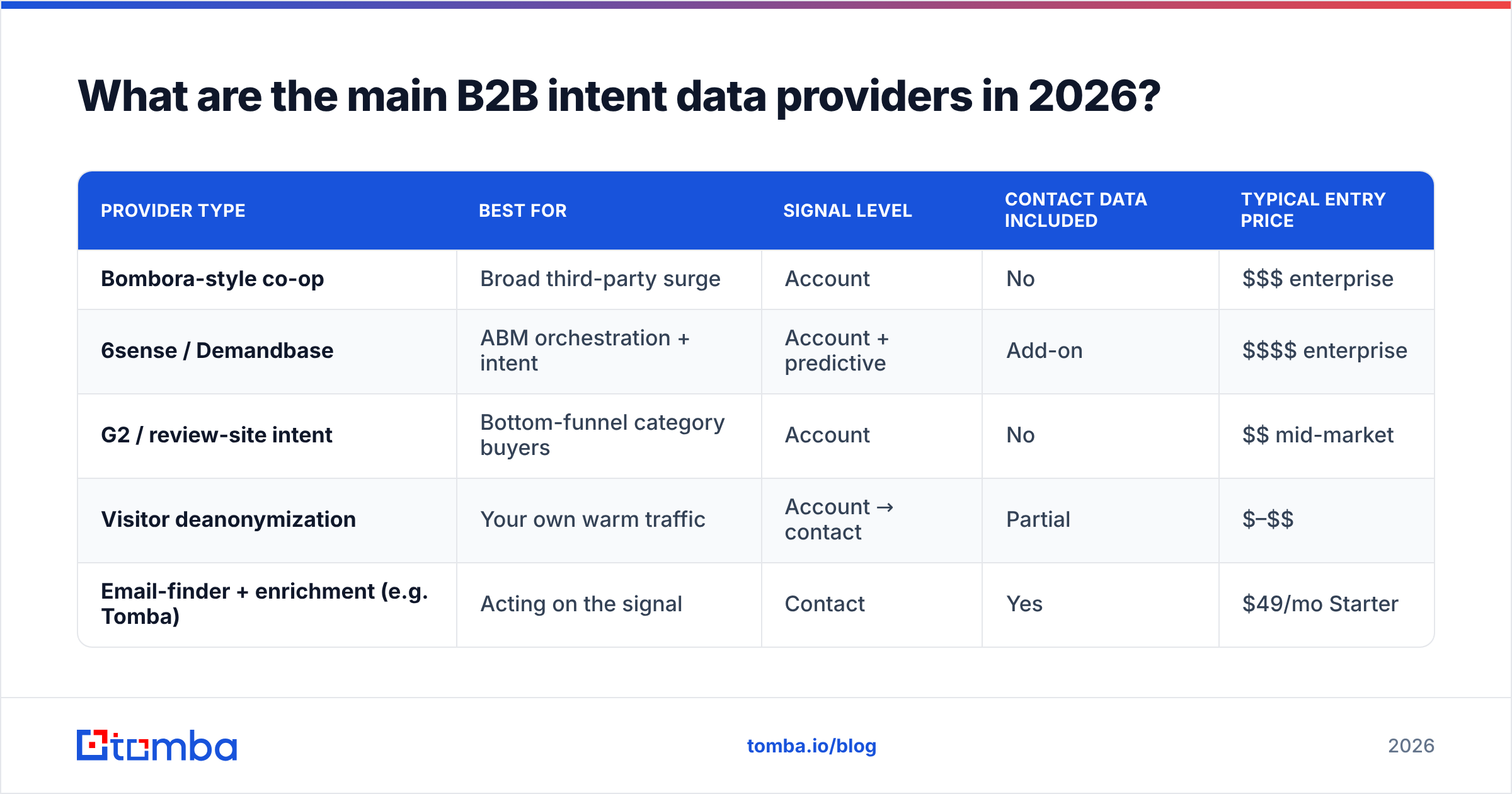
The market has consolidated, but the trade-offs are unchanged: reach versus precision, account-level versus contact-level, and whether the platform also gives you the contact data to act. Here's how the common options stack up.
| Provider type | Best for | Signal level | Contact data included | Typical entry price |
|---|---|---|---|---|
| Bombora-style co-op | Broad third-party surge | Account | No | $$$ enterprise |
| 6sense / Demandbase | ABM orchestration + intent | Account + predictive | Add-on | $$$$ enterprise |
| G2 / review-site intent | Bottom-funnel category buyers | Account | No | $$ mid-market |
| Visitor deanonymization | Your own warm traffic | Account → contact | Partial | $–$$ |
| Email-finder + enrichment (e.g. Tomba) | Acting on the signal | Contact | Yes | $49/mo Starter |
The pattern to notice: most pure intent vendors stop at the account. They tell you Acme Corp is in-market and leave you to figure out who at Acme and how to reach them. That last mile — turning an account into a verified, contactable human — is where an email finder and a verification layer pay for themselves. According to Gartner's research on B2B buying, buying groups now involve six to ten stakeholders, so finding one contact at a surging account is rarely enough.
How do you score and prioritize intent signals?#
Conclusion first: weight signals by funnel depth, ICP fit, and recency — then act fast, because intent decays.
A workable scoring model combines four inputs:
- Topic depth — Bottom-funnel keywords ("X vs Y pricing", "best X for enterprise") outrank top-funnel ones ("what is X"). A pricing-page visit beats a blog read.
- Surge intensity — How far above the account's baseline is current research? A 4x spike sustained over a week is far stronger than a one-day blip.
- ICP fit — Firmographic match. A perfect-fit account at low intent often beats a poor-fit account at high intent.
- Recency — Intent is perishable. Forrester's buyer behavior research consistently shows that much of the buying journey is complete before a vendor is contacted, so a signal you act on in 24 hours is worth far more than one you chase in two weeks.
Multiply ICP fit and surge intensity, gate on recency, and you get a ranked list your reps can actually work. Anything that scores well should be enriched immediately — pull the buying committee, verify emails, and grab a direct line via a phone finder so the rep has more than one way in.
How do you act on B2B intent data without wrecking deliverability?#
The fastest way to waste an intent program is to fire a generic blast at every surging account. Intent earns you relevance — use it, or you're just spamming with extra steps.
A disciplined motion looks like this:
- Reference the signal, don't expose it. "Saw you researching X" is creepy. "A lot of teams your size are rethinking X right now — here's how we think about it" is helpful. Same insight, no surveillance vibe.
- Verify before you send. A surge list is worthless if half the emails bounce. Run every address through an email verifier first; a clean list protects your sender reputation and keeps you out of spam folders.
- Multi-thread the committee. Don't bet a six-figure deal on one contact. Map three to five stakeholders per account and reach them across email, phone, and LinkedIn.
- Match channel to title. Economic buyers respond to peers and outcomes; practitioners respond to depth. Intent tells you the topic — your enriched data tells you the role.
This is the join most teams botch: intent identifies the account, but pipeline comes from contacting the right people accurately. If your bounce rate is high, even perfect intent timing won't save the campaign.
What are the risks and limitations of B2B intent data?#
Be honest about what intent can't do. It's a probability, not a promise.
- Account-level fuzziness. Most third-party intent is mapped to a company via IP or device graphs, not to a person. With cookie deprecation, this resolution has gotten harder, not easier.
- Noise from large orgs. A 50,000-person enterprise generates "intent" on nearly every topic. Baselines and surge math matter more than raw scores there.
- Vendor overlap and double-counting. Several providers draw from the same co-ops. Buying three doesn't triple your coverage.
- Privacy and compliance. GDPR, CCPA, and their successors constrain how you collect and use behavioral data. Lean on transparent, consent-based sources — and document where your data comes from. (Tomba publishes its data sources for exactly this reason.)
- Staleness. A signal is only as good as its freshness. Quarterly batch feeds are nearly useless for fast sales cycles.
Independent reviews on G2 are worth reading before you commit — the gap between a vendor's claimed accuracy and real-world user experience is often where budgets die.
How does intent data fit into a full GTM stack?#
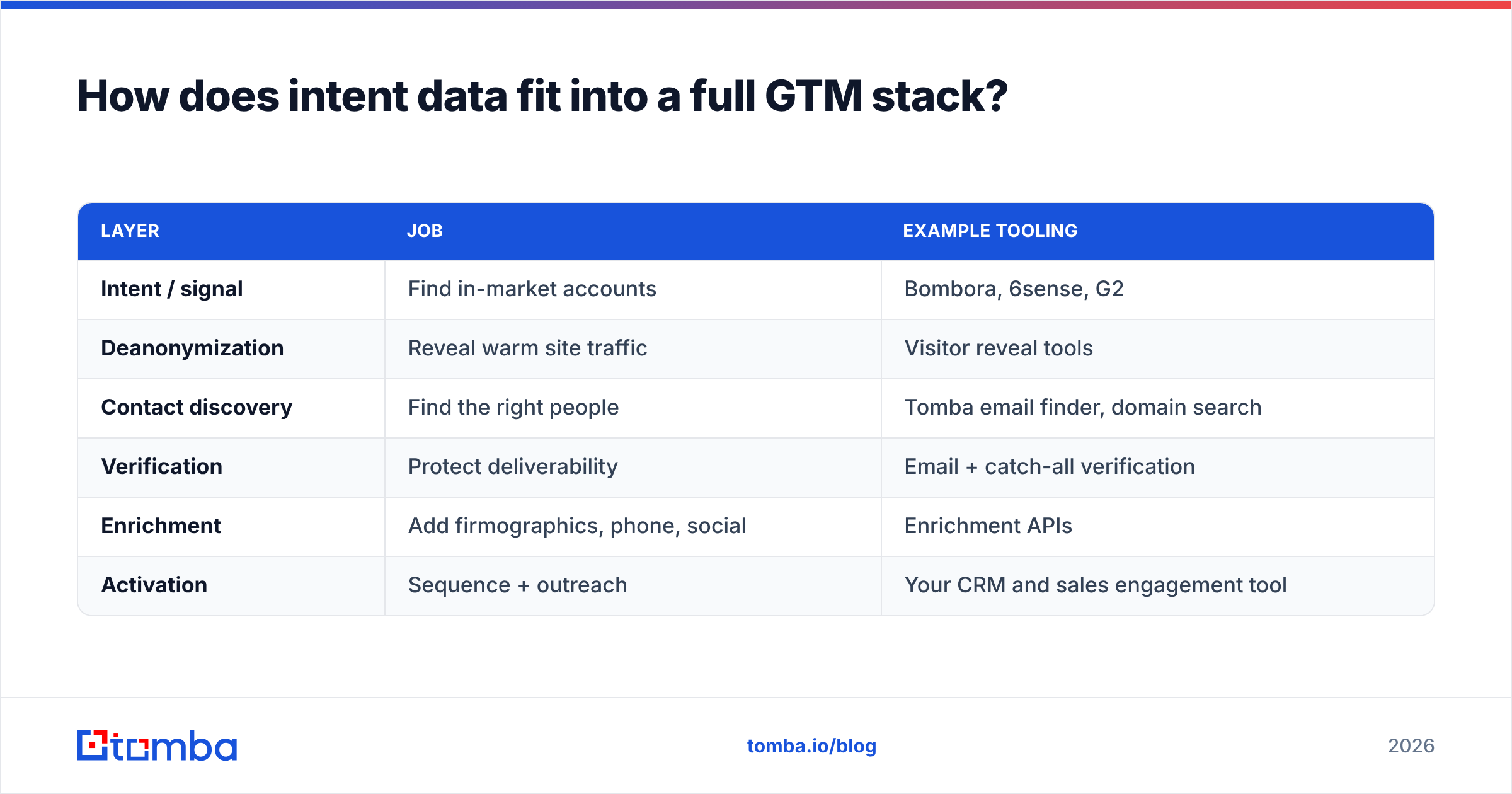
Intent is one layer in a pipeline, not the whole engine. The stack that actually produces meetings looks like this:
| Layer | Job | Example tooling |
|---|---|---|
| Intent / signal | Find in-market accounts | Bombora, 6sense, G2 |
| Deanonymization | Reveal warm site traffic | Visitor reveal tools |
| Contact discovery | Find the right people | Tomba email finder, domain search |
| Verification | Protect deliverability | Email + catch-all verification |
| Enrichment | Add firmographics, phone, social | Enrichment APIs |
| Activation | Sequence + outreach | Your CRM and sales engagement tool |
Notice that three of the six layers are about getting accurate contact data — because that's where intent converts to revenue. You can buy the most sophisticated predictive intent model on the market, but if the contact record is wrong, your rep dials a dead number. For teams running this at scale, a bulk email finder plus an enrichment API turns a list of surging account domains into a campaign-ready, verified contact set in minutes.
How do you start a B2B intent program on a budget?#
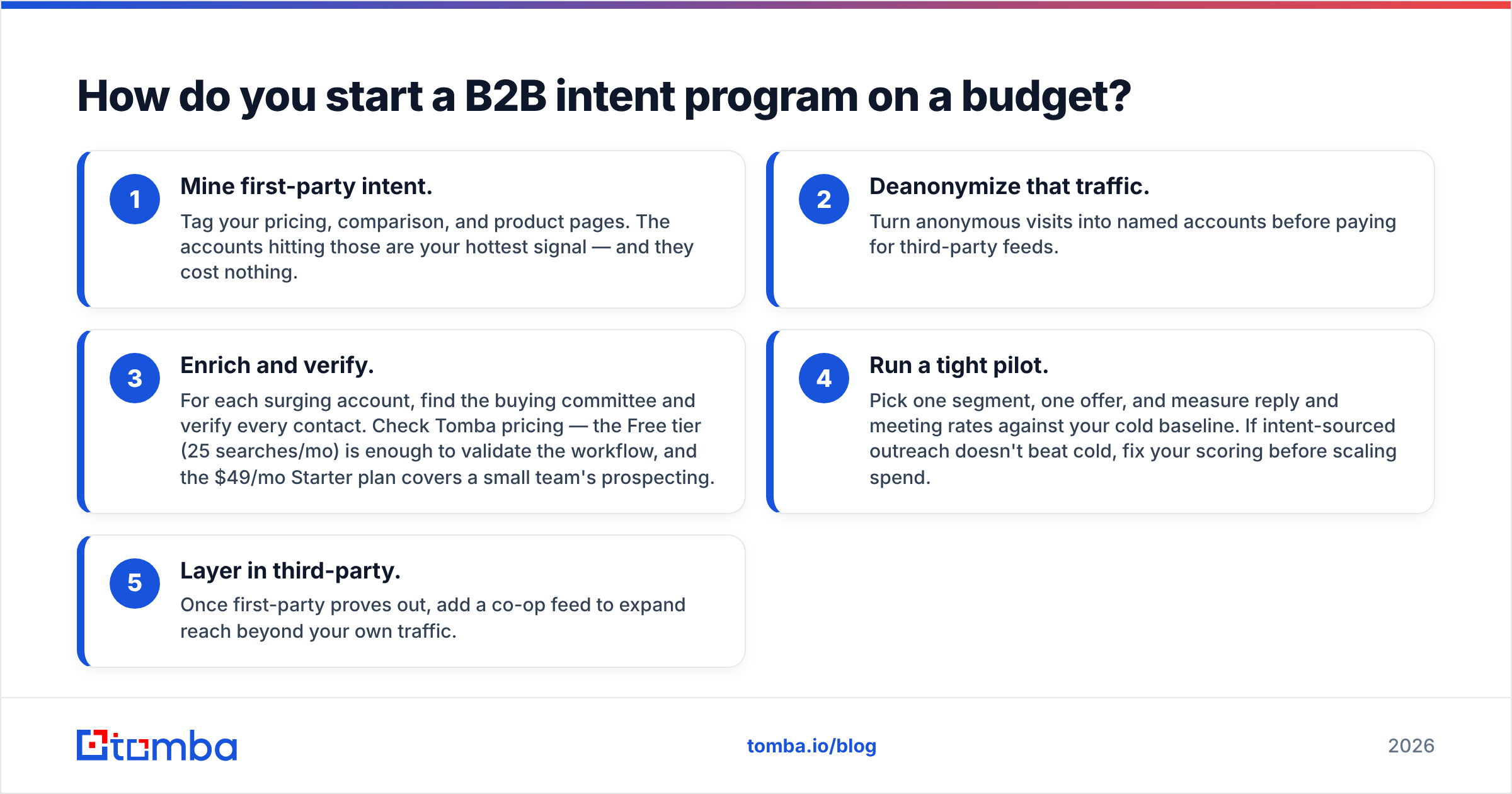
You don't need a six-figure enterprise contract to test the thesis. Start with the intent you already own and build from there.
- Mine first-party intent. Tag your pricing, comparison, and product pages. The accounts hitting those are your hottest signal — and they cost nothing.
- Deanonymize that traffic. Turn anonymous visits into named accounts before paying for third-party feeds.
- Enrich and verify. For each surging account, find the buying committee and verify every contact. Check Tomba pricing — the Free tier (25 searches/mo) is enough to validate the workflow, and the $49/mo Starter plan covers a small team's prospecting.
- Run a tight pilot. Pick one segment, one offer, and measure reply and meeting rates against your cold baseline. If intent-sourced outreach doesn't beat cold, fix your scoring before scaling spend.
- Layer in third-party. Once first-party proves out, add a co-op feed to expand reach beyond your own traffic.
This sequence keeps your spend tied to proven lift instead of a vendor's promise.
Final take#
B2B intent data is one of the highest-leverage signals in modern GTM — but only when it's paired with accurate, verified contact data and a disciplined motion. The signal tells you when and which account; your data stack has to deliver who and how. Skip the second half and you've bought an expensive list of companies you can't actually reach.
Start where the signal is warmest and cheapest: your own traffic, enriched and verified. When you're ready to turn surging accounts into real conversations, Tomba's Email Finder gives you verified, ICP-ready contacts at the buying committees your intent data surfaces — so the moment an account heats up, your reps have a real person to reach, not just a company name. Try the free tier, prove the lift, then scale.
// get started
Find, verify and enrich your first contacts today
Start on the free plan with 25 searches a month, then scale when your team is ready.
Free plan · No credit card required · GDPR & CCPA
// about the author