Best B2B Intent Data Providers in 2026: Top 9 Compared
Intent data tells you who is in-market before they fill out a form. Here's how the top 9 B2B intent data providers compare on signals, coverage, and price in 2026.
Most of your buyers research solutions for weeks before they ever talk to sales. B2B intent data is how you find them during that window — instead of after a competitor already won the deal.
TL;DR#
- Intent data providers track digital signals (content consumption, search, review-site activity) to flag accounts that are actively researching a problem you solve.
- The market splits into three camps: bidder/co-op networks (Bombora), review-site intent (G2, TrustRadius), and all-in-one platforms with intent baked in (6sense, ZoomInfo, Demandbase).
- Accuracy and "time-to-contact" matter more than raw signal volume — a hot account is useless if you can't reach the right person fast.
- Budgets range from a few thousand dollars a year for review-site intent to $60K–$120K+ for enterprise ABM platforms.
- Intent only converts when it's paired with accurate contact data. Pair a provider with an email finder so signals become real conversations.
What is B2B intent data?#
B2B intent data is the digital exhaust buyers leave while researching a purchase. Think of it like a store clerk noticing which aisles you keep circling back to: you haven't bought anything yet, but your behavior says you're close.
Technically, providers aggregate signals such as article reads, keyword searches, ad engagement, competitor comparisons, and software review-site visits. They map that activity to a company (and sometimes a person), score it against a topic, and surface accounts whose research is spiking above their normal baseline.
There are two broad flavors:
- First-party intent — signals from your own properties (website visits, pricing-page views, demo requests). You own it, it's accurate, but it only covers people already on your radar.
- Third-party intent — signals collected across a network of publishers, review sites, and bidstream data. Wider reach, earlier in the funnel, but noisier and never 100% deterministic.
The best programs blend both: third-party intent tells you who to wake up to, first-party intent confirms when they're ready.
How do the main types of intent data providers differ?#
Not every "intent" vendor does the same thing. Lumping them together is how teams overspend. Here are the core categories you'll evaluate:
- Co-op / bidstream networks (e.g., Bombora): Aggregate content-consumption signals across thousands of publisher sites into a "Company Surge" score. Strongest for top-of-funnel topic interest at scale.
- Review-site intent (e.g., G2, TrustRadius): Capture buyers comparing specific products on review platforms. Lower volume, but extremely high purchase intent — these people are shortlisting.
- All-in-one revenue platforms (e.g., 6sense, Demandbase, ZoomInfo): Bundle intent with contact data, predictive scoring, and orchestration. Powerful, expensive, and heavier to deploy.
- Sales-intelligence tools with intent add-ons (e.g., Apollo, Cognism): Lead with contact data and layer intent on top — a pragmatic middle ground for SMB and mid-market teams.
Match the category to your motion. A self-serve SaaS team lives on review-site intent; an enterprise ABM org needs the orchestration layer; a lean outbound team wants intent stapled to accurate emails and phone numbers.
Which are the best B2B intent data providers in 2026?#
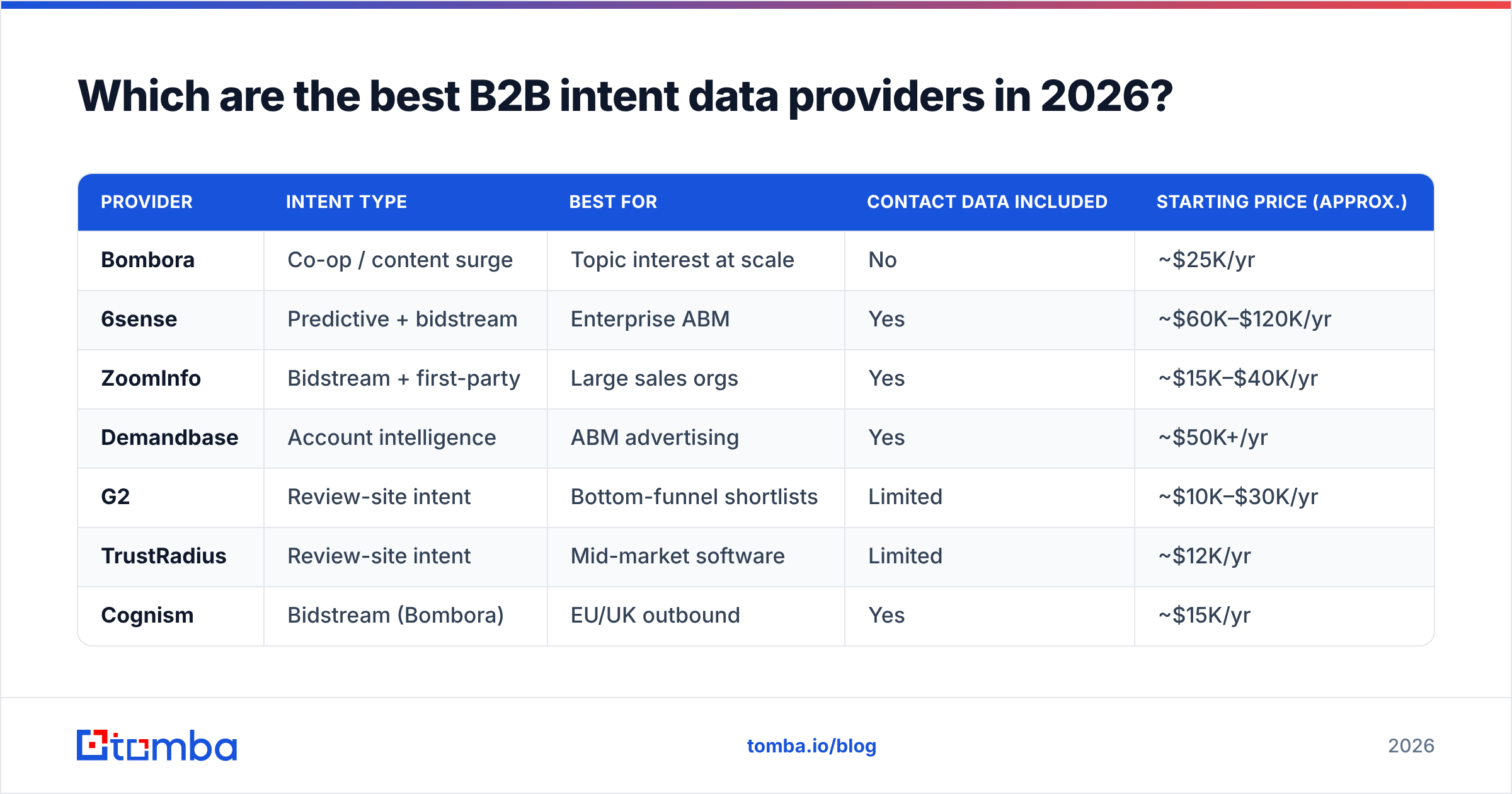
Below is a side-by-side look at nine widely used providers. "Time-to-contact" reflects how easily the platform gets you from a hot account to a reachable decision-maker — the metric that actually drives pipeline.
| Provider | Intent type | Best for | Contact data included | Starting price (approx.) |
|---|---|---|---|---|
| Bombora | Co-op / content surge | Topic interest at scale | No | ~$25K/yr |
| 6sense | Predictive + bidstream | Enterprise ABM | Yes | ~$60K–$120K/yr |
| ZoomInfo | Bidstream + first-party | Large sales orgs | Yes | ~$15K–$40K/yr |
| Demandbase | Account intelligence | ABM advertising | Yes | ~$50K+/yr |
| G2 | Review-site intent | Bottom-funnel shortlists | Limited | ~$10K–$30K/yr |
| TrustRadius | Review-site intent | Mid-market software | Limited | ~$12K/yr |
| Cognism | Bidstream (Bombora) | EU/UK outbound | Yes | ~$15K/yr |
| Apollo | Aggregated web intent | SMB outbound | Yes | From $49–$99/seat/mo |
| Tomba (paired) | First-party + enrichment | Turning intent into contacts | Yes | Free, then $49/mo |
A note on the last row: Tomba isn't a third-party intent network. It's the layer that makes intent actionable — once another tool flags an in-market account, Tomba finds the verified emails and enrichment data so your team reaches the right buyer. More on that below.
For independent buyer reviews of each platform, G2's intent data category is a solid neutral starting point, and analyst firms like Gartner publish account-based marketing comparisons worth reading before a six-figure commitment.
How accurate is B2B intent data, really?#
Set expectations: third-party intent is probabilistic, not deterministic. Vendors model behavior and assign confidence — they aren't reading anyone's mind.
Accuracy depends on three things:
- Signal source quality. Co-op networks with explicit publisher partnerships (like Bombora) tend to be cleaner than raw bidstream resold through many hops.
- Account resolution. Mapping an anonymous signal to the right company is hard; mapping it to the right person is harder. Many providers stop at the account level.
- Freshness. A surge from three weeks ago is cold. Weekly (or faster) refresh beats monthly batch files.
The practical takeaway: treat intent as a prioritization layer, not gospel. Use it to decide who to contact first, then validate with first-party signals and a real conversation. And before you email anyone, run addresses through an email verifier — intent-flagged accounts are worthless if your messages bounce and torch your sender reputation.
What should you look for when choosing an intent data provider?#
Use this checklist to cut through vendor demos:
- Coverage that matches your ICP geography. US-heavy networks underperform in EMEA; Cognism and others are stronger for EU/UK compliance and coverage.
- Topic granularity. Can you track "container orchestration" specifically, or only "DevOps" broadly? Narrow topics = less noise.
- Account-to-contact path. Does the tool hand you reachable people, or just a glowing account with no names? This is where most intent ROI leaks out.
- Integration with your stack. Native syncs to your CRM and outreach tools matter. Check the provider's HubSpot and Salesforce connectors — and confirm how scores flow into workflows. (HubSpot and Salesforce both have published intent integration docs.)
- Refresh cadence and history. Daily/weekly beats monthly. Trend data (is interest rising or fading?) beats a static score.
- Total cost of action. Add the platform fee plus the contact data you'll still need to buy. A cheap intent feed with no emails can cost more than a bundled tool once you add enrichment.
If you already own a B2B database or enrichment layer, you may only need the signal feed — not a $100K platform that re-sells contact data you can source far cheaper.
How do you turn intent signals into actual pipeline?#
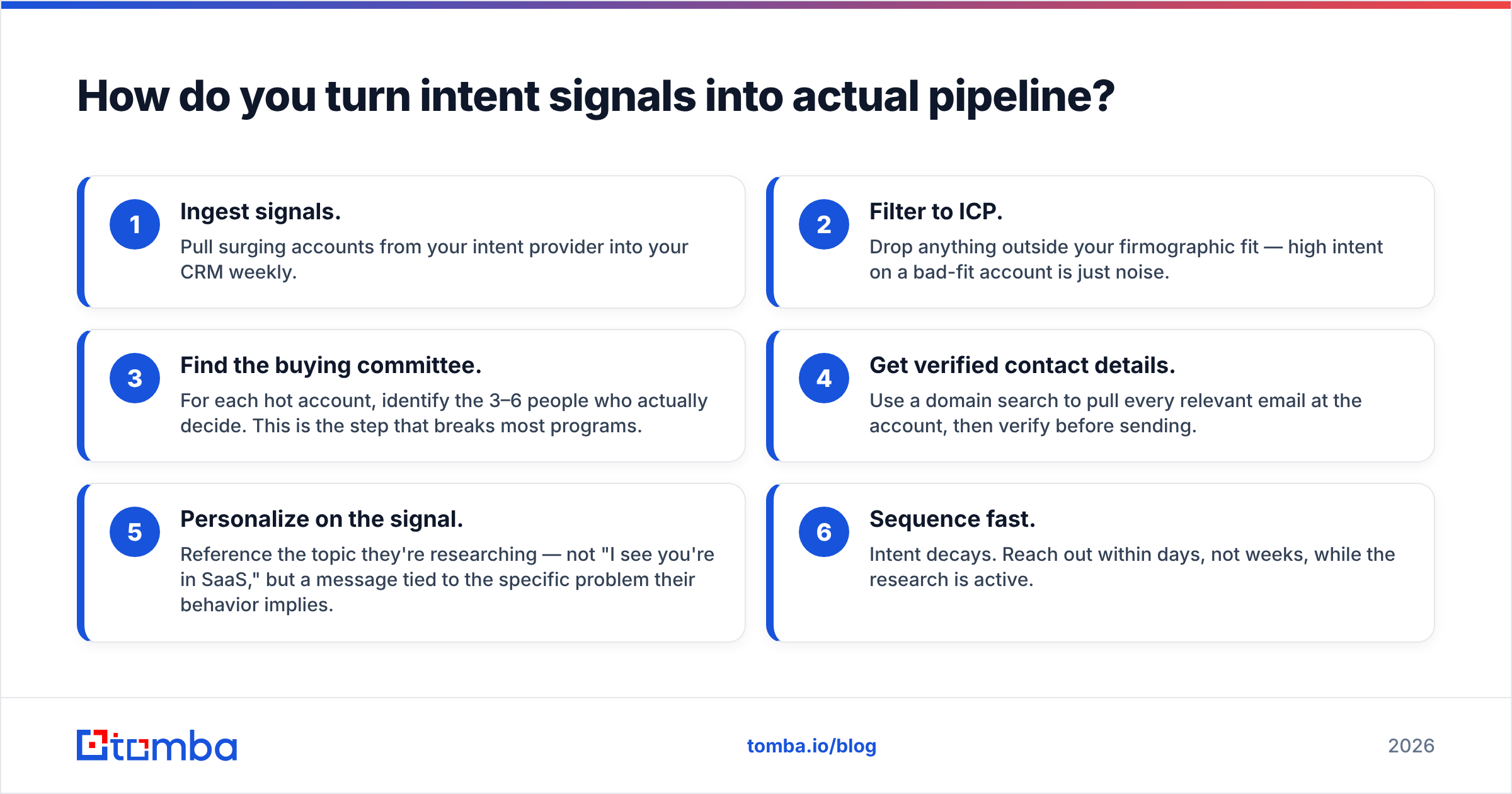
Intent data is a starting pistol, not a finish line. The workflow that converts looks like this:
- Ingest signals. Pull surging accounts from your intent provider into your CRM weekly.
- Filter to ICP. Drop anything outside your firmographic fit — high intent on a bad-fit account is just noise.
- Find the buying committee. For each hot account, identify the 3–6 people who actually decide. This is the step that breaks most programs.
- Get verified contact details. Use a domain search to pull every relevant email at the account, then verify before sending.
- Personalize on the signal. Reference the topic they're researching — not "I see you're in SaaS," but a message tied to the specific problem their behavior implies.
- Sequence fast. Intent decays. Reach out within days, not weeks, while the research is active.
The bottleneck is almost always step 3 and 4. You have a list of in-market companies, but no clean, verified way to reach the humans inside them. That gap is where pipeline dies — and where pairing an intent provider with a dedicated contact tool pays for itself.
Is an all-in-one platform or a best-of-breed stack better?#
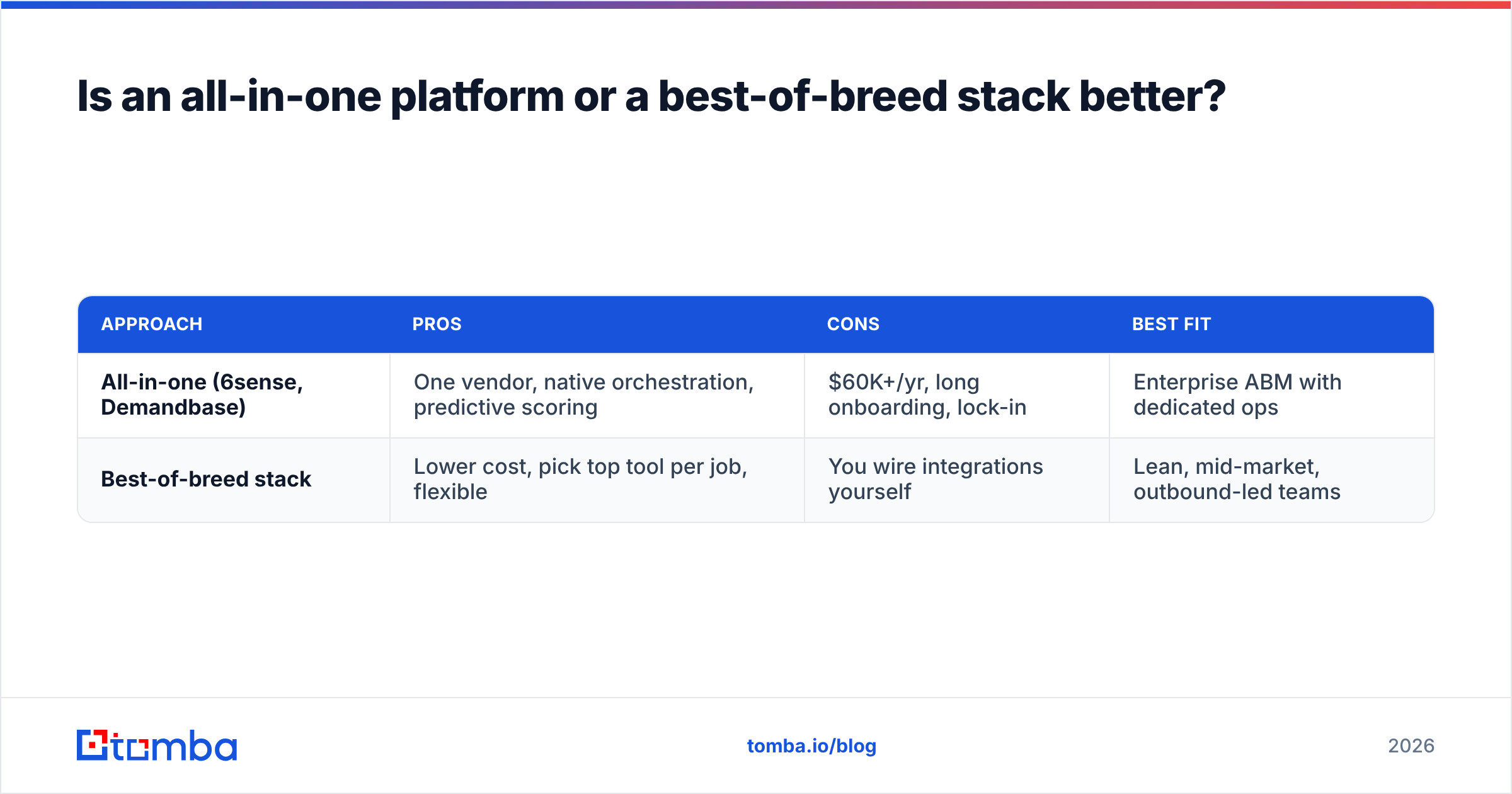
It depends on team size and budget — there's no universal winner.
| Approach | Pros | Cons | Best fit |
|---|---|---|---|
| All-in-one (6sense, Demandbase) | One vendor, native orchestration, predictive scoring | $60K+/yr, long onboarding, lock-in | Enterprise ABM with dedicated ops |
| Best-of-breed stack | Lower cost, pick top tool per job, flexible | You wire integrations yourself | Lean, mid-market, outbound-led teams |
For most growing teams, a best-of-breed stack wins on cost and speed: a focused intent feed (review-site or co-op), your CRM, an outreach tool, and an accurate email-and-enrichment layer. You assemble it in a week, not a quarter, and you only pay for what you use.
The all-in-one platforms earn their price when you have a large field team, complex multi-touch ABM, and the operations headcount to actually run orchestration. If you're buying one to "have intent data," you'll likely overpay for shelfware.
Where does Tomba fit in your intent stack?#
Tomba is the contact-and-enrichment layer that turns intent signals into reachable people. When 6sense, Bombora, or G2 flags an in-market account, Tomba's data enrichment and email finder give you the verified emails, formats, and details to act — without paying enterprise platform prices for contact data you can source affordably.
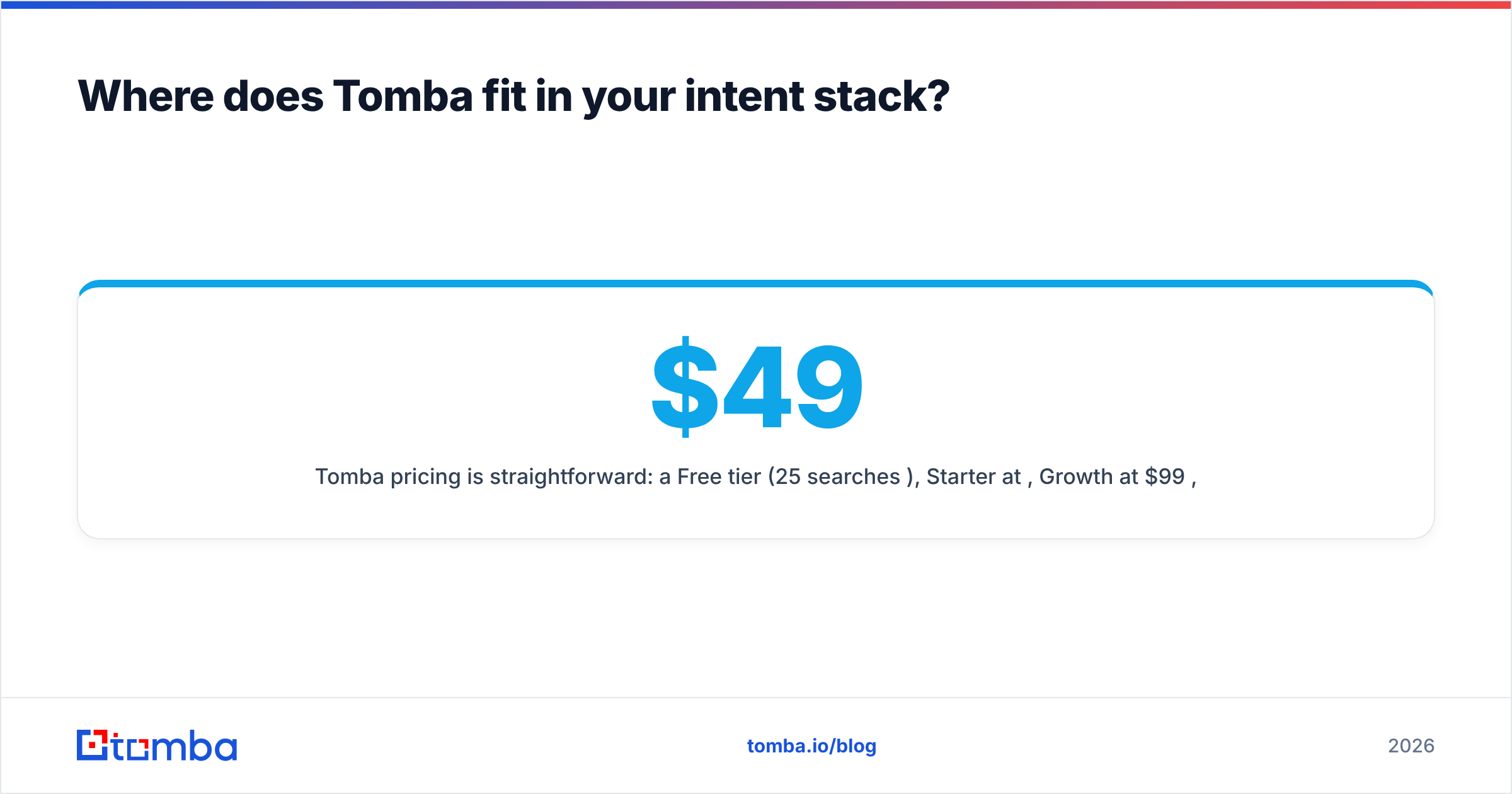
Tomba pricing is straightforward: a Free tier (25 searches/mo), Starter at $49/mo, Growth at $99/mo, and Pro at $249/mo, with custom Enterprise plans. Compare that to bolting contact data onto a six-figure ABM suite. You can review full Tomba pricing and see exactly where the data comes from before committing a cent.
The honest positioning: don't buy Tomba instead of intent data. Buy your intent feed for signals, then use the Tomba Email Finder to close the gap between "this account is hot" and "I'm emailing the right VP today." Start free, find your first verified contacts in minutes, and only scale up when intent is reliably turning into booked meetings.
// get started
Find, verify and enrich your first contacts today
Start on the free plan with 25 searches a month, then scale when your team is ready.
Free plan · No credit card required · GDPR & CCPA
// about the author