B2B Intent Signals in 2026: How to Find Ready Buyers
B2B intent signals tell you which accounts are actively researching a solution like yours right now. Here is how to capture, score, and act on them in 2026.
Most outbound still treats every account the same: same list, same blast, same week. The teams pulling ahead in 2026 do the opposite — they wait for a buyer to raise their hand, then strike. That raised hand is a B2B intent signal, and learning to read it is the single highest-leverage change you can make to a prospecting motion this year.
TL;DR#
- B2B intent signals are behavioral data points that reveal an account is actively researching a problem or solution like yours — before they ever fill out a form.
- They split into three buckets: first-party (your own site/product), second-party (review sites, communities), and third-party (publisher networks tracking content consumption).
- Intent data does not replace good targeting — it prioritizes it. You still need clean contact data to act on a hot account.
- Scoring matters more than raw signals: a spike in research from an in-ICP account beats a thousand random page views.
- The winning workflow is signal → account → contact → personalized outreach, and the weak link is usually the contact step, not the signal.
What are B2B intent signals?#
A B2B intent signal is any observable behavior that suggests a company is moving toward a purchase. Think of it like a smoke detector for buying interest: you do not see the fire (the internal budget meeting, the Slack thread, the "we need to fix this" decision), but you detect the smoke — surging research, repeat visits, competitor comparisons — and you respond before the room is fully ablaze.
Concretely, signals look like:
- A target account reading three "vendor comparison" articles in a week.
- A company posting five new SDR job reqs (a hiring signal that they are scaling outbound).
- Repeat anonymous visits to your pricing page from one company's IP range.
- A spike in branded + competitor searches coming from a single domain.
- A funding round, leadership change, or new tech install detected in firmographic data.
The point is not that any one signal is proof. It is that a cluster of signals, tied to an account that already fits your ideal customer profile, is the closest thing outbound has to a warm lead.

Wait — that placeholder belongs below. Here is the meme that fits this section:
)
What are the three types of intent data?#
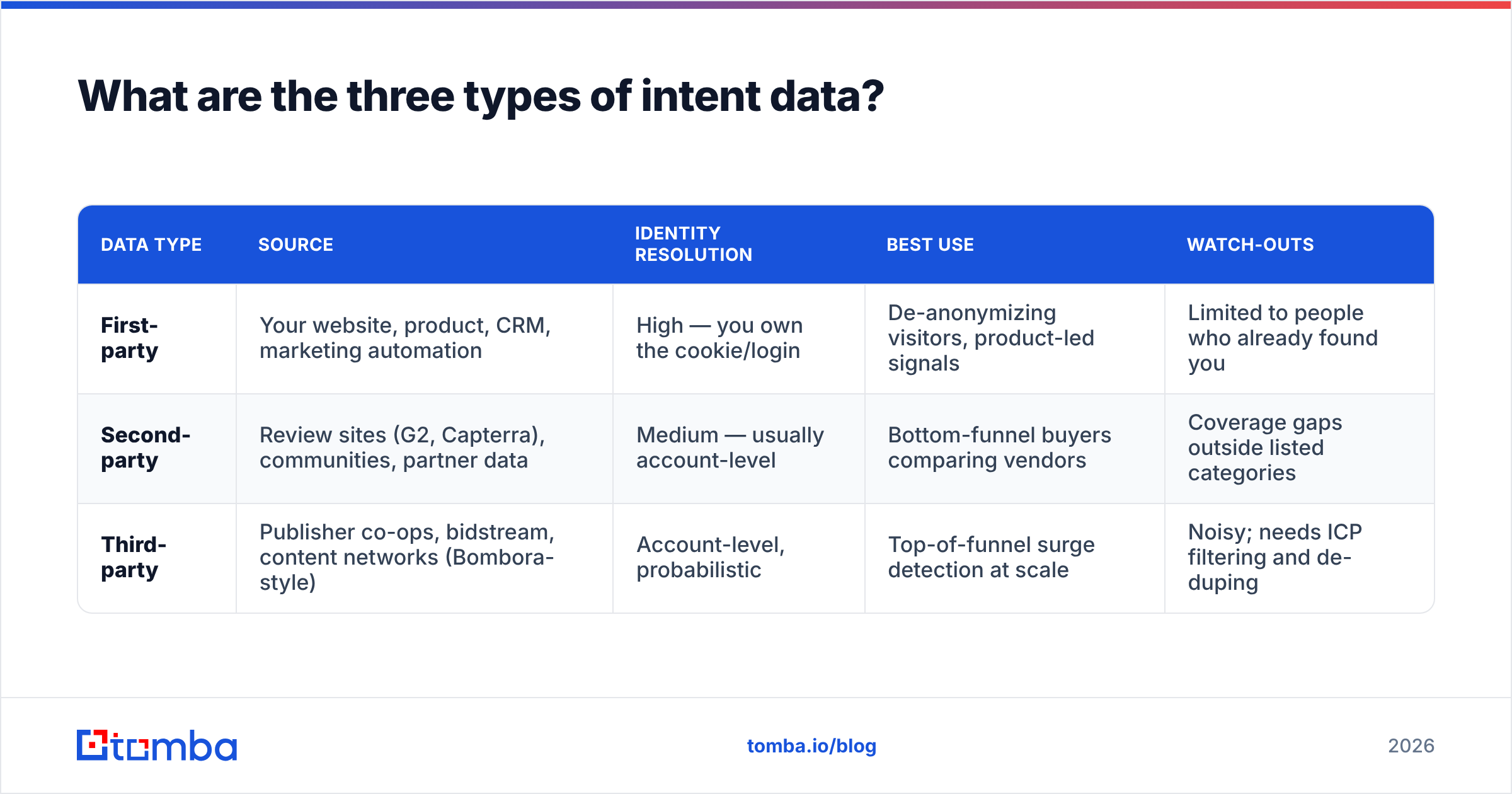
Understanding where a signal comes from tells you how reliable it is and how you are allowed to use it. There are three sources, and serious teams blend all three.
| Data type | Source | Identity resolution | Best use | Watch-outs |
|---|---|---|---|---|
| First-party | Your website, product, CRM, marketing automation | High — you own the cookie/login | De-anonymizing visitors, product-led signals | Limited to people who already found you |
| Second-party | Review sites (G2, Capterra), communities, partner data | Medium — usually account-level | Bottom-funnel buyers comparing vendors | Coverage gaps outside listed categories |
| Third-party | Publisher co-ops, bidstream, content networks (Bombora-style) | Account-level, probabilistic | Top-of-funnel surge detection at scale | Noisy; needs ICP filtering and de-duping |
First-party intent is the most accurate because it is your own data. The catch is volume: only a fraction of in-market buyers visit your site, and most arrive anonymous. Tools that handle website visitor reveal close part of that gap by tying anonymous traffic back to a company.
Second-party intent is gold at the bottom of the funnel. When someone reads your G2 category page or your comparison grid, they are shortlisting. That is buying behavior, not curiosity.
Third-party intent gives you reach you cannot get alone — it watches content consumption across thousands of sites and flags accounts whose research is "surging" above their baseline. The tradeoff is noise. Without strict ICP filtering, you will drown in accounts that will never buy.
Why do B2B intent signals matter in 2026?#
The short answer: budgets got tighter and buying committees got bigger, so spraying outreach stopped working. Intent signals fix the two expensive problems of modern outbound — timing and prioritization.
On timing: research from Gartner has long shown that B2B buyers spend the majority of their journey doing independent research before they ever talk to a vendor. By the time someone fills out a "contact sales" form, they may already have a frontrunner. Intent signals let you enter the conversation during the research phase, when you can still shape the shortlist.
On prioritization: a rep with 200 accounts cannot work all of them well. Intent scoring tells that rep which 20 to call this week. That is a focusing function, and focus is what raises win rate.
There is also a defensive angle. If a competitor is using intent data and you are not, they are reaching your prospects during the research window and you are showing up after the decision. Same list, worse timing.
How do you score and prioritize intent signals?#
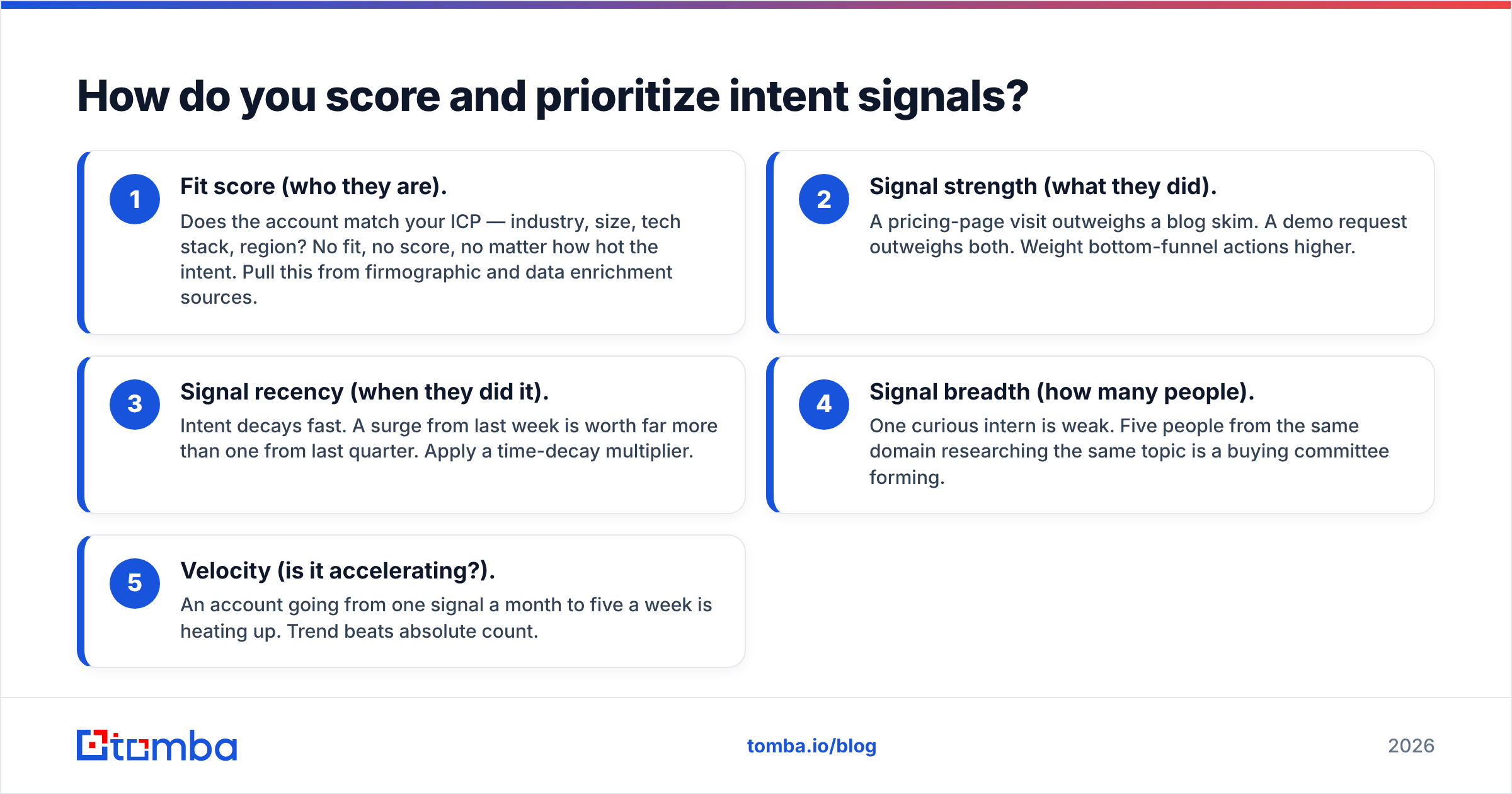
Raw signals are noise. A scoring model turns them into a ranked action list. The mistake teams make is treating intent as binary ("they're in-market or not") when it is really a weighted sum.
A simple, durable scoring framework:
- Fit score (who they are). Does the account match your ICP — industry, size, tech stack, region? No fit, no score, no matter how hot the intent. Pull this from firmographic and data enrichment sources.
- Signal strength (what they did). A pricing-page visit outweighs a blog skim. A demo request outweighs both. Weight bottom-funnel actions higher.
- Signal recency (when they did it). Intent decays fast. A surge from last week is worth far more than one from last quarter. Apply a time-decay multiplier.
- Signal breadth (how many people). One curious intern is weak. Five people from the same domain researching the same topic is a buying committee forming.
- Velocity (is it accelerating?). An account going from one signal a month to five a week is heating up. Trend beats absolute count.
Combine these into a single 0–100 score, set a threshold for "sales-ready," and route everything above it to a rep with the context attached. Everything below stays in nurture. This is the same logic behind a marketing qualified lead, just applied to anonymous and account-level behavior instead of a single known contact.
)
What are the best B2B intent data platforms?#
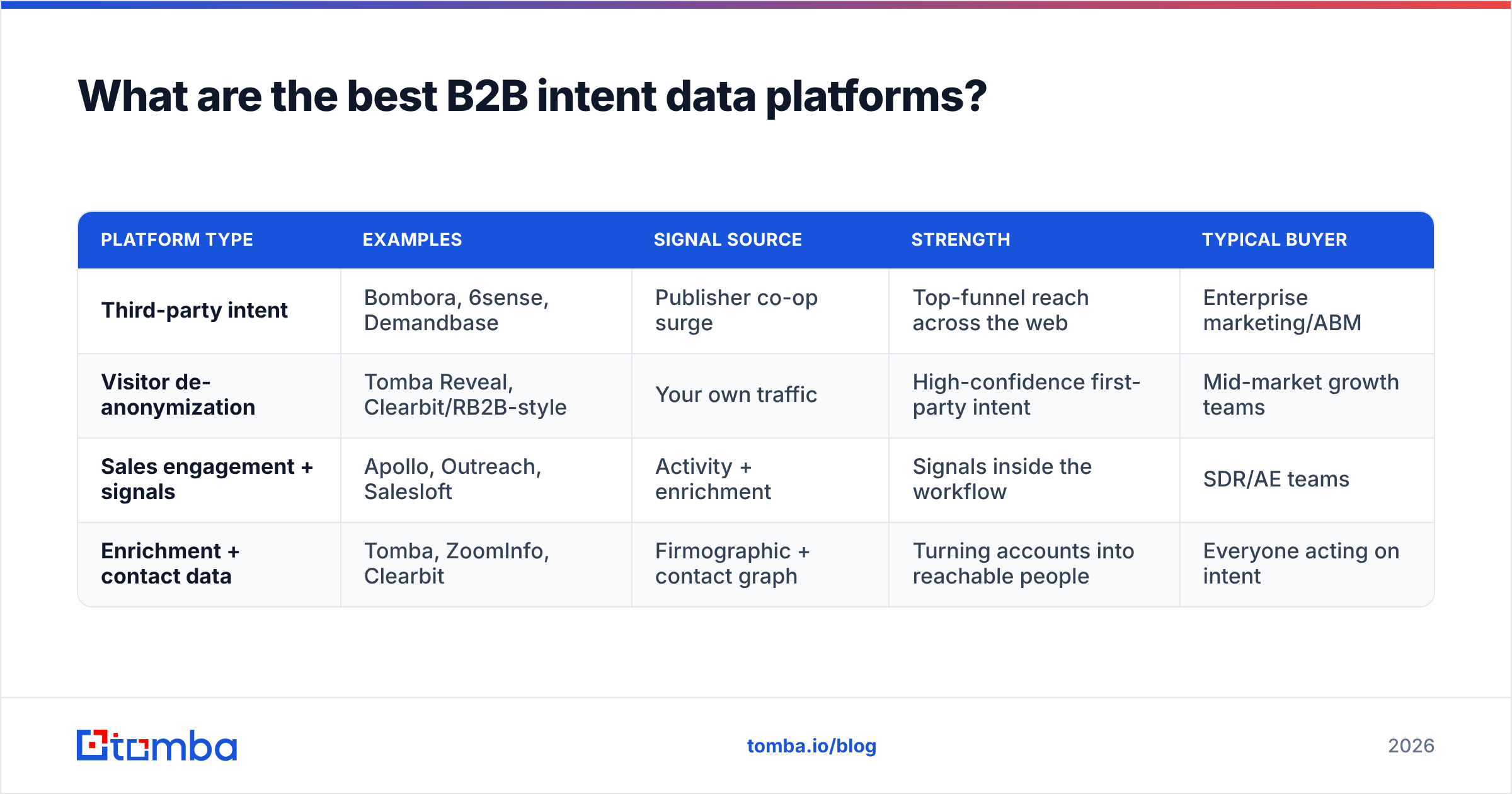
There is no single "best" — it depends on whether you need third-party reach, first-party de-anonymization, or both. Here is how the main categories stack up.
| Platform type | Examples | Signal source | Strength | Typical buyer |
|---|---|---|---|---|
| Third-party intent | Bombora, 6sense, Demandbase | Publisher co-op surge | Top-funnel reach across the web | Enterprise marketing/ABM |
| Visitor de-anonymization | Tomba Reveal, Clearbit/RB2B-style | Your own traffic | High-confidence first-party intent | Mid-market growth teams |
| Sales engagement + signals | Apollo, Outreach, Salesloft | Activity + enrichment | Signals inside the workflow | SDR/AE teams |
| Enrichment + contact data | Tomba, ZoomInfo, Clearbit | Firmographic + contact graph | Turning accounts into reachable people | Everyone acting on intent |
Notice the last row. Every intent platform stops at the same wall: it tells you which account is in-market, but a rep cannot email "Account." You still need the verified contact — the right person, the right email, the right phone number. That handoff from "hot account" to "reachable human" is where most intent programs leak pipeline.
This is the gap Tomba fills. When your intent stack flags an account, Tomba's domain search returns the people at that company by role, the email verifier confirms the addresses are deliverable, and the phone finder adds a dialer-ready number. The signal gets you the account; Tomba gets you the conversation.
How do you turn intent signals into pipeline?#
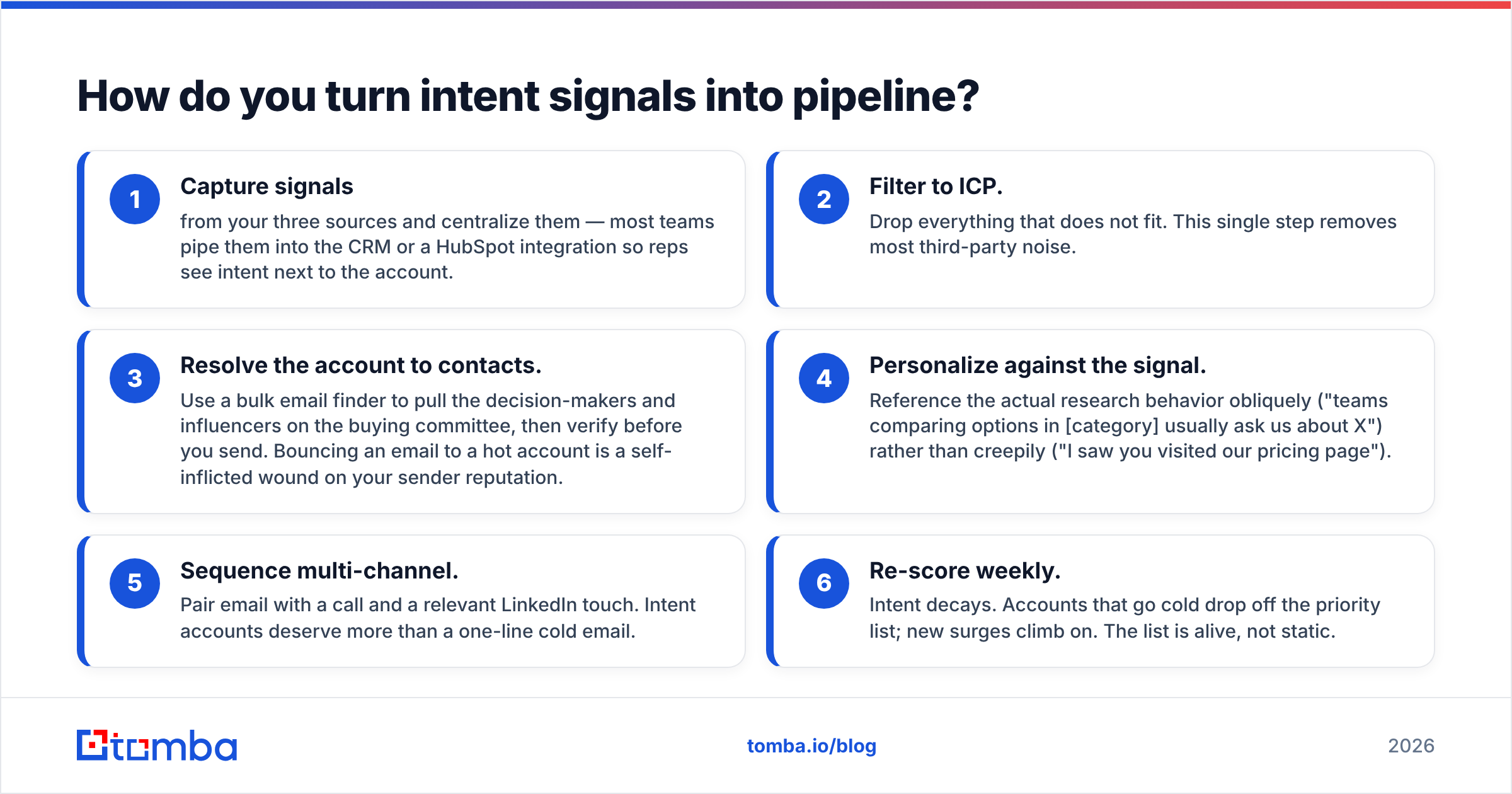
A signal you do not act on within days is a wasted signal. Here is the end-to-end workflow that converts intent into booked meetings.
- Capture signals from your three sources and centralize them — most teams pipe them into the CRM or a HubSpot integration so reps see intent next to the account.
- Filter to ICP. Drop everything that does not fit. This single step removes most third-party noise.
- Resolve the account to contacts. Use a bulk email finder to pull the decision-makers and influencers on the buying committee, then verify before you send. Bouncing an email to a hot account is a self-inflicted wound on your sender reputation.
- Personalize against the signal. Reference the actual research behavior obliquely ("teams comparing options in [category] usually ask us about X") rather than creepily ("I saw you visited our pricing page").
- Sequence multi-channel. Pair email with a call and a relevant LinkedIn touch. Intent accounts deserve more than a one-line cold email.
- Re-score weekly. Intent decays. Accounts that go cold drop off the priority list; new surges climb on. The list is alive, not static.
The teams that win do not have better signals than everyone else — they have a tighter loop between the signal and the first human touch. Speed and relevance are the whole game.
Common mistakes with B2B intent data#
- Acting on intent without fit. A surging account that will never buy is still a bad account. Fit gates everything.
- Chasing third-party signals alone. They are probabilistic and account-level. Treat them as a prioritization layer, not a list of people to email.
- Skipping verification. Hot account + bad email = bounce. Always run contacts through an email verifier before sequencing.
- Being too literal. Telling a prospect exactly which pages they visited is creepy and kills trust. Reference the topic, not the surveillance.
- No decay model. Last quarter's intent is not this week's. If your scoring ignores recency, you will keep working accounts that already chose someone else.
- Stopping at the account. The most common failure: great signal data, no plan to find and verify the actual humans. The contact layer is not optional.
Frequently asked questions#
Is third-party intent data accurate? It is directional, not exact. Third-party data tells you an account's research is surging above baseline, with account-level (not person-level) confidence. Use it to prioritize, then confirm with first-party signals and verified contact data before you invest rep time.
Do I need an expensive ABM platform to use intent signals? No. You can start with first-party signals (visitor reveal, pricing-page tracking) plus solid enrichment and contact data, then layer third-party intent later as you scale. Many mid-market teams get most of the value from first-party intent alone.
How fast does intent data decay? Fast. Treat a strong signal as actionable for roughly one to three weeks. After that, re-qualify before reaching out — the buying window may have closed.
What is the difference between intent data and lead scoring? Lead scoring grades known contacts who already engaged with you. Intent data includes anonymous and account-level behavior, often before anyone identifies themselves. They complement each other in a single scoring model.
Put your intent signals to work#
Intent signals point you at the right accounts at the right moment — but a signal is only as good as your ability to reach a real person behind it. That is the step that turns a dashboard full of "in-market" accounts into actual conversations.
Start free with the Tomba Email Finder: the moment your intent stack flags a hot account, find the decision-makers by domain, verify their emails, and hand your reps a contact-ready list. The Free tier includes 25 searches a month, and paid plans start at $49/mo — see full Tomba pricing to match a plan to your volume. Stop letting hot accounts go cold at the contact step.
// get started
Find, verify and enrich your first contacts today
Start on the free plan with 25 searches a month, then scale when your team is ready.
Free plan · No credit card required · GDPR & CCPA
// about the author