B2B Lead Capture in 2026: A Complete Conversion Guide
Most B2B lead capture leaks revenue at the form. Here's how to capture, enrich, and route leads in 2026 without burning your funnel.
TL;DR
- B2B lead capture is the system that turns anonymous interest into a contactable, qualified record — not just a form on a landing page.
- The biggest leak is friction: every extra form field costs you conversions, so capture less from the visitor and enrich the rest from data.
- Modern capture stacks combine a short form, progressive profiling, website visitor identification, and real-time enrichment to fill the gaps.
- Speed-to-lead beats everything: routing and contacting a lead within five minutes can lift qualification rates dramatically.
- Tools like Tomba let you capture a single work email and instantly enrich it into a full, sales-ready contact record.
What is B2B lead capture?#
B2B lead capture is the process of collecting identifying information from a business prospect and turning it into a structured, contactable record your sales and marketing teams can act on. Think of it like a coat check at a restaurant: the visitor hands over one ticket (an email, a name, a company), and your system gives back a full profile — title, company size, phone, LinkedIn, and intent signals — that you can use later.
The mistake most teams make is treating capture as a single moment: someone fills out a form, and that's it. In reality, capture is a pipeline. It starts the moment an anonymous visitor lands on your site and continues through identification, qualification, enrichment, and routing. The form is only one node in that chain, and increasingly it's not even the most important one.
Here's the tension that defines the entire discipline. The more you ask the visitor to type, the more you know — but the fewer people finish. The less you ask, the higher your conversion rate, but the thinner your data. Good B2B lead capture in 2026 resolves that tension by asking for almost nothing up front and using data tools to reconstruct the rest.
)
Why does B2B lead capture matter more in 2026?#
Because acquisition costs are up and buyer patience is down. The cost of a paid B2B click keeps climbing, which means every visitor you drive to a landing page is more expensive than the last. If your capture process loses 80% of them at the form, you're not just losing leads — you're lighting ad spend on fire.
At the same time, buyers expect consumer-grade speed. A prospect who requests a demo at 2 p.m. expects a response that afternoon, not a templated email three days later. The gap between capture and contact is where most pipeline dies. Research from Harvard Business Review's classic study on lead response found that companies contacting leads within an hour were far more likely to qualify them than those who waited even a few hours.
There's also a data-quality problem. Self-reported form data is notoriously dirty — people type "asdf" into the company field, use personal Gmail addresses, or fat-finger their job title. A capture system that validates and enriches at the point of entry keeps your CRM clean instead of forcing a quarterly cleanup project.
What are the core methods of B2B lead capture?#
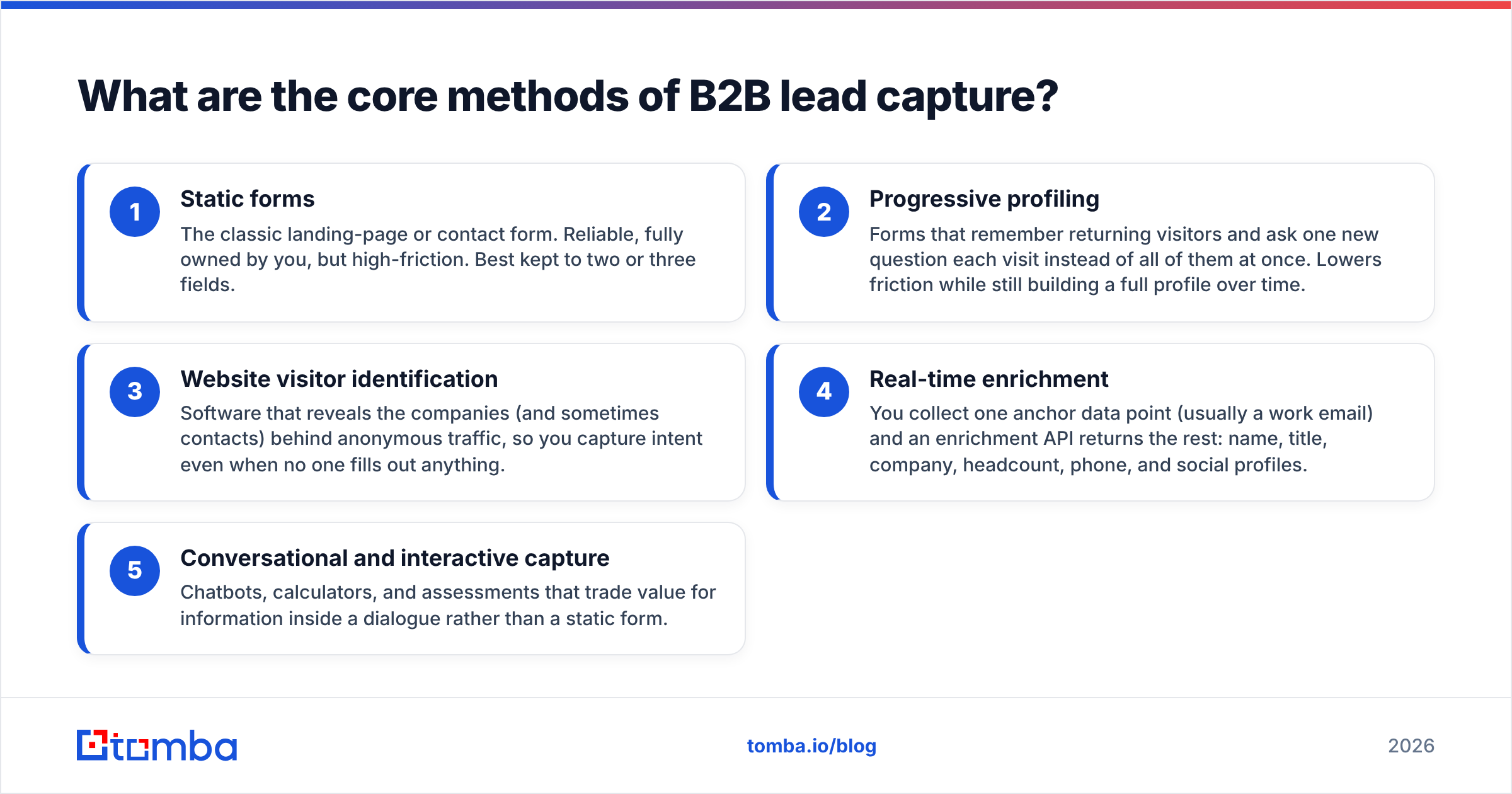
There are five capture methods worth knowing, and most strong funnels use three or four of them together rather than betting on one.
- Static forms — The classic landing-page or contact form. Reliable, fully owned by you, but high-friction. Best kept to two or three fields.
- Progressive profiling — Forms that remember returning visitors and ask one new question each visit instead of all of them at once. Lowers friction while still building a full profile over time.
- Website visitor identification — Software that reveals the companies (and sometimes contacts) behind anonymous traffic, so you capture intent even when no one fills out anything.
- Real-time enrichment — You collect one anchor data point (usually a work email) and an enrichment API returns the rest: name, title, company, headcount, phone, and social profiles.
- Conversational and interactive capture — Chatbots, calculators, and assessments that trade value for information inside a dialogue rather than a static form.
The smart play is to layer these. Capture a work email with a two-field form, identify the company with visitor reveal, and enrich the record with an API — three methods, one seamless experience for the prospect.
How do you reduce form friction without losing data?#
Capture less, enrich more. That single principle drives modern B2B lead capture. Instead of asking a visitor for ten fields, ask for one or two that are genuinely hard to fake — typically a business email — and rebuild the full profile from data sources behind the scenes.
A work email is a remarkably dense anchor. From jane.doe@acme.com alone, an enrichment tool can infer the person's likely full name, the company (Acme), the company's domain, industry, size, and often the direct phone and LinkedIn URL. You went from one field to a complete record without making Jane type a single extra character. This is exactly the workflow Tomba's data enrichment is built for.
The second lever is validation at the point of capture. If you verify the email the instant it's entered, you stop fake and mistyped addresses from ever entering your CRM. Running submissions through an email verifier keeps your sender reputation intact and your sales reps from chasing dead inboxes. For domains that accept everything, a dedicated catch-all verifier tells you whether the address is actually safe to mail.
The third lever is timing. Don't front-load every qualifying question. Capture the email now, then use progressive profiling or a post-submit enrichment step to learn budget, timeline, and authority. Friction you remove from the first interaction is conversion you keep.
What does a modern B2B lead capture stack look like?#
A complete stack covers four jobs: attract, identify, enrich, and route. You rarely need one giant platform — you need a few focused tools that hand data to each other cleanly.
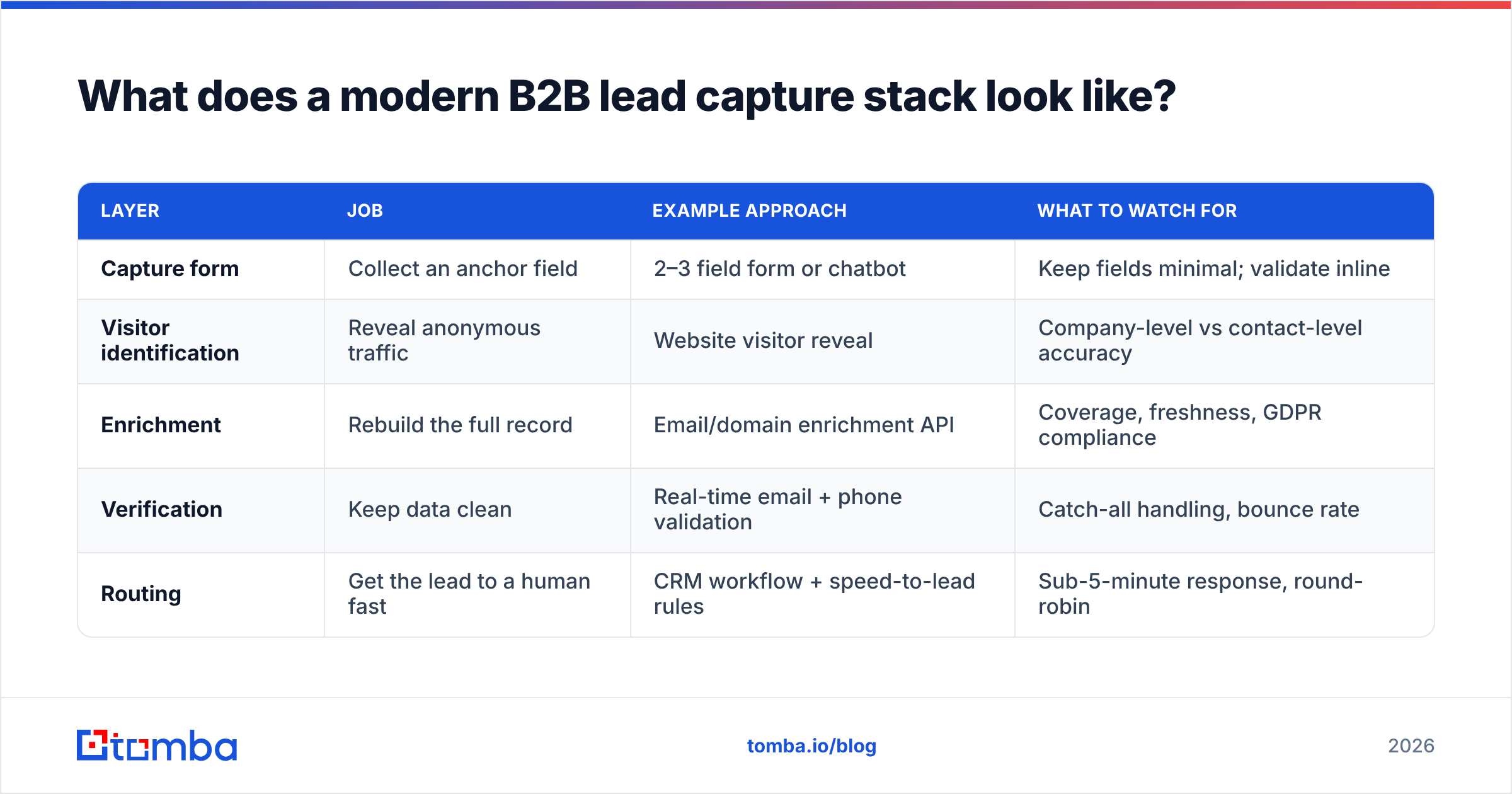
| Layer | Job | Example approach | What to watch for |
|---|---|---|---|
| Capture form | Collect an anchor field | 2–3 field form or chatbot | Keep fields minimal; validate inline |
| Visitor identification | Reveal anonymous traffic | Website visitor reveal | Company-level vs contact-level accuracy |
| Enrichment | Rebuild the full record | Email/domain enrichment API | Coverage, freshness, GDPR compliance |
| Verification | Keep data clean | Real-time email + phone validation | Catch-all handling, bounce rate |
| Routing | Get the lead to a human fast | CRM workflow + speed-to-lead rules | Sub-5-minute response, round-robin |
The connective tissue is your CRM and an automation layer. Tools like a Zapier integration or a direct HubSpot integration let a captured email flow into enrichment, get verified, and land as a fully populated contact assigned to the right rep — all in seconds and without manual data entry.
)
Which B2B lead capture tools should you compare?#
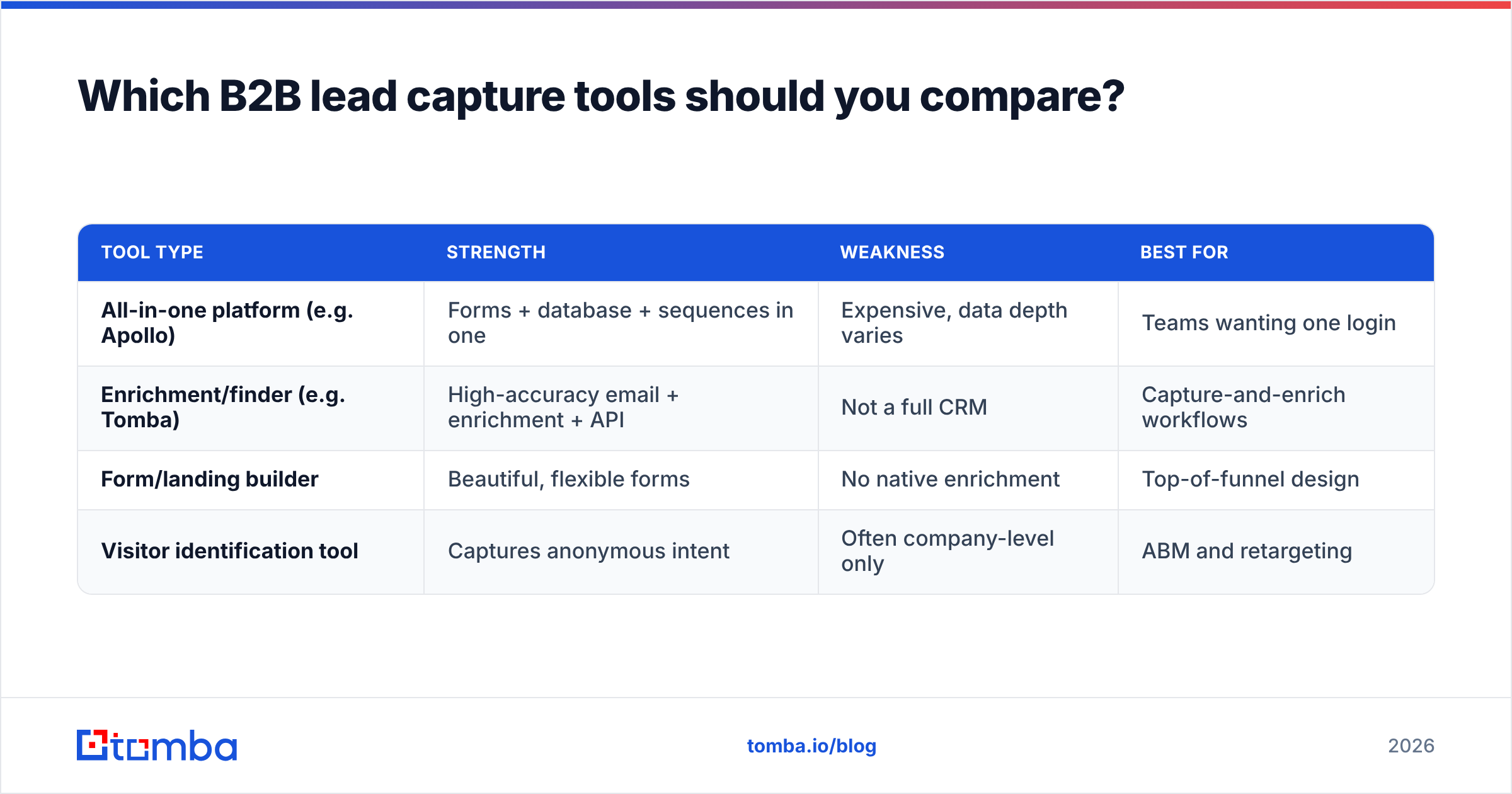
The market splits into three rough categories: all-in-one sales platforms, dedicated enrichment and finder tools, and form/landing builders. Here's how the trade-offs shake out for capture specifically.
| Tool type | Strength | Weakness | Best for |
|---|---|---|---|
| All-in-one platform (e.g. Apollo) | Forms + database + sequences in one | Expensive, data depth varies | Teams wanting one login |
| Enrichment/finder (e.g. Tomba) | High-accuracy email + enrichment + API | Not a full CRM | Capture-and-enrich workflows |
| Form/landing builder | Beautiful, flexible forms | No native enrichment | Top-of-funnel design |
| Visitor identification tool | Captures anonymous intent | Often company-level only | ABM and retargeting |
If your bottleneck is "we get form fills but the data is thin and slow to action," an enrichment-first tool is the highest-leverage addition. If your bottleneck is "we get traffic but no fills," a visitor identification layer or a website visitor reveal tool addresses the anonymous gap. Many teams evaluating a broader platform also look at focused Apollo alternatives when they only need the data layer, not the entire sales-engagement suite.
For pricing context, Tomba runs a free tier with 25 searches a month, then Starter at $49/mo, Growth at $99/mo, and Pro at $249/mo — you can see the full breakdown on the Tomba pricing page. The point isn't that cheaper is better; it's that you should pay for the layer you're actually missing rather than buying a platform to use 10% of it.
How do you qualify and route captured leads?#
Capture without qualification just fills your CRM with noise. Once a lead is captured and enriched, you need two fast decisions: is this a fit, and who gets it?
Fit usually comes down to firmographics you now have thanks to enrichment — company size, industry, role seniority — scored against your ideal customer profile. A captured lead from a 5,000-person target-industry company with a VP title should jump the queue. A solo freelancer on a free email might go to a nurture track instead. Because enrichment supplied those firmographic fields automatically, your scoring model has real inputs instead of blank columns.
Routing is where speed-to-lead lives. The single highest-ROI change most teams can make is shortening the time between capture and first human contact. That means automated round-robin assignment, instant Slack or CRM alerts, and pre-loaded context so the rep isn't researching from scratch. When the lead record already contains a verified phone number and LinkedIn profile, the rep can reach out on the channel the prospect actually answers — within minutes, not days.
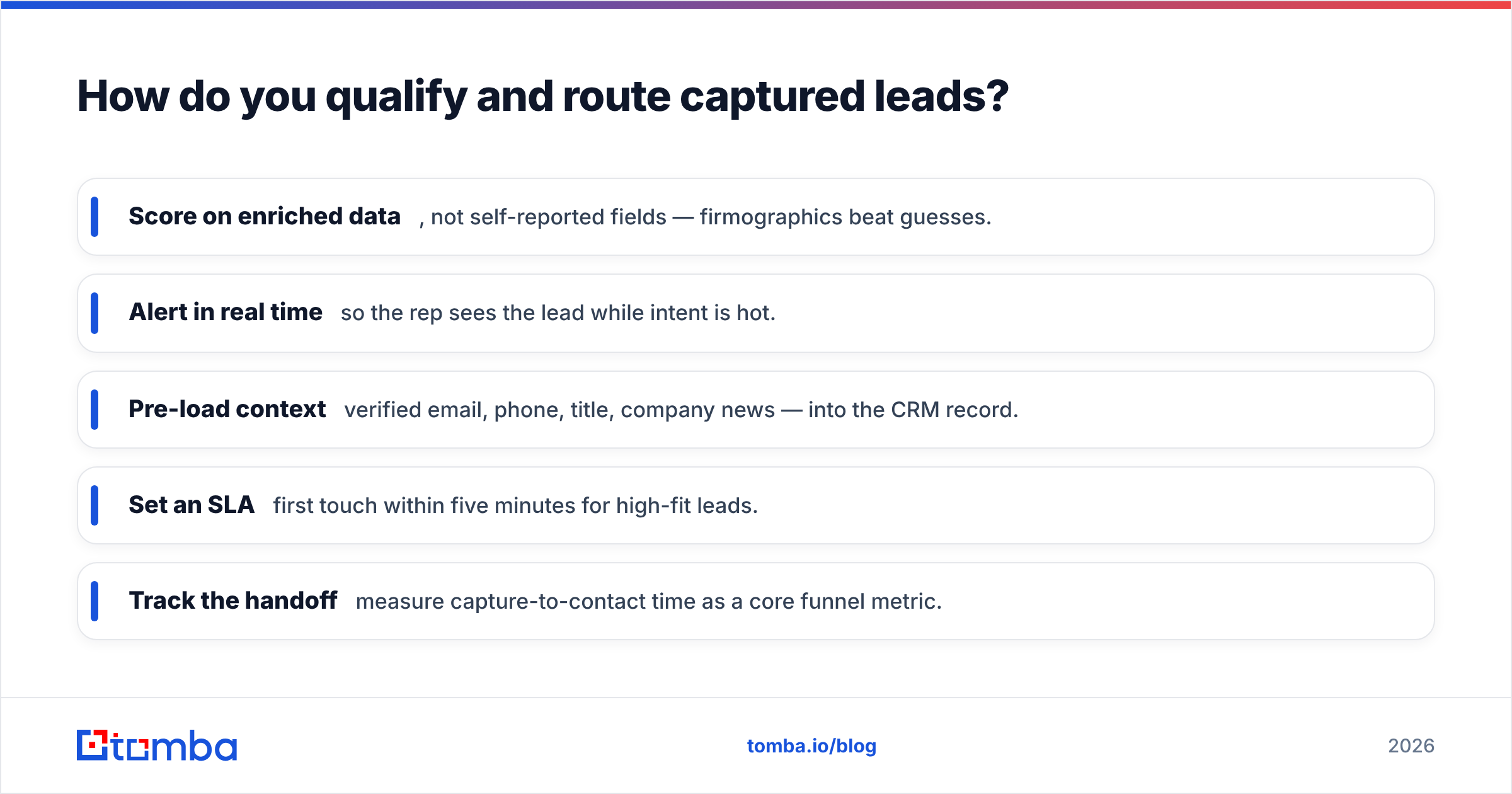
A practical routing checklist:
- Score on enriched data, not self-reported fields — firmographics beat guesses.
- Alert in real time so the rep sees the lead while intent is hot.
- Pre-load context — verified email, phone, title, company news — into the CRM record.
- Set an SLA — first touch within five minutes for high-fit leads.
- Track the handoff — measure capture-to-contact time as a core funnel metric.
What are the most common B2B lead capture mistakes?#
The mistakes are predictable, which means they're fixable.
Asking for too much. Eleven-field forms feel thorough and convert terribly. Cut to the bone and enrich the rest. If a field doesn't change who you route the lead to or whether you'll mail them, it doesn't belong on the form.
Never validating. Letting unverified emails into the CRM guarantees bounces, hurts your sender reputation, and wastes rep time. Validate at capture, every time.
Ignoring anonymous traffic. If 97% of visitors leave without filling anything out and you do nothing about it, you're walking past most of your pipeline. Visitor identification turns some of that anonymous intent into capturable accounts.
Slow follow-up. A perfectly captured, enriched lead that sits in a queue for two days is a wasted lead. Speed-to-lead is the cheapest conversion lever you have.
No deduplication. The same prospect fills out two forms and now you have two records, two reps, and an awkward call. Run lists through a dedupe step and keep one clean source of truth.
How does enrichment fit into B2B lead capture?#
Enrichment is the multiplier that makes low-friction capture possible. It's the difference between a one-field form that gives you a complete contact and a one-field form that gives you almost nothing.
The mechanics are straightforward. A visitor submits a work email. Your system passes that email to an enrichment service, which returns the associated name, title, company, company size, industry, social profiles, and often a direct phone. Some tools work the other direction too — a reverse email lookup takes an address you already have and surfaces the person behind it, useful for cleaning up legacy lists or identifying who actually filled out an old form.
You can also flip the anchor entirely. With domain search, you start from a company website and pull the relevant contacts and email patterns at that organization — handy when a lead gives you a company name but not a personal email, or when you want to find the right buyer at an account that just showed intent. For high-volume scenarios, a bulk email finder processes entire lists at once instead of one record at a time.
The strategic upshot: enrichment lets you design your capture experience around the prospect's convenience instead of your data team's wishlist. You ask for the one thing they'll happily give, and you reconstruct everything else. That's how you raise conversion and data quality at the same time — two metrics that usually pull against each other.
For deeper background on the discipline, G2's lead capture software category is a useful neutral reference for comparing form-first tools, and HubSpot's lead generation guide covers the broader funnel context.
Start capturing better-qualified B2B leads#
The throughline of every section above is the same: capture less from the human, rebuild more from the data. Short forms, instant verification, and real-time enrichment let you raise conversion rates and CRM quality together instead of trading one for the other.
If your capture process is leaking — thin records, dirty emails, slow handoffs — the fastest fix is adding an enrichment-and-verification layer at the point of entry. The Tomba Email Finder turns a single work email or company domain into a complete, verified, sales-ready contact, and the Tomba API drops that capability straight into your existing forms and CRM workflow. Start on the free tier, wire it into one high-traffic form, and measure the lift in qualified leads. Capture more, leak less.
// get started
Find, verify and enrich your first contacts today
Start on the free plan with 25 searches a month, then scale when your team is ready.
Free plan · No credit card required · GDPR & CCPA
// about the author