B2B Lead Conversion: The 2026 Playbook to Close More Deals
Most B2B teams obsess over lead volume and ignore the leaks that quietly kill conversion. Here is the 2026 playbook for turning qualified leads into real revenue.
B2B lead conversion is the percentage of qualified leads that turn into paying customers — and in 2026 it is decided more by data quality and follow-up speed than by how many leads you pour in at the top. If your pipeline feels busy but revenue is flat, the problem is almost never volume. It is the leaks between stages.
TL;DR#
- Conversion is a stage problem, not a volume problem. Most B2B teams lose deals at the lead-to-MQL and MQL-to-SQL handoffs, not at the close.
- Bad contact data is the silent killer. Bounced emails and wrong numbers can wipe out 20–40% of your usable pipeline before a rep ever talks to a buyer.
- Speed-to-lead compounds. Responding within 5 minutes can lift conversion several times over a 30-minute reply.
- Scoring keeps reps on the right deals. A simple, transparent lead score beats a black-box model nobody trusts.
- Verified data + fast, relevant follow-up is the whole game. Tools like the Tomba Email Finder feed clean contacts into that motion.
What is B2B lead conversion (and what is it not)?#
B2B lead conversion is the rate at which prospects move from one stage of your funnel to the next, all the way to a closed deal. Think of your funnel like a series of buckets stacked on top of each other. Water (leads) pours in at the top, but every bucket has small holes. Conversion rate measures how much water reaches the bottom bucket — revenue — instead of leaking out the sides.
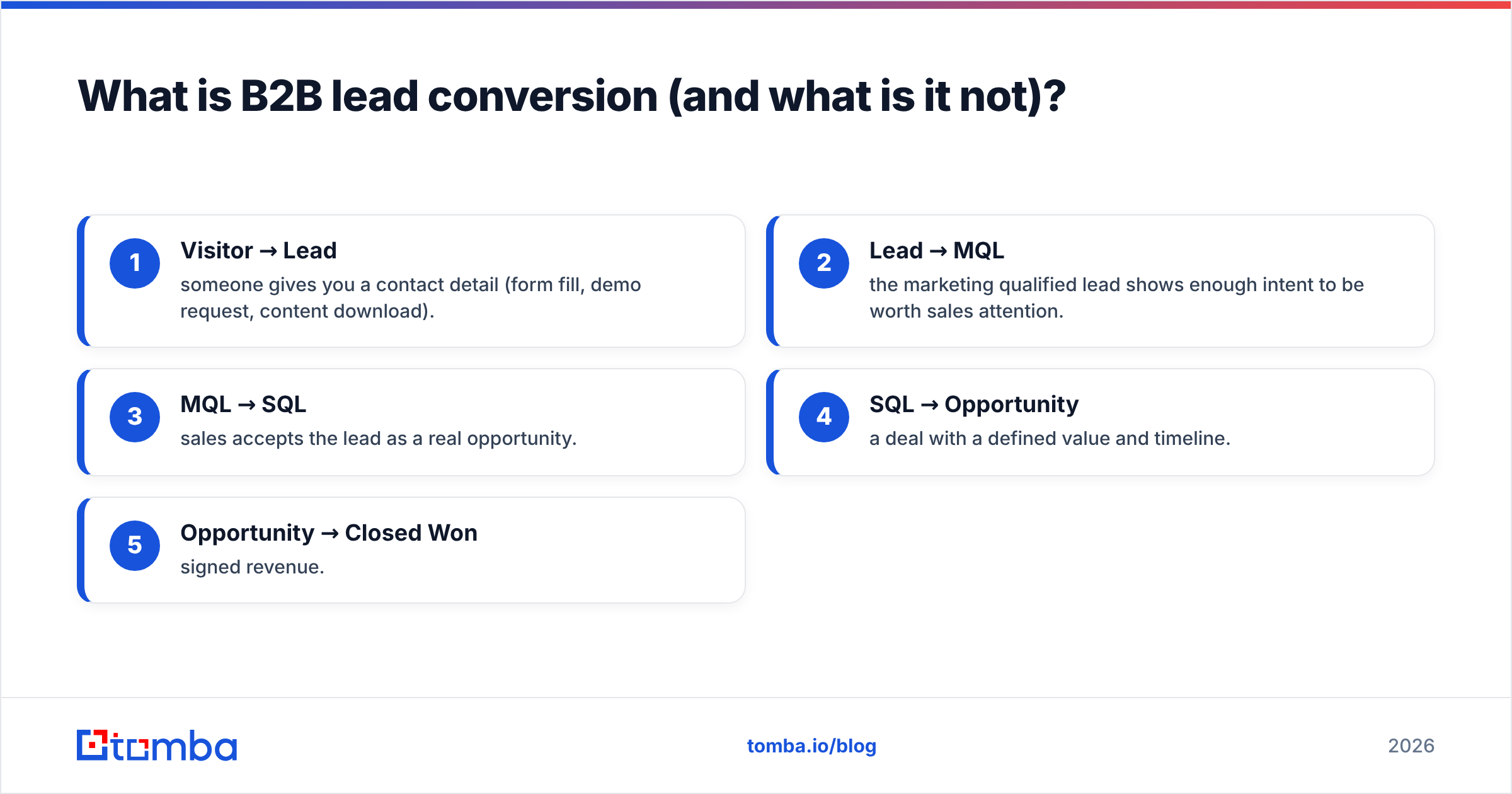
The mistake teams make is treating "conversion rate" as a single number. In reality you have several conversion points, and each one has its own leak:
- Visitor → Lead — someone gives you a contact detail (form fill, demo request, content download).
- Lead → MQL — the marketing qualified lead shows enough intent to be worth sales attention.
- MQL → SQL — sales accepts the lead as a real opportunity.
- SQL → Opportunity — a deal with a defined value and timeline.
- Opportunity → Closed Won — signed revenue.
A team obsessed with the top of the funnel buys more traffic and more lists. A team that understands conversion fixes the bucket with the biggest hole first. Usually that hole is the lead-to-MQL or MQL-to-SQL handoff — where stale data and slow follow-up quietly destroy good intent.
What are good B2B lead conversion benchmarks in 2026?#
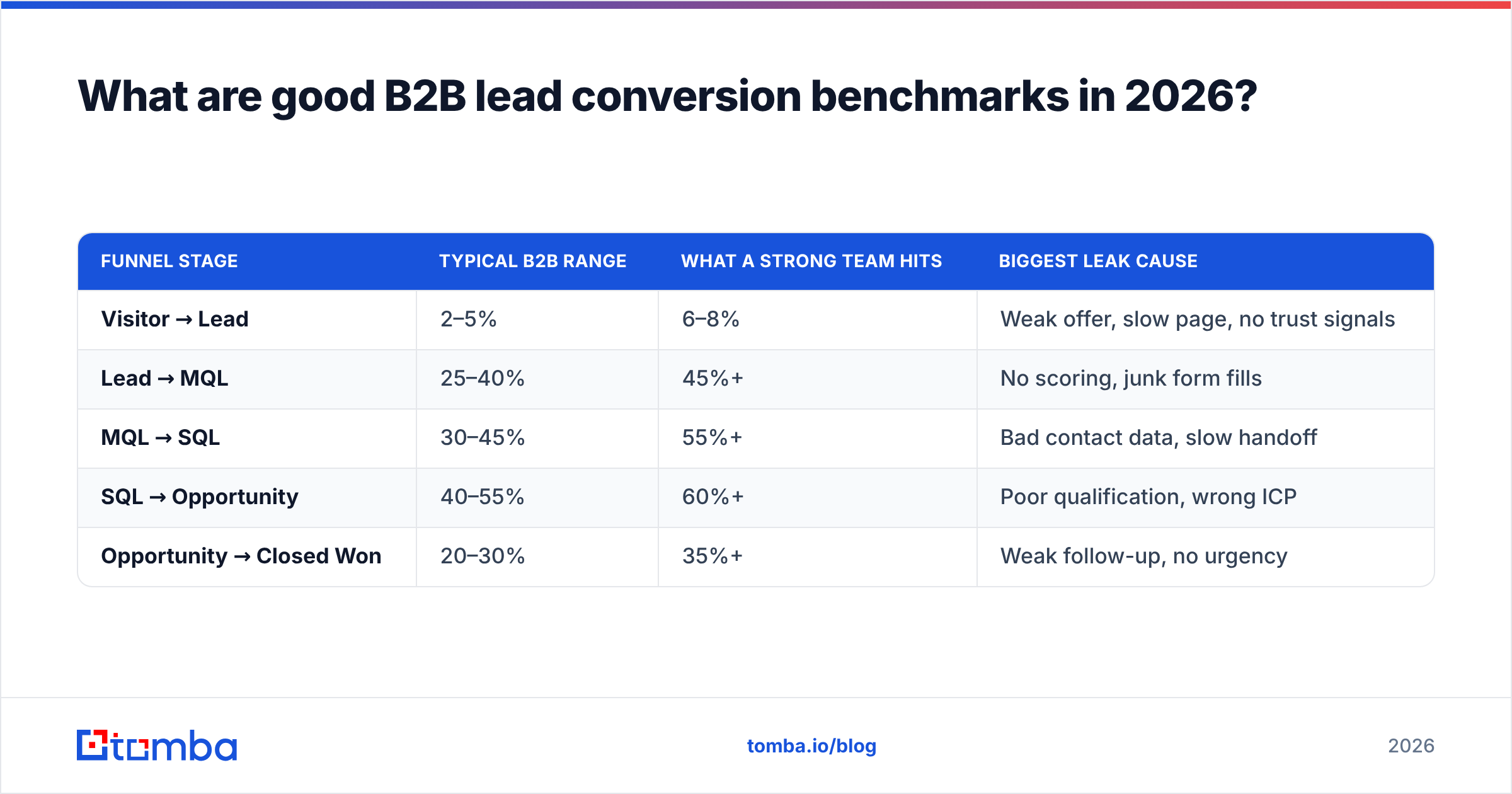
Benchmarks vary wildly by industry, deal size, and channel, so treat these as orientation rather than targets. The point is to find your weakest stage, not to hit an average.
| Funnel stage | Typical B2B range | What a strong team hits | Biggest leak cause |
|---|---|---|---|
| Visitor → Lead | 2–5% | 6–8% | Weak offer, slow page, no trust signals |
| Lead → MQL | 25–40% | 45%+ | No scoring, junk form fills |
| MQL → SQL | 30–45% | 55%+ | Bad contact data, slow handoff |
| SQL → Opportunity | 40–55% | 60%+ | Poor qualification, wrong ICP |
| Opportunity → Closed Won | 20–30% | 35%+ | Weak follow-up, no urgency |
Two numbers matter more than any single conversion rate. The first is your overall lead-to-customer rate — multiply the stages together and you see how much of the top actually reaches the bottom. The second is your win rate on accepted opportunities, which tells you whether sales is working the right deals. If your win rate is healthy but your MQL-to-SQL rate is awful, your marketing is sending noise. If both are weak, start with data and qualification before you touch messaging.
Why does bad data destroy B2B lead conversion?#
Bad contact data is the most underrated conversion killer in B2B. According to HubSpot research on database decay, B2B data goes stale at roughly 22–30% per year as people change jobs, companies get acquired, and email formats change. That decay does not just sit in your CRM quietly — it actively burns conversion in three ways:
- Wasted rep hours. A rep working a list that is 30% wrong spends a third of their prospecting time on dead contacts. That is time not spent on real buyers.
- Deliverability damage. High bounce rates hurt your sender reputation, which means even your good emails start landing in spam. One bad list can poison the channel for months.
- False pipeline. Leads that look real but have unreachable contacts inflate your MQL count and hide the true conversion problem.
The fix is boring but decisive: verify before you act. Run new contacts through an email verifier before they enter a sequence, and use a catch-all verifier for the domains that block standard SMTP checks. Clean data is not a nice-to-have — it is the foundation every other conversion tactic sits on. You cannot out-message a list of bounces.
How does lead scoring improve conversion?#
Lead scoring improves conversion by pointing rep time at the deals most likely to close. The everyday analogy: it is a triage nurse in an ER. Not every patient needs surgery first, and not every lead needs a call today. Scoring sorts the urgent from the merely interested so your best resource — rep attention — goes where it converts.
A workable B2B score blends two dimensions:
- Fit (who they are): title, company size, industry, and ICP match. A VP of Engineering at a 500-person SaaS company scores higher than a student using a free email.
- Behavior (what they did): pricing-page visits, demo requests, repeat sessions, email replies. Intent signals weighted by how close they sit to a buying decision.
Keep the model transparent. A 100-point score where reps can see exactly why a lead is hot will be trusted and used. A black-box AI score nobody understands gets ignored, and an ignored model is worse than no model. Start simple, watch which scored leads actually convert, and tune the weights every quarter. You can read more on the mechanics in our overview of lead management and scoring workflows, then layer automation on top once the manual version proves out.
Does speed-to-lead really matter that much?#
Yes — speed-to-lead is one of the highest-leverage conversion levers in B2B, and most teams are far too slow. The classic Lead Response Management study (widely cited by Salesforce and others) found that contacting a web lead within 5 minutes makes you dramatically more likely to qualify it than waiting 30 minutes, and the odds collapse further by the hour.
The reason is human, not technical. A buyer who just filled out a form is at peak intent. Their problem is top of mind, your brand is fresh, and a competitor has not called yet. Wait a day and that window closes — they have moved on, gone cold, or booked a demo with whoever answered first.

To win on speed without burning out your team:
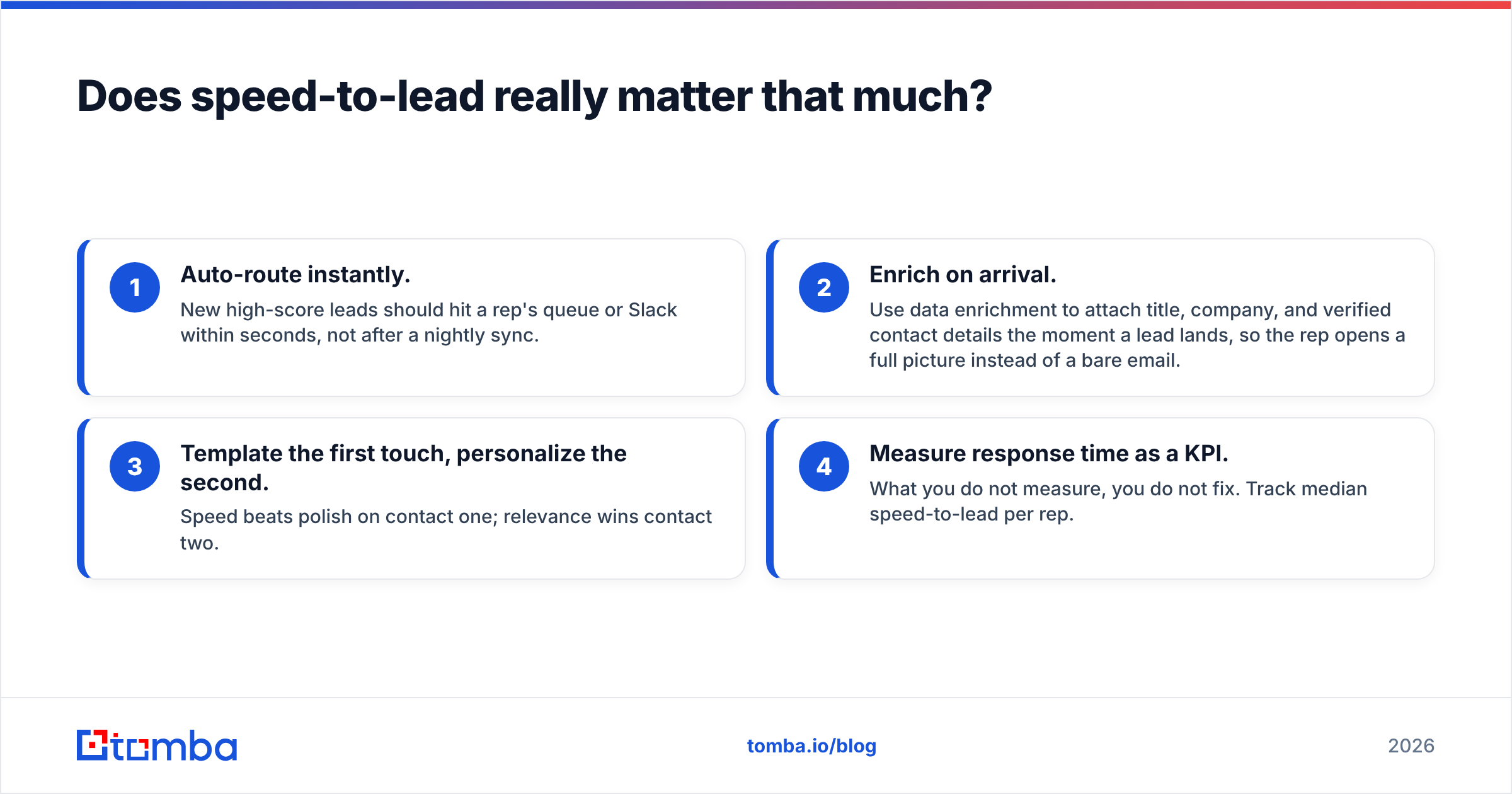
- Auto-route instantly. New high-score leads should hit a rep's queue or Slack within seconds, not after a nightly sync.
- Enrich on arrival. Use data enrichment to attach title, company, and verified contact details the moment a lead lands, so the rep opens a full picture instead of a bare email.
- Template the first touch, personalize the second. Speed beats polish on contact one; relevance wins contact two.
- Measure response time as a KPI. What you do not measure, you do not fix. Track median speed-to-lead per rep.
How do you build a B2B lead conversion process that holds?#
A durable conversion process is a loop, not a funnel you fill and forget. Here is the spine of it, in order:
- Define your ICP precisely. Conversion starts with not chasing the wrong leads. The tighter your ideal-customer profile, the higher every downstream rate climbs.
- Source clean contacts. Build target lists from a real B2B database or by running domain search against companies that fit your ICP, then verify before outreach.
- Score and route. Apply fit-plus-behavior scoring and push hot leads to reps instantly.
- Follow up relentlessly and relevantly. Most B2B deals need 5–8 touches across email, phone, and LinkedIn. Track your response rate by sequence and cut what does not work.
- Qualify hard, then commit. Use a consistent framework (BANT, MEDDIC, whatever fits) so SQLs are real opportunities, not hopeful guesses.
- Review the leaks monthly. Pull stage-by-stage rates, find the biggest drop, and run one experiment against it.
The teams that win at this are not running exotic tactics. They are running an unglamorous, well-instrumented loop on top of clean data. Everything compounds: better data lifts speed-to-lead, faster follow-up lifts MQL-to-SQL, tighter qualification lifts win rate. Fix the inputs and the output takes care of itself.
What tools actually move B2B lead conversion?#
You do not need a 15-tool stack. You need reliable contact data, fast routing, and a way to measure each stage. The non-negotiable layer is accurate contact data — because every other tool downstream multiplies whatever quality you feed it. Garbage in, garbage converted.
That is where a focused email-finding and verification layer earns its place. Instead of buying a bloated all-in-one and paying for seats nobody uses, you can plug a precise data source into the CRM and sequencer you already run. Check the Tomba pricing tiers — Free (25 searches/mo), Starter at $49/mo, Growth at $99/mo, and Pro at $249/mo — against what an enrichment add-on costs inside a big platform, and the focused approach usually wins on both accuracy and price. For a deeper feature view, the Apollo alternative breakdown compares data-first stacks against suite tools.
Close the leaks before you buy more leads#
If you take one thing from this: stop pouring more water into a leaky bucket. Audit your funnel stage by stage, find the worst conversion drop, and fix the input behind it — which, nine times out of ten, is contact-data quality and follow-up speed.
Start at the foundation. Feed your pipeline verified, ICP-matched contacts so your reps spend their hours on buyers who can actually reply and buy. The Tomba Email Finder gives you accurate professional emails by name, company, or domain, with built-in verification so bounces never reach your sequencer. Wire it into your CRM, route hot leads in seconds, and watch every downstream conversion rate climb. Better data is the cheapest conversion lift you will ever buy — fix that first, then scale the volume.
// get started
Find, verify and enrich your first contacts today
Start on the free plan with 25 searches a month, then scale when your team is ready.
Free plan · No credit card required · GDPR & CCPA
// about the author