B2B Lead Generation in 2026: The Complete Playbook
A practical 2026 guide to B2B lead generation: channels that still convert, the math behind pipeline, and how to build a lead engine that doesn't rely on bought lists.
TL;DR
- B2B lead generation in 2026 is about building a repeatable engine, not chasing one-off campaigns or bought lists that bounce and burn your domain.
- The channels that still convert: targeted outbound, content-led inbound, intent data, referrals, and partner co-marketing — ranked by cost-per-qualified-lead below.
- Quality beats volume. A verified, enriched list of 500 right-fit contacts outperforms 50,000 scraped emails every quarter.
- Your tooling stack matters: an accurate email finder, a verifier, and enrichment are the difference between a 2% and an 8% reply rate.
- Use the pipeline math in this post to reverse-engineer how many leads you actually need to hit revenue.
What is B2B lead generation?#
B2B lead generation is the process of identifying companies and people who fit your ideal customer profile (ICP), capturing their contact details, and moving them toward a buying conversation. Think of it like fishing with a sonar instead of a net: you're not scooping up everything in the water, you're locating the specific fish that match what you sell and casting deliberately.
Technically, it spans three stages — sourcing (finding accounts and contacts), qualifying (scoring them against your ICP and intent signals), and activating (the first outreach that earns a reply). Most teams obsess over the third stage and neglect the first two, which is exactly why their reply rates stall.
The shift in 2026 is that buyers are harder to reach and more allergic to spray-and-pray. According to HubSpot's research on sales trends, the highest-performing teams concentrate effort on fewer, better-fit accounts. That makes data accuracy the foundation of everything else.
Why do most B2B lead generation efforts fail?#
They fail for three predictable reasons, and none of them are "we didn't send enough emails."
- Bad data at the source. If 30% of your list bounces, you're not just wasting sends — you're training inbox providers to flag your domain. Bounce rates above 3% directly damage email deliverability and sender reputation.
- No ICP discipline. Generic targeting produces generic results. "Any SaaS company" is not an ICP; "Series A-B HR-tech companies with 50-200 employees using Workday" is.
- Volume over relevance. Sending 10,000 identical emails feels productive. It isn't. One relevant message to a researched account beats a hundred templated ones.
Fixing the data layer first is the cheapest, highest-leverage move you can make. That's why so much of this guide focuses on sourcing accurate contacts before you write a single line of copy.
Which B2B lead generation channels actually work in 2026?#
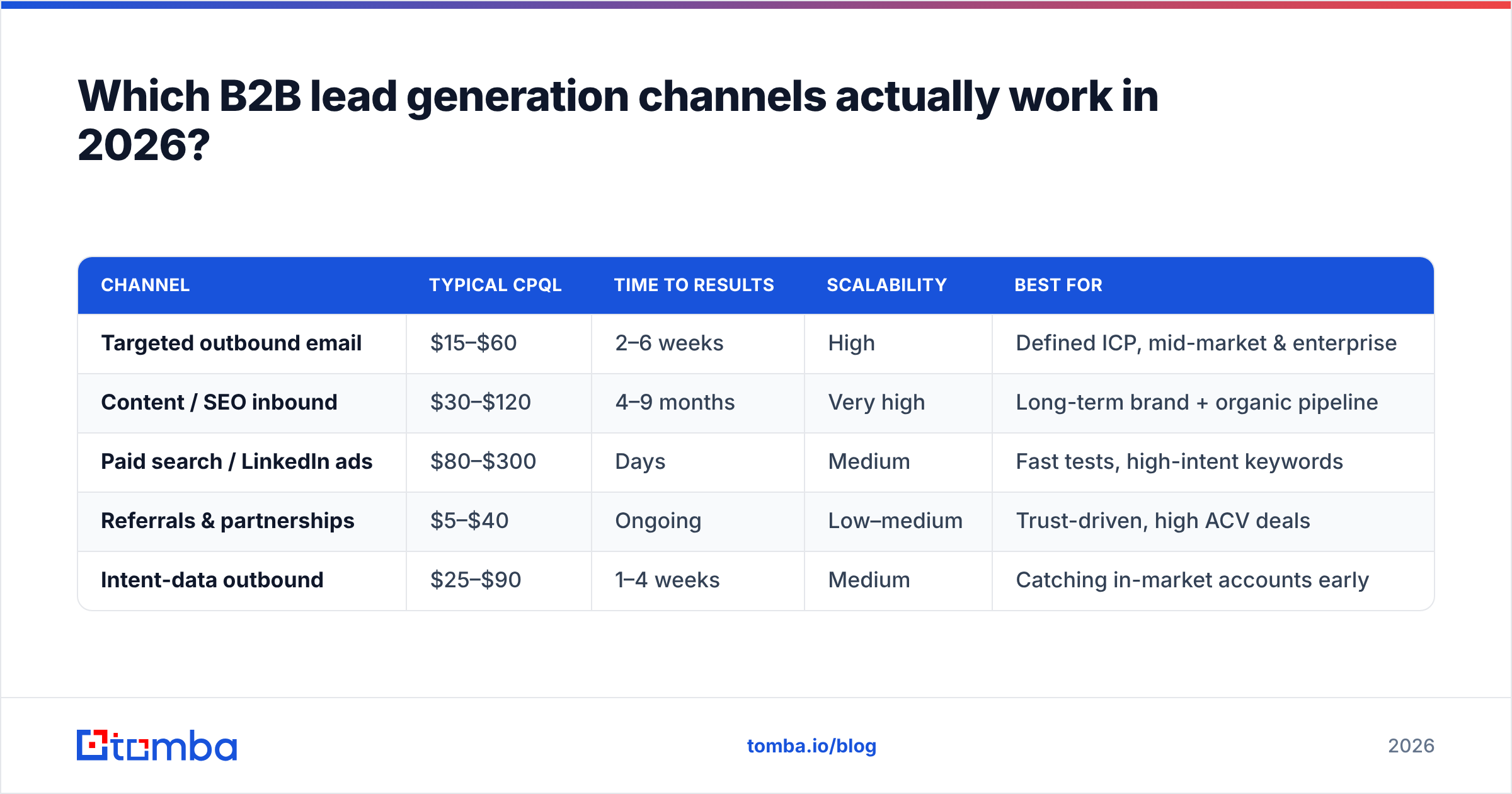
Here's an honest comparison of the major channels, ranked by typical cost-per-qualified-lead (CPQL) and effort. Numbers are directional industry ranges, not guarantees — your mileage varies by market.
| Channel | Typical CPQL | Time to results | Scalability | Best for |
|---|---|---|---|---|
| Targeted outbound email | $15–$60 | 2–6 weeks | High | Defined ICP, mid-market & enterprise |
| Content / SEO inbound | $30–$120 | 4–9 months | Very high | Long-term brand + organic pipeline |
| Paid search / LinkedIn ads | $80–$300 | Days | Medium | Fast tests, high-intent keywords |
| Referrals & partnerships | $5–$40 | Ongoing | Low–medium | Trust-driven, high ACV deals |
| Intent-data outbound | $25–$90 | 1–4 weeks | Medium | Catching in-market accounts early |
The pattern is clear: outbound and referrals win on cost, inbound wins on compounding scale. Most strong programs run outbound for near-term pipeline while building inbound for the long game. You don't pick one — you sequence them.
Outbound deserves special attention because it's the fastest lever you control directly. And outbound lives or dies on contact data. This is where a reliable email finder and data enrichment stop being "nice to have" and become the engine itself.
How do you build a B2B lead generation engine step by step?#
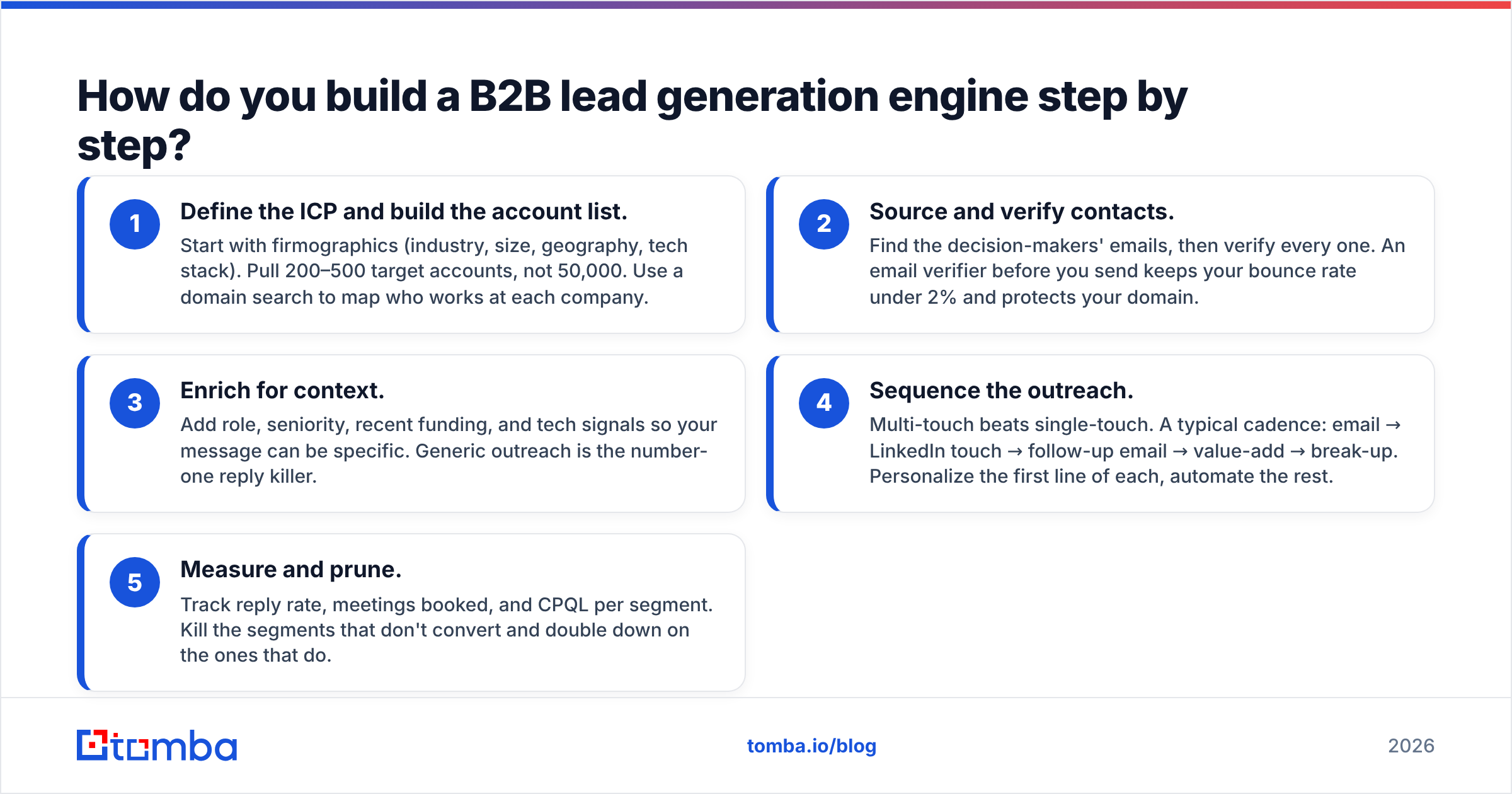
An engine is a repeatable sequence you can run every week without reinventing it. Here's the build order that works.
- Define the ICP and build the account list. Start with firmographics (industry, size, geography, tech stack). Pull 200–500 target accounts, not 50,000. Use a domain search to map who works at each company.
- Source and verify contacts. Find the decision-makers' emails, then verify every one. An email verifier before you send keeps your bounce rate under 2% and protects your domain.
- Enrich for context. Add role, seniority, recent funding, and tech signals so your message can be specific. Generic outreach is the number-one reply killer.
- Sequence the outreach. Multi-touch beats single-touch. A typical cadence: email → LinkedIn touch → follow-up email → value-add → break-up. Personalize the first line of each, automate the rest.
- Measure and prune. Track reply rate, meetings booked, and CPQL per segment. Kill the segments that don't convert and double down on the ones that do.
The discipline here is doing step 2 before step 4. Teams that skip verification to "move faster" end up rebuilding their domain reputation for months.
How many leads do you actually need? (The pipeline math)#
Most teams set lead targets by guessing. Don't. Reverse-engineer from revenue.
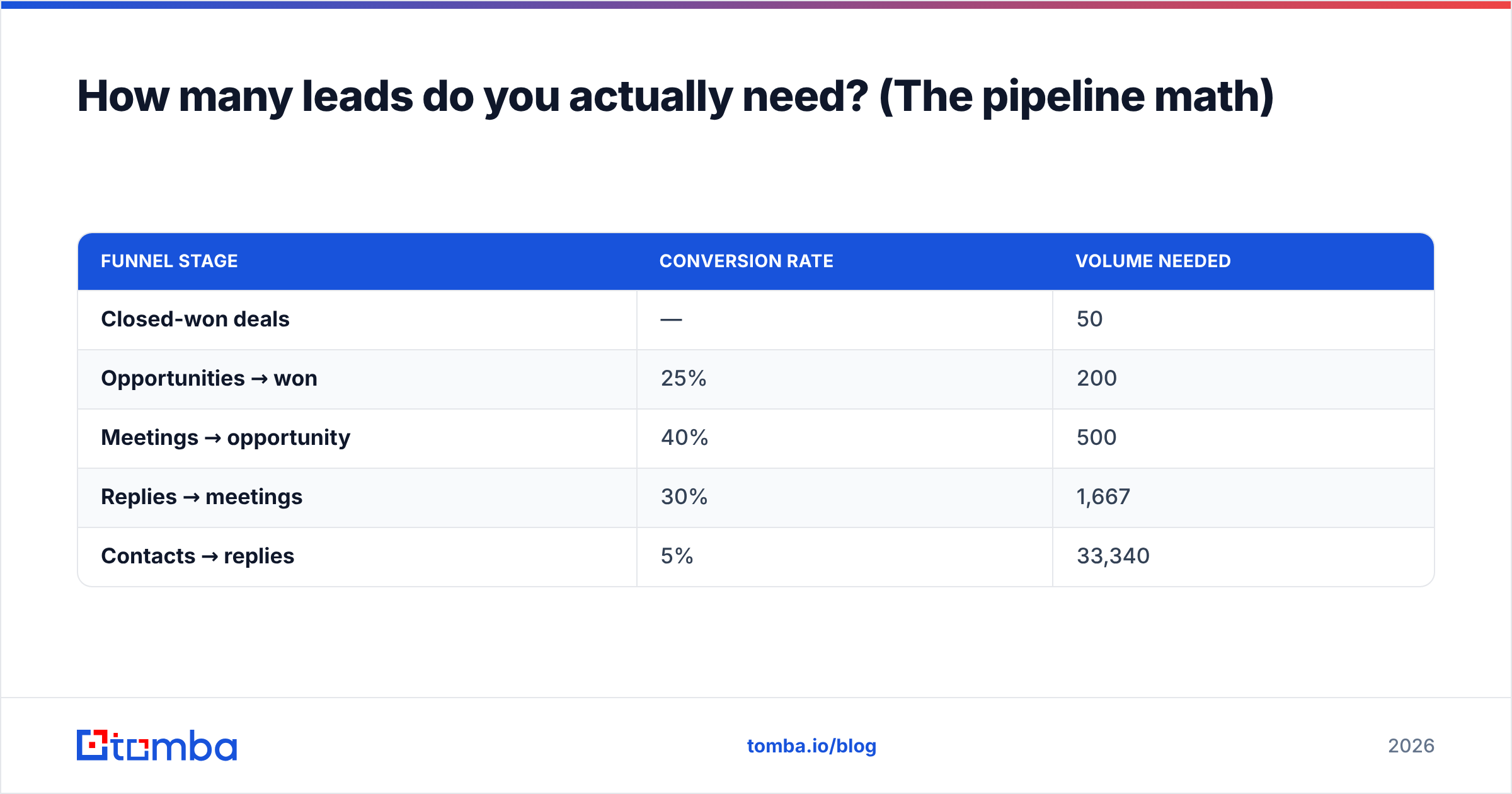
Say you need $1,000,000 in new bookings this quarter and your average deal is $20,000. That's 50 closed deals. Walk it backward through your conversion rates:
| Funnel stage | Conversion rate | Volume needed |
|---|---|---|
| Closed-won deals | — | 50 |
| Opportunities → won | 25% | 200 |
| Meetings → opportunity | 40% | 500 |
| Replies → meetings | 30% | 1,667 |
| Contacts → replies | 5% | 33,340 |
So to close 50 deals you need roughly 33,000 verified, well-targeted contacts at a 5% reply rate — or far fewer if you raise reply rates with better data and personalization. Bump that reply rate from 5% to 8% and you cut the required contact volume by nearly 40%. That single number is why data quality is the highest-leverage variable in the whole funnel.
This is also the argument against bought lists: a cheap list with a 1% reply rate forces you to source five times the volume and torch your deliverability doing it.
What tools do you need for B2B lead generation?#
You need fewer tools than vendors want you to believe. The non-negotiables:
- An email finder — to turn names and domains into verified contact emails. Look for accuracy above 95% and bulk support.
- An email verifier — to scrub lists before sending, including a catch-all verifier for tricky domains.
- Enrichment — to add the context that makes personalization possible.
- A sequencer / CRM — to run cadences and track conversion.
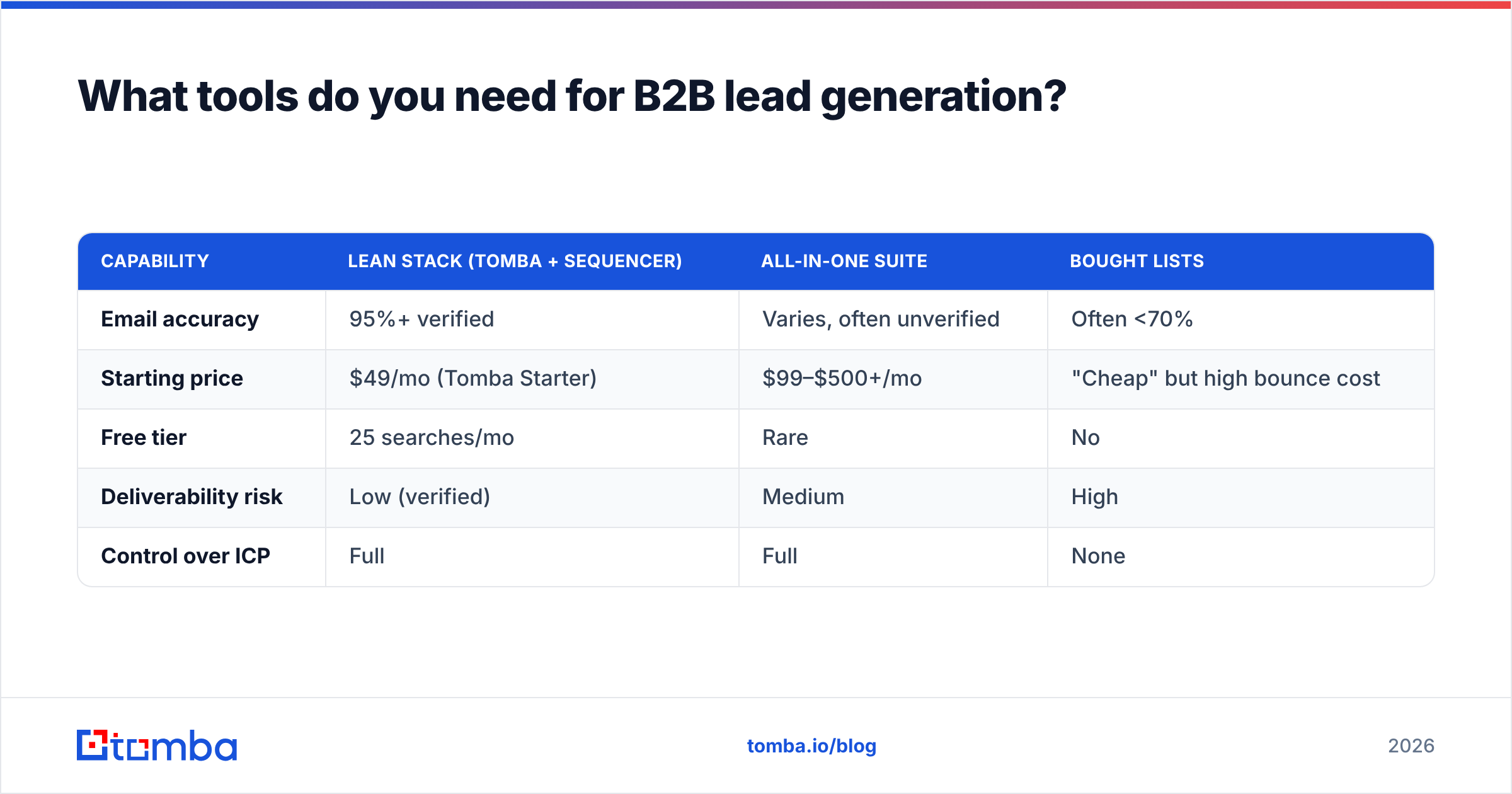
Here's how a focused stack compares to the "buy everything" approach:
| Capability | Lean stack (Tomba + sequencer) | All-in-one suite | Bought lists |
|---|---|---|---|
| Email accuracy | 95%+ verified | Varies, often unverified | Often <70% |
| Starting price | $49/mo (Tomba Starter) | $99–$500+/mo | "Cheap" but high bounce cost |
| Free tier | 25 searches/mo | Rare | No |
| Deliverability risk | Low (verified) | Medium | High |
| Control over ICP | Full | Full | None |
For most teams under 50 reps, the lean stack wins on cost and control. Tomba's pricing runs from a free tier (25 searches/month) through Starter at $49/mo, Growth at $99/mo, and Pro at $249/mo — so you can scale spend with pipeline rather than paying enterprise rates on day one. You can validate vendor claims on independent sites like G2 before committing.
For high-volume sourcing, a bulk email finder lets you process whole account lists at once instead of one contact at a time, and the Tomba API wires the whole thing into your existing workflow.
How do you keep lead quality high as you scale?#
Scaling is where quality usually collapses. Three guardrails keep it from happening:
- Verify on a schedule, not just at import. Contact data decays roughly 2–3% per month as people change jobs. Re-verify active lists quarterly.
- Segment before you send. Never blast one message to everyone. Group by role and trigger, then write to each group.
- Watch leading indicators, not just closed deals. Bounce rate, spam complaints, and reply sentiment tell you about a problem weeks before it shows up in revenue.
Gartner's research on buyer behavior, summarized across its B2B sales insights, consistently shows that buyers reward relevance and punish noise. The teams that scale cleanly treat every send as if their domain reputation depends on it — because it does.
What's the biggest mistake to avoid?#
Treating lead generation as a one-time campaign instead of a system. A campaign ends; an engine compounds. The teams winning in 2026 build the sourcing-verification-enrichment loop once, then run it every single week, pruning and improving as they go.
The second biggest mistake is starting with copy. Your subject line cannot save a list that bounces 30% of the time. Fix the data layer first, and your existing copy will suddenly look like it got better overnight.
Where should you start this week?#
Pick one ICP. Build a list of 200 right-fit accounts. Find and verify the decision-maker at each. Send a researched, specific sequence. Measure the reply rate. That's a complete engine in miniature — and it's the fastest way to learn what actually converts in your market before you scale spend.
The foundation of all of it is accurate contact data. The Tomba Email Finder turns your target account list into verified, ready-to-contact emails — with a free tier to start, 95%+ accuracy, and bulk and API options when you're ready to grow. Build your list right the first time, protect your domain, and let the pipeline math work in your favor.
Ready to find emails that actually work?
Join 150,000+ professionals who stopped guessing and started sending. Free credits on signup — no credit card required.
Get the Tomba newsletter
Practical outbound tactics and product updates — once every two weeks.
About the author