B2B Lead Generation Best Practices: 12 Tactics for 2026
A field-tested 2026 playbook of B2B lead generation best practices — from ICP definition to data hygiene, multi-channel outreach, and the metrics that actually predict pipeline.
B2B lead generation in 2026 is not about volume anymore. It is about precision: reaching the right accounts, with the right message, using data clean enough to actually get delivered. The teams winning right now have quietly stopped buying giant lists and started engineering a repeatable system.
This guide breaks that system into 12 concrete best practices you can apply this quarter — no fluff, no "synergy."
TL;DR#
- Define a sharp ICP first. Every other tactic gets cheaper and more accurate once you know exactly who you sell to.
- Source clean, verified data. Bounce rates above 3% wreck deliverability and burn your domain — verification is non-negotiable.
- Go multi-channel. Email plus LinkedIn plus phone beats any single channel by a wide margin in reply rate.
- Score and route leads fast. Speed-to-lead under 5 minutes can multiply conversion rates several times over.
- Measure pipeline, not vanity metrics. Track cost per qualified opportunity, not raw lead counts.
What is B2B lead generation in 2026?#
B2B lead generation is the process of identifying companies and decision-makers who fit your ideal customer profile, capturing their interest, and moving them into your sales pipeline. Think of it like fishing: you can drag a net across the whole ocean and catch mostly junk, or you can learn where your specific fish feed and cast precisely. Modern lead gen is all about the second approach.
The shift over the last few years has been from quantity to fit. Inbox providers got stricter, buyers got more skeptical, and AI made generic outreach trivial to spot. As a result, the best practices that matter now cluster around three pillars:
- Targeting — a documented ICP and buying-committee map so you stop wasting effort on poor-fit accounts.
- Data quality — accurate, verified contact data that protects your sender reputation and your team's time.
- Orchestration — coordinated, multi-channel sequences that respect how buyers actually research.
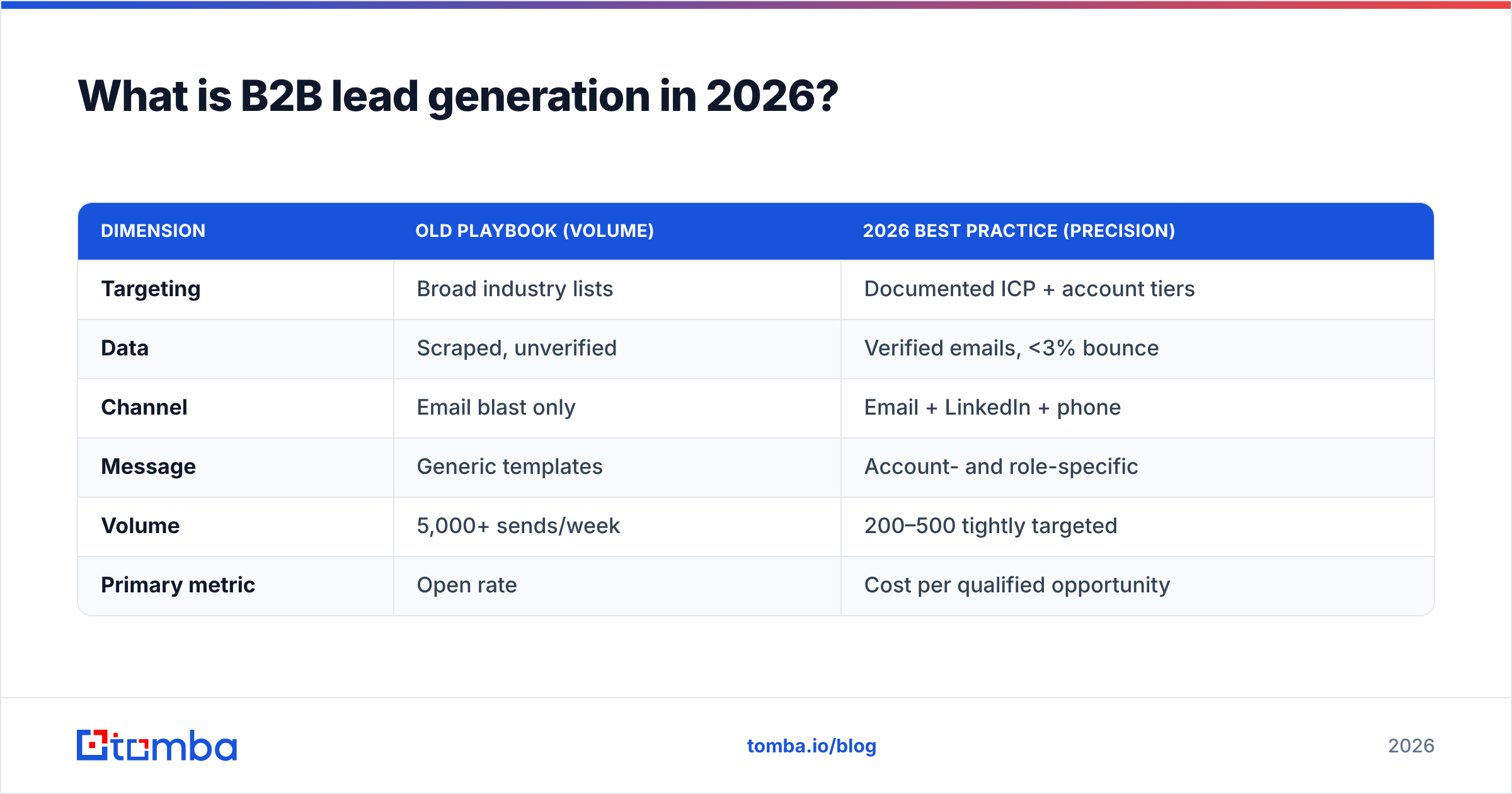
Here is how the old playbook compares to what works in 2026:
| Dimension | Old playbook (volume) | 2026 best practice (precision) |
|---|---|---|
| Targeting | Broad industry lists | Documented ICP + account tiers |
| Data | Scraped, unverified | Verified emails, <3% bounce |
| Channel | Email blast only | Email + LinkedIn + phone |
| Message | Generic templates | Account- and role-specific |
| Volume | 5,000+ sends/week | 200–500 tightly targeted |
| Primary metric | Open rate | Cost per qualified opportunity |
If your current motion looks like the left column, the rest of this article is your migration path to the right.
Why does data quality matter more than volume?#
Because bad data quietly poisons everything downstream. Send to a list that bounces 12% of the time and mailbox providers throttle you, your reply rate craters, and reps waste hours chasing dead contacts. One clean lead is worth more than ten guesses.
This is the single biggest lever most teams ignore. Before you send a single message, you should be enriching and verifying contacts. A good email verifier catches invalid, role-based, and risky addresses so your real campaigns only hit live inboxes. Pair it with an email finder to source addresses by name and domain rather than buying stale lists that thousands of other senders already burned.
)
The escalation in that meme is the whole point: the smartest tier is not "send more," it is "send to verified contacts via a reliable API." Clean data is the foundation everything else stands on. According to HubSpot's research on data decay, B2B contact data degrades by roughly 22–30% per year as people change jobs — so verification is not a one-time task, it is a habit.
How do you build an ideal customer profile?#
Start with your best existing customers and reverse-engineer what they have in common. Your ICP is the filter that makes every later step cheaper and sharper.
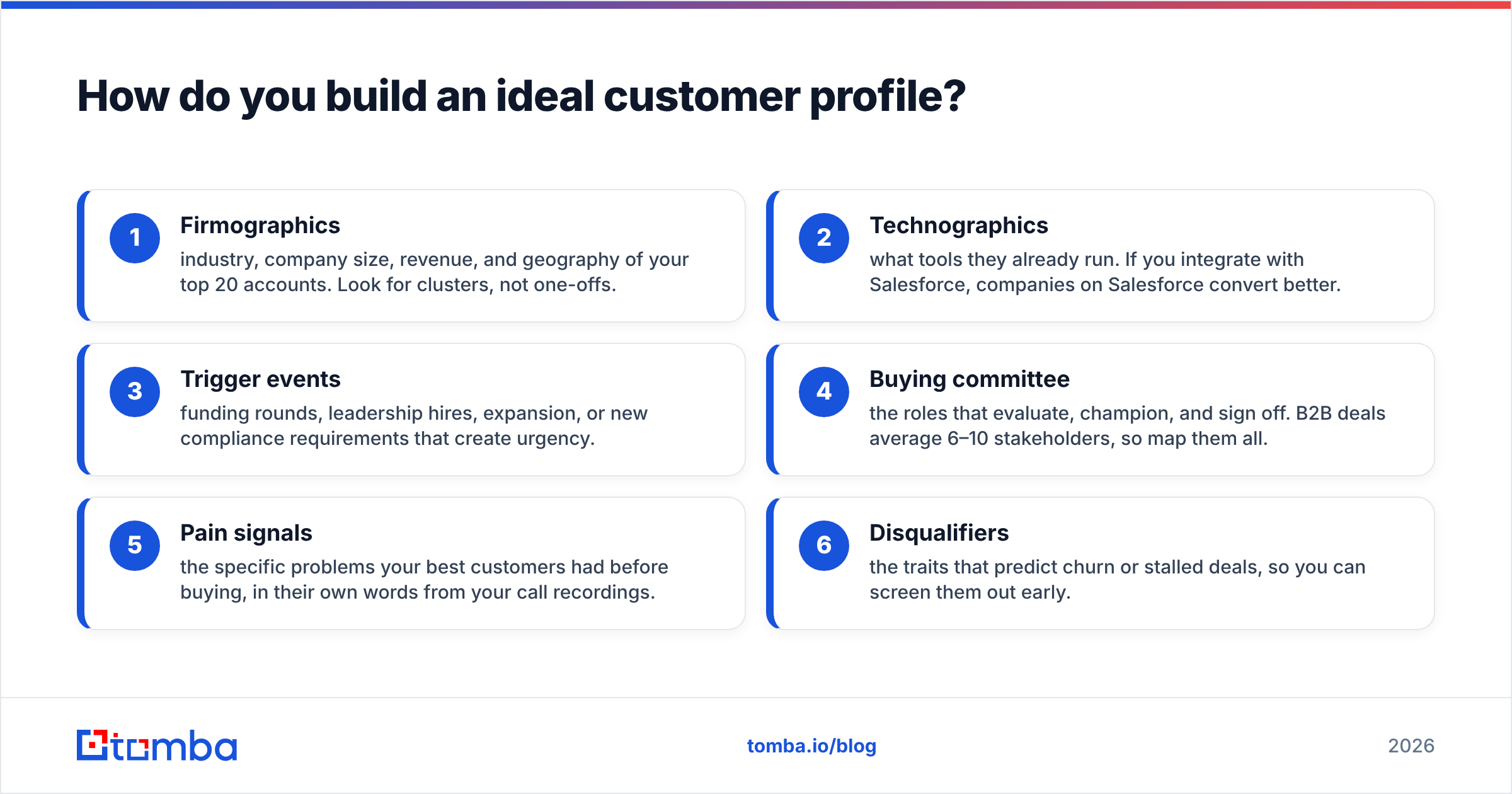
Work through these dimensions in order:
- Firmographics — industry, company size, revenue, and geography of your top 20 accounts. Look for clusters, not one-offs.
- Technographics — what tools they already run. If you integrate with Salesforce, companies on Salesforce convert better.
- Trigger events — funding rounds, leadership hires, expansion, or new compliance requirements that create urgency.
- Buying committee — the roles that evaluate, champion, and sign off. B2B deals average 6–10 stakeholders, so map them all.
- Pain signals — the specific problems your best customers had before buying, in their own words from your call recordings.
- Disqualifiers — the traits that predict churn or stalled deals, so you can screen them out early.
Document this as a one-page profile your whole team can reference. When you later run a domain search to pull contacts at a target company, your ICP tells you which roles to prioritize instead of scraping everyone.
What are the highest-ROI lead generation channels?#
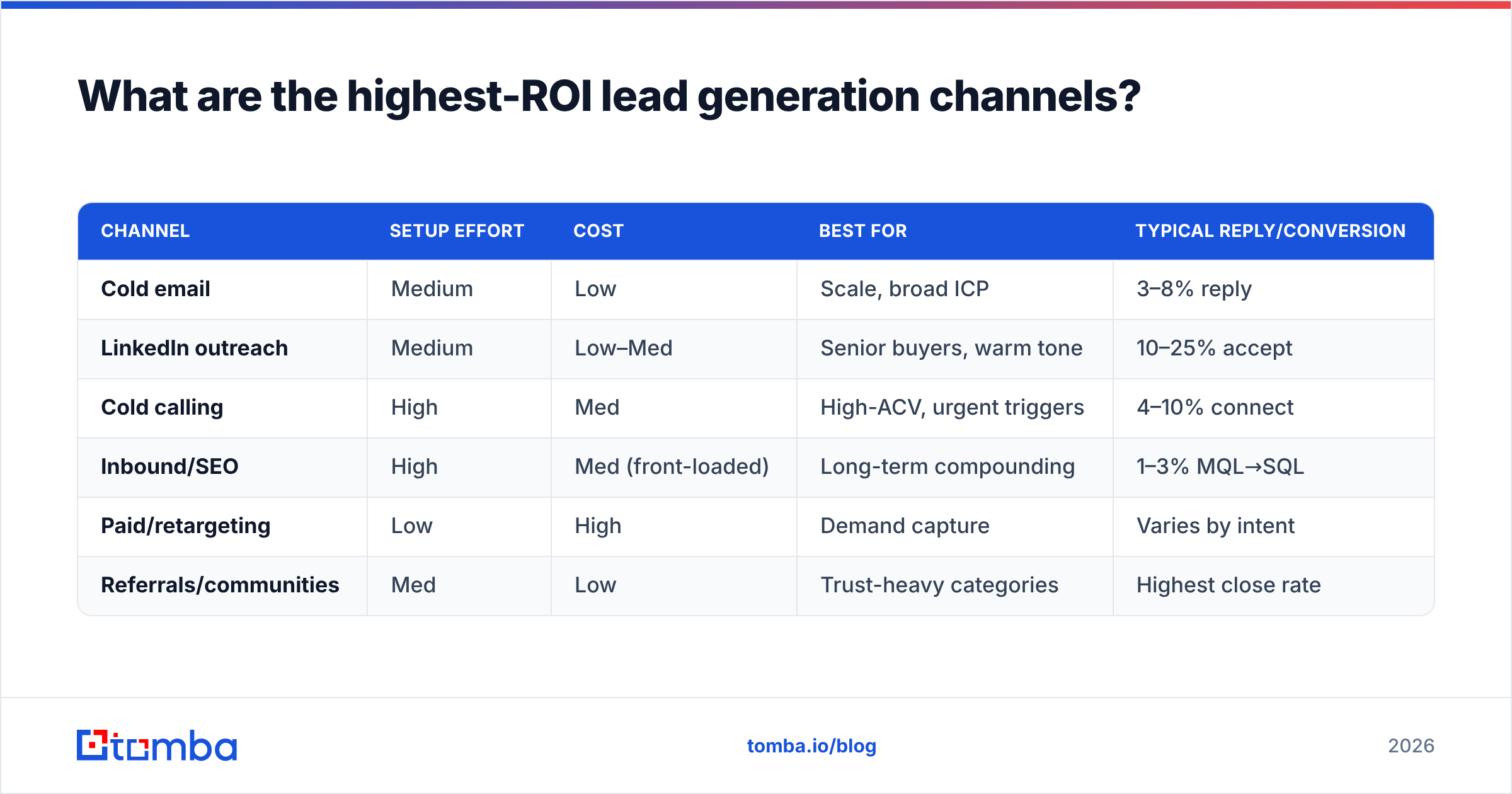
No single channel wins anymore — the best performers stack them. Buyers research across email, LinkedIn, search, and peer communities, so meeting them in one place leaves pipeline on the table. Here is how the main channels compare on the factors that decide where to invest:
| Channel | Setup effort | Cost | Best for | Typical reply/conversion |
|---|---|---|---|---|
| Cold email | Medium | Low | Scale, broad ICP | 3–8% reply |
| LinkedIn outreach | Medium | Low–Med | Senior buyers, warm tone | 10–25% accept |
| Cold calling | High | Med | High-ACV, urgent triggers | 4–10% connect |
| Inbound/SEO | High | Med (front-loaded) | Long-term compounding | 1–3% MQL→SQL |
| Paid/retargeting | Low | High | Demand capture | Varies by intent |
| Referrals/communities | Med | Low | Trust-heavy categories | Highest close rate |
The practical move for most teams: anchor on cold email for reach, layer LinkedIn touches for warmth, and reserve calls for your top-tier accounts. For deeper tactics on the social layer, see Tomba's primer on LinkedIn outreach.
How should you sequence multi-channel outreach?#
Coordinate touches across channels on a deliberate cadence rather than blasting all at once. A buyer who sees a thoughtful email, then a relevant LinkedIn comment, then a well-timed call experiences you as persistent and credible — not spammy.
A reliable 14-day sequence looks like this:
- Day 1 — Personalized email referencing a specific trigger event.
- Day 2 — LinkedIn connection request, no pitch.
- Day 4 — Follow-up email adding one new insight or resource.
- Day 7 — Phone call or voicemail for tier-1 accounts.
- Day 9 — LinkedIn message tied to something they posted or engaged with.
- Day 14 — Short "breakup" email that makes it easy to say not now.
Keep each message short, value-first, and easy to reply to. Use a phone finder to add direct-dial numbers to your tier-1 list so the day-7 call actually reaches a human instead of a switchboard.
What metrics actually predict pipeline growth?#
Stop celebrating open rates. They became unreliable the moment Apple Mail Privacy Protection started pre-loading images, and they never correlated with revenue anyway. Track metrics that connect directly to money:
- Reply rate and positive reply rate — the real signal that your targeting and message land.
- Meeting booked rate — replies are nice; calendar holds pay rent.
- Lead-to-opportunity conversion — how many leads become real, qualified deals.
- Cost per qualified opportunity — total spend divided by SQLs, the metric your CFO cares about.
- Speed-to-lead — time from inbound signal to first human touch. Faster is dramatically better.
- Pipeline velocity — how quickly qualified deals move toward closed-won.
Build a simple dashboard around these and review it weekly. If a channel produces lots of leads but few opportunities, it is a cost center wearing a costume.
)
How does lead scoring and speed-to-lead work?#
Lead scoring ranks contacts by fit and intent so reps spend time on the leads most likely to close. Speed-to-lead is how fast you respond once a lead raises a hand — and it is one of the most under-appreciated levers in B2B.
Build a basic score from two inputs:
- Fit score — how closely the lead matches your ICP (industry, size, role, tech stack).
- Intent score — behavioral signals like demo requests, pricing-page visits, or repeated email engagement.
Route anything that clears your threshold straight to a rep with full context. The classic Lead Response Management research popularized the finding that contacting a web lead within five minutes makes qualification vastly more likely than waiting even 30 minutes. Automate the handoff so a hot lead never sits in a queue overnight.
For the data side, enrich every inbound lead automatically. A data enrichment step can fill in company size, role, and direct contact details the instant a form is submitted, so your scoring model has something real to work with.
How do you keep cold email out of spam?#
Protect your sender reputation like it is the asset it is — because once it is damaged, everything you send underperforms. Three habits keep you in the primary inbox:
- Authenticate your domain. Set up SPF, DKIM, and DMARC correctly. These are the digital equivalent of a verified ID badge; without them, providers treat you as a stranger.
- Verify before you send. A bounce rate above 3% tells mailbox providers you are sending to junk lists. Run every list through verification first.
- Warm up and pace. New domains and inboxes need gradual volume ramps, not a 2,000-email day-one blast.
For a fuller treatment of inbox placement fundamentals, G2's category research is a useful neutral reference on which tools teams actually rely on. The core idea is simple: deliverability is earned through consistency, and clean data is the price of admission.
What does a modern B2B lead gen tech stack look like?#
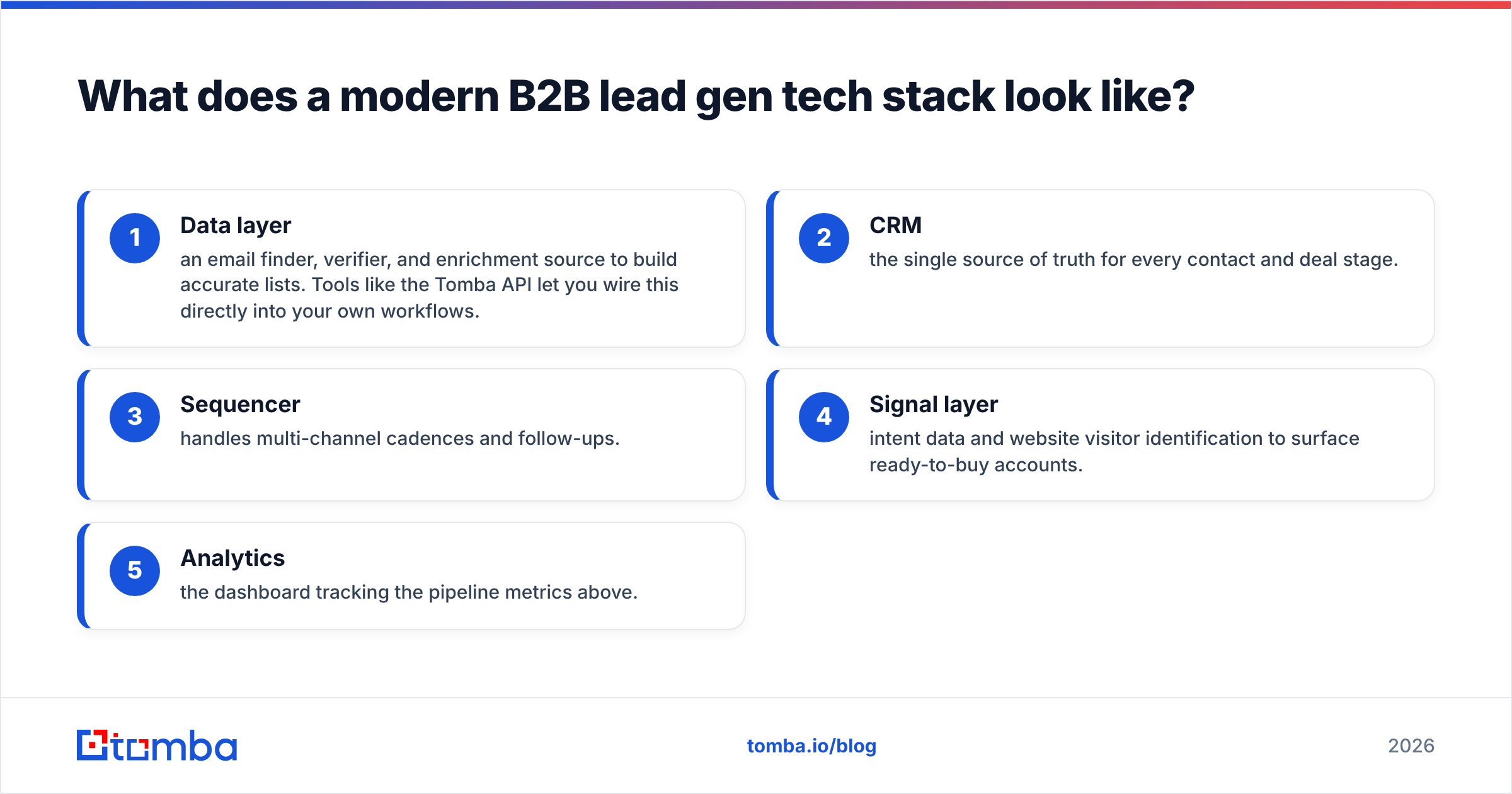
You do not need 15 tools. You need a tight stack where each layer feeds the next without manual copy-paste. A lean, effective setup:
- Data layer — an email finder, verifier, and enrichment source to build accurate lists. Tools like the Tomba API let you wire this directly into your own workflows.
- CRM — the single source of truth for every contact and deal stage.
- Sequencer — handles multi-channel cadences and follow-ups.
- Signal layer — intent data and website visitor identification to surface ready-to-buy accounts.
- Analytics — the dashboard tracking the pipeline metrics above.
Keep the data layer accurate and the rest of the stack performs better automatically. Garbage in still means garbage out, no matter how slick your sequencer is. Compare options against your budget with the published Tomba pricing, which starts free at 25 searches a month and scales to a $49/mo Starter and $99/mo Growth tier as your volume grows.
What are the most common B2B lead generation mistakes?#
Avoid these and you will already be ahead of most teams:
- Skipping verification. The fastest way to torch a domain and waste a quarter.
- Over-personalizing the wrong things. Mentioning someone's dog is creepy; referencing their company's funding round is relevant.
- Confusing activity with progress. 5,000 sends and three meetings is worse than 300 sends and 12 meetings.
- Ignoring the buying committee. Selling to one champion who cannot get budget stalls deals indefinitely.
- No follow-up discipline. Most replies come after the second or third touch, yet most reps quit after one.
- Buying lists instead of building them. Recycled lists are already burned across thousands of senders.
Putting it all together#
The throughline across all 12 practices is precision over volume. Define exactly who you sell to, reach them with clean and verified data, coordinate your channels, respond fast, and measure what predicts revenue. Each practice compounds: a tight ICP makes your data cheaper to source, clean data makes your outreach land, and landing outreach makes your metrics honest.
Start with the foundation. If your data is shaky, fix that before you touch your sequences or your messaging — it is the multiplier under everything else.
Ready to build pipeline on clean data? The Tomba Email Finder lets you find verified professional email addresses by name, domain, or company, so your 2026 campaigns reach real inboxes instead of bouncing into spam. Start free with 25 searches a month, then scale on the $49/mo Starter plan when your pipeline takes off. Build your list right, and every other best practice in this guide works harder for you.
// get started
Find, verify and enrich your first contacts today
Start on the free plan with 25 searches a month, then scale when your team is ready.
Free plan · No credit card required · GDPR & CCPA
// about the author