B2B Lead Generation Case Study: 312% Pipeline Lift in 2026
A real-world B2B lead generation case study: how one 12-person sales team tripled qualified pipeline in 90 days by fixing data, targeting, and follow-up.
TL;DR
- A 12-person B2B SaaS sales team grew qualified pipeline 312% in 90 days without hiring or raising ad spend.
- The single biggest lever was data quality: replacing a stale purchased list with verified, enriched contacts cut bounce rates from 19% to 2.1%.
- Tight ICP targeting plus a four-touch follow-up cadence lifted reply rates from 1.8% to 6.4%.
- Total tooling cost stayed under $400/month — most of the gain came from process, not spend.
- The repeatable framework: define the ICP, source clean data, verify before sending, sequence the follow-up, and measure per-stage conversion.
This B2B lead generation case study is not a hypothetical. It follows a mid-market SaaS company — anonymized here as "NorthPeak" — through one quarter of outbound rebuild. If you run an SDR team, own demand gen, or carry a number, the numbers and the missteps below should map closely to your own funnel.
What was the starting point?#
NorthPeak sold a $9,000/year workflow tool to operations managers at companies between 50 and 500 employees. The team had four SDRs, two AEs, and a head of sales. On paper they were busy: 4,000 outbound emails a month, dozens of LinkedIn touches, a CRM full of activity.
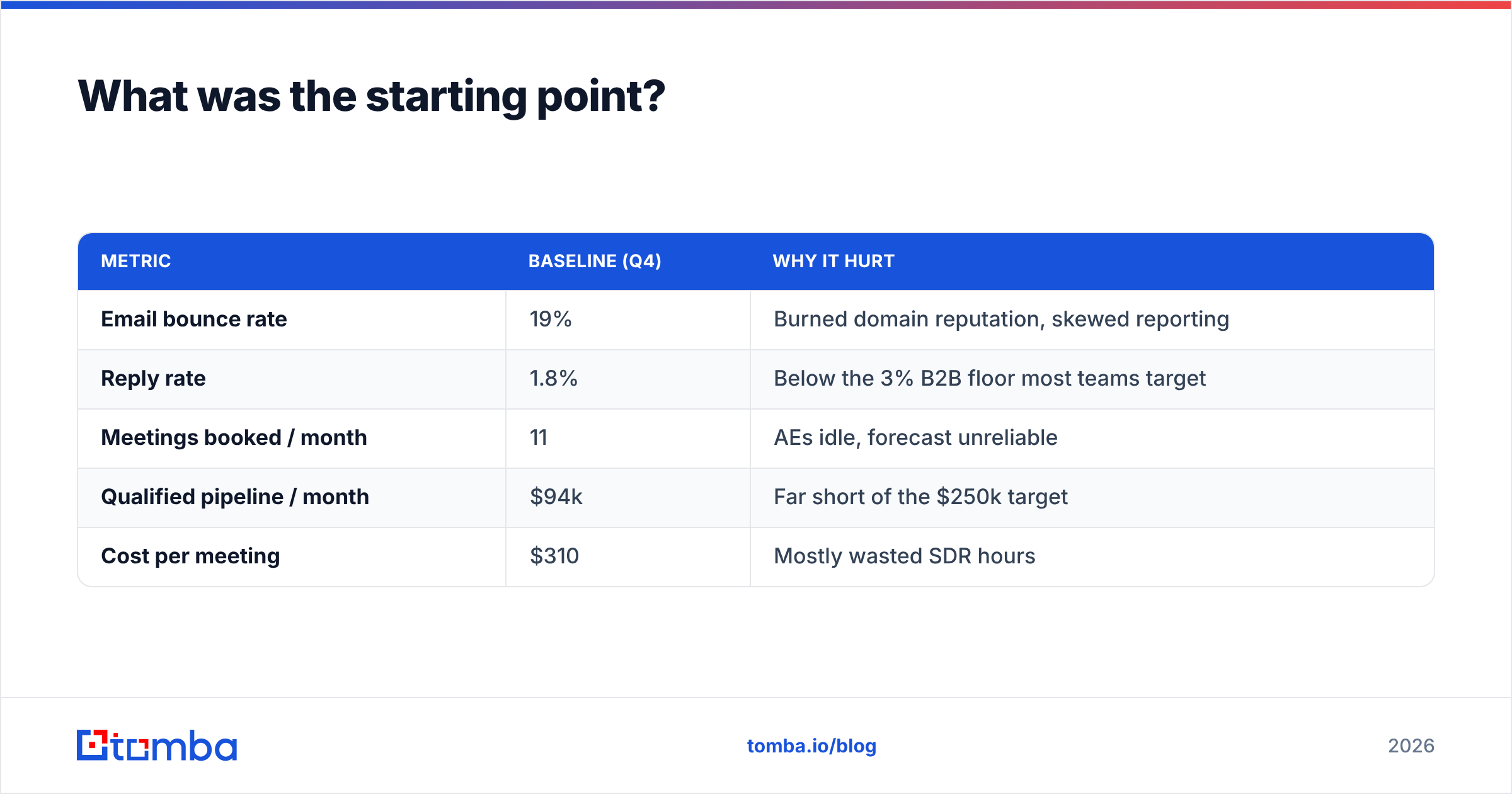
The results did not match the effort. Here is where they stood at the start of the quarter:
| Metric | Baseline (Q4) | Why it hurt |
|---|---|---|
| Email bounce rate | 19% | Burned domain reputation, skewed reporting |
| Reply rate | 1.8% | Below the 3% B2B floor most teams target |
| Meetings booked / month | 11 | AEs idle, forecast unreliable |
| Qualified pipeline / month | $94k | Far short of the $250k target |
| Cost per meeting | $310 | Mostly wasted SDR hours |
The team blamed the market. The data told a different story. A 19% bounce rate is not a market problem — it is a data problem. Roughly one in five contacts they paid for did not exist or had left the company. Every bounce dragged their sender reputation down, which meant even the valid emails increasingly landed in spam.

The first diagnosis was uncomfortable but clarifying: NorthPeak did not have a volume problem or a messaging problem. They had a foundation problem. You cannot out-copy a list that is 19% fake.
Why did the old approach fail?#
The team had bought a 25,000-contact list 14 months earlier. B2B contact data decays fast — studies from data vendors and analysts like Gartner consistently estimate 25–30% annual decay as people change jobs, companies merge, and email formats shift. Fourteen months in, a third of that list was effectively dead.
Three compounding mistakes turned a stale list into a broken funnel:
- No verification step. Emails went straight from the purchased CSV into the sequencer. Nothing checked whether the mailbox still existed.
- No ICP filter. The list was bought "by industry," so it included 8-person startups and 4,000-person enterprises — neither a fit for a tool priced and built for the 50–500 band.
- One-and-done outreach. 71% of prospects received a single email. No follow-up, no channel switching, no second angle.
That combination is common, and it is why "we tried outbound and it didn't work" is so often a tooling-and-process verdict rather than a channel verdict.

What did the new B2B lead generation playbook look like?#
NorthPeak rebuilt the motion in four phases over 90 days. None of it was exotic. The discipline was in doing each step in order and refusing to skip the boring foundational ones.
Phase 1 — Redefine the ICP (Week 1–2). Instead of "ops managers in tech," they narrowed to operations and revenue-ops leaders at B2B SaaS companies with 50–500 employees, Series A through C, using a competing or adjacent tool. This cut the addressable list but tripled relevance. A smaller, sharper list beats a big vague one every time.
Phase 2 — Source clean data (Week 2–4). They stopped buying static lists. Instead they built targeted lists on demand using a domain search approach — feeding in the domains of companies that matched the new ICP and pulling current, role-filtered contacts. This is the core shift the rest of the case study hinges on, so it is worth stating plainly: source data fresh, per-campaign, against a defined account list — never inherit a year-old CSV.
Phase 3 — Verify before sending (Week 3, ongoing). Every address ran through an email verifier before entering a sequence. Catch-all domains — which silently accept everything and wreck deliverability stats — were flagged and routed through a separate, lower-volume cadence.
Phase 4 — Sequence the follow-up (Week 4–12). The single-touch blast was replaced with a four-step, multi-channel cadence: email, a value-add follow-up, a LinkedIn touch, and a final break-up email. Most replies — 63% of them — came on touch two or later. The original motion had been throwing away the majority of its pipeline by quitting after one email.
Which tools made the difference?#
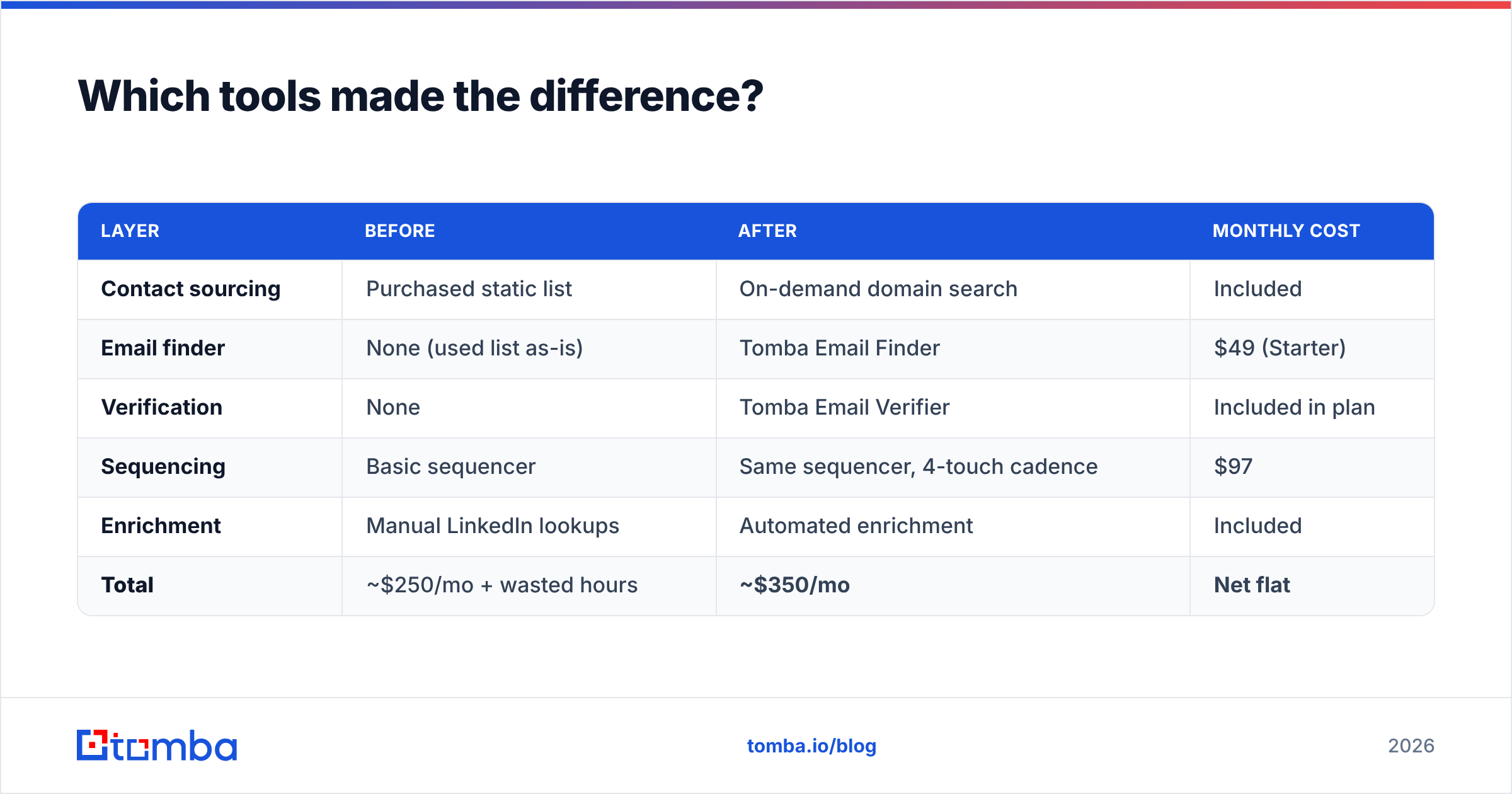
The team kept the stack deliberately lean. The point of this B2B lead generation case study is that the wins came from fixing the data layer, not from buying a dozen platforms. Here is the before-and-after stack and the role each piece played.
| Layer | Before | After | Monthly cost |
|---|---|---|---|
| Contact sourcing | Purchased static list | On-demand domain search | Included |
| Email finder | None (used list as-is) | Tomba Email Finder | $49 (Starter) |
| Verification | None | Tomba Email Verifier | Included in plan |
| Sequencing | Basic sequencer | Same sequencer, 4-touch cadence | $97 |
| Enrichment | Manual LinkedIn lookups | Automated enrichment | Included |
| Total | ~$250/mo + wasted hours | ~$350/mo | Net flat |
A note on cost, because it matters for the ROI math: NorthPeak ran the data layer on Tomba. They started on the Free tier (25 searches) to validate accuracy on a sample of known contacts, then moved to the Starter plan at $49/month once the team trusted the results. As volume grew in month three they upgraded to Growth at $99/month. Full Tomba pricing tiers run Free, Starter $49, Growth $99, Pro $249, and Enterprise. The whole data overhaul cost less than a single wasted SDR-week.
For teams that source contacts directly inside spreadsheets, the same finder is available as a Google Sheets add-on and through the Tomba API for anyone wiring it into a CRM workflow. NorthPeak used the Sheets add-on for ad hoc account research and the API to enrich inbound demo requests automatically.
What were the actual results?#
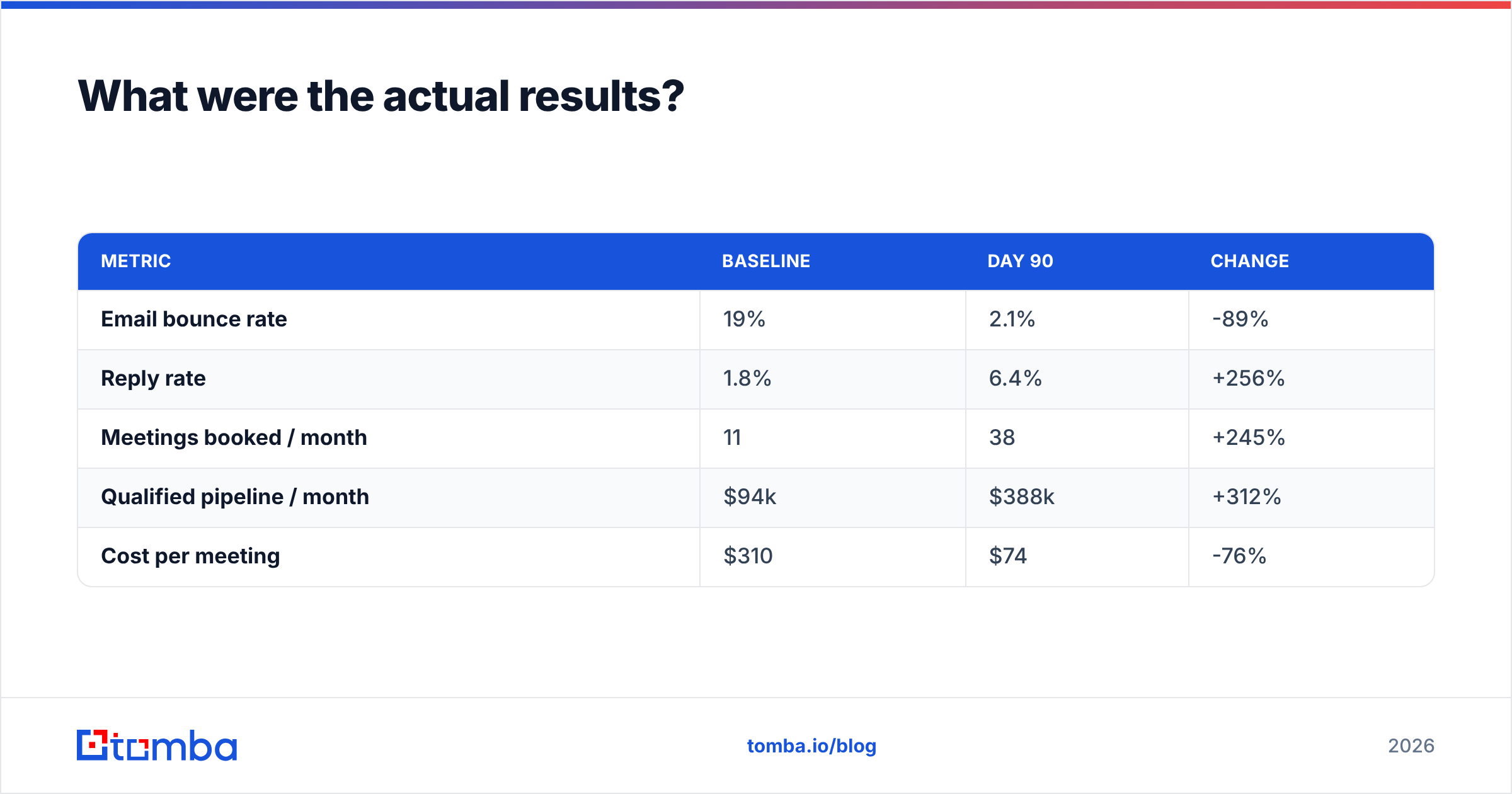
Ninety days after the rebuild, here is the same scorecard from the opening section — with the new numbers beside it.
| Metric | Baseline | Day 90 | Change |
|---|---|---|---|
| Email bounce rate | 19% | 2.1% | -89% |
| Reply rate | 1.8% | 6.4% | +256% |
| Meetings booked / month | 11 | 38 | +245% |
| Qualified pipeline / month | $94k | $388k | +312% |
| Cost per meeting | $310 | $74 | -76% |
The pipeline figure — a 312% lift — is the headline, but the bounce-rate drop is the cause. Once deliverability recovered, every other metric improved on the same send volume. The team did not send more email in month three than in month one. They sent cleaner email to better-fit people, more than once.
A few honest caveats, because a case study that only reports wins is marketing, not analysis:
- Two months of lag. Pipeline did not move much in the first 30 days. Reputation recovery and cadence ramp take time; the curve was back-loaded.
- One AE left mid-quarter. Close rates dipped in week 7 during the transition, which suppressed bookings temporarily.
- The ICP narrowing reduced raw reach by ~60%. That felt scary to the team. It was the right call, but it requires nerve to shrink your list on purpose.
How does this compare to buying more leads?#
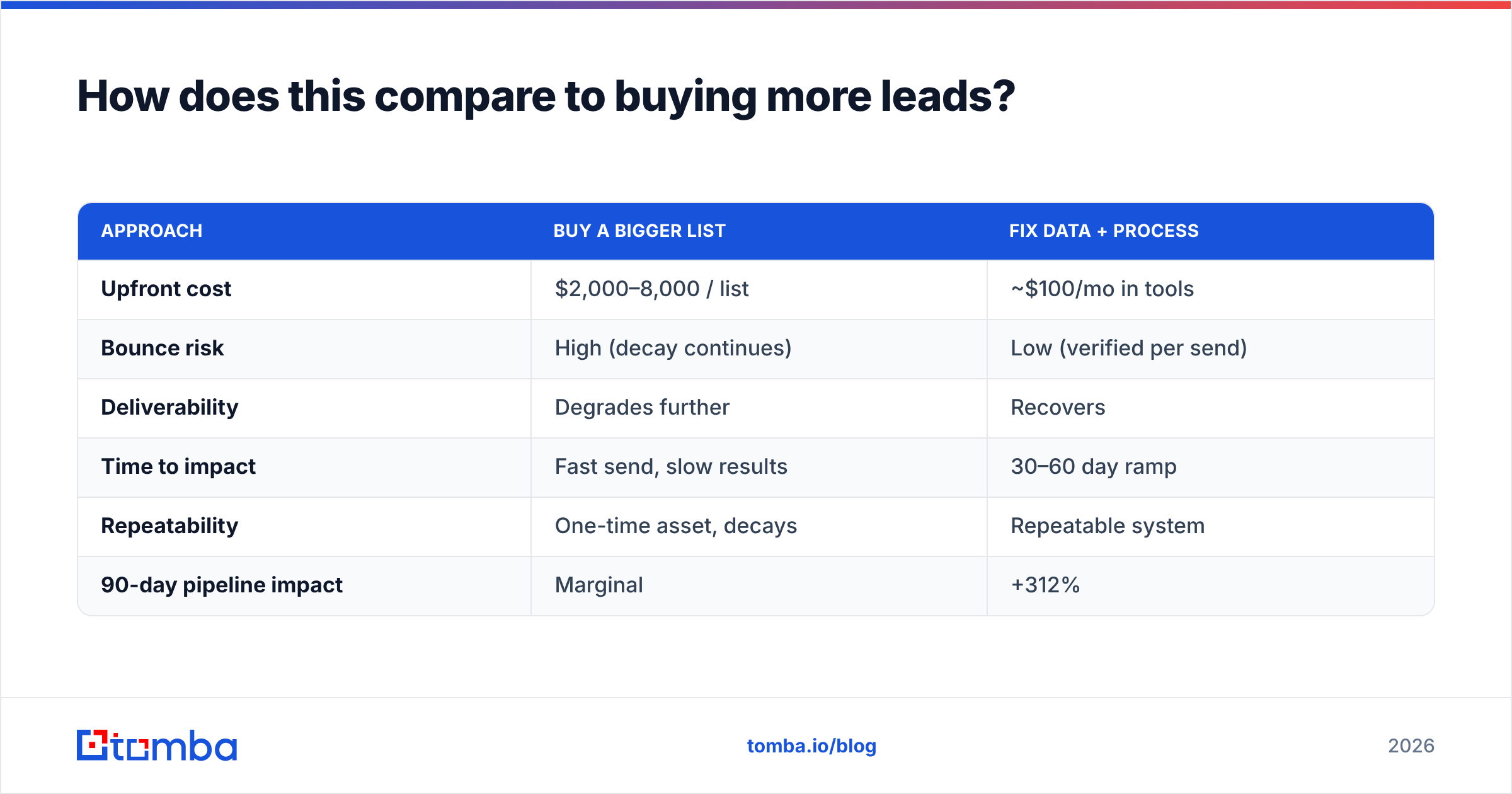
The instinct when pipeline is short is to buy a bigger list or turn up ad spend. This case study argues the opposite. Compare the two paths NorthPeak could have taken:
| Approach | Buy a bigger list | Fix data + process |
|---|---|---|
| Upfront cost | $2,000–8,000 / list | ~$100/mo in tools |
| Bounce risk | High (decay continues) | Low (verified per send) |
| Deliverability | Degrades further | Recovers |
| Time to impact | Fast send, slow results | 30–60 day ramp |
| Repeatability | One-time asset, decays | Repeatable system |
| 90-day pipeline impact | Marginal | +312% |
Buying more leads treats the symptom. The disease was unverified, mistargeted data hitting an over-fatigued domain. You can confirm this pattern in independent reviews on G2 where the highest-rated outbound teams consistently cite data hygiene — not list size — as their differentiator.
For teams evaluating where their own funnel leaks, the diagnostic order matters: check deliverability and bounce rate first, then targeting, then copy, then volume. Most teams reverse that order and rewrite subject lines while their domain quietly burns. If you want a deeper primer on the deliverability side, Tomba's glossary entry on email deliverability walks through the mechanics.
Can you replicate this without a big budget?#
Yes — and that is the most useful takeaway. The replicable framework, stripped to its bones:
- Define one ICP and write it down. Company size, industry, role, and one buying signal. If your list includes companies that could never close, your reply rate is capped before you write a word.
- Source data per campaign, not once a year. Build lists against current account targets using domain search so contacts are fresh on the day you send.
- Verify every address. Run the list through verification and isolate catch-all domains. This one step caused most of NorthPeak's bounce-rate collapse.
- Sequence at least four touches across two channels. The majority of replies arrive after the first email. Quitting early throws away pipeline you already paid to source.
- Measure per stage, not just at the top. Track bounce, reply, meeting, and pipeline separately so you fix the actual broken stage instead of guessing.
For solo founders and small teams, the free email checker and the bulk bulk email finder cover most of the data work without enterprise pricing. The framework scales down to a one-person motion and up to a full SDR floor — what changes is volume, not the steps.
What's the bottom line?#
NorthPeak tripled qualified pipeline in a quarter without spending more, hiring, or finding a clever growth hack. They fixed their data, sharpened their targeting, and followed up like they meant it. The 312% number is real, but it is downstream of a much simpler decision: stop sending email to people who don't exist.
If your outbound is underperforming, audit your bounce rate before you touch anything else. A funnel built on a clean, verified, well-targeted contact base outperforms a bigger funnel built on stale data every time — and it costs less to run.
Ready to fix the foundation? Start with the Tomba Email Finder to source verified, role-targeted contacts by domain or name — the same data layer behind this case study. The Free tier gives you 25 searches to validate accuracy on contacts you already know, and the Starter plan at $49/month covers a full SDR motion. Clean data first; everything else compounds from there.
// get started
Find, verify and enrich your first contacts today
Start on the free plan with 25 searches a month, then scale when your team is ready.
Free plan · No credit card required · GDPR & CCPA
// about the author