B2B Lead Generation Challenges in 2026 and How to Fix Them
The 7 B2B lead generation challenges killing pipeline in 2026 — bad data, weak targeting, rising CAC — plus the fixes that actually move numbers.
B2B lead generation is harder in 2026 than it was three years ago, and the reason is not effort. Teams are sending more, posting more, and spending more — yet booking fewer qualified meetings. The bottleneck has moved upstream: it is the quality of your data, the precision of your targeting, and the deliverability of your outreach, not the volume of activity.
This guide breaks down the seven challenges that actually drag down B2B pipeline, why each one happens, and the specific fix for each. No platitudes about "providing value." Concrete diagnostics and concrete moves.
TL;DR#
- Dirty data is the root cause of most B2B lead generation challenges — bounces, wrong titles, and dead numbers waste both rep time and sender reputation.
- Rising acquisition costs and ad fatigue mean paid channels alone no longer scale profitably; outbound precision matters more than spend.
- Poor ICP definition produces high lead volume and low conversion — the most expensive kind of "success."
- Deliverability collapse from Google and Yahoo's bulk-sender rules quietly tanks reply rates before anyone notices.
- The fix is a tight loop: define a sharp ICP, source verified contact data, verify before you send, and measure reply rate over raw volume.
What are the biggest B2B lead generation challenges in 2026?#
The short answer: data decay, targeting drift, rising costs, and deliverability rules that punish sloppy sending. Most teams treat these as separate problems handled by separate tools. They are actually one connected failure — bad inputs at the top of the funnel multiply into wasted spend and damaged sender reputation at the bottom.
Here is the full list, ranked by how much pipeline they quietly destroy.
- Data decay and dirty records — roughly 30% of B2B contact data goes stale every year as people change jobs. Emailing those records bounces, and bounces hurt your domain.
- Vague or oversized ICP — casting a wide net feels productive but fills the pipeline with leads who will never buy.
- Rising customer acquisition cost (CAC) — paid channels are more expensive and more crowded, compressing margins.
- Deliverability and spam filtering — the 2024 Gmail/Yahoo sender requirements made authentication and low spam rates mandatory, not optional.
- Low reply and conversion rates — generic messaging to poorly matched contacts produces single-digit reply rates.
- Sales and marketing misalignment — leads get passed over the wall with no shared definition of "qualified."
- Attribution and measurement gaps — teams can't tell which channels actually produce revenue, so budget goes to the loudest, not the best.
Each of these compounds the next. A vague ICP feeds a list-buying habit, which feeds dirty data, which feeds bounces, which feeds deliverability problems. Fix the top of the chain and the rest gets easier.
Why does bad data cause most B2B lead generation challenges?#
Bad data is the single highest-leverage problem because it sits at the top of the funnel and contaminates everything downstream. Think of your sending domain like a credit score. Every hard bounce and spam complaint is a missed payment. Send to a list full of dead addresses and your score drops — so even your good emails to real prospects start landing in spam.
The numbers are unforgiving. According to research summarized by HubSpot, B2B databases degrade by about 22.5% to 30% per year. That means a list you bought in January is meaningfully wrong by summer. Job changes, company moves, rebrands, and acquisitions all break the records you paid for.
The fix is a two-step discipline that most teams skip:
- Source from a live, queried provider instead of a static file. A purchased CSV is a snapshot of the past. A real-time email finder resolves addresses against current company domains at the moment you query.
- Verify every address before it enters a sequence. An email verifier checks syntax, domain, MX records, and mailbox existence so you never send to a guess.
For domains that accept everything (the dreaded "catch-all" servers), use a dedicated catch-all verifier so you are not flying blind on whether the mailbox actually exists. This single layer — verify before send — is the cheapest deliverability insurance you can buy.
How do you fix a vague ICP that fills the pipeline with junk?#
Tighten the definition until it hurts, then source against it precisely. A vague Ideal Customer Profile is the most expensive mistake in B2B because it disguises itself as growth: lead volume goes up, dashboards look green, and conversion quietly craters.
A useful ICP is specific on at least five axes:
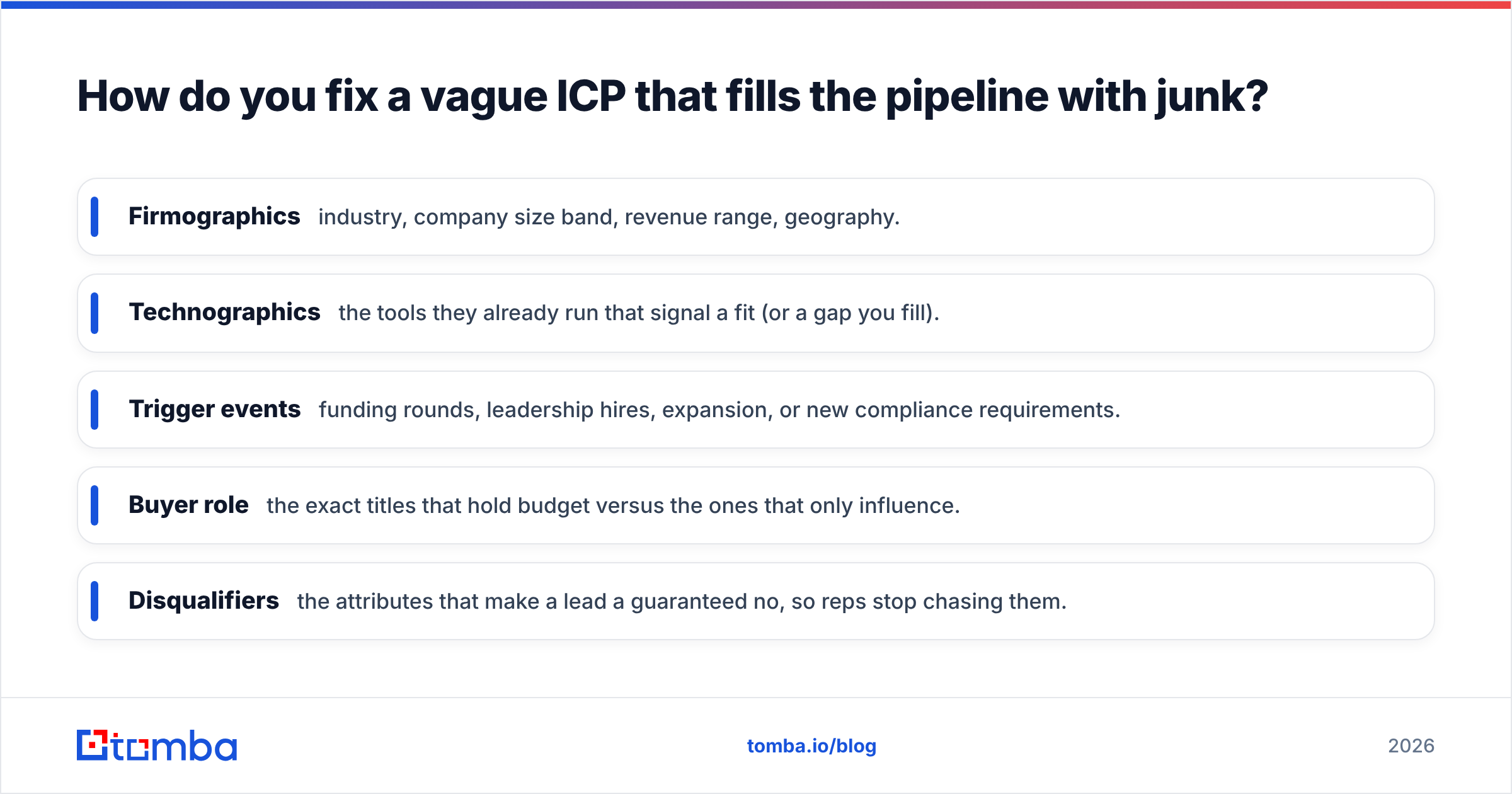
- Firmographics — industry, company size band, revenue range, geography.
- Technographics — the tools they already run that signal a fit (or a gap you fill).
- Trigger events — funding rounds, leadership hires, expansion, or new compliance requirements.
- Buyer role — the exact titles that hold budget versus the ones that only influence.
- Disqualifiers — the attributes that make a lead a guaranteed no, so reps stop chasing them.
Once the profile is sharp, the sourcing problem becomes tractable. Instead of buying a 50,000-row list and hoping, you run a domain search against the specific companies that match your firmographics, then filter to the roles that match your buyer definition. Fewer leads, dramatically higher fit. A list of 300 verified, on-ICP contacts will out-convert 10,000 random ones every time.
What's the real cost of rising CAC and how do you offset it?#
Customer acquisition cost is climbing because paid channels are saturated and privacy changes have made ad targeting blunter. The offset is not "spend less" — it is "waste less," and the biggest waste is paying to reach people who were never going to buy.
Outbound precision is the lever. When your contact data is verified and your targeting is tight, every email and call goes to a real, relevant human, so your cost per booked meeting drops even if your raw spend stays flat. Pair that with channels you own — your own B2B database of enriched contacts and a data enrichment layer that keeps records current — and you reduce your dependence on rented audiences.
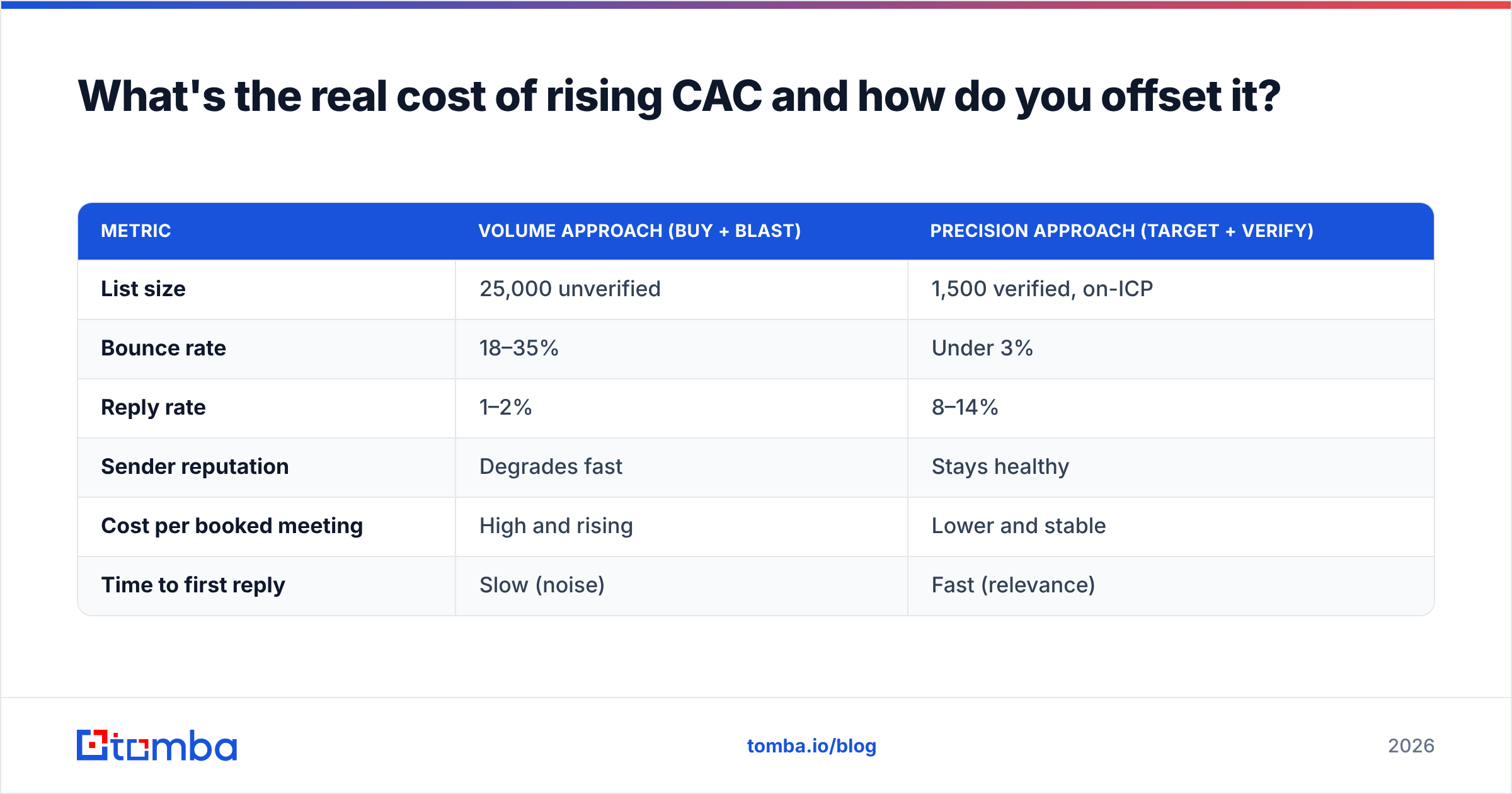
Here is how the cost math shifts when you move from a volume mindset to a precision mindset:
| Metric | Volume approach (buy + blast) | Precision approach (target + verify) |
|---|---|---|
| List size | 25,000 unverified | 1,500 verified, on-ICP |
| Bounce rate | 18–35% | Under 3% |
| Reply rate | 1–2% | 8–14% |
| Sender reputation | Degrades fast | Stays healthy |
| Cost per booked meeting | High and rising | Lower and stable |
| Time to first reply | Slow (noise) | Fast (relevance) |
The precision column is not aspirational. It is what happens when you stop sending to records you have not verified.
How do deliverability rules break B2B lead generation?#
Since the 2024 bulk-sender requirements from Google and Yahoo, deliverability is a hard gate, not a nice-to-have. If you send meaningful volume, you now need SPF, DKIM, and DMARC authentication in place, easy one-click unsubscribe, and — critically — a spam complaint rate kept below 0.3%. Cross those thresholds and your mail gets filtered or rejected regardless of how good your copy is.
This connects directly back to data quality. High bounce rates and spam complaints both come from sending to bad or unwanted addresses. So the deliverability fix and the data fix are the same fix.
Practical checklist before you scale any sending:
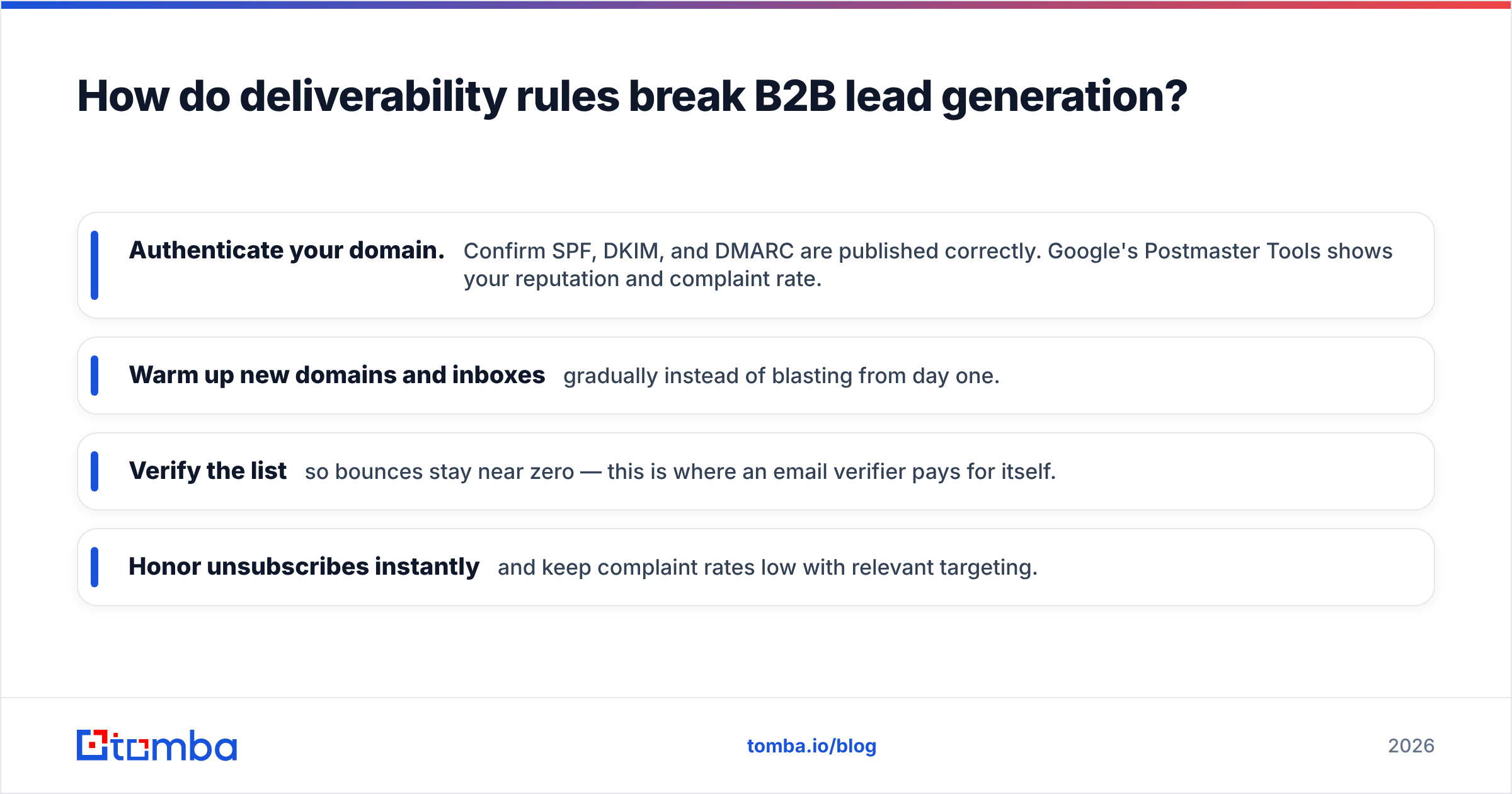
- Authenticate your domain. Confirm SPF, DKIM, and DMARC are published correctly. Google's Postmaster Tools shows your reputation and complaint rate.
- Warm up new domains and inboxes gradually instead of blasting from day one.
- Verify the list so bounces stay near zero — this is where an email verifier pays for itself.
- Honor unsubscribes instantly and keep complaint rates low with relevant targeting.
If you want the broader background on how inbox placement works, the concept of email deliverability is worth understanding before you spend on volume.

Which tools actually solve these B2B lead generation challenges?#
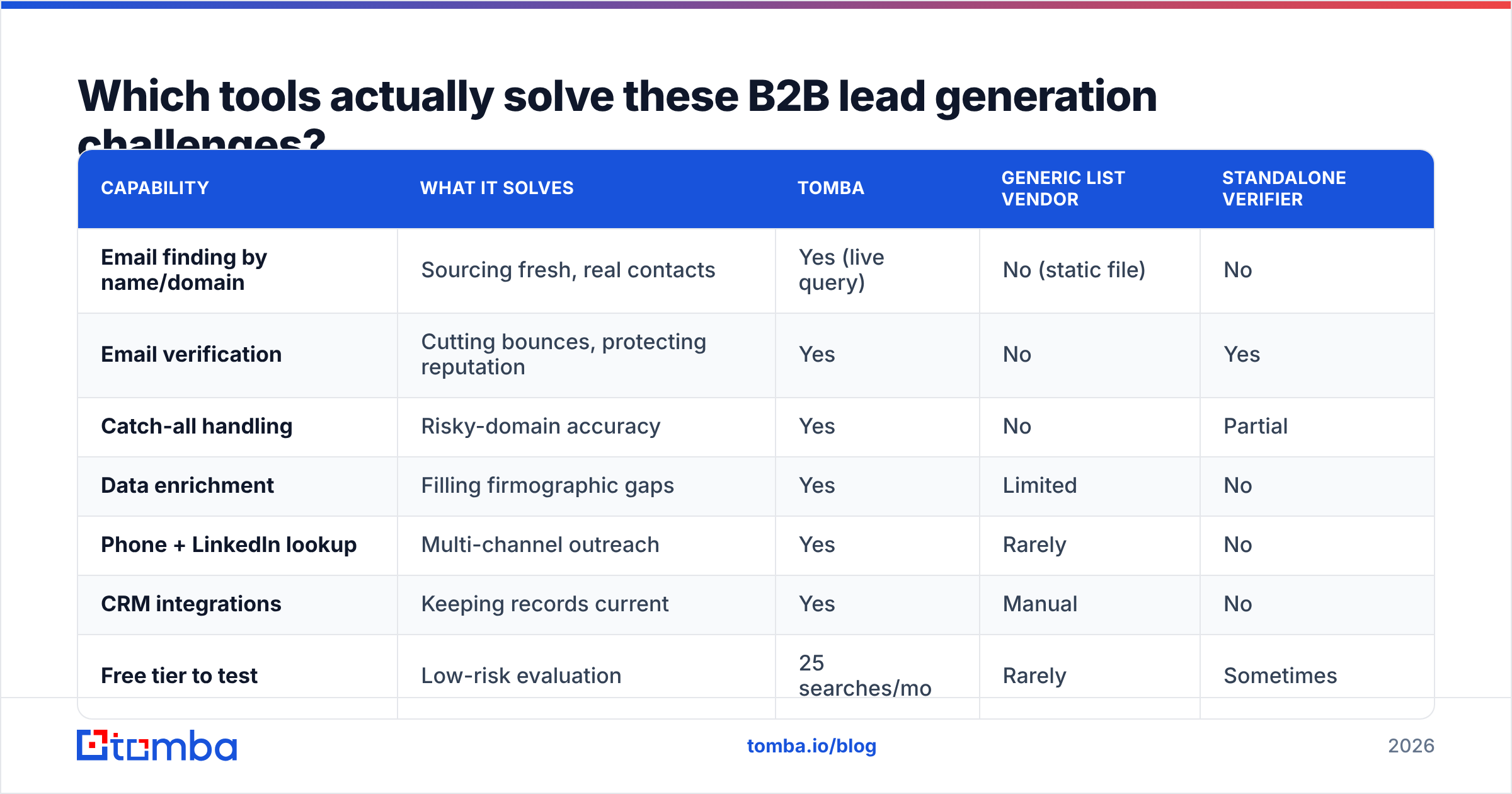
The right stack depends on whether your bottleneck is sourcing, verification, or enrichment — but most teams need all three working together. Buying five disconnected tools creates the same fragmentation that causes the problem. The goal is a connected loop: find, verify, enrich, then sync into your CRM.
Below is how the common categories stack up against the challenges they address.
| Capability | What it solves | Tomba | Generic list vendor | Standalone verifier |
|---|---|---|---|---|
| Email finding by name/domain | Sourcing fresh, real contacts | Yes (live query) | No (static file) | No |
| Email verification | Cutting bounces, protecting reputation | Yes | No | Yes |
| Catch-all handling | Risky-domain accuracy | Yes | No | Partial |
| Data enrichment | Filling firmographic gaps | Yes | Limited | No |
| Phone + LinkedIn lookup | Multi-channel outreach | Yes | Rarely | No |
| CRM integrations | Keeping records current | Yes | Manual | No |
| Free tier to test | Low-risk evaluation | 25 searches/mo | Rarely | Sometimes |
When the same platform handles finding, verifying, and enriching, your data stays consistent end to end. You can find a phone number with a phone finder for the prospects who never answer email, then push everything into your pipeline through native integrations with HubSpot, Salesforce, and Pipedrive. Pricing scales with volume — the Tomba pricing runs from a free tier at 25 searches per month up through Starter at $49/mo, Growth at $99/mo, and Pro at $249/mo.
For an independent read on how vendors compare, G2 and Capterra carry verified user reviews across the lead-intelligence category.
How do you fix sales and marketing misalignment?#
Agree on one shared definition of a qualified lead and one shared scoring model, then hold both teams to it. Misalignment is usually not a personality problem — it is a definitions problem. Marketing counts form fills; sales counts meetings that close. Those two scoreboards never agree.
The fix is mechanical:
- Co-author the ICP and the marketing qualified lead definition. If sales won't work a lead, it isn't qualified — period.
- Use a single lead-scoring rubric so a "hot" lead means the same thing in both org charts.
- Set a closed-loop feedback rule: every rejected lead gets a reason code that flows back to marketing weekly.
- Review the same dashboard in one shared meeting, not two separate ones.
This is less about software and more about a contract between the two teams. But clean, enriched data makes the contract enforceable, because everyone is scoring the same accurate records.
How should you measure B2B lead generation to fix attribution gaps?#
Measure reply rate, meeting rate, and cost per opportunity — not raw lead count. The attribution problem persists because teams optimize the metric that is easy to count (leads) instead of the one that matters (revenue).
A clean measurement frame for outbound looks like this:
- Deliverability rate — what share of sends actually reach the inbox. If this is low, nothing else matters.
- Reply rate — the truest near-term signal of targeting and message fit.
- Meeting-booked rate — replies that convert to real conversations.
- Opportunity-to-close — the only number finance cares about.
- Cost per opportunity — total spend divided by qualified opportunities, the metric that exposes whether "cheap leads" are actually cheap.
When you track these, the volume trap dissolves on its own. A campaign that produces 10,000 leads and three meetings looks worse than one that produces 400 leads and 40 meetings — which is exactly the correction most B2B teams need.
Putting it together: the fix loop#
Every challenge above connects to one root discipline — clean inputs, tight targeting, verified sending. The loop is simple to state and demanding to run:
- Define a sharp ICP with explicit disqualifiers.
- Source verified contacts against that ICP instead of buying static lists.
- Verify and enrich every record before it enters a sequence.
- Authenticate your domain and protect deliverability.
- Measure reply rate and cost per opportunity, then feed the learnings back into the ICP.
Run that loop and the seven challenges stop being separate fires to fight. They become one system you control.
Start fixing your pipeline with verified data#
The fastest fix you can make this week is at the top of the funnel: stop sending to records you have not verified. The Tomba Email Finder lets you find professional email addresses by name, domain, or company, then verify them before they ever hit a sequence — so your bounces stay low, your sender reputation stays healthy, and your reps spend time on real prospects instead of dead addresses. Start on the free tier with 25 searches a month, prove the lift on your own ICP, and scale up only when the numbers justify it. Precision beats volume, and it starts with data you can trust.
// get started
Find, verify and enrich your first contacts today
Start on the free plan with 25 searches a month, then scale when your team is ready.
Free plan · No credit card required · GDPR & CCPA
// about the author