B2B Lead Generation Companies: Costs & Top Picks (2026)
Hiring a lead gen agency in 2026? Here's what B2B lead generation companies actually charge, what they deliver, and when building in-house wins.
You are weighing whether to hand your pipeline to an outside agency or build the engine yourself. This guide breaks down what B2B lead generation companies actually do, what they charge in 2026, and where the math stops making sense.
TL;DR#
- B2B lead generation companies sell you appointments, MQLs, or raw contact lists — pricing ranges from $2,000/mo retainers to $200+ per qualified appointment.
- The three models are retainer agencies, pay-per-lead vendors, and data/list providers. Each fails differently.
- Outsourcing buys speed and a team you don't manage; it costs margin, control, and often data ownership.
- A lean in-house stack — an email finder, a verifier, and a sequencer — frequently beats a mid-tier agency on cost-per-meeting once you pass month three.
- Vet any company on data sourcing, lead definition, and exclusivity before signing. Vague answers there are the single biggest red flag.
What do B2B lead generation companies actually do?#
Think of a lead generation company like a fishing charter. You can buy a boat, learn the waters, and catch fish yourself — or you pay a captain who already knows where they bite. You get fish faster, but you never learn the lake, and you pay per trip forever.
In practice these companies fall into three buckets, and conflating them is how buyers overpay:
- Appointment-setting / SDR agencies — They run outbound (email, calls, LinkedIn) under your brand and book meetings on your reps' calendars. You pay for activity plus booked appointments.
- Pay-per-lead (PPL) vendors — You pay only for leads that hit an agreed definition (a form fill, a demo request, a qualified contact). Predictable cost, variable quality.
- Data and list providers — They sell contacts and enrichment, not outreach. You get names, emails, firmographics, and intent signals; you do the selling.
The trap is buying bucket #3 (a list) while expecting bucket #1 results (booked meetings). A contact database is fuel, not a finished campaign.
How do the main lead generation models compare?#
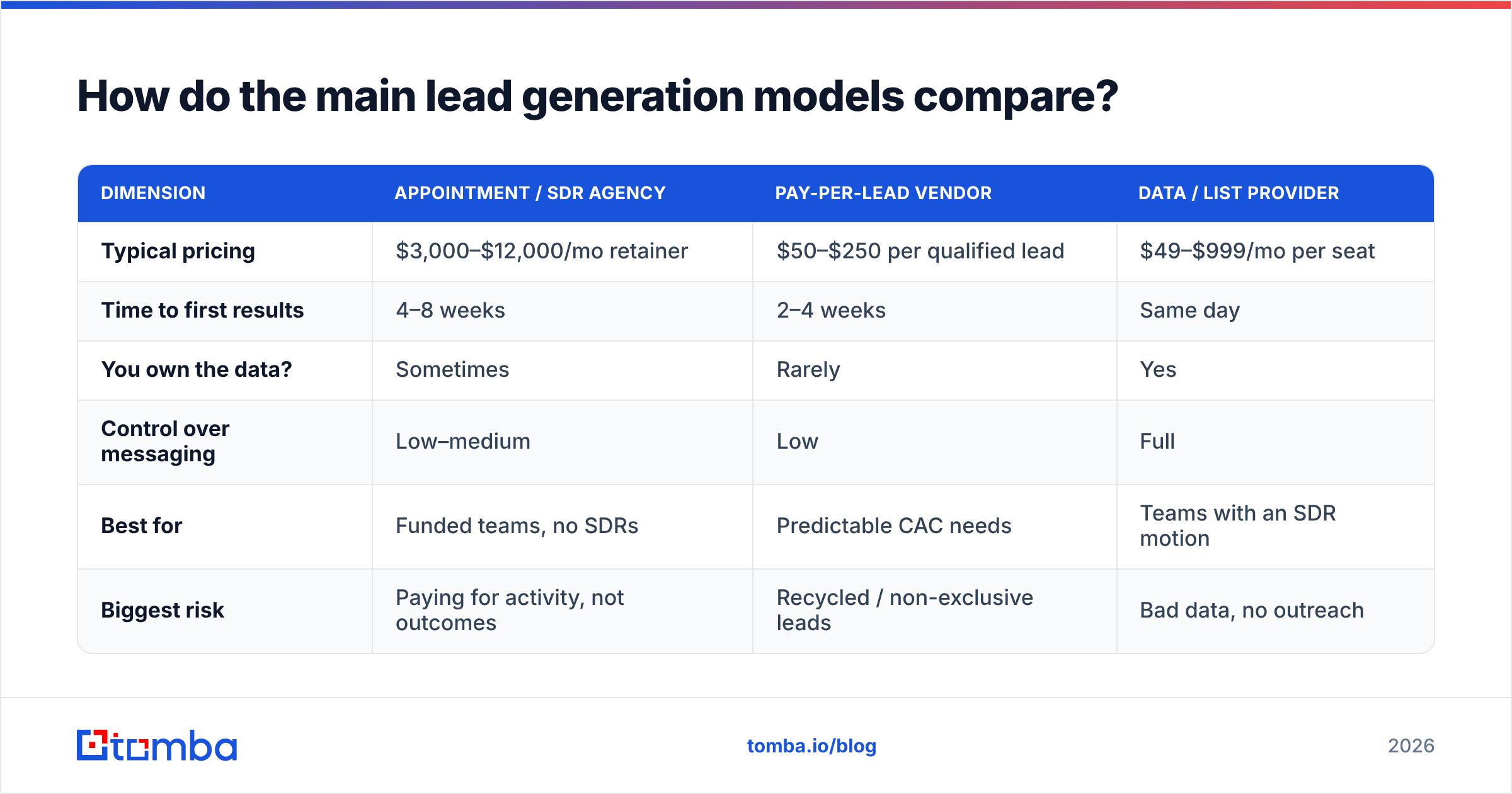
Here's how the three dominant models stack up on the dimensions buyers actually care about:
| Dimension | Appointment / SDR agency | Pay-per-lead vendor | Data / list provider |
|---|---|---|---|
| Typical pricing | $3,000–$12,000/mo retainer | $50–$250 per qualified lead | $49–$999/mo per seat |
| Time to first results | 4–8 weeks | 2–4 weeks | Same day |
| You own the data? | Sometimes | Rarely | Yes |
| Control over messaging | Low–medium | Low | Full |
| Best for | Funded teams, no SDRs | Predictable CAC needs | Teams with an SDR motion |
| Biggest risk | Paying for activity, not outcomes | Recycled / non-exclusive leads | Bad data, no outreach |
Notice the inverse relationship: the more of the work you outsource, the less you own and control. The cheapest line item (a data tool) gives you the most ownership; the priciest (a full-service agency) gives you the least.
How much do B2B lead generation companies cost in 2026?#
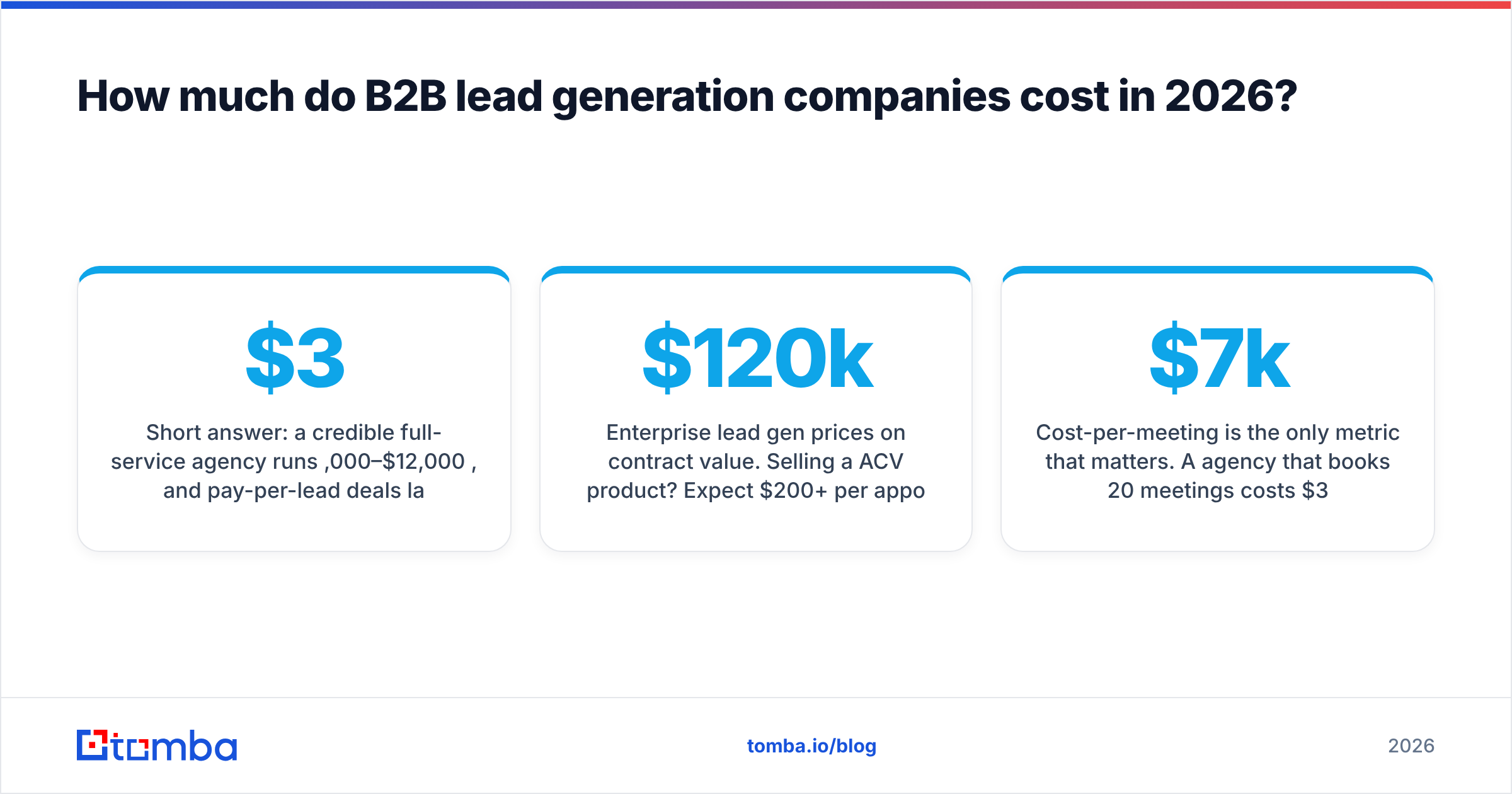
Short answer: a credible full-service agency runs $3,000–$12,000 per month, and pay-per-lead deals land between $50 and $250 per qualified lead depending on contract value and industry.
A few honest realities behind those numbers:
- Retainers front-load risk. You pay months one and two while the agency builds lists, warms domains, and tunes messaging. Meetings often don't land until week six. Budget for a ramp, not instant ROI.
- Pay-per-lead sounds safe but hides exclusivity gaps. Some vendors sell the same "qualified lead" to three competitors. Always ask, in writing, whether leads are exclusive.
- Enterprise lead gen prices on contract value. Selling a $120k ACV product? Expect $200+ per appointment because each meeting is worth more.
- Cost-per-meeting is the only metric that matters. A $7k/mo agency that books 20 meetings costs $350/meeting. An in-house rep with a $300/mo tool stack who books 25 costs you far less per meeting after fixed salary.
For reference on real vendor pricing and verified reviews, G2 and Clutch are the two directories worth cross-checking before you trust an agency's own case studies.
Which type of company is right for you?#
Match the model to your stage, not to the flashiest pitch deck:
- No SDRs, recent funding, need pipeline yesterday → full-service appointment agency. You're buying a team you don't have time to hire.
- Finance wants predictable CAC → pay-per-lead, but lock exclusivity and a clear lead definition.
- You already have 1+ SDRs and a CRM → skip the agency. Buy data and tooling, keep the margin. This is where most scaling teams land.
- You sell to a narrow vertical → a niche boutique agency that lives in your space beats a generalist every time.
If you have any outbound motion at all, the in-house path usually wins on a 12-month view. That's because the recurring cost of a bulk lead generation workflow plus a sequencer is a fraction of an agency retainer — and you keep every contact you find.
What separates good lead gen companies from bad ones?#
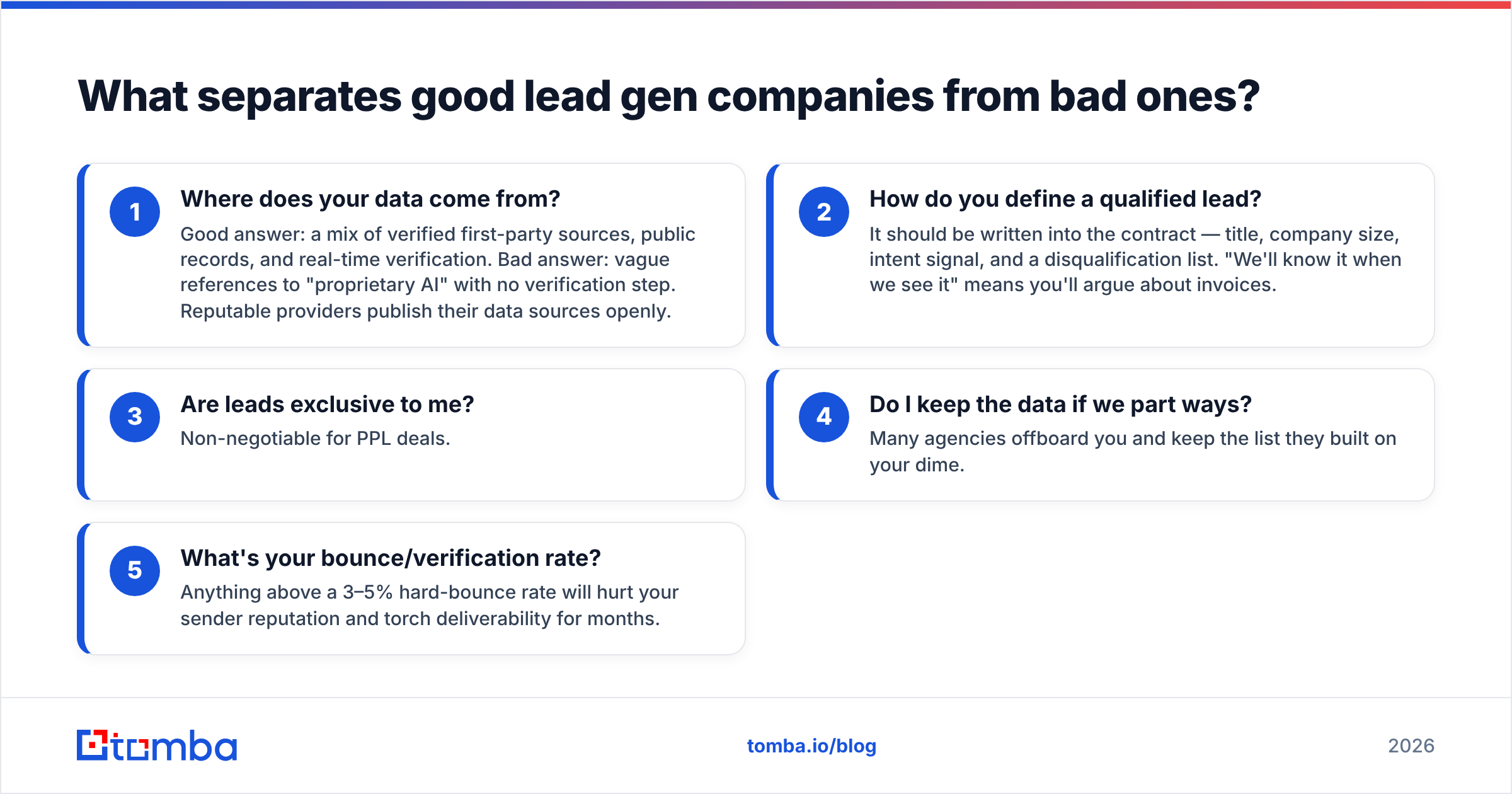
The difference is almost always data quality and transparency, not the polish of the sales call. Vet on these five questions:
- Where does your data come from? Good answer: a mix of verified first-party sources, public records, and real-time verification. Bad answer: vague references to "proprietary AI" with no verification step. Reputable providers publish their data sources openly.
- How do you define a qualified lead? It should be written into the contract — title, company size, intent signal, and a disqualification list. "We'll know it when we see it" means you'll argue about invoices.
- Are leads exclusive to me? Non-negotiable for PPL deals.
- Do I keep the data if we part ways? Many agencies offboard you and keep the list they built on your dime.
- What's your bounce/verification rate? Anything above a 3–5% hard-bounce rate will hurt your sender reputation and torch deliverability for months.
That last point is where outsourced campaigns quietly fail. An agency blasting an unverified list under your domain can get your sending reputation blacklisted before you see a single meeting. If you bring outreach in-house, run every address through an email verifier first — it's the cheapest insurance in the entire funnel.

Can you replace a lead generation company with in-house tools?#
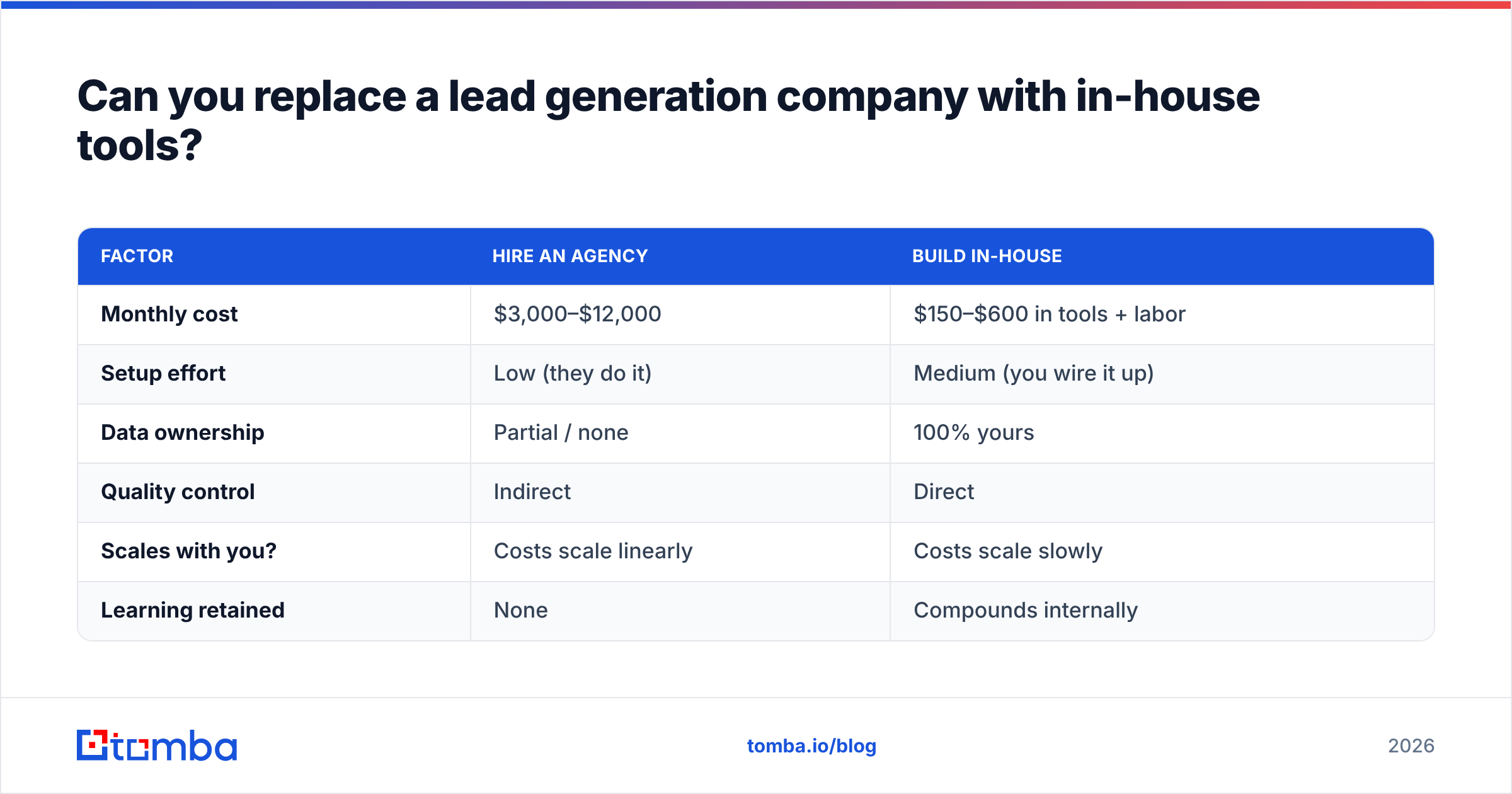
Yes — for most teams with at least one person owning outbound, and usually for less money. The catch is that you're trading a managed service for a workflow you have to run. Here's the honest trade-off:
| Factor | Hire an agency | Build in-house |
|---|---|---|
| Monthly cost | $3,000–$12,000 | $150–$600 in tools + labor |
| Setup effort | Low (they do it) | Medium (you wire it up) |
| Data ownership | Partial / none | 100% yours |
| Quality control | Indirect | Direct |
| Scales with you? | Costs scale linearly | Costs scale slowly |
| Learning retained | None | Compounds internally |
The in-house stack is not complicated. You need three things working together:
- Find the contacts. An email finder turns a name and company domain into a verified professional email. Pair it with domain search to pull every reachable contact at a target account.
- Clean the list. Verification and catch-all checks strip out the addresses that will bounce before you ever hit send.
- Run the outreach. A sequencer or your CRM handles cadence, follow-up, and tracking.
That's the entire engine a $7k/mo agency is charging you for. The tools are commodities now; the strategy and the offer are what actually move reply rates — and nobody knows your offer better than you.
To put real numbers on it: Tomba's pricing starts at a free tier with 25 searches per month, then $49/mo for Starter, $99/mo for Growth, and $249/mo for Pro. Even the Pro plan is cheaper than two booked appointments from a mid-tier agency. The math is not subtle.
How do you vet a B2B lead generation company before signing?#
Run this checklist on every shortlisted vendor. Treat any "we can't share that" as a no.
- Ask for cost-per-meeting math, not lead volume. Volume is vanity; meetings booked and pipeline created are the real numbers.
- Request three references in your industry — and actually call them.
- Read the offboarding clause. Confirm you keep the data and the domains.
- Pilot before you commit. A 30–60 day paid pilot with a clear success metric beats a 12-month contract every time.
- Verify their verification. Ask what their bounce rate is and how they measure it. Cross-check against independent reviews on G2 rather than testimonials on their own site.
- Confirm compliance. GDPR, CAN-SPAM, and CCPA handling should be documented, not assumed. HubSpot's guide to lead generation is a solid neutral baseline for what compliant practice looks like.
A company that answers all six crisply is worth a pilot. One that dodges even two is selling you opacity, and opacity in lead gen almost always means recycled lists and inflated reporting.
Frequently asked questions#
Are B2B lead generation companies worth it? For teams without an outbound function and with budget to absorb a 6–8 week ramp, yes. For teams that already have an SDR and a CRM, an in-house tool stack usually delivers more meetings per dollar and keeps the data.
What's the difference between a lead gen agency and a data provider? An agency runs outreach and books meetings for you. A data provider sells you verified contacts and enrichment; you run the outreach. Agencies cost more and own more of the process; data providers are cheaper and leave you in control.
How fast should I expect results? Pay-per-lead vendors can deliver in 2–4 weeks. Retainer agencies typically need 4–8 weeks to ramp. An in-house finder-and-sequencer setup can start producing contacts the same day, with replies following your cadence.
Is buying email lists a good idea? Buying static, pre-built lists is risky — they're often stale, non-exclusive, and full of bounces. Generating fresh, verified contacts on demand with an email finder and verifier is far safer for your sender reputation.
The bottom line#
Lead generation companies make sense when you're buying a team and a head start you genuinely can't build in time. But once you have a single person owning outbound, the recurring cost of an agency rarely beats a sharp in-house stack — and the in-house route keeps the data, the learning, and the margin inside your business.
If you're leaning toward building it yourself, start with the part every campaign depends on: accurate contacts. The Tomba Email Finder turns names and company domains into verified professional emails, with verification, domain search, and data enrichment built into the same platform. Spin up the free tier, find your first 25 prospects today, and measure your real cost-per-meeting before you sign any retainer. The comparison usually makes the decision for you.
// get started
Find, verify and enrich your first contacts today
Start on the free plan with 25 searches a month, then scale when your team is ready.
Free plan · No credit card required · GDPR & CCPA
// about the author