B2B Lead Generation Companies in USA: 2026 Buyer's Guide
A neutral, side-by-side look at the top B2B lead generation companies in the USA for 2026 — pricing, models, and how to pick the right partner without burning budget.
Picking a lead generation partner in the United States is mostly a question of where your bottleneck actually is. Most teams over-buy: they hire a full-service appointment-setting agency when what they really needed was clean contact data and a better outbound motion. This guide separates the categories, names representative players, and gives you a framework so you don't pay agency margins for work a $99/month tool could do.
TL;DR#
- B2B lead generation companies in the USA split into four models: full-service agencies, appointment-setters, data/intelligence providers, and self-serve prospecting tools. They are not interchangeable.
- Agencies charge $3,000–$15,000+/month and own the whole funnel; data tools charge $49–$249/month and hand you the raw material to run it yourself.
- Data quality is the hidden variable. A great agency on bad data still books garbage meetings. Verify before you outsource.
- Most mid-market teams win with a hybrid: a self-serve data stack (finder + verifier + enrichment) plus a fractional SDR or a focused agency for the human touch.
- Tomba sits in the data layer — accurate, verified B2B emails by domain or name — so whichever model you choose, the contacts going in are real.
What do "B2B lead generation companies" actually mean in the USA?#
The phrase covers four very different businesses that get lumped under one search term. Knowing which one you're talking to is the entire game.
- Full-service demand-gen agencies — They run paid ads, content, SEO, and nurture to generate inbound leads end to end. Think Belkins, CIENCE, or Martal Group. You pay for outcomes (MQLs/SQLs) and hand over a lot of strategic control.
- Appointment-setting / outbound agencies — They write the sequences, do the sending, and book calls onto your reps' calendars. The deliverable is meetings, not data.
- Data and intelligence providers — They sell access to contact databases, intent signals, and enrichment. ZoomInfo, Apollo, Clearbit, and Cognism live here. You get the fuel; you drive.
- Self-serve prospecting tools — Lower-cost, API-first products that find and verify business emails and phone numbers on demand. This is where a B2B database and an email finder like Tomba fit.
The mistake that wastes the most money is buying category 1 when your real gap is category 3 or 4. If you already have SDRs and a working pitch, you don't need an agency — you need better contacts.
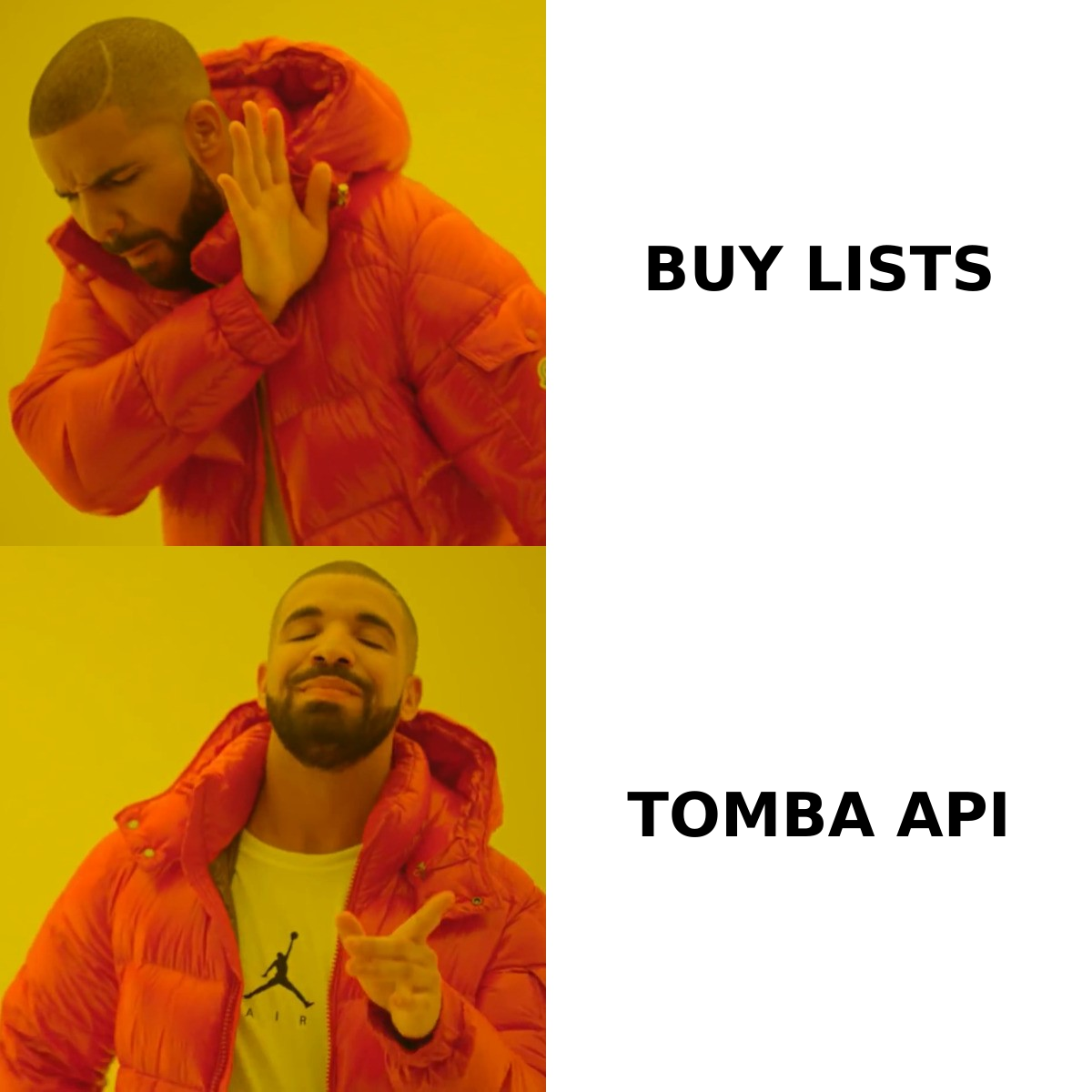
Which model fits your team? A side-by-side comparison#
Here's the honest trade-off table. "Control" means how much you keep; "speed to first lead" assumes you're starting from zero.
| Model | Typical US pricing | Control you keep | Speed to first lead | Best for |
|---|---|---|---|---|
| Full-service demand-gen agency | $5,000–$15,000+/mo | Low | 30–60 days | Funded teams with no in-house marketing |
| Appointment-setting agency | $3,000–$8,000/mo + per-meeting | Medium-low | 2–4 weeks | Teams with reps but no SDR engine |
| Data / intelligence platform | $1,000–$4,000+/mo (annual) | High | Days | RevOps-led orgs running their own outbound |
| Self-serve prospecting tool | $49–$249/mo | Full | Hours | Founders, SMBs, lean growth teams |
The further down this table you go, the more work you do yourself — and the less you pay per lead. A $99/month tool that finds verified emails can replace the data portion of a $5,000/month retainer. What it can't replace is the human who writes the copy and works the replies. That's the real decision: are you buying labor, or are you buying data?
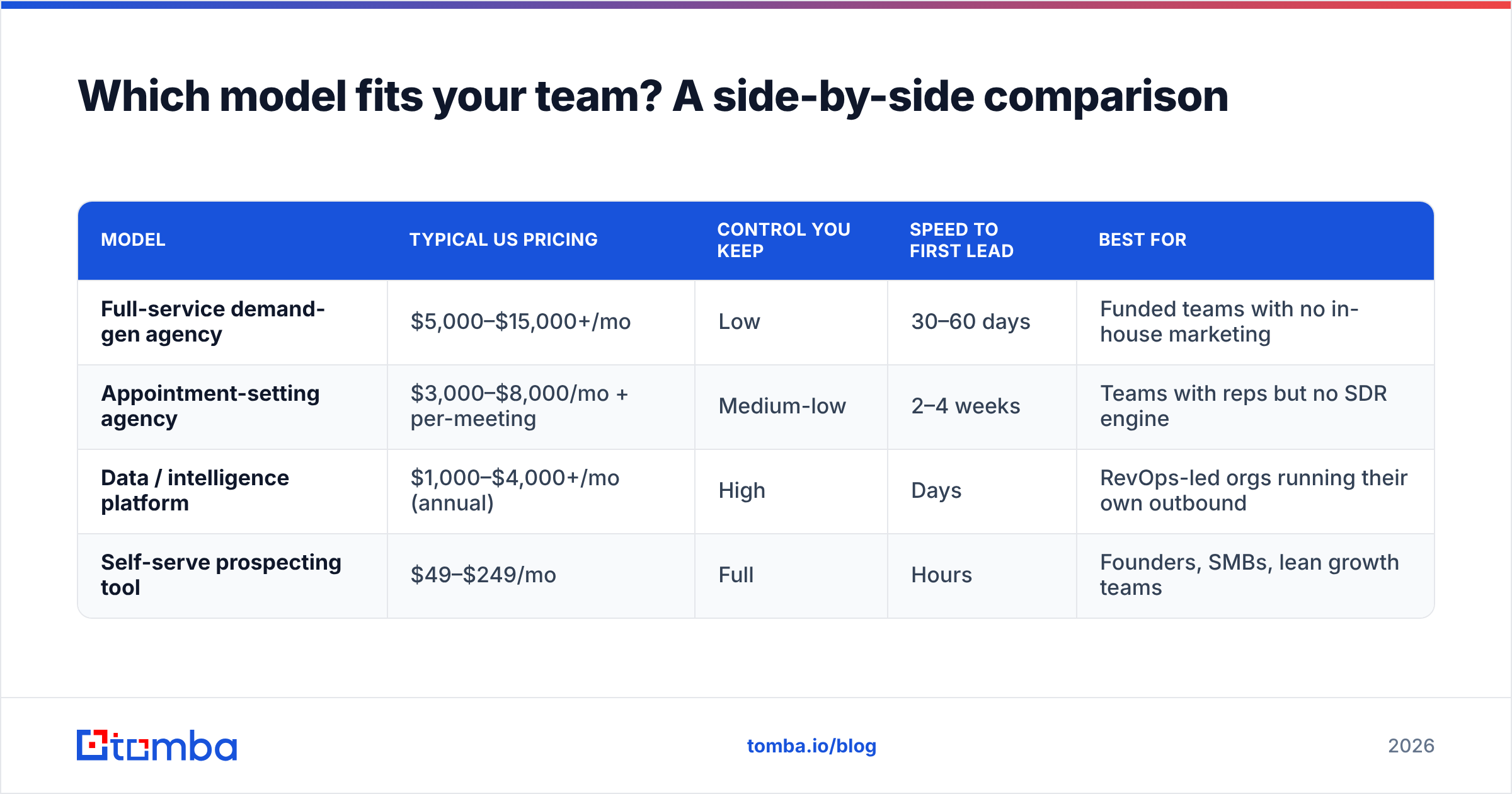
What separates a good lead gen company from an expensive one?#
Three things, in order of impact.
- Data accuracy. Everything downstream multiplies off this number. A 70% deliverable list means 30% of your spend bounces before a human ever reads it — and high bounce rates wreck your sender reputation, which then suppresses the good 70%. Ask any vendor for their verified-deliverability rate and how recently the data was re-checked.
- Targeting depth. "We have 250M contacts" is a vanity number. The question is whether they can filter to your ICP — VP of Engineering at Series B SaaS companies in Texas using a specific tech stack — and still return enough volume.
- Transparency of method. Agencies that won't tell you which tools and lists they use are usually marking up the same data you could license directly. According to peer-review sites like G2, the highest-rated providers are consistently the ones that show their sourcing.
Run a small paid pilot before any annual contract. Give two vendors the same 100-account target list and compare match rate, deliverability, and the quality of the contacts returned. The winner is usually obvious within a week.
Is it better to outsource or build in-house in 2026?#
Build in-house if you have — or can hire — one person who owns the motion. The economics have shifted hard toward self-serve since 2023. Tools that used to require enterprise contracts now have flat monthly pricing and APIs, so a single growth hire with the right stack outperforms a mid-tier agency at a fraction of the cost.
A workable in-house stack looks like this:
- Find contacts: domain search to pull every email pattern at a target company, plus an email finder for named prospects.
- Verify before sending: an email verifier to strip invalids and protect deliverability.
- Enrich and route: data enrichment to add titles, company size, and tech stack, then push into your CRM.
- Send and follow up: a sequencing tool plus a real human reviewing replies.
Outsource if speed matters more than margin, if you have budget but no headcount, or if you're testing a new market and don't want to commit to building. Just keep ownership of the data and the domain reputation — that way, when the contract ends, you keep the asset.

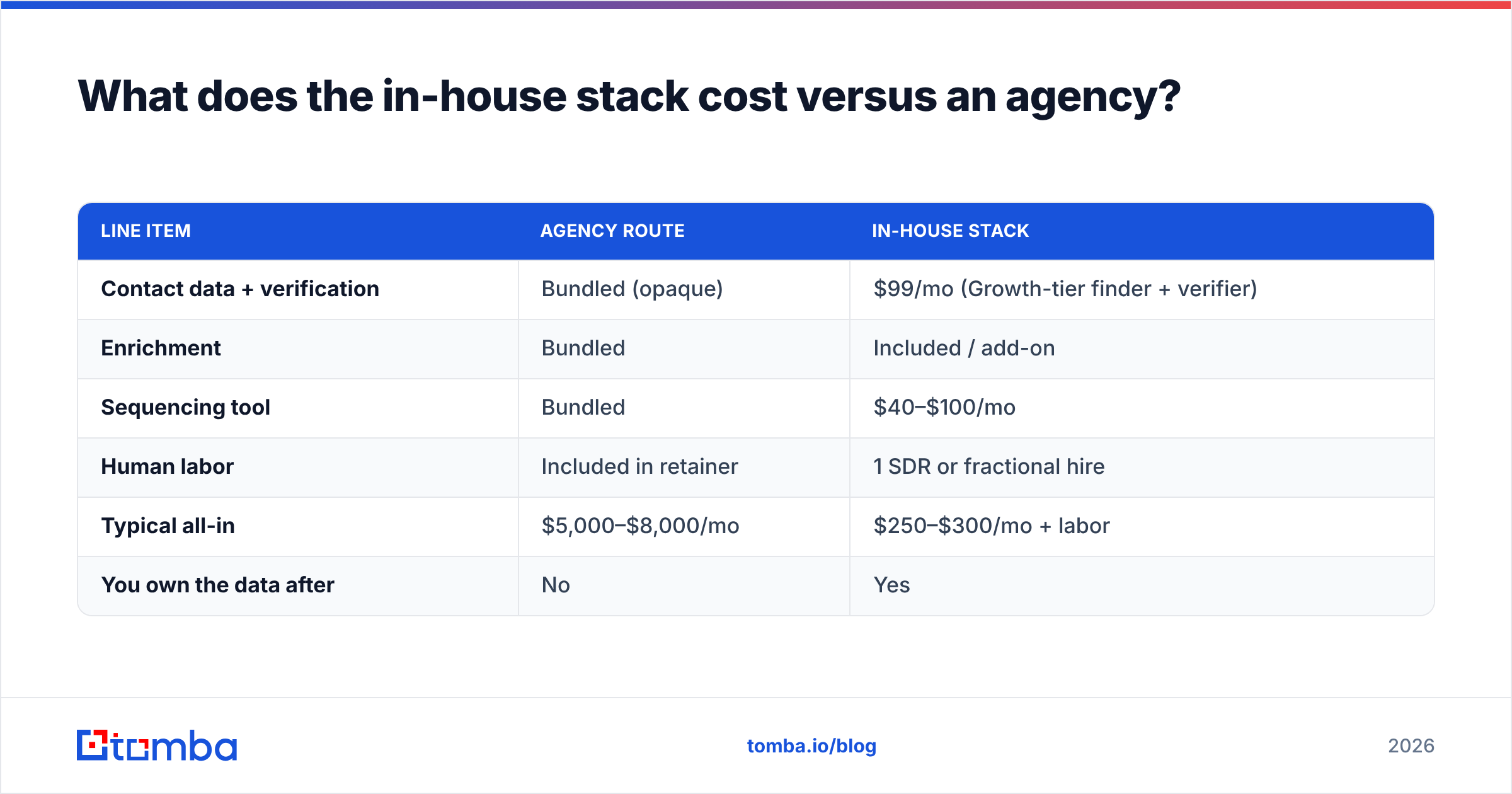
What does the in-house stack cost versus an agency?#
Here's a concrete monthly comparison for a team targeting ~2,000 new contacts a month.
| Line item | Agency route | In-house stack |
|---|---|---|
| Contact data + verification | Bundled (opaque) | $99/mo (Growth-tier finder + verifier) |
| Enrichment | Bundled | Included / add-on |
| Sequencing tool | Bundled | $40–$100/mo |
| Human labor | Included in retainer | 1 SDR or fractional hire |
| Typical all-in | $5,000–$8,000/mo | $250–$300/mo + labor |
| You own the data after | No | Yes |
Tomba's own pricing anchors the data line: a Free tier with 25 searches/month to test, Starter at $49/month, Growth at $99/month, and Pro at $249/month for higher-volume teams. The point isn't that tools are always cheaper — it's that you should know exactly what the data costs before an agency bundles it into an untraceable retainer.
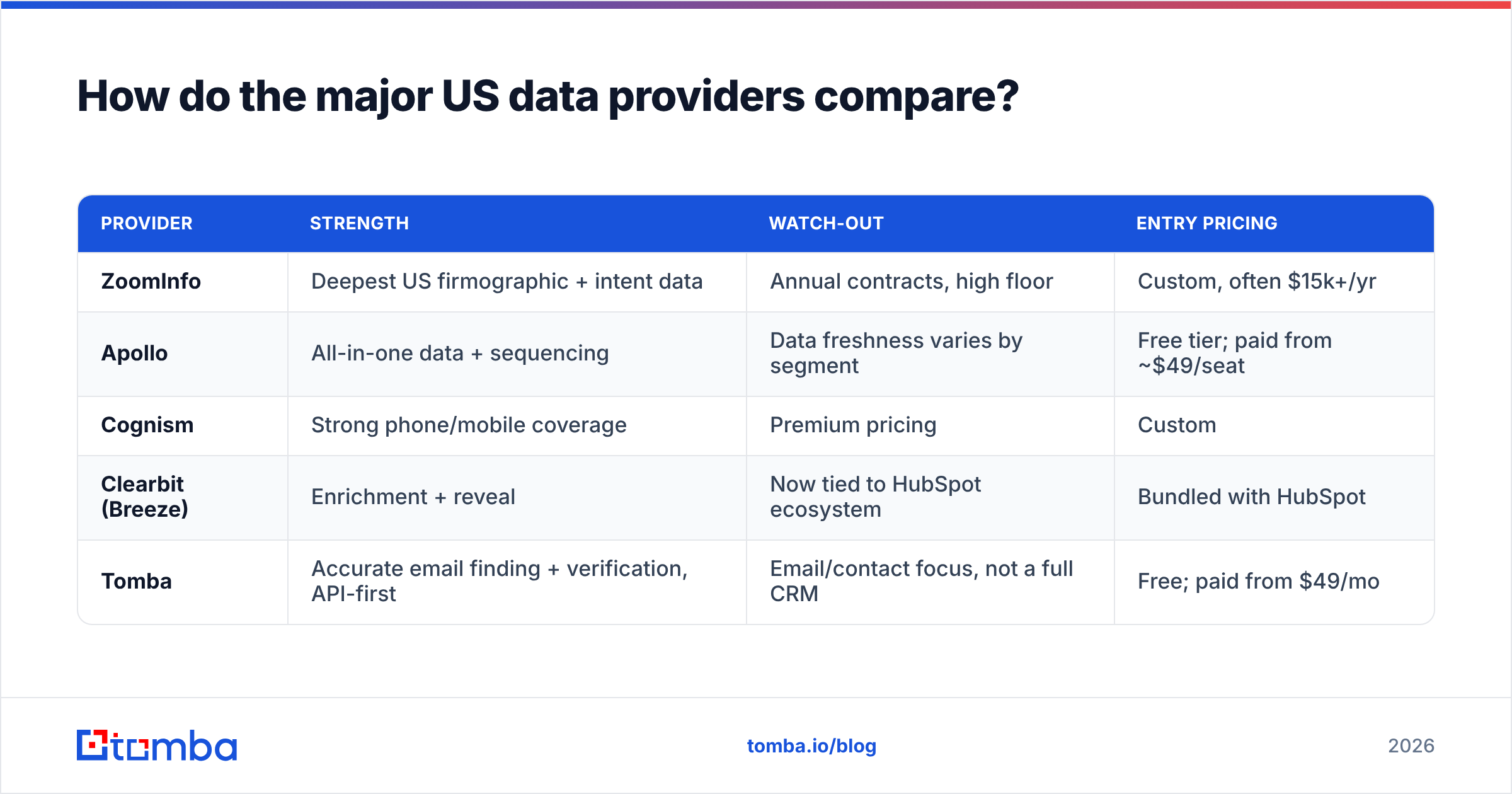
How do the major US data providers compare?#
If you go the data-platform route, these are the names you'll evaluate. This is a neutral read on where each leans.
| Provider | Strength | Watch-out | Entry pricing |
|---|---|---|---|
| ZoomInfo | Deepest US firmographic + intent data | Annual contracts, high floor | Custom, often $15k+/yr |
| Apollo | All-in-one data + sequencing | Data freshness varies by segment | Free tier; paid from ~$49/seat |
| Cognism | Strong phone/mobile coverage | Premium pricing | Custom |
| Clearbit (Breeze) | Enrichment + reveal | Now tied to HubSpot ecosystem | Bundled with HubSpot |
| Tomba | Accurate email finding + verification, API-first | Email/contact focus, not a full CRM | Free; paid from $49/mo |
Apollo and ZoomInfo are platforms; Tomba is a focused data layer you can drop into any workflow via the Tomba API or native integrations with HubSpot, Salesforce, and Pipedrive. If you want a single suite and have the budget, the platforms make sense. If you want accurate emails without paying for a CRM you already have, the focused tool wins. (HubSpot's own lead generation guides are a solid neutral primer if you're still mapping the space.)
How do you vet a US lead gen company before signing?#
Use this checklist on every shortlisted vendor — agency or tool.
- Ask for a deliverability guarantee. Reputable data providers will commit to a bounce rate (often under 5%) and credit you for bad records. No guarantee is a red flag.
- Confirm the data is re-verified, not just collected. Static databases rot at roughly 25–30% per year as people change jobs. Ask how often records are re-checked.
- Test catch-all handling. Many B2B domains accept all mail, which fools weak verifiers. A serious provider has a dedicated catch-all verifier so you're not flying blind on those domains.
- Run a 100-contact pilot. Compare match rate and deliverability against your own send data, not the vendor's marketing.
- Check compliance. Confirm GDPR/CCPA handling and where the data is sourced. Vendor docs and analyst sites like Gartner are useful neutral references.
If a vendor passes all five, they're worth a paid trial. If they dodge two or more, keep looking — the US market is crowded enough that you don't have to settle.
Which option should you choose?#
Match the model to your actual constraint, not the loudest sales pitch:
- No team, real budget, need leads fast: a full-service or appointment-setting agency. Keep ownership of the data and domain.
- A rep or two but no SDR engine: an appointment-setter, or a fractional SDR plus a data stack.
- RevOps-led, running your own outbound: license data directly and skip the agency margin.
- Founder or lean SMB: a self-serve stack — finder, verifier, enrichment — and one person who owns it.
Whatever you choose, the data layer is the part you should never compromise on, because every other dollar in the funnel compounds off it.
Start with data you can trust#
Before you sign an agency retainer or stand up an outbound team, fix the input. The Tomba Email Finder finds professional email addresses by domain, name, or company and verifies them in the same pass, so the contacts entering your funnel are real — not a recycled list that bounces and drags your sender reputation down. Start free with 25 searches a month, scale to the Growth plan at $99/month when you're ready, and plug it straight into your CRM via the API. Whether you build in-house or hire out, accurate data is the one decision that makes every other one pay off.
// get started
Find, verify and enrich your first contacts today
Start on the free plan with 25 searches a month, then scale when your team is ready.
Free plan · No credit card required · GDPR & CCPA
// about the author