B2B Lead Generation Consulting in 2026: Worth It?
What B2B lead generation consulting actually delivers, what it costs, and how to know whether to hire a consultant or build the engine in-house in 2026.
You are weighing whether to pay someone else to fill your pipeline. Before you sign a retainer, here is what B2B lead generation consulting really is, what it costs in 2026, and the honest test for whether you need it at all.
TL;DR#
- B2B lead generation consulting is paid expertise that designs and often runs your outbound and inbound demand engine — targeting, data, messaging, channels, and measurement — instead of just handing you raw leads.
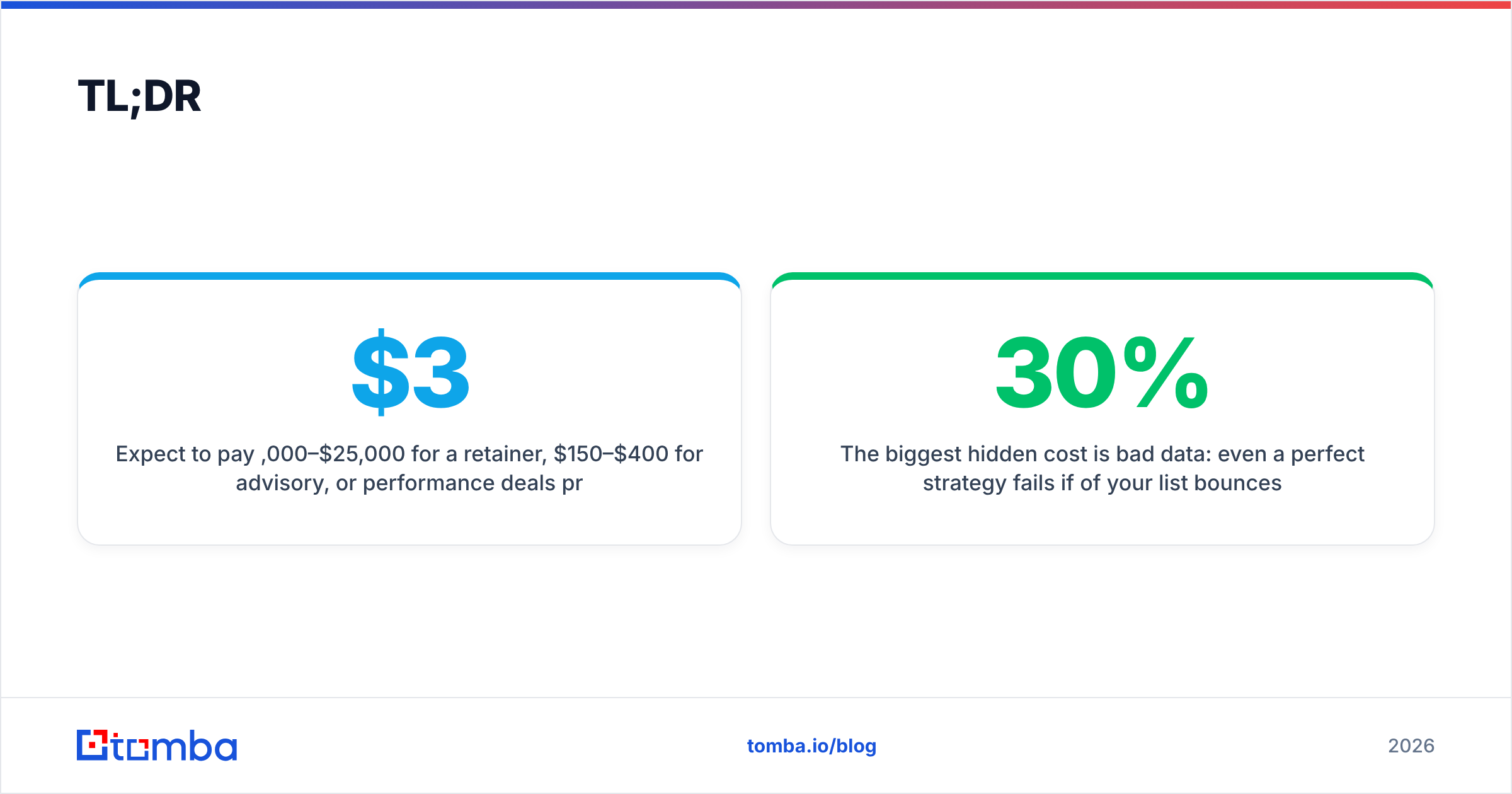
- Expect to pay $3,000–$25,000/month for a retainer, $150–$400/hour for advisory, or performance deals priced per qualified meeting.
- Consultants earn their fee when you lack an internal playbook, are entering a new market, or your current outbound has stalled — not when you simply need more contact data.
- The biggest hidden cost is bad data: even a perfect strategy fails if 30% of your list bounces. Tooling like a B2B database and verification belongs in the plan from day one.
- For many teams, a lean in-house stack plus an email finder beats a five-figure retainer. This guide helps you tell which camp you are in.
What is B2B lead generation consulting?#
B2B lead generation consulting is hiring an outside specialist to build, fix, or scale the system that turns strangers into qualified sales conversations. Think of it like hiring an architect before you pour concrete: you could lay bricks yourself, but a good architect saves you from building a house with no doors.
A consultant is not a lead list vendor. A list vendor sells you 5,000 contacts and disappears. A consultant diagnoses why your pipeline is thin and redesigns the machine that produces it. That usually spans five areas:
- Ideal customer profile (ICP) and targeting — defining exactly who to chase and who to ignore, then turning that into a buildable list.
- Data and contact sourcing — where the names, emails, and phone numbers come from, and how clean they are.
- Channel strategy — the mix of cold email, LinkedIn, phone, paid, and content that fits your motion.
- Messaging and offer — the sequences, hooks, and positioning that actually get replies.
- Measurement and handoff — how a marketing qualified lead becomes a sales-accepted opportunity, and how you track it.
Good consultants leave you with a repeatable playbook. Mediocre ones leave you with a dependency.
What does a lead generation consultant actually deliver?#
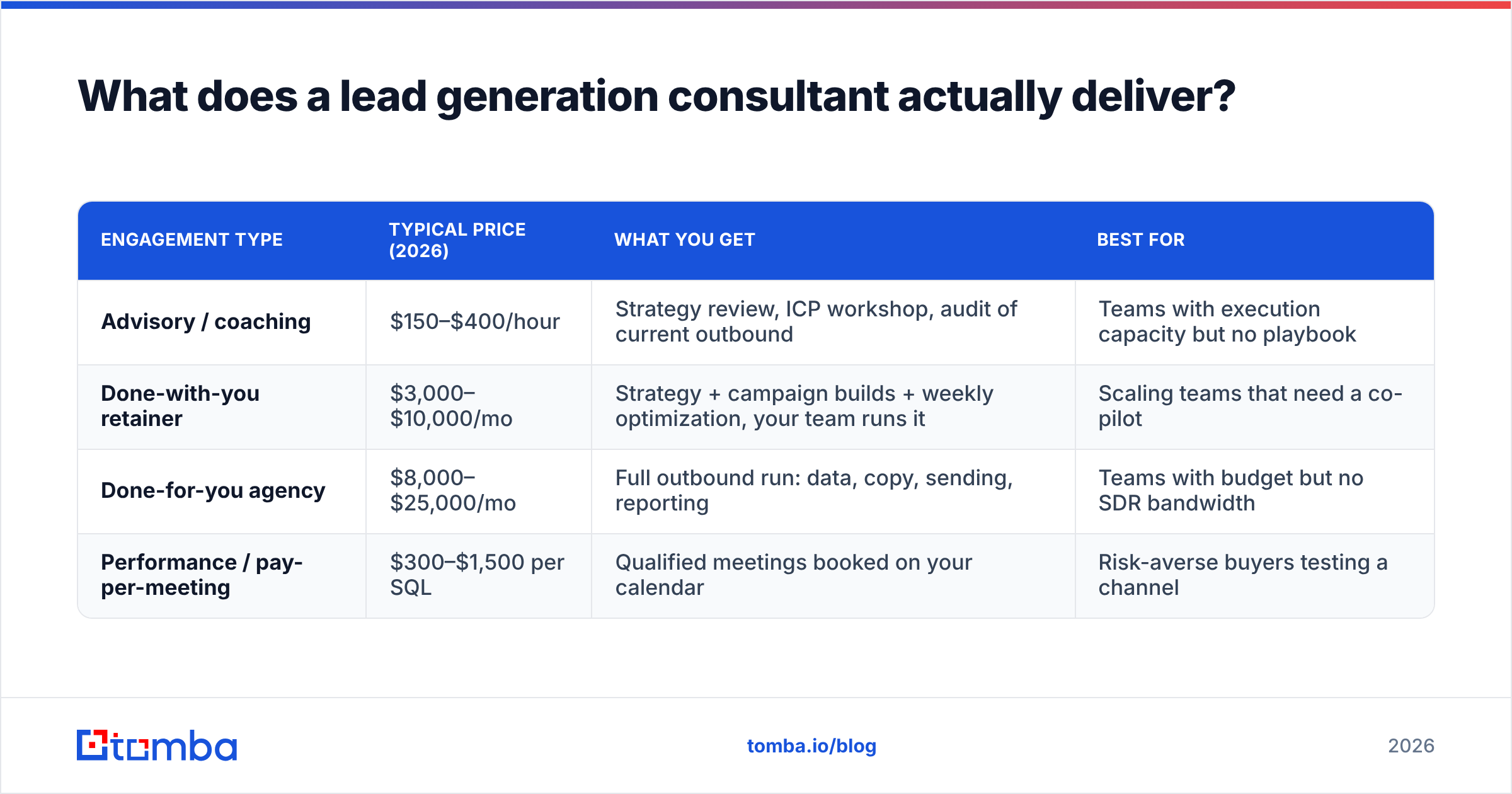
The deliverables vary by engagement type, but a serious consultant produces tangible artifacts, not just slides. Here is what the three common models look like side by side.
| Engagement type | Typical price (2026) | What you get | Best for |
|---|---|---|---|
| Advisory / coaching | $150–$400/hour | Strategy review, ICP workshop, audit of current outbound | Teams with execution capacity but no playbook |
| Done-with-you retainer | $3,000–$10,000/mo | Strategy + campaign builds + weekly optimization, your team runs it | Scaling teams that need a co-pilot |
| Done-for-you agency | $8,000–$25,000/mo | Full outbound run: data, copy, sending, reporting | Teams with budget but no SDR bandwidth |
| Performance / pay-per-meeting | $300–$1,500 per SQL | Qualified meetings booked on your calendar | Risk-averse buyers testing a channel |
Notice the spread. The same words — "lead gen consulting" — cover a $200 strategy call and a $25,000/month outsourced sales floor. Always force the conversation toward specifics: how many touches, on what channels, with what data source, measured how.
A useful gut check from buyer reviews on G2 and Capterra: the engagements that get the worst ratings are almost always the vague performance deals where "qualified" was never defined. Get the SQL definition in writing.
How much does B2B lead generation consulting cost?#
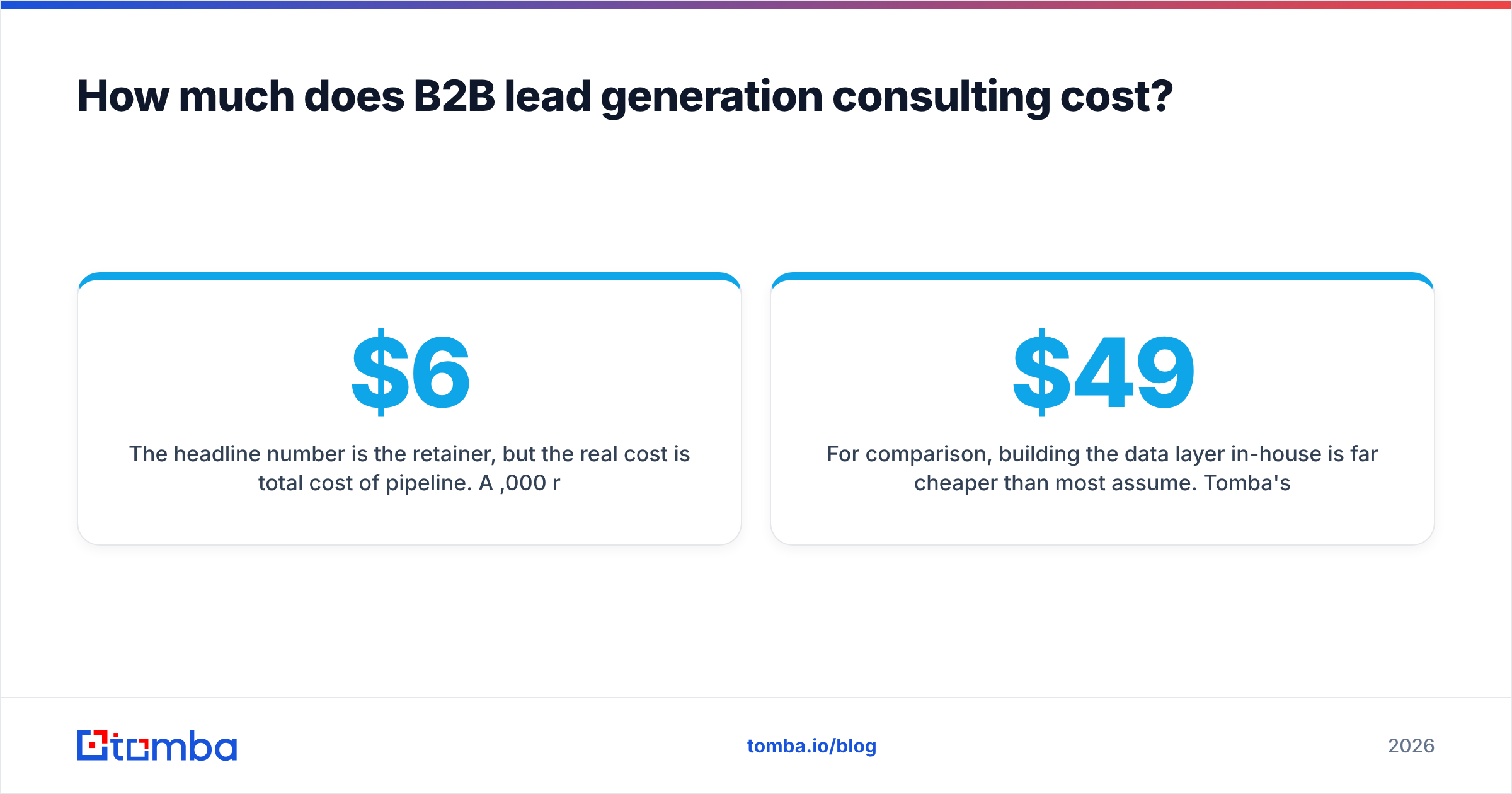
The headline number is the retainer, but the real cost is total cost of pipeline. A $6,000/month retainer that produces 12 meetings costs you $500 per meeting before you add the tools the consultant uses on your behalf — data platforms, sending infrastructure, and CRM seats often get billed back to you or expected as your responsibility.
Build your budget around three buckets:
- The fee — the retainer or hourly rate above.
- The stack — data sourcing, verification, sending, and CRM. This is where teams underestimate. A consultant's strategy assumes clean contact data exists; sourcing and cleaning it is a line item, not an afterthought.
- Your time — even done-for-you engagements need weekly feedback, lead review, and fast sales follow-up. Budget several hours a week internally.
For comparison, building the data layer in-house is far cheaper than most assume. Tomba's pricing runs from a free tier (25 searches/month) to Starter at $49/mo, Growth at $99/mo, and Pro at $249/mo — a rounding error next to a five-figure retainer. The consultant's value has to come from strategy and execution, not from access to data you can source yourself.
Is hiring a consultant better than building in-house?#
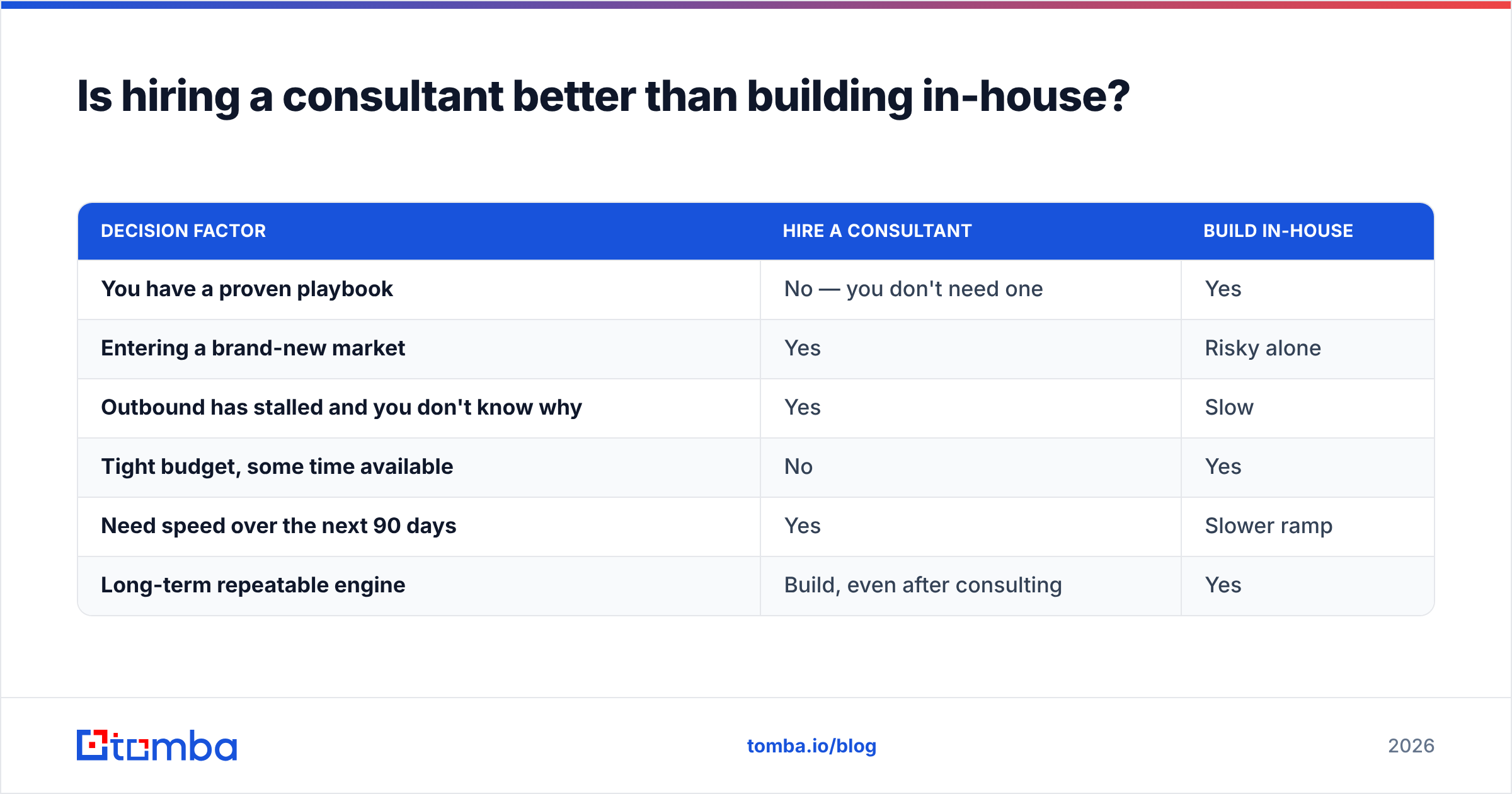
It depends on which of two problems you actually have: a knowledge gap or a capacity gap.
If you do not know what to do — your ICP is fuzzy, your outbound has never worked, you are entering a market you do not understand — that is a knowledge gap, and a consultant is often the fastest fix. They have run the experiments you are about to pay to run yourself.
If you already know what to do but lack the hands to do it, that is a capacity gap. Here, a consultant is an expensive way to buy execution you could hire or tool your way into. A junior SDR plus a solid data stack frequently beats a retainer on cost per meeting.
| Decision factor | Hire a consultant | Build in-house |
|---|---|---|
| You have a proven playbook | No — you don't need one | Yes |
| Entering a brand-new market | Yes | Risky alone |
| Outbound has stalled and you don't know why | Yes | Slow |
| Tight budget, some time available | No | Yes |
| Need speed over the next 90 days | Yes | Slower ramp |
| Long-term repeatable engine | Build, even after consulting | Yes |
The smartest pattern combines both: hire a consultant for a fixed 60–90 day engagement to build the playbook, then run it in-house with your own tooling. You buy the knowledge once instead of renting it forever.

What separates a good consultant from a expensive one?#
The market is crowded, and the gap between the best and worst is enormous. Use these signals.
Green flags:
- They obsess over your ICP before pitching tactics. Strategy starts with who, not how.
- They name their data sources. A consultant who is cagey about where contacts come from is hiding either scraping you can't legally use or a list that's two years stale.
- They define "qualified" in writing. No definition, no deal.
- They plan for deliverability. Anyone serious will discuss sender reputation, warmup, and verification — because volume without email deliverability just burns your domain.
- They build for handoff. The goal is your independence, not your dependence.
Red flags:
- Guarantees of a specific lead count with no ICP discussion.
- Per-lead pricing with a vague quality bar.
- No mention of data hygiene or bounce rates.
- Locked-in 12-month contracts before any pilot.
- Reporting that counts "leads" but never traces to revenue or win rate.
A reliable filter: ask how they keep bounce rates under 3%. A real practitioner will immediately talk about verification and catch-all handling. A reseller will change the subject.
Why does data quality decide the whole engagement?#
Because the best strategy in the world dies on a dirty list. If a consultant builds you a brilliant sequence and sends it to a database where a third of the addresses bounce, your domain reputation tanks, your inbox placement collapses, and the campaign fails — not because the strategy was wrong, but because the foundation was rotten.
This is the single most common reason lead gen engagements underperform, and it is entirely preventable. The fix is unglamorous:
- Source from a maintained database. A current B2B database beats a scraped CSV every time.
- Verify before you send. Run every address through an email verifier so bounces never leave your outbox.
- Handle catch-all domains deliberately. Many corporate domains accept everything, so a catch-all verifier tells you which "valid" addresses are actually risky.
- Enrich for relevance. Data enrichment adds the firmographic detail that lets you personalize at scale.
If you are running outbound at volume, a bulk email finder lets you build and verify lists in batches instead of one contact at a time. Whether you hire a consultant or not, this layer is yours to own — and owning it is what makes you independent of any single vendor.
For deeper grounding on how the modern demand engine fits together, HubSpot's research library is a credible neutral reference, and analyst firms like Gartner publish buyer guides worth reading before you sign anything.
How do you measure whether the consulting is working?#
Set the scorecard before the engagement starts, not after. Track these from week one:
- Cost per qualified meeting — total spend (fee + stack) divided by meetings that met your SQL bar.
- Reply and positive-reply rate — volume is vanity; positive replies predict pipeline.
- Bounce rate — should sit under 3%; anything higher signals a data problem, not a messaging one.
- Pipeline created and win rate — the only metrics your CFO cares about.
- Time to repeatability — how close are you to running this without the consultant?
If after 90 days your cost per meeting is dropping and you can see the playbook taking shape internally, the engagement is working. If you are simply renting meetings with no transfer of knowledge, you have bought an addiction, not a capability.
Frequently asked questions#
How long should a lead generation consulting engagement last? Aim for a defined 60–90 day build, then re-evaluate. Open-ended retainers create dependency. The exception is a done-for-you agency relationship you have consciously chosen because you never intend to build SDR capacity internally.
What is the difference between a consultant and an agency? A consultant primarily transfers strategy and knowledge; an agency primarily executes on your behalf. Many firms blur the line, so ask directly: "At the end, do I run this, or do you?"
Can I do B2B lead generation without any consultant? Yes, if you have a clear ICP and someone to execute. A modern stack — an email finder, verification, and a sending tool — plus a tested sequence covers most early-stage needs at a fraction of a retainer.
What should I never pay for? Unverified lead lists priced per name, contracts with no pilot, and "guaranteed leads" with no quality definition. Those are the most-regretted purchases in every buyer review set.
The bottom line#
B2B lead generation consulting is worth it when you have a knowledge gap and a deadline — when you need a proven playbook fast and are entering territory you do not yet understand. It is a poor buy when you already know what to do and just need cleaner data and more hands. In that case, you are better served owning your data layer and executing yourself.
Either way, the contact data underneath is yours to control. Start by building accurate, verified lists with the Tomba Email Finder — find professional emails by domain, name, or company, verify them before you send, and keep your bounce rate low whether a consultant runs your campaigns or you do. Strategy you can rent; a clean pipeline foundation you should own.
// get started
Find, verify and enrich your first contacts today
Start on the free plan with 25 searches a month, then scale when your team is ready.
Free plan · No credit card required · GDPR & CCPA
// about the author