B2B Lead Generation Guide for 2026: Tactics That Convert
A practical B2B lead generation guide for 2026: build your ICP, pick channels that convert, source accurate contact data, and turn pipeline into revenue.
TL;DR
- B2B lead generation works when you start with a sharp ICP, not a bigger list — targeting beats volume every time.
- Multi-channel beats single-channel: combine outbound email, LinkedIn, content, and intent data instead of betting everything on one.
- Accurate contact data is the silent killer or multiplier — bounce rates above 5% wreck deliverability and waste rep hours.
- Score and route leads fast; speed-to-lead under 5 minutes can multiply conversion rates several times over.
- Tooling matters less than process, but the right email finder and verifier removes the biggest bottleneck: reaching real people.
B2B lead generation is the system you use to turn strangers into qualified buyers who enter your pipeline. This guide walks through the full process — defining who you target, choosing channels, sourcing accurate data, and scoring leads — with concrete numbers and tools you can deploy this quarter.
What is B2B lead generation, really?#
B2B lead generation is the process of identifying companies and people who match your ideal customer, capturing their interest, and collecting permission-based ways to reach them. Think of it like fishing: you can cast a wide net and haul in everything (most of it useless), or you can learn where your specific fish swim and use the right bait. The second approach catches fewer fish but a far higher percentage of keepers.
A "lead" is not a name on a spreadsheet. A real lead has three things: a fit (they match your ICP), a contactable channel (a verified email or phone), and at least a hint of intent (they downloaded something, visited pricing, or replied). Strip any of those away and you have a contact, not a lead.
The mistake most teams make is optimizing for raw volume. Buying a list of 50,000 "decision makers" feels productive. But if 30% of those emails bounce, your sending domain reputation tanks, and the 70% that land go to people who never fit your product. You burn money and your email deliverability at the same time.

What does the B2B lead generation process look like?#
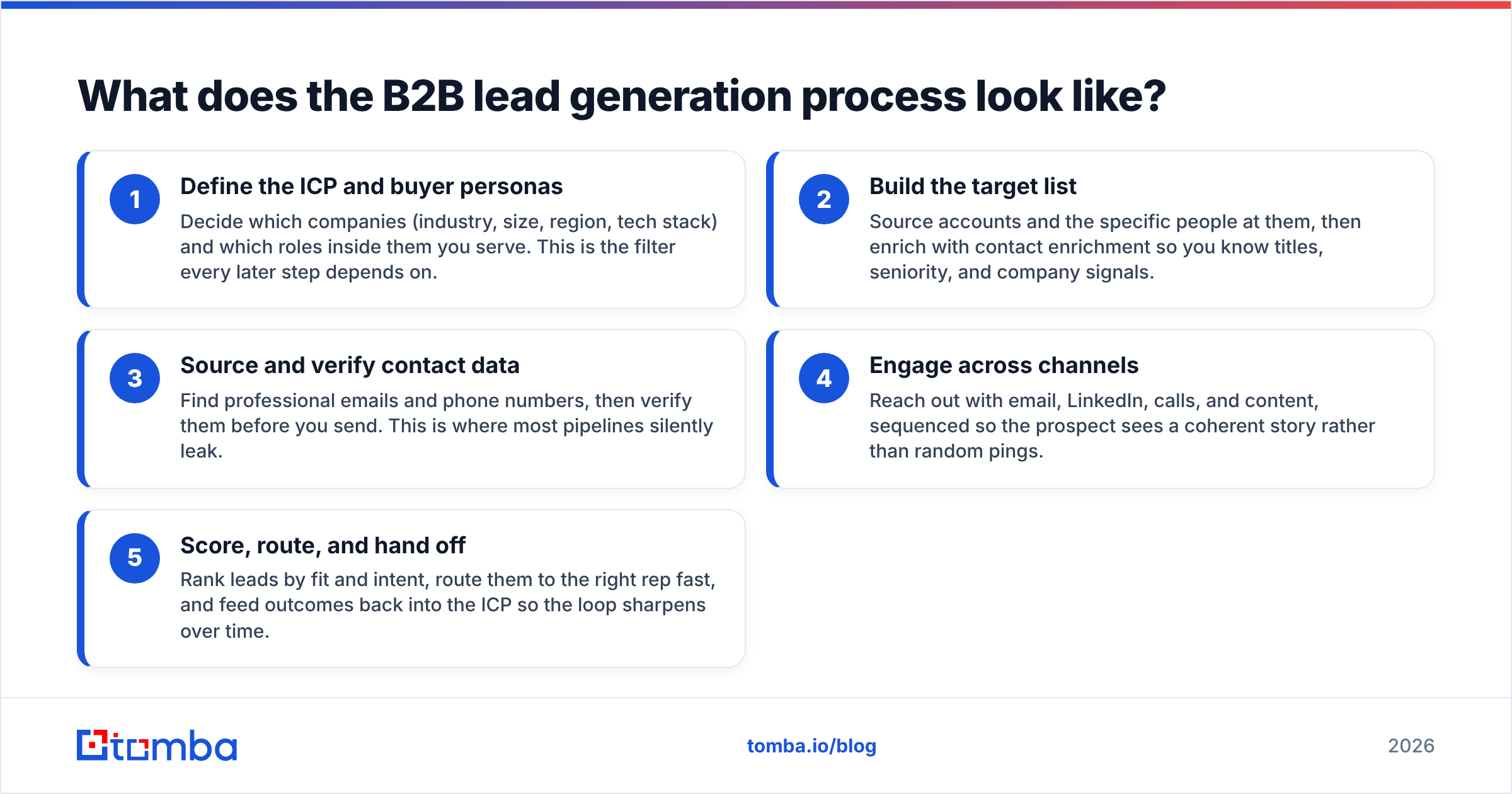
The process has five repeatable stages. Run them as a loop, not a one-time campaign.
- Define the ICP and buyer personas — Decide which companies (industry, size, region, tech stack) and which roles inside them you serve. This is the filter every later step depends on.
- Build the target list — Source accounts and the specific people at them, then enrich with contact enrichment so you know titles, seniority, and company signals.
- Source and verify contact data — Find professional emails and phone numbers, then verify them before you send. This is where most pipelines silently leak.
- Engage across channels — Reach out with email, LinkedIn, calls, and content, sequenced so the prospect sees a coherent story rather than random pings.
- Score, route, and hand off — Rank leads by fit and intent, route them to the right rep fast, and feed outcomes back into the ICP so the loop sharpens over time.
Each stage feeds the next. A flawless email sequence sent to a badly defined list produces nothing. Verified data sent to the wrong personas produces polite rejections. The stages only compound when they're aligned.
How do you build an ICP that actually filters?#
Start with your best existing customers, not your aspirations. Pull your 20 happiest, highest-retention accounts and look for what they share: company size band, industry, the problem they hired you for, and the title of the person who championed the purchase. Those patterns are your ICP — grounded in revenue, not in a brainstorm.
A useful ICP is specific enough to exclude. "Mid-market SaaS companies in North America, 50–500 employees, with a dedicated RevOps function" excludes thousands of accounts on purpose. That exclusion is the point. Every account you rule out is rep time you don't waste.
Layer buyer personas on top of the account profile. In a single target company you might sell to a VP of Sales (economic buyer), a RevOps manager (technical evaluator), and an SDR lead (end user). Each needs a different message, but they share the same account context. Map the marketing qualified lead criteria to these personas so marketing and sales agree on what "qualified" means before any handoff happens.
Which B2B lead generation channels convert best in 2026?#
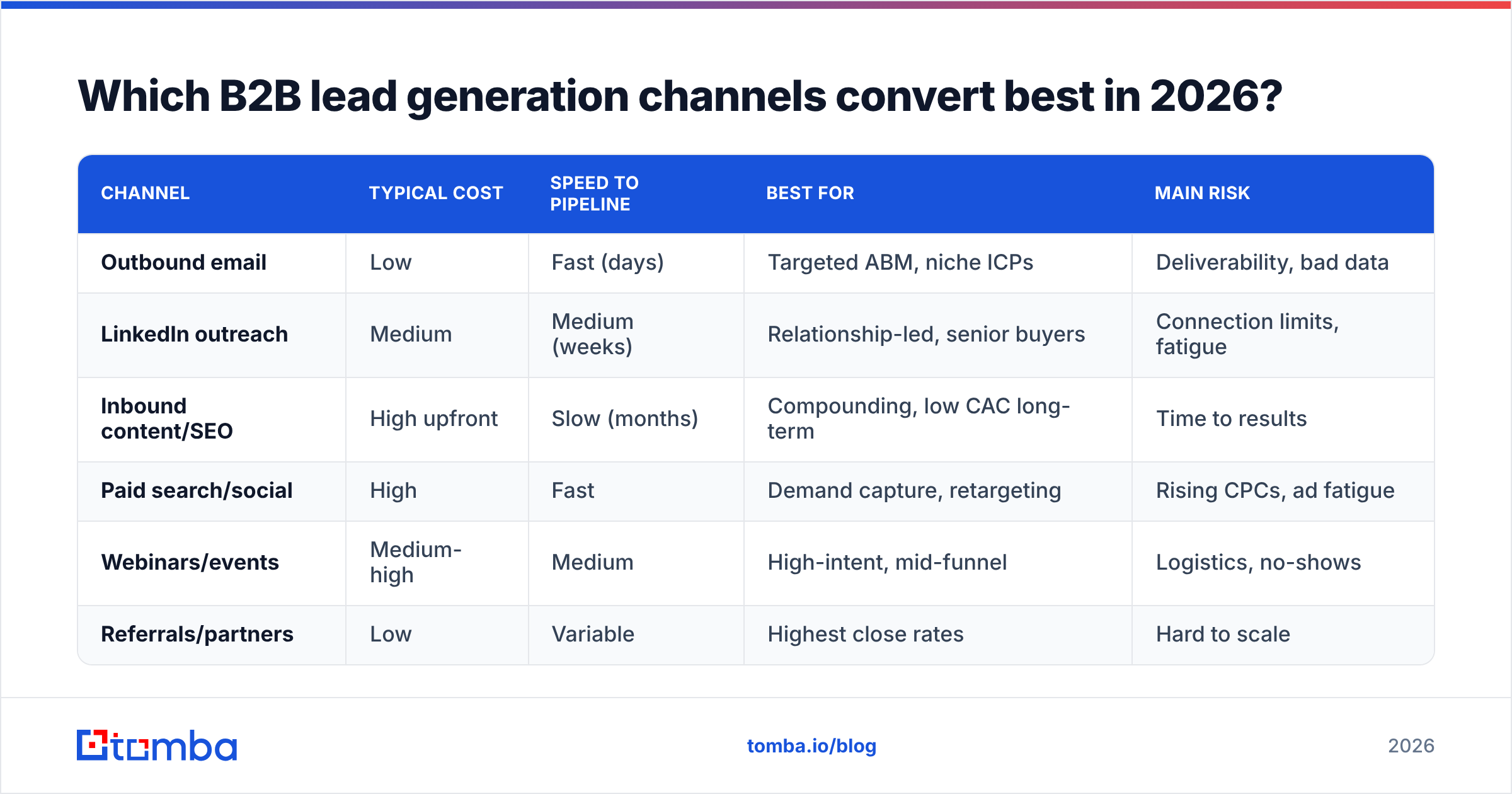
No single channel wins; the combination does. Here's how the major channels compare on the metrics that matter for B2B.
| Channel | Typical cost | Speed to pipeline | Best for | Main risk |
|---|---|---|---|---|
| Outbound email | Low | Fast (days) | Targeted ABM, niche ICPs | Deliverability, bad data |
| LinkedIn outreach | Medium | Medium (weeks) | Relationship-led, senior buyers | Connection limits, fatigue |
| Inbound content/SEO | High upfront | Slow (months) | Compounding, low CAC long-term | Time to results |
| Paid search/social | High | Fast | Demand capture, retargeting | Rising CPCs, ad fatigue |
| Webinars/events | Medium-high | Medium | High-intent, mid-funnel | Logistics, no-shows |
| Referrals/partners | Low | Variable | Highest close rates | Hard to scale |
The right mix depends on your deal size and sales cycle. A $5,000 ACV product can lean on inbound and self-serve. A $150,000 enterprise deal needs outbound, LinkedIn outreach, events, and air cover from content working together. Most teams underinvest in outbound's data foundation and overinvest in clever copy — the order should be reversed.
Whatever channels you pick, the constraint is the same: you need to reach a real human at a real address. That's why data sourcing sits at the center of every channel, not off to the side.
How do you source accurate B2B contact data?#
You source contact data in three layers: find the company, find the person, and verify the contact point before you use it. Skipping the verify step is the single most common cause of failed campaigns.
Start with domain search when you know the company but not the people — it returns the email addresses and patterns associated with a domain, so you can map an org chart quickly. When you have a name and a company, an email finder returns the specific professional address. For inbound that arrives as a raw email, reverse email lookup tells you who the person is and where they work.
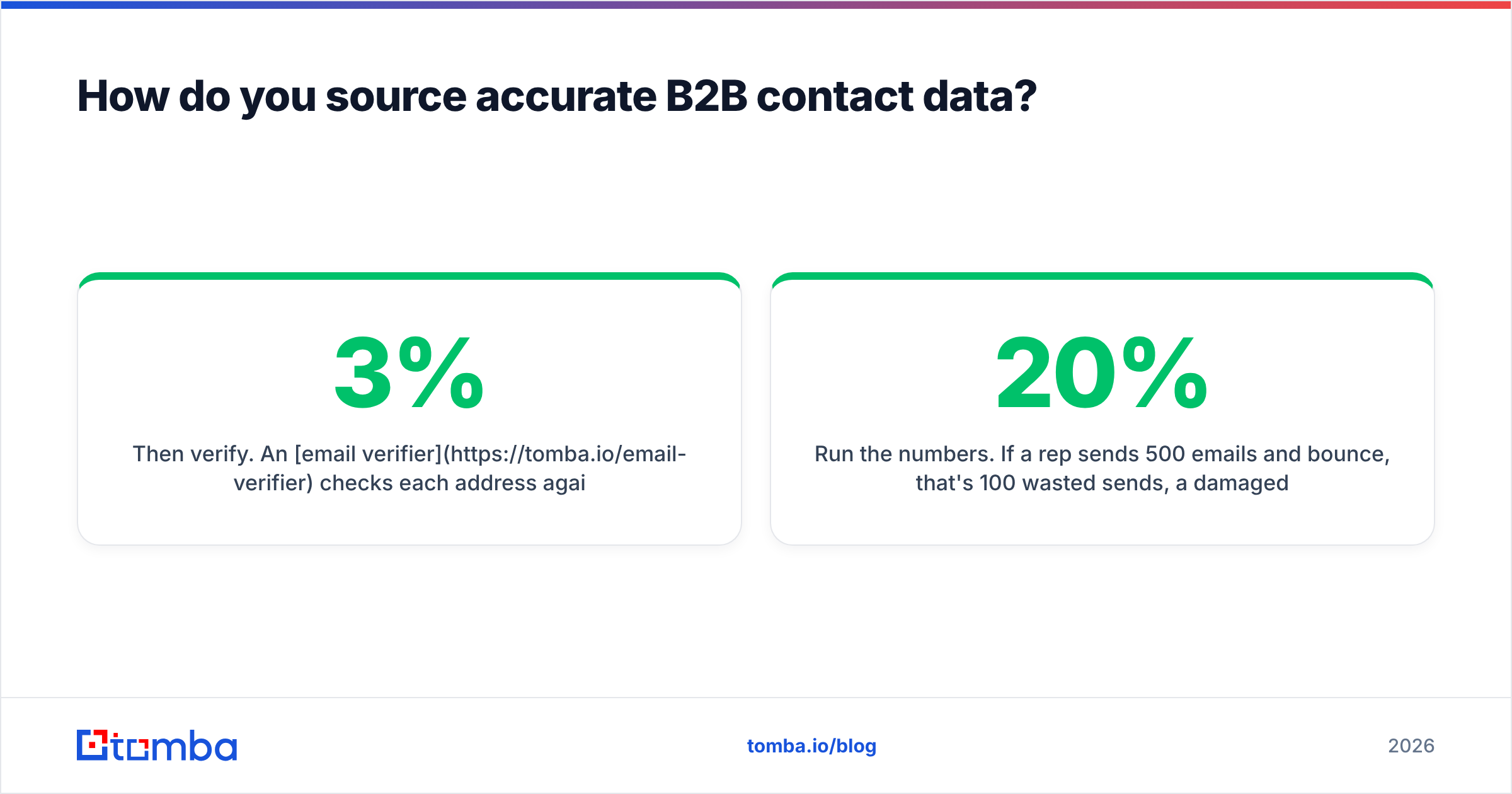
Then verify. An email verifier checks each address against the mail server before you send, catching dead inboxes, typos, and traps. Keep your bounce rate under 3% and your domain reputation stays intact; let it drift past 5% and mailbox providers start routing you to spam regardless of how good your copy is.

For volume, run a bulk email finder over a CSV of accounts and let it find-and-verify in one pass rather than checking addresses by hand. The goal is a list where you trust every row, not a bigger list you half-trust.
Why does data accuracy matter more than list size?#
Because deliverability is a reputation system with a long memory. Mailbox providers track how many of your sends bounce, how many recipients mark you as spam, and how many never engage. A list padded with stale or guessed addresses poisons all three signals at once. Three weeks of sending to bad data can take months to recover from — your good prospects stop seeing you in the inbox at all.
Run the numbers. If a rep sends 500 emails and 20% bounce, that's 100 wasted sends, a damaged domain, and a real chance the other 400 land in spam. Verifying first turns that same effort into 490 delivered messages to real people. The verified list is smaller on paper and far larger in results.
How should you score and route the leads you generate?#
Score leads on two axes: fit and intent. Fit is how closely they match your ICP (industry, size, role). Intent is what they've done (visited pricing, opened three emails, requested a demo). A high-fit, high-intent lead goes to a rep immediately. A high-fit, low-intent lead enters nurture. A low-fit lead, however active, gets disqualified — chasing it wastes the cycle.
Speed of routing matters as much as the score. Research across B2B teams consistently shows that responding within five minutes of a lead's action dramatically outperforms responding an hour later, because you reach the prospect while the problem is still top of mind. Build the routing so a qualified lead lands in a rep's queue automatically, not after a nightly batch job.
Feed outcomes back. When a scored lead closes, note what made it fit; when a "perfect" lead ghosts, note that too. Over a quarter, this loop tightens your ICP and your lead scoring model far more than any vendor's out-of-the-box rules. Track response rate and win rate by source so you know which channel and which data quality actually produces revenue.
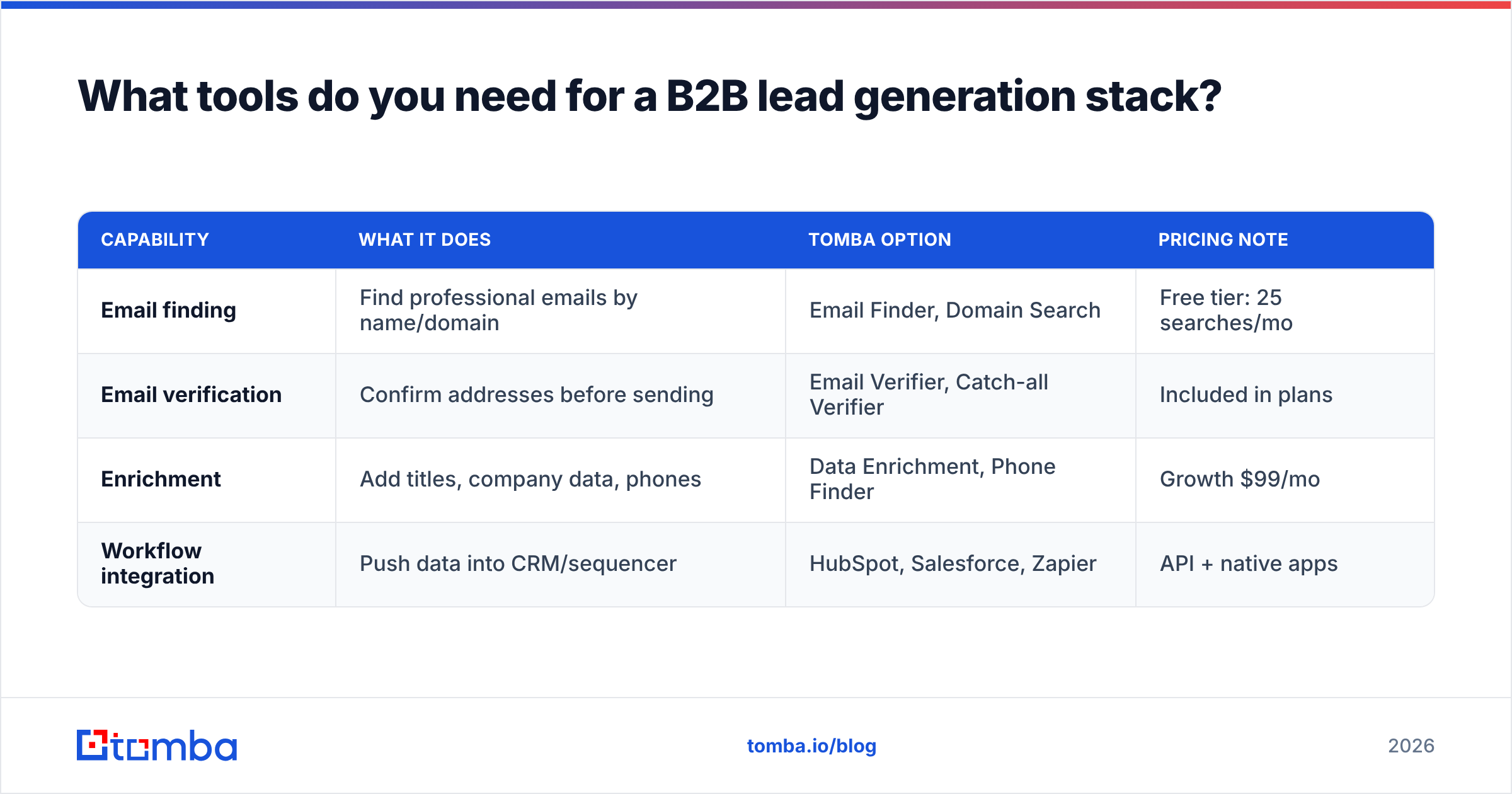
What tools do you need for a B2B lead generation stack?#
You need four capabilities, which a handful of tools cover. Don't over-buy; most teams pay for overlapping platforms they barely use.
| Capability | What it does | Tomba option | Pricing note |
|---|---|---|---|
| Email finding | Find professional emails by name/domain | Email Finder, Domain Search | Free tier: 25 searches/mo |
| Email verification | Confirm addresses before sending | Email Verifier, Catch-all Verifier | Included in plans |
| Enrichment | Add titles, company data, phones | Data Enrichment, Phone Finder | Growth $99/mo |
| Workflow integration | Push data into CRM/sequencer | HubSpot, Salesforce, Zapier | API + native apps |
The integration layer is what people forget. Found-and-verified data only helps if it flows into the tools your reps already live in. Tomba connects to HubSpot, Salesforce, and Zapier, plus a Chrome extension and a Google Sheets add-on for reps who work from a browser or a spreadsheet. Pick tools that meet your team where it already operates.
For pricing, map your monthly contact volume to a plan rather than buying the biggest tier. A team running a few hundred targeted searches a month rarely needs enterprise; the Tomba pricing Starter at $49/mo or Growth at $99/mo covers most early-stage outbound motions, and you can scale up when volume proves the channel works.
If you currently pay for a heavy all-in-one platform mostly for its email-finding feature, compare a focused tool against it directly — many teams switching from broad suites to a dedicated finder cut cost while improving data accuracy, which is the whole reason to compare an Apollo alternative or RocketReach alternative before renewing.
What are the most common B2B lead generation mistakes?#
- Optimizing for volume over fit — A 50,000-row list of the wrong people loses to 500 rows of the right ones.
- Skipping verification — Sending to unverified data quietly destroys deliverability for the whole team.
- One channel, one message — Buyers ignore a single cold email; they respond to a coordinated email-plus-LinkedIn-plus-content sequence.
- Slow lead routing — A perfect lead handed to a rep a day late is a cold lead.
- No feedback loop — Teams that never revisit their ICP keep paying to reach people who'll never buy.
- Treating tools as strategy — Software removes friction; it doesn't decide who to target or what to say.
Avoiding these is mostly discipline, not budget. The teams that win at lead generation aren't the ones with the most tools — they're the ones who define their target tightly, keep their data clean, and move fast on intent.
How do you measure if your lead generation is working?#
Measure at the stage level, not just the top. Track these and you'll know exactly where the pipeline leaks:
- Lead-to-MQL rate — Are the leads you generate actually fitting the ICP?
- MQL-to-SQL rate — Is sales accepting what marketing sends, or rejecting it?
- Email bounce/deliverability rate — Keep bounces under 3%; it's your data-quality canary.
- Response and meeting-booked rate — The real test of channel plus message plus data.
- Cost per qualified lead by channel — Tells you where to reinvest and where to cut.
If your top-of-funnel volume looks healthy but SQLs are flat, the problem is fit or data, not effort. If bounce rates climb, fix sourcing before you touch copy. Let the stage metrics point you to the constraint instead of guessing.
For deeper definitions of the terms above — from revenue operations to sales automation — the B2B glossary is a useful reference when you're aligning marketing and sales on shared language. External benchmarks from sources like HubSpot's research and analyst reviews on G2 help you sanity-check your numbers against the market.
Start with the bottleneck: reaching real people#
Every framework in this guide collapses if you can't reach the buyer. The fastest improvement most B2B teams can make is not a new channel or a cleverer sequence — it's clean, verified contact data flowing into the tools they already use. Fix that, and your existing channels start converting better overnight.
Tomba's Email Finder finds professional email addresses by name, domain, or company and verifies them in the same workflow, so your reps spend time talking to real prospects instead of bouncing off dead inboxes. Start free with 25 searches a month, run it against your ICP list, and watch your delivered rate — and your pipeline — climb. Build the list right, and the rest of the playbook does its job.
Ready to find emails that actually work?
Join 150,000+ professionals who stopped guessing and started sending. Free credits on signup — no credit card required.
Get the Tomba newsletter
Practical outbound tactics and product updates — once every two weeks.
About the author