B2B Lead Generation Pay for Performance: 2026 Buyer's Guide
Pay-for-performance lead gen promises to tie every dollar to a booked meeting or qualified lead. Here's how the model actually works, what it costs, where it breaks, and when building it in-house wins.
TL;DR
- Pay-for-performance (P4P) lead generation means you pay per delivered outcome — a lead, an MQL, or a booked meeting — instead of a flat retainer or hourly fee.
- The model shifts risk to the vendor, but you pay a premium for that risk: a "$50 lead" often costs more than the same lead built in-house once you account for quality disputes.
- The hardest part is defining "a lead." Without a tight spec and a shared validation process, P4P deals dissolve into arguments over junk records.
- Hybrid models (small base + per-result bonus) outperform pure CPL for most B2B teams in 2026.
- For full control of cost and quality, an in-house stack built on tools like a precise email finder plus enrichment usually beats buying leads by the unit.
You want predictable pipeline and you're tired of paying agencies that bill whether or not anything lands. Pay-for-performance lead generation sounds like the fix: money only changes hands when a result does. Sometimes that's true. Often the model just relocates the risk and adds a margin. This guide breaks down how P4P actually works, what it costs, and when you're better off owning the machine.
What is pay-for-performance lead generation?#
Pay-for-performance lead generation is any arrangement where you pay based on a measurable result rather than effort or time. Instead of "$5,000/month for outreach," the invoice reads "$80 per qualified lead" or "$350 per booked sales meeting."
The appeal is obvious: the vendor only earns when you get something countable. In theory that aligns incentives — they're motivated to deliver, not to look busy. In practice, the entire deal lives or dies on how you define the unit you're buying.
There are three common pricing units, and they are not interchangeable:
- Cost per lead (CPL) — You pay for a contact record that matches an agreed profile (industry, title, company size). Cheapest per unit, lowest quality bar.
- Cost per qualified lead (CPQL / MQL) — The lead must clear a scoring or fit threshold before it counts. A marketing qualified lead is the usual benchmark.
- Cost per appointment (CPA / per meeting) — You only pay when a prospect actually shows up to a call. Most expensive, highest intent.
The further down that list you go, the more risk the vendor absorbs — and the more they charge to absorb it. A no-show on a CPA deal is the vendor's loss; a junk record on a CPL deal is yours.
How does the pay-for-performance model actually work?#
A typical P4P engagement runs through five steps:
- Spec definition — You and the vendor agree on the exact lead profile: job titles, seniority, company headcount, geography, tech stack, and any disqualifiers. This document is the contract's spine.
- Channel build — The vendor stands up the outreach engine: cold email, LinkedIn, paid ads, or telemarketing. You usually don't see how the sausage is made.
- Delivery — Leads or meetings flow into your CRM or a shared sheet, tagged with source and timestamp.
- Validation — You review each delivered unit against the spec. Disputed leads get flagged. This is where most relationships fracture.
- Billing — You're invoiced only for accepted units, often weekly or per batch.
The validation loop is the whole game. A vendor wants a loose definition so more records qualify; you want a tight one so you only pay for real opportunities. Smart contracts include a dispute window (say, 5 business days), a maximum rejection rate before renegotiation, and a clear evidence standard — a bounced email or a wrong-title contact is an automatic reject.
If you skip the spec and the dispute process, you will pay for leads that were never going to convert, and you'll have no leverage to claw the money back.
Is pay-for-performance cheaper than a retainer?#
Not usually — and that surprises people. Here's the honest math: a vendor taking 100% delivery risk prices that risk in. If 30% of their outreach produces nothing, the cost of those wasted attempts gets baked into the price of the leads that do land.
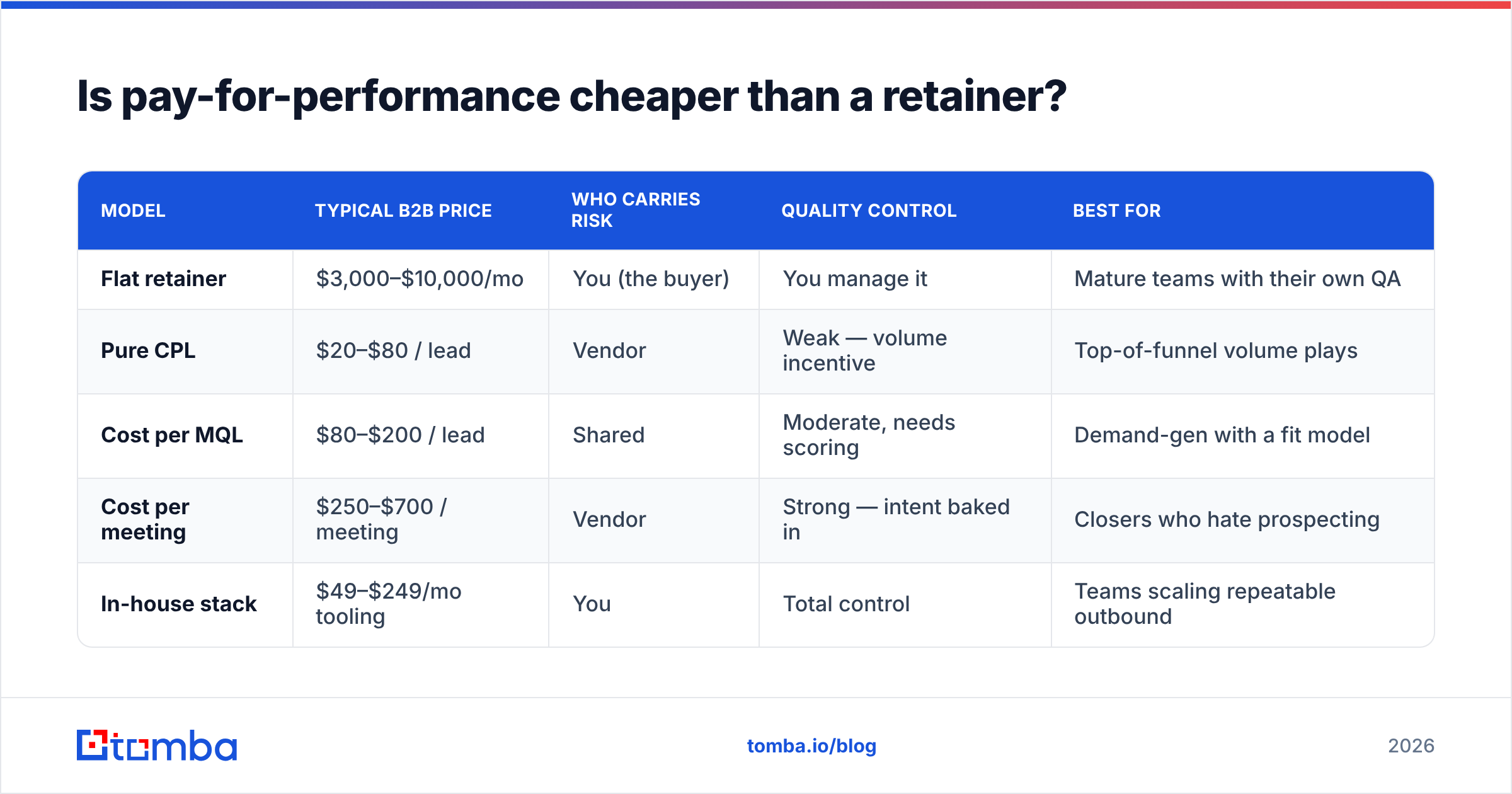
Compare the three dominant pricing structures:
| Model | Typical B2B price | Who carries risk | Quality control | Best for |
|---|---|---|---|---|
| Flat retainer | $3,000–$10,000/mo | You (the buyer) | You manage it | Mature teams with their own QA |
| Pure CPL | $20–$80 / lead | Vendor | Weak — volume incentive | Top-of-funnel volume plays |
| Cost per MQL | $80–$200 / lead | Shared | Moderate, needs scoring | Demand-gen with a fit model |
| Cost per meeting | $250–$700 / meeting | Vendor | Strong — intent baked in | Closers who hate prospecting |
| In-house stack | $49–$249/mo tooling | You | Total control | Teams scaling repeatable outbound |
The per-meeting number looks steep until you compare it to a fully loaded SDR salary divided by the meetings they book. But it also looks cheap until you realize a "booked meeting" with no buying authority converts at near zero. Price per unit means nothing without conversion rate per unit.
The unit economics only favor P4P when two things are true: your average deal size is large enough to absorb a $400 meeting cost, and your sales team can actually close the meetings the vendor delivers. Fail either test and you're subsidizing the vendor's learning curve.
What are the pros and cons of pay-for-performance lead gen?#
Where it wins:
- Cash-flow alignment — You don't pay until pipeline exists. For early-stage teams, that's oxygen.
- Lower upfront commitment — No long retainer lock-in to test a channel.
- Forced accountability — The vendor can't hide behind "brand-building" activity.
- Fast to start — A good P4P shop already has the infrastructure; you skip the build.
Where it breaks:
- Quality erosion — Volume-based incentives push vendors toward the loosest reading of "qualified."
- Definition disputes — Every gray-area lead becomes a negotiation that costs you time.
- No asset ownership — When the contract ends, the playbook, the data, and the warm relationships leave with the vendor.
- Brand risk — You rarely control the messaging going out under your name, and sloppy outreach damages sender reputation you'll need later.
The asset-ownership problem is the quiet killer. Spend two years buying meetings and you've built nothing repeatable — no data, no templates, no institutional knowledge. The day the vendor raises prices, you have zero leverage and no fallback.
How do you keep lead quality high in a P4P deal?#
Quality control is contractual, not aspirational. The vendors who deliver junk are responding rationally to a contract that rewards volume. Fix the incentive and you fix the output.
Build these clauses into any P4P agreement:
- A machine-checkable spec. "Director+ at SaaS companies, 50–500 employees, US-based, valid work email." Every term must be verifiable without a judgment call.
- A verification standard. Every delivered email gets checked before it counts. Run delivered contacts through an email verifier so bounces never reach your sequences — and never get billed.
- A rejection threshold. If more than 15% of a batch fails spec, the whole batch is reviewed and the rate gets renegotiated.
- Source transparency. You should know whether a lead came from cold email, an ad, or a list buy. Different sources convert at wildly different rates.
- A clawback window. Bounced, duplicate, or out-of-spec leads delivered in the last 30 days are credited back.
Notice how much of this depends on data you can independently verify. If you can't confirm an email is real or a title is current, you can't enforce the spec — and the vendor knows it. That's why teams that run P4P well almost always own their own verification and enrichment layer, even when they outsource the outreach.
When should you build lead gen in-house instead?#
Build in-house when outbound is core to how you grow — not a side experiment. The break-even logic is simple: if you'll need leads every month for the foreseeable future, owning the machine beats renting it.
A modern in-house stack is cheaper and more controllable than it was even two years ago. The core components:
- A targeting source — Define your ICP and pull matching companies. A domain search turns a target account list into named contacts with verified email patterns.
- A contact finder — Convert names and domains into reachable emails. This is the foundation; everything downstream depends on its accuracy.
- A verification layer — Scrub the list before sending to protect deliverability.
- Enrichment — Add titles, headcount, and tech stack so your scoring and personalization have fuel. Tomba's data enrichment handles this at the record level.
- A sending and sequencing tool — Your outreach engine, owned and tuned by your team.
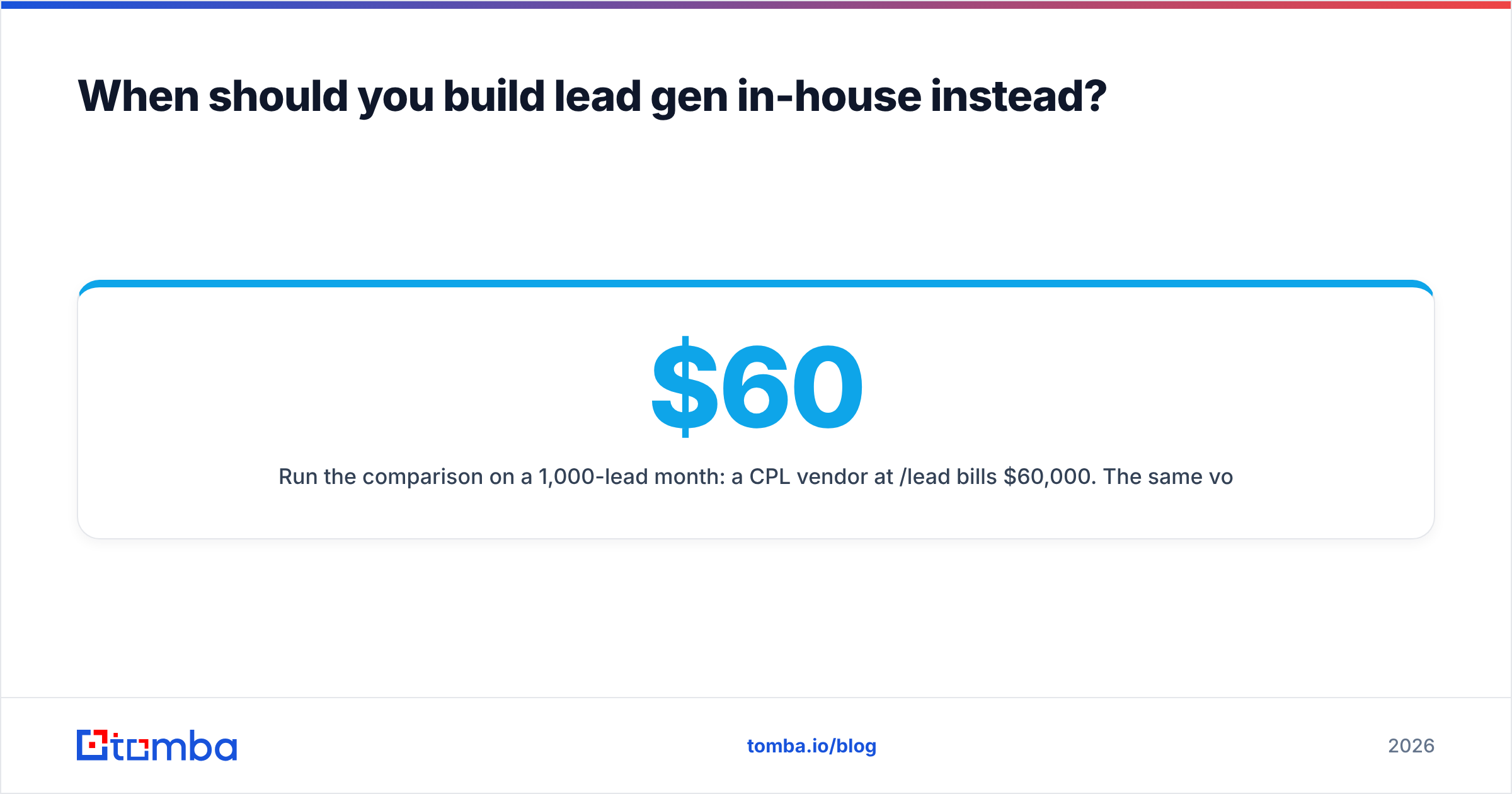
Run the comparison on a 1,000-lead month: a CPL vendor at $60/lead bills $60,000. The same volume built in-house on a Tomba plan — Growth at $99/mo plus a sending tool — runs a few hundred dollars in tooling, plus the cost of the person operating it. The vendor wins on speed and zero headcount; you win on cost, control, and the compounding asset you keep.
In-house also means you own the relationship with deliverability. According to HubSpot's research on email marketing, inbox placement and list hygiene drive a large share of campaign ROI — and you can't manage either when a third party controls the sending. Independent review sites like G2 make it easy to compare tooling before you commit, so the build-vs-buy decision is grounded in real user data rather than a sales pitch.
What does a hybrid model look like?#
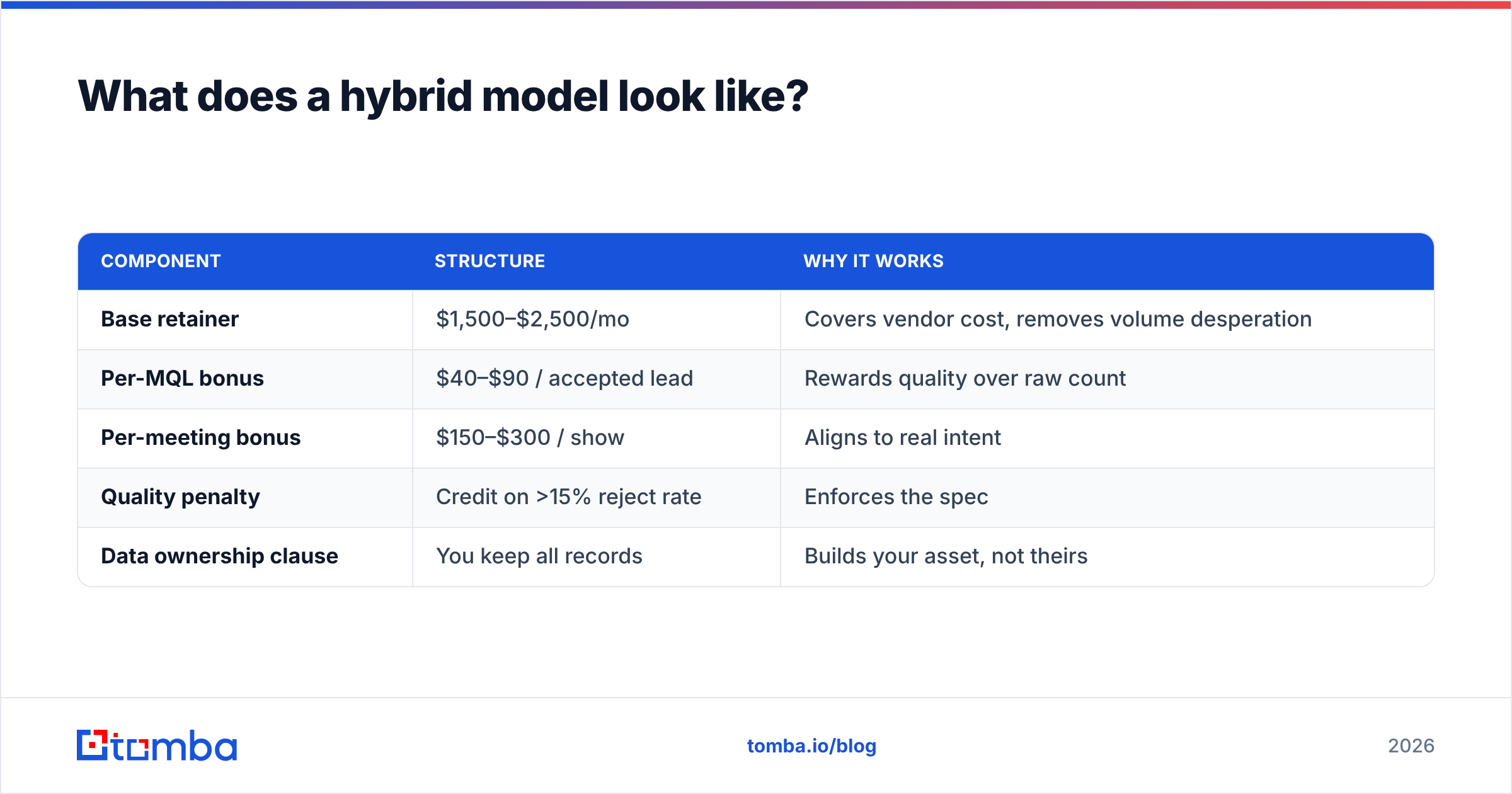
For most B2B teams in 2026, the right answer isn't pure P4P or pure in-house — it's a hybrid. You keep a small base fee to cover the vendor's setup and infrastructure, then layer a per-result bonus on top. This removes the perverse volume incentive (the vendor isn't desperate to hit a number to break even) while keeping skin in the game.
A workable hybrid structure:
| Component | Structure | Why it works |
|---|---|---|
| Base retainer | $1,500–$2,500/mo | Covers vendor cost, removes volume desperation |
| Per-MQL bonus | $40–$90 / accepted lead | Rewards quality over raw count |
| Per-meeting bonus | $150–$300 / show | Aligns to real intent |
| Quality penalty | Credit on >15% reject rate | Enforces the spec |
| Data ownership clause | You keep all records | Builds your asset, not theirs |
The data-ownership clause matters most. Whatever you pay for, make sure every contact record — verified email, title, company, source — lands in your CRM and stays there. That way, even a pure-outsourcing arrangement quietly builds the in-house database you'll eventually want to run yourself.
You can also bring your own data to a hybrid deal. Hand the vendor a pre-verified target list built from your own B2B database queries, and you've removed their biggest cost driver — sourcing — which gives you leverage to negotiate the per-lead rate down. The vendor focuses on what they're good at (outreach and booking), and you control the inputs.
How do you measure whether P4P is actually working?#
Track conversion at every stage, not just cost per unit. A vendor delivering cheap leads that never close is more expensive than a vendor delivering pricey leads that do. The metrics that matter:
- Lead-to-opportunity rate — What share of delivered leads become real pipeline?
- Opportunity-to-close rate — Do those opportunities actually convert? Compare to your house win rate on self-sourced deals.
- Fully loaded cost per closed deal — Total P4P spend divided by deals won. This is the only number that matters at the end of the quarter.
- Reject rate trend — Rising rejects mean the vendor is stretching the spec; catch it early.
If your P4P-sourced deals close at half the rate of your in-house deals, the "cheaper" lead is actually the expensive one. Run that comparison every quarter and let the data — not the per-unit price — decide where the budget goes.
The bottom line#
Pay-for-performance lead generation is a legitimate model when your deal size is large, your spec is airtight, and your team can close what's delivered. It's a trap when you use it to avoid building anything of your own. The vendors who do it well are worth their margin; the ones who don't will bury you in billable junk.
The smartest teams in 2026 treat P4P as a supplement, not a foundation — and they own the data layer no matter who runs the outreach. If you want predictable cost and full control over lead quality, start by owning the part that everything else depends on: finding accurate, verified contacts. The Tomba Email Finder turns your target account list into reachable, verified emails at a flat, predictable price — Free to test with 25 searches, $49/mo Starter when you scale. Build the machine once, and stop renting your pipeline by the unit.
// get started
Find, verify and enrich your first contacts today
Start on the free plan with 25 searches a month, then scale when your team is ready.
Free plan · No credit card required · GDPR & CCPA
// about the author