B2B Lead Generation Strategy: The 2026 Playbook That Works
A practical, channel-by-channel B2B lead generation strategy for 2026 — what to build, what to cut, and how to fill your pipeline with leads that actually convert.
TL;DR
- A B2B lead generation strategy in 2026 is a system, not a campaign: define your ICP, pick two or three channels you can run well, feed them clean contact data, and score every lead before sales touches it.
- The biggest leak isn't traffic — it's bad data and unqualified handoffs. Fix verification and scoring before you spend more on ads.
- Multi-channel beats single-channel, but only when channels reinforce each other (content fuels outbound, intent data prioritizes follow-up).
- Accurate, verified contact data is the cheapest lever you have — it raises deliverability, reply rates, and rep productivity all at once.
- Measure cost per qualified opportunity, not cost per lead. Volume vanity metrics hide a broken funnel.
What is a B2B lead generation strategy in 2026?#
A B2B lead generation strategy is the repeatable system you use to turn strangers into qualified buyers your sales team can close. Think of it like running a restaurant: traffic is people walking past the door, leads are the ones who sit down, and qualified opportunities are the tables that actually order. A good strategy doesn't just get more foot traffic — it gets the right people seated and served fast.
In 2026, three things changed how this works. Buyers self-educate before they ever talk to sales, so your content has to do the early selling. AI made outbound volume trivial, which means generic outreach is dead and personalization is the only thing that lands. And privacy shifts (cookie deprecation, stricter spam filters) put a premium on first-party and verified data over scraped lists.
The strategy that wins ties all of that together: a clear ideal customer profile, a small number of channels you execute well, clean data flowing into them, and a scoring model that protects your reps' time.
Why do most B2B lead gen strategies fail?#
Most strategies fail because teams optimize for lead volume instead of lead quality, then blame the channel. You generate 500 form fills, sales calls 50, books 3 meetings, and everyone concludes "ads don't work." The real problem is usually upstream.
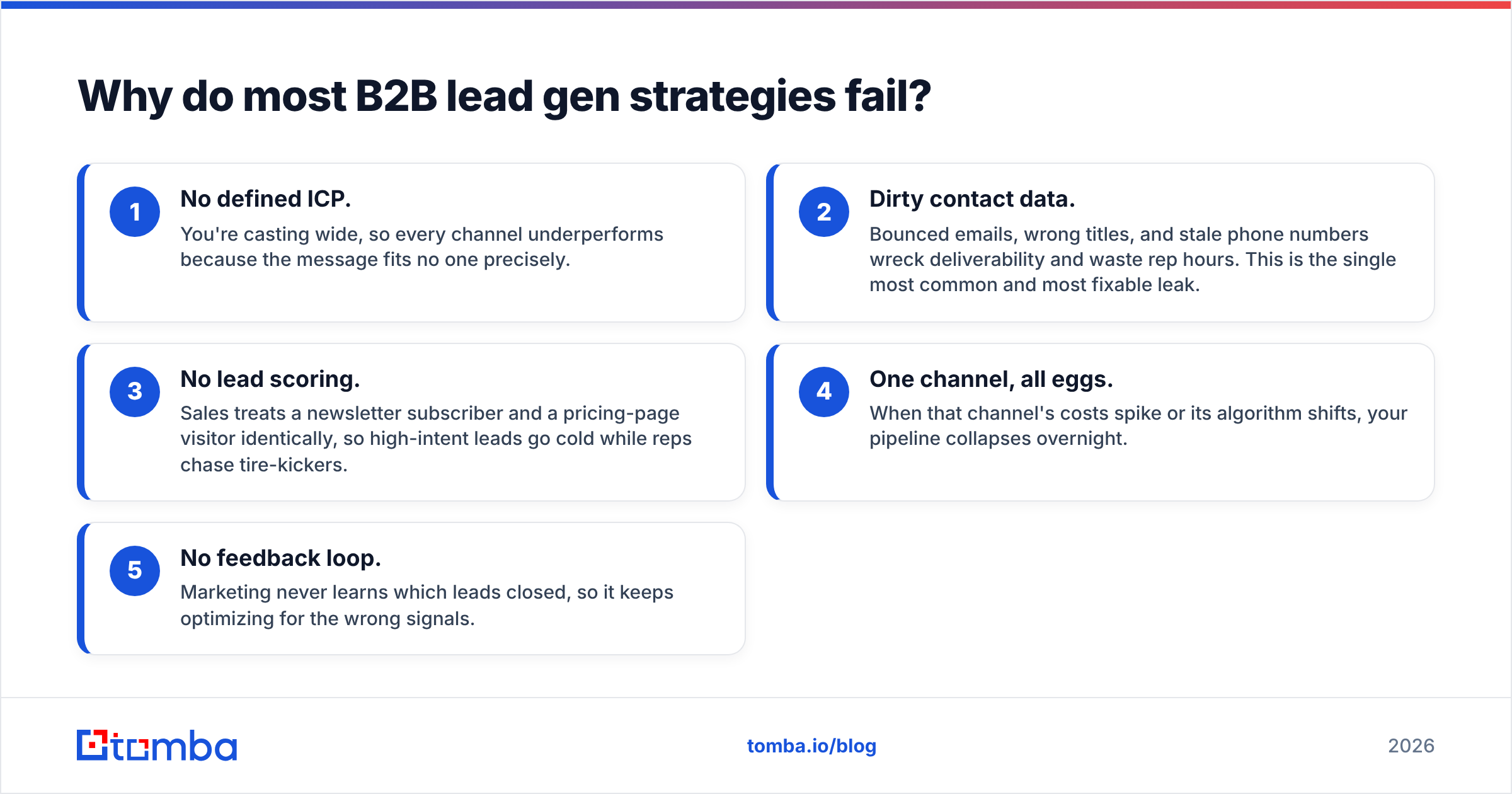
Here are the failure patterns that show up over and over:
- No defined ICP. You're casting wide, so every channel underperforms because the message fits no one precisely.
- Dirty contact data. Bounced emails, wrong titles, and stale phone numbers wreck deliverability and waste rep hours. This is the single most common and most fixable leak.
- No lead scoring. Sales treats a newsletter subscriber and a pricing-page visitor identically, so high-intent leads go cold while reps chase tire-kickers.
- One channel, all eggs. When that channel's costs spike or its algorithm shifts, your pipeline collapses overnight.
- No feedback loop. Marketing never learns which leads closed, so it keeps optimizing for the wrong signals.
Before you add a new channel or raise your ad budget, audit these five. Fixing data and scoring usually returns more pipeline than any new acquisition source.
Which B2B lead generation channels actually work?#
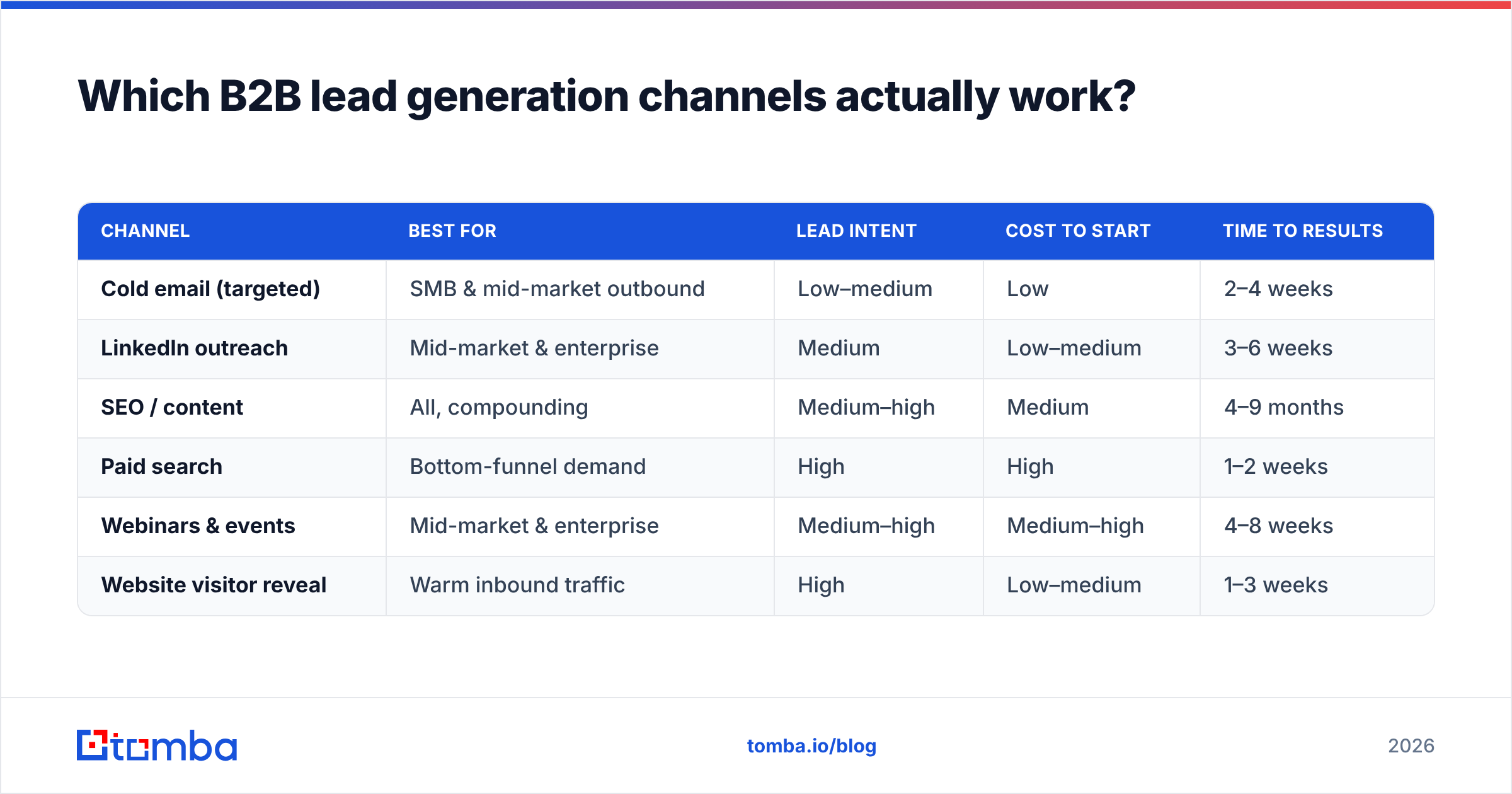
The channels that work depend on your motion (high-volume SMB vs. enterprise ABM), but the durable winners cluster into a handful. The table below compares the main options on the dimensions that matter when you're deciding where to spend.
| Channel | Best for | Lead intent | Cost to start | Time to results |
|---|---|---|---|---|
| Cold email (targeted) | SMB & mid-market outbound | Low–medium | Low | 2–4 weeks |
| LinkedIn outreach | Mid-market & enterprise | Medium | Low–medium | 3–6 weeks |
| SEO / content | All, compounding | Medium–high | Medium | 4–9 months |
| Paid search | Bottom-funnel demand | High | High | 1–2 weeks |
| Webinars & events | Mid-market & enterprise | Medium–high | Medium–high | 4–8 weeks |
| Website visitor reveal | Warm inbound traffic | High | Low–medium | 1–3 weeks |
A pragmatic 2026 mix for most B2B teams: one compounding channel (SEO/content), one direct channel (cold email or LinkedIn), and one demand-capture channel (paid search or visitor reveal). Run two or three well rather than six badly.
Note where intent is highest: paid search, visitor reveal, and inbound content capture people who are already looking. Outbound channels are lower intent but let you control who you reach — which is exactly why precise targeting and clean data matter more there.
How do you build a B2B lead generation funnel step by step?#
Build the funnel back-to-front: start from the qualified opportunity you want and work backward to the traffic that creates it. Here's the sequence I run with teams.
Step 1 — Define and document your ICP. Firmographics (industry, size, geography), the buying committee (titles and roles), and trigger events (funding, hiring, tech changes). Write it down; vague ICPs produce vague campaigns.
Step 2 — Build a clean contact list. Use a domain search to pull the right people at target accounts, then enrich each record with role, seniority, and a verified email. This is where your strategy lives or dies — garbage in, garbage out.
Step 3 — Verify before you send. Run every address through an email verifier to strip invalids and catch-alls. A 2% bounce ceiling protects your sender reputation; cross it and your whole domain's email deliverability tanks.
Step 4 — Engage across channels. Sequence email, LinkedIn touches, and a call where the data supports it. Personalize the first line with the trigger event you found in Step 1.
Step 5 — Score and route. Apply your scoring model (next section), and route only sales-ready leads to reps. Everyone else goes to nurture.
Step 6 — Close the loop. Feed won/lost data back to marketing monthly so the model and targeting keep improving.
The discipline is in Steps 2–3. Most teams sprint to Step 4 with a list they never cleaned, then wonder why replies are flat.
How do you qualify and score B2B leads?#
Qualify leads with a simple two-axis model: fit (do they match your ICP?) and intent (are they showing buying signals?). A lead that's high on both is sales-ready; high-fit/low-intent goes to nurture; low-fit gets disqualified regardless of how engaged they are.
A workable point system:
- Fit signals: correct industry (+15), company size in range (+15), decision-maker title (+20), uses a complementary tool (+10).
- Intent signals: visited pricing page (+25), opened 3+ emails (+10), booked a demo (+40), downloaded a bottom-funnel asset (+20).
- Negative signals: student/personal email (−20), competitor domain (−30), unsubscribed (−100).
Set a threshold (say, 60 points) for sales handoff. The exact numbers matter less than the discipline of having a threshold so reps stop chasing everyone. If you want the formal definitions, Tomba's glossary covers what a marketing qualified lead is and how it differs from a sales-qualified one.
Track your response rate by segment — it's the fastest way to spot whether your scoring actually predicts engagement or just feels good on a dashboard.
Why does data quality decide your lead gen ROI?#
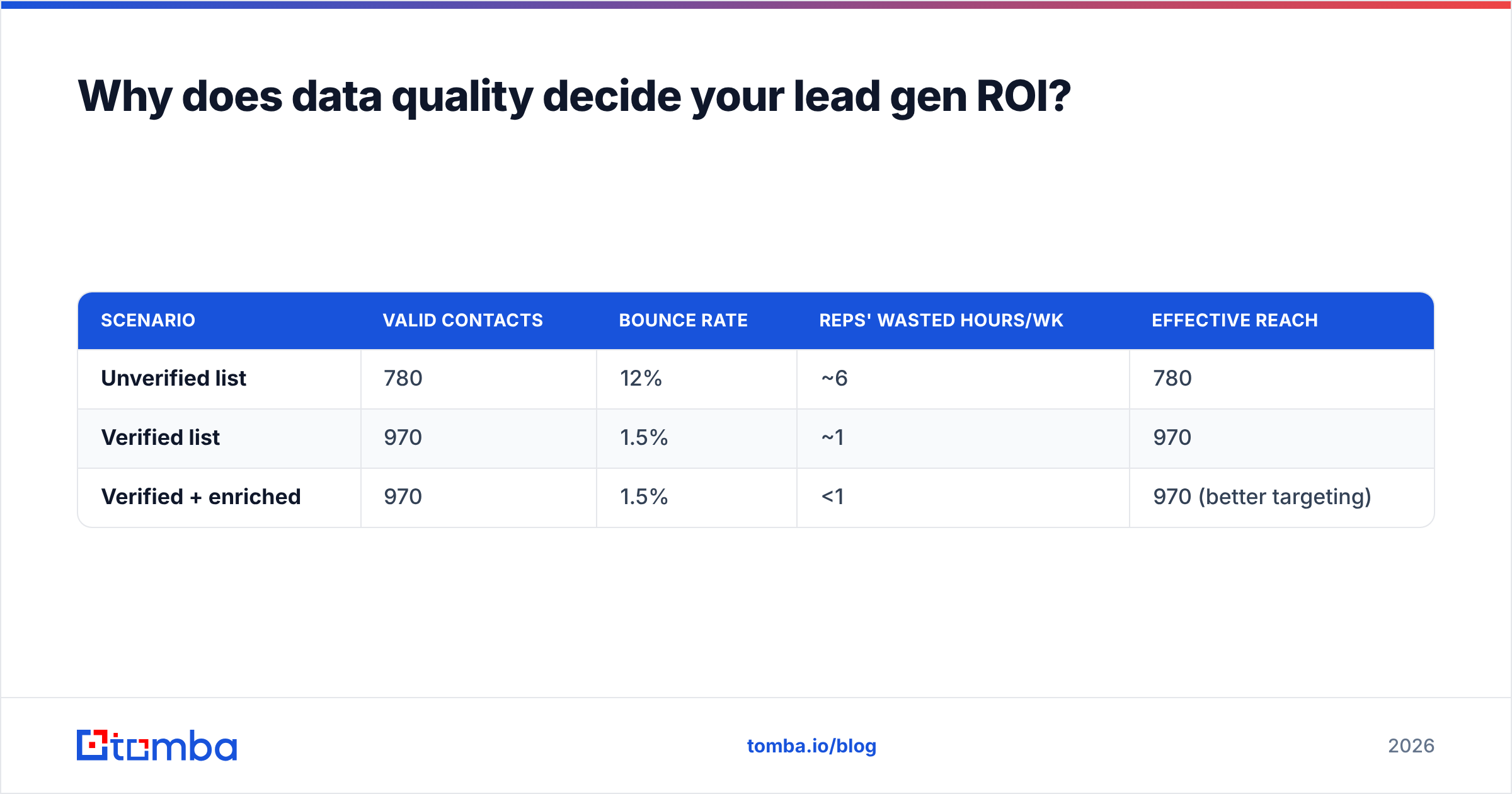
Data quality decides ROI because every downstream metric inherits its accuracy. If 20% of your contacts are wrong, you're not just wasting 20% of sends — you're degrading sender reputation, polluting your scoring model, and burning rep trust in the whole system. The damage compounds.
Run the math. Say you send to 1,000 contacts:
| Scenario | Valid contacts | Bounce rate | Reps' wasted hours/wk | Effective reach |
|---|---|---|---|---|
| Unverified list | 780 | 12% | ~6 | 780 |
| Verified list | 970 | 1.5% | ~1 | 970 |
| Verified + enriched | 970 | 1.5% | <1 | 970 (better targeting) |
The verified list reaches 24% more people and keeps your domain out of spam folders. Enrichment then raises conversion on the contacts you do reach, because reps personalize with real role and company context. This is why data enrichment and verification aren't "nice to have" — they're the highest-leverage spend in the entire strategy.
For high-volume motions, a bulk email finder lets you build and clean lists at scale instead of one record at a time. The goal is simple: never let a rep or a sequence touch an address you haven't verified.
What tools do you need for a B2B lead generation strategy?#
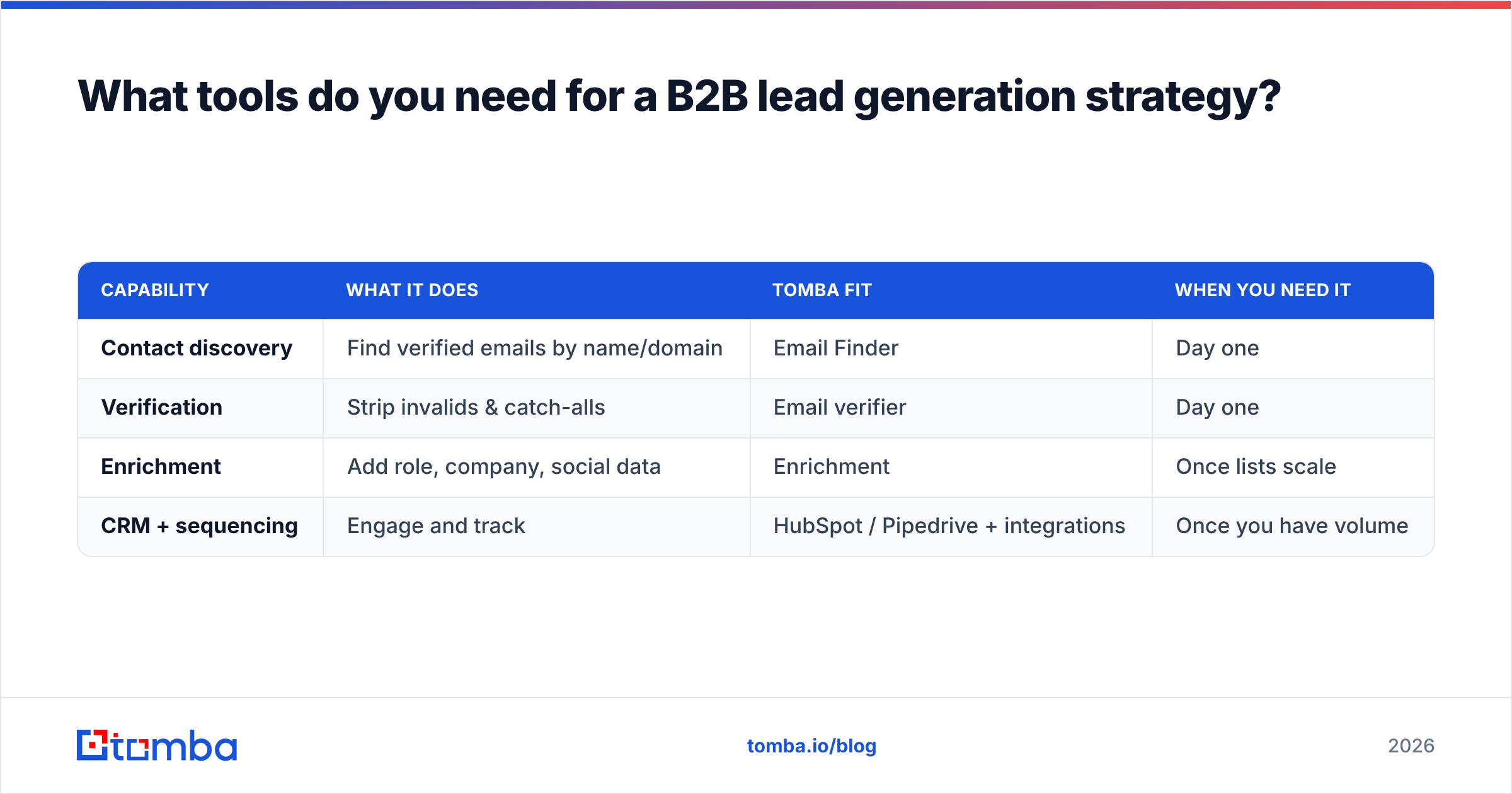
You need four capabilities, and you can cover them without a bloated stack: find contacts, verify them, engage across channels, and track what converts. Many teams overbuy here — start lean and add only when a gap is proven.
| Capability | What it does | Tomba fit | When you need it |
|---|---|---|---|
| Contact discovery | Find verified emails by name/domain | Email Finder | Day one |
| Verification | Strip invalids & catch-alls | Email verifier | Day one |
| Enrichment | Add role, company, social data | Enrichment | Once lists scale |
| CRM + sequencing | Engage and track | HubSpot / Pipedrive + integrations | Once you have volume |
The integration layer matters more than any single tool. If your finder, verifier, and CRM don't talk, reps end up copy-pasting between tabs and data drifts out of sync. Tomba connects to HubSpot, Pipedrive, Salesforce, and Zapier, so verified contacts flow straight into the sequences and pipeline stages where they get worked.
For broader stack decisions, independent review sites like G2 and Capterra are worth checking for category-level comparisons before you commit to annual contracts. And vendor docs — for example HubSpot's lead gen resources — are useful for understanding how CRM-native scoring and forms fit your funnel.
How do you measure B2B lead generation success?#
Measure success on cost per qualified opportunity and pipeline velocity — not raw lead count. Lead volume is a vanity metric; you can double it by lowering form friction and learn nothing about revenue.
Track these five:
- Cost per qualified opportunity (CPQO): total spend ÷ opportunities that reach your defined threshold. This is your north star.
- Lead-to-opportunity rate: the percent of leads that qualify. Low here means a targeting or data problem.
- Reply / response rate by channel: tells you which channel and message actually resonate.
- Sales-accepted lead rate: the percent of "qualified" leads sales agrees to work. A gap here means marketing and sales disagree on the bar.
- Pipeline velocity: how fast opportunities move stage to stage. Clean data and good scoring speed this up.
Review these monthly with sales in the room. The feedback loop — which leads closed, which stalled, which bounced — is what turns a static playbook into a system that compounds. According to analyst guidance from firms like Gartner, aligning sales and marketing on a shared definition of a qualified lead is one of the strongest predictors of revenue growth.
Putting it together#
Start small and sequence it: document your ICP this week, clean and verify your existing list next, stand up one direct channel and one compounding channel, and only then expand. Most teams already have enough traffic — what they lack is clean data and a scoring discipline that protects rep time. Fix those two and your existing channels will quietly start producing more pipeline.
The thread running through every section is data accuracy. It's the cheapest lever, it improves every downstream metric at once, and it's the one most teams skip. Get it right and the rest of the strategy works the way the diagrams promise.
Ready to build pipeline on data you can trust? Start with the Tomba Email Finder to source verified, decision-maker contacts at your target accounts — then verify, enrich, and route them into your sequences. The free tier gives you 25 searches a month to test it; the Starter plan is $49/mo when you're ready to scale. Stop paying to reach addresses that bounce, and start filling your funnel with leads that convert.
// get started
Find, verify and enrich your first contacts today
Start on the free plan with 25 searches a month, then scale when your team is ready.
Free plan · No credit card required · GDPR & CCPA
// about the author