B2B Lead Generation UK: The 2026 Playbook That Works
A practical, GDPR-aware guide to B2B lead generation in the UK for 2026 — channels, data sources, costs, and a repeatable system that fills pipeline without buying junk lists.
TL;DR
- B2B lead generation in the UK works differently from the US: GDPR and PECR govern how you source, store, and contact data, so "spray and pray" list-buying is both illegal-adjacent and ineffective.
- The highest-ROI UK channels in 2026 are outbound built on verified first-party data, LinkedIn-led social selling, intent-driven inbound, and tightly targeted paid search.
- Your data layer is the lever that moves everything else. Accurate, recently verified contact data beats a clever sequence every time.
- Budget realistically: a working UK outbound motion costs roughly £2,000–£8,000/month all-in for a small team once you factor data, tooling, and SDR time.
- Build a repeatable system — define ICP, source compliant data, verify, personalise, multi-touch, measure — instead of chasing one-off "growth hacks".
What is B2B lead generation in the UK and how is it different?#
B2B lead generation in the UK is the process of identifying, attracting, and qualifying British and EU-facing business buyers until they're ready for a sales conversation. The mechanics — outbound, inbound, paid, partnerships — look familiar to anyone who's run demand gen in the US. The difference is the legal and cultural floor you build on.
Two rules shape everything. GDPR (retained in UK law as the UK GDPR) governs personal data: a named person's work email, like jane.smith@acme.co.uk, is personal data even though it's a business address. PECR (the Privacy and Electronic Communications Regulations) governs electronic marketing. The good news for outbound sellers: under PECR you can email a corporate body or a "corporate subscriber" without prior consent, provided you offer an opt-out and you have a legitimate-interest basis under GDPR. Sole traders and some partnerships are treated more like individuals, so they need more care.
The practical upshot: UK buyers expect relevance and a clear opt-out, and the regulator (the ICO) expects you to know where your data came from. That kills the "buy a 50,000-row list and blast it" model. It rewards sellers who source narrow, verify hard, and personalise.
)
Culturally, UK buyers are more sceptical of hyperbole than US audiences. "Revolutionary game-changing 10x" copy underperforms. Specific, modest, evidence-led messaging wins replies.
Which B2B lead generation channels actually work in the UK in 2026?#
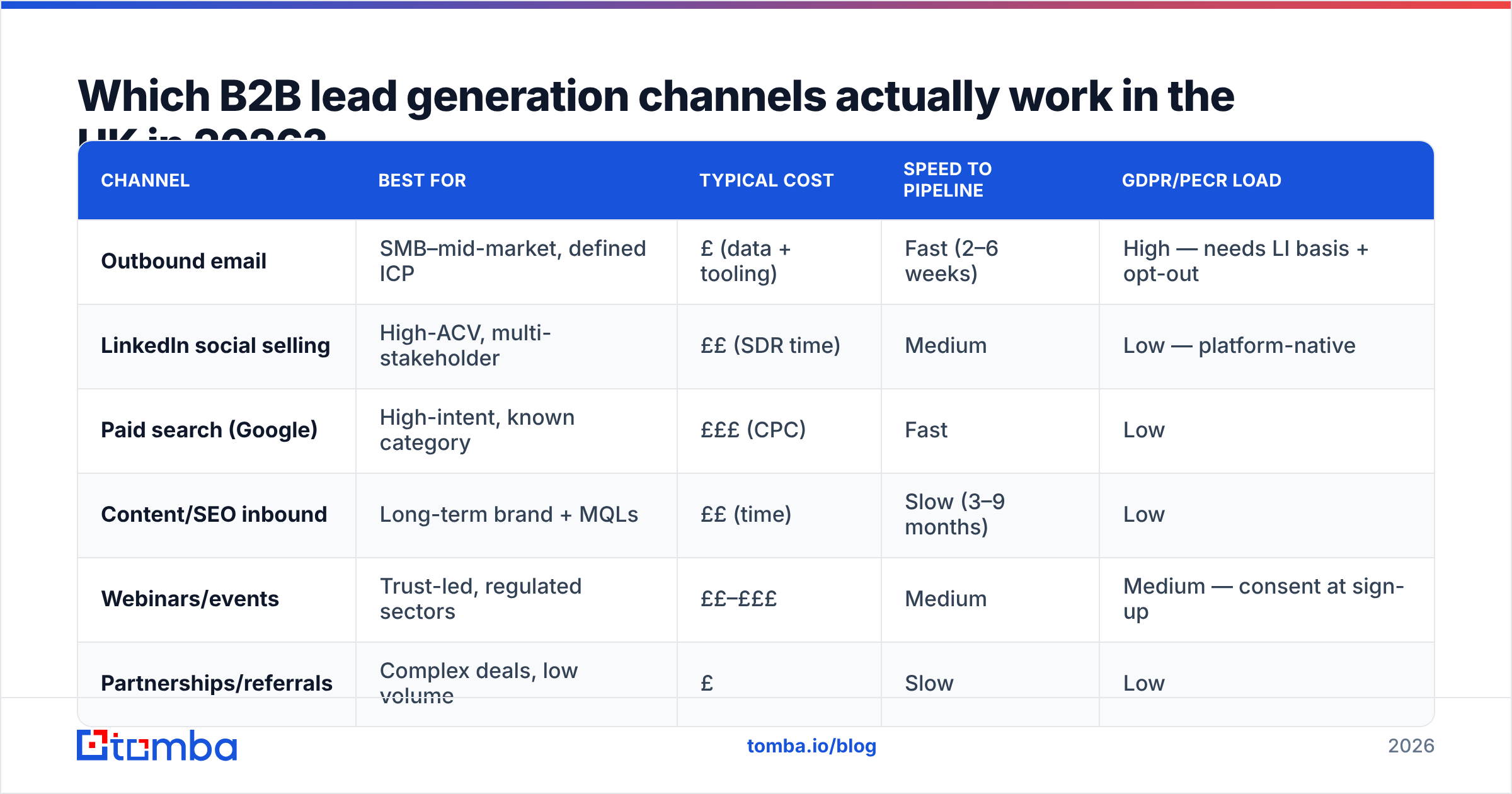
There's no single best channel — there's a best mix for your ICP and deal size. Here's how the main UK channels stack up.
| Channel | Best for | Typical cost | Speed to pipeline | GDPR/PECR load |
|---|---|---|---|---|
| Outbound email | SMB–mid-market, defined ICP | £ (data + tooling) | Fast (2–6 weeks) | High — needs LI basis + opt-out |
| LinkedIn social selling | High-ACV, multi-stakeholder | ££ (SDR time) | Medium | Low — platform-native |
| Paid search (Google) | High-intent, known category | £££ (CPC) | Fast | Low |
| Content/SEO inbound | Long-term brand + MQLs | ££ (time) | Slow (3–9 months) | Low |
| Webinars/events | Trust-led, regulated sectors | ££–£££ | Medium | Medium — consent at sign-up |
| Partnerships/referrals | Complex deals, low volume | £ | Slow | Low |
A few UK-specific notes:
- Outbound email still works — but only on verified, narrowly targeted data. The deliverability bar is high because UK inboxes (heavy on Microsoft 365 and Google Workspace) punish list-blasting fast.
- LinkedIn is the UK's strongest B2B channel by trust. British buyers research on LinkedIn before replying to anything. Pair connection requests with genuine LinkedIn outreach, not pitch-on-connect spam.
- Paid search is excellent for high-intent categories but expensive in competitive UK verticals (legal, fintech, recruitment). Use it to capture demand, not create it.
- Inbound content compounds but won't fill Q3 pipeline if you start in Q2. Run it in parallel, not instead of outbound.
Why does data quality decide your UK lead-gen results?#
Because everything downstream multiplies off it. A perfect sequence sent to a 40%-bounce list produces nothing but a wrecked sender reputation. Think of your contact data as the foundation of a house: you can have beautiful copy and a slick CRM upstairs, but if the foundation is cracked the whole thing sinks.
UK B2B data decays fast — people change roles, companies rebrand, .co.uk domains get consolidated. Industry estimates put B2B data decay at roughly 2–3% per month, which means a list is meaningfully stale within a year. So the question isn't "where do I buy a list" but "how do I generate fresh, verified contacts on demand and re-verify continuously."
That's where a real email finder and an email verifier replace the list broker. You search by company domain or person, get the current professional email, and verify it before it ever enters a sequence. For UK domains with strict catch-all configurations, a dedicated catch-all verifier tells you whether an address is genuinely reachable rather than silently accepted.
)
The compliance benefit is real too: when you source data yourself through documented tools with transparent data sources, you can answer the ICO's first question — "where did this come from?" — which you cannot do with an anonymous purchased CSV.
How do you build a repeatable UK lead-generation system?#
Stop thinking in campaigns and start thinking in a loop you run every week. Here's the system that consistently fills UK pipeline.
1. Define the ICP precisely. Industry (SIC code if you can), headcount band, region, tech stack, and the specific job titles that own the problem. "UK SaaS, 50–200 staff, Head of RevOps or VP Sales" beats "tech companies."
2. Source compliant data. Use domain search to pull the right contacts at target accounts, or a bulk email finder when you're working from an account list. Keep a record of source and date for every contact.
3. Verify before you send. Run every address through verification. Aim to keep bounce rates under 2%. Discard risky and unknown results rather than gambling your domain reputation.
4. Personalise at the first line, not just the merge tag. UK buyers spot a {{first_name}} template instantly. Reference something specific — a hire, a launch, a post.
5. Multi-touch across channels. Email + LinkedIn + the occasional call outperforms any single channel. Sequence 6–9 touches over 3–4 weeks.
6. Measure the funnel, not vanity metrics. Track reply rate, positive-reply rate, meetings booked, and SQL-to-opportunity — not opens (which are unreliable post-Apple-MPP anyway).
The teams that win treat this as an operating cadence: refresh the data, re-segment, ship, measure, prune, repeat. The compounding comes from the loop, not from any one clever email.
How much does B2B lead generation cost in the UK?#
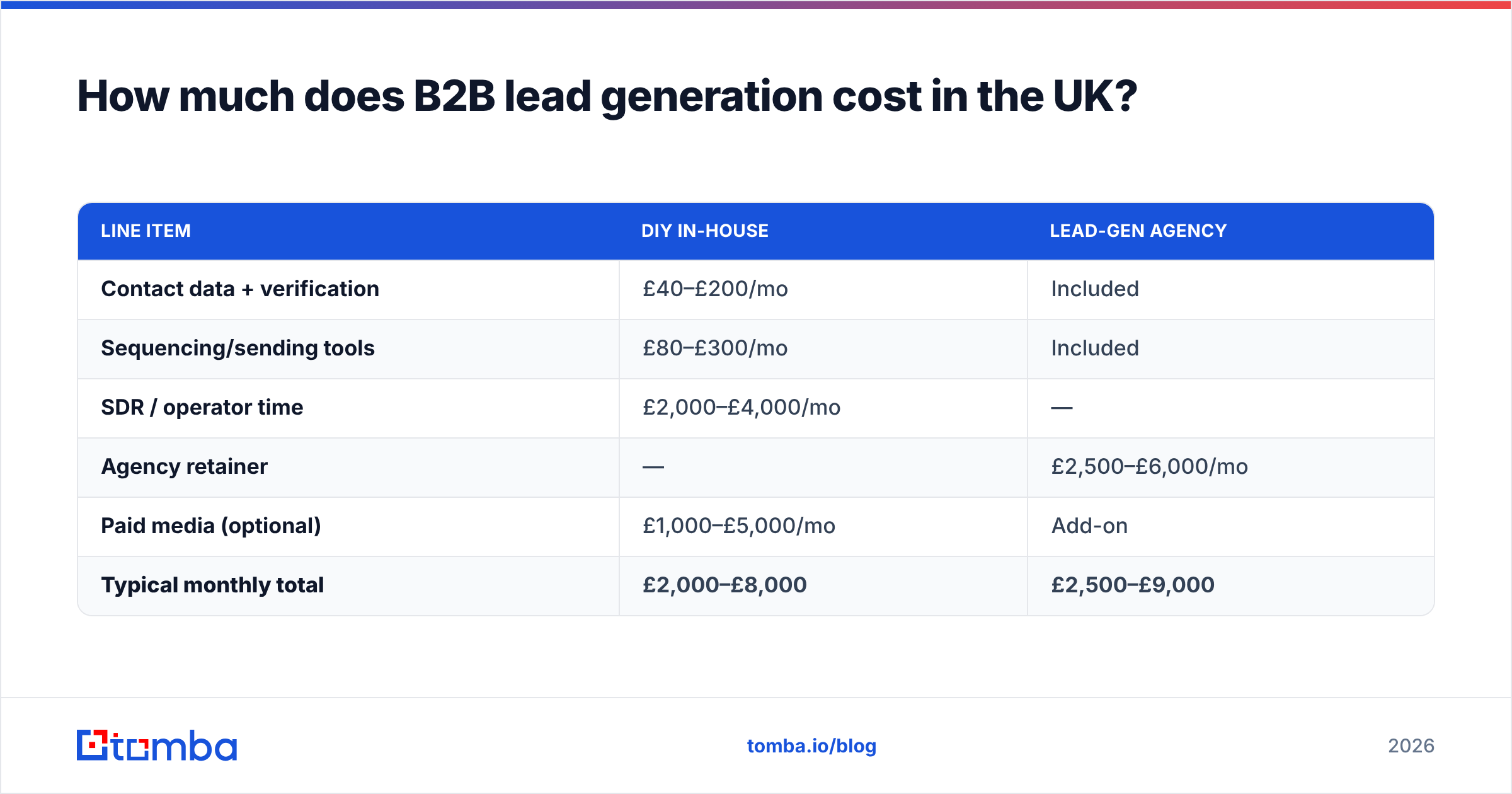
It depends on whether you build in-house or outsource, but here's a realistic 2026 picture for a small UK team running outbound plus light inbound.
| Line item | DIY in-house | Lead-gen agency |
|---|---|---|
| Contact data + verification | £40–£200/mo | Included |
| Sequencing/sending tools | £80–£300/mo | Included |
| SDR / operator time | £2,000–£4,000/mo | — |
| Agency retainer | — | £2,500–£6,000/mo |
| Paid media (optional) | £1,000–£5,000/mo | Add-on |
| Typical monthly total | £2,000–£8,000 | £2,500–£9,000 |
The data line is the smallest number on this table and the highest leverage. Underspending on data to "save money" is the most common and most expensive mistake — it shows up later as wasted SDR hours, blocked domains, and missed quota. Tools like Tomba sit at the affordable end: see current Tomba pricing for tiers from a free plan up through Starter at $49/mo and Growth at $99/mo, which covers most small UK teams' sourcing and verification needs.
For comparison shopping on platforms, neutral review sites like G2 and Capterra let you filter by UK reviewers and pricing.
What about GDPR — can you legally do cold outbound in the UK?#
Yes, with conditions — and this is where most teams get nervous unnecessarily. Conclusion first: B2B cold email to corporate contacts is lawful in the UK when you rely on legitimate interest under GDPR and respect PECR's corporate-subscriber rules, including an unsubscribe in every message.
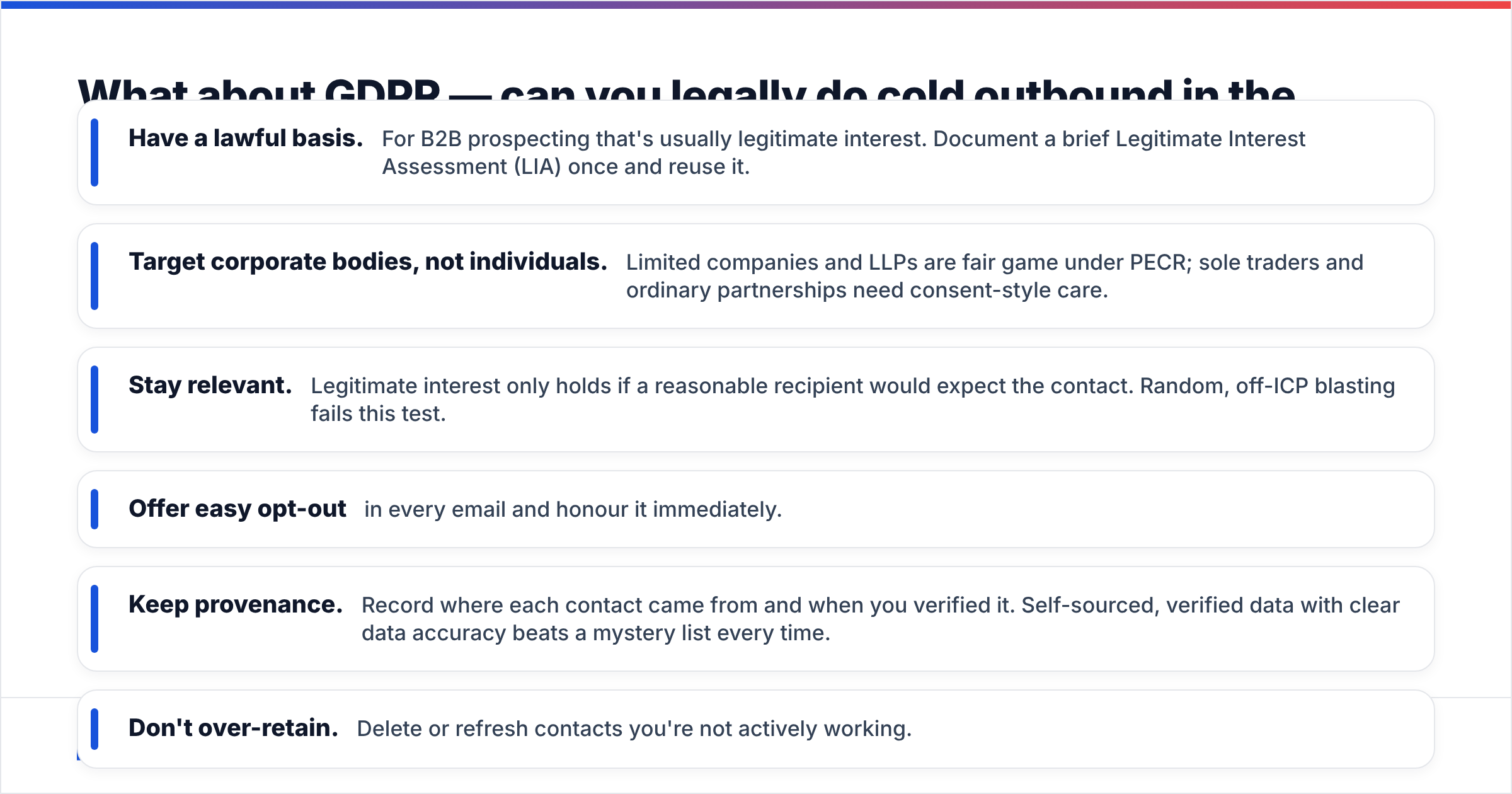
Practical compliance checklist:
- Have a lawful basis. For B2B prospecting that's usually legitimate interest. Document a brief Legitimate Interest Assessment (LIA) once and reuse it.
- Target corporate bodies, not individuals. Limited companies and LLPs are fair game under PECR; sole traders and ordinary partnerships need consent-style care.
- Stay relevant. Legitimate interest only holds if a reasonable recipient would expect the contact. Random, off-ICP blasting fails this test.
- Offer easy opt-out in every email and honour it immediately.
- Keep provenance. Record where each contact came from and when you verified it. Self-sourced, verified data with clear data accuracy beats a mystery list every time.
- Don't over-retain. Delete or refresh contacts you're not actively working.
For the authoritative wording, the ICO's guide to PECR is the source of truth — read it once, not third-hand summaries.
The strategic point: GDPR isn't a blocker to UK lead gen, it's a moat. Teams that source narrowly, verify, and personalise are already doing what compliance requires. Teams that buy bulk lists are both non-compliant and ineffective. Doing it right and doing it well are the same activity.
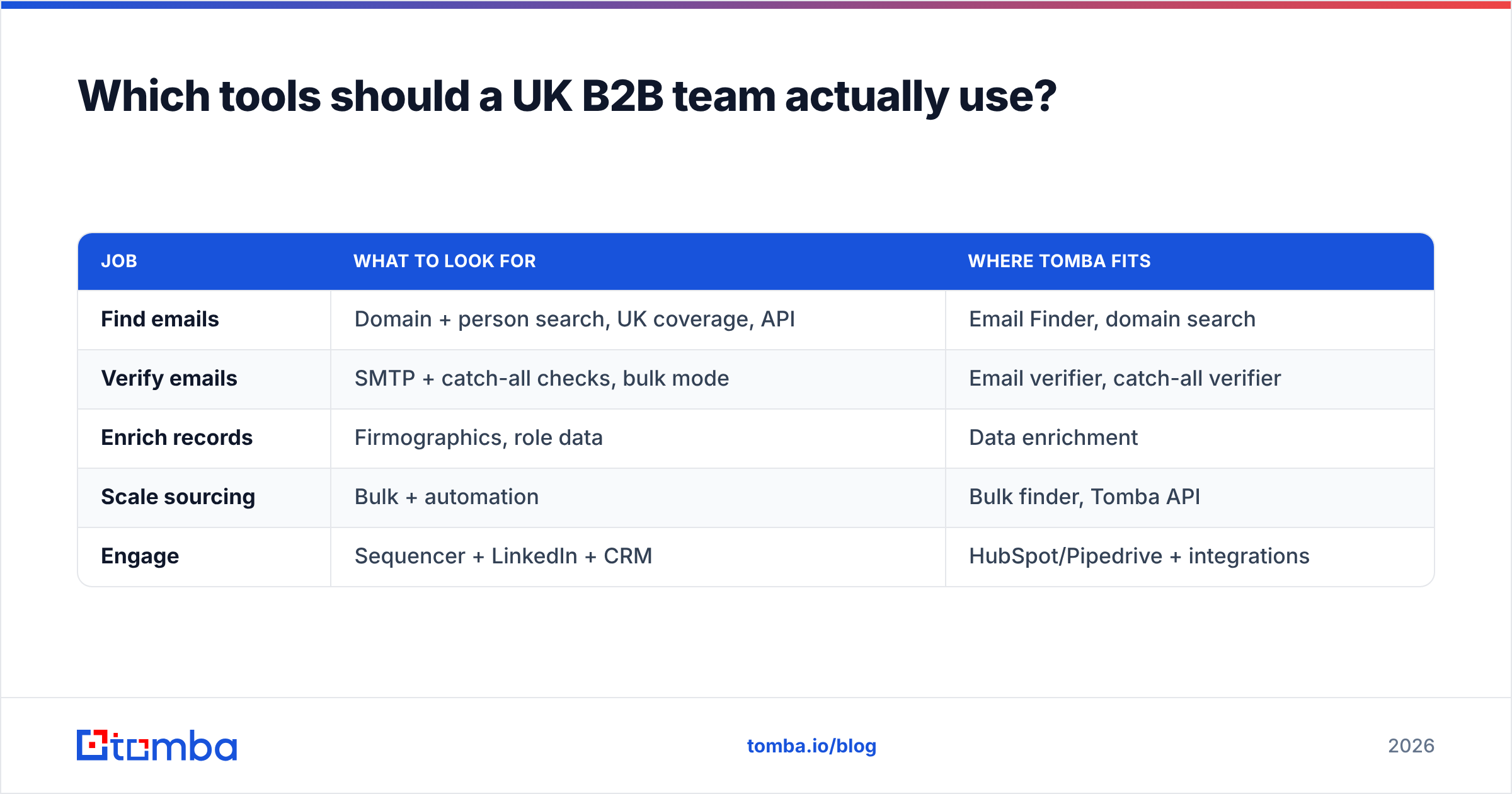
Which tools should a UK B2B team actually use?#
You need three capabilities: find contacts, verify them, and engage them. You don't need a 12-tool stack.
| Job | What to look for | Where Tomba fits |
|---|---|---|
| Find emails | Domain + person search, UK coverage, API | Email Finder, domain search |
| Verify emails | SMTP + catch-all checks, bulk mode | Email verifier, catch-all verifier |
| Enrich records | Firmographics, role data | Data enrichment |
| Scale sourcing | Bulk + automation | Bulk finder, Tomba API |
| Engage | Sequencer + LinkedIn + CRM | HubSpot/Pipedrive + integrations |
A lean, effective UK stack in 2026 looks like: Tomba for sourcing and verification, a sequencer (or your CRM's native one), LinkedIn Sales Navigator for social selling, and HubSpot or Pipedrive as the system of record. Wire them together so a verified contact flows from finder to CRM automatically via the HubSpot integration or Zapier — manual CSV juggling is where data quality goes to die.
If you've been evaluating heavier all-in-one platforms, it's worth weighing them against a focused data layer: see how Tomba compares as an Apollo alternative or a RocketReach alternative for UK contact accuracy specifically.
What are the most common UK lead-gen mistakes to avoid?#
- Buying lists. Cheap, stale, non-compliant, reputation-killing. Source and verify instead.
- Ignoring deliverability. Warm your domain, authenticate SPF/DKIM/DMARC, and keep volume sane. A blocked domain ends your channel.
- US-style hype copy. UK buyers tune it out. Be specific and modest.
- Single-channel reliance. Email-only or LinkedIn-only caps your reach. Combine them.
- No measurement loop. If you can't see reply-to-meeting conversion, you can't improve it.
- Treating compliance as an afterthought. Bake provenance and opt-out in from day one.
Frequently asked questions#
Is cold email legal for B2B in the UK? Yes, when you target corporate contacts, rely on legitimate interest, stay relevant, and include an opt-out in every message.
How many leads can a UK SDR generate per month? A well-equipped SDR working verified data typically books 10–20 qualified meetings per month; poor data can cut that by more than half.
Do I need consent to email a business contact? Not for corporate subscribers under PECR, but you still need a GDPR lawful basis (usually legitimate interest) and an opt-out.
What's the fastest channel to start? Verified outbound email or paid search — both can produce pipeline within weeks, unlike SEO.
Build your UK pipeline on data you can trust#
UK lead generation rewards precision over volume. The teams winning in 2026 aren't the ones with the biggest lists — they're the ones with the cleanest, freshest, most compliant data, engaged through relevant multi-channel sequences. Start at the foundation: use the Tomba Email Finder to source accurate, GDPR-defensible contacts at your target UK accounts, verify them before they hit a sequence, and feed them straight into your CRM. Spin up a free account, run your first 25 searches, and see what verified data does to your reply rate before you spend another pound on a broker list.
// get started
Find, verify and enrich your first contacts today
Start on the free plan with 25 searches a month, then scale when your team is ready.
Free plan · No credit card required · GDPR & CCPA
// about the author