B2B Lead Identification in 2026: The Complete How-To Guide
B2B lead identification is how you turn anonymous traffic and raw firmographics into named, reachable buyers. Here's the 2026 playbook, signals, and tooling.
TL;DR
- B2B lead identification is the process of turning anonymous demand — website visitors, list rows, account names — into specific, named, contactable people at companies that fit your ICP.
- It runs in three layers: account (which company), person (which human), and contactability (verified email or phone you can actually reach).
- Intent and engagement signals tell you who to prioritize; data enrichment tells you who they are; verification tells you whether you can reach them.
- Accuracy and freshness beat volume. A 500-row list of verified, on-ICP contacts outperforms 50,000 stale guesses every time.
- Tools like Tomba's email finder, domain search, and enrichment collapse all three layers into one repeatable workflow.
What is B2B lead identification?#
B2B lead identification is the discipline of figuring out exactly which companies and people represent real buying potential, then attaching enough verified data to each one that a rep can act. Think of it like a airport security line that actually works: thousands of travelers (raw traffic) get narrowed to the handful holding a boarding pass for your flight (your ICP), and each one gets a verified ID (a confirmed email or phone number) before they board.
It is not the same as lead generation. Generation creates demand and captures interest. Identification answers a narrower, more operational question: given everything happening around my brand right now, who specifically should sales talk to, and how do I reach them?
Most teams lose money in the gap between those two. You spend to drive traffic and book demos, then 95% of the visitors leave anonymous, half your CRM rows are missing a valid email, and reps waste mornings guessing address patterns. Identification closes that gap.
Why does B2B lead identification matter in 2026?#
Three shifts made this a board-level concern rather than a back-office task.
- Anonymous demand is the norm. Buyers research in stealth. By the time someone fills a form, they have often already consumed six to ten pieces of content. If you only identify form-fillers, you are meeting buyers at the end of their journey, after competitors have shaped the shortlist.
- Data decays fast. Roughly 25–30% of B2B contact data goes stale every year as people change jobs. A list you bought in January is materially wrong by summer.
- Deliverability is unforgiving. Mailbox providers now punish senders who hit invalid addresses. Bad identification doesn't just waste time — it tanks your sender reputation and quietly kills the inbox placement of your good emails too.
So identification stopped being "nice data hygiene" and became the thing that protects pipeline, deliverability, and rep morale at once.
What are the three layers of lead identification?#
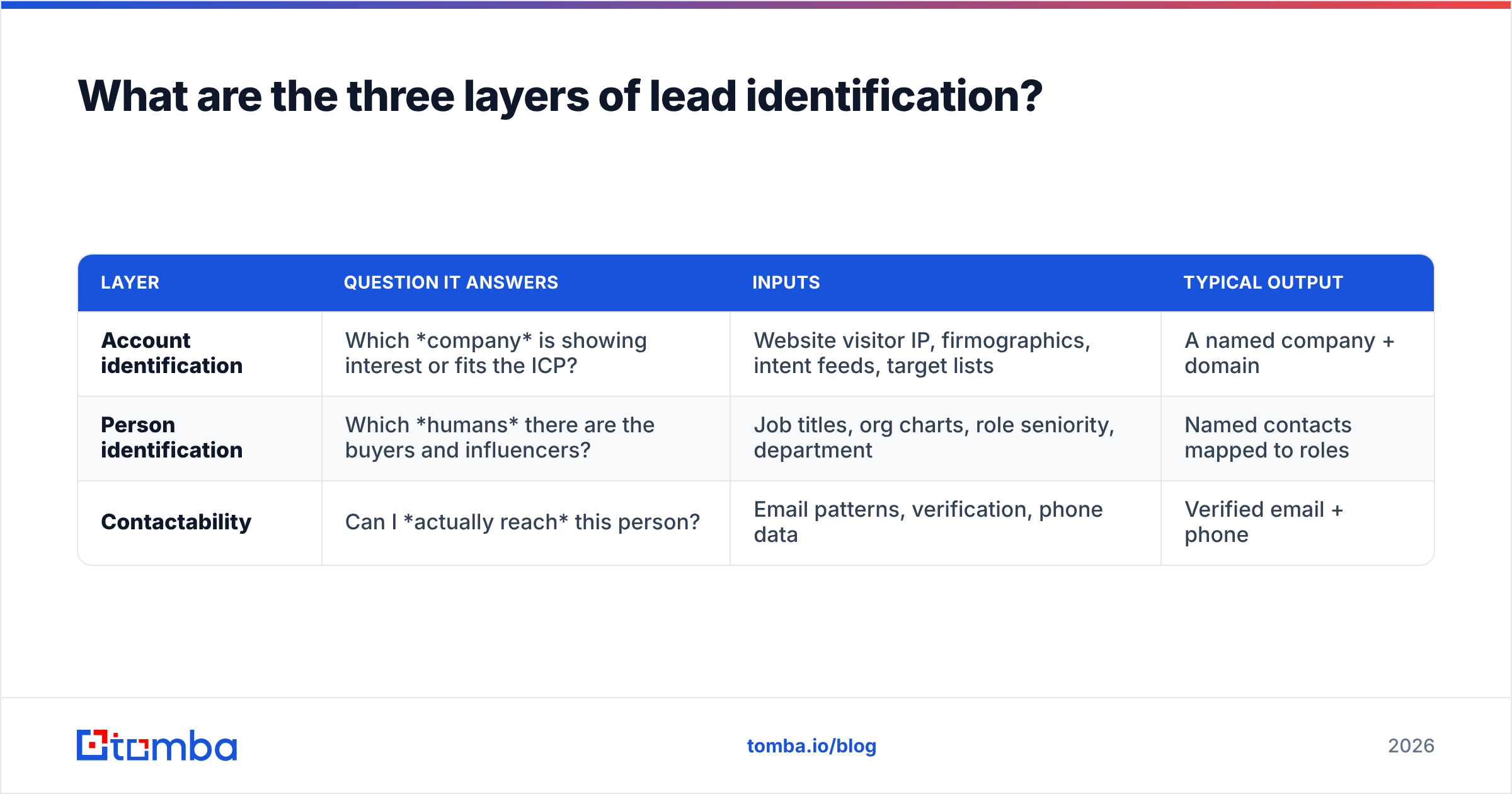
Every reliable identification workflow moves through the same three layers. Skip one and the chain breaks.
| Layer | Question it answers | Inputs | Typical output |
|---|---|---|---|
| Account identification | Which company is showing interest or fits the ICP? | Website visitor IP, firmographics, intent feeds, target lists | A named company + domain |
| Person identification | Which humans there are the buyers and influencers? | Job titles, org charts, role seniority, department | Named contacts mapped to roles |
| Contactability | Can I actually reach this person? | Email patterns, verification, phone data | Verified email + phone |
The art is moving an account down the funnel without losing fidelity. You can identify a hot account all day long, but if you stall at layer two with no named buyer — or layer three with an unverified info@ address — you have a dashboard metric, not a lead.
Layer 1 — Account identification#
Start with the company. The two main sources are inbound signal (who is on your site, opening your emails, engaging on LinkedIn) and outbound targeting (accounts you proactively select because they match your ICP). Tools that perform website visitor reveal de-anonymize traffic to the company level, so a stealth research session becomes a named account on your list.
Layer 2 — Person identification#
Once you know the company, find the right humans. A 200-person SaaS company might have a five-person buying committee: an economic buyer, a champion, two end users, and a blocker. Mapping titles to your ICP roles — and pulling org structure — is what turns "Acme Corp is interested" into "email the VP of RevOps, CC the Ops Manager."
Layer 3 — Contactability#
This is where most pipelines silently leak. You can know the person's name and still have no way to reach them. Use a domain search to pull the company's known email pattern, generate the likely address, then run it through an email verifier before anyone hits send. Contactability without verification is just a more confident form of guessing.
What signals tell you a lead is worth identifying?#
Not every account deserves enrichment budget. Prioritize using signals, then spend your verification credits on the survivors.
- Fit signals (static): industry, headcount, revenue, tech stack, geography. Answers "should we ever sell to them?"
- Intent signals (behavioral): content downloads, pricing-page visits, repeated site sessions, competitor research, review-site activity. Answers "are they in-market now?"
- Engagement signals (first-party): email opens/clicks, webinar attendance, LinkedIn outreach replies, demo requests. Answers "are they reacting to us?"
- Relationship signals: existing customers at a prospect's new employer, mutual connections, past closed-lost deals re-opening.
The highest-converting leads sit where fit, intent, and engagement overlap. A perfect-fit account that just visited your pricing page twice and opened your last email is a different priority than a cold name on a purchased list — even if both look identical in a spreadsheet.
How do you build a B2B lead identification workflow?#
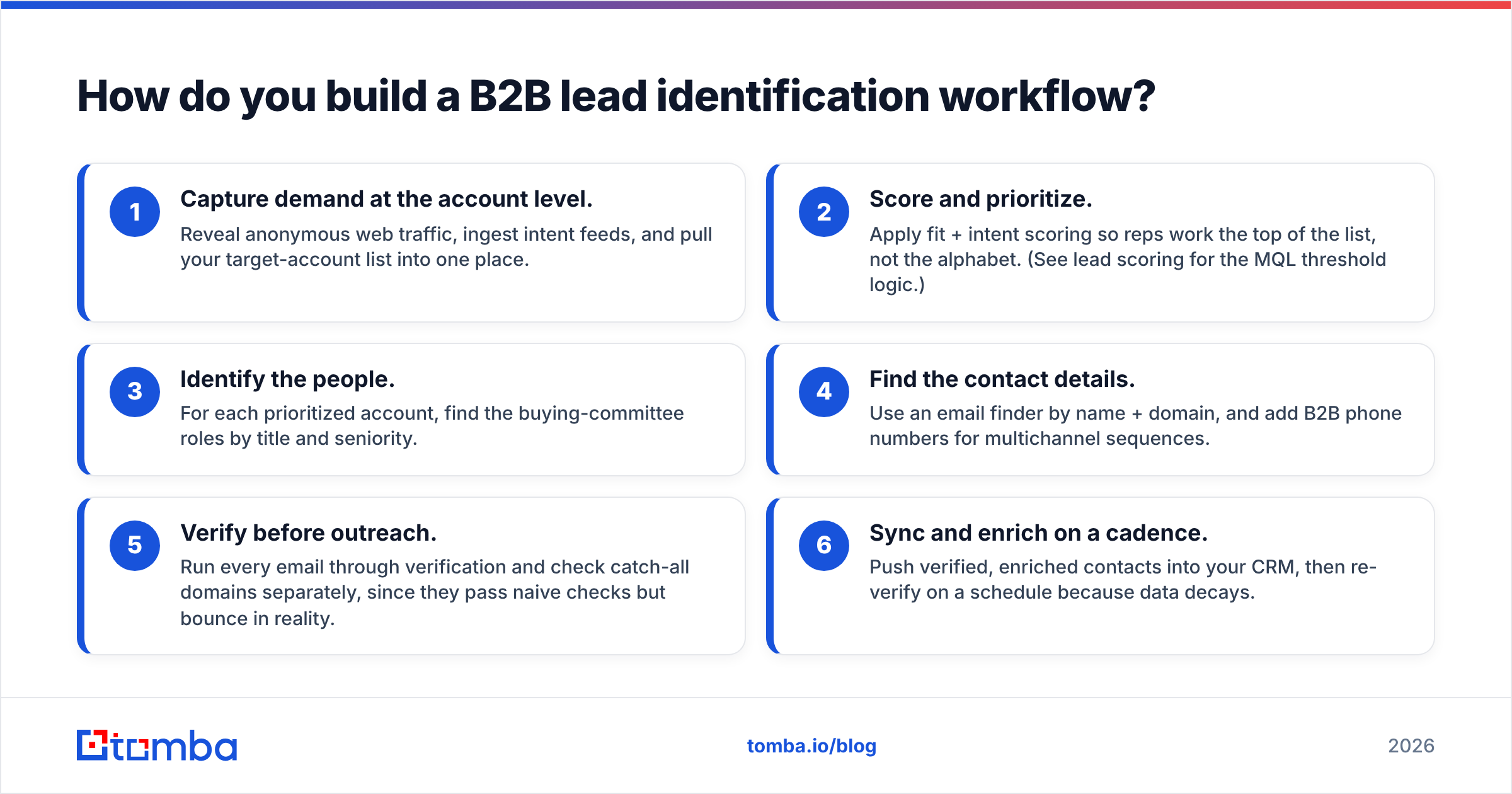
Here is a repeatable, six-step loop you can run weekly. It assumes you already know your ICP; if you don't, define that first or every later step inherits the fuzziness.
- Capture demand at the account level. Reveal anonymous web traffic, ingest intent feeds, and pull your target-account list into one place.
- Score and prioritize. Apply fit + intent scoring so reps work the top of the list, not the alphabet. (See lead scoring for the MQL threshold logic.)
- Identify the people. For each prioritized account, find the buying-committee roles by title and seniority.
- Find the contact details. Use an email finder by name + domain, and add B2B phone numbers for multichannel sequences.
- Verify before outreach. Run every email through verification and check catch-all domains separately, since they pass naive checks but bounce in reality.
- Sync and enrich on a cadence. Push verified, enriched contacts into your CRM, then re-verify on a schedule because data decays.
Run that loop continuously and your CRM stops being a graveyard of stale rows and starts being a live map of who's actually reachable and in-market.
What tools handle B2B lead identification?#
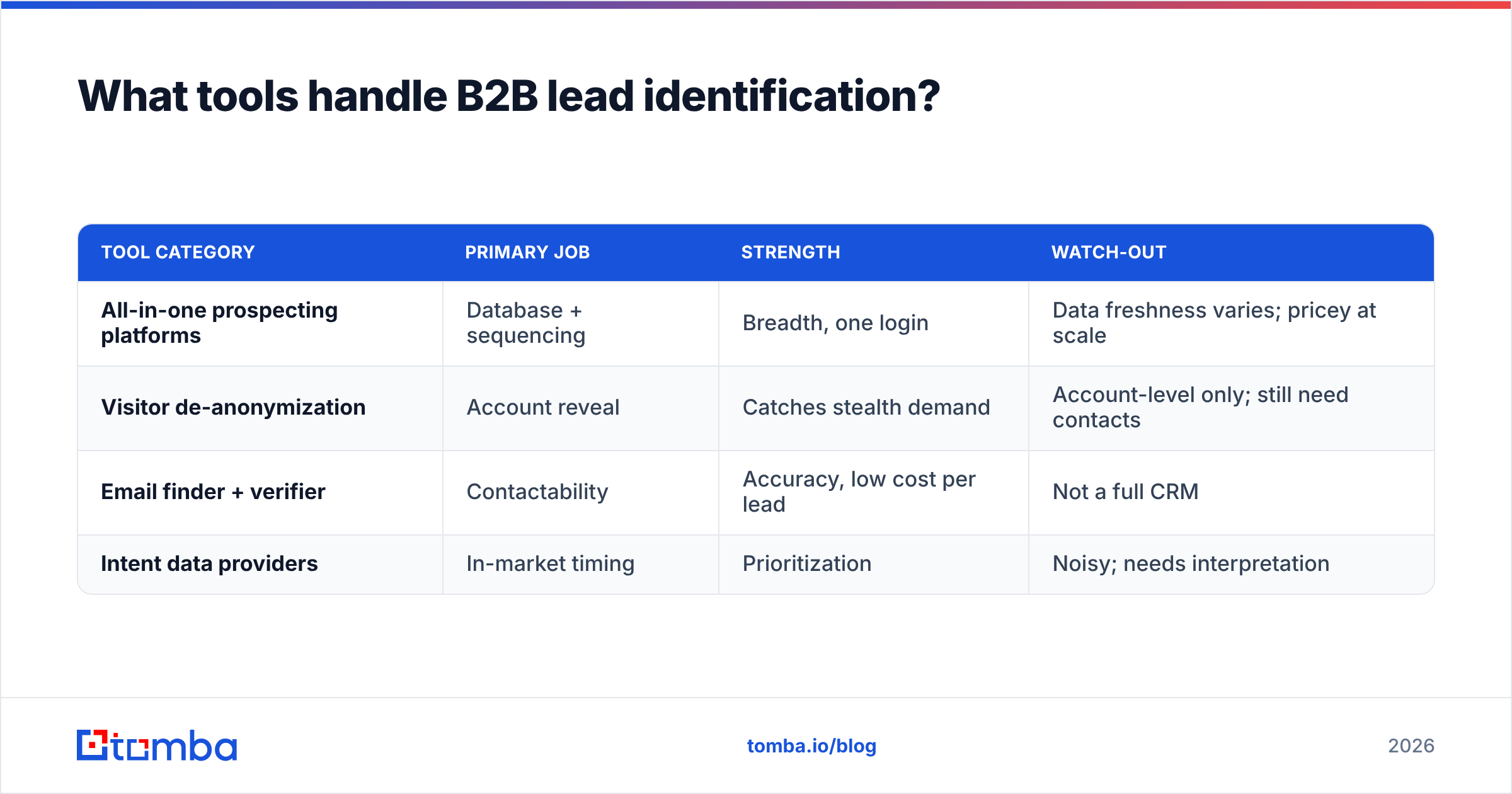
The market splits into a few categories. Most teams stitch two or three together; the trick is minimizing the seams.
| Tool category | Primary job | Strength | Watch-out |
|---|---|---|---|
| All-in-one prospecting platforms | Database + sequencing | Breadth, one login | Data freshness varies; pricey at scale |
| Visitor de-anonymization | Account reveal | Catches stealth demand | Account-level only; still need contacts |
| Email finder + verifier | Contactability | Accuracy, low cost per lead | Not a full CRM |
| Intent data providers | In-market timing | Prioritization | Noisy; needs interpretation |
For evaluating any vendor's real-world accuracy rather than its marketing claims, cross-check independent reviews on G2 and Capterra before you commit budget — self-reported "98% accuracy" numbers rarely survive a free-trial test against your own domains.
Where Tomba fits#
Tomba concentrates on the layers that leak most — person identification and contactability. You can run a domain search to surface a company's contacts and email pattern, use the email finder for a specific name, verify in the same flow, and enrich the record with role and social data. Everything is available through the Tomba API or no-code routes like the Google Sheets add-on and HubSpot integration, so identification becomes part of your existing stack rather than a separate tab.
How do you measure accuracy and avoid bad data?#
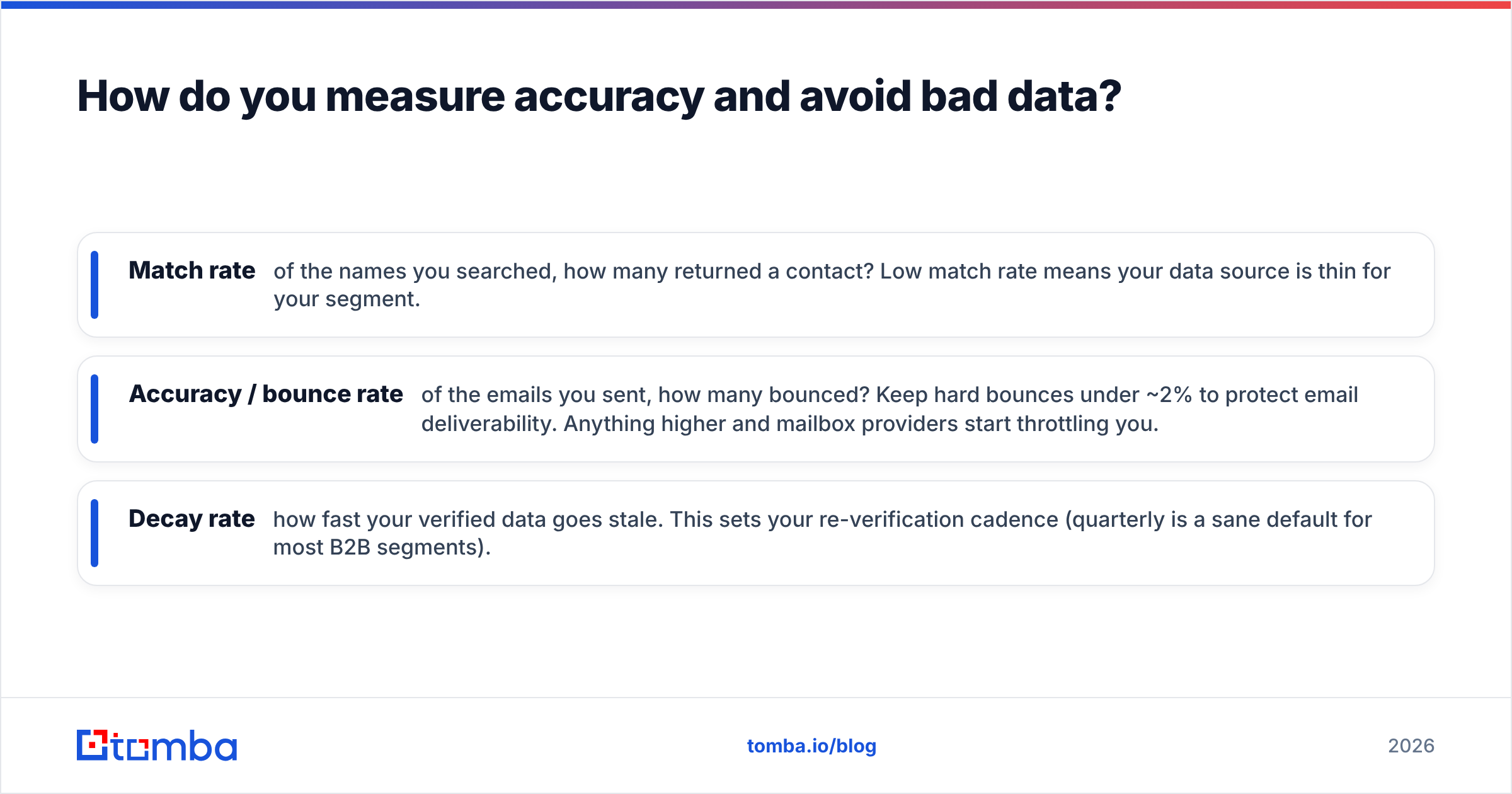
Conclusion first: measure bounce rate, match rate, and decay, and treat verification as non-negotiable.
- Match rate — of the names you searched, how many returned a contact? Low match rate means your data source is thin for your segment.
- Accuracy / bounce rate — of the emails you sent, how many bounced? Keep hard bounces under ~2% to protect email deliverability. Anything higher and mailbox providers start throttling you.
- Decay rate — how fast your verified data goes stale. This sets your re-verification cadence (quarterly is a sane default for most B2B segments).
Two practices keep these numbers healthy. First, always verify before sending, never after a bounce. Second, handle catch-all domains explicitly — they accept every address at the SMTP layer, so a naive verifier marks them "valid" while real messages silently vanish. A dedicated catch-all verifier gives you a confidence score instead of a false green light.
A useful gut-check: if your team is celebrating list size, you are measuring the wrong thing. Celebrate verified, on-ICP, reachable contacts. The rest is vanity.
Is more data always better than better data?#
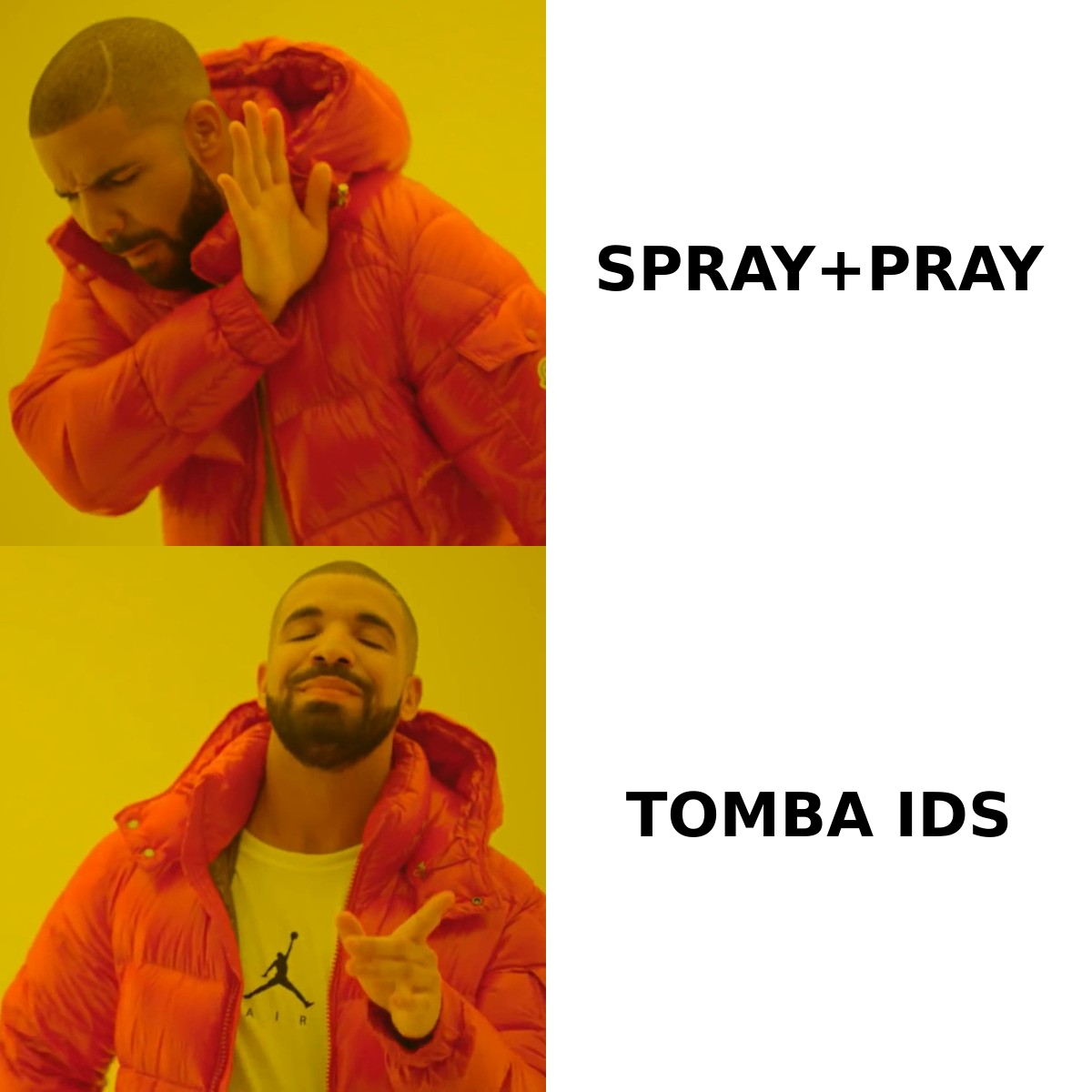
No — and this is the most expensive misconception in the category. A bigger list raises your costs (per-record enrichment, sending infrastructure, rep time) while lowering quality if the incremental rows are off-ICP or unverified. Worse, blasting marginal addresses damages the deliverability of your good ones, so volume can actively suppress the performance of the contacts you got right.
The economic logic is simple. A reply or response rate of 8% on 500 perfectly-identified contacts (40 conversations) beats 0.5% on 50,000 sprayed ones (250 conversations) once you subtract the deliverability damage, spam complaints, and rep hours wasted on dead addresses — and the small, clean list keeps your domain healthy for next quarter. Precision compounds; volume decays.
Frequently asked questions#
How is lead identification different from lead generation? Generation creates and captures interest (ads, content, events). Identification figures out exactly which companies and people behind that interest are worth contacting, and attaches verified details so reps can reach them.
Can I identify anonymous website visitors? At the account level, yes — visitor-reveal tools map IPs to companies. To go from company to a named, reachable person you still need person identification plus an email finder and verification.
How often should I re-verify my data? Quarterly for most B2B segments, more often for high-churn industries. Roughly a quarter of B2B contacts change roles annually, so a once-and-done list is wrong within months.
Does verification really affect deliverability? Yes, directly. High bounce rates signal to mailbox providers that you send to bad lists, which lowers inbox placement for all your mail. Verifying first keeps bounces low and your sender reputation intact.
Putting it into practice#
B2B lead identification is the connective tissue between marketing demand and sales action. Get the three layers right — account, person, contactability — prioritize with real signals, and verify everything before it leaves your outbox. Do that, and your pipeline stops being a numbers game and starts being a precision instrument.
Ready to fix the layer that leaks most? Start with the Tomba Email Finder: search by name and domain, verify in the same flow, and push clean, enriched contacts straight into your CRM. The free tier gives you 25 searches a month to test accuracy against your own target accounts before you spend a dollar — so you can prove the data quality on your ICP, not ours. Identify the right buyers, reach them on the first try, and let the rest of your team stop guessing email patterns for good.
// get started
Find, verify and enrich your first contacts today
Start on the free plan with 25 searches a month, then scale when your team is ready.
Free plan · No credit card required · GDPR & CCPA
// about the author