B2B Lead Nurturing in 2026: Strategy, Stages & Tools
Most B2B leads aren't ready to buy the day you find them. Here's how to build a lead nurturing engine that warms prospects, scores intent, and hands sales a pipeline that actually closes.
TL;DR
- B2B lead nurturing is the system you use to build trust with prospects who aren't ready to buy yet — most of your pipeline lives here, not in the "ready now" bucket.
- The fundamentals: clean contact data, a stage model (awareness → consideration → decision), lead scoring, and multi-channel touches that match buyer intent.
- Roughly half of leads in any funnel are qualified but not yet ready to purchase, so the brands that nurture well win the deal months before the competitor even calls.
- Bad data kills nurturing faster than bad copy. Verify and enrich every contact before you sequence them.
- You don't need a 12-tool stack. You need accurate data, a CRM, an email engine, and a scoring rule — then iterate.
What is B2B lead nurturing?#
B2B lead nurturing is the process of building relationships with potential buyers at every stage of the funnel, especially before they're ready to purchase. Think of it like watering a garden: you don't dig up the seed every morning to check if it sprouted — you create the conditions (light, water, time) and let it grow on a schedule that respects the plant, not your impatience.
In practice, nurturing means delivering relevant content and touches — email, retargeting, LinkedIn, a timely call — to leads based on who they are and what they've done, until they self-identify as sales-ready. The goal isn't to pitch harder. It's to stay useful and present so that when the buying trigger fires inside the prospect's company, you're the vendor they already trust.
This matters because B2B buying cycles are long and committee-driven. According to Gartner research, a typical buying group for a complex B2B solution involves six to ten decision-makers, each armed with their own information. Nurturing is how you stay relevant across all of them over the weeks or months it takes to reach a decision.

Why does lead nurturing matter more than lead generation?#
Generation gets attention; nurturing gets revenue. You can fill the top of the funnel all day, but if 50% of those leads aren't ready to buy and you have no system to stay in touch, you're paying to acquire contacts and then abandoning them.
Here's the uncomfortable math most teams ignore:
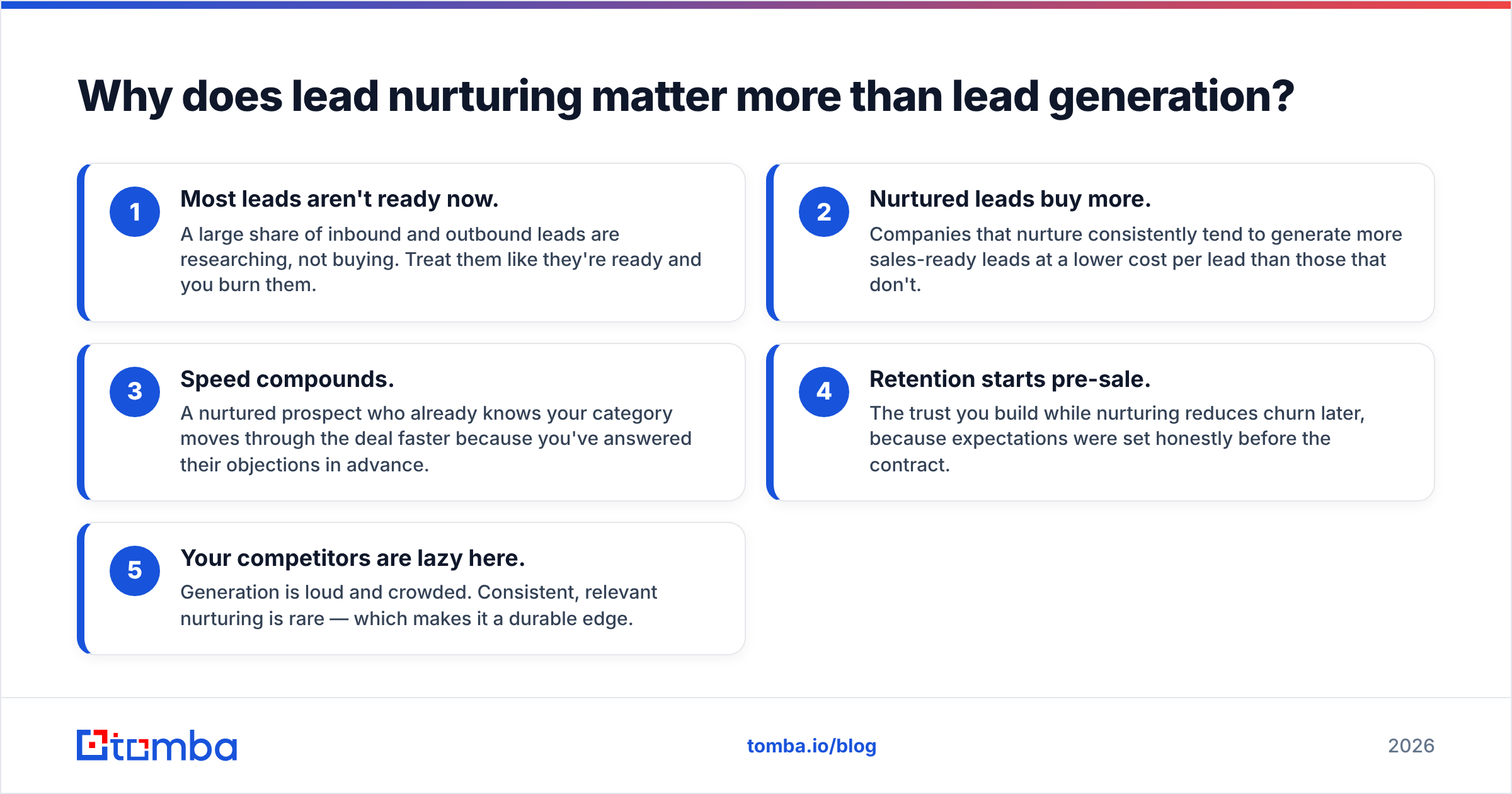
- Most leads aren't ready now. A large share of inbound and outbound leads are researching, not buying. Treat them like they're ready and you burn them.
- Nurtured leads buy more. Companies that nurture consistently tend to generate more sales-ready leads at a lower cost per lead than those that don't.
- Speed compounds. A nurtured prospect who already knows your category moves through the deal faster because you've answered their objections in advance.
- Retention starts pre-sale. The trust you build while nurturing reduces churn later, because expectations were set honestly before the contract.
- Your competitors are lazy here. Generation is loud and crowded. Consistent, relevant nurturing is rare — which makes it a durable edge.
If you want the textbook definition of where nurturing fits, a marketing qualified lead is the handoff point: nurturing is what moves a raw contact toward MQL and then toward sales-readiness.
What are the stages of a B2B lead nurturing funnel?#
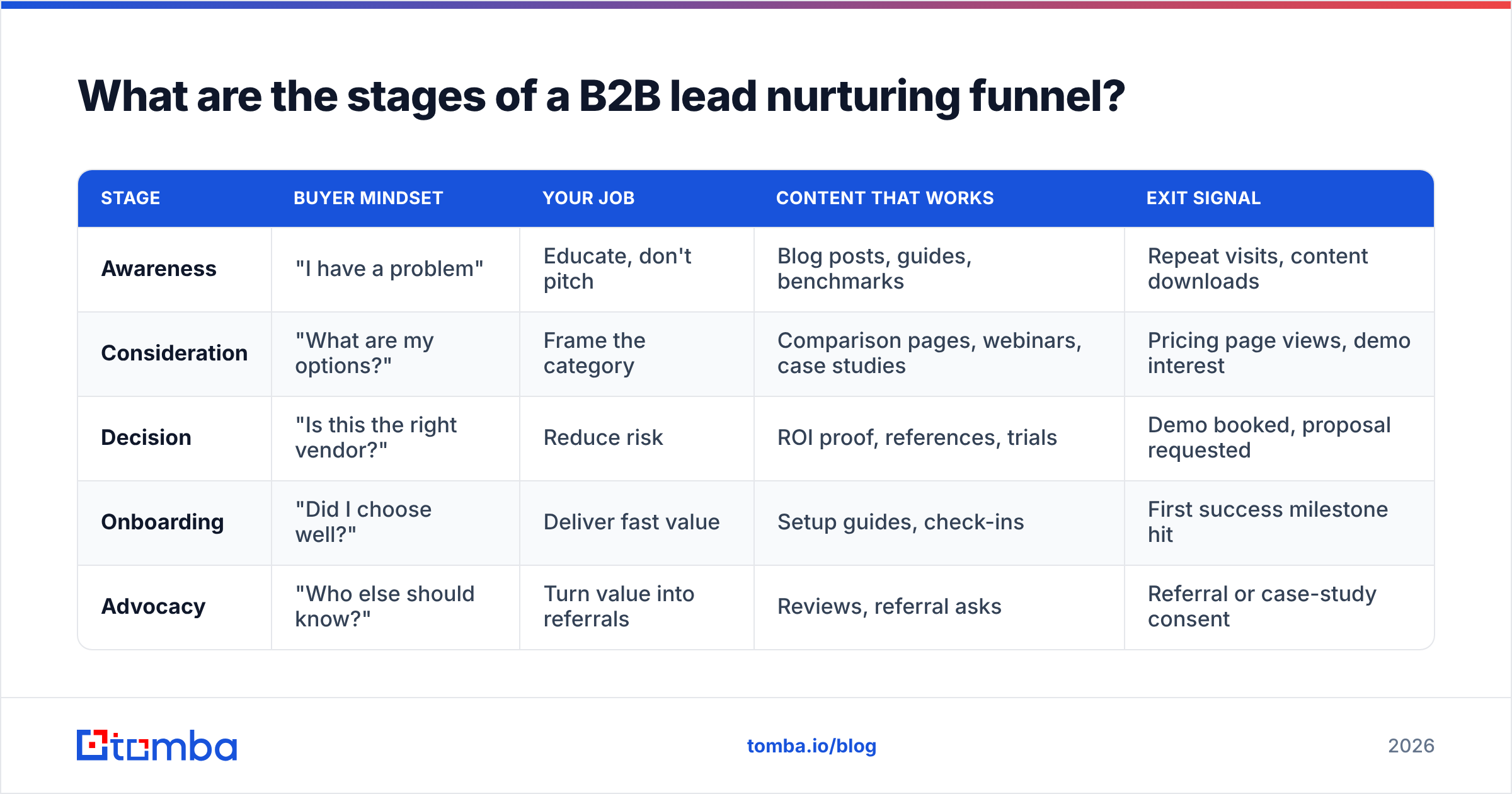
A nurturing funnel mirrors how buyers actually think, not how your org chart is drawn. Each stage has a job, a content type, and an exit signal that tells you the lead is ready to advance.
| Stage | Buyer mindset | Your job | Content that works | Exit signal |
|---|---|---|---|---|
| Awareness | "I have a problem" | Educate, don't pitch | Blog posts, guides, benchmarks | Repeat visits, content downloads |
| Consideration | "What are my options?" | Frame the category | Comparison pages, webinars, case studies | Pricing page views, demo interest |
| Decision | "Is this the right vendor?" | Reduce risk | ROI proof, references, trials | Demo booked, proposal requested |
| Onboarding | "Did I choose well?" | Deliver fast value | Setup guides, check-ins | First success milestone hit |
| Advocacy | "Who else should know?" | Turn value into referrals | Reviews, referral asks | Referral or case-study consent |
The mistake teams make is collapsing all five stages into one "BUY NOW" email blast. A prospect in the awareness stage who gets a hard demo ask unsubscribes; the same person, fed a useful benchmark for three weeks, books the demo on their own.
Map each stage to a measurable behavior so your CRM can route automatically. When someone who downloaded an awareness guide later views your pricing page twice, that's a consideration-to-decision signal — and it should trigger a different sequence than a brand-new contact.
How does lead scoring fit into nurturing?#
Lead scoring is the scoreboard that tells you when to stop nurturing and start selling. It assigns points to two dimensions — fit (do they match your ICP?) and engagement (are they acting interested?) — and surfaces the leads worth a rep's time.
A workable starter model:
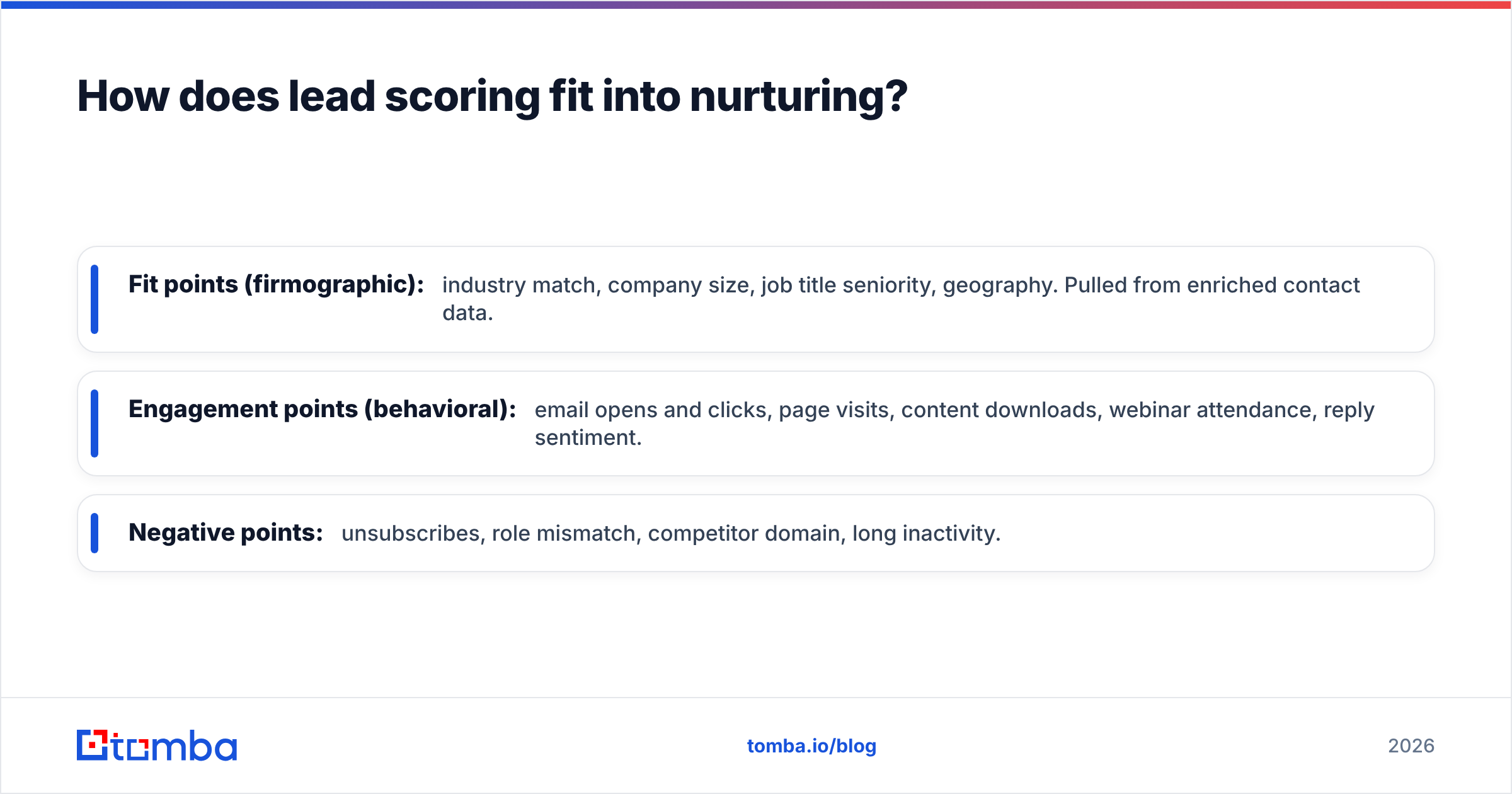
- Fit points (firmographic): industry match, company size, job title seniority, geography. Pulled from enriched contact data.
- Engagement points (behavioral): email opens and clicks, page visits, content downloads, webinar attendance, reply sentiment.
- Negative points: unsubscribes, role mismatch, competitor domain, long inactivity.
When a lead crosses a threshold, it becomes a marketing qualified lead and routes to sales. Below the threshold, it stays in nurturing. The threshold isn't sacred — calibrate it against how many leads your reps can actually work, and revisit quarterly.
Scoring is only as good as the data feeding it. If a contact's title is wrong or the email bounces, your score is fiction. This is why data enrichment sits underneath scoring: fill in the firmographic gaps so fit scoring is real, not guesswork. Salesforce's own guidance on lead scoring makes the same point — accurate inputs first, model second.
What channels should a B2B nurture sequence use?#
Email is the backbone, but single-channel nurturing leaves response on the table. The strongest sequences layer channels so a prospect who ignores email might still convert from a LinkedIn touch or a well-timed call.

A balanced multi-channel cadence:
- Email — the workhorse for educational drips and triggered sequences. Cheap, scalable, measurable.
- LinkedIn — soft touches (engaging with posts, a relevant DM) that humanize the brand without a hard pitch.
- Retargeting ads — keep your category top-of-mind between email touches.
- Phone — reserved for high-score leads showing decision-stage intent; a call at the right moment closes what email can't.
- SMS or chat — fast, late-funnel nudges for booked-but-unconfirmed demos.
The principle: match channel intensity to lead score. Low-score leads get low-intensity, high-leverage touches (email, ads). High-score leads earn a human. Spending a rep's hour on a lead that just downloaded their first guide is how teams waste their best people.
How do you build a nurture sequence that doesn't get ignored?#
Start with accurate data, write for one buyer, and trigger on behavior instead of the calendar. Here's the build order that keeps sequences out of the spam folder and in the reply box.
1. Verify and enrich before you send. A nurture sequence sent to stale or fake addresses tanks your sender reputation and corrupts your scoring data. Run every contact through an email verifier and fill firmographic gaps first. This is non-negotiable — deliverability problems caused early poison every campaign after.
2. Segment by stage and persona. One generic drip for everyone underperforms a handful of tight sequences. At minimum, split by funnel stage; ideally also by persona (the economic buyer reads differently than the end user).
3. Lead with value, gate the pitch. The first three to five touches should be useful with zero ask. Earn the right to pitch by being worth opening. HubSpot's research on email and lead nurturing consistently shows that relevance and segmentation, not volume, drive reply rates.
4. Trigger on behavior. Time-based drips are fine as a baseline, but behavior-triggered sequences convert better. A pricing-page visit should fire a decision-stage email within hours, not next Tuesday's batch.
5. Set an exit and a recycle path. Every sequence needs an exit (lead converts or replies) and a recycle path (no engagement after N touches → drop to a low-frequency newsletter, not the trash).
To wire behavioral triggers cleanly, connect your data and email tooling to your CRM — Tomba's HubSpot integration and similar connectors let verified contact data flow straight into the workflows that fire your sequences.
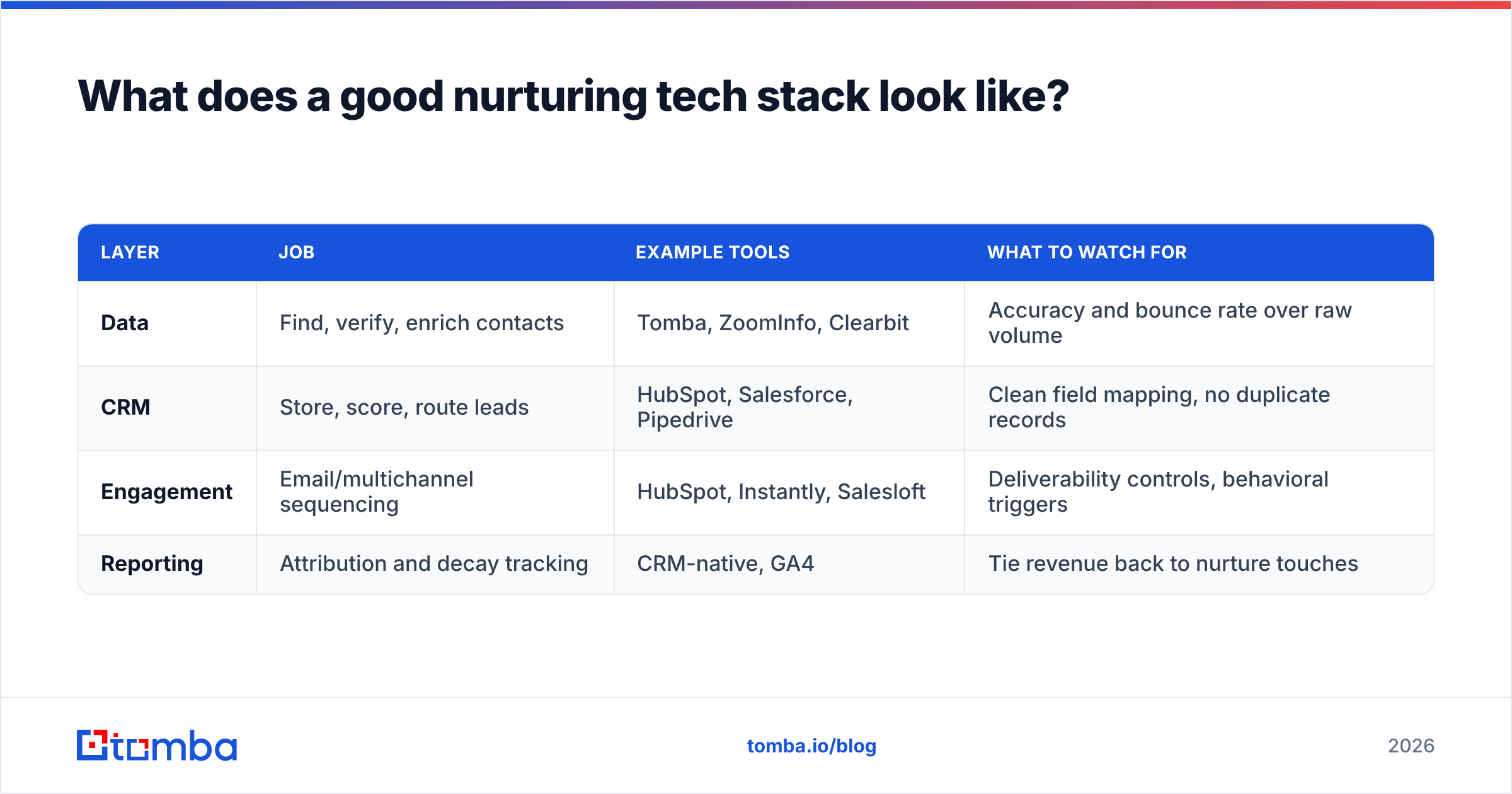
What does a good nurturing tech stack look like?#
You need four jobs covered: find and verify contacts, store and score them, sequence them, and report. You can do this with four tools or forty — the four-tool version usually wins on focus and cost.
| Layer | Job | Example tools | What to watch for |
|---|---|---|---|
| Data | Find, verify, enrich contacts | Tomba, ZoomInfo, Clearbit | Accuracy and bounce rate over raw volume |
| CRM | Store, score, route leads | HubSpot, Salesforce, Pipedrive | Clean field mapping, no duplicate records |
| Engagement | Email/multichannel sequencing | HubSpot, Instantly, Salesloft | Deliverability controls, behavioral triggers |
| Reporting | Attribution and decay tracking | CRM-native, GA4 | Tie revenue back to nurture touches |
A few honest notes on tool selection:
- Don't over-buy. A startup nurturing a few hundred leads a month does not need an enterprise RevOps suite. Start lean, add tools when a specific bottleneck demands it.
- Data quality is the foundation. The fanciest sequencing engine still fails on bad addresses. Whatever else you choose, verify and enrich at the source.
- Integration beats best-in-class. Two tools that talk to each other beat three best-in-class tools that don't. Map your data flow before you buy.
This is where accurate sourcing pays off twice. Using a reliable email finder to build clean contact lists means your scoring, sequencing, and reporting all run on real data instead of garbage. Garbage in, garbage funnel.
How do you measure whether nurturing is working?#
Track movement and revenue, not vanity opens. Opens tell you a subject line landed; they don't tell you the funnel is healthy. The metrics that matter trace a lead from cold to closed.
- Stage conversion rates — what percentage advance from awareness to consideration to decision? A leak between two stages tells you exactly which content to fix.
- Time-to-MQL — how long does nurturing take to produce a sales-ready lead? Shrinking this number is the whole game.
- Engagement-to-reply rate — replies and booked meetings, not opens. This reflects real interest.
- Nurture-influenced pipeline — revenue from deals that touched a nurture sequence. This is the number that justifies the budget.
- List health — bounce rate, spam complaints, unsubscribes. Rising bounces mean your data decayed and it's time to re-verify.
Set a quarterly review. Pull the leads that converted and reverse-engineer what touched them; pull the leads that went cold and find where they stalled. Nurturing is iterative — the first sequence is a hypothesis, not a monument.
Common B2B lead nurturing mistakes to avoid#
- Sequencing unverified data. The fastest way to wreck deliverability and corrupt scoring. Verify first, always.
- One drip for everyone. No segmentation means no relevance, and no relevance means the unsubscribe button.
- Pitching too early. A hard ask in touch one converts nobody who wasn't already converting.
- Ignoring sales handoff. A high-score lead that sits in a queue for three days goes cold. Speed of response matters as much as the score.
- No recycle path. Leads who go quiet aren't dead — drop them to a low-frequency track instead of deleting months of relationship-building.
- Measuring opens, not revenue. If your dashboard stops at open rate, you can't prove nurturing pays, and the budget gets cut.
The bottom line#
B2B lead nurturing is the difference between a list of names and a predictable pipeline. The brands that win aren't the ones with the loudest top-of-funnel — they're the ones who stay useful, relevant, and present until the buyer is ready, then hand sales a warm, well-scored lead. Get the four fundamentals right — clean data, a stage model, lead scoring, and multi-channel relevance — and iterate from there.
Every part of that system rests on one thing: accurate contact data. If your emails bounce, your scores are fiction and your sequences poison your own sender reputation. Start by building clean, verified contact lists with the Tomba Email Finder — find professional emails by domain, name, or company, verify them before you send, and enrich them so your scoring is real. Plans start free with 25 searches a month, then scale to Starter at $49/mo as your nurture engine grows. See full Tomba pricing and give your nurturing the foundation it actually needs.
// get started
Find, verify and enrich your first contacts today
Start on the free plan with 25 searches a month, then scale when your team is ready.
Free plan · No credit card required · GDPR & CCPA
// about the author