B2B Lead Nurturing Email Examples That Convert in 2026
Steal 7 proven B2B lead nurturing email examples, plus the sequence structure, timing, and copy patterns that turn cold leads into booked demos in 2026.
Most B2B leads don't say no. They go quiet. They downloaded your guide, sat through a webinar, then vanished into a CRM row nobody touches. Lead nurturing is how you re-earn their attention without begging for a meeting every week.
This guide gives you seven real B2B lead nurturing email examples you can adapt today, plus the sequence logic, timing, and subject lines that make them work.
TL;DR#
- Nurturing is not follow-up. Follow-up chases a meeting; nurturing builds trust across 5–8 touches so the meeting feels obvious.
- Lead with their problem, not your product. The best-performing nurture emails reference a specific pain or trigger, then offer one useful thing.
- Timing beats volume. A spaced cadence (day 1, 3, 7, 12, 20) outperforms daily blasts and protects your sender reputation.
- Segment by intent. A pricing-page visitor and a blog subscriber need different emails. Generic "just checking in" notes get ignored.
- Clean data is the multiplier. Even perfect copy fails if it lands in a spam trap or an outdated inbox — verify before you send.
What is B2B lead nurturing (and how is it different from follow-up)?#
Lead nurturing is the process of building a relationship with a prospect over multiple touches until they're ready to buy. Think of it like dating versus proposing on the first date: you earn small commitments before you ask for the big one.
A follow-up email says "Did you get my last note?" A nurture email says "You were looking at workflow automation — here's how a team your size cut onboarding time by 40%." One is about you. The other is about them.
The difference matters because response rate on self-serving check-ins collapses after the second send, while value-led nurture sequences keep earning replies through touch six and beyond.

What does a B2B lead nurturing sequence look like?#
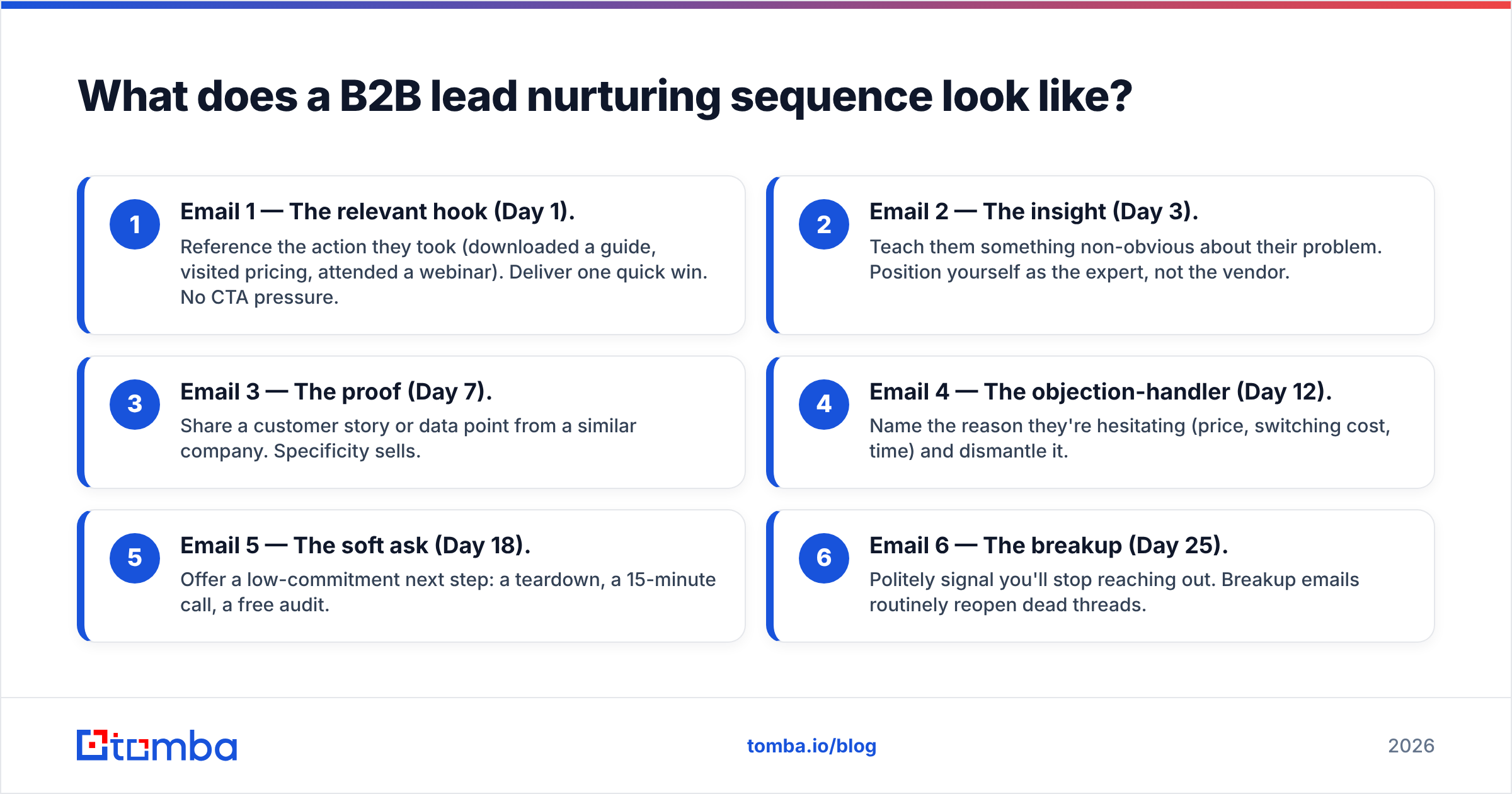
A good sequence is built around a single narrative arc: acknowledge the problem, prove you understand it, show evidence, lower the risk, and make the ask. Here's a structure that works across most B2B funnels.
- Email 1 — The relevant hook (Day 1). Reference the action they took (downloaded a guide, visited pricing, attended a webinar). Deliver one quick win. No CTA pressure.
- Email 2 — The insight (Day 3). Teach them something non-obvious about their problem. Position yourself as the expert, not the vendor.
- Email 3 — The proof (Day 7). Share a customer story or data point from a similar company. Specificity sells.
- Email 4 — The objection-handler (Day 12). Name the reason they're hesitating (price, switching cost, time) and dismantle it.
- Email 5 — The soft ask (Day 18). Offer a low-commitment next step: a teardown, a 15-minute call, a free audit.
- Email 6 — The breakup (Day 25). Politely signal you'll stop reaching out. Breakup emails routinely reopen dead threads.
This isn't rigid. A high-intent lead from a demo request might compress this to three emails over a week. A top-of-funnel newsletter subscriber might stretch it across two months.
7 B2B lead nurturing email examples you can steal#
Below are templates with the psychology behind each. Swap the brackets for your specifics and verify the recipient exists before you hit send.
Example 1 — The post-download hook#
Subject: Quick thing about [topic] you'll want to see
Hi [First name],
Thanks for grabbing the [guide name] — most people skip page 4, but that's where the [specific tactic] lives, and it's the part teams at [similar company type] act on first.
One question worth asking yourself this week: [provocative question tied to their pain]?
No need to reply — just wanted page 4 on your radar.
[Your name]
Why it works: it references a specific action, adds value beyond the download, and removes reply pressure, which paradoxically increases replies.
Example 2 — The insight email#
Subject: Why [common approach] quietly costs you [metric]
Hi [First name],
Most [job title]s try to fix [problem] by [common approach]. It feels productive, but it usually hides the real cost: [counterintuitive consequence].
The teams that get ahead flip it — they [better approach] first. Here's a 90-second breakdown: [link].
Curious whether your team has hit this wall yet.
[Your name]
Example 3 — The proof email#
Subject: How [Customer] went from [before] to [after]
Hi [First name],
[Customer], a [industry] team about your size, was stuck at [specific metric]. Within [timeframe] of changing [one thing], they hit [result].
The full story is here if useful: [link].
Happy to share the exact playbook they used — want it?
[Your name]
Example 4 — The objection-handler#
Subject: "We don't have time to switch" — here's the honest math
Hi [First name],
The biggest reason teams stay on [status quo] isn't price. It's the fear that switching eats two weeks they don't have.
Fair. So here's the honest version: setup takes [X], migration is [Y], and most teams see [benefit] inside the first month. I'll send the migration checklist if you want to pressure-test it.
[Your name]
Example 5 — The soft ask#
Subject: A 15-minute teardown of your [process]?
Hi [First name],
I've been sending you ideas for a few weeks — figured I'd offer something concrete. I'll record a short teardown of your current [process] and three things I'd change, no call required.
Want it? Just reply "yes" and I'll get started.
[Your name]
Example 6 — The re-engagement email#
Subject: Should I close your file?
Hi [First name],
I don't want to clutter your inbox if the timing's wrong. If [problem] isn't a priority this quarter, just say the word and I'll step back.
If it is still on your list, reply and I'll send the one resource most likely to move the needle.
[Your name]
Example 7 — The trigger-based email#
Subject: Saw [company] just [trigger event] — congrats
Hi [First name],
Noticed [company] just [funding round / new hire / product launch]. That usually means [predictable next challenge] lands on someone's desk soon.
We help teams handle exactly that. Worth a quick conversation before it gets urgent?
[Your name]
Trigger emails convert because they're timely. Pairing them with accurate contact enrichment data — role, company size, recent funding — is what separates a relevant nudge from a guess.

How do nurture styles compare?#
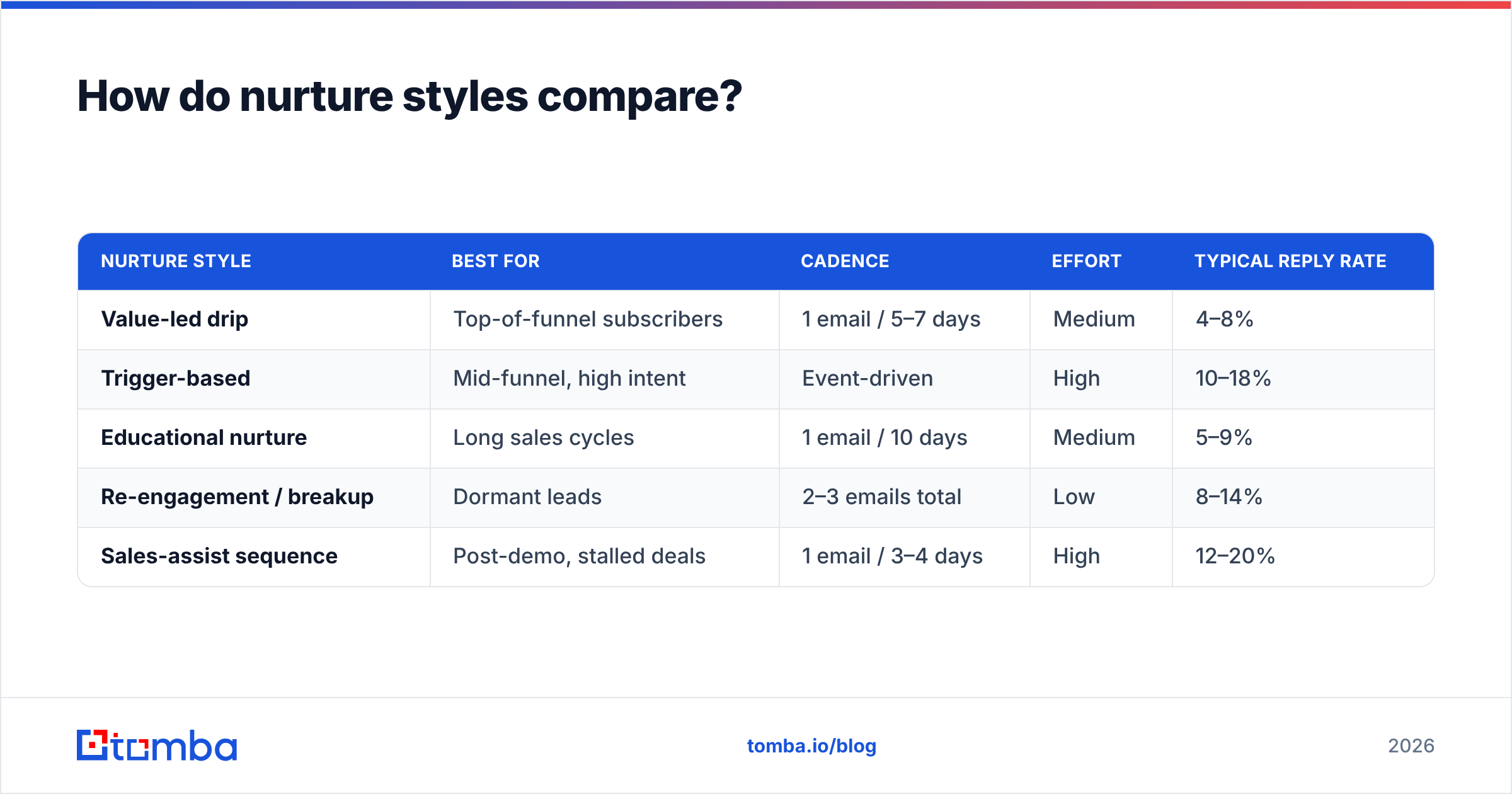
Not every nurture motion fits every lead. Here's how the common approaches stack up so you can match style to intent.
| Nurture style | Best for | Cadence | Effort | Typical reply rate |
|---|---|---|---|---|
| Value-led drip | Top-of-funnel subscribers | 1 email / 5–7 days | Medium | 4–8% |
| Trigger-based | Mid-funnel, high intent | Event-driven | High | 10–18% |
| Educational nurture | Long sales cycles | 1 email / 10 days | Medium | 5–9% |
| Re-engagement / breakup | Dormant leads | 2–3 emails total | Low | 8–14% |
| Sales-assist sequence | Post-demo, stalled deals | 1 email / 3–4 days | High | 12–20% |
The pattern: the more specific the trigger and the warmer the lead, the higher the reply rate — and the shorter the sequence needs to be. Cold, generic drips need patience; warm, triggered ones need speed.
What makes a nurture email actually convert?#
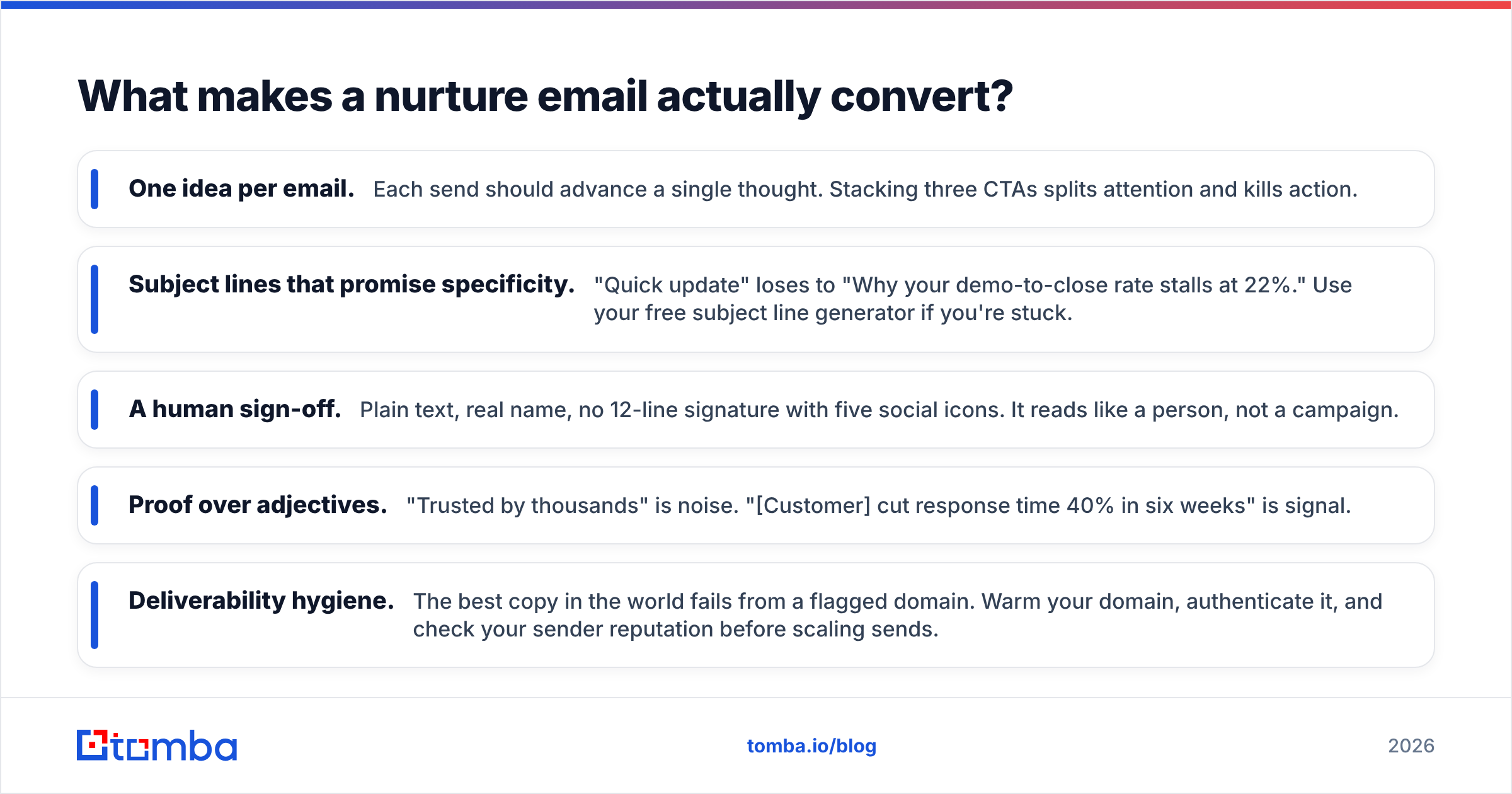
Five things separate emails that get replies from emails that get archived.
- One idea per email. Each send should advance a single thought. Stacking three CTAs splits attention and kills action.
- Subject lines that promise specificity. "Quick update" loses to "Why your demo-to-close rate stalls at 22%." Use your free subject line generator if you're stuck.
- A human sign-off. Plain text, real name, no 12-line signature with five social icons. It reads like a person, not a campaign.
- Proof over adjectives. "Trusted by thousands" is noise. "[Customer] cut response time 40% in six weeks" is signal.
- Deliverability hygiene. The best copy in the world fails from a flagged domain. Warm your domain, authenticate it, and check your sender reputation before scaling sends.
Industry research backs the structure-over-volume point: HubSpot's email marketing benchmarks consistently show segmented, behavior-triggered emails outperforming batch sends, and review data on platforms like G2 reflects the same shift toward intent-based nurturing.
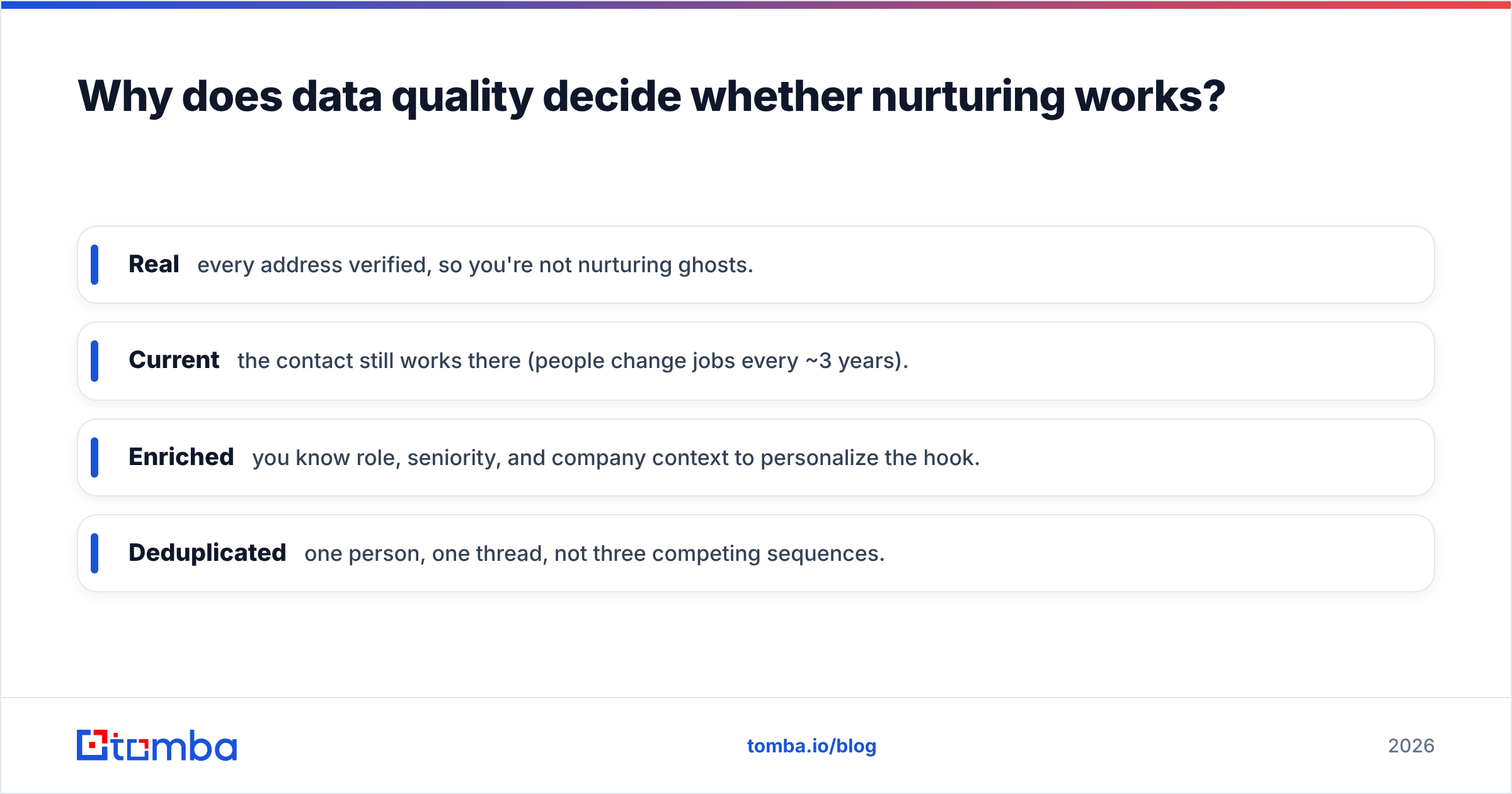
Why does data quality decide whether nurturing works?#
Here's the conclusion first: you can write the best nurture sequence on earth and still fail if half your list is wrong. A nurture email sent to a bounced, role-based, or outdated address does three kinds of damage — it wastes the send, it dents your domain reputation, and it skews your reply-rate data so you can't tell good copy from bad.
This is the unglamorous half of nurturing. Before a single email goes out, your list should be:
- Real — every address verified, so you're not nurturing ghosts.
- Current — the contact still works there (people change jobs every ~3 years).
- Enriched — you know role, seniority, and company context to personalize the hook.
- Deduplicated — one person, one thread, not three competing sequences.
That's why teams pair their nurturing platform with a finder-and-verifier layer. Tools like Salesforce handle the CRM and orchestration, while an email verifier keeps the underlying list clean enough that your carefully written sequences actually reach inboxes. Garbage data turns a great sequence into a spam-folder rehearsal.
How often should you send nurture emails?#
Conclusion: space them out, and let behavior speed them up. A safe default is one email every 5–7 days for cold nurture, tightening to every 3–4 days once a lead shows intent (opens, clicks, replies, pricing-page visits).
Avoid two failure modes. Sending daily looks desperate and triggers spam filters. Sending monthly lets the relationship go cold between touches — they forget who you are and your next email reads like a cold open. The middle path keeps you present without becoming noise.
Tie cadence to signals where you can. If a lead clicks a case-study link, move them up the sequence faster. If they go silent for three sends, drop them to a slow quarterly check-in instead of burning more frequency on a non-responder.
Common B2B lead nurturing mistakes to avoid#
- Talking about yourself too early. The first two emails should be almost entirely about their world.
- No segmentation. One sequence for every lead means it fits none of them well.
- Forgetting the breakup. The "should I close your file?" email is often the highest-converting one. Don't skip it.
- Ignoring deliverability. Authentication, warmup, and list verification aren't optional at scale.
- Measuring opens only. With privacy changes inflating open rates, track replies, clicks, and booked meetings instead.
Start with a list worth nurturing#
Great nurture copy is only as good as the inbox it reaches. Before you load these examples into your sequencer, build a list of real, verified, decision-maker contacts — then enrich them so every hook lands with context.
That's where Tomba's Email Finder fits in. Find professional email addresses by name, domain, or company, verify them in the same workflow, and push clean contacts straight into your nurture sequence. Plans start free with 25 searches a month, scaling to Starter at $49/mo and Growth at $99/mo — see full Tomba pricing for details. Write the emails above; let Tomba make sure they reach a human who can say yes.
// get started
Find, verify and enrich your first contacts today
Start on the free plan with 25 searches a month, then scale when your team is ready.
Free plan · No credit card required · GDPR & CCPA
// about the author