Best B2B Lead Providers in 2026: How to Choose a Data Source
Not all B2B lead providers sell the same data. Compare accuracy, coverage, pricing, and compliance so you stop paying for bounced contacts.
TL;DR
- B2B lead providers fall into four buckets: database platforms, email-finder/enrichment APIs, intent-data vendors, and managed list sellers. Each trades coverage for accuracy differently.
- The metric that actually predicts ROI is deliverable, verified contacts — not the headline "200M+ contacts" number on the pricing page.
- Pay-per-valid-credit tools beat flat database seats for most small teams because you only burn budget on emails that pass verification.
- Compliance (GDPR/CCPA), refresh cadence, and catch-all handling separate a usable provider from a refund request.
- A self-serve email finder with built-in verification is the cheapest way to test data quality before you commit to an annual contract.
What is a B2B lead provider?#
A B2B lead provider is a service that sells or surfaces contact data — names, business emails, phone numbers, job titles, and company firmographics — so your sales and marketing teams can reach buyers without manually digging through LinkedIn and company sites.
Think of it like sourcing produce. A managed list seller is the supermarket: convenient, pre-packaged, but you don't know how long the contacts have been sitting on the shelf. A self-serve finder-and-verifier is the farmers' market: you pick each contact, check it's fresh, and pay for exactly what you take. Both feed you, but one wastes far less.
The catch is that "lead provider" covers wildly different products. Sorting them before you compare prices saves you from buying the wrong category entirely.
The four types of B2B lead providers#
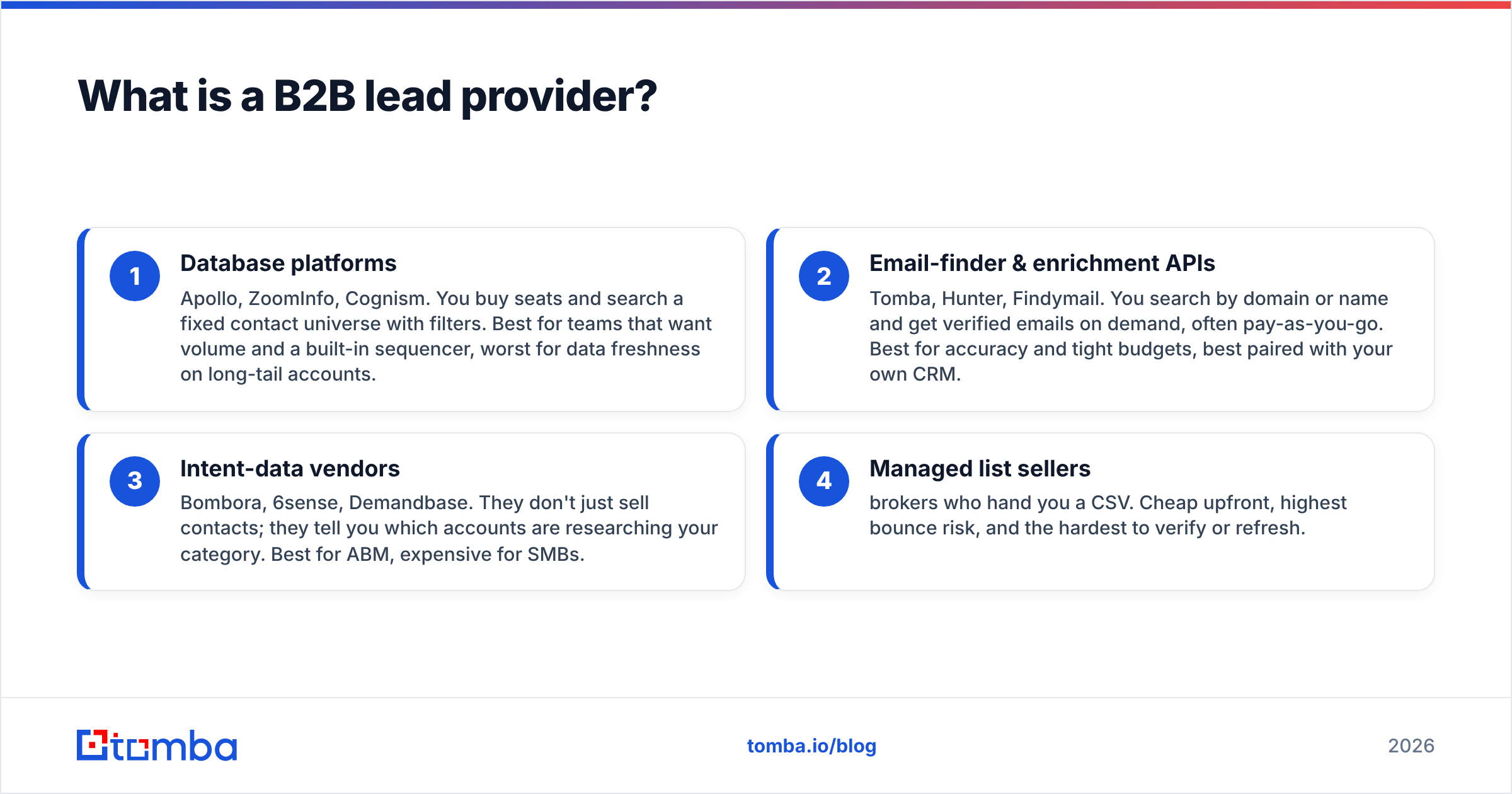
- Database platforms — Apollo, ZoomInfo, Cognism. You buy seats and search a fixed contact universe with filters. Best for teams that want volume and a built-in sequencer, worst for data freshness on long-tail accounts.
- Email-finder & enrichment APIs — Tomba, Hunter, Findymail. You search by domain or name and get verified emails on demand, often pay-as-you-go. Best for accuracy and tight budgets, best paired with your own CRM.
- Intent-data vendors — Bombora, 6sense, Demandbase. They don't just sell contacts; they tell you which accounts are researching your category. Best for ABM, expensive for SMBs.
- Managed list sellers — brokers who hand you a CSV. Cheap upfront, highest bounce risk, and the hardest to verify or refresh.
Most teams need one platform from rows 1–2 plus optional intent from row 3. Buying a static list (row 4) is almost always the move you regret.

How do you compare B2B lead providers?#
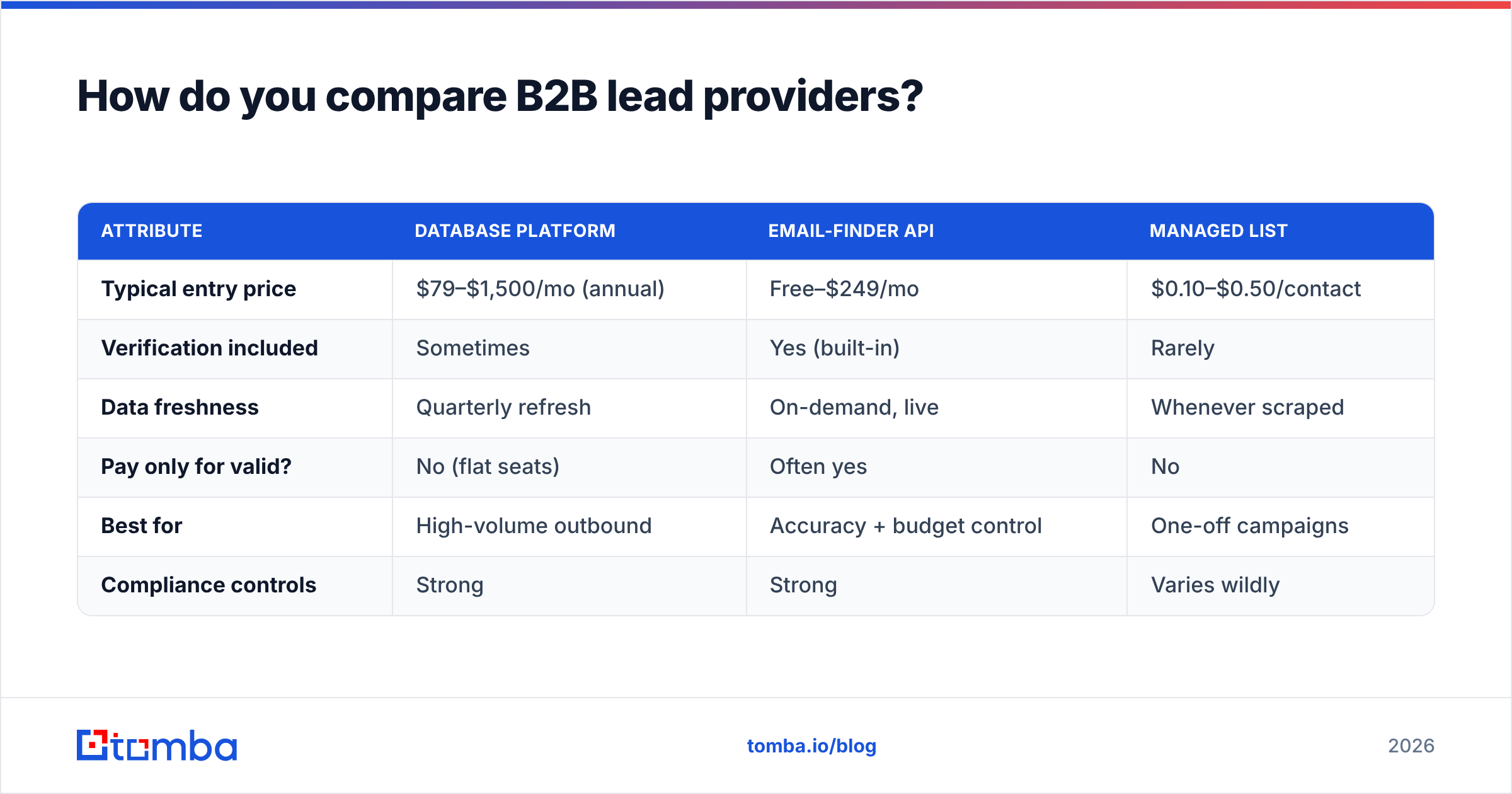
Compare on deliverability-adjusted cost, not sticker price. A $99 plan that gives you 1,000 verified emails is cheaper than a "$49" plan that gives you 1,000 raw guesses where 35% bounce. The five attributes below decide that math.
| Attribute | Database platform | Email-finder API | Managed list |
|---|---|---|---|
| Typical entry price | $79–$1,500/mo (annual) | Free–$249/mo | $0.10–$0.50/contact |
| Verification included | Sometimes | Yes (built-in) | Rarely |
| Data freshness | Quarterly refresh | On-demand, live | Whenever scraped |
| Pay only for valid? | No (flat seats) | Often yes | No |
| Best for | High-volume outbound | Accuracy + budget control | One-off campaigns |
| Compliance controls | Strong | Strong | Varies wildly |
A few buying rules that follow from the table:
- If you send fewer than 5,000 emails a month, a pay-per-valid email-finder almost always wins on cost-per-meeting.
- If you run a 20-rep outbound floor, a database platform's flat seat and native sequencer earn their keep.
- If you only need contacts for a single event push, even then, build the list yourself with a bulk email finder rather than buying a stale CSV.
The accuracy problem nobody puts on the pricing page#
Every vendor advertises a giant contact count. None advertise their bounce rate, because bounce rate is where the money leaks. A 90%-accurate provider and a 97%-accurate provider sound close, but on a 10,000-send campaign that's 700 extra bounces — enough to dent your sender reputation and land future mail in spam.
Two things protect you here. First, insist on a provider that runs email verification before it hands you an address, and that flags catch-all domains separately with a catch-all verifier. Second, ask where the data comes from — providers that publish their data sources tend to have less to hide than brokers who won't.
According to independent review platforms like G2 and Capterra, self-reported accuracy and verified user accuracy routinely differ by 10–20 points, so weight real reviews over marketing claims.
Which B2B lead providers are the best in 2026?#
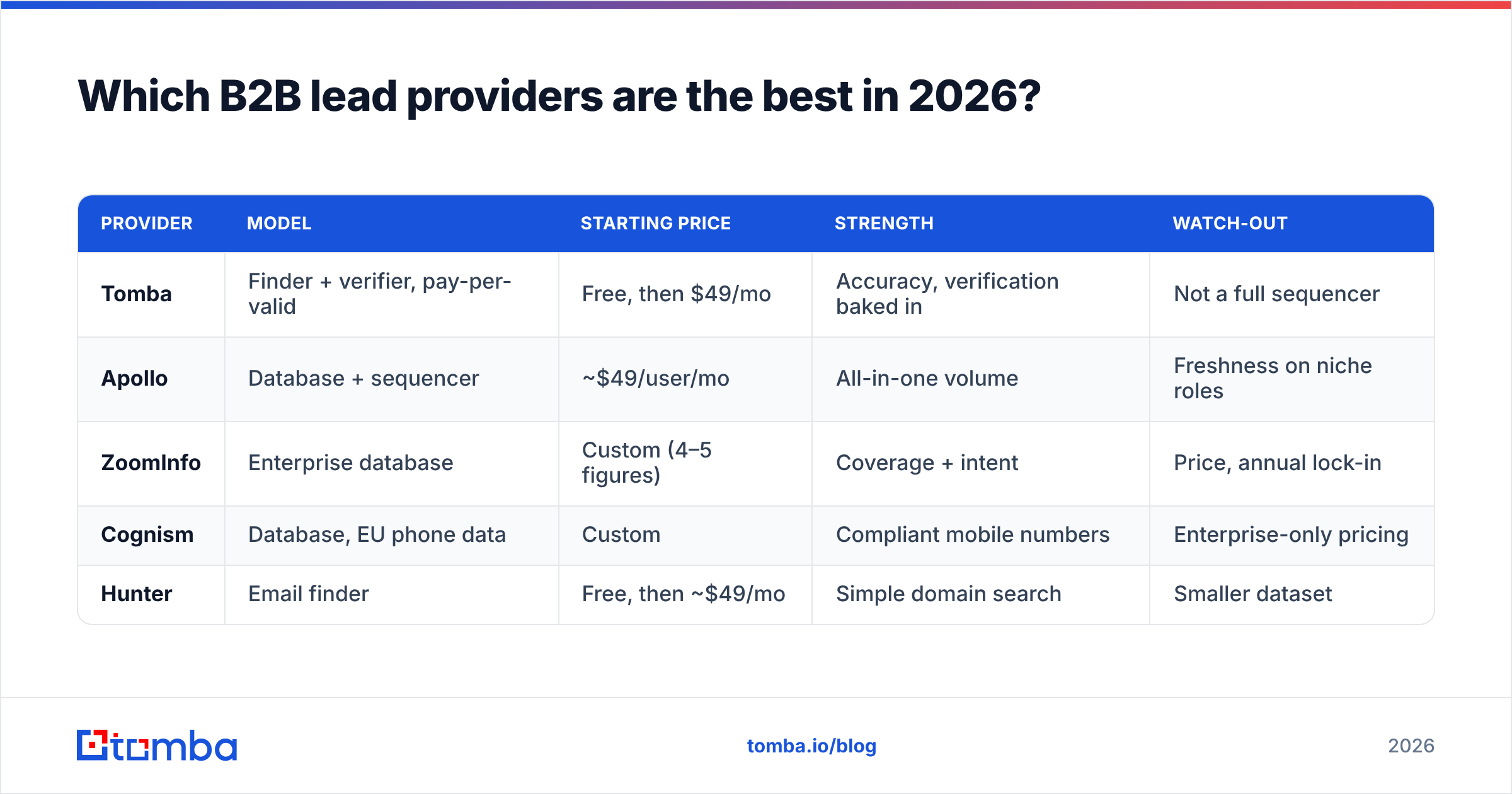
There's no single "best" — there's best-for-your-motion. Below is how the most common providers actually slot in, judged on data quality, pricing model, and who they fit.
| Provider | Model | Starting price | Strength | Watch-out |
|---|---|---|---|---|
| Tomba | Finder + verifier, pay-per-valid | Free, then $49/mo | Accuracy, verification baked in | Not a full sequencer |
| Apollo | Database + sequencer | ~$49/user/mo | All-in-one volume | Freshness on niche roles |
| ZoomInfo | Enterprise database | Custom (4–5 figures) | Coverage + intent | Price, annual lock-in |
| Cognism | Database, EU phone data | Custom | Compliant mobile numbers | Enterprise-only pricing |
| Hunter | Email finder | Free, then ~$49/mo | Simple domain search | Smaller dataset |
A grounded read on each:
- Tomba is the budget-and-accuracy pick. The free tier (25 searches/mo) lets you test data quality with zero risk, the Starter plan is $49/mo, Growth is $99/mo, and Pro is $249/mo. See full Tomba pricing for credit allowances. Because verification is built in, you spend credits on contacts that actually land.
- Apollo is the popular all-in-one. Great if you want search, enrichment, and sequences in one tab; check the Apollo alternative breakdown if data freshness on specialized titles matters to you.
- ZoomInfo is the enterprise default — deepest coverage and strong intent signals, but you'll sign an annual contract and pay accordingly.
- Cognism wins on phone-verified EU mobile numbers and GDPR posture, which matters if you sell into Europe.
- Hunter is a clean, simple finder; smaller dataset than Tomba but a fine entry point.

How do you verify a B2B lead provider's data quality?#
Run a 100-contact bake-off before you pay for anything annual. The process takes an afternoon and saves you a quarter of wasted send volume.
- Pull the same 100 target accounts from two or three providers using identical filters (industry, title, region).
- Cross-check overlap. If two providers return the same email for a contact, confidence is high. Where they disagree, the provider with verification status wins.
- Run every email through a verifier — even the ones a provider marked "valid." Use a standalone free email checker to audit a sample.
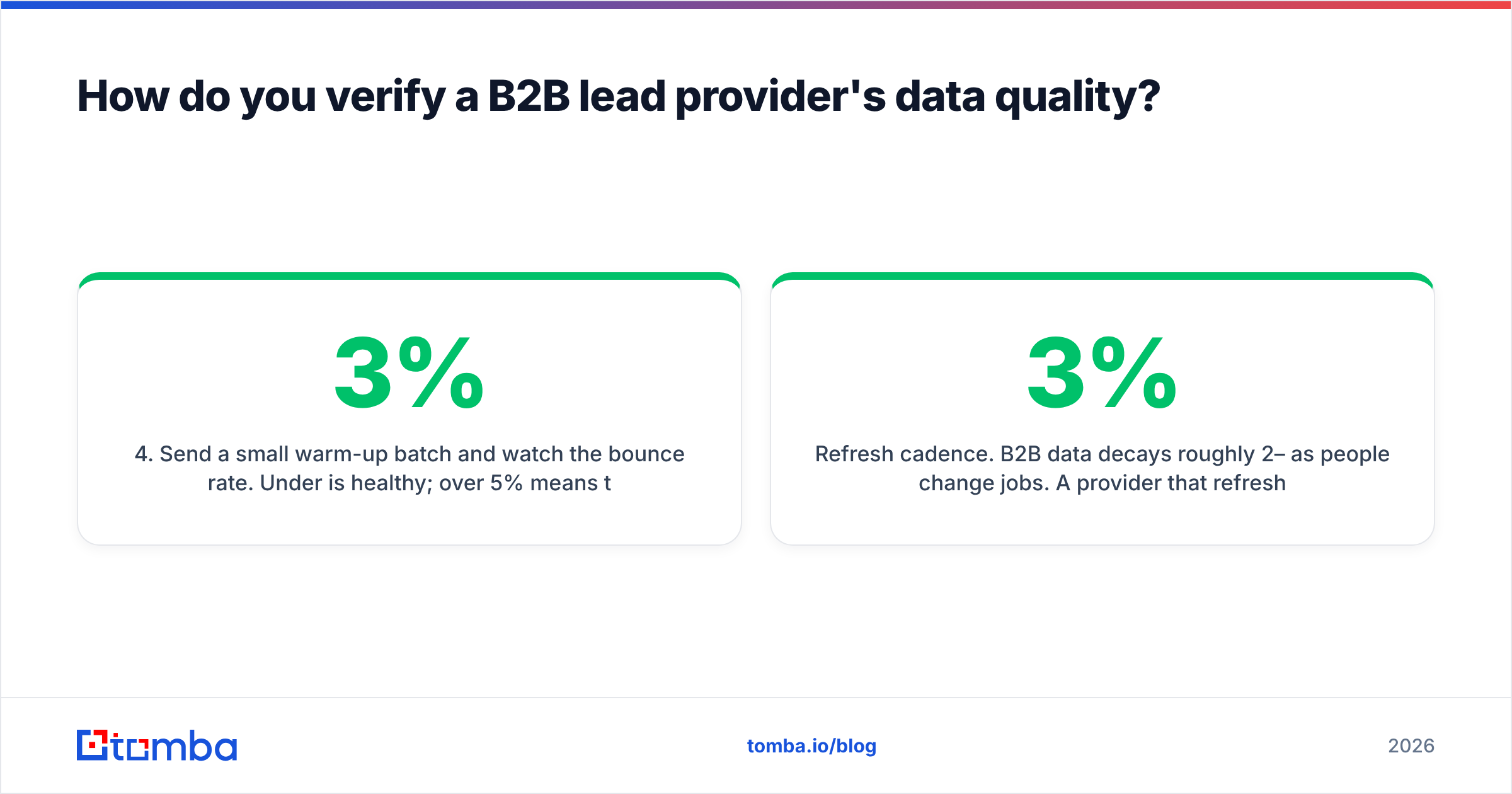
- Send a small warm-up batch and watch the bounce rate. Under 3% is healthy; over 5% means the source is stale.
- Re-pull the same list in 30 days. A live provider's data will have changed (job moves, new hires); a static broker's won't.
This is also where pay-as-you-go pricing protects you: testing five providers costs almost nothing when you only pay for valid hits, versus buying five annual seats to run the same experiment.
Don't forget compliance and refresh cadence#
Two quiet deal-breakers:
- Compliance. If you touch EU or California contacts, your provider must support GDPR and CCPA workflows — lawful basis, suppression lists, and deletion on request. Vendors like HubSpot publish clear guidance; mirror that standard when you evaluate a data source. A broker who can't tell you their lawful basis is a liability, not a bargain.
- Refresh cadence. B2B data decays roughly 2–3% per month as people change jobs. A provider that refreshes quarterly is already 7–9% stale by the next cycle. On-demand finders sidestep this because they resolve the email when you ask, not when they last scraped.
You can layer data enrichment on top of either model to keep your existing CRM records current, which is often higher-ROI than buying brand-new contacts you haven't worked yet.
Should you build lists in-house or buy them?#
Buy the tool, build the list. The highest-converting outbound teams don't purchase finished lists — they license a finder-and-verifier and assemble targeted lists themselves, so every contact maps to a real account they chose.
The reason is targeting precision. A bought list optimizes for the seller's volume; a self-built list optimizes for your ICP. When you search by domain with a domain search tool, you control exactly which companies and roles enter your pipeline, and you can enrich straight into your CRM through native integrations like HubSpot, Salesforce, and Pipedrive.
A quick decision guide:
- Buy a database seat when you need 50,000+ contacts a month and a built-in sequencer, and you can absorb an annual contract.
- Use a finder API when accuracy and budget control matter more than raw volume — the common case for SMBs and lean RevOps teams.
- Never buy a static CSV unless you can verify it before send and the seller can prove compliance.
What does a good B2B lead provider cost?#
Expect three pricing shapes. Pay-per-valid credit (you're charged only for verified contacts) is the most cost-efficient for under ~10k sends/month. Flat seats (database platforms) make sense at scale where per-credit math would explode. Per-contact brokerage is cheapest upfront and most expensive after bounces.
For a concrete anchor: a team doing 4,000 verified outbound emails a month can run that on a $99/mo Growth plan with credits to spare, versus a four-figure annual database seat aimed at much higher volume. Match the pricing model to your real send volume, not your ambition.
The bottom line#
The best B2B lead providers in 2026 aren't the ones with the biggest contact counts — they're the ones that hand you contacts that actually deliver, refresh in real time, and keep you compliant. Compare on deliverable cost, run a 100-contact bake-off, and never sign an annual deal before you've stress-tested the data.
If you want to test data quality with zero risk, start with the Tomba Email Finder. The free tier gives you 25 searches a month to verify accuracy on your own target accounts, verification is built into every lookup so you only act on emails that land, and plans scale from $49/mo without an annual lock-in. Find your first verified contacts in the next ten minutes, then decide whether you ever need a heavier platform at all.
// get started
Find, verify and enrich your first contacts today
Start on the free plan with 25 searches a month, then scale when your team is ready.
Free plan · No credit card required · GDPR & CCPA
// about the author