B2B Lead Qualification in 2026: Frameworks, Data & Process
A practical 2026 guide to B2B lead qualification: BANT, MEDDIC, scoring models, and the data that decides which leads your reps actually call.
Most B2B revenue problems are not closing problems. They are qualification problems wearing a closing costume. When reps chase every hand-raiser and every scraped contact, win rates sink, pipeline math lies, and forecasting becomes fiction. This guide gives you a concrete, 2026-ready system for b2b lead qualification — the frameworks, the scoring model, and the data layer that actually decides who gets a call.
TL;DR#
- Qualification is a filter, not a formality. Its job is to spend rep time only on accounts that can and will buy.
- Pick one primary framework (BANT, CHAMP, or MEDDIC) based on deal size and sales motion — don't bolt on three.
- Score on fit + intent + data quality. A perfect-fit lead with a bounced email is not a lead.
- Bad contact data silently kills qualification. Verify and enrich before routing, not after.
- Route by tier, not by gut. MQL, SQL, and SAL each need a defined hand-off and SLA.
What is B2B lead qualification?#
B2B lead qualification is the process of deciding whether a lead is worth your sales team's time — before a rep ever picks up the phone. Think of it like airport security for your pipeline: everyone lines up, but only the people with a valid ticket and ID get through to the gate. Everyone else gets redirected to nurture, recycled, or politely turned away.
Technically, qualification answers three questions in order: Does this lead fit your ideal customer profile (ICP)? Do they show intent to solve the problem you sell against? And is the contact data good enough to act on? Skip the third question and the first two are academic — you can perfectly qualify a buyer you can never reach.
The cost of getting this wrong is brutal and quiet. Reps burn hours on accounts that were never going to buy, marketing celebrates lead volume that never converts, and leadership trusts a forecast built on sand. Tight qualification is the cheapest performance lever most teams ignore.
Why does qualification break down for most teams?#
Three failure modes show up again and again:
- No shared definition of "qualified." Marketing's MQL and sales' idea of a real lead are different planets. Hand-offs feel like throwing leads over a wall.
- Volume worship. Someone is comped on lead count, so the funnel fills with low-fit traffic that looks great in a dashboard and converts at 1%.
- Dirty data. The lead is real, the fit is great, but the email bounces and the phone number is three jobs out of date. Reps give up after two tries and blame "bad leads."
The first two are organizational. The third is solvable today with the right tooling — and it's the one teams most often overlook, because it hides inside otherwise-good leads. You don't see it on the dashboard; you see it in the silence after outreach. Verifying contacts with an email verifier before a lead is ever routed removes that silent tax.
Which lead qualification framework should you use?#
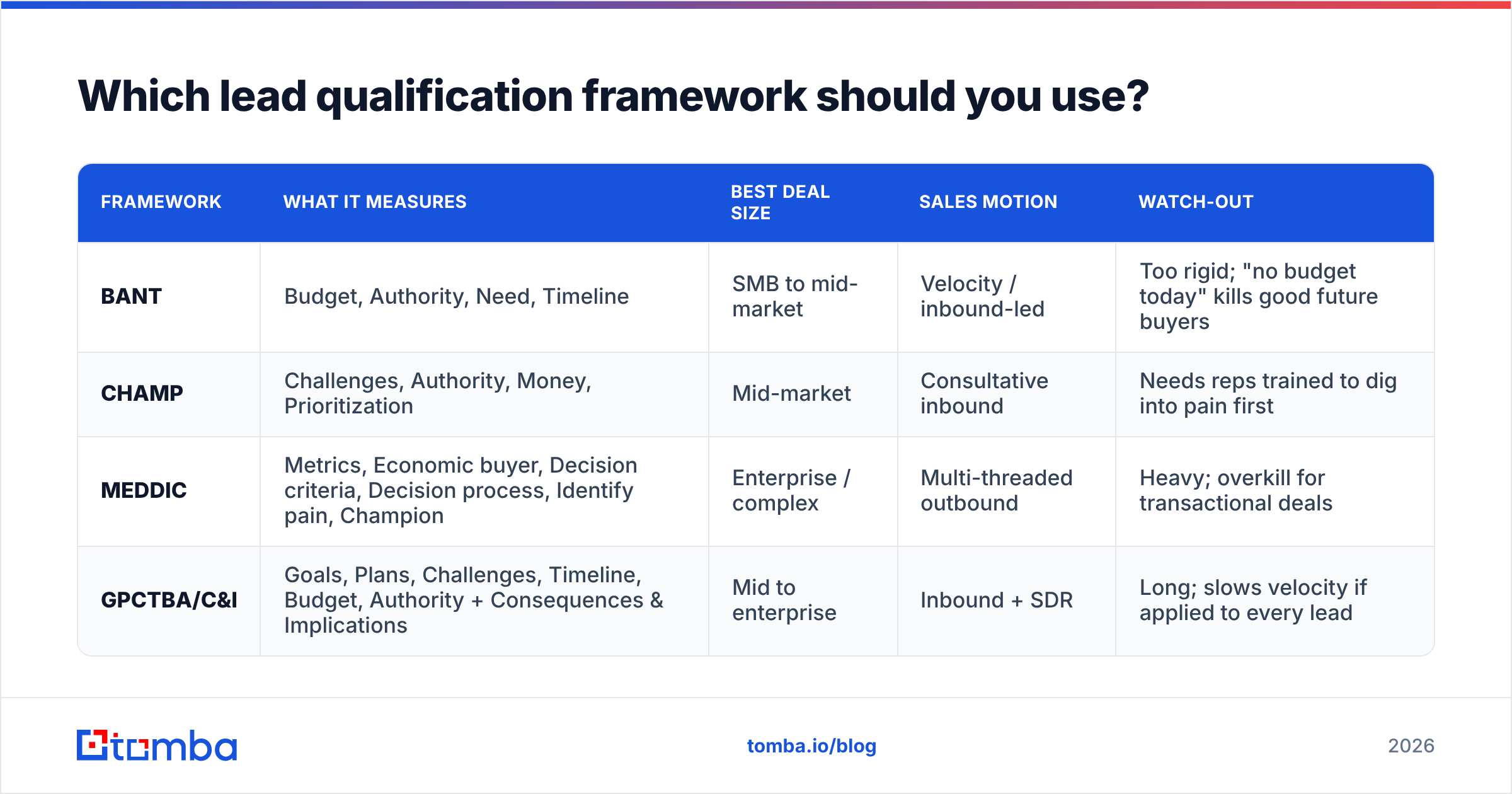
There is no single best framework — there is a best framework for your deal size and sales motion. Here's how the three most common ones compare.
| Framework | What it measures | Best deal size | Sales motion | Watch-out |
|---|---|---|---|---|
| BANT | Budget, Authority, Need, Timeline | SMB to mid-market | Velocity / inbound-led | Too rigid; "no budget today" kills good future buyers |
| CHAMP | Challenges, Authority, Money, Prioritization | Mid-market | Consultative inbound | Needs reps trained to dig into pain first |
| MEDDIC | Metrics, Economic buyer, Decision criteria, Decision process, Identify pain, Champion | Enterprise / complex | Multi-threaded outbound | Heavy; overkill for transactional deals |
| GPCTBA/C&I | Goals, Plans, Challenges, Timeline, Budget, Authority + Consequences & Implications | Mid to enterprise | Inbound + SDR | Long; slows velocity if applied to every lead |
A practical rule: start with the lightest framework your deal complexity allows. A $400/month self-serve product does not need MEDDIC. A $250k platform deal with seven stakeholders absolutely does. HubSpot's overview of qualification frameworks is a solid neutral primer if you want to go deeper on any single model.
Whichever you choose, codify it. A framework that lives in a rep's head is not a framework — it's a vibe.
How do you build a lead scoring model?#
Scoring turns qualification from a yes/no judgment call into a repeatable number. Build it on three axes:
- Fit score — how closely the account and contact match your ICP (industry, company size, role, geography, tech stack).
- Intent score — behavioral signals of buying interest (pricing-page visits, demo requests, content downloads, repeat sessions).
- Data-quality score — is the email verified, the phone valid, the title current? A lead you can't contact scores zero on action-readiness no matter how good the fit.
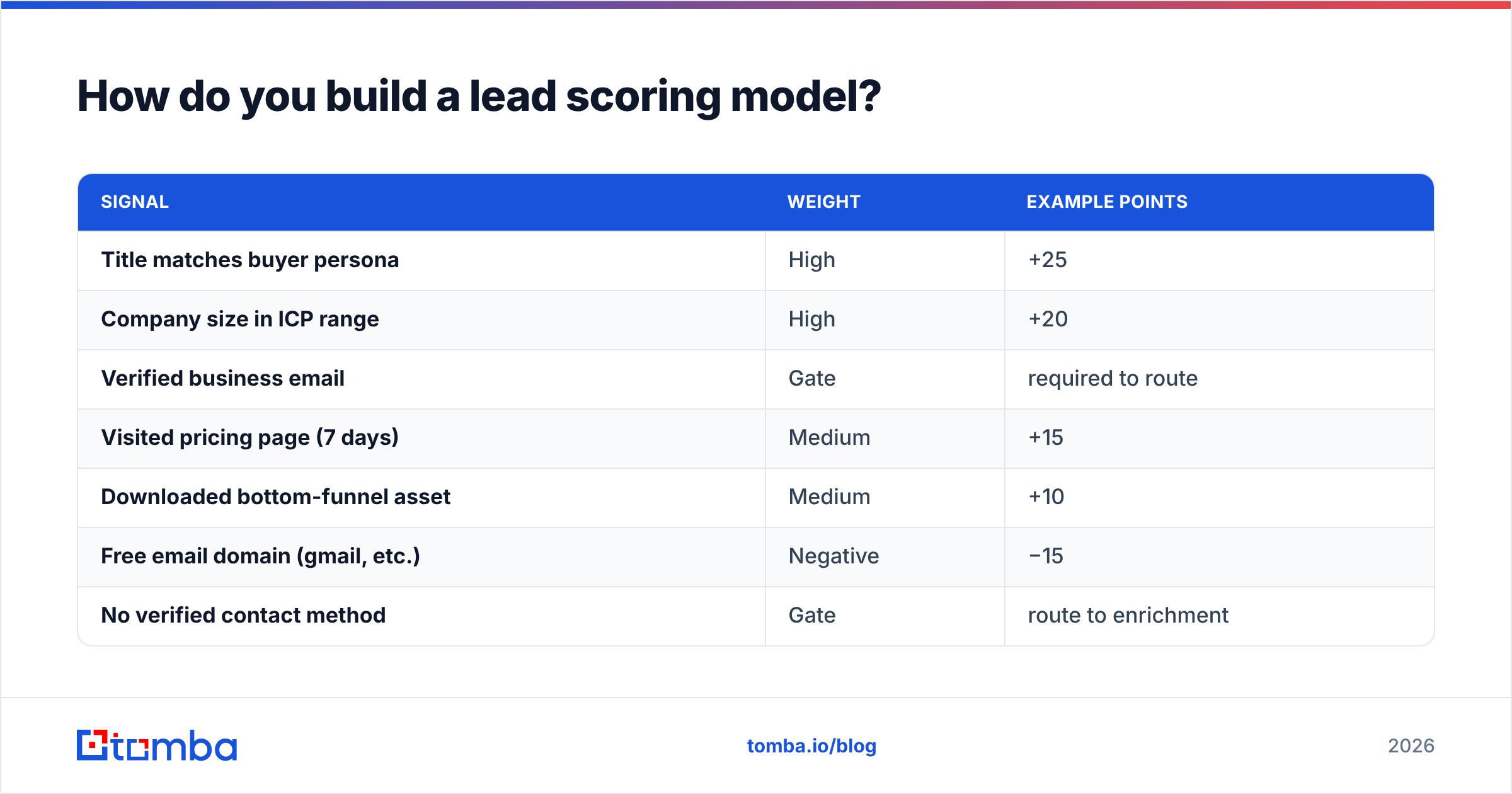
Here's a simple, transparent model you can adapt:
| Signal | Weight | Example points |
|---|---|---|
| Title matches buyer persona | High | +25 |
| Company size in ICP range | High | +20 |
| Verified business email | Gate | required to route |
| Visited pricing page (7 days) | Medium | +15 |
| Downloaded bottom-funnel asset | Medium | +10 |
| Free email domain (gmail, etc.) | Negative | −15 |
| No verified contact method | Gate | route to enrichment |
Notice the two gates. Fit and intent are additive, but a missing verified email isn't a small deduction — it's a stop sign that sends the lead to enrichment first. This is where most scoring models quietly fail: they score a beautiful lead 90/100 and route it to a rep who then discovers the email is dead.
You can read more on how scoring feeds routing in our breakdown of lead management and scoring, and benchmark your thresholds against published response rate data before you lock in weights.
What's the difference between an MQL, SQL, and SAL?#
These acronyms cause more inter-team fights than any other in B2B. Define them once, in writing, and enforce the hand-offs.
- MQL (Marketing Qualified Lead): Hit a scoring threshold based on fit + intent. Marketing's job. The lead has raised a hand or matched ICP behavior, but a human hasn't vetted them.
- SAL (Sales Accepted Lead): A rep or SDR reviewed the MQL and agreed it's worth working. This is the accountability checkpoint — sales formally accepts or rejects, with a reason code.
- SQL (Sales Qualified Lead): After a conversation, the rep confirms genuine fit, need, and a path to a deal. This is where your chosen framework (BANT, MEDDIC, etc.) gets applied in depth.
The SAL step is the one teams skip and the one that fixes the "marketing leads are garbage" war. When sales must accept or reject with a reason, marketing finally gets the feedback loop to improve targeting — and the revenue operations team gets clean data on where leads die.
How does data quality make or break qualification?#
You can have the best framework and the smartest scoring model and still fail, because qualification runs on contact data — and contact data decays fast. Industry estimates put B2B data decay at roughly 30% per year as people change roles, companies rebrand, and inboxes go dark. A lead qualified in January can be unreachable by June.
Two things protect you:
1. Verify before you route. Every email should pass verification before a rep ever sees it. A clean list isn't just a deliverability win — it's a qualification win, because it stops reps wasting their two-touch patience on dead addresses. Bulk-checking a list with a bulk email finder and verifier turns a noisy import into routable pipeline.
2. Enrich what's missing. A lead from a webform often arrives as a name and a company. Qualification needs the role, the company size, the direct line, the LinkedIn profile. Filling those gaps with data enrichment is the difference between scoring a lead and guessing at one. The same applies when you start from a company and need to find the right person — domain search surfaces verified contacts by role so you qualify the actual buyer, not whoever filled out the form.
Here's the uncomfortable truth: most "low-quality leads" are actually well-fit leads with broken data. Fix the data and the same list converts. This is why qualification and data hygiene are the same project, not two.
What does a qualification workflow look like end to end?#
Put the pieces together into a routing flow your whole team can see:
- Capture — Lead enters via form, list import, event, or outbound research.
- Enrich — Auto-append role, company size, verified email, phone, and social profiles. Missing data is filled, not ignored.
- Score — Apply fit + intent + data-quality weights. Gates enforce verified contact info.
- Tier — Threshold determines MQL vs nurture vs disqualify.
- Accept (SAL) — SDR reviews top-tier leads, accepts or rejects with a reason code, within an agreed SLA (e.g., 1 business day).
- Qualify (SQL) — Rep applies the framework in a live conversation and confirms or recycles.
- Feedback — Rejection reasons flow back to marketing weekly to retune scoring.
The loop in step 7 is what turns this from a static filter into a learning system. Without it, your scoring model rots at the same 30% rate as your data.
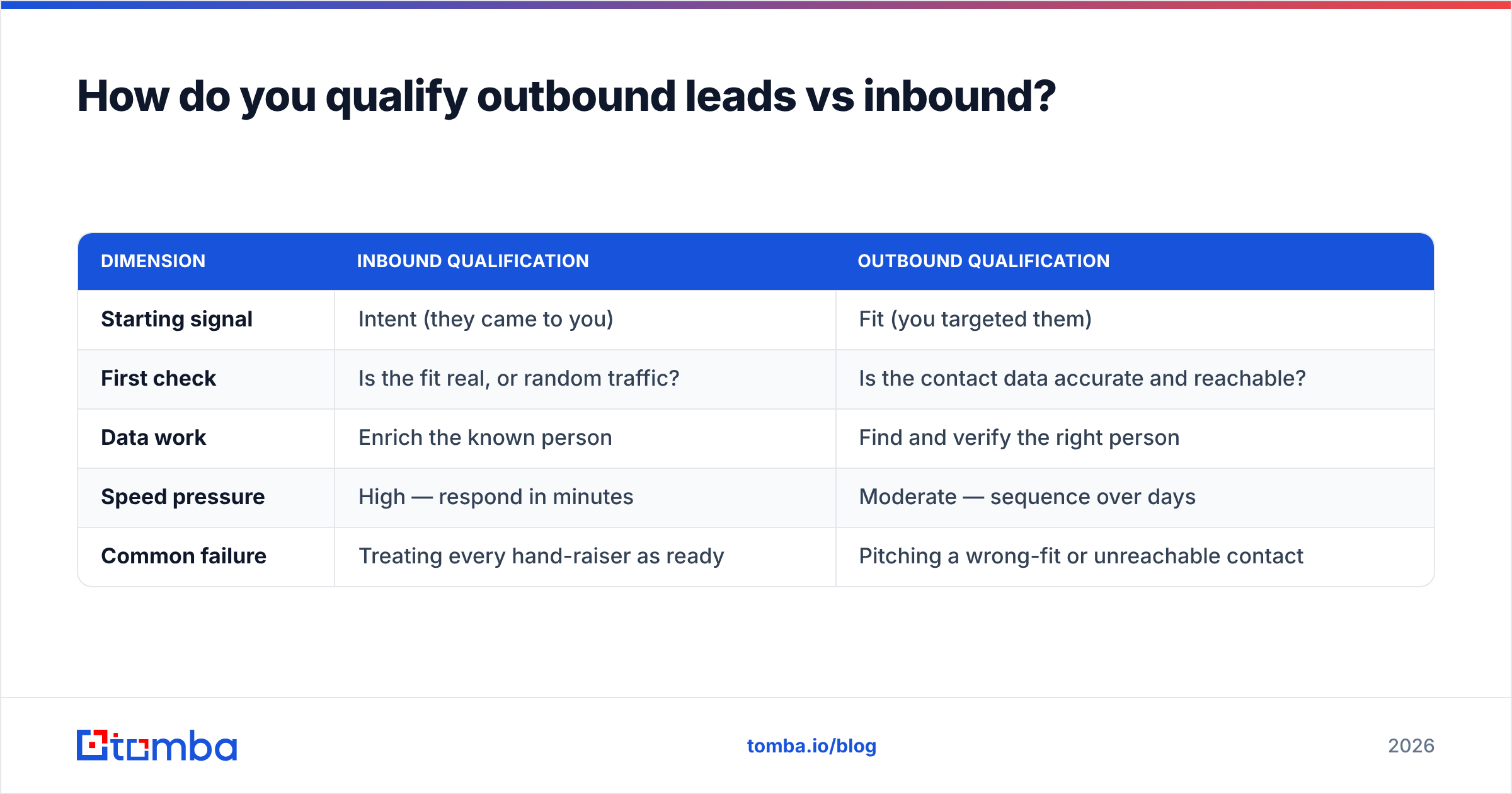
How do you qualify outbound leads vs inbound?#
Inbound and outbound qualification share the framework but differ on sequence.
| Dimension | Inbound qualification | Outbound qualification |
|---|---|---|
| Starting signal | Intent (they came to you) | Fit (you targeted them) |
| First check | Is the fit real, or random traffic? | Is the contact data accurate and reachable? |
| Data work | Enrich the known person | Find and verify the right person |
| Speed pressure | High — respond in minutes | Moderate — sequence over days |
| Common failure | Treating every hand-raiser as ready | Pitching a wrong-fit or unreachable contact |
For outbound, qualification starts before outreach: you build a target list against ICP, then find and verify contacts so you're not sequencing ghosts. Tools like an email finder and phone finder do the heavy lifting of turning a named account into a reachable, qualified contact. For inbound, the contact is known — your job is to confirm fit fast and not let a hot lead cool while you "research."
Cross-check your outbound targeting against a neutral source like G2's grid for your category so you're qualifying against the segments that actually buy software like yours, not just the ones that are easy to find.
What metrics tell you your qualification is working?#
Track these, and review them monthly:
- MQL-to-SQL conversion rate — if it's under ~15%, your scoring threshold is too loose.
- SAL rejection rate + reasons — high rejection with consistent reasons points to a targeting or data problem upstream.
- Time-to-first-touch — slow follow-up wastes good qualification; speed is part of the model.
- Win rate by lead source — tells you which channels produce genuinely qualified pipeline.
- Bounce / connect rate — a leading indicator of data decay; rising bounces mean re-verify now.
When MQL-to-SQL conversion climbs after you add data verification, you have proof that qualification was a data problem in disguise. That's the most common — and most fixable — finding teams uncover when they instrument this properly. Keep an eye on your win rate trend as the downstream confirmation that better qualification is reaching revenue.
Put clean, qualified data under every lead#
Frameworks decide how you judge a lead. Scoring decides which leads pass. But both run on contact data, and contact data is where qualification quietly succeeds or fails. The fastest improvement most B2B teams can make in 2026 isn't a new framework — it's verifying and enriching every lead before it's routed, so reps spend their hours on accounts they can actually reach.
That's exactly what the Tomba Email Finder is built for: turn a name or a company domain into a verified, enrichable contact you can confidently qualify and route. Start free with 25 searches a month, and when you're ready to scale qualification across your whole pipeline, Tomba pricing runs from $49/mo Starter to $99/mo Growth and $249/mo Pro — far less than the cost of a sales team chasing leads they can't contact. Qualify the leads that can buy. Skip the ones that can't. Let the data tell you which is which.
// get started
Find, verify and enrich your first contacts today
Start on the free plan with 25 searches a month, then scale when your team is ready.
Free plan · No credit card required · GDPR & CCPA
// about the author