B2B Lead Segmentation in 2026: Frameworks, Models & Tactics
Most pipelines stall because every lead gets the same message. Here is how to build a B2B lead segmentation model that routes, scores, and converts in 2026.
Most B2B pipelines do not leak because of bad reps or weak products. They leak because every lead gets treated like the same lead. The enterprise buyer with a procurement team gets the same drip as the solo founder kicking tires. B2B lead segmentation fixes that — it is the discipline of grouping prospects by traits and behavior so your messaging, routing, and scoring actually match who you are talking to.
This guide walks through the segmentation models that matter in 2026, how to score and route the segments you build, and the data foundation that keeps the whole thing from rotting.
TL;DR#
- B2B lead segmentation is grouping leads by firmographic, behavioral, intent, and technographic traits so each group gets the right message and the right rep.
- The four core models stack: start with firmographic (who they are), layer behavioral (what they do), add intent (what they are researching), then technographic (what they run).
- Segmentation is worthless without clean, enriched data — bad emails and missing fields collapse every model into noise.
- A simple scoring matrix (fit × engagement) turns segments into a routing and prioritization system your reps will actually follow.
- Teams that segment and route well see materially higher response rates and shorter cycles than teams running one-size-fits-all blasts.
What is B2B lead segmentation?#
B2B lead segmentation is the practice of dividing your inbound and outbound leads into defined groups based on shared characteristics, then tailoring outreach, scoring, and assignment to each group. Think of it like a hospital triage desk: a walk-in with a cough and a patient with chest pain both get care, but they do not get the same room, the same urgency, or the same specialist. Segmentation is your triage desk for revenue.
Technically, a segment is a rule (or set of rules) applied to lead records — "SaaS companies, 50–200 employees, using HubSpot, who visited the pricing page twice this week." Every lead that matches drops into that bucket and inherits the playbook attached to it.
The payoff is concentration. Instead of diluting effort across 5,000 undifferentiated names, you point your best sequence at the 400 leads that look like your best customers and behave like buyers.
Why does segmentation beat one big list?#
Because relevance is the only lever that still moves reply rates. Buyers ignore generic outreach by default, and a single mega-list forces a lowest-common-denominator message that speaks to no one.
A segmented approach changes three things at once:
- Message fit — A 12-person agency and a 4,000-person enterprise have different problems. Segmentation lets you write to each.
- Rep efficiency — Reps spend time on the leads most likely to close, not the loudest or the most recent.
- Routing accuracy — Enterprise leads reach AEs, SMB leads reach a lighter-touch motion, and nobody fights over ownership.
The cost of skipping segmentation is quiet but real: wasted sends burn sender reputation, inflate your cost per opportunity, and train your team to distrust the lead queue.
What are the core B2B lead segmentation models?#
There are four models worth building, and the strongest programs layer them rather than picking one. Each answers a different question about the lead.
- Firmographic — Who is the company? Industry, company size, revenue, location, business model. This is your baseline fit filter.
- Behavioral — What has this lead done? Page visits, demo requests, email opens, content downloads, product trials. This signals timing.
- Intent — What are they researching right now? Third-party intent data and on-site signals reveal active buying cycles before a form is filled.
- Technographic — What stack do they run? Knowing a prospect uses Salesforce, Shopify, or AWS lets you tailor integrations and pain points.
- Persona/role — Who is the person? Title, seniority, department, and decision-making power decide your message and your channel.
- Lifecycle stage — Where are they in the journey? New lead, MQL, SQL, opportunity, or customer-expansion target.
The mistake is treating these as alternatives. Firmographic fit without behavioral timing gets you a great-looking lead who is not buying. Behavioral heat without firmographic fit gets you an excited prospect who will never have budget. You want both, then refine with intent and technographics.
How do the segmentation models compare?#
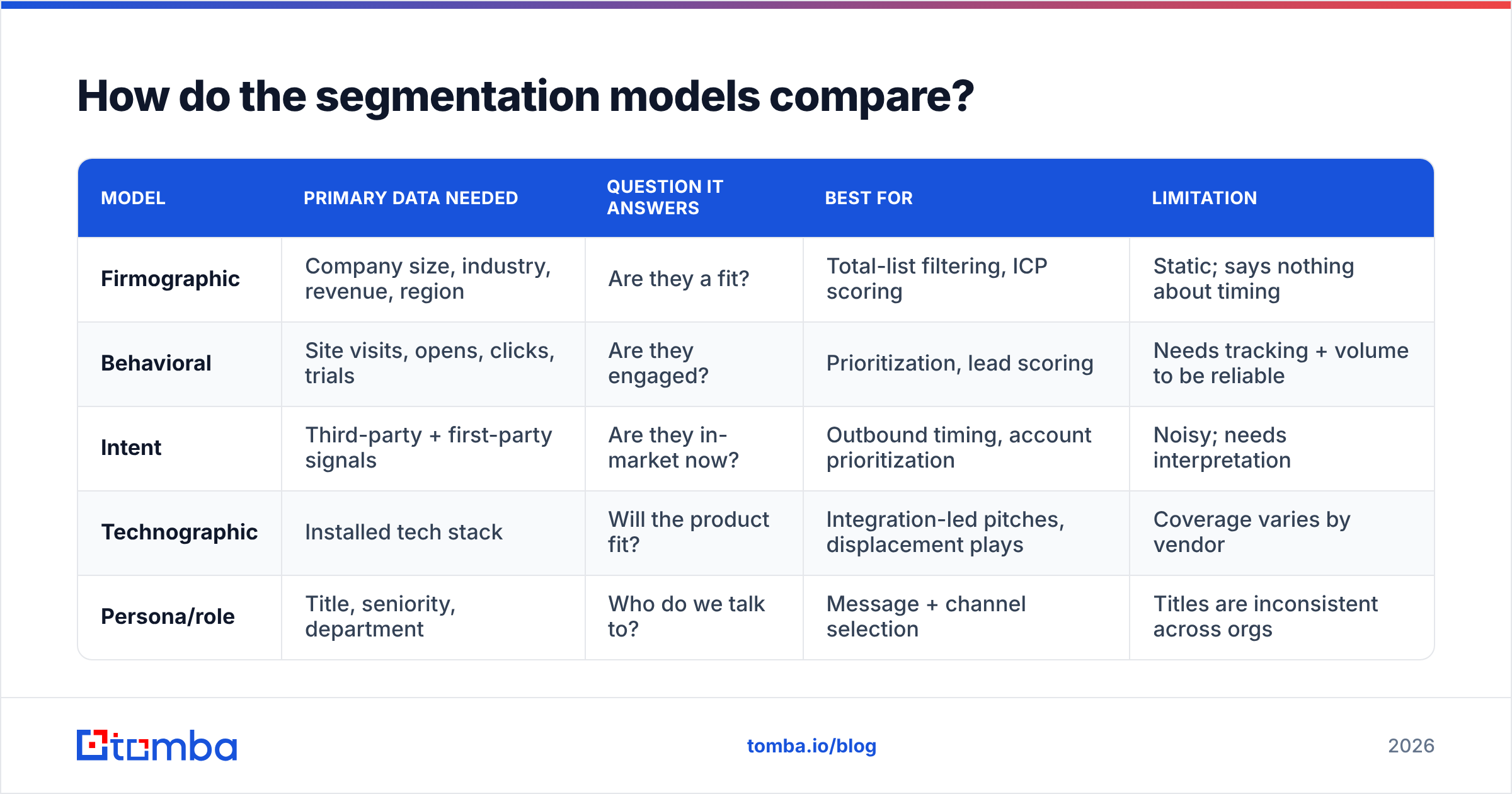
Here is how the core models stack up on what they need, what they tell you, and where they are strongest.
| Model | Primary data needed | Question it answers | Best for | Limitation |
|---|---|---|---|---|
| Firmographic | Company size, industry, revenue, region | Are they a fit? | Total-list filtering, ICP scoring | Static; says nothing about timing |
| Behavioral | Site visits, opens, clicks, trials | Are they engaged? | Prioritization, lead scoring | Needs tracking + volume to be reliable |
| Intent | Third-party + first-party signals | Are they in-market now? | Outbound timing, account prioritization | Noisy; needs interpretation |
| Technographic | Installed tech stack | Will the product fit? | Integration-led pitches, displacement plays | Coverage varies by vendor |
| Persona/role | Title, seniority, department | Who do we talk to? | Message + channel selection | Titles are inconsistent across orgs |
A practical sequence: filter the universe with firmographics, rank within it using behavioral and intent signals, then personalize the actual outreach with persona and technographic detail. That order keeps your list small enough to act on and specific enough to convert.
How do you turn segments into a scoring and routing system?#
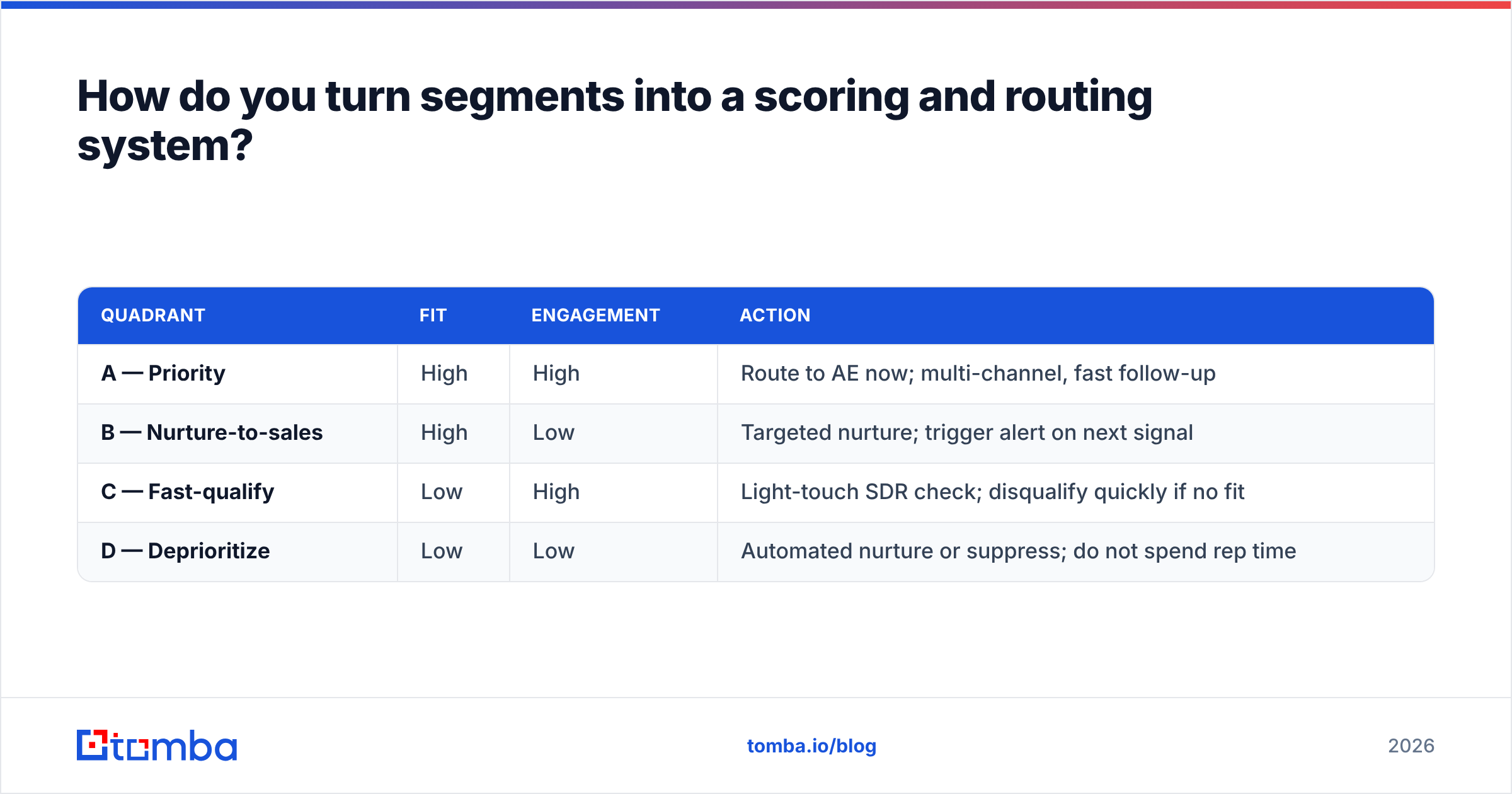
Combine fit and engagement into a single grid. Score each lead on two axes — how well they match your ideal profile (fit) and how actively they are engaging (engagement) — then route based on which quadrant they land in.
| Quadrant | Fit | Engagement | Action |
|---|---|---|---|
| A — Priority | High | High | Route to AE now; multi-channel, fast follow-up |
| B — Nurture-to-sales | High | Low | Targeted nurture; trigger alert on next signal |
| C — Fast-qualify | Low | High | Light-touch SDR check; disqualify quickly if no fit |
| D — Deprioritize | Low | Low | Automated nurture or suppress; do not spend rep time |
This is where segmentation stops being a marketing exercise and becomes a sales operating system. A clean fit-versus-engagement model tells reps exactly what to do next, which is the whole point. If you want the formal definitions behind the handoffs, the marketing qualified lead threshold is where most teams draw the line between quadrant B nurture and quadrant A action.
Keep the scoring transparent. If a rep cannot explain why a lead is an "A," they will ignore the score and fall back to gut feel — and your segmentation investment evaporates.
Why does data quality make or break segmentation?#
Every segmentation model is only as good as the fields it runs on. A rule like "manufacturing firms, 200+ employees, VP-level contact" is useless if half your records have a blank industry field, a stale headcount, or a bounced email. Garbage fields produce garbage segments, and reps learn to distrust the entire system after a few bad lists.
Three data problems quietly sabotage segmentation:
- Missing firmographic fields — You cannot segment on industry or size you never captured. Enrichment fills these gaps.
- Stale contact data — People change jobs constantly; an email that worked last quarter may be dead now.
- Invalid emails — Sending to bad addresses tanks email deliverability and corrupts your engagement signals, because a "non-open" might just be a bounce.
The fix is a pipeline that enriches and verifies before leads ever hit a segment. Tools like data enrichment append the firmographic and contact fields your rules depend on, while an email verifier strips out the addresses that would otherwise pollute your behavioral data. Run both on intake, not as an afterthought.
This is also where the contact layer matters. Firmographic segmentation tells you which accounts to pursue; you still need the right person inside them. A domain search surfaces the contacts at a target company, and an email finder gets you the verified address for the specific persona your segment calls for — so the message you carefully tailored actually lands in the right inbox.
What does a segmentation workflow look like end to end?#
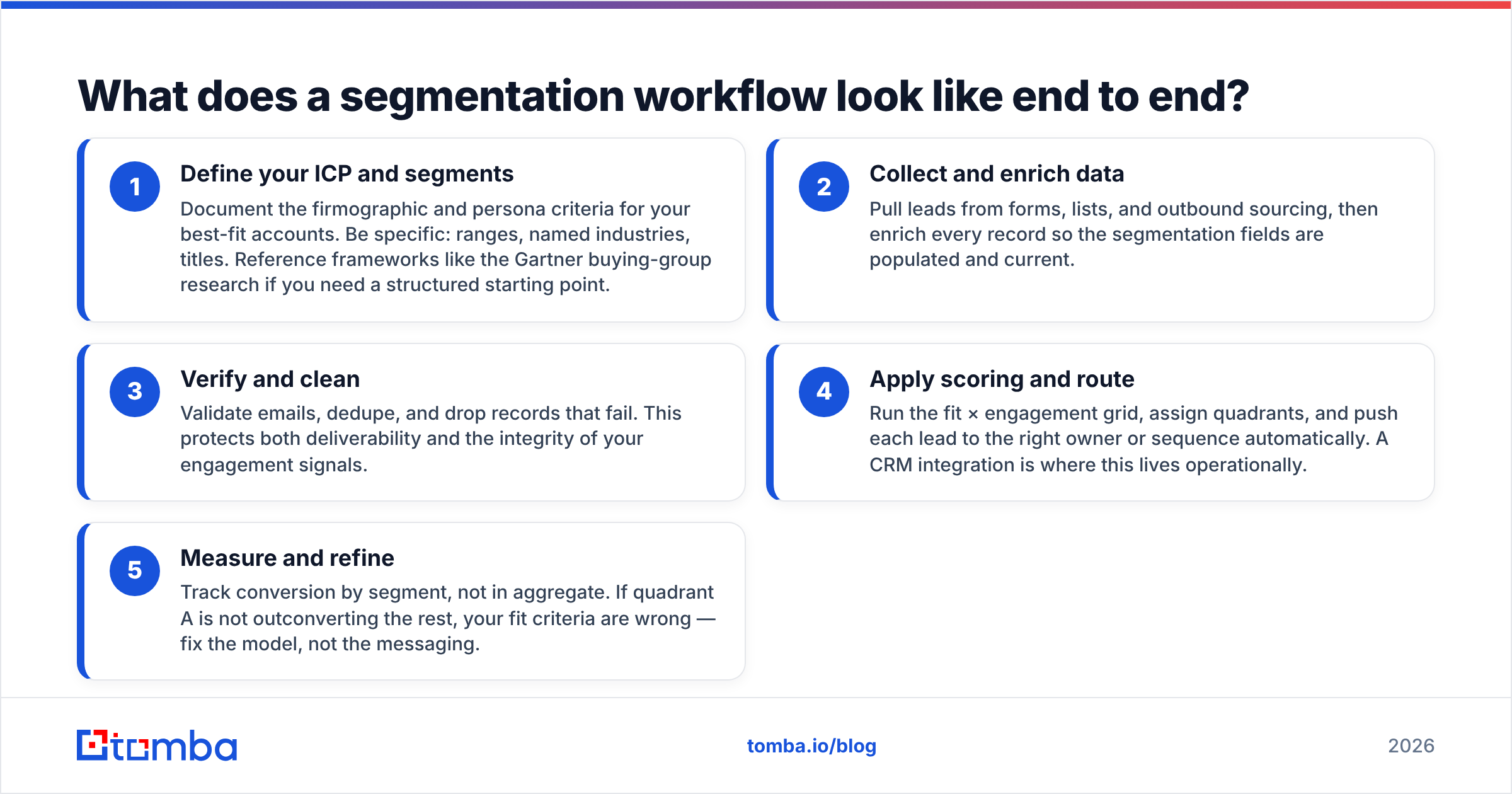
A working B2B lead segmentation workflow has five stages, and each one feeds the next.
- Define your ICP and segments — Document the firmographic and persona criteria for your best-fit accounts. Be specific: ranges, named industries, titles. Reference frameworks like the Gartner buying-group research if you need a structured starting point.
- Collect and enrich data — Pull leads from forms, lists, and outbound sourcing, then enrich every record so the segmentation fields are populated and current.
- Verify and clean — Validate emails, dedupe, and drop records that fail. This protects both deliverability and the integrity of your engagement signals.
- Apply scoring and route — Run the fit × engagement grid, assign quadrants, and push each lead to the right owner or sequence automatically. A CRM integration is where this lives operationally.
- Measure and refine — Track conversion by segment, not in aggregate. If quadrant A is not outconverting the rest, your fit criteria are wrong — fix the model, not the messaging.
The loop matters more than the first pass. Your initial segments are a hypothesis; the conversion data tells you which ones to merge, split, or kill.
How do segmentation tools and approaches compare?#
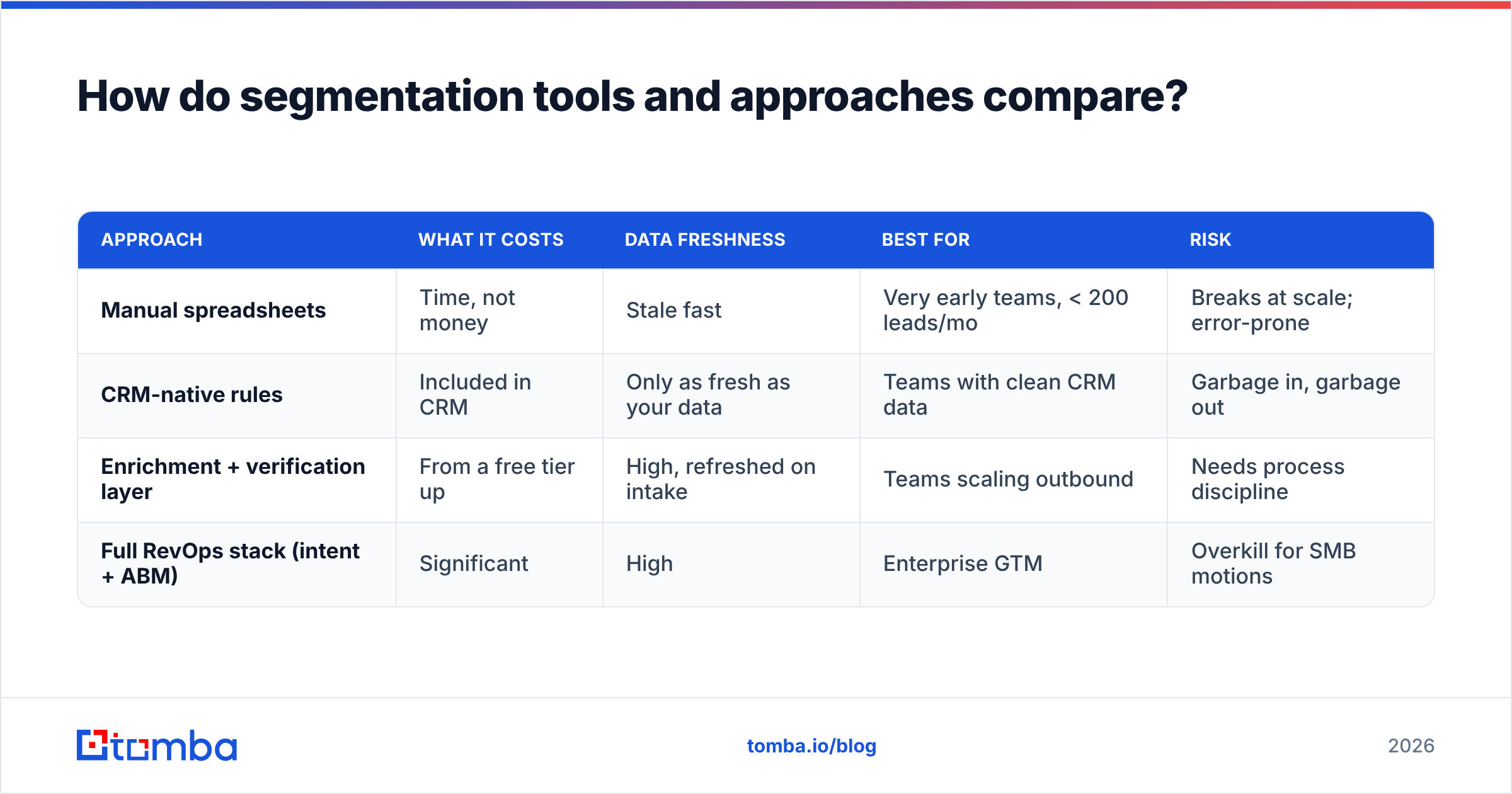
Not every team needs the same machinery. Here is a rough comparison of how teams approach segmentation by maturity.
| Approach | What it costs | Data freshness | Best for | Risk |
|---|---|---|---|---|
| Manual spreadsheets | Time, not money | Stale fast | Very early teams, < 200 leads/mo | Breaks at scale; error-prone |
| CRM-native rules | Included in CRM | Only as fresh as your data | Teams with clean CRM data | Garbage in, garbage out |
| Enrichment + verification layer | From a free tier up | High, refreshed on intake | Teams scaling outbound | Needs process discipline |
| Full RevOps stack (intent + ABM) | Significant | High | Enterprise GTM | Overkill for SMB motions |
Most mid-market teams land on the third row: a CRM plus an enrichment and verification layer that keeps segmentation fields trustworthy. You do not need a six-figure intent platform to segment well — you need accurate fields and a disciplined intake process. For reference on where the broader category is heading, G2's sales intelligence grid is a reasonable map of the vendor landscape.
If cost is the gating factor, start lean. You can validate a full segmentation model on a free or Starter plan before committing budget — the model's logic is what creates value, and that costs nothing to design.
What are the most common segmentation mistakes?#
- Over-segmenting — Forty micro-segments you cannot staff is worse than five you can execute. Build only as many segments as you have distinct plays for.
- Static segments — A lead's behavior and firmographics change. Re-score on a schedule; do not set rules once and forget them.
- Ignoring negative signals — A demo no-show or an unsubscribe is data. Feed it back into scoring.
- Segmenting on data you do not have — If you cannot reliably populate a field, you cannot segment on it. Enrich first or drop the rule.
- Confusing fit with intent — A perfect-fit account that is not in-market is a nurture target, not an A-lead. Keep the axes separate.
Avoiding these is mostly about restraint and hygiene. The teams that win do not have the most segments — they have the cleanest data and the tightest loop between segment performance and segment definition.
Build segmentation on data you can trust#
B2B lead segmentation is only as strong as the records underneath it. You can design the smartest fit × engagement grid in your category, but if the industry field is blank and the email bounces, every segment collapses into noise.
Start with the contact layer. Use the Tomba Email Finder to source verified, professional email addresses for the exact personas your segments target — by name, by domain, or across a whole company — so the leads you carefully group are real, reachable people. Pair it with verification and enrichment on intake, and your segmentation model stops being a slide and starts being a pipeline. Spin up a free account, find your first 25 verified contacts, and route them through the fit × engagement grid above. That is the whole flywheel: clean data in, relevant outreach out, better conversion every cycle.
// get started
Find, verify and enrich your first contacts today
Start on the free plan with 25 searches a month, then scale when your team is ready.
Free plan · No credit card required · GDPR & CCPA
// about the author