B2B Lists 2026: Pricing, Reviews, Pros and Cons Compared
A no-fluff breakdown of B2B lists in 2026: what they cost, how the big providers actually review out, and the real pros and cons before you spend a dollar.
Buying a B2B list looks like the fastest way to fill a pipeline. Pay a vendor, download a CSV, start sending. The reality is messier: prices swing from a few hundred dollars to five figures a year, "verified" records bounce, and two providers selling the same company will hand you wildly different data. This guide cuts through it with concrete numbers and honest trade-offs.
TL;DR#
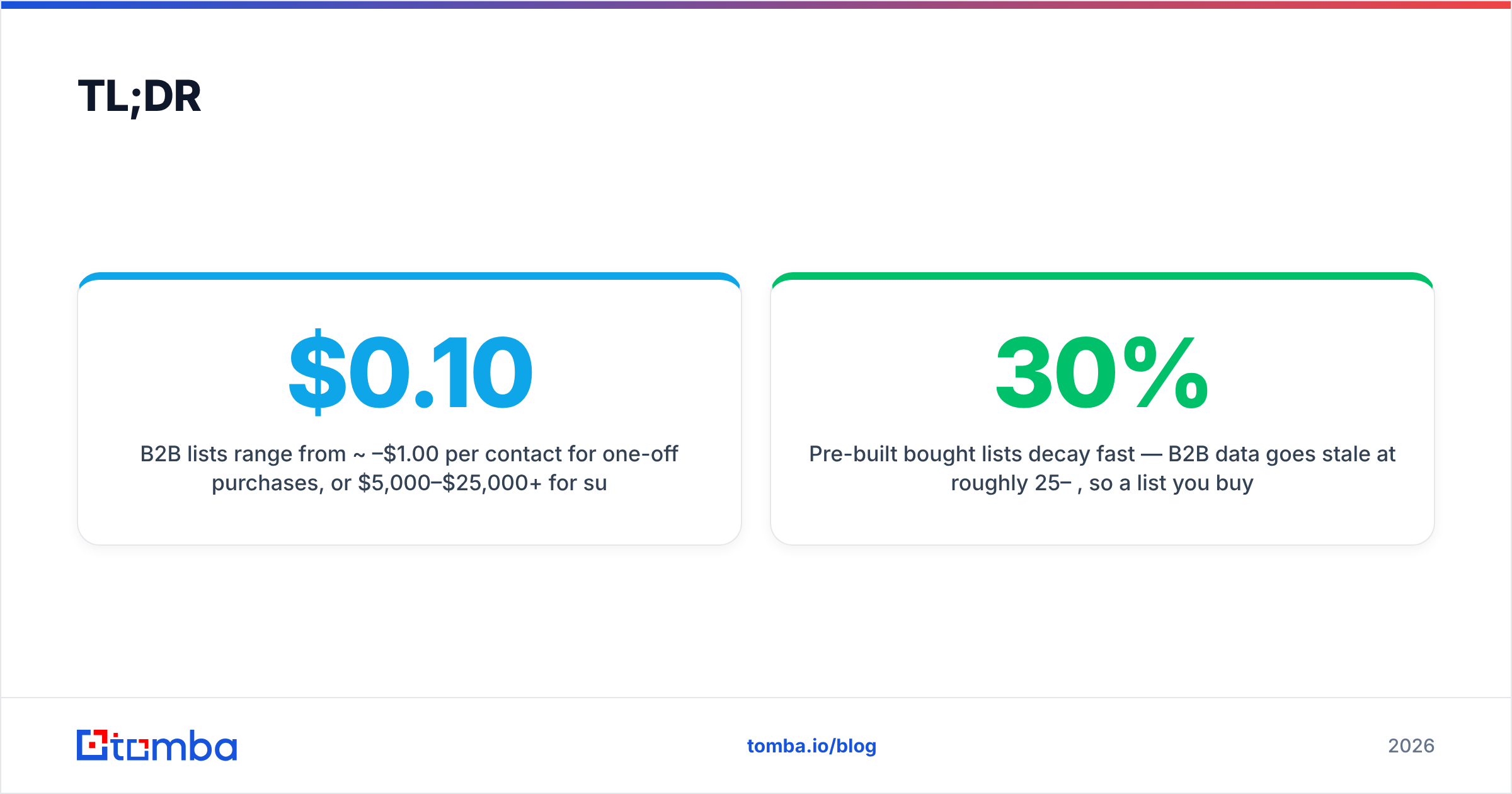
- B2B lists range from ~$0.10–$1.00 per contact for one-off purchases, or $5,000–$25,000+/year for subscription data platforms like ZoomInfo and Cognism.
- Pre-built bought lists decay fast — B2B data goes stale at roughly 25–30% per year, so a list you buy in January is meaningfully wrong by Q4.
- Self-serve enrichment tools (find and verify contacts on demand) usually beat static lists on freshness and cost per usable contact.
- The best provider depends on your motion: enterprise ABM teams lean ZoomInfo/Cognism; lean teams and founders get more value from credit-based finders.
- Always verify before you send. Even premium lists need an email verifier pass to protect deliverability.
What are B2B lists, exactly?#
A B2B list is a structured file of business contacts — names, job titles, company, email, and sometimes phone numbers — that you use for outbound sales or marketing. The term covers a few different products that get lumped together but behave very differently:
- Static purchased lists — a one-time CSV bought from a data broker. Cheap upfront, no refresh, quality varies enormously.
- Subscription data platforms — tools like ZoomInfo, Apollo, or Cognism where you pay annually for access and export contacts from a live database.
- On-demand finders and enrichment — credit-based tools where you pull specific contacts as you need them (by domain, name, or company), so the data is fresh at the moment of use.
- Built-in-house lists — records your team compiles from LinkedIn, events, website visitors, and data enrichment on inbound leads.
The distinction matters because "buying a B2B list" can mean a $300 stale spreadsheet or a $20,000 platform contract. They are not the same purchase, and they fail in different ways.
How much do B2B lists cost in 2026?#
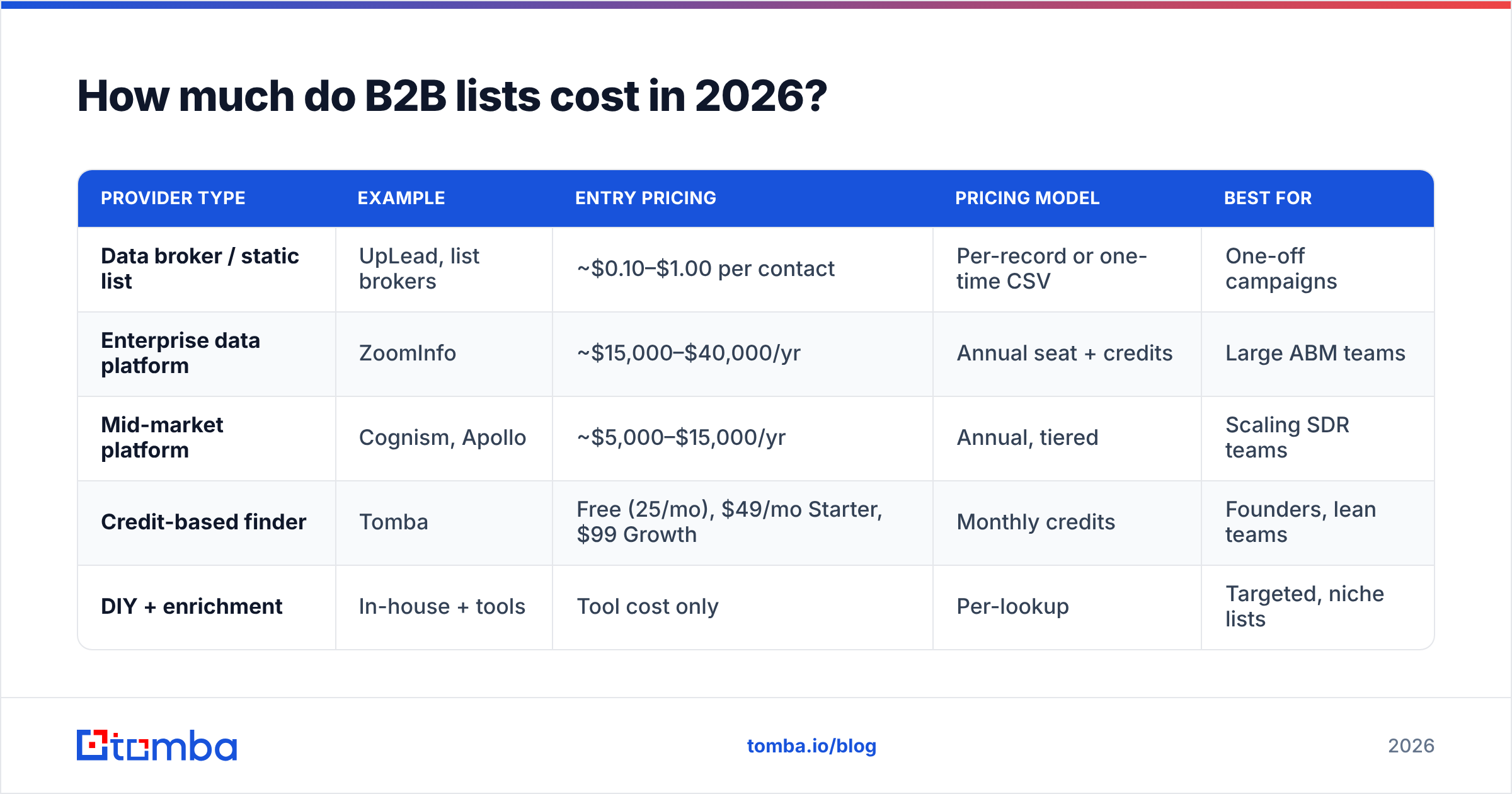
Pricing is the first thing people search and the hardest to pin down, because vendors hide it behind "contact sales." Here is a realistic snapshot of what teams actually pay this year.
| Provider type | Example | Entry pricing | Pricing model | Best for |
|---|---|---|---|---|
| Data broker / static list | UpLead, list brokers | ~$0.10–$1.00 per contact | Per-record or one-time CSV | One-off campaigns |
| Enterprise data platform | ZoomInfo | ~$15,000–$40,000/yr | Annual seat + credits | Large ABM teams |
| Mid-market platform | Cognism, Apollo | ~$5,000–$15,000/yr | Annual, tiered | Scaling SDR teams |
| Credit-based finder | Tomba | Free (25/mo), $49/mo Starter, $99 Growth | Monthly credits | Founders, lean teams |
| DIY + enrichment | In-house + tools | Tool cost only | Per-lookup | Targeted, niche lists |
A few things worth calling out. ZoomInfo remains the priciest option and rarely publishes numbers — expect a five-figure annual minimum and a hard sell on multi-year terms. Apollo and Cognism sit in a more accessible band but still gate exports behind annual plans. On the lighter end, Tomba pricing starts free with 25 searches a month and moves to $49/mo Starter and $99/mo Growth, so you pay for what you pull instead of a yearly license you might not fully use.
The number that actually matters is cost per usable contact, not sticker price. A $300 list where 40% bounces costs more per real conversation than a $49 plan that returns verified contacts.
What are the pros and cons of buying B2B lists?#
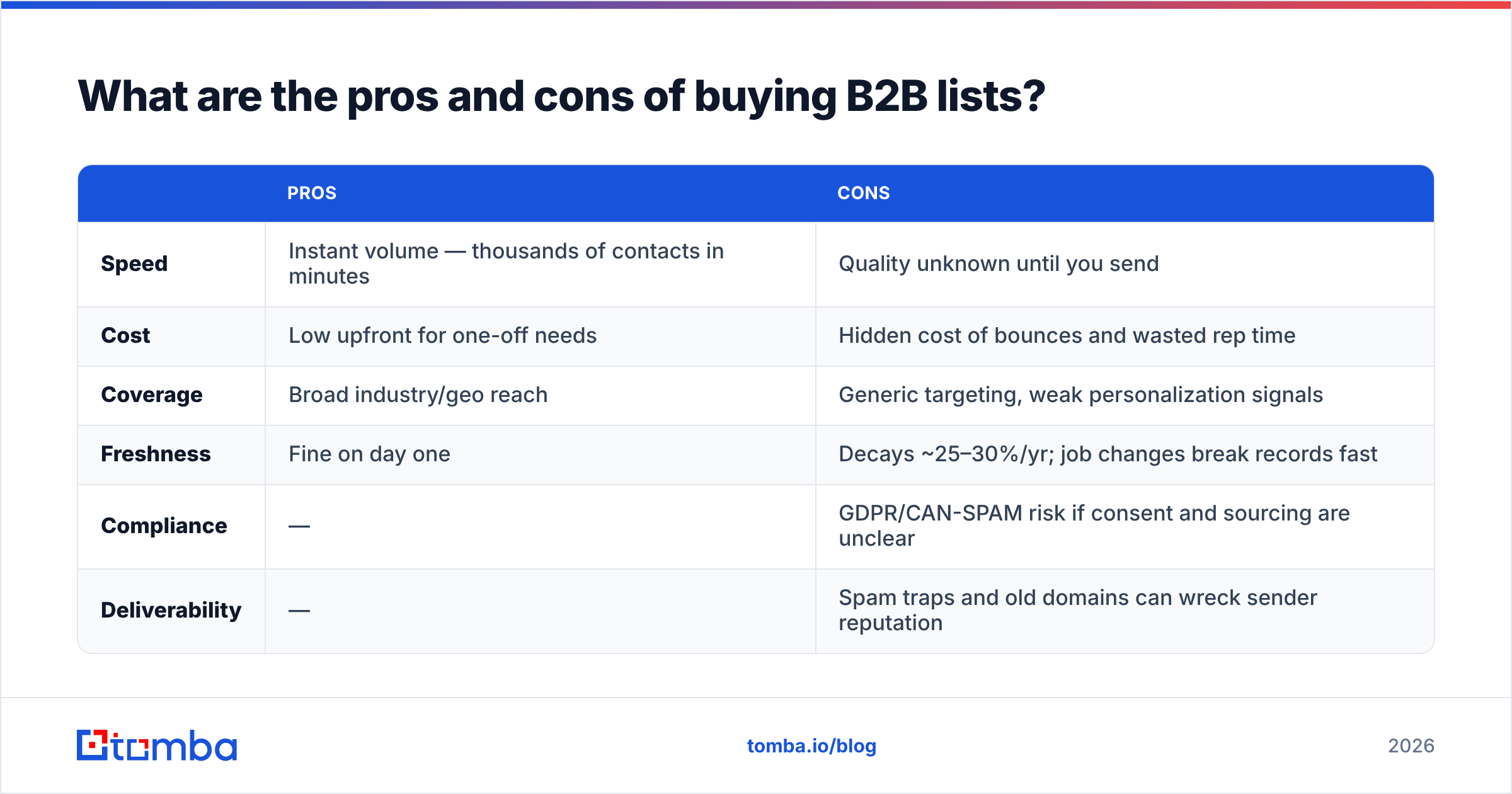
Bought lists are not automatically bad. They are a tool with a specific shape. Here is the honest ledger.
| Pros | Cons | |
|---|---|---|
| Speed | Instant volume — thousands of contacts in minutes | Quality unknown until you send |
| Cost | Low upfront for one-off needs | Hidden cost of bounces and wasted rep time |
| Coverage | Broad industry/geo reach | Generic targeting, weak personalization signals |
| Freshness | Fine on day one | Decays ~25–30%/yr; job changes break records fast |
| Compliance | — | GDPR/CAN-SPAM risk if consent and sourcing are unclear |
| Deliverability | — | Spam traps and old domains can wreck sender reputation |
The biggest risk people underestimate is deliverability. Old purchased lists are riddled with spam traps and dead mailboxes, and hitting those tanks your sender reputation for every campaign that follows. According to HubSpot's research on email marketing, database decay and poor list hygiene are among the top reasons campaigns underperform. One bad list can poison a domain you spent months warming up.
The second underestimated risk is compliance. In the EU and UK, B2B outreach still falls under GDPR, and a list with murky consent provenance is a liability. Reputable platforms like Cognism market their compliance posture heavily for exactly this reason — it is a real cost center, not a checkbox.
Which B2B list providers review best in 2026?#
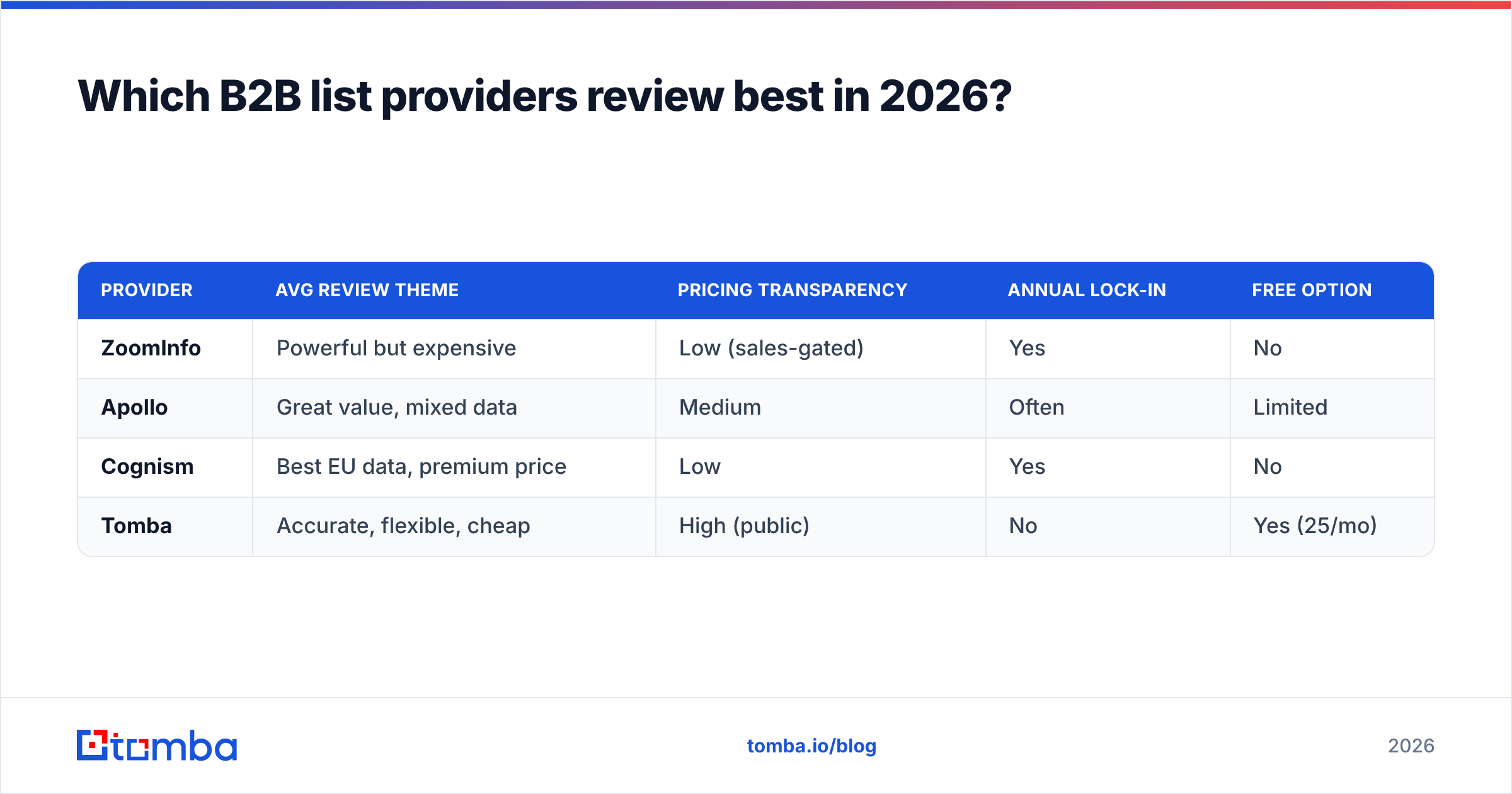
Reviews tell a consistent story if you read across G2 and Capterra rather than cherry-picking one badge. Patterns by category:
- ZoomInfo — deepest US firmographic and intent data, but reviewers consistently flag aggressive contracts, high cost, and friction cancelling. Loved by enterprise, resented by SMBs.
- Apollo — strong all-in-one value (data + sequencing), but data accuracy reviews are mixed, especially outside North America.
- Cognism — praised for EU/UK coverage and phone-verified mobile numbers; the trade-off is price and an annual commitment.
- Credit-based finders (Tomba and peers) — reviewed well for accuracy on verified emails, transparent pricing, and not locking teams into annual deals. The trade-off is they are finders and verifiers, not full intent/ABM suites.
| Provider | Avg review theme | Pricing transparency | Annual lock-in | Free option |
|---|---|---|---|---|
| ZoomInfo | Powerful but expensive | Low (sales-gated) | Yes | No |
| Apollo | Great value, mixed data | Medium | Often | Limited |
| Cognism | Best EU data, premium price | Low | Yes | No |
| Tomba | Accurate, flexible, cheap | High (public) | No | Yes (25/mo) |
If your motion is enterprise account-based marketing with intent signals, the heavyweight platforms earn their cost. If you are a founder, agency, or SDR team that needs accurate contacts without a five-figure commitment, a credit-based finder reviews better on the metrics you actually feel month to month.
Are bought B2B lists worth it, or should you build your own?#
The honest answer: buy for speed and breadth, build for precision and freshness. Most strong teams do a hybrid.
A pre-built list wins when you need volume fast for a broad campaign and you accept that a chunk will be wrong. Building wins when you have a tight ICP, niche verticals, or accounts where personalization drives reply rates and a generic list would waste your best reps' time.
The build path is far less painful than it used to be. Instead of scraping LinkedIn by hand, you can:
- Start from a target account list and run a domain search to pull every relevant contact at each company.
- Find individual decision-makers by name and company with an email finder, so you only collect the people who matter.
- Enrich what you already have — turn a thin lead row into a full profile with title, company, and verified contact details.
- Verify everything before it touches your sequencer to protect deliverability and keep bounce rates under 2%.
- Pull from a live B2B database when you need scale without buying a static dump.
This is where the "buy a list" instinct quietly loses. A static list is a photograph; a finder-plus-verifier workflow is a live feed. People change jobs, companies rebrand, domains move — and a built list refreshed on demand stays current in a way a Q1 CSV never can.
How do you evaluate a B2B list before you pay?#
Run every prospective provider through the same checklist before signing anything. Vendors optimize their demos; your job is to test the boring stuff.
- Sample accuracy — request a free sample for accounts you already know cold. Count how many emails and titles are correct. Anything under 90% verified is a red flag.
- Freshness policy — ask how often records are re-verified. "Continuously" with proof beats "quarterly," and both beat a one-time CSV.
- Bounce guarantee — credible providers offer a bounce credit or replacement. No guarantee usually means no confidence.
- Compliance documentation — sourcing, consent basis, and a clear GDPR/CAN-SPAM stance, in writing.
- Pricing clarity — if you cannot get a number without three sales calls, factor that friction into the cost.
- Export and ownership — can you actually export and keep the data, or does access vanish when the contract lapses?
Whatever you buy or build, treat verification as non-negotiable. Even a premium list should pass through an email verifier before send. It is the cheapest insurance you can buy for your domain reputation, and it is the single step that separates teams with healthy email deliverability from teams stuck in spam folders.
What's the smartest B2B list strategy for 2026?#
Stop thinking of a B2B list as a thing you buy once and start thinking of it as a process you run continuously.
- For broad top-of-funnel campaigns: a reputable platform or vetted purchased list gets you volume — just verify before sending and accept the decay.
- For targeted, high-value outbound: build on demand. Find and verify the exact contacts at your target accounts, and you will spend less per usable contact while keeping data fresh.
- For everyone: layer enrichment and verification on top of whatever source you use. The source is interchangeable; hygiene is what protects results.
The teams winning at outbound in 2026 are not the ones with the biggest list. They are the ones with the cleanest, freshest, most-targeted list — and they got there by building and verifying rather than buying and praying.
Build a fresher list than you can buy#
If your bought lists keep bouncing and the enterprise platforms want a five-figure check before they will even quote you, there is a leaner path. The Tomba Email Finder lets you pull verified professional emails by name, domain, or company — fresh at the moment you need them — starting free with 25 searches a month and scaling to $49/mo when you are ready. Pair it with on-demand verification and you get the speed of a bought list without the decay, the lock-in, or the deliverability hangover. Build the list once, keep it current forever, and spend your budget on conversations instead of CSVs.
// get started
Find, verify and enrich your first contacts today
Start on the free plan with 25 searches a month, then scale when your team is ready.
Free plan · No credit card required · GDPR & CCPA
// about the author