B2B Lists vs FindThatLead: Which Wins for 2026 Prospecting?
Should you buy static B2B lists or find emails on demand with FindThatLead? We break down accuracy, cost, and data freshness — and where a verified email finder fits in 2026.
Buying a pre-built B2B list and using a self-serve finder like FindThatLead solve the same problem in opposite ways: one hands you a frozen spreadsheet, the other lets you pull contacts on demand. The right choice depends on how fast your target data decays and how much verification you can stomach doing yourself.
TL;DR#
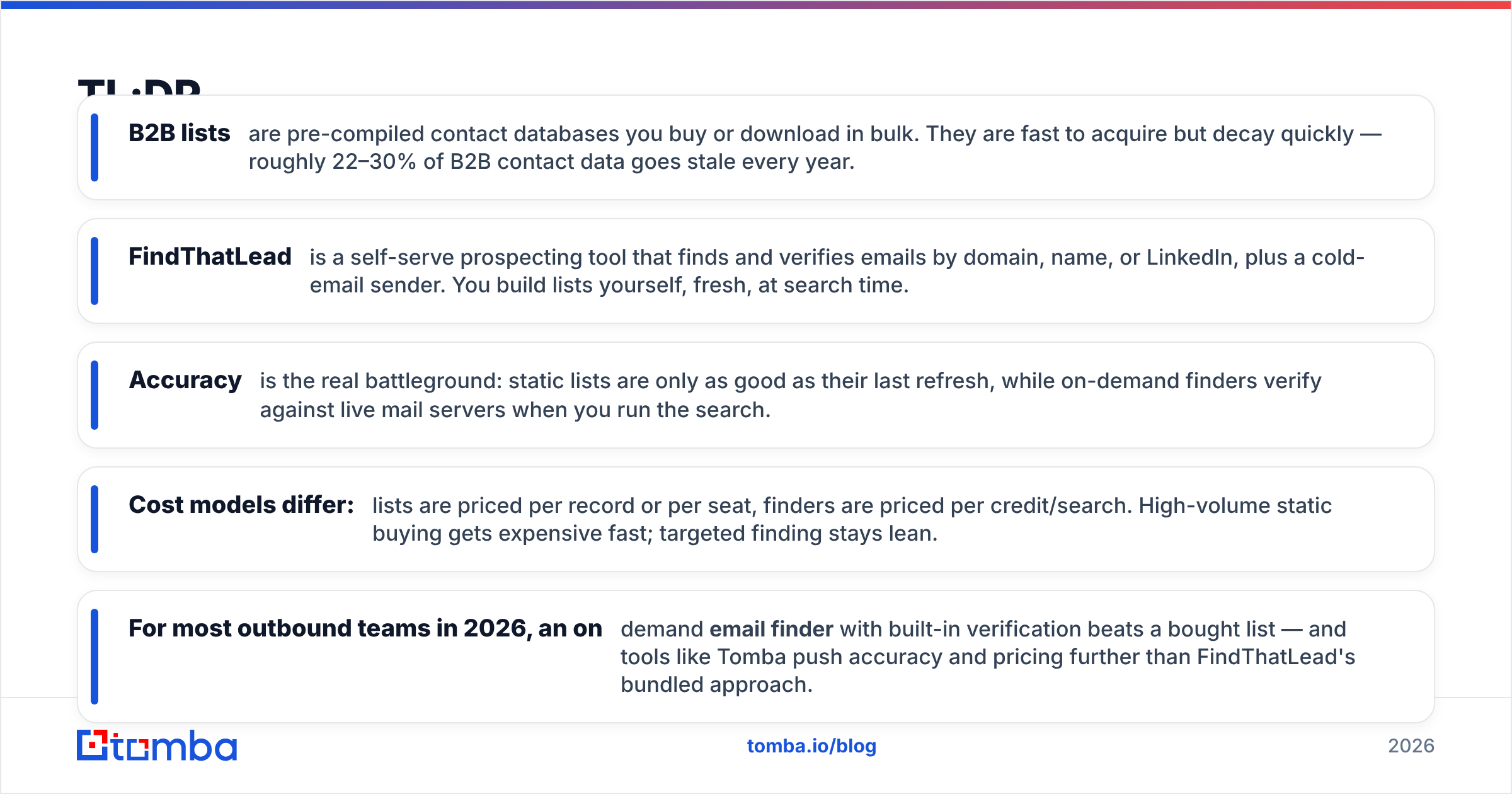
- B2B lists are pre-compiled contact databases you buy or download in bulk. They are fast to acquire but decay quickly — roughly 22–30% of B2B contact data goes stale every year.
- FindThatLead is a self-serve prospecting tool that finds and verifies emails by domain, name, or LinkedIn, plus a cold-email sender. You build lists yourself, fresh, at search time.
- Accuracy is the real battleground: static lists are only as good as their last refresh, while on-demand finders verify against live mail servers when you run the search.
- Cost models differ: lists are priced per record or per seat, finders are priced per credit/search. High-volume static buying gets expensive fast; targeted finding stays lean.
- For most outbound teams in 2026, an on-demand email finder with built-in verification beats a bought list — and tools like Tomba push accuracy and pricing further than FindThatLead's bundled approach.
What is the real difference between B2B lists and FindThatLead?#
A B2B list is a snapshot. Someone scraped, aggregated, or licensed a block of company and contact records, packaged it, and sold you a copy. The moment you download it, the clock starts ticking — people change jobs, domains migrate, and inboxes get deactivated.
FindThatLead is a faucet, not a bucket. Instead of buying a frozen block of data, you query for the specific people you need, when you need them. It returns email addresses tied to a domain or name, runs a verification check, and lets you push those contacts into a cold-email campaign inside the same platform.
Think of it like groceries. A bought B2B list is a freezer full of meals someone cooked months ago — convenient, but you are gambling on freshness. A finder is buying ingredients the day you cook. More effort per meal, far less spoilage.

That freshness gap is the whole argument. If your total addressable market is small and slow-moving, a list can work. If you sell into fast-growing companies where titles and tooling churn, static data rots before you finish working it.
How accurate is bought list data vs an on-demand finder?#
Accuracy is where this comparison is won or lost. A purchased list reports its accuracy as of the day it was built. An on-demand finder verifies at the moment of search, which means it catches the job-changer who left last week.

There are three failure modes that quietly wreck campaigns:
- Hard bounces — the address never existed or was deleted. These directly damage your sender reputation and can land you on a blocklist.
- Catch-all traps — the domain accepts every address, so a naive verifier marks it "valid" when it may not be. You need a dedicated catch-all verifier to score these properly.
- Role accounts — info@, sales@, support@. They pad list counts but rarely convert and often route to shared inboxes.
Bought lists are riddled with all three because nobody re-verifies a record after the sale. FindThatLead verifies at search time, which is genuinely better than a static list. But its verification is a single pass bundled into the finder — fine for a quick check, less robust than a standalone verifier tuned for catch-all and SMTP edge cases. If deliverability is your bottleneck, run found contacts through a dedicated email verifier before you ever hit send.
B2B Lists vs FindThatLead: side-by-side comparison#
Here is the honest breakdown across the attributes that actually move pipeline.
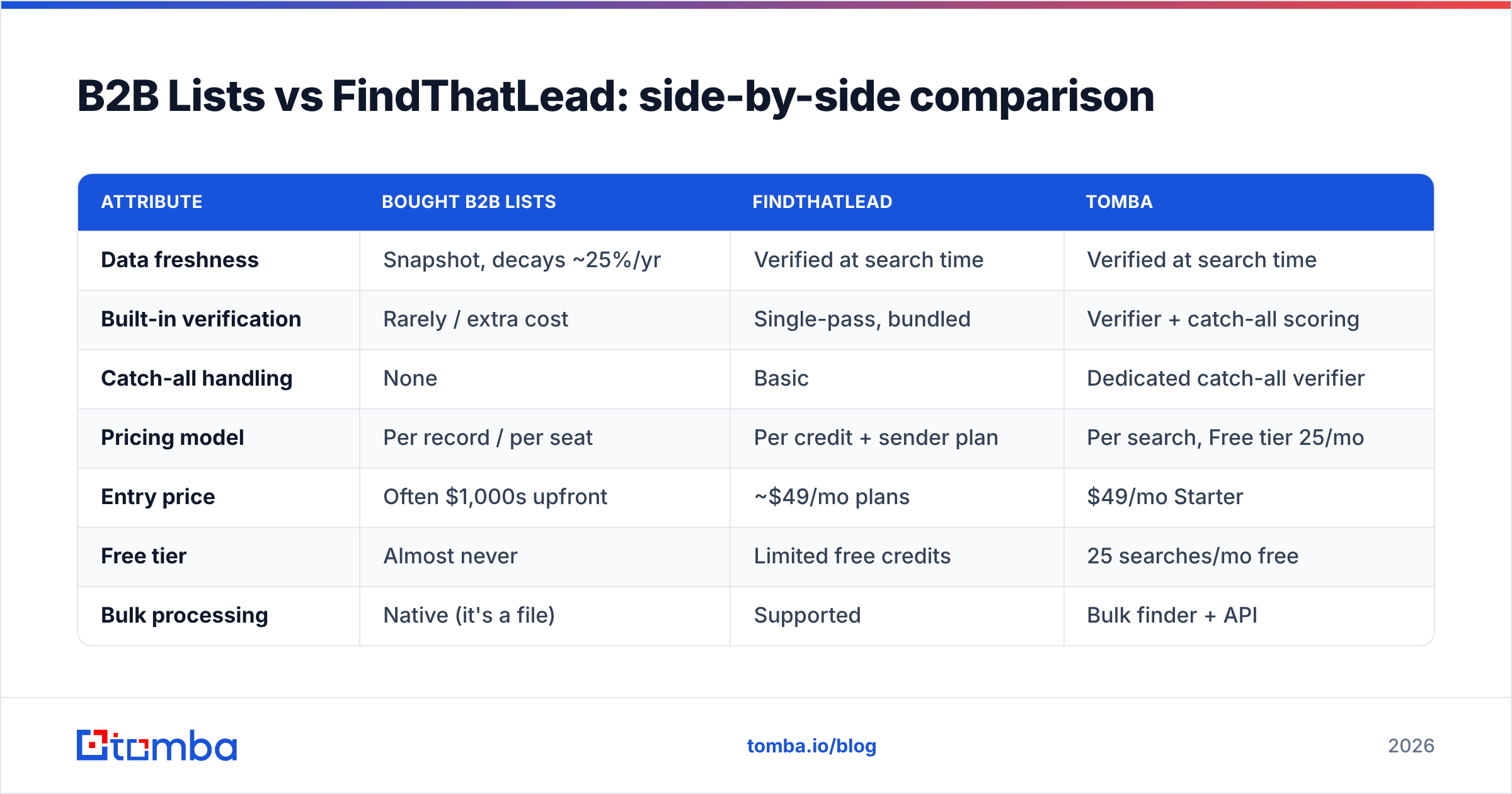
| Attribute | Bought B2B Lists | FindThatLead | Tomba |
|---|---|---|---|
| Data freshness | Snapshot, decays ~25%/yr | Verified at search time | Verified at search time |
| Built-in verification | Rarely / extra cost | Single-pass, bundled | Verifier + catch-all scoring |
| Catch-all handling | None | Basic | Dedicated catch-all verifier |
| Pricing model | Per record / per seat | Per credit + sender plan | Per search, Free tier 25/mo |
| Entry price | Often $1,000s upfront | ~$49/mo plans | $49/mo Starter |
| Free tier | Almost never | Limited free credits | 25 searches/mo free |
| Bulk processing | Native (it's a file) | Supported | Bulk finder + API |
| Domain search | No | Yes | Yes |
| API access | Usually none | Yes | Full REST API |
| Compliance control | You inherit their sourcing | Self-sourced | Documented data sources |
The pattern is clear. Static lists win only on "it's already a file." On every axis that affects reply rates and deliverability — freshness, verification, catch-all handling — on-demand finders lead. And when you stack FindThatLead against Tomba, the gap narrows on finding but widens on verification depth and the free entry point.
When does buying a B2B list still make sense?#
Buying a list is not always wrong. It makes sense in a few narrow cases:
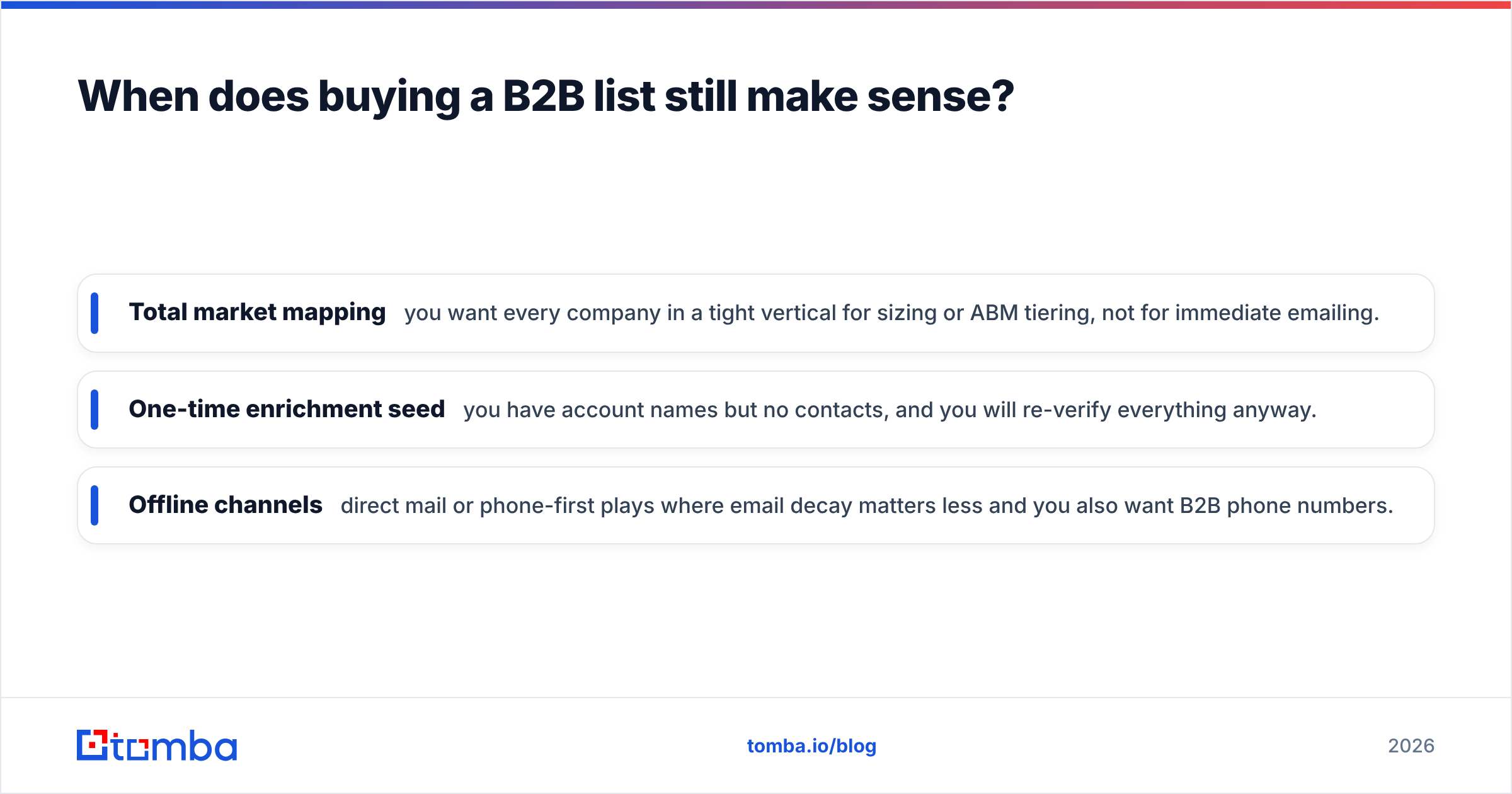
- Total market mapping — you want every company in a tight vertical for sizing or ABM tiering, not for immediate emailing.
- One-time enrichment seed — you have account names but no contacts, and you will re-verify everything anyway.
- Offline channels — direct mail or phone-first plays where email decay matters less and you also want B2B phone numbers.
Even then, treat the list as raw material, not a finished asset. Pipe it through verification, dedupe it, and enrich the gaps. A purchased list that you re-verify and re-enrich is essentially a worse, more expensive version of what an on-demand finder gives you natively — which is exactly why most teams stop buying lists once they adopt a finder.
Is FindThatLead a complete prospecting stack?#
FindThatLead bundles three jobs: finding emails, verifying them, and sending cold campaigns. That all-in-one pitch is its biggest selling point and its biggest trade-off.
Bundling is convenient. One login, one bill, prospect-to-send in a single flow. According to G2 reviews across this category, teams consistently value that simplicity for small, fast-moving outbound motions.
But all-in-one tools tend to be good-not-great at each job. A bundled sender is rarely as deliverable-tuned as a dedicated cold-email platform, and a bundled verifier is rarely as rigorous as a specialist. If you are running serious volume, you usually want a best-of-breed stack: a sharp finder, a dedicated verifier, and a sender built for inbox placement.
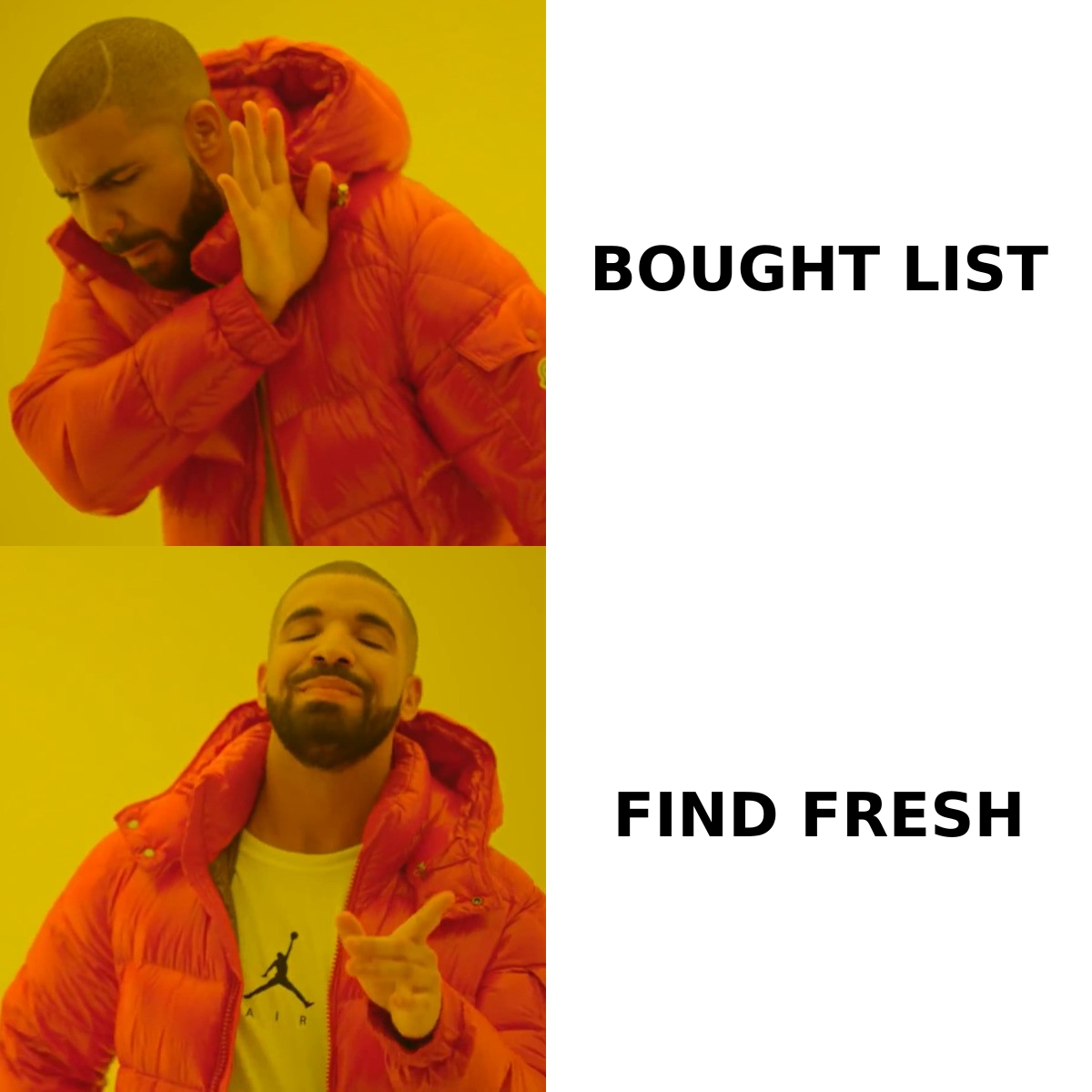
This is the core strategic question. Do you want one tool that does everything adequately, or focused tools that each do one thing excellently and connect through an API? For most growing teams, the modular path scales better — you swap the weakest link without ripping out the whole stack.
How does Tomba compare to both options?#
Tomba sits in the finder-plus-verifier lane and pushes it harder than FindThatLead on the two things that matter most: verification depth and a real free tier.
Where bought lists give you a frozen file and FindThatLead gives you a bundled finder, Tomba gives you a focused data layer:
- Email finder — find professional addresses by name, company, or domain, verified at search time.
- Domain search — pull every discoverable contact at a company, with role and seniority context.
- Catch-all verifier — score the catch-all domains that trip up most single-pass checkers.
- Data enrichment and a bulk finder for list-scale work, plus a documented view of where the data comes from.
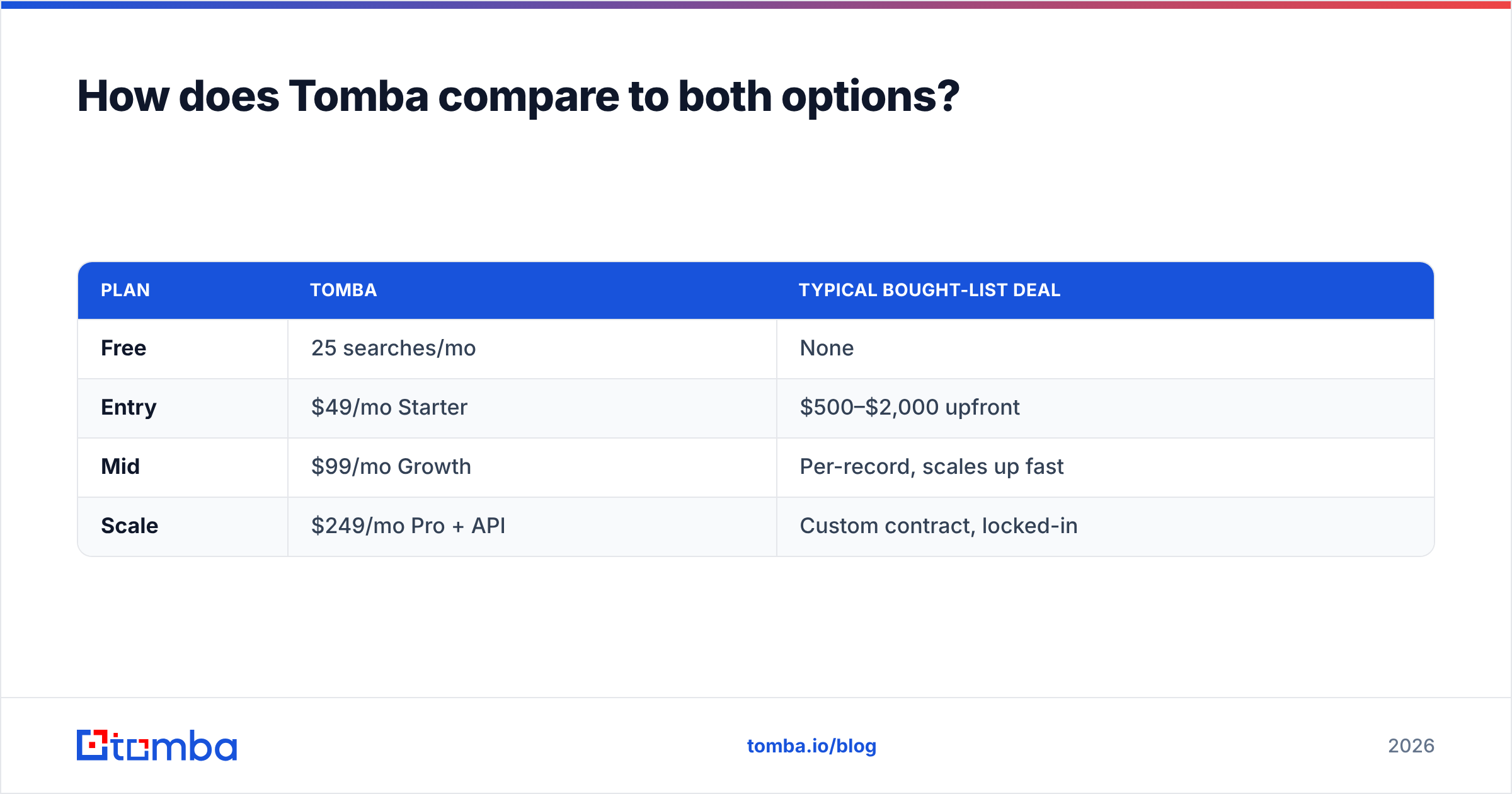
On price, Tomba's pricing starts with a genuinely usable Free tier (25 searches/month), then $49/mo Starter, $99/mo Growth, and $249/mo Pro. That free tier matters: you can validate the data quality on your own target accounts before paying anything — something you essentially never get with a bought list.
| Plan | Tomba | Typical bought-list deal |
|---|---|---|
| Free | 25 searches/mo | None |
| Entry | $49/mo Starter | $500–$2,000 upfront |
| Mid | $99/mo Growth | Per-record, scales up fast |
| Scale | $249/mo Pro + API | Custom contract, locked-in |
The structural advantage is that you only pay for what you pull, and what you pull is fresh. A list charges you for thousands of records you may never work — and a quarter of which are stale before you start.
What's the verdict for 2026 outbound teams?#
Default to on-demand finding, not bought lists. The freshness math alone settles it: a list that decays 25% a year is a depreciating asset, while a finder gives you verified-at-search-time data every campaign. Bought lists earn their keep only for market mapping or offline channels where you will re-verify anyway.
Between FindThatLead and a focused finder, the deciding factor is how much you value verification depth and risk-free trial. FindThatLead's all-in-one bundle suits a solo founder who wants prospect-to-send in one tab. A team that cares about deliverability, catch-all accuracy, and clean data enrichment is better served by a specialist finder feeding a dedicated sender.
Whatever you pick, stop treating contact data as a one-time purchase. It is a perishable input, and your reply rate tracks its freshness more than any subject line ever will.
Ready to replace stale, bought lists with verified contacts you pull on demand? Start with the Tomba Email Finder on the free tier — run it against your own target accounts, check the accuracy yourself, and only scale up once the data proves out. Fresh, verified, and priced so you pay for searches, not for a spreadsheet that's already going stale.
// get started
Find, verify and enrich your first contacts today
Start on the free plan with 25 searches a month, then scale when your team is ready.
Free plan · No credit card required · GDPR & CCPA
// about the author