B2B Lists vs LeadIQ: Which Data Source Wins in 2026?
Static B2B lists are cheap but decay fast. LeadIQ captures data live but costs more per seat. Here is the honest 2026 breakdown of which one your team should actually buy.
B2B Lists vs LeadIQ: Which Data Source Wins in 2026?
You have a quota, a blank CRM, and two ways to fill it: buy a static B2B list and start dialing, or pay for a live capture tool like LeadIQ that pulls contacts straight off LinkedIn. Both promise pipeline. Only one fits how your team actually works — and the right answer depends on volume, budget, and how fast your market moves.
This is a neutral breakdown of B2B lists vs LeadIQ, including where each wins, where each quietly costs you more than the sticker price, and a third option most teams overlook.
TL;DR#
- Static B2B lists are cheap per record and good for one-time bulk campaigns, but they decay 22–30% per year and you pay for stale rows you can't return.
- LeadIQ captures contacts live from LinkedIn and pushes them into your CRM/sequencer, which is great for rep-by-rep prospecting but costs more per seat and is capped by credits.
- The real trade-off is freshness and workflow fit vs. cost and control, not "which tool is better."
- If you mostly need verified emails on demand and hate paying for inflated seat licenses, a usage-priced API like Tomba's email finder often beats both.
- Whatever you choose, run every record through an email verifier before sending — that single step protects your sender reputation more than the data source you picked.
What's the real difference between B2B lists and LeadIQ?#
A static B2B list is a snapshot. A vendor (or a list broker) sells you a CSV of names, titles, companies, emails, and phone numbers scraped and compiled at a point in time. You own the file, you import it, and from that moment it starts aging. People change jobs, companies rebrand, mailboxes get deactivated.
LeadIQ is a live capture and sales-prospecting platform. Instead of handing you a file, it sits in your browser (and inside your sequencer) and lets reps grab contact data while they browse LinkedIn or Sales Navigator, then one-click that contact into Salesforce, HubSpot, Outreach, or Salesloft. You can read more about the product on the official LeadIQ site.
The core mental model: a static list is groceries you bought in bulk — cheap per unit, but some of it spoils before you use it. LeadIQ is ordering fresh each time — you only pull what you're about to work, but you pay a premium and you're limited by how much you're allowed to order each month.
Five differences that actually matter#
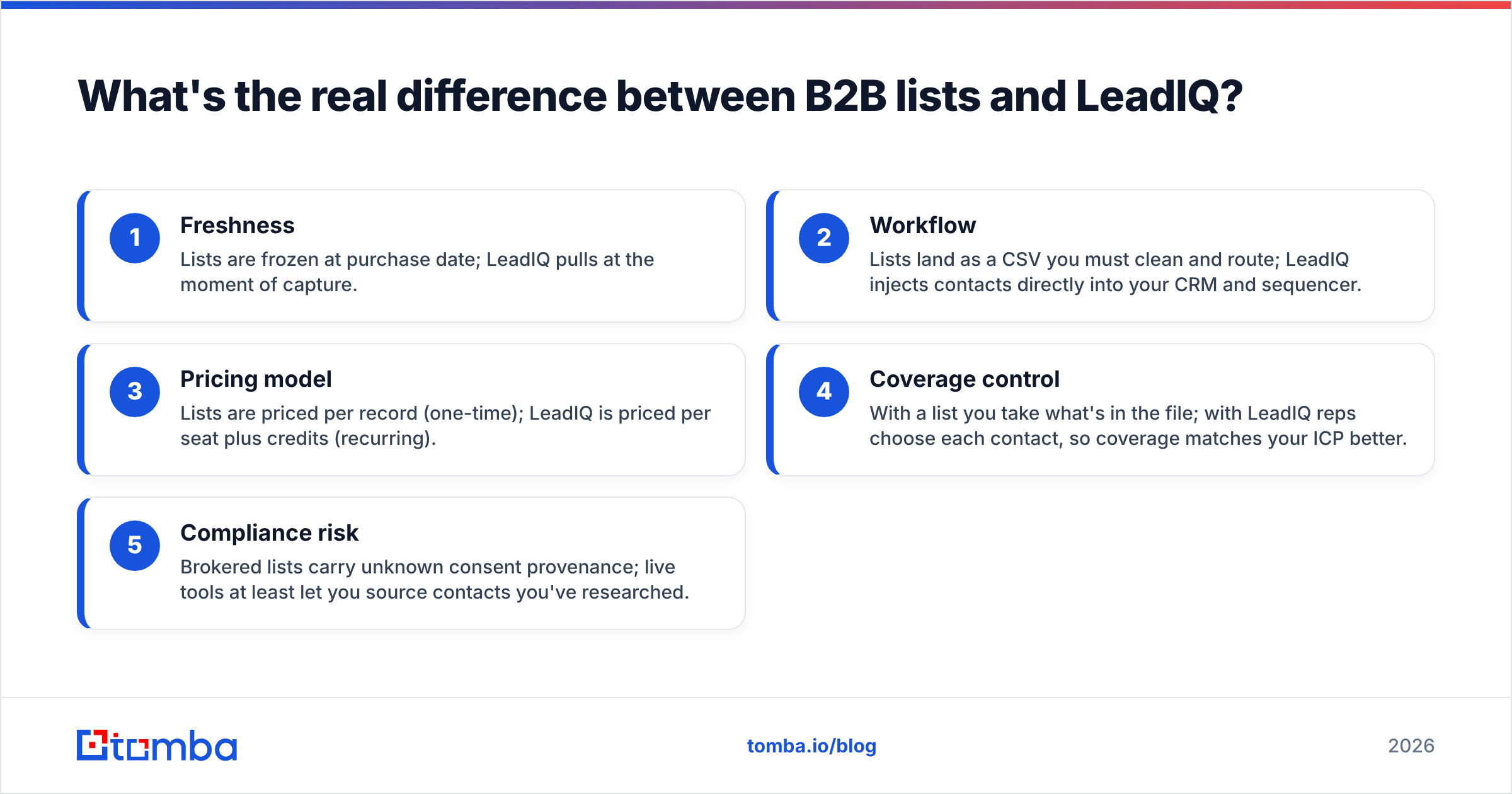
- Freshness — Lists are frozen at purchase date; LeadIQ pulls at the moment of capture.
- Workflow — Lists land as a CSV you must clean and route; LeadIQ injects contacts directly into your CRM and sequencer.
- Pricing model — Lists are priced per record (one-time); LeadIQ is priced per seat plus credits (recurring).
- Coverage control — With a list you take what's in the file; with LeadIQ reps choose each contact, so coverage matches your ICP better.
- Compliance risk — Brokered lists carry unknown consent provenance; live tools at least let you source contacts you've researched.

Is a static B2B list good enough in 2026?#
It depends entirely on your motion. A purchased list is genuinely good when you need volume fast, once: a webinar invite blast to 10,000 mid-market ops managers, an event follow-up, or seeding a brand-new territory where any coverage beats none.
The problem is decay. Industry estimates put B2B data decay at roughly 22–30% per year, and it spikes during hiring freezes and layoffs when job changes accelerate. A list you bought in January is measurably worse by July. You can't return the dead rows, and worse, emailing them inflates your bounce rate.
That bounce rate is the hidden tax. Mailbox providers read high bounce volume as a spam signal. Send to a stale brokered list and you can torch your email deliverability for the clean prospects too. Before any list touches your sequencer, it needs a verification pass — ideally with a catch-all verifier so you know which "valid" rows are actually risky catch-all domains.
Lists also create a sourcing-quality lottery. Reputable compilers refresh continuously and document consent; bargain-bin brokers resell the same scraped file to everyone, so your "exclusive" prospects have heard the same pitch ten times. Check any vendor's reviews on G2 before you wire money.
Is LeadIQ worth the price?#
LeadIQ earns its price when prospecting is a daily, rep-driven activity and your team lives in LinkedIn and a sequencer. The capture-to-CRM workflow is where it shines: a rep finds an account, grabs three contacts, enriches them, and fires them into an Outreach sequence without leaving the tab. That saved friction, multiplied across a team hitting daily activity targets, is real money.
Where it frustrates buyers:
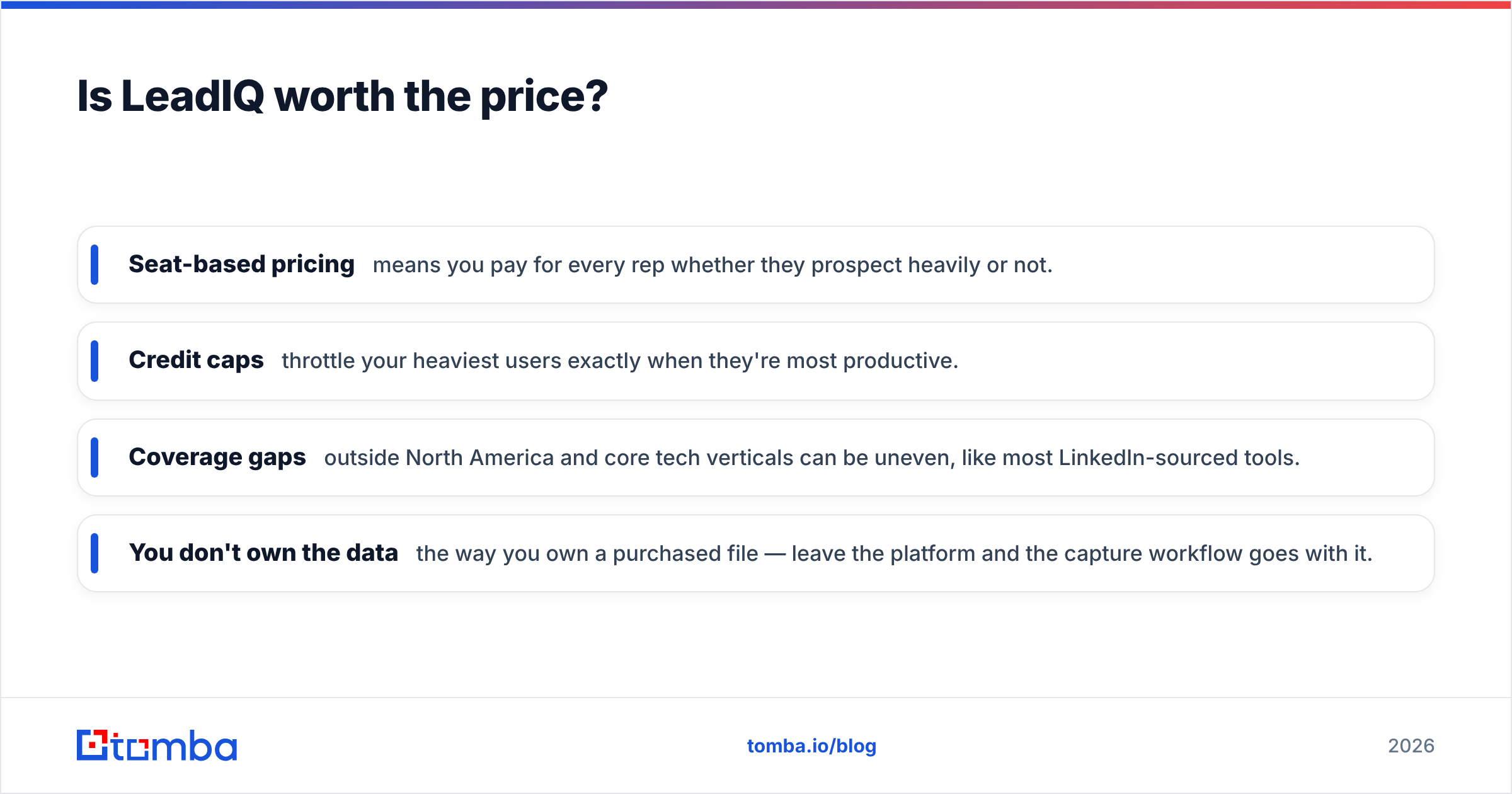
- Seat-based pricing means you pay for every rep whether they prospect heavily or not.
- Credit caps throttle your heaviest users exactly when they're most productive.
- Coverage gaps outside North America and core tech verticals can be uneven, like most LinkedIn-sourced tools.
- You don't own the data the way you own a purchased file — leave the platform and the capture workflow goes with it.
For pure rep enablement, that bundle is defensible. For programmatic lead generation — enriching thousands of records in a pipeline, not one rep at a time — paying per seat is the wrong shape, and that's where an API-first approach wins.
B2B lists vs LeadIQ vs an email-finder API: full comparison#
Here's the honest side-by-side, including the third option most "lists vs LeadIQ" articles skip — a usage-priced data API.
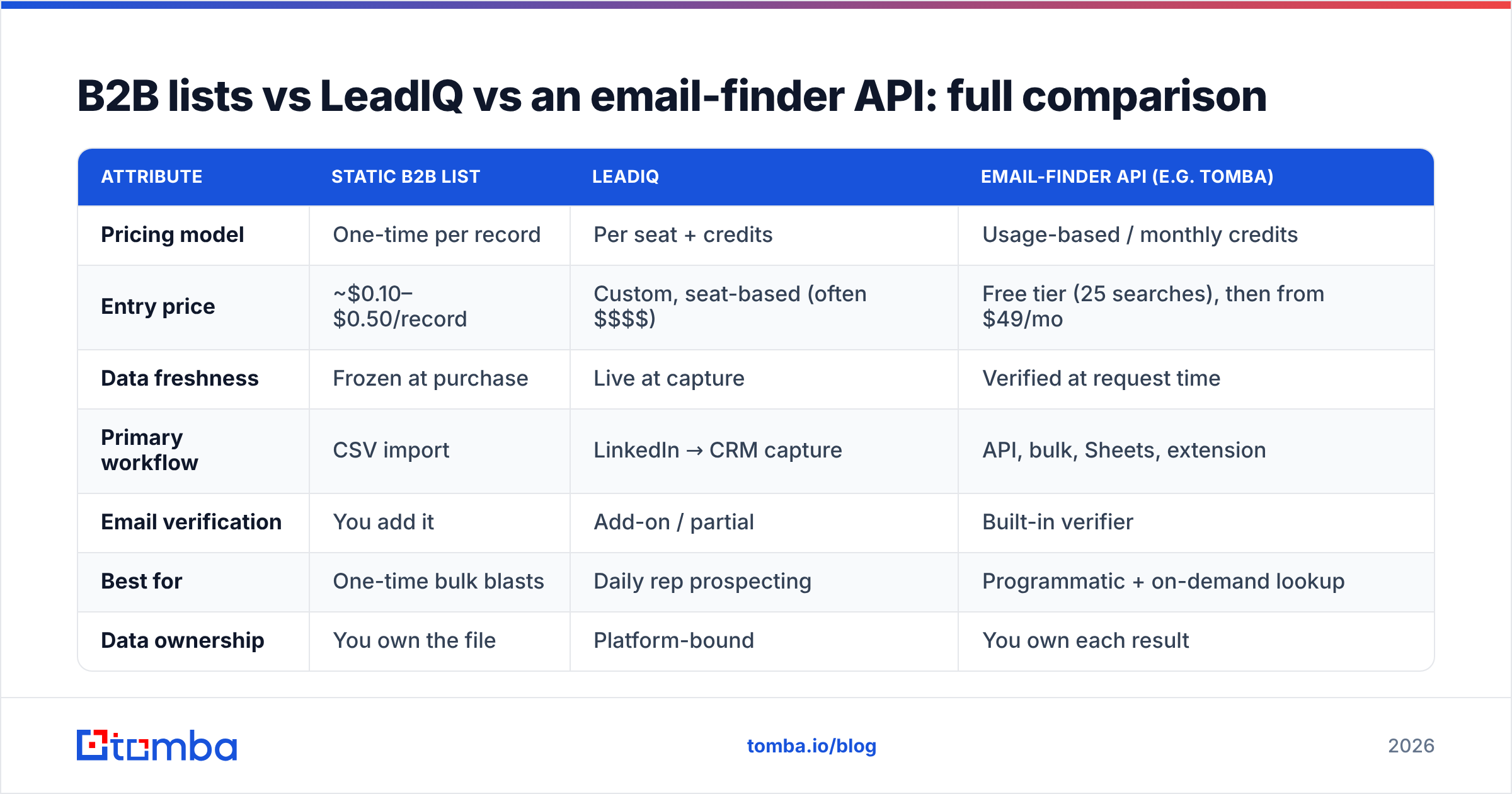
| Attribute | Static B2B List | LeadIQ | Email-Finder API (e.g. Tomba) |
|---|---|---|---|
| Pricing model | One-time per record | Per seat + credits | Usage-based / monthly credits |
| Entry price | ~$0.10–$0.50/record | Custom, seat-based (often $$$$) | Free tier (25 searches), then from $49/mo |
| Data freshness | Frozen at purchase | Live at capture | Verified at request time |
| Primary workflow | CSV import | LinkedIn → CRM capture | API, bulk, Sheets, extension |
| Email verification | You add it | Add-on / partial | Built-in verifier |
| Best for | One-time bulk blasts | Daily rep prospecting | Programmatic + on-demand lookup |
| Data ownership | You own the file | Platform-bound | You own each result |
| Coverage control | Take what's in the file | Per-contact selection | Domain + name targeting |
The pattern is clear: lists win on upfront cost for bulk, LeadIQ wins on rep workflow, and an API wins on freshness-per-dollar and flexibility. Most teams that think they have a "lists vs LeadIQ" problem actually have a "we need verified contacts on demand without buying seats" problem.

How do the costs really compare over a year?#
Sticker price lies in both directions. Run the 12-month math instead.
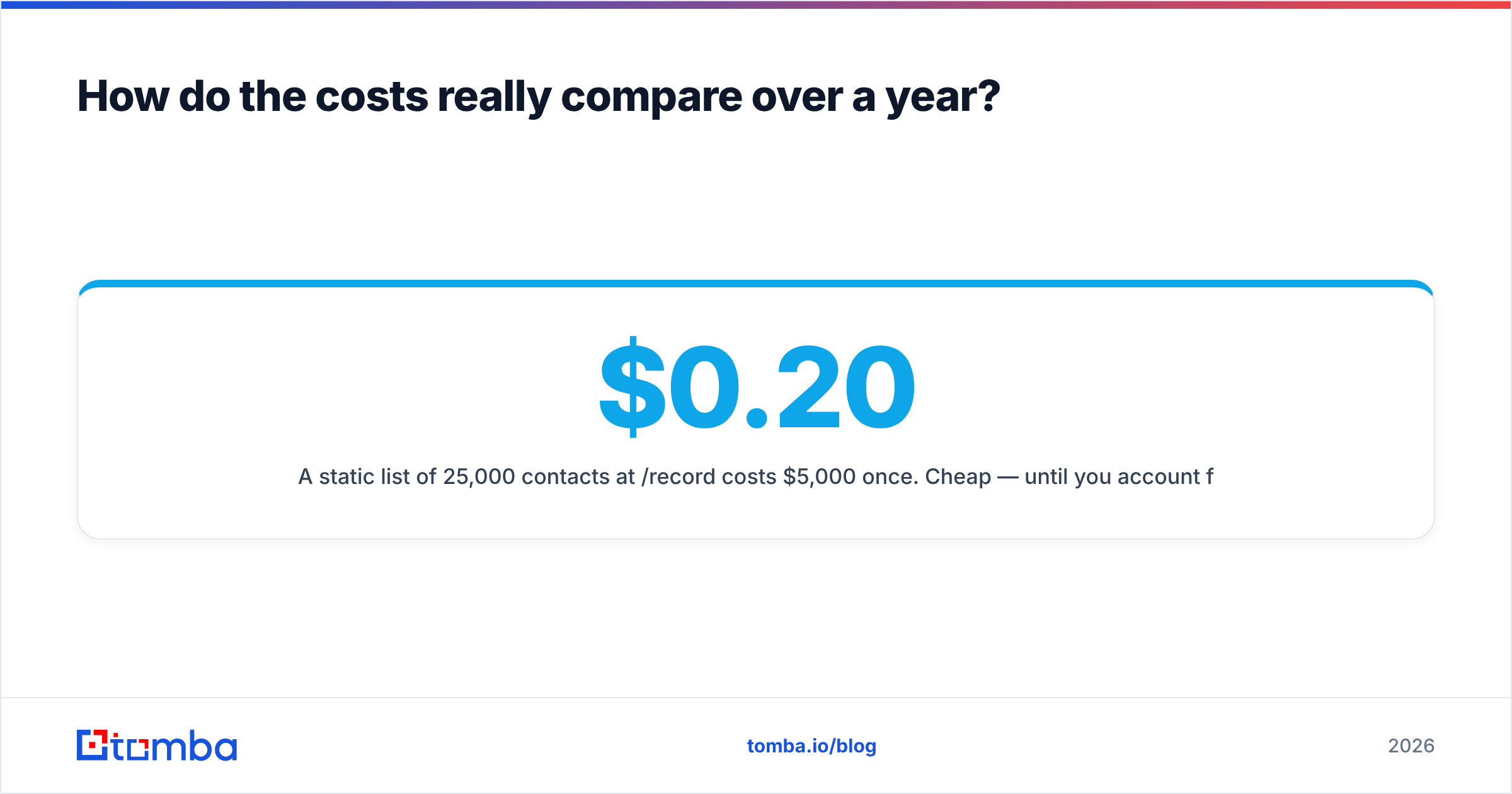
A static list of 25,000 contacts at $0.20/record costs $5,000 once. Cheap — until you account for ~25% decay. By month 12 you're effectively working ~18,750 usable records, so your true cost per usable contact climbs, and any re-buy resets the clock.
LeadIQ at, say, five seats recurs every month. The value scales with how hard each rep prospects; an under-utilized seat is pure waste, and credit overages hit your best reps first.
A usage-based API lets you pay only for lookups you actually run. Need 4,000 verified emails this month and 400 next month? You pay for 4,000 then 400. No idle seats, no spoiled rows. For teams blending bulk enrichment with on-demand lookups, you can mix the bulk email finder for big jobs and the domain search for targeted account work under one budget.
A quick cost-fit checklist#
- Bulk, one-time, price-sensitive → static list (then verify hard).
- Daily rep prospecting inside a sequencer → LeadIQ or similar live tool.
- Programmatic enrichment + variable monthly volume → email-finder API.
- Mixed needs on a tight budget → API with a free tier to test before committing.
What about data accuracy and compliance?#
Accuracy is where the source you pick shows up in your numbers. A frozen list degrades predictably; a live tool is fresher but inherits LinkedIn's gaps and any scraping limits; an API that verifies at request time gives you the freshest single-record result because it checks the mailbox when you ask.
Compliance deserves a hard look regardless of source. Brokered lists often can't document where consent came from, which is a real exposure under GDPR and CCPA. Before you buy any list, ask the vendor for consent provenance and suppression handling in writing — and read a neutral primer like Wikipedia's GDPR overview so you know what to demand.
Across every option, the non-negotiable is verification before send. Pull data from a list, LeadIQ, or an API — it doesn't matter — but route it through email verification first. A clean send protects the sender reputation that your entire outbound program depends on. The cheapest list in the world is expensive if it gets your domain blacklisted.
Which should your team choose?#
Decide on motion, not marketing.
- Choose a static B2B list if you run occasional high-volume campaigns, are budget-constrained, and have the discipline to verify and suppress aggressively. Accept the decay and don't email a six-month-old file raw.
- Choose LeadIQ if prospecting is a daily team sport, your reps live in LinkedIn and a sequencer, and the capture-to-CRM time savings clearly outweigh seat costs. Pressure-test coverage in your specific region and vertical during the trial.
- Choose an email-finder API if your volume is variable, you want to own each result, you're enriching programmatically, or you simply don't want to pay for seats and spoiled records. Start on a free tier and scale only what you use.
There's no shame in a hybrid: many teams keep a list for big blasts, give SDRs a live tool for daily capture, and run an API in the background for enrichment and verification. The mistake is paying premium recurring prices for a workflow you don't actually run, or trusting a cheap static file you never clean.
The bottom line#
B2B lists vs LeadIQ isn't a winner-takes-all fight — it's a fit question. Lists are cheap snapshots that decay. LeadIQ is a fresh, workflow-tight tool that charges for seats and credits. And for a large share of teams, the smartest move is neither: pay only for the verified contacts you need, when you need them.
If that sounds like your situation, start with the Tomba Email Finder. You get a free tier with 25 searches to test accuracy on your own ICP, built-in verification so you don't ship bounces, and usage-based pricing from $49/mo that never charges you for an idle seat or a dead row. Find the emails, verify them in the same pass, and put your budget where it actually converts.
// get started
Find, verify and enrich your first contacts today
Start on the free plan with 25 searches a month, then scale when your team is ready.
Free plan · No credit card required · GDPR & CCPA
// about the author