B2B Lists vs ZoomInfo 2026: Which Data Source Wins?
Bought B2B lists are cheap but decay fast. ZoomInfo is fresh but pricey. Here's an honest 2026 breakdown of cost, accuracy, compliance, and the smarter middle path.
You have two ways to fill your CRM with prospects: buy a static B2B list from a broker, or subscribe to a live data platform like ZoomInfo. They look similar on the surface — both hand you names, titles, emails, and phone numbers. Underneath, they behave nothing alike, and choosing the wrong one wastes either your budget or your sender reputation.
This is a neutral breakdown of b2b lists vs ZoomInfo for 2026: what each actually delivers, where each fails, and a cheaper third option that beats both for most teams.
TL;DR#
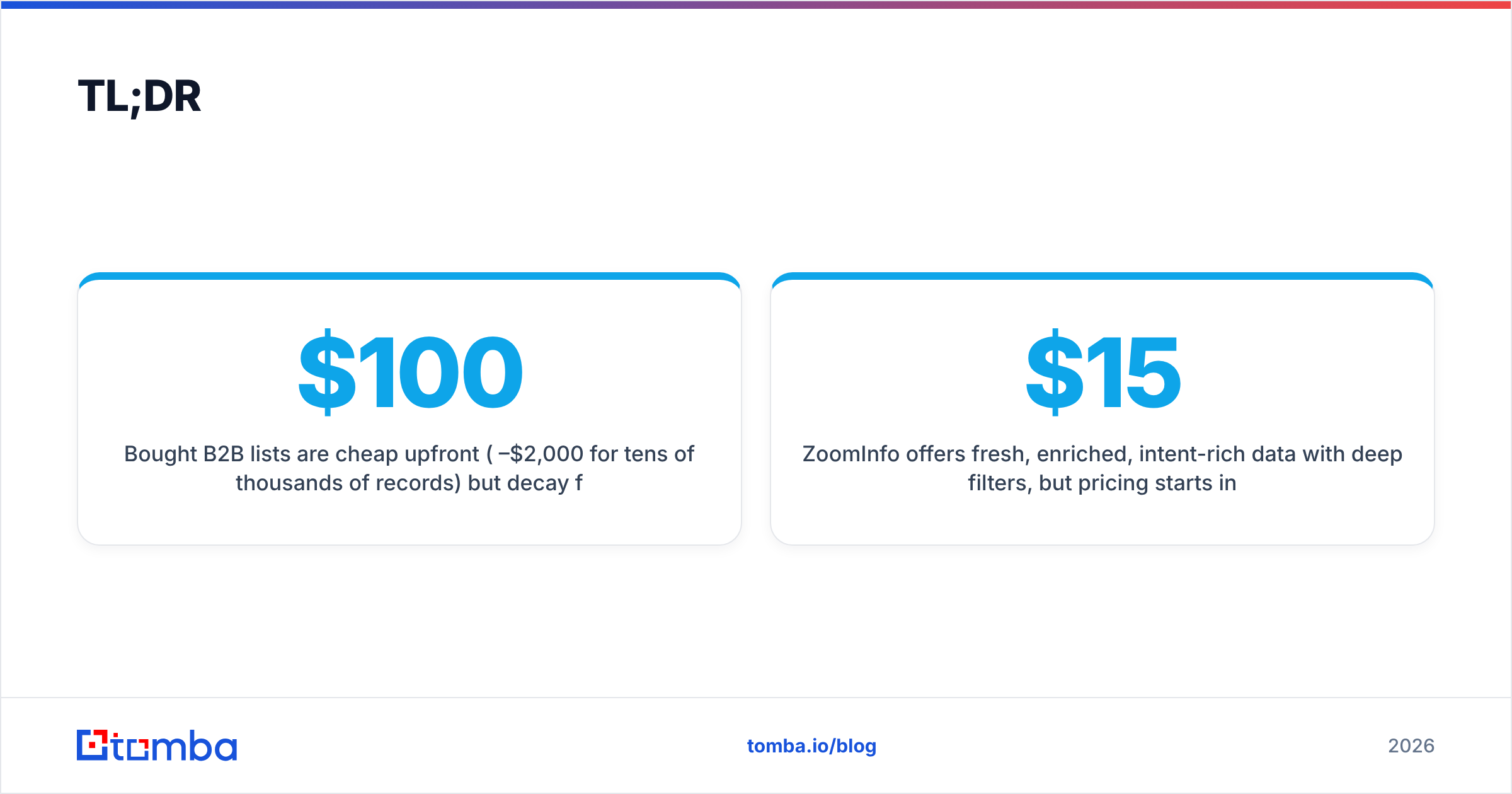
- Bought B2B lists are cheap upfront ($100–$2,000 for tens of thousands of records) but decay fast — 25–30% of B2B contact data goes stale every year, so a six-month-old list is already partly dead.
- ZoomInfo offers fresh, enriched, intent-rich data with deep filters, but pricing starts in the $15,000+/year range and locks you into annual contracts with seat and credit limits.
- Accuracy is the real battleground: lists are sold "as-is" with no verification; ZoomInfo refreshes continuously but still carries gaps in SMB and non-US data.
- Compliance risk is higher with purchased lists — many violate GDPR/CAN-SPAM consent rules and can torch your domain reputation.
- The middle path — verify-on-demand tools that pull and validate contacts in real time — gives you ZoomInfo-grade freshness at list-grade prices. That's where Tomba fits.
What are bought B2B lists?#
A bought B2B list is a one-time data file — usually a CSV or Excel export — sold by a list broker or scraped database vendor. You pay once, download tens of thousands of rows, and they're yours to keep. The pitch is volume: "50,000 verified CMO contacts for $499."
The catch is that the file is a snapshot frozen in time. The moment a contact changes jobs, the row is wrong. People switch companies roughly every 2–4 years, which means at any given moment a meaningful slice of your list points at the wrong inbox. By the time you've worked through a static list, bounce rates climb and your email deliverability suffers.
Lists also rarely come verified. "Verified" on a broker site usually means the data was valid when first collected — not today. There's no SMTP check, no catch-all detection, and no way to audit where the records came from.

What is ZoomInfo?#
ZoomInfo is a subscription B2B data platform. Instead of selling you a file, it gives you searchable access to a continuously updated database of companies and contacts, plus layers most list brokers can't touch:
- Continuous refresh — records are re-checked and updated on a rolling basis, not sold once and abandoned.
- Firmographic and technographic filters — search by revenue, headcount, tech stack, location, and dozens of other attributes.
- Intent data — signals about which accounts are actively researching topics in your category.
- Org charts and direct dials — useful for multi-threading into larger accounts.
ZoomInfo is genuinely strong data, and for enterprise sales teams the intent and org-chart features can justify the cost. The problem is the cost itself, and the contract shape around it.
How much do B2B lists and ZoomInfo cost in 2026?#
Cost is the cleanest way to separate these options. One is a small one-time fee; the other is a five-figure annual commitment.
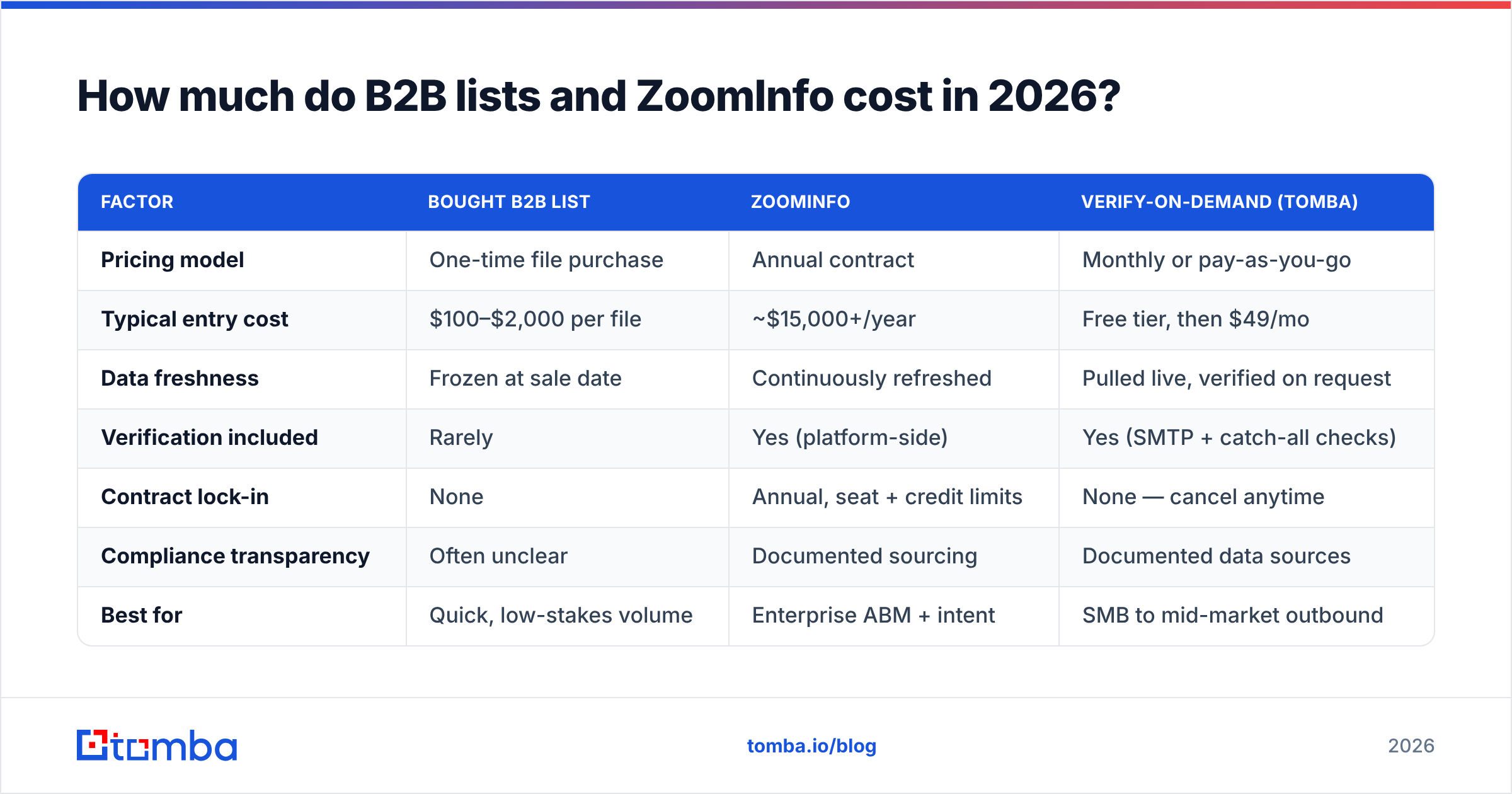
| Factor | Bought B2B List | ZoomInfo | Verify-on-demand (Tomba) |
|---|---|---|---|
| Pricing model | One-time file purchase | Annual contract | Monthly or pay-as-you-go |
| Typical entry cost | $100–$2,000 per file | ~$15,000+/year | Free tier, then $49/mo |
| Data freshness | Frozen at sale date | Continuously refreshed | Pulled live, verified on request |
| Verification included | Rarely | Yes (platform-side) | Yes (SMTP + catch-all checks) |
| Contract lock-in | None | Annual, seat + credit limits | None — cancel anytime |
| Compliance transparency | Often unclear | Documented sourcing | Documented data sources |
| Best for | Quick, low-stakes volume | Enterprise ABM + intent | SMB to mid-market outbound |
The headline: a bought list looks 10–100x cheaper than ZoomInfo, but you're paying for a depreciating asset. ZoomInfo costs more because freshness has a real, recurring cost — someone has to keep re-checking the data. You can compare that against transparent Tomba pricing to see how a pay-as-you-go model changes the math.
Is ZoomInfo more accurate than a bought list?#
Yes — and it's not particularly close. Here's why, broken into the factors that actually drive accuracy:
- Recency of collection. A list is accurate to its collection date and degrades from there. ZoomInfo re-verifies on a rolling cycle, so the average record is far younger.
- Verification layer. ZoomInfo runs validation before surfacing a contact. Most list brokers ship raw rows with no SMTP or syntax checks, so you inherit every typo and dead mailbox.
- Source transparency. ZoomInfo documents where data originates. Many brokers won't — which is a red flag for both quality and compliance.
- Coverage depth. ZoomInfo's filters let you target precisely; a generic list is whatever the broker happened to have.
That said, ZoomInfo isn't flawless. Independent reviews on G2 consistently flag two weak spots: thinner coverage for small businesses and non-North-American markets, and direct-dial numbers that have gone stale. No database is 100% accurate, and anyone claiming otherwise is selling something. The honest framing: ZoomInfo gives you better odds per record, and a static list gives you worse odds that keep getting worse.
This is why verification matters regardless of source. Even with good data, running contacts through an email verifier before you send protects your domain. Bounces above ~3% start dragging your sender reputation down with mailbox providers.
What about compliance and deliverability risk?#
This is the factor most teams underweight until it bites them. Bought lists carry the highest legal and technical risk of any acquisition method.
Under GDPR, contacts generally need a lawful basis for processing, and a broker selling you 50,000 EU records rarely passes that bar. Under CAN-SPAM and similar rules, you're responsible for how you contact people regardless of where the data came from. A cheap list can turn into fines, and — more immediately — into spam complaints that wreck your domain.
The deliverability mechanics are unforgiving:
- High bounce rates from stale list emails signal to Gmail and Outlook that you're not maintaining list hygiene.
- Spam-trap addresses are common in old purchased lists. Hit a few and you can land on a blocklist.
- Low engagement from uninterested recipients further depresses inbox placement.
ZoomInfo's documented sourcing reduces (though doesn't eliminate) the compliance ambiguity, and its verification cuts bounce risk. A verify-on-demand approach goes further by checking each address at the moment you use it. Tomba publishes its data sources so you know what you're working with rather than guessing.
When does each option actually make sense?#
Neither tool is universally right. Match the option to the job:
- Choose a bought list when the campaign is low-stakes, high-volume, and disposable — say, a one-off event invite to a broad audience where a high bounce rate won't hurt a domain you care about. Use a throwaway sending domain and verify before sending.
- Choose ZoomInfo when you're running enterprise account-based marketing, need intent signals and org charts, have the budget for a five-figure annual contract, and your ICP sits squarely in ZoomInfo's strongest coverage (mid-to-large North American companies).
- Choose verify-on-demand when you're an SMB or mid-market team that needs fresh, accurate contacts without enterprise pricing or annual lock-in — the most common situation by far.
Is there a better middle path than lists or ZoomInfo?#
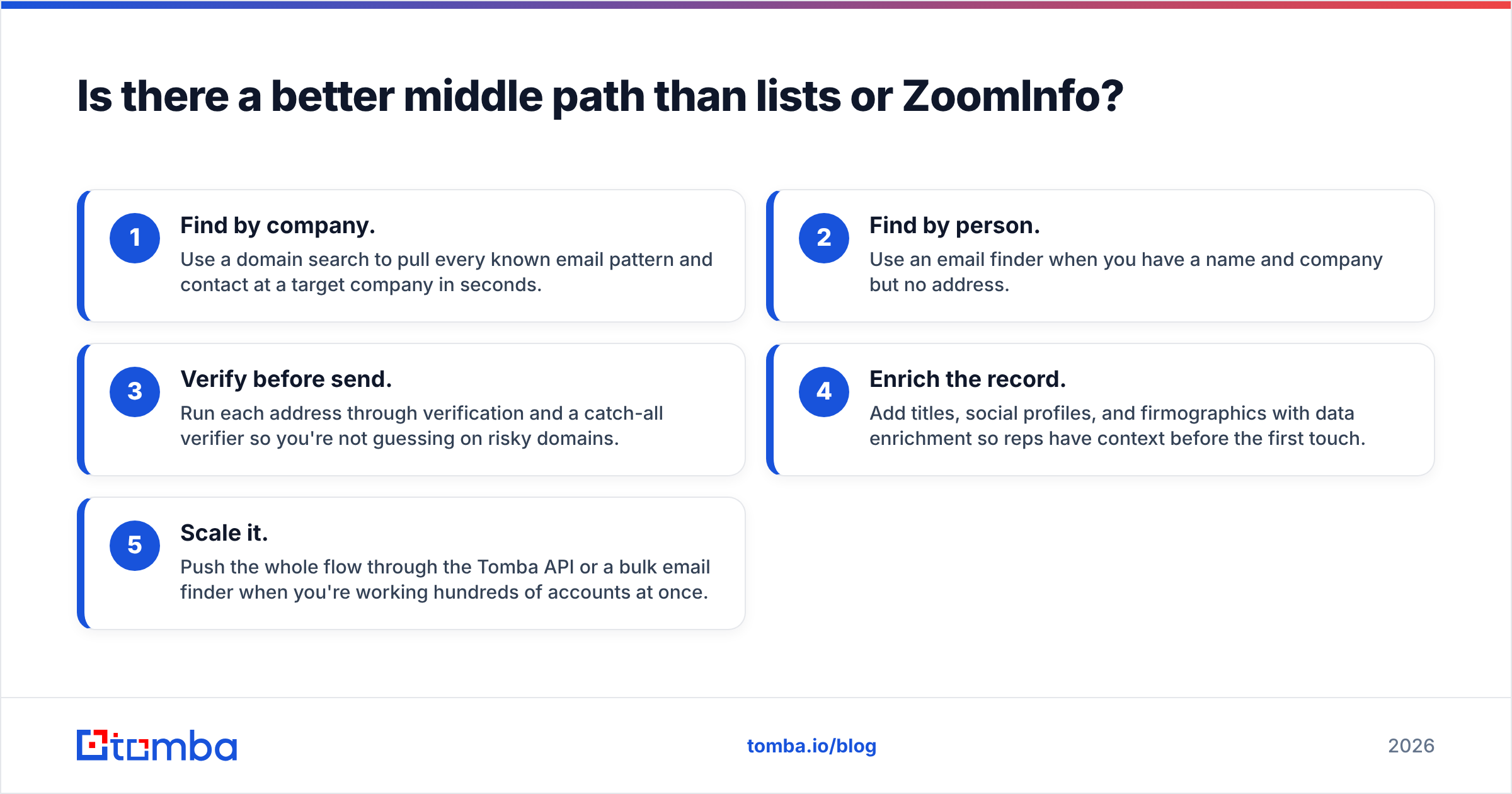
For most teams, yes: pull contacts live and verify them on demand instead of buying a frozen file or signing an enterprise contract you'll under-use.
This model treats data as a flow, not a stock. Rather than owning 50,000 decaying rows, you fetch exactly the contacts you need, when you need them, already validated. You get list-grade economics with platform-grade freshness — the gap that both pure options leave open.
Here's how the pieces fit a typical outbound workflow:
- Find by company. Use a domain search to pull every known email pattern and contact at a target company in seconds.
- Find by person. Use an email finder when you have a name and company but no address.
- Verify before send. Run each address through verification and a catch-all verifier so you're not guessing on risky domains.
- Enrich the record. Add titles, social profiles, and firmographics with data enrichment so reps have context before the first touch.
- Scale it. Push the whole flow through the Tomba API or a bulk email finder when you're working hundreds of accounts at once.
The result behaves like ZoomInfo's freshness at a fraction of the commitment, and unlike a bought list, nothing rots in storage. Analyst coverage from firms like Gartner increasingly frames B2B data quality as an ongoing process rather than a one-time purchase — which is exactly the logic behind verify-on-demand.
How do bounce rates compare in practice?#
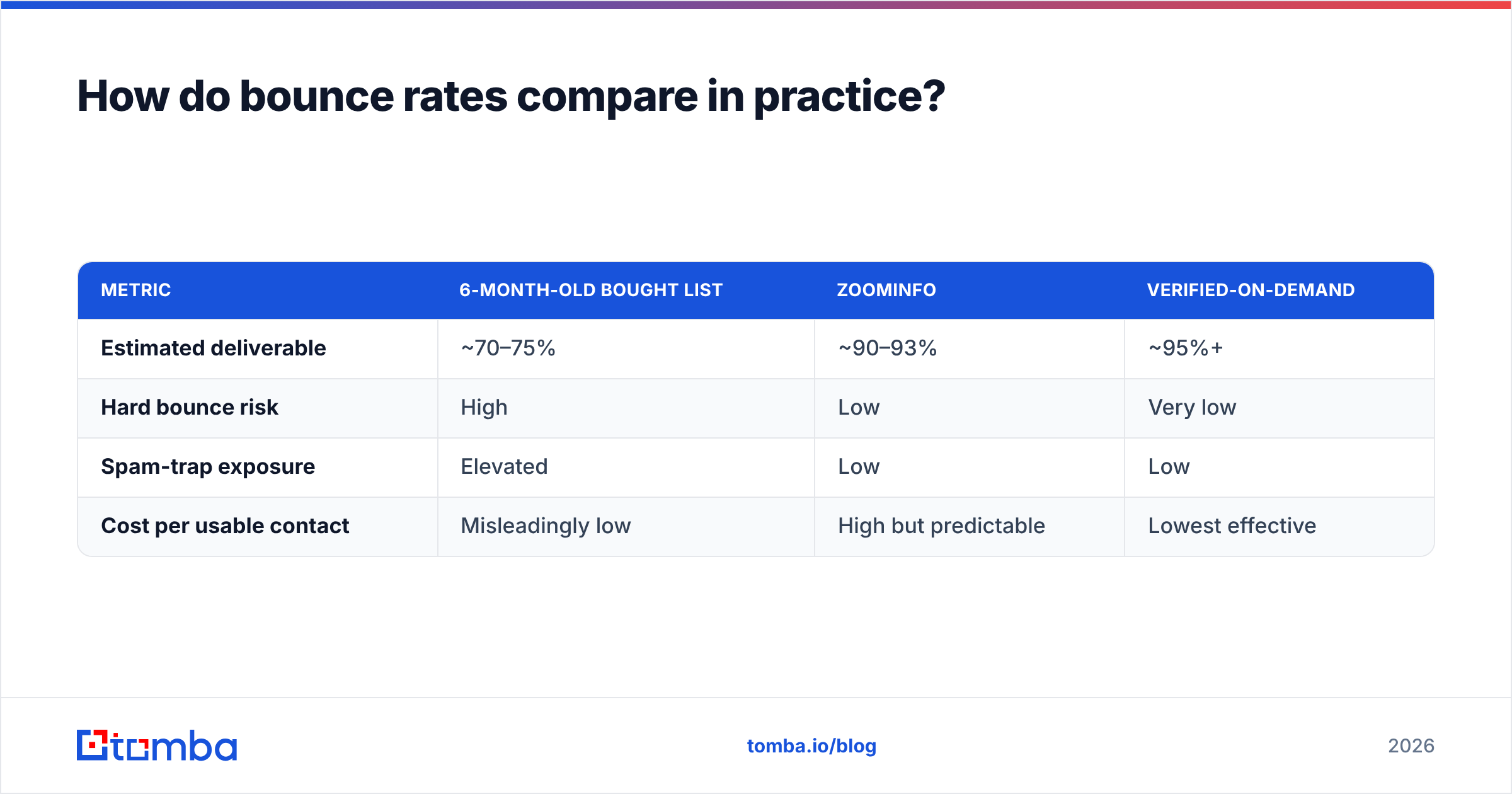
A simplified but realistic picture of what happens to 10,000 contacts from each source after one quarter:
| Metric | 6-month-old bought list | ZoomInfo | Verified-on-demand |
|---|---|---|---|
| Estimated deliverable | ~70–75% | ~90–93% | ~95%+ |
| Hard bounce risk | High | Low | Very low |
| Spam-trap exposure | Elevated | Low | Low |
| Cost per usable contact | Misleadingly low | High but predictable | Lowest effective |
The "cost per usable contact" row is the one that matters. A $499 list of 50,000 looks like $0.01 per contact — until you discount the 25–30% that bounce and the unknown share that were never your ICP. The effective cost climbs fast, and the deliverability damage isn't priced in at all.
Frequently asked questions#
Is buying B2B email lists legal? It depends on jurisdiction and how you use the data. In the EU, GDPR makes most purchased lists legally risky without a lawful basis. In the US, CAN-SPAM allows cold B2B email but holds you responsible for honoring opt-outs and avoiding deceptive headers. Legality aside, the deliverability risk often outweighs any savings.
Does ZoomInfo offer a free trial? ZoomInfo typically offers limited trials or demos rather than a standing free tier, and pricing is quote-based. If you need a genuine free starting point, Tomba's free tier includes 25 searches per month with no contract.
Can I just verify a bought list instead of replacing it? You can, and you should if you already own one — running it through verification removes the worst bounce risk. But verification can't fix records that are simply outdated (right person, wrong company). It cleans syntax and dead mailboxes; it can't un-rot a stale file.
What's the cheapest accurate option for a small team? For most SMB and mid-market teams, verify-on-demand wins on effective cost. You pay only for contacts you actually pursue, every address is checked at use time, and there's no annual minimum to absorb.
The bottom line#
Bought lists win on sticker price and lose on everything that matters after the first month. ZoomInfo wins on freshness, depth, and intent — and charges accordingly, with contracts that punish under-use. For the large middle of the market, neither extreme is the right buy.
If you want ZoomInfo-grade accuracy without the enterprise contract, start with the Tomba Email Finder. Pull live, verified contacts by name or domain, enrich them with full firmographics, and skip both the decaying CSV and the five-figure annual commitment. Spin up the free tier, run your real target accounts through it, and compare the bounce rates yourself — that's the only benchmark that counts.
// get started
Find, verify and enrich your first contacts today
Start on the free plan with 25 searches a month, then scale when your team is ready.
Free plan · No credit card required · GDPR & CCPA
// about the author