B2B Market Intelligence Tools: The 2026 Buyer's Guide
A neutral 2026 breakdown of B2B market intelligence tools — what they do, how categories differ, pricing tiers, and how to pick the stack that fits your GTM motion.
TL;DR
- B2B market intelligence tools turn scattered signals — firmographics, intent, technographics, contact data — into decisions about who to sell to and when.
- The category splits into four buckets: market/competitive research, account intelligence, contact and enrichment data, and intent/visitor signals. Most teams need two of the four, not all.
- Pricing ranges wildly: free tiers and $49/mo entry points for contact data, $25k+/year for enterprise intent platforms. Pay for accuracy, not dashboards.
- Data freshness and verification matter more than database size. A 200M-record database that's 40% stale is worse than a smaller verified one.
- For most lead-gen and outbound teams, a verified contact + enrichment layer (like Tomba) plus one intent source covers 90% of the job.
What are B2B market intelligence tools?#
B2B market intelligence tools are software that collects, cleans, and analyzes external data about companies, buyers, and markets so your go-to-market team can decide where to spend its time. Think of it like the difference between fishing blind and fishing with sonar. Without intelligence, you cast wide and hope. With it, you see where the fish are, how big they are, and when they're biting — then you cast once.
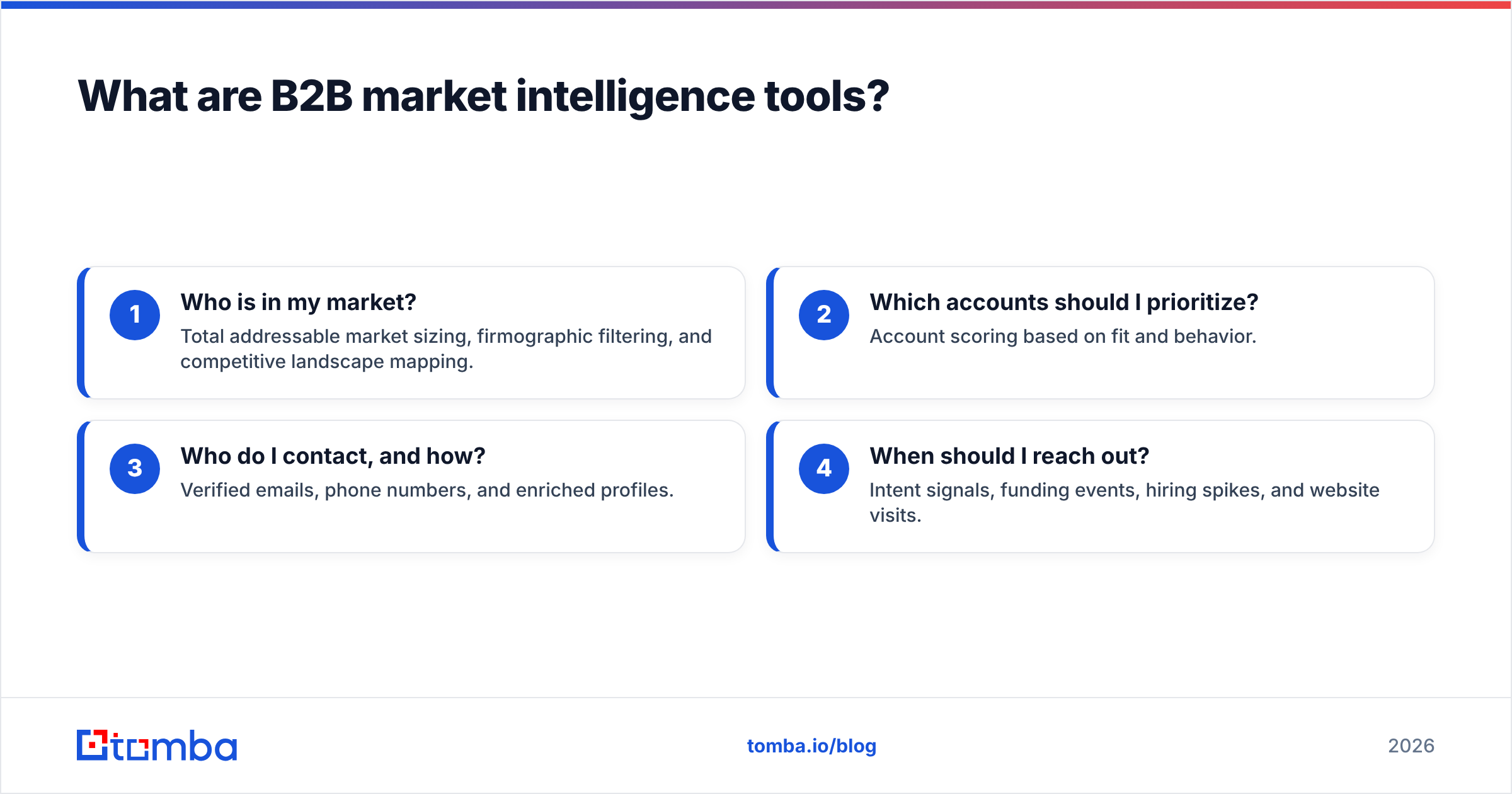
In practice these tools answer four questions:
- Who is in my market? Total addressable market sizing, firmographic filtering, and competitive landscape mapping.
- Which accounts should I prioritize? Account scoring based on fit and behavior.
- Who do I contact, and how? Verified emails, phone numbers, and enriched profiles.
- When should I reach out? Intent signals, funding events, hiring spikes, and website visits.
No single tool does all four well. Vendors that claim to are usually strong in one bucket and thin in the others. The art of building a stack is knowing which question is your bottleneck.
What are the main categories of market intelligence tools?#
The market looks crowded until you sort it. Almost every platform falls into one of four categories, and each solves a different problem.
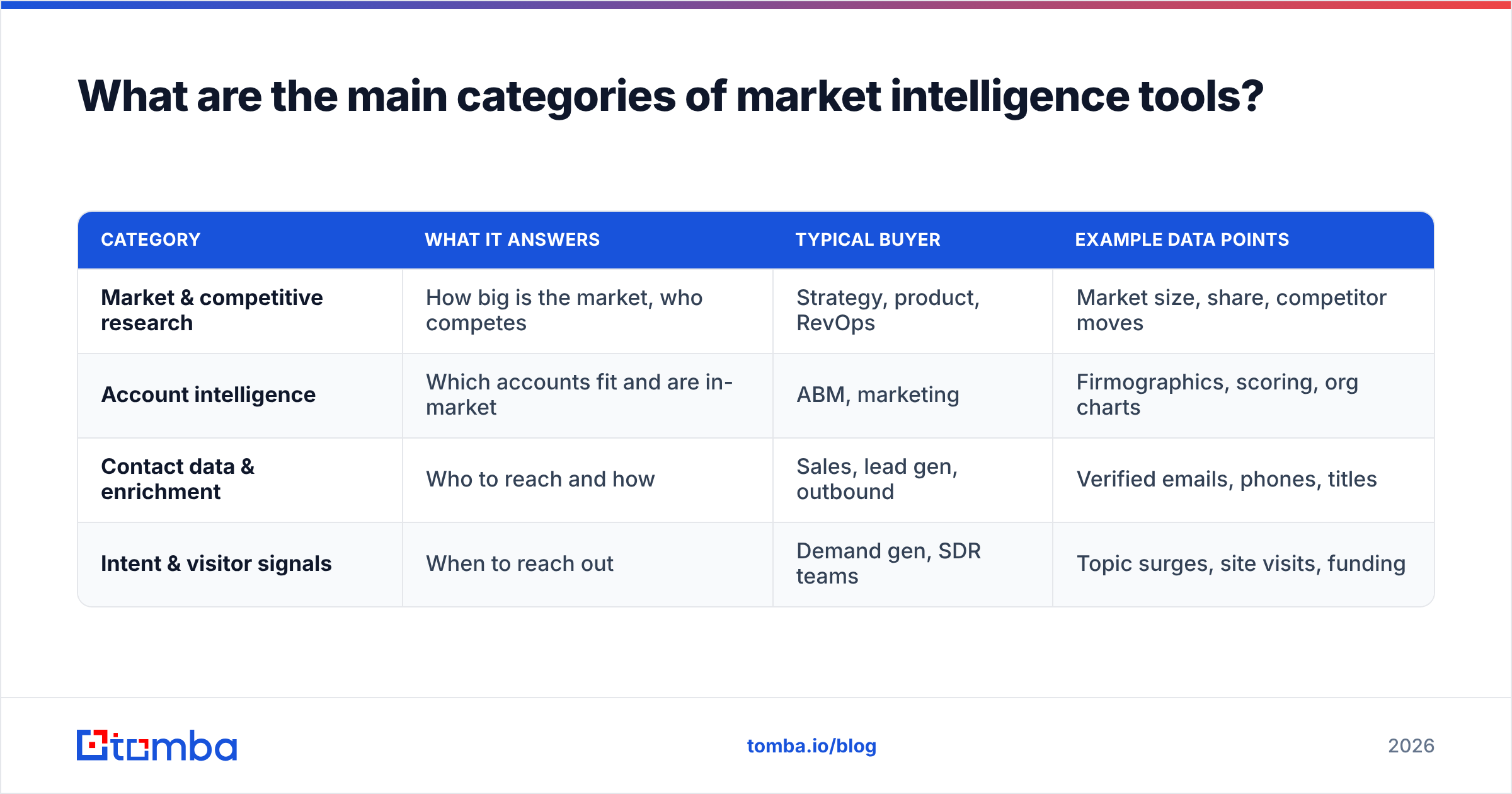
| Category | What it answers | Typical buyer | Example data points |
|---|---|---|---|
| Market & competitive research | How big is the market, who competes | Strategy, product, RevOps | Market size, share, competitor moves |
| Account intelligence | Which accounts fit and are in-market | ABM, marketing | Firmographics, scoring, org charts |
| Contact data & enrichment | Who to reach and how | Sales, lead gen, outbound | Verified emails, phones, titles |
| Intent & visitor signals | When to reach out | Demand gen, SDR teams | Topic surges, site visits, funding |
Here's the practical breakdown of when each one earns its budget:
- Market & competitive research — Buy this when you're entering a new vertical or building a board deck. Tools like Gartner and Forrester live here. It's strategic, slow-moving, and expensive. You don't need it weekly.
- Account intelligence — Buy this when marketing and sales argue about which accounts matter. It aligns the two teams around a scored, agreed list.
- Contact data & enrichment — Buy this the moment reps waste time hunting for emails. It's the highest-ROI, lowest-cost layer, and it's where a B2B database with strong verification pays off fastest.
- Intent & visitor signals — Buy this when your list is good but your timing is bad. Intent tells you which of your known accounts just got interested.
Most teams over-invest in category one (impressive in slides, rarely actioned) and under-invest in category three (boring, but it's what reps actually use every morning).
How do you evaluate accuracy and data quality?#
Accuracy is the whole game, and it's where vendor marketing is least honest. A database can advertise "300 million contacts" and still hand your reps a 35% bounce rate. Size is a vanity metric; verification is the real one.
When you evaluate any contact or enrichment provider, test these four things on a sample of 100 records you already know:
- Match rate — Of the records you searched, how many came back with data at all?
- Accuracy rate — Of those returned, how many were actually correct (right person, right company, deliverable email)?
- Freshness — When was each record last verified? Job changes break B2B data fast; people switch roles every 2–3 years on average.
- Coverage of your ICP — A tool can be 95% accurate on US tech and useless for EMEA manufacturing. Test your segment, not theirs.
Independent review sites like G2 and Capterra are useful for surfacing real complaints about stale data — read the 3-star reviews, not the 5-star ones. The 3-stars tell you where the tool actually breaks.
This is why a real-time verification layer beats a static dump. Running addresses through an email verifier before a campaign protects your sender reputation far more than any "billion-record" claim on a pricing page. The goal is to send fewer, cleaner emails — not more of them.
Which B2B market intelligence tools should you compare in 2026?#
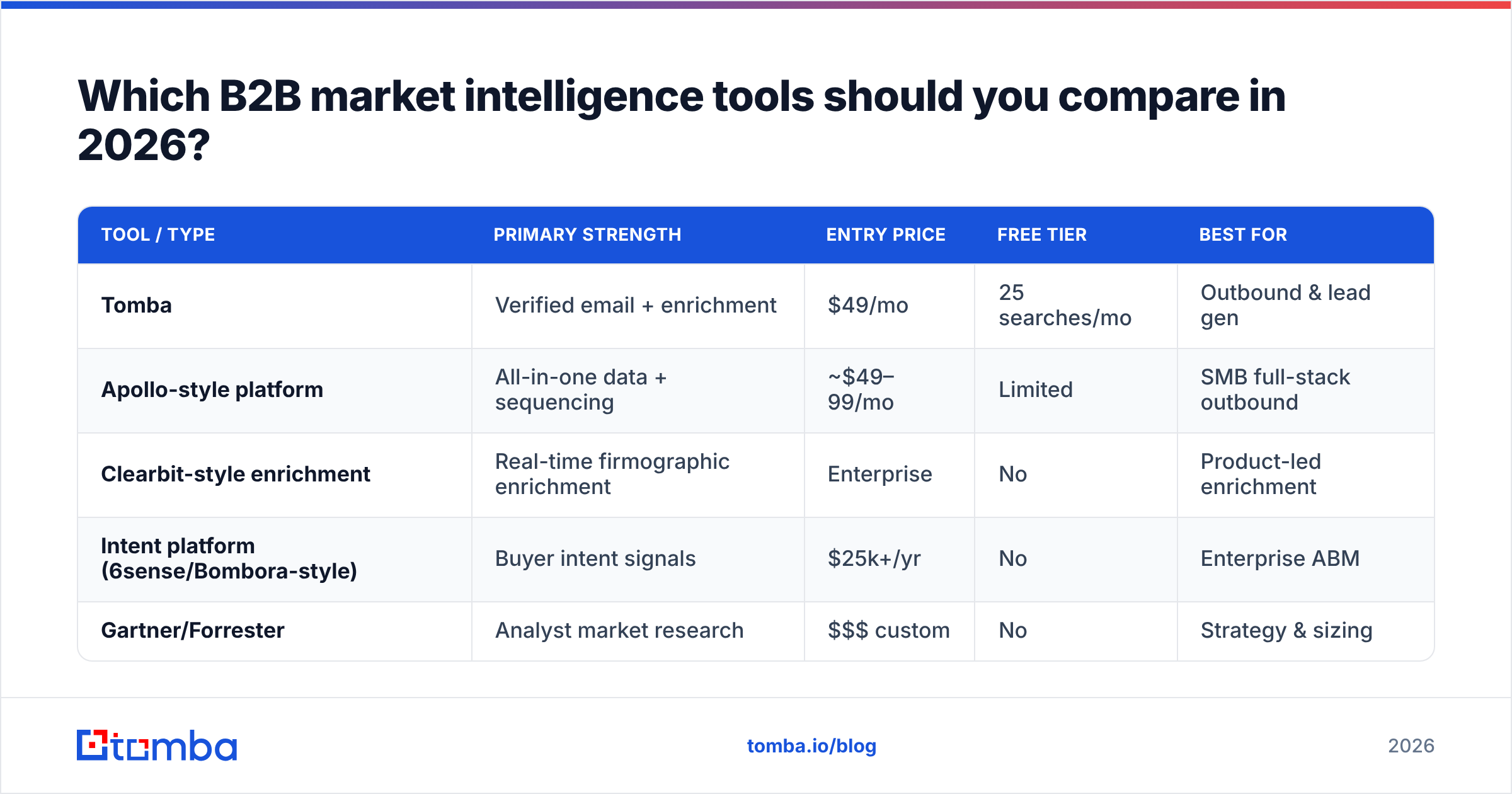
Rather than rank tools (rankings go stale and depend on your ICP), compare them on the axes that change your decision: primary strength, entry price, free option, and best-fit use case. Here's a representative cross-section of the categories.
| Tool / type | Primary strength | Entry price | Free tier | Best for |
|---|---|---|---|---|
| Tomba | Verified email + enrichment | $49/mo | 25 searches/mo | Outbound & lead gen |
| Apollo-style platform | All-in-one data + sequencing | ~$49–99/mo | Limited | SMB full-stack outbound |
| Clearbit-style enrichment | Real-time firmographic enrichment | Enterprise | No | Product-led enrichment |
| Intent platform (6sense/Bombora-style) | Buyer intent signals | $25k+/yr | No | Enterprise ABM |
| Gartner/Forrester | Analyst market research | $$$ custom | No | Strategy & sizing |
A few honest notes on this table:
- Entry-price tools (contact and enrichment data) deliver value in week one. You can prove ROI on a single campaign.
- Enterprise intent platforms require a mature ABM motion to justify. If you can't name the five accounts you'd act on tomorrow, you're not ready for one.
- Analyst research is a strategic purchase, not an operational one. Treat it like a consulting line item.
For teams whose bottleneck is "we have target accounts but no reliable contacts," the fastest fix is a focused contact-data tool plus enrichment. You can layer intent later. See current Tomba pricing for where the entry tiers sit — the Starter plan is $49/mo, not the $39 some outdated comparison posts still list.
How much should you budget for a market intelligence stack?#
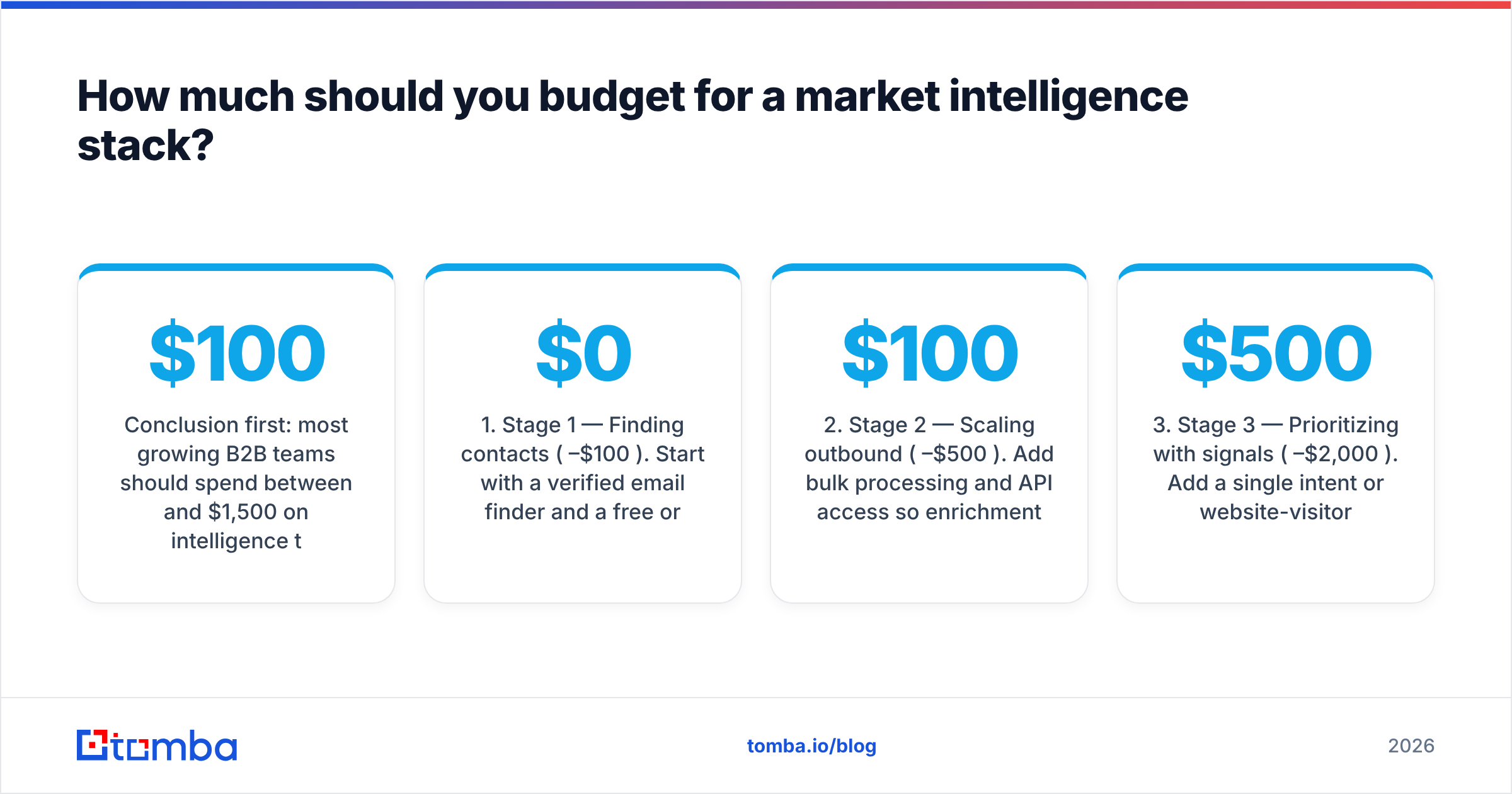
Conclusion first: most growing B2B teams should spend between $100 and $1,500 per month on intelligence tooling, and concentrate it on contact data plus one signal source. Six-figure enterprise contracts only make sense when you have a dedicated ops team to operationalize the data.
Here's a sane way to phase spend as you grow:
- Stage 1 — Finding contacts ($0–$100/mo). Start with a verified email finder and a free or starter tier. Prove that better data lifts reply rates before spending more. A data enrichment add-on fills in titles and company size automatically.
- Stage 2 — Scaling outbound ($100–$500/mo). Add bulk processing and API access so enrichment runs inside your CRM, not in spreadsheets. This is where the email finder API earns its keep.
- Stage 3 — Prioritizing with signals ($500–$2,000/mo). Add a single intent or website-visitor source. Don't buy two competing signal vendors; you'll never reconcile them.
- Stage 4 — Enterprise ABM ($25k+/yr). Only when you have analysts to act on the data daily.
The most common budgeting mistake is buying Stage 4 capabilities at Stage 2 maturity. The dashboards look impressive in the demo, then no one logs in after month two. Buy the stage you're in, not the stage you aspire to.
How do you integrate market intelligence into your workflow?#
A tool that lives in its own dashboard is a tool no one uses. The value shows up only when data flows into the systems your team already touches — the CRM, the sequencer, the spreadsheet.
Practical integration patterns that work:
- Enrich on entry. When a lead hits your CRM, auto-enrich it with firmographics and a verified email so reps never start cold. Most enrichment tools push into HubSpot or Salesforce natively.
- Verify before send. Route every list through verification before it touches your sequencer. This single step is the cheapest deliverability insurance you can buy.
- Score, then route. Combine fit (firmographics) with behavior (intent, visits) into one score so SDRs work the top of the list, not the whole list.
- Close the loop. Feed won/lost outcomes back into your scoring so the model learns which signals actually predict revenue.
The teams that win with market intelligence aren't the ones with the most data. They're the ones who made the data invisible — it just appears in the right field at the right moment, and reps act on it without thinking about which tool it came from.
What's the difference between data quantity and data usefulness?#
Quantity is what vendors sell; usefulness is what you actually need. A 500-million-record database sounds powerful, but if your ICP is "Series B fintech companies in North America with 50–200 employees," you need maybe 4,000 of those records — and you need them correct.
Ask three filtering questions of any provider:
- Can it segment to my exact ICP? If you can't filter to your niche, the headcount is noise.
- How are records sourced and refreshed? Public web crawling, user contributions, and partnerships all have different freshness profiles. Transparent vendors publish their data sources; evasive ones don't.
- What happens to stale records? Good providers re-verify and retire dead data. Bad ones keep counting it toward the headline number.
Usefulness beats volume every time. A smaller, verified, well-segmented dataset will outperform a massive stale one on every metric that matters: bounce rate, reply rate, and rep trust. Once reps catch a tool serving bad data twice, they stop using it — and an unused tool is 100% wasted spend regardless of its database size.
Frequently asked questions#
Are free market intelligence tools good enough? For early-stage testing, yes. Free tiers — like Tomba's 25 searches a month — let you validate that better data improves your numbers before you commit budget. They're not enough for sustained outbound at volume.
Do I need an intent platform? Only if your account list is already solid and timing is your problem. If your contact data is weak, fix that first; intent on bad contacts is just faster failure.
How often does B2B data go stale? Plan for roughly 25–30% of contact records to decay per year as people change jobs. This is why real-time verification matters more than database age.
Can one tool replace my whole stack? Rarely well. All-in-one platforms are convenient but usually average across categories. Many teams pair a best-in-class contact-data tool with one specialized signal source.
The bottom line#
Most teams don't have a data-quantity problem — they have a data-quality and timing problem. The right B2B market intelligence stack in 2026 is smaller than the demos suggest: a verified contact and enrichment layer your reps trust, plus one signal source that tells them when to act. Spend on accuracy, integrate it where people already work, and re-verify relentlessly.
If your bottleneck is finding and verifying the right people to contact, start there. The Tomba Email Finder gives you verified professional emails by name, company, or domain, with enrichment and a verification layer built in — and a free tier so you can prove the lift before you ever upgrade. Get the contact data right first; everything else in your intelligence stack builds on top of it.
// get started
Find, verify and enrich your first contacts today
Start on the free plan with 25 searches a month, then scale when your team is ready.
Free plan · No credit card required · GDPR & CCPA
// about the author