B2B Market Segmentation in 2026: A Practical Framework
Stop spraying every account on your list. This 2026 guide breaks down B2B market segmentation models, a step-by-step framework, and the data you need to make tiers actionable.
TL;DR
- B2B market segmentation splits your total market into groups of accounts that share traits — firmographics, technographics, behavior, or intent — so you can target the ones most likely to buy.
- The four segmentation models that actually move pipeline in 2026 are firmographic, technographic, behavioral, and needs/value-based. Most teams blend two or three.
- Segments are useless without an Ideal Customer Profile (ICP) and tiering. Tier A gets human outreach, Tier C gets automation, and the bottom gets ignored on purpose.
- Bad data kills good segmentation. If your account records are missing size, stack, or verified contacts, every tier is a guess.
- Start narrow: one ICP, three tiers, one channel. Expand once you can prove which segment converts.
Most B2B teams think they have a segmentation problem when they actually have a focus problem. They treat a list of 40,000 companies as one audience, write one message, and wonder why reply rates sit at 1%. B2B market segmentation is the fix: instead of one giant blurry market, you build a handful of sharp, addressable groups and aim different plays at each. Done right, it raises win rates, shortens sales cycles, and stops your reps from burning hours on accounts that were never going to close.
This guide covers what segmentation is, the models worth using in 2026, a step-by-step framework, and — the part most articles skip — the data you need underneath it all.
What is B2B market segmentation?#
B2B market segmentation is the practice of dividing your addressable market into distinct groups of companies (and the buyers inside them) based on shared characteristics, so each group can be marketed and sold to differently.
Think of it like a fishing trip. You wouldn't drop the same bait into every body of water and hope. You'd figure out which lake holds the fish you want, then pick the bait that species actually bites. Segmentation is choosing the lake and the bait before you cast — instead of dumping one net into the ocean.
The B2C version segments people by age, income, or lifestyle. B2B is harder because you're targeting organizations, and inside each organization sits a buying committee of 6–10 people, according to Gartner's B2B buying research. So B2B segmentation works on two levels at once: which accounts to pursue, and which roles inside them to engage. Miss either layer and your "personalized" campaign lands in the wrong inbox.
Why does B2B market segmentation matter in 2026?#
Because attention and budget are both tighter than they were two years ago, and spray-and-pray is now actively expensive. Three forces make segmentation non-optional:
- Inbox saturation. Buyers get more cold outreach than ever. Generic messages to broad lists hurt your sender reputation and your brand.
- Longer buying committees. More stakeholders means you need role-specific messaging, which is impossible without knowing who's in each account.
- AI-generated noise. Everyone can now produce volume. The edge has shifted from how much you send to how precisely you target.
The payoff is measurable. Tight segmentation concentrates spend on accounts that fit, which lifts conversion at every stage of the funnel and improves your revenue operations reporting because you can finally attribute results to a defined segment instead of a vague "outbound" bucket.
What are the main types of B2B market segmentation?#
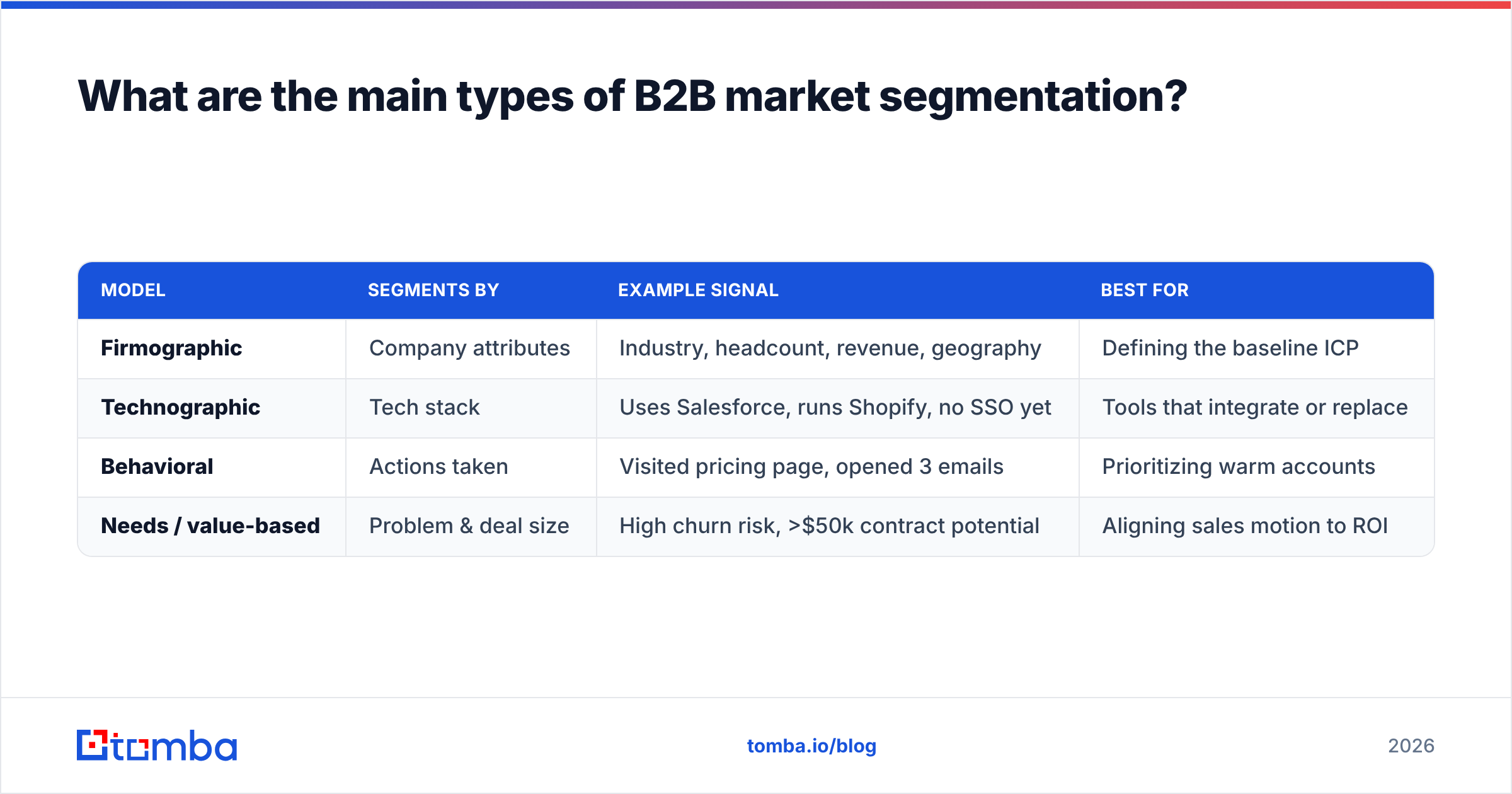
There are four models that earn their keep. You rarely use just one — the strongest ICPs stack two or three filters on top of each other.
| Model | Segments by | Example signal | Best for |
|---|---|---|---|
| Firmographic | Company attributes | Industry, headcount, revenue, geography | Defining the baseline ICP |
| Technographic | Tech stack | Uses Salesforce, runs Shopify, no SSO yet | Tools that integrate or replace |
| Behavioral | Actions taken | Visited pricing page, opened 3 emails | Prioritizing warm accounts |
| Needs / value-based | Problem & deal size | High churn risk, >$50k contract potential | Aligning sales motion to ROI |
Firmographic is the foundation. If you can't name the industry, size band, and region of your best customers, nothing downstream works.
Technographic segmentation is increasingly the differentiator. Knowing a company runs a specific CRM or e-commerce platform tells you whether your product even fits before a rep lifts a finger. Tools like Tomba's website tech checker let you filter accounts by the technology they already run.
Behavioral segmentation layers intent on top — who's actually showing buying signals right now. A marketing qualified lead that hit your pricing page twice this week belongs in a different tier than a cold name from a purchased list.
Needs/value-based segmentation closes the loop by sorting accounts by the size of the problem you solve and the deal that solves it. This is what keeps reps from spending Tier-A effort on Tier-C revenue.
How do you build a B2B segmentation framework? (6 steps)#
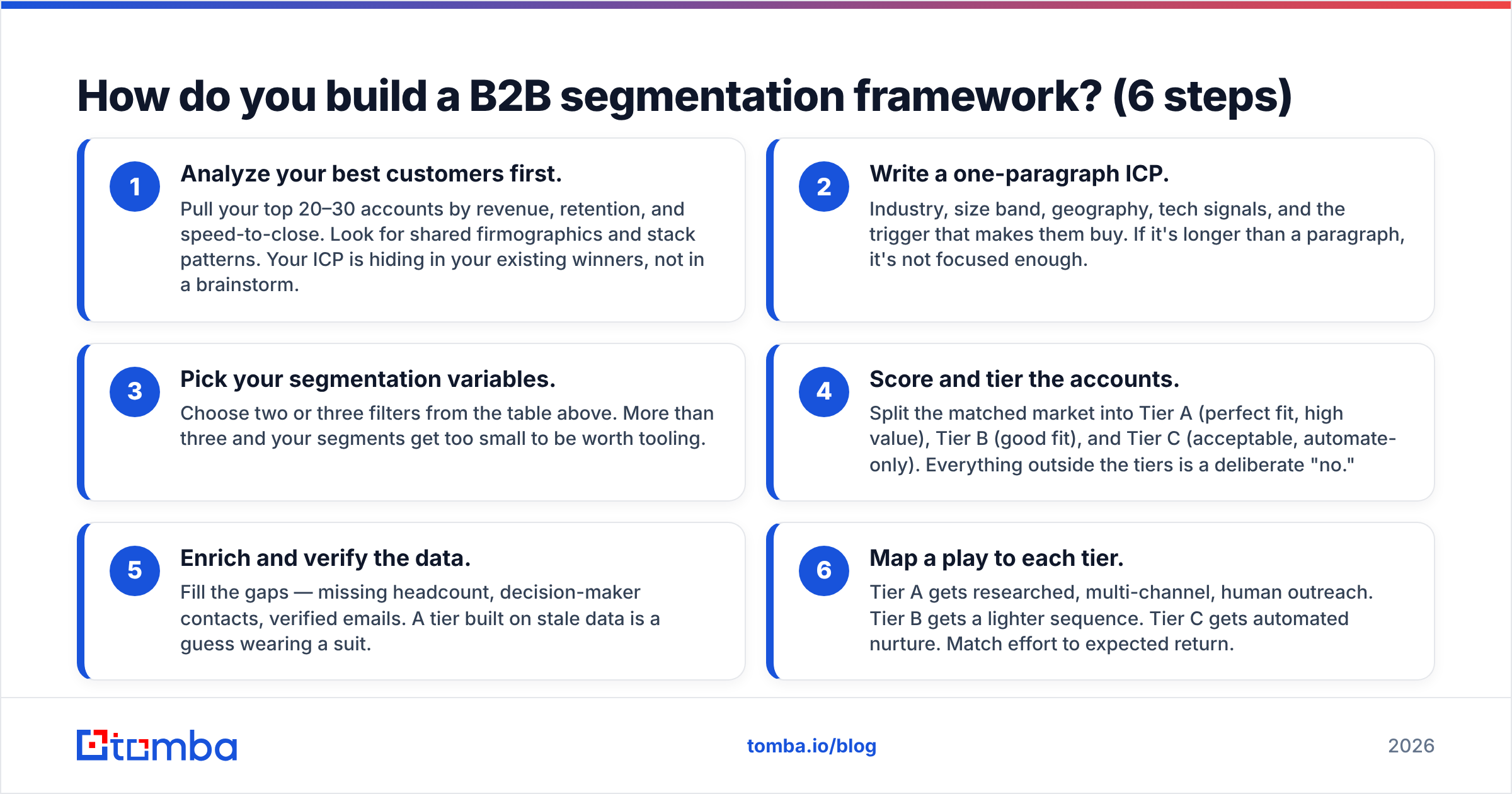
Here's the sequence that turns a flat list into a tiered, actionable market. Run it in order — skipping the ICP step is the most common reason segmentation projects fail.
- Analyze your best customers first. Pull your top 20–30 accounts by revenue, retention, and speed-to-close. Look for shared firmographics and stack patterns. Your ICP is hiding in your existing winners, not in a brainstorm.
- Write a one-paragraph ICP. Industry, size band, geography, tech signals, and the trigger that makes them buy. If it's longer than a paragraph, it's not focused enough.
- Pick your segmentation variables. Choose two or three filters from the table above. More than three and your segments get too small to be worth tooling.
- Score and tier the accounts. Split the matched market into Tier A (perfect fit, high value), Tier B (good fit), and Tier C (acceptable, automate-only). Everything outside the tiers is a deliberate "no."
- Enrich and verify the data. Fill the gaps — missing headcount, decision-maker contacts, verified emails. A tier built on stale data is a guess wearing a suit.
- Map a play to each tier. Tier A gets researched, multi-channel, human outreach. Tier B gets a lighter sequence. Tier C gets automated nurture. Match effort to expected return.
Notice that steps 4 and 5 are where most teams stall — not because the strategy is wrong, but because the underlying account records are incomplete. That's a data problem, and it's the next section.
What data do you need for B2B segmentation?#
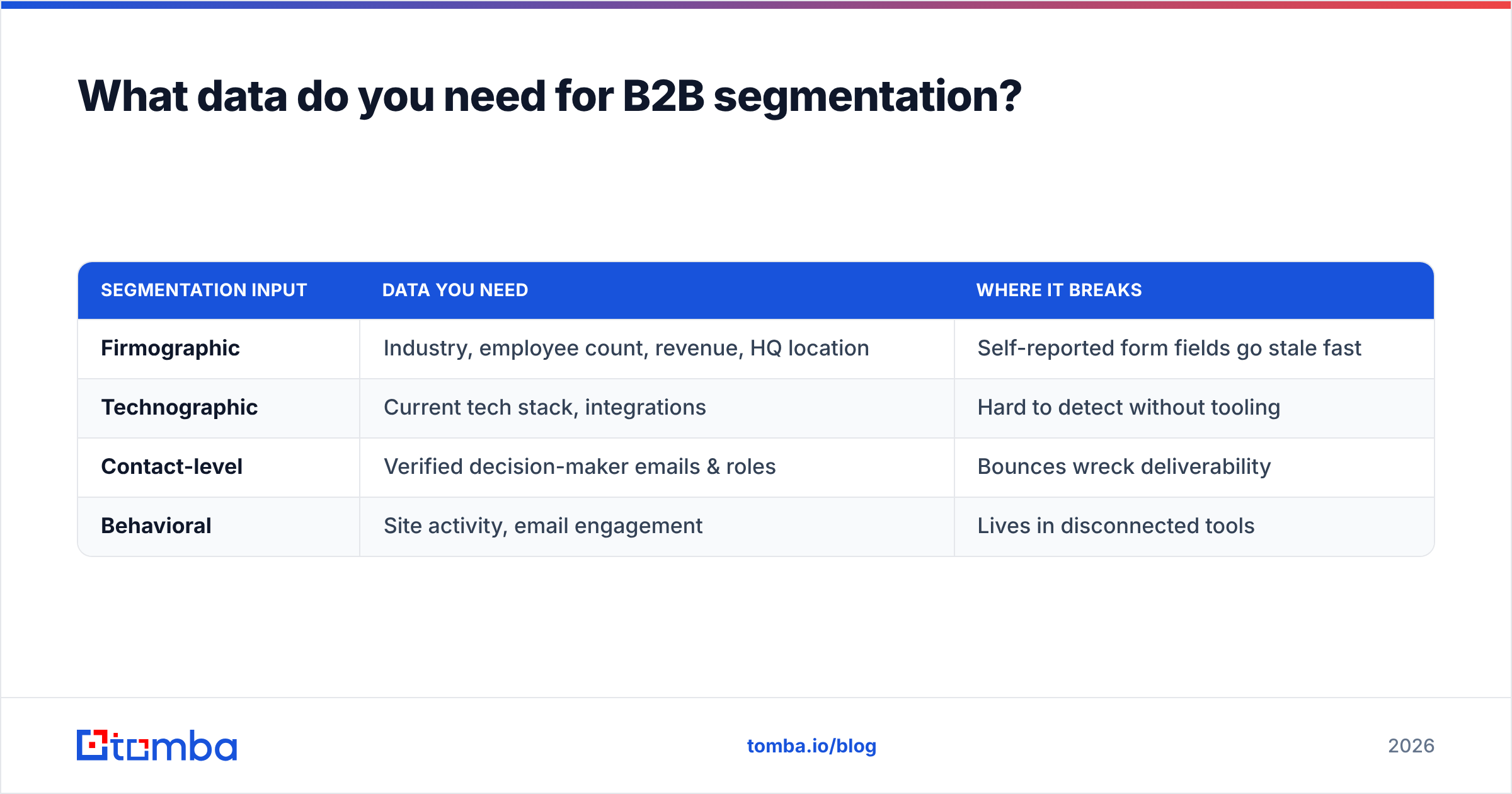
Segmentation is only as good as the records under it. You can design a beautiful three-tier ICP, but if 40% of your accounts are missing firmographic fields or have unverified contacts, every tier is fiction.
Here's the minimum data layer each model needs:
| Segmentation input | Data you need | Where it breaks |
|---|---|---|
| Firmographic | Industry, employee count, revenue, HQ location | Self-reported form fields go stale fast |
| Technographic | Current tech stack, integrations | Hard to detect without tooling |
| Contact-level | Verified decision-maker emails & roles | Bounces wreck deliverability |
| Behavioral | Site activity, email engagement | Lives in disconnected tools |
This is where an enrichment layer earns its place. Pulling company-level data and verified contacts directly into your account records turns a half-empty CRM into a segmentable market. Data enrichment fills the firmographic and contact gaps, while a domain search returns the named buyers inside each target account so your Tier-A list has actual people in it — not just logos.
Verification matters as much as discovery. A segment full of guessed email addresses will tank your sender reputation the moment you start outreach, which quietly poisons every other segment you email from that domain. Verify before you send, every time.
How is segmentation different from an ICP and a buyer persona?#
These three get used interchangeably and shouldn't be. They're layers, not synonyms.
- Segmentation is the act of dividing the whole market into groups. It's the method.
- ICP (Ideal Customer Profile) is the account-level description of your single best-fit segment. It answers "which companies?"
- Buyer persona is the person-level description inside that account. It answers "which humans, and what do they care about?"
A clean workflow runs top-down: segment the market → name the ICP segment → define the personas inside it. HubSpot's framework on the buyer's journey is a useful companion here, because once you know the segment and the persona, you still have to meet them at the right journey stage with the right message.
Get the order wrong — say, writing personas before you've segmented — and you'll produce detailed profiles of buyers in accounts you should never have targeted.
What are common B2B segmentation mistakes?#
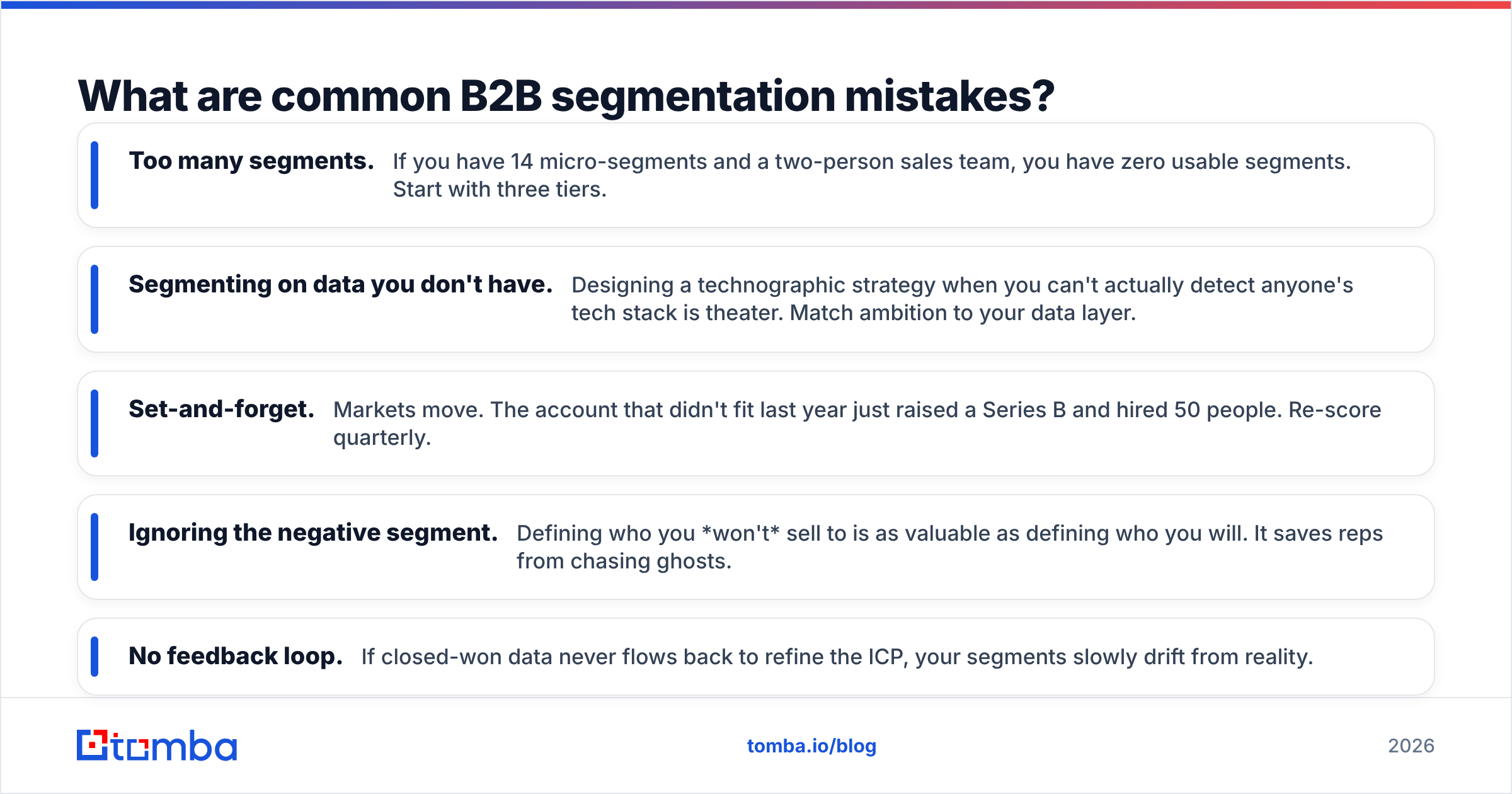
The failure modes are predictable. Avoid these and you're ahead of most teams:
- Too many segments. If you have 14 micro-segments and a two-person sales team, you have zero usable segments. Start with three tiers.
- Segmenting on data you don't have. Designing a technographic strategy when you can't actually detect anyone's tech stack is theater. Match ambition to your data layer.
- Set-and-forget. Markets move. The account that didn't fit last year just raised a Series B and hired 50 people. Re-score quarterly.
- Ignoring the negative segment. Defining who you won't sell to is as valuable as defining who you will. It saves reps from chasing ghosts.
- No feedback loop. If closed-won data never flows back to refine the ICP, your segments slowly drift from reality.
Independent reviews on G2 make the same point repeatedly in sales-intelligence categories: teams rate tools highly when they keep account data fresh, and abandon them when records rot. Segmentation is a maintenance discipline, not a one-time project.
How do you action segments without burning your team out?#
Match the motion to the tier, then automate the bottom. The whole point of segmentation is to spend human attention where it pays back.
A simple operating model:
- Tier A — high-touch. Reps research each account, personalize outreach across email and LinkedIn, and loop in the buying committee. You found these committee members with a domain search and verified them, so the effort lands.
- Tier B — semi-automated. Templated-but-relevant sequences with light personalization. Promote to Tier A when behavioral signals fire.
- Tier C — fully automated. Newsletter and nurture only. Cheap to maintain, occasionally surprises you.
The trick is making Tier A's data effortless to assemble, because that's where reps waste the most time. Pulling verified contacts into your CRM in bulk — rather than hand-researching each one — is what makes a high-touch motion survivable at scale. A bulk workflow that feeds a clean B2B database into your tiers keeps reps selling instead of Googling.
Putting B2B market segmentation to work#
Segmentation isn't a strategy deck — it's a data exercise with a strategy on top. The teams that win in 2026 aren't the ones with the cleverest tier names. They're the ones whose account records are complete and verified enough that their tiers reflect reality, so every play lands on a real buyer at a real company.
Start small. Define one ICP, build three tiers, enrich the gaps, and run one channel until you can prove which segment converts. Then expand from evidence instead of opinion.
If your segments keep collapsing because the contact data underneath them is thin, that's the first thing to fix. Tomba's Email Finder turns a list of target accounts into verified, role-specific contacts you can actually tier and reach — by domain, name, or company. It plugs the gap between "we know which accounts fit" and "we can email the right person there." Free tier gives you 25 searches a month to test it on your Tier-A list; paid Tomba plans start at $49/mo when you're ready to scale the whole segment. Build the tiers, fill them with real people, and let the data do the targeting.
// get started
Find, verify and enrich your first contacts today
Start on the free plan with 25 searches a month, then scale when your team is ready.
Free plan · No credit card required · GDPR & CCPA
// about the author