B2B Marketing in 2026: The Practical Pipeline Playbook
B2B marketing in 2026 rewards teams that pair sharp targeting with clean data. Here is the channel mix, metrics, and stack that actually builds pipeline.
B2B Marketing in 2026: The Practical Pipeline Playbook
B2B marketing has quietly changed jobs. It used to be measured by clicks, impressions, and a pile of "leads" that sales quietly ignored. In 2026, marketing is measured by pipeline and revenue — and that shift changes how you pick channels, write copy, and spend budget. This guide is a working playbook, not a trend list.
TL;DR#
- B2B marketing in 2026 is pipeline-first. Vanity metrics (impressions, raw MQLs) are out; sourced and influenced pipeline are the numbers that survive a budget review.
- Buying groups, not single buyers. The average B2B deal involves 6–10 stakeholders, so your content and targeting have to reach a committee, not a persona.
- Data quality is the silent multiplier. A great campaign on a stale list still fails. Clean, verified contact data is the difference between reaching buyers and bouncing.
- Fewer channels, run deeper. Most teams win by mastering 3–4 channels (email, LinkedIn, SEO, paid retargeting) instead of dabbling in ten.
- AI helps with drafting and routing, not strategy. Use it to scale production and personalization; keep humans on positioning and offers.
What is B2B marketing in 2026?#
B2B marketing is the work of generating demand and pipeline from other businesses — not consumers. The core mechanics (positioning, targeting, channels, measurement) are old, but three forces have reshaped the day-to-day:
- Longer, committee-driven cycles. Gartner has long noted that a typical B2B purchase pulls in six to ten decision-makers. Your job is to arm a buying group, not to convince one champion.
- Self-serve research. Buyers complete most of their evaluation before they ever talk to sales. Your content has to do the selling while you are not in the room.
- Signal over spray. Intent data, website visitor identification, and enrichment let you focus spend on accounts actually in-market — instead of blasting everyone.
The teams that struggle still treat marketing as a lead-volume factory. The teams that win treat it as a pipeline engine where every campaign ties back to a revenue number.
Which B2B marketing channels actually drive pipeline?#
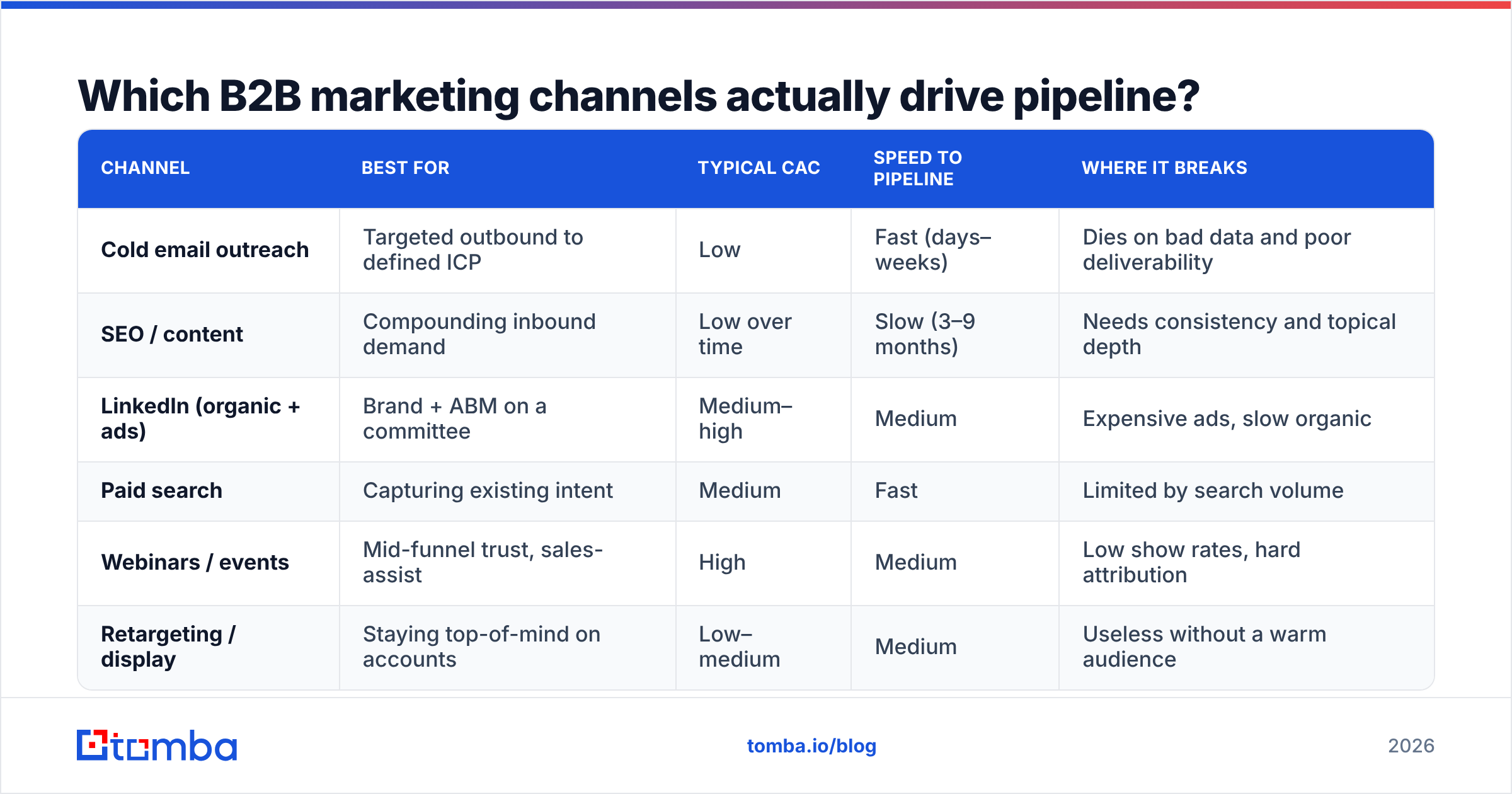
There is no universal "best" channel — there is a best mix for your motion. A product-led SaaS company leans on SEO and self-serve; an enterprise platform leans on ABM and events. The table below maps the major channels to what they realistically deliver.
| Channel | Best for | Typical CAC | Speed to pipeline | Where it breaks |
|---|---|---|---|---|
| Cold email outreach | Targeted outbound to defined ICP | Low | Fast (days–weeks) | Dies on bad data and poor deliverability |
| SEO / content | Compounding inbound demand | Low over time | Slow (3–9 months) | Needs consistency and topical depth |
| LinkedIn (organic + ads) | Brand + ABM on a committee | Medium–high | Medium | Expensive ads, slow organic |
| Paid search | Capturing existing intent | Medium | Fast | Limited by search volume |
| Webinars / events | Mid-funnel trust, sales-assist | High | Medium | Low show rates, hard attribution |
| Retargeting / display | Staying top-of-mind on accounts | Low–medium | Medium | Useless without a warm audience |
The practical move: pick one fast channel (usually cold email or paid search) to fund the quarter, and one compounding channel (SEO or LinkedIn) to fund the year. Run both deeply before adding a third.
Cold outbound deserves special attention because it is the channel most teams execute badly. It is not the channel that is broken — it is the list. When you send to a purchased database full of role-changers and dead inboxes, you torch your domain reputation and blame "cold email." The fix is upstream: build targeted lists from current, verified contacts using an email finder and a email verifier before a single send.
Why does data quality decide B2B marketing outcomes?#
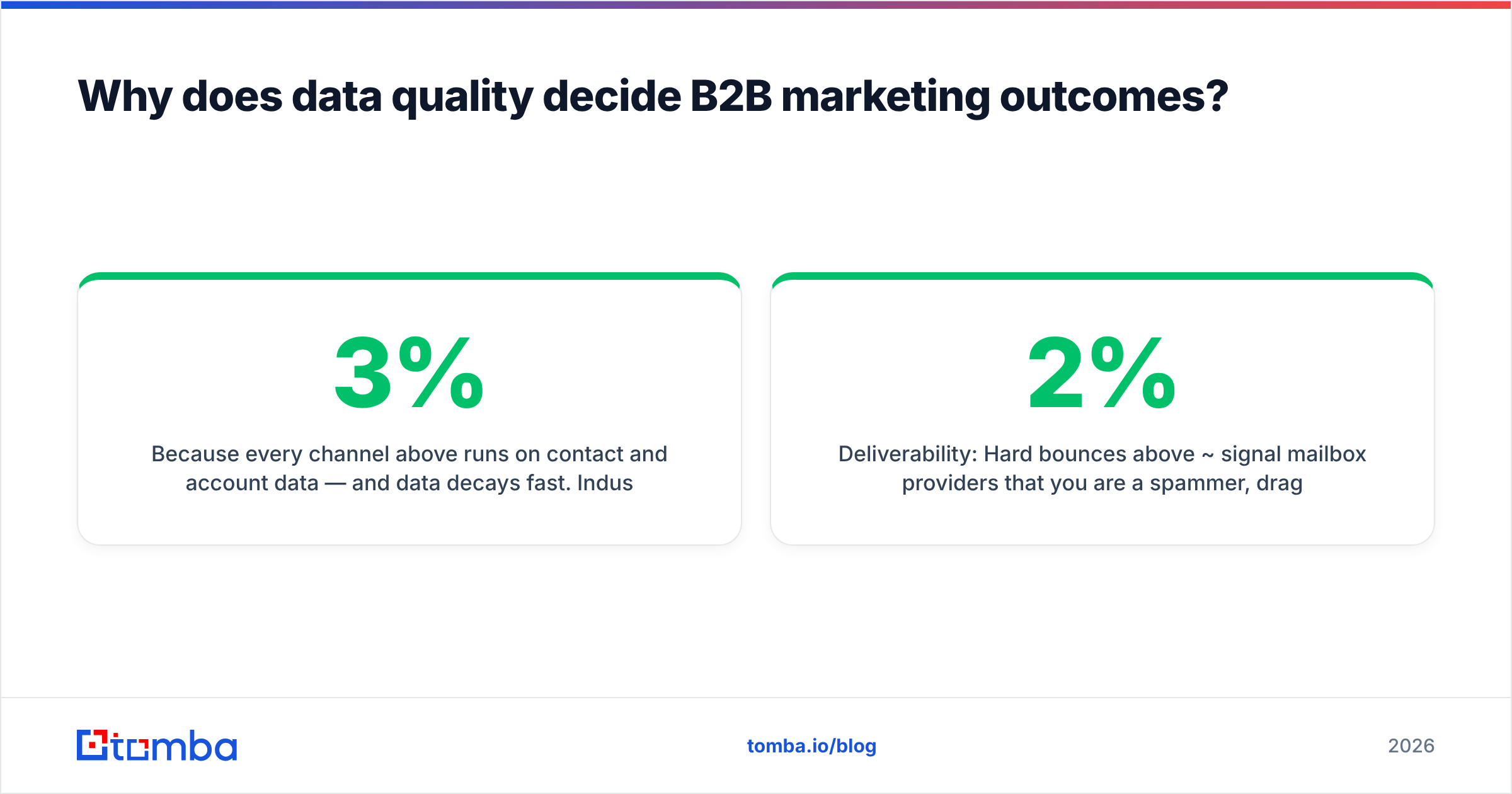
Because every channel above runs on contact and account data — and data decays fast. Industry estimates put B2B data decay at roughly 2–3% per month as people change jobs, companies rebrand, and emails get deprecated. Over a year, a list you bought in January can be 25–30% wrong by December.
Bad data quietly taxes everything:
- Deliverability: Hard bounces above ~2% signal mailbox providers that you are a spammer, dragging down inbox placement for good sends too.
- Wasted spend: Paid audiences and direct mail built on stale records pay to reach ghosts.
- Rep credibility: Sales stops trusting marketing-sourced contacts after the third "this person left two years ago."
- Attribution noise: You cannot measure what you cannot match; dirty records break the join between campaign and CRM.
This is why modern marketing stacks treat data as a pipeline of its own: find, verify, enrich, dedupe, route. A B2B database and ongoing data enrichment keep records current so your CRM reflects reality instead of last year's org chart. Where the data comes from matters too — vet a provider's data sources before you build a year of campaigns on it.
What metrics should B2B marketers report in 2026?#
Report the numbers a CFO recognizes. The hierarchy below moves from "activity" (useful for diagnosis, useless for board decks) to "outcome" (what gets you budget).
- Sourced pipeline — dollar value of opportunities marketing originated. The headline number.
- Influenced pipeline — deals marketing touched but did not source. Shows full contribution.
- Pipeline velocity — how fast opportunities move stage to stage. Speed is revenue.
- CAC payback — months to recover acquisition cost. Keeps growth honest.
- Win rate by source — which channels produce closable deals, not just leads.
- MQL-to-SQL conversion — a quality check on your lead definitions, not a goal in itself.
Notice what is missing: impressions, raw click counts, and undifferentiated MQL totals. Those are diagnostic, not directional. A campaign can triple MQLs and shrink pipeline if the new leads are junk — which is exactly what happens when targeting loosens to hit a volume goal.
How should you split a B2B marketing budget?#
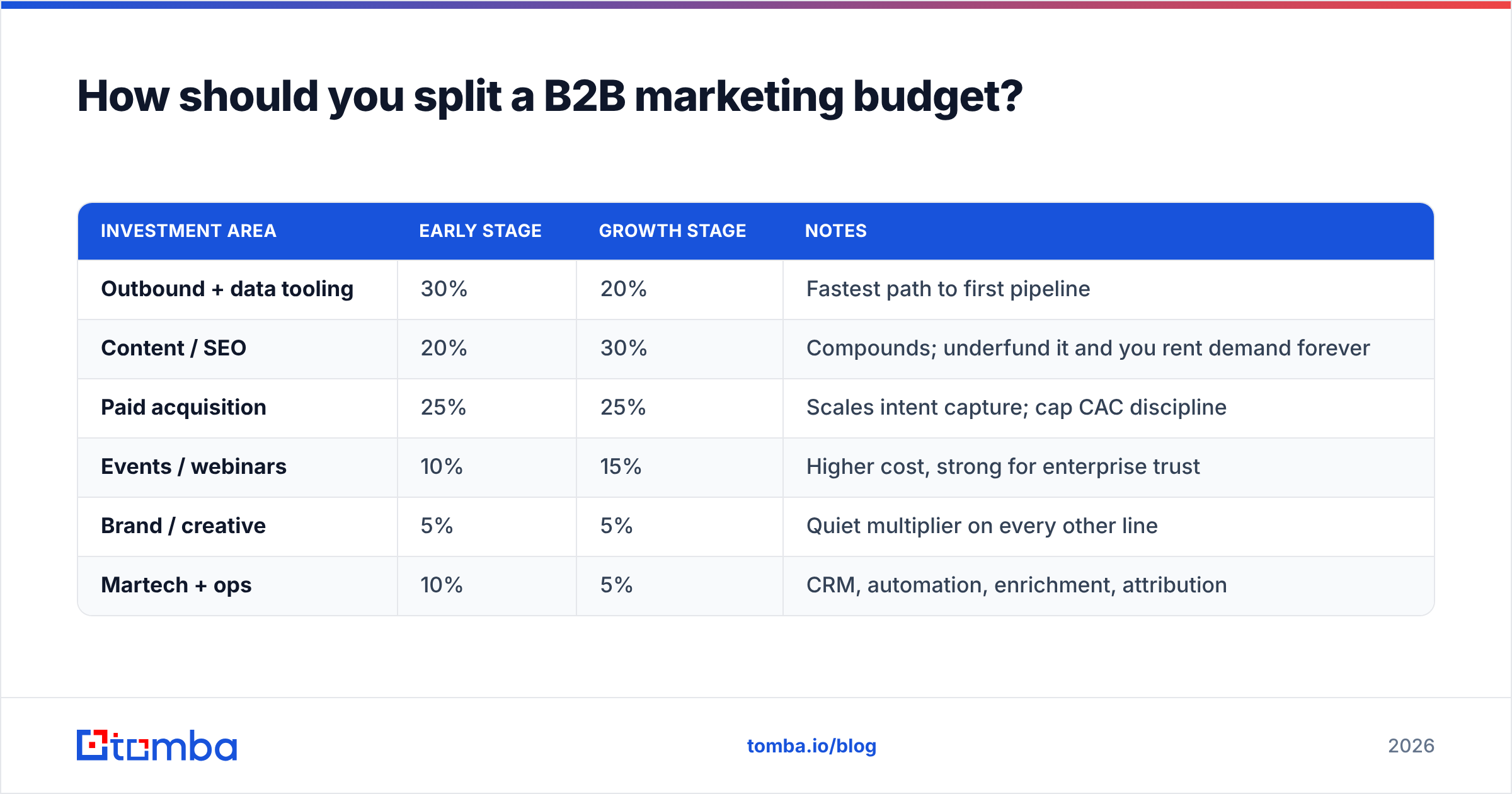
Budgets are bets, and the right split depends on your stage. The breakdown below is a defensible starting point for a growth-stage B2B company, then adjust based on what your own win-rate-by-source data tells you.
| Investment area | Early stage | Growth stage | Notes |
|---|---|---|---|
| Outbound + data tooling | 30% | 20% | Fastest path to first pipeline |
| Content / SEO | 20% | 30% | Compounds; underfund it and you rent demand forever |
| Paid acquisition | 25% | 25% | Scales intent capture; cap CAC discipline |
| Events / webinars | 10% | 15% | Higher cost, strong for enterprise trust |
| Brand / creative | 5% | 5% | Quiet multiplier on every other line |
| Martech + ops | 10% | 5% | CRM, automation, enrichment, attribution |
Two rules keep this honest. First, tooling is not overhead — the data and automation lines make every other dollar more efficient, so treat them as leverage, not cost. Second, rebalance quarterly against outcomes; a channel that sourced pipeline last quarter may be saturating this one.
Is AI changing B2B marketing strategy or just execution?#
Mostly execution — and that is still a big deal. In 2026, AI reliably accelerates the production layer: drafting variants, summarizing call transcripts, scoring and routing leads, personalizing email at scale, and generating first-pass creative. Tools like a cold email AI writer or subject-line testers cut hours off campaign builds.
Where AI does not replace you: positioning, offer design, pricing narrative, and channel strategy. Those require judgment about your specific market that a model cannot infer from a prompt. The failure mode of 2026 is teams that automate mediocre strategy and simply produce bad content faster.
The pragmatic split:
- Let AI draft, you direct. Generate ten subject lines, pick the one that fits your buyer's actual pain.
- Let AI personalize, you verify the data. Personalization on wrong data is worse than no personalization. Garbage in, confidently-wrong out.
- Let AI route, you set the rules. Lead scoring is great when the scoring logic reflects real win patterns.
For a broader vendor landscape, neutral review sites like G2 and resources such as HubSpot's marketing statistics are useful sanity checks before you commit budget to a new platform.
What does a modern B2B marketing stack look like?#
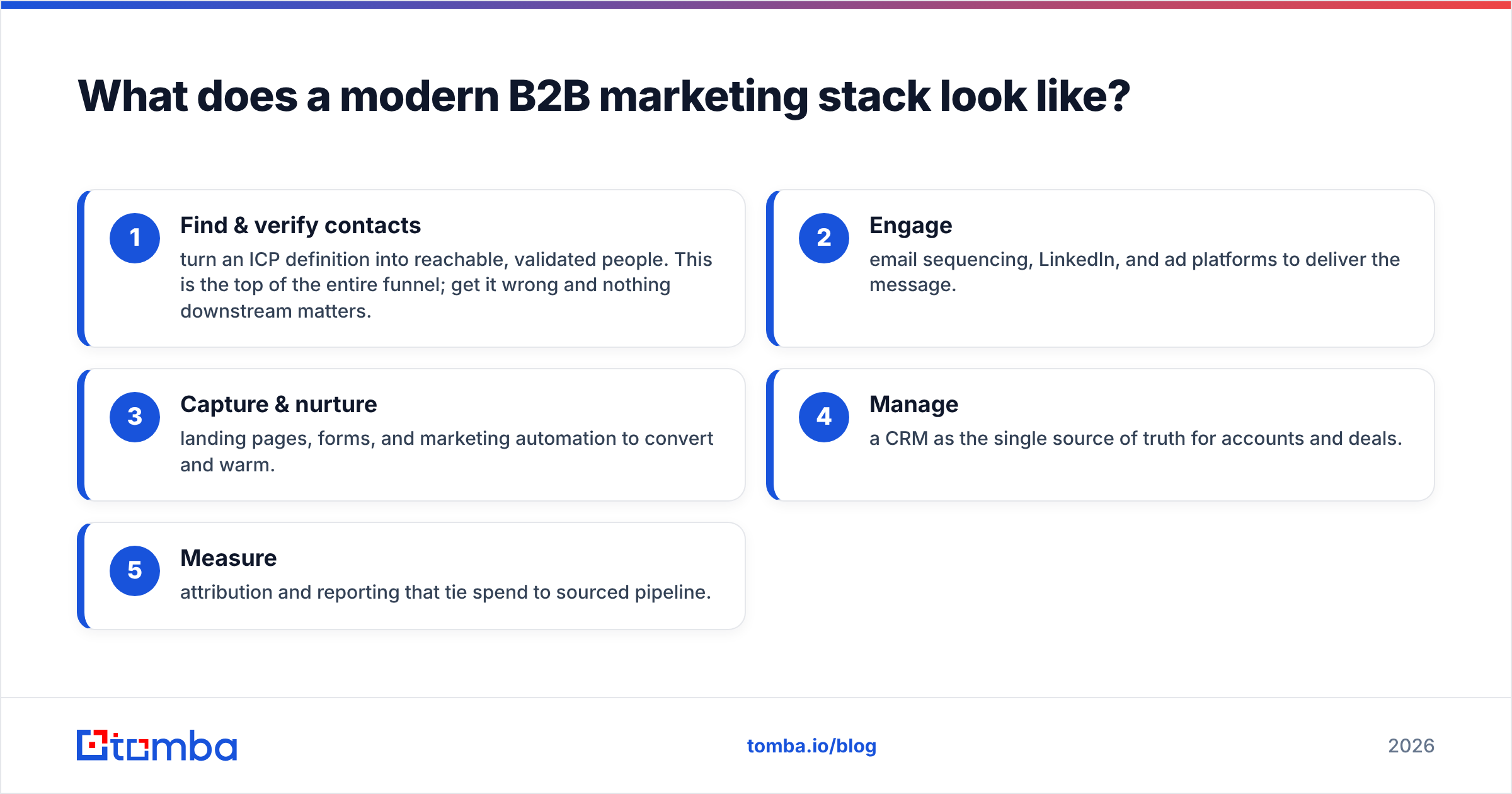
You do not need forty tools. You need coverage across five jobs, with as little overlap as possible:
- Find & verify contacts — turn an ICP definition into reachable, validated people. This is the top of the entire funnel; get it wrong and nothing downstream matters.
- Engage — email sequencing, LinkedIn, and ad platforms to deliver the message.
- Capture & nurture — landing pages, forms, and marketing automation to convert and warm.
- Manage — a CRM as the single source of truth for accounts and deals.
- Measure — attribution and reporting that tie spend to sourced pipeline.
Most teams over-invest in jobs 2–4 and starve job 1, then wonder why response rates are flat. The cheapest performance gain available to most B2B marketers is not a new ad creative — it is feeding the existing machine accurate data. Compared to platform license costs, contact data tooling is inexpensive; you can see real Tomba pricing starting with a free tier at 25 searches per month and a Starter plan at $49/mo, which is a rounding error against a single wasted paid-media week.
How do you put this into a 90-day plan?#
Strategy without sequencing is a wish list. Here is a concrete first quarter:
- Days 1–15 — Define and clean. Lock your ICP, then build a verified target list. Use domain search to map companies to real contacts and verify before import.
- Days 16–45 — Launch two channels. One fast (cold email to the verified list), one compounding (publish two cornerstone SEO pieces). Instrument both to CRM.
- Days 46–75 — Personalize and retarget. Layer enrichment onto engaged accounts, add LinkedIn retargeting on warm visitors, and tune messaging by win-rate-by-source.
- Days 76–90 — Report pipeline, not activity. Present sourced and influenced pipeline to leadership, kill the weakest channel, and double down on the winner.
Run that loop, then repeat it with sharper data each quarter. The compounding comes from the discipline, not from any single clever tactic.
The bottom line#
B2B marketing in 2026 rewards teams that combine sharp targeting, a focused channel mix, and ruthlessly clean data — measured against pipeline instead of vanity metrics. The strategy is not exotic; the execution discipline is what separates teams that build predictable pipeline from teams that report busy.
If your funnel is starving at the top, fix the data first. Start with the Tomba Email Finder to turn your ICP into a verified, reachable list — then let your channels do their job on contacts that actually exist. Spin up the free tier, find your first 25 prospects today, and feel the difference accurate data makes on day-one response rates.
// get started
Find, verify and enrich your first contacts today
Start on the free plan with 25 searches a month, then scale when your team is ready.
Free plan · No credit card required · GDPR & CCPA
// about the author