B2B Marketing and Sales Alignment: The 2026 RevOps Guide
Misaligned sales and marketing teams quietly burn 10% of revenue a year. Here's the 2026 playbook for SLAs, shared data, and a single pipeline both teams own.
Sales says marketing's leads are garbage. Marketing says sales never follows up. Both are partly right, and the gap between them is where revenue quietly leaks. B2B marketing and sales alignment is the discipline of closing that gap on purpose instead of hoping two departments figure it out over Slack.
This guide is the practical version: what alignment actually means, the structures that hold it together, the metrics that prove it, and the data layer most teams forget until their pipeline stalls.
TL;DR#
- Misalignment is expensive. Disconnected sales and marketing teams routinely lose around 10% of annual revenue to wasted spend, ignored leads, and slow follow-up.
- Alignment is structural, not cultural. A shared lead definition, a written SLA, and one source of pipeline truth beat any number of "let's collaborate more" meetings.
- Data quality is the hidden lever. Most "bad leads" are really bad records — wrong email, missing role, stale company data. Clean contact data fixes more fights than any process change.
- Measure the handoff, not the departments. Track MQL-to-SQL conversion, lead response time, and pipeline contribution by source, jointly owned.
- Start small. One agreed definition of a qualified lead, one weekly pipeline review, one feedback loop. Expand from there.
What is B2B marketing and sales alignment?#
B2B marketing and sales alignment is the state where both teams share goals, definitions, data, and accountability for the same revenue number — instead of optimizing for separate metrics that quietly work against each other.
Think of it like a relay race. Marketing runs the first leg and sales runs the second, but the race is won or lost in the handoff. A blazing-fast first runner means nothing if the baton hits the ground. Most "sales vs. marketing" conflict is really a dropped baton: a lead that was handed off with no context, no agreed criteria, and no clock running on the follow-up.
Technically, alignment shows up in three places:
- Shared definitions — everyone agrees what a marketing qualified lead is versus a sales-accepted one.
- Shared data — both teams look at the same records in the same CRM, enriched to the same standard.
- Shared accountability — pipeline and revenue are joint metrics, not "marketing's number" and "sales' number."
When those three line up, the relay works. When they don't, you get finger-pointing dressed up as strategy.

Wait — that image is the meme. Let me keep going.

Why does misalignment cost so much?#
Misalignment is expensive because it compounds at every stage of the funnel. A small definitional disagreement at the top becomes a six-figure problem at the bottom.
Here's where the money goes:
- Wasted marketing spend. If sales ignores 50% of leads marketing generates, half the demand-gen budget is theoretical.
- Slow lead response. Research on lead response consistently shows that contacting a lead within five minutes beats contacting them an hour later by an order of magnitude. Misaligned teams measure response time in days.
- Pipeline blind spots. When marketing reports MQLs and sales reports closed deals with no shared layer between, nobody can see where deals die.
- Forecasting noise. Two teams with two definitions of "qualified" produce two forecasts that never reconcile.
The number most often cited — roughly 10% of revenue lost to poor coordination — is conservative once you add the opportunity cost of reps chasing the wrong accounts. The fix isn't more enthusiasm. It's a structure that makes the right behavior the default.
What does an aligned funnel actually look like?#
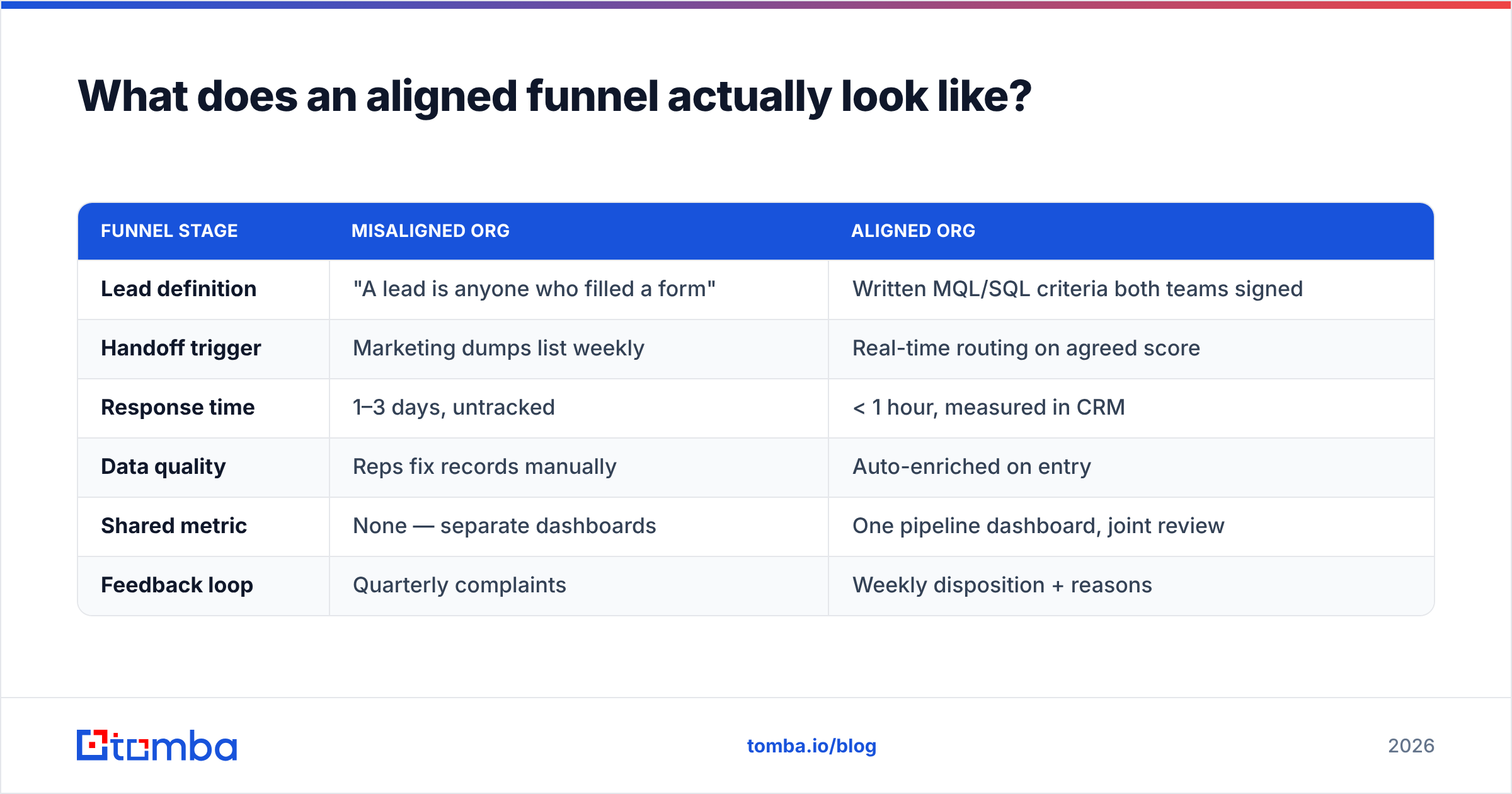
An aligned funnel replaces vague handoffs with explicit stages, owners, and exit criteria. Below is a comparison of how the same funnel behaves with and without alignment.
| Funnel stage | Misaligned org | Aligned org |
|---|---|---|
| Lead definition | "A lead is anyone who filled a form" | Written MQL/SQL criteria both teams signed |
| Handoff trigger | Marketing dumps list weekly | Real-time routing on agreed score |
| Response time | 1–3 days, untracked | < 1 hour, measured in CRM |
| Data quality | Reps fix records manually | Auto-enriched on entry |
| Shared metric | None — separate dashboards | One pipeline dashboard, joint review |
| Feedback loop | Quarterly complaints | Weekly disposition + reasons |
The right-hand column isn't aspirational — it's a checklist. Each row is a thing you can implement this quarter. The first one to fix is almost always the lead definition, because everything downstream inherits its ambiguity.
How do you build a sales and marketing SLA?#
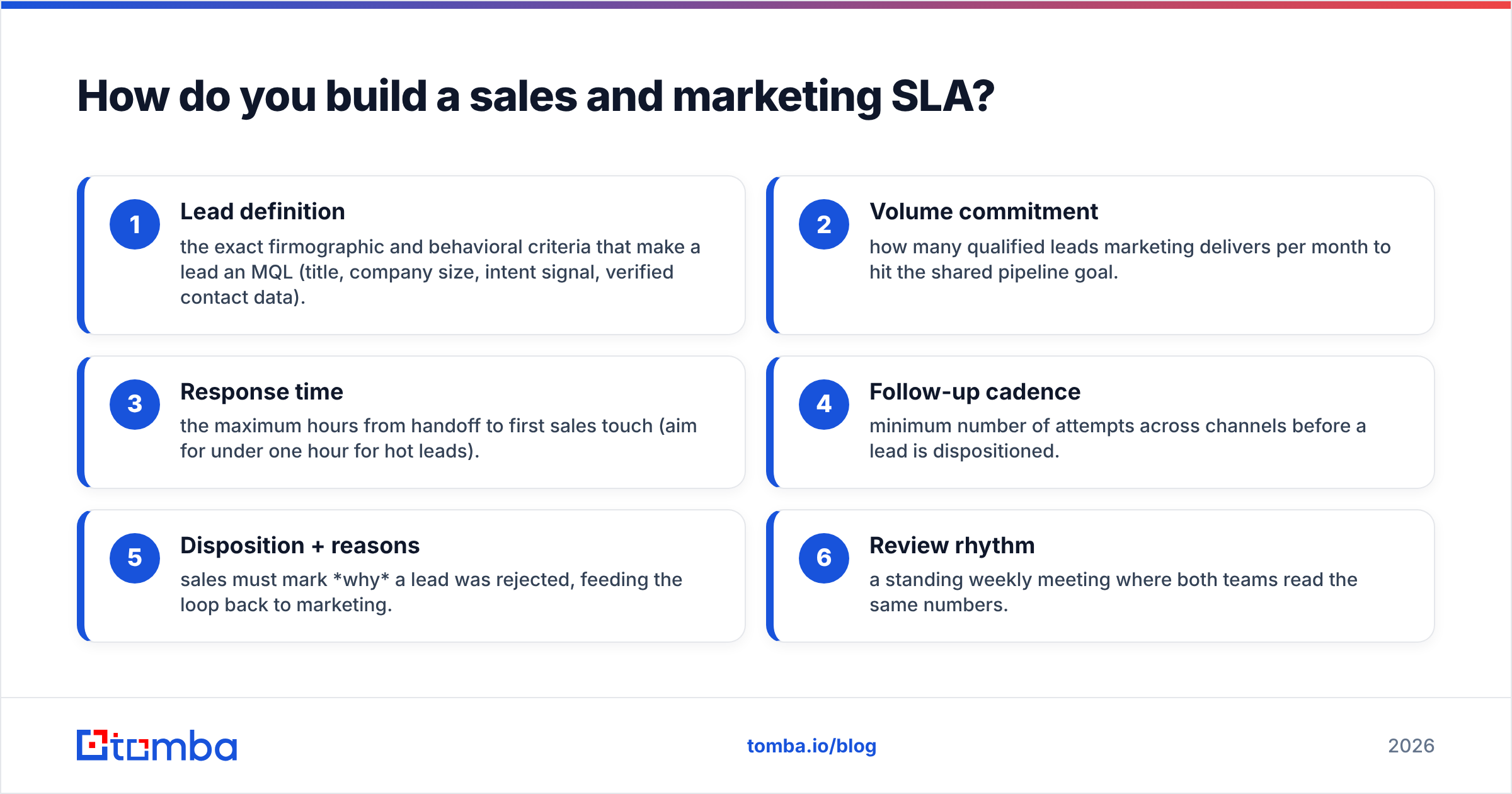
A service-level agreement (SLA) is the single most effective alignment tool because it turns opinions into commitments. It's a two-way contract: marketing promises a volume and quality of leads, sales promises a response time and follow-up cadence.
A workable B2B SLA has six components:
- Lead definition — the exact firmographic and behavioral criteria that make a lead an MQL (title, company size, intent signal, verified contact data).
- Volume commitment — how many qualified leads marketing delivers per month to hit the shared pipeline goal.
- Response time — the maximum hours from handoff to first sales touch (aim for under one hour for hot leads).
- Follow-up cadence — minimum number of attempts across channels before a lead is dispositioned.
- Disposition + reasons — sales must mark why a lead was rejected, feeding the loop back to marketing.
- Review rhythm — a standing weekly meeting where both teams read the same numbers.
The disposition step (#5) is the one teams skip and the one that matters most. Without it, marketing never learns which leads convert and keeps optimizing for volume. With it, "your leads are bad" becomes "leads from this campaign convert at 3%, let's cut it" — a fixable, factual statement.
Why is data quality the hidden half of alignment?#
Most "bad lead" arguments are actually data arguments. The lead might be perfect; the record is broken. Alignment processes assume the contact data is correct, and it usually isn't.
Consider what a sales rep sees when a "qualified" lead lands in the CRM: a name, maybe a job title, and an email that bounces. They burn a slot trying to reach a person whose address was scraped wrong or whose role changed eight months ago. To the rep, that's marketing's fault. To marketing, the rep "didn't try." Neither is the real problem — the data is.
This is why a clean, enriched data layer sits underneath every alignment program that actually works. Before a lead is routed, its email should be verified, its company and role enriched, and duplicates removed. A few ways teams operationalize that:
- Verify before routing. Run new leads through an email verifier so reps never waste a touch on a dead address.
- Enrich on entry. Use data enrichment to fill missing title, company size, and seniority so scoring is accurate.
- Find the right contact, not just any contact. When a form fills with a generic inbox, an email finder gets you the decision-maker's direct address.
- De-duplicate ruthlessly. Two records for one person split the activity history and break attribution.

When the data is trustworthy, the SLA arguments mostly evaporate, because both teams are finally looking at reality instead of at a corrupted copy of it.
Which metrics keep both teams honest?#
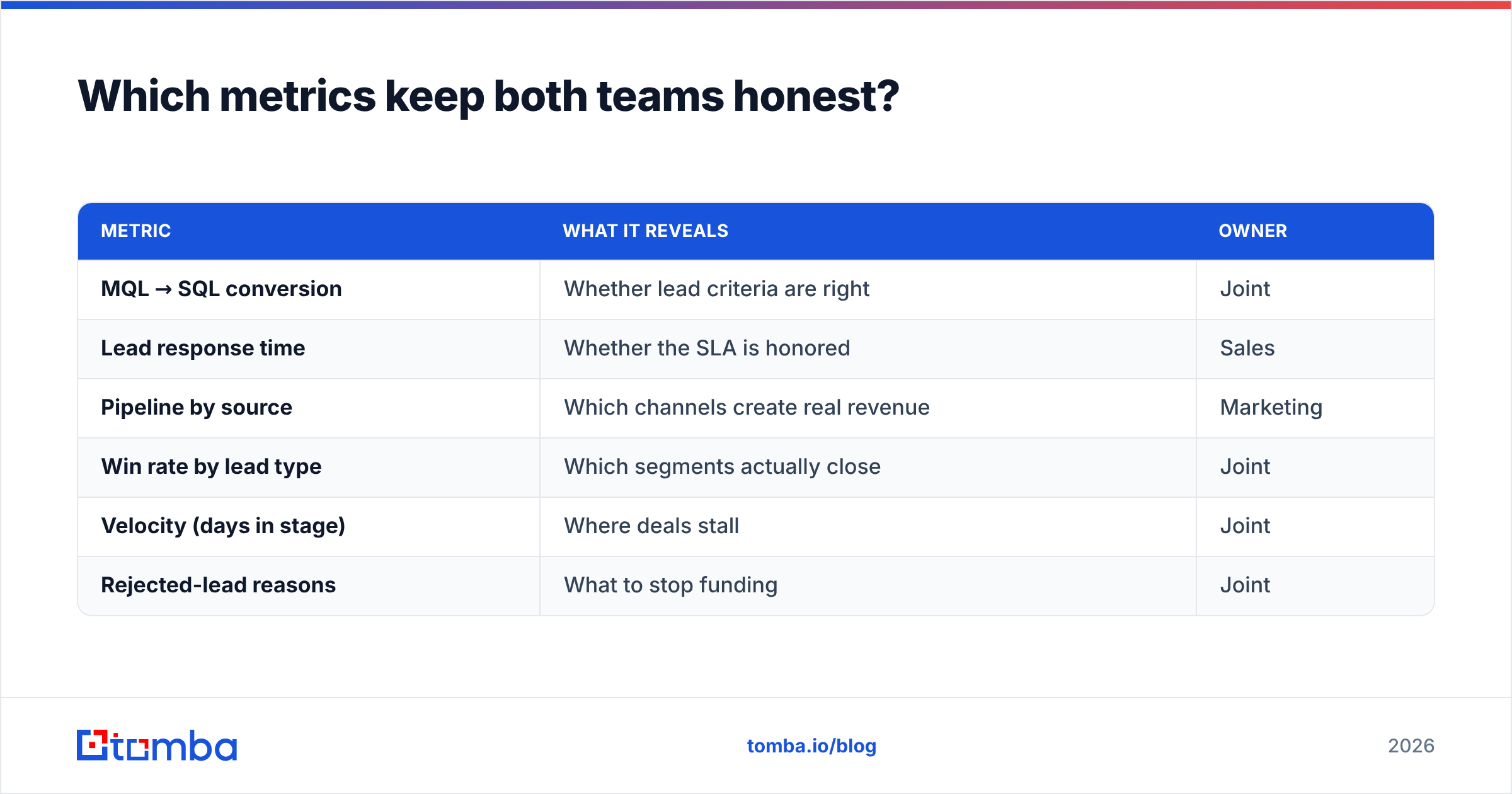
Aligned teams measure the handoff and the outcome jointly, not their own departments in isolation. If marketing only watches MQLs and sales only watches closed-won, the middle of the funnel is invisible — and the middle is where alignment lives or dies.
The core shared scorecard:
| Metric | What it reveals | Owner |
|---|---|---|
| MQL → SQL conversion | Whether lead criteria are right | Joint |
| Lead response time | Whether the SLA is honored | Sales |
| Pipeline by source | Which channels create real revenue | Marketing |
| Win rate by lead type | Which segments actually close | Joint |
| Velocity (days in stage) | Where deals stall | Joint |
| Rejected-lead reasons | What to stop funding | Joint |
Notice how many rows are jointly owned. That's deliberate. A metric with two owners forces a conversation; a metric with one owner becomes a place to hide. Pull these into one dashboard, review them weekly, and the meeting stops being a blame session and starts being a tuning session. For the conversion definitions themselves, a shared B2B glossary keeps everyone using the same vocabulary.
How do you actually roll this out?#
Start with one definition, one SLA, and one dashboard — then expand. Trying to fix everything at once produces a 40-page RevOps document that nobody reads. A staged rollout sticks.
A realistic 90-day sequence:
- Weeks 1–2: Get both leaders in a room and write a single MQL definition. Argue it out now so you don't argue it forever.
- Weeks 3–4: Draft the SLA — volume, response time, cadence, disposition. Keep it to one page.
- Weeks 5–6: Fix the data layer. Verify, enrich, and de-dupe the existing lead pool before routing anything new.
- Weeks 7–8: Stand up one shared pipeline dashboard. Kill the separate dashboards.
- Weeks 9–12: Run the weekly joint review. Use disposition data to cut the worst-performing source and double the best.
Tooling helps but doesn't replace the agreement. Marketing automation platforms like HubSpot and CRMs like Salesforce give you the routing and dashboards; review sites like G2 help you benchmark. But the SLA is a human contract, and the data quality underneath it is what makes the contract enforceable.
What tends to break alignment again?#
Even aligned teams drift. The usual culprits are predictable, which means you can guard against them.
- Leadership changes. A new VP brings new definitions. Re-ratify the SLA on any leadership change.
- Data decay. Contact data goes stale at roughly 25–30% per year. Without ongoing enrichment, your clean layer rots within months. Schedule re-verification.
- Metric drift. Teams quietly revert to their favorite siloed numbers. Keep the joint dashboard as the only dashboard.
- Skipping disposition. The moment reps stop logging why leads fail, the feedback loop dies and the "bad leads" fight returns.
Alignment is a maintained state, not a finished project. Treat it like deliverability or sender reputation — something you monitor continuously, not a box you check once.
Get the data layer right first#
Process fixes alignment on paper; clean data fixes it in practice. Before you write another SLA clause, make sure the contacts flowing between your teams are real, verified, and enriched — because no amount of agreement survives a CRM full of bounced emails and wrong titles.
That's where Tomba's Email Finder fits a RevOps stack: it gives marketing and sales the same verified, enriched contact records so the handoff is built on data both teams trust. Pair it with the email verifier and data enrichment, start on the free tier (25 searches/month), and scale into a paid plan as your shared pipeline grows — see Tomba pricing for the Starter ($49/mo), Growth ($99/mo), and Pro ($249/mo) tiers. Fix the data, and the alignment conversation finally gets to be about strategy instead of blame.
Ready to find emails that actually work?
Join 150,000+ professionals who stopped guessing and started sending. Free credits on signup — no credit card required.
Get the Tomba newsletter
Practical outbound tactics and product updates — once every two weeks.
About the author