B2B Marketing Automation in 2026: A Practical Playbook
A no-fluff guide to B2B marketing automation in 2026: what it is, which workflows actually move pipeline, platform comparisons, and the data layer that makes it all work.
TL;DR
- B2B marketing automation is software that runs repetitive marketing tasks — lead capture, scoring, nurture emails, routing — on rules and triggers instead of manual effort.
- The platform matters less than the data feeding it. Garbage contacts produce garbage automation, no matter how slick the workflow builder is.
- The highest-ROI workflows in 2026 are trigger-based (behavior, intent, lifecycle) — not the old time-based "drip every 3 days" sequences.
- HubSpot, Marketo, ActiveCampaign, and Customer.io cover most B2B use cases; pick by team size, budget, and CRM alignment.
- Clean, enriched contact data is the prerequisite. Tools like a dedicated email verifier and data enrichment keep your automation firing at real people.
What is B2B marketing automation?#
B2B marketing automation is the use of software to execute marketing actions automatically based on rules, schedules, and buyer behavior. Think of it like a thermostat for your funnel: you set the conditions ("when a lead downloads the pricing PDF, notify sales and start the demo nurture"), and the system reacts the moment those conditions are met — without anyone clicking send.
Technically, it's a layer that sits between your data sources (forms, CRM, product, ads) and your communication channels (email, SMS, in-app, ad audiences). It listens for events, evaluates them against your logic, and triggers the right next step.
The "B2B" qualifier matters. Consumer automation optimizes for volume and instant purchase. B2B automation optimizes for long, multi-stakeholder buying cycles — where a deal involves 6 to 10 people, takes months, and lives or dies on whether the right person got the right message at the right moment. That changes everything about how you design workflows.
Why does B2B marketing automation matter in 2026?#
Because buyers now self-educate before they ever talk to you. By the time a prospect raises a hand, they've consumed your content, compared you to competitors, and formed an opinion. Automation is how you stay present and helpful across that invisible research phase without hiring an army of SDRs.
Three forces make it non-negotiable this year:
- Buying committees got bigger. You're not nurturing one lead — you're nurturing an account. Automation lets you orchestrate touches across multiple contacts at the same company.
- Manual follow-up doesn't scale. A rep can personally chase maybe 50 leads. Automation handles 5,000 while flagging the 50 that are genuinely sales-ready.
- AI made personalization cheap. Generating relevant variants per segment used to be a copywriting bottleneck. In 2026 it's a prompt, which means the constraint shifted back to data quality and targeting — exactly where most teams are weakest.
What does a B2B marketing automation workflow look like?#
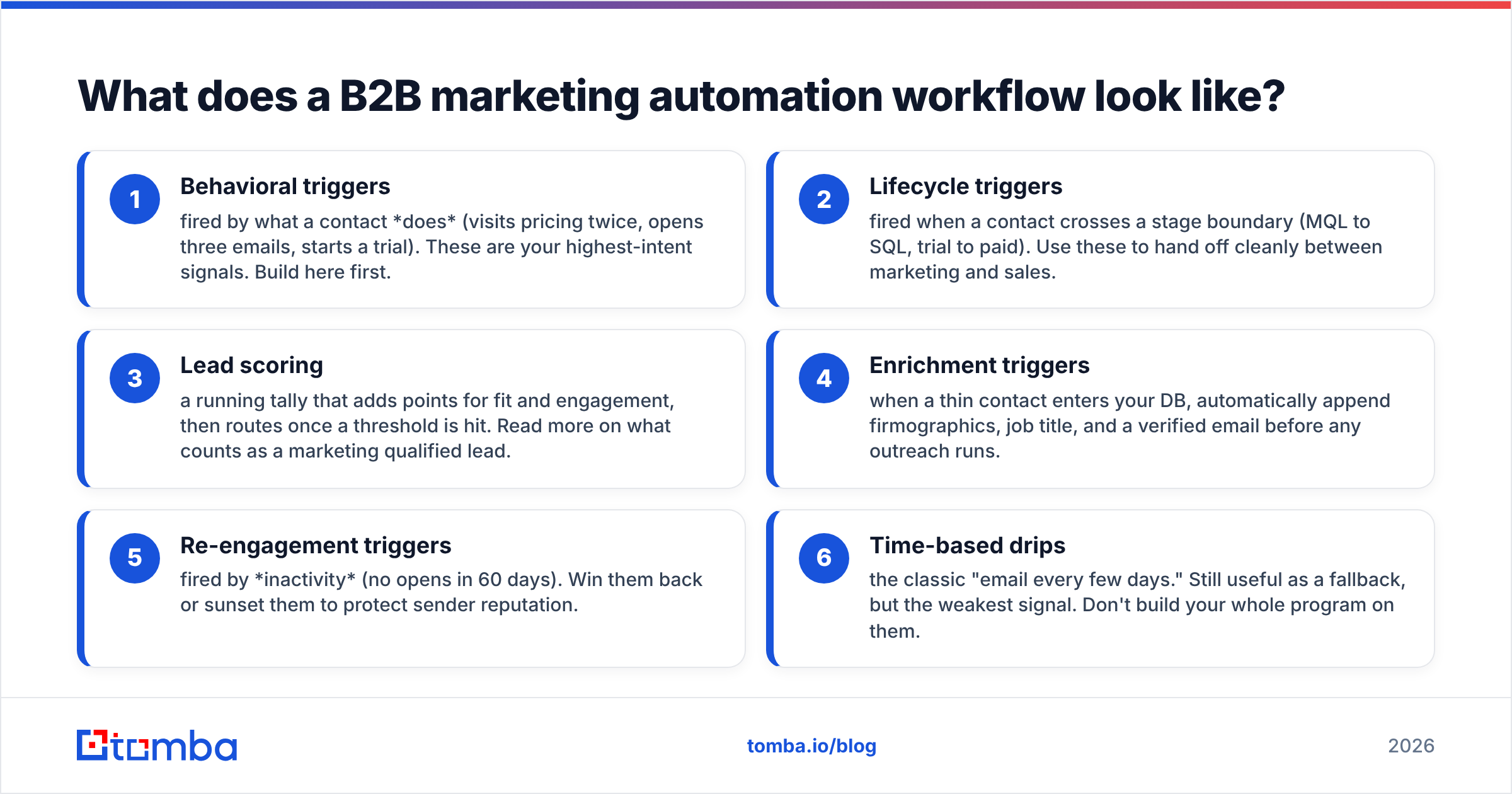
Every useful workflow has the same three parts: a trigger, a condition, and an action. The art is in choosing triggers that signal real intent rather than noise.
Here are the core building blocks, ranked by how much pipeline they tend to produce:
- Behavioral triggers — fired by what a contact does (visits pricing twice, opens three emails, starts a trial). These are your highest-intent signals. Build here first.
- Lifecycle triggers — fired when a contact crosses a stage boundary (MQL to SQL, trial to paid). Use these to hand off cleanly between marketing and sales.
- Lead scoring — a running tally that adds points for fit and engagement, then routes once a threshold is hit. Read more on what counts as a marketing qualified lead.
- Enrichment triggers — when a thin contact enters your DB, automatically append firmographics, job title, and a verified email before any outreach runs.
- Re-engagement triggers — fired by inactivity (no opens in 60 days). Win them back or sunset them to protect sender reputation.
- Time-based drips — the classic "email every few days." Still useful as a fallback, but the weakest signal. Don't build your whole program on them.
The mistake most teams make: they start with #6 because it's easy, then wonder why response rates are flat. Start at the top of this list and work down.
Which B2B marketing automation platform should you choose?#
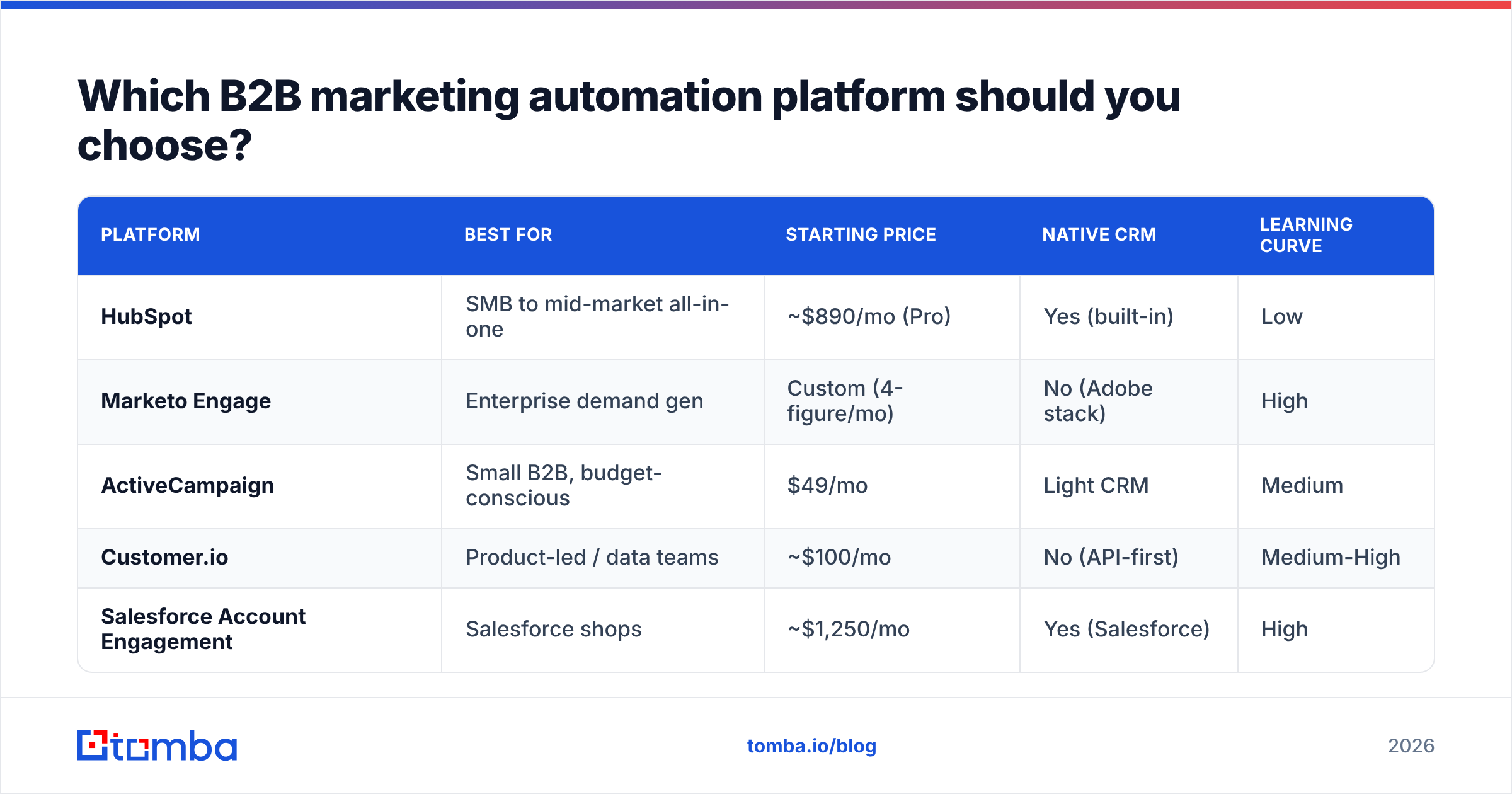
There's no universal winner — the right tool depends on your team size, technical depth, and how tightly you need it to fuse with your CRM. Here's an honest side-by-side of the platforms most B2B teams shortlist in 2026.
| Platform | Best for | Starting price | Native CRM | Learning curve |
|---|---|---|---|---|
| HubSpot | SMB to mid-market all-in-one | ~$890/mo (Pro) | Yes (built-in) | Low |
| Marketo Engage | Enterprise demand gen | Custom (4-figure/mo) | No (Adobe stack) | High |
| ActiveCampaign | Small B2B, budget-conscious | $49/mo | Light CRM | Medium |
| Customer.io | Product-led / data teams | ~$100/mo | No (API-first) | Medium-High |
| Salesforce Account Engagement | Salesforce shops | ~$1,250/mo | Yes (Salesforce) | High |
A few decision rules:
- If you're under 20 people, ActiveCampaign or HubSpot Starter give you 90% of the value at a fraction of the enterprise cost.
- If you live in Salesforce, Account Engagement (formerly Pardot) avoids painful sync issues — see the Salesforce integration patterns for keeping enriched data flowing in.
- If you're product-led, Customer.io's event-based model maps cleanly to product usage triggers.
- If you want one tool for marketing and sales, HubSpot's unified database is hard to beat. Compare against the official HubSpot platform and read independent reviews on G2 before committing.
Whatever you pick, remember: the platform is the engine, not the fuel.
How do you keep automation from breaking? (The data problem)#
Your automation is only as good as the contact data underneath it. This is the part vendors gloss over and the part that quietly kills most programs.
Here's what goes wrong when data is dirty:
- Bounces tank your sender reputation. Send to invalid addresses and mailbox providers start routing your good emails to spam. One bad list can poison months of deliverability.
- Bad routing sends hot leads to the wrong rep because the job title field was empty or wrong.
- Personalization tokens render as
{{firstName}}in front of a prospect — instant credibility loss. - Scoring lies because you're scoring engagement from spam traps and role accounts, not humans.
The fix is a data hygiene layer that runs before automation, not after the damage. At minimum:
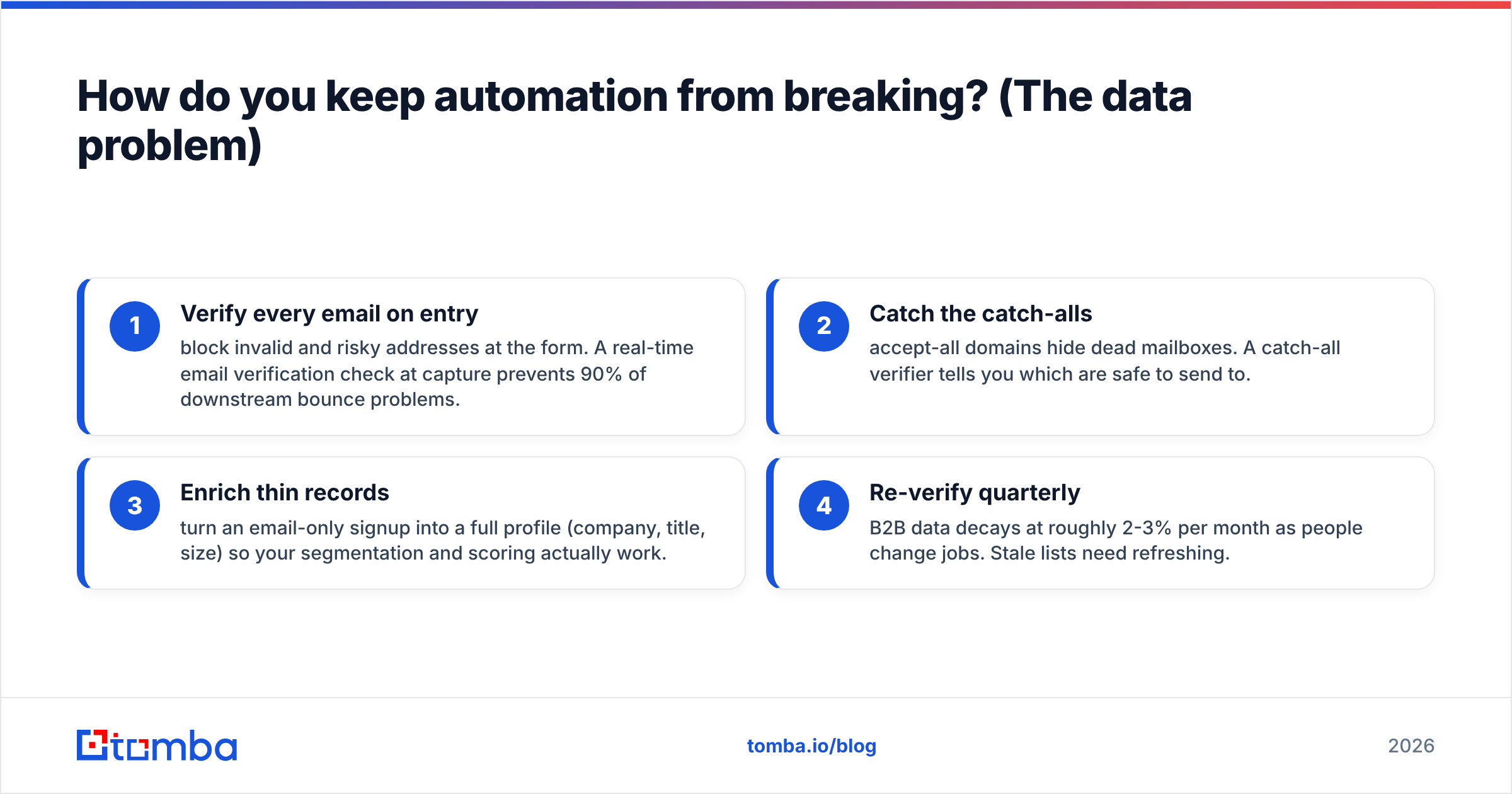
- Verify every email on entry — block invalid and risky addresses at the form. A real-time email verification check at capture prevents 90% of downstream bounce problems.
- Catch the catch-alls — accept-all domains hide dead mailboxes. A catch-all verifier tells you which are safe to send to.
- Enrich thin records — turn an email-only signup into a full profile (company, title, size) so your segmentation and scoring actually work.
- Re-verify quarterly — B2B data decays at roughly 2-3% per month as people change jobs. Stale lists need refreshing.
For teams building this layer programmatically, the email finder API lets you verify and enrich inside your existing automation flows — no manual export-import dance.
What metrics prove your B2B marketing automation is working?#
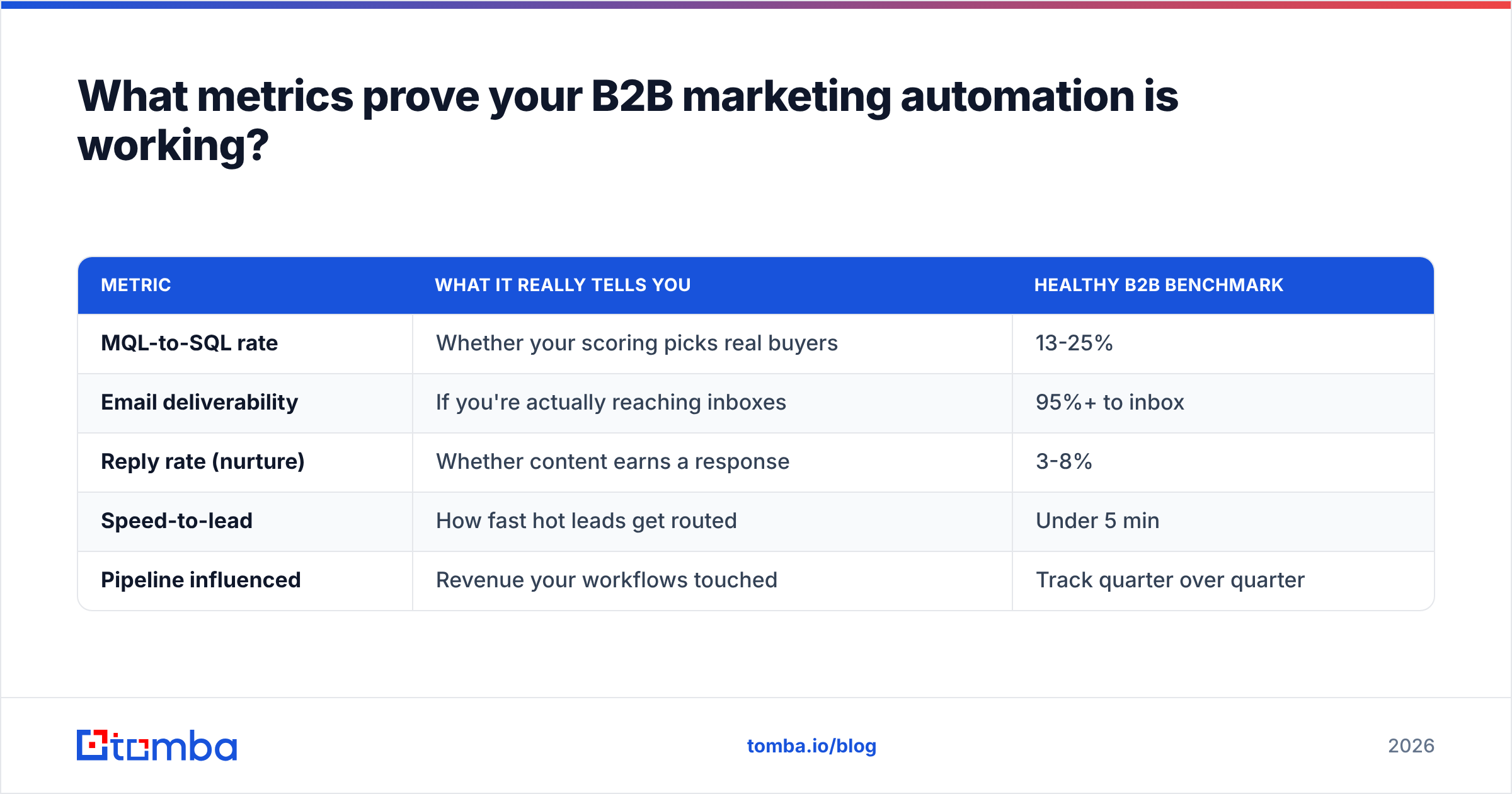
Vanity metrics will lie to you. Open rates inflate, click rates flatter, and "leads generated" means nothing if none convert. Tie automation to revenue-adjacent numbers instead.
| Metric | What it really tells you | Healthy B2B benchmark |
|---|---|---|
| MQL-to-SQL rate | Whether your scoring picks real buyers | 13-25% |
| Email deliverability | If you're actually reaching inboxes | 95%+ to inbox |
| Reply rate (nurture) | Whether content earns a response | 3-8% |
| Speed-to-lead | How fast hot leads get routed | Under 5 min |
| Pipeline influenced | Revenue your workflows touched | Track quarter over quarter |
Two of these — deliverability and reply rate — are downstream of data quality, which is why the hygiene layer above pays for itself. If your email deliverability is below 95%, fix data before you touch copy. No subject line can save an email that never lands.
Watch your response rate as the leading indicator. When it climbs, your targeting and timing are aligned. When it drops, something upstream broke — usually the data, occasionally the offer.
What are the most common B2B marketing automation mistakes?#
- Automating a broken process. Automation amplifies whatever you point it at. If your manual nurture didn't convert, automating it just fails faster. Fix the play first.
- Over-engineering the first workflow. Teams build a 40-branch monster before shipping anything. Start with one trigger, one audience, one goal. Iterate.
- Ignoring list hygiene until deliverability collapses. By then it's a recovery project, not a tune-up.
- Treating marketing and sales handoff as an afterthought. Define the MQL-to-SQL trigger and SLA before you launch, or leads will rot in the gap.
- No human escape hatch. Every automated sequence needs a clean way to pause when a real conversation starts. Nothing kills trust like a drip email arriving mid-deal.
How do you get started without overcomplicating it?#
Start small and prove value in 30 days:
- Pick one trigger — new demo request is a great first one. High intent, clear next step.
- Verify and enrich the contact automatically on entry, so sales gets a complete, valid profile.
- Route it in under 5 minutes to the right rep with full context.
- Send one well-timed follow-up if no booking happens within 24 hours.
- Measure MQL-to-SQL and speed-to-lead. If both improve, expand to the next workflow.
That's a complete, revenue-producing loop you can build in a week. Everything fancier is an optimization on top of it.
Conclusion: data first, automation second#
B2B marketing automation in 2026 isn't about having the most sophisticated platform — it's about firing the right message at real, verified people at the moment they signal intent. The teams that win treat their contact data as the foundation and the workflow builder as the finishing touch, not the other way around.
Before you spend on another automation seat, make sure every contact entering your funnel is real, verified, and enriched. The fastest way to do that is to plug accurate data discovery into your stack: use the Tomba Email Finder to source verified professional emails by domain, name, or company, then let your automation do what it does best — run tirelessly on a clean list. Check the Tomba pricing (free tier with 25 searches, Starter at $49/mo) and start feeding your automation data it can trust.
// get started
Find, verify and enrich your first contacts today
Start on the free plan with 25 searches a month, then scale when your team is ready.
Free plan · No credit card required · GDPR & CCPA
// about the author