B2B Marketing Automation Strategy: The 2026 Playbook
A practical 2026 framework for building a B2B marketing automation strategy that fills pipeline instead of inboxes — data, scoring, workflows, and the stack to run it.
B2B Marketing Automation Strategy: The 2026 Playbook
Marketing automation does not fail because the software is bad. It fails because teams automate a broken process on top of dirty data and call it a strategy. This is the playbook for doing it the other way around.
TL;DR#
- A B2B marketing automation strategy is a system, not a tool. It connects data, segmentation, scoring, and triggered workflows to move buyers from anonymous to closed-won with less manual work.
- Data quality is the ceiling. Automation amplifies whatever you feed it — clean, enriched contact records decide whether your campaigns scale or spam.
- Lead scoring is the brain. Without explicit (firmographic) and implicit (behavioral) scoring, every lead looks the same and sales ignores all of them.
- Start with three workflows, not thirty. Welcome/nurture, lead routing, and re-engagement cover 80% of the value before you touch advanced branching.
- Measure pipeline, not opens. Tie every automation to a revenue metric or kill it.
What is a B2B marketing automation strategy?#
A B2B marketing automation strategy is the documented plan for how you use software to execute repetitive marketing and handoff tasks — email nurtures, lead scoring, routing, enrichment, and reporting — triggered by buyer behavior instead of a human pressing send.
Think of it like a building's plumbing. Nobody admires the pipes, but when they are laid out well, water arrives where it should at the right pressure without anyone hauling buckets. Automation is the plumbing between your website, CRM, and sales team. The "strategy" part is the blueprint that decides where the pipes go before you pour concrete.
The distinction matters because most teams buy the tool first. They license HubSpot or Marketo, build a few emails, and wonder why conversion is flat. The platform was never the constraint. The constraint was the absence of a plan for which signals trigger which actions for which segments.
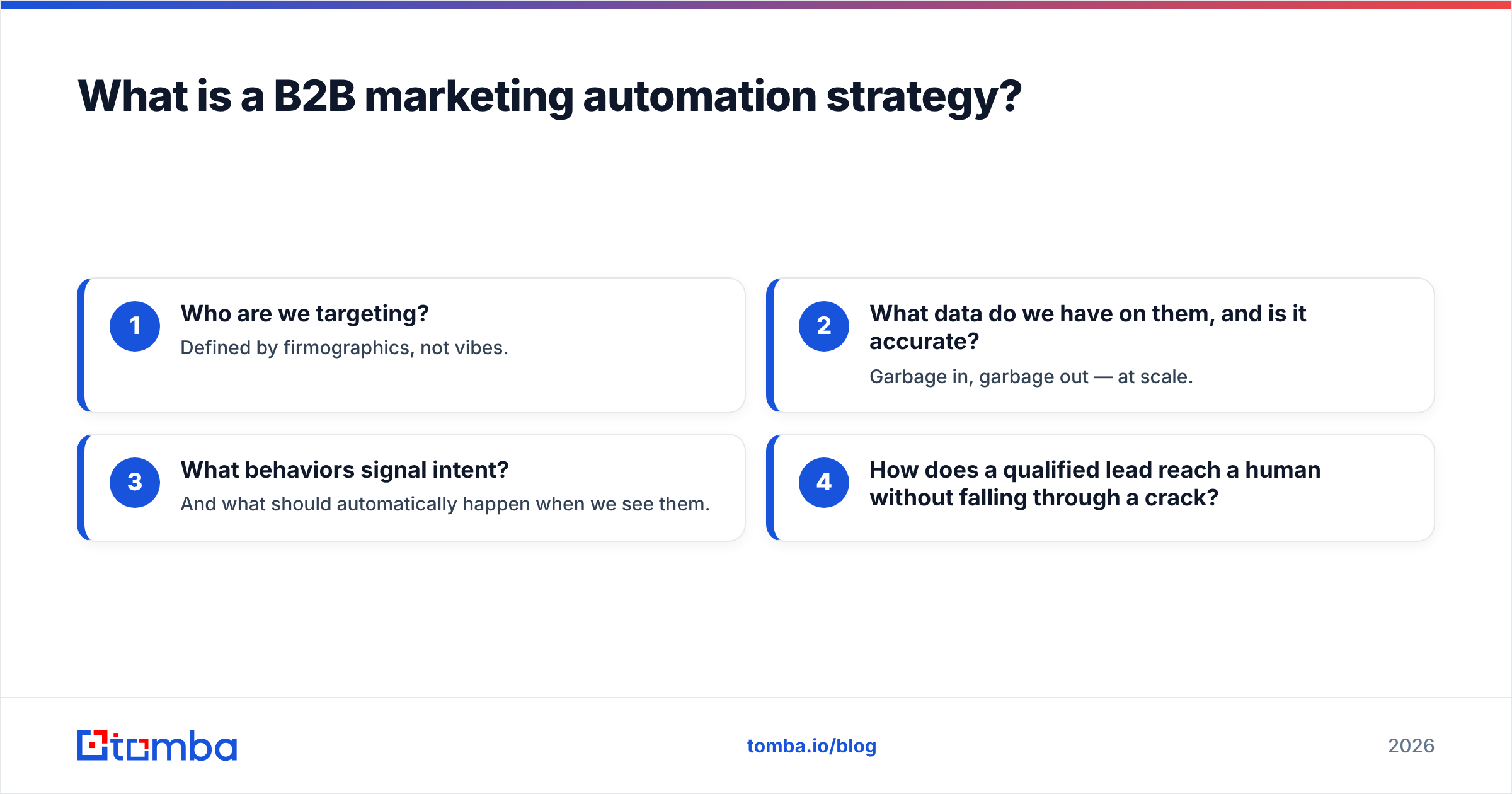
A real strategy answers four questions:
- Who are we targeting? Defined by firmographics, not vibes.
- What data do we have on them, and is it accurate? Garbage in, garbage out — at scale.
- What behaviors signal intent? And what should automatically happen when we see them.
- How does a qualified lead reach a human without falling through a crack?

Why do most B2B automation strategies fail?#
They fail at the data layer, then blame the workflow layer. Here is the failure chain in order:
- Incomplete records. You capture an email but no company size, title, or industry, so segmentation collapses into "everyone."
- Decayed data. B2B contact data degrades roughly 22–30% per year as people change jobs. Last year's list is this year's bounce rate.
- No scoring discipline. Every form fill is treated as a hot lead, sales loses trust, and the leads rot in a queue.
- Over-automation. Teams build a 19-step branching nurture before they have 200 contacts to run it on.
The fix is sequencing. You earn the right to complex automation by first nailing data hygiene and scoring. A study by Gartner on martech utilization repeatedly finds that organizations use only a fraction of their stack's capabilities — the gap is almost always process and data maturity, not missing features.
What are the core components of the strategy?#
Five layers, built bottom-up. Skip a layer and the ones above it wobble.
- Data foundation — Accurate, enriched contact and company records. This is where tools like the Tomba Email Finder and data enrichment feed verified emails, titles, and firmographics into your CRM so segmentation has something real to stand on.
- Segmentation — Slicing your database by industry, company size, role, and lifecycle stage so messaging stays relevant.
- Lead scoring — Combining explicit fit (firmographics) and implicit intent (behavior) into a number sales can trust.
- Triggered workflows — The if-this-then-that engine: nurtures, routing, internal alerts, re-engagement.
- Measurement — Closed-loop reporting that ties each workflow back to pipeline and revenue.
Notice that the actual "automation" most people picture — the email workflows — sits at layer four. Three layers of unglamorous groundwork come first. That ordering is the whole game.
How do you build a lead scoring model that sales trusts?#
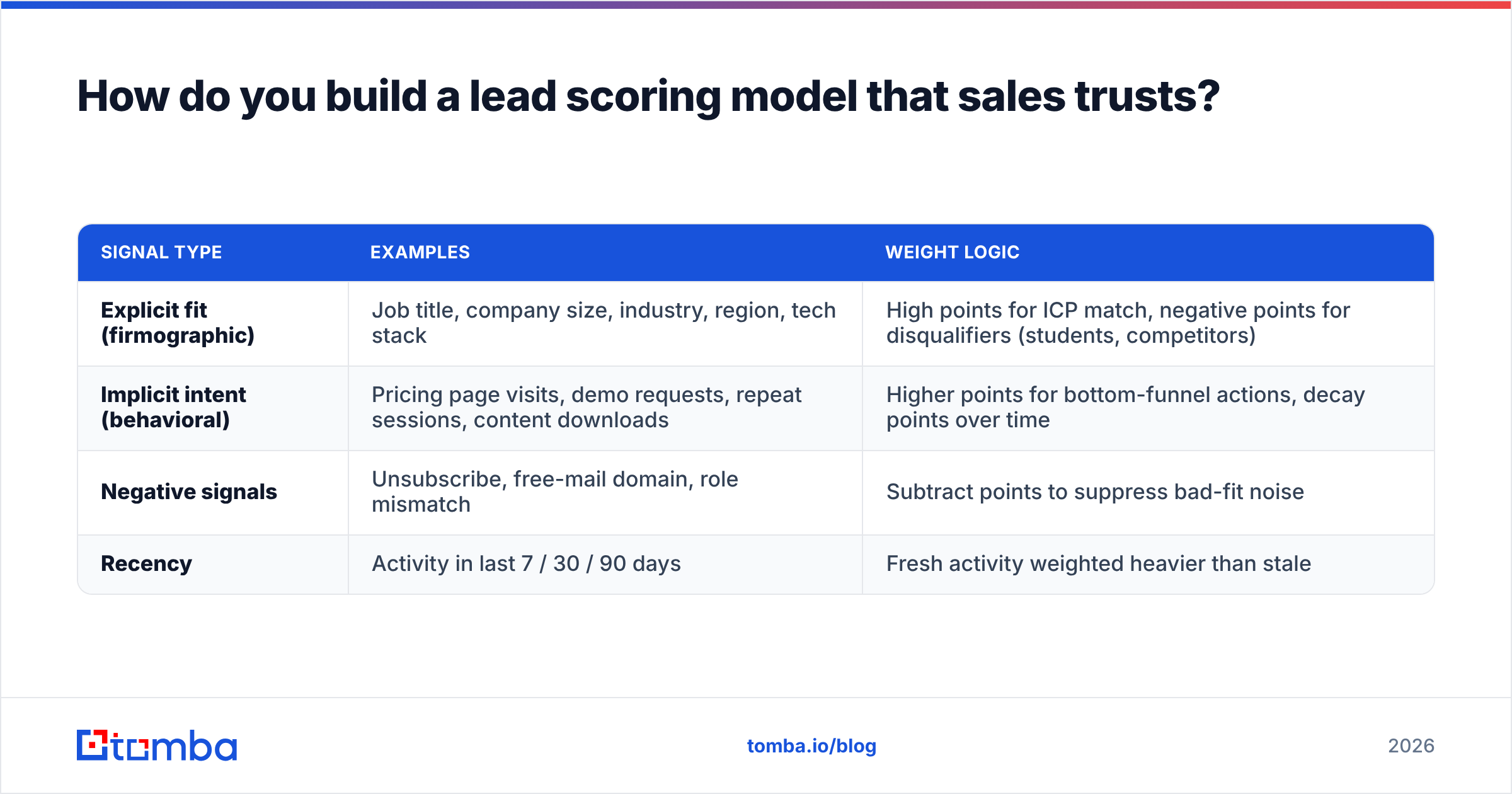
Use two axes: fit and intent. Score them separately, then combine. A lead with high fit but low intent gets nurtured; high intent but low fit gets monitored; high on both gets routed to sales immediately.
| Signal type | Examples | Weight logic |
|---|---|---|
| Explicit fit (firmographic) | Job title, company size, industry, region, tech stack | High points for ICP match, negative points for disqualifiers (students, competitors) |
| Implicit intent (behavioral) | Pricing page visits, demo requests, repeat sessions, content downloads | Higher points for bottom-funnel actions, decay points over time |
| Negative signals | Unsubscribe, free-mail domain, role mismatch | Subtract points to suppress bad-fit noise |
| Recency | Activity in last 7 / 30 / 90 days | Fresh activity weighted heavier than stale |
The mistake to avoid: scoring intent without verifying fit. A free Gmail address downloading every ebook is engagement noise, not a buyer. This is why enrichment matters — you cannot score firmographics you do not have. Pulling clean company and role data via domain search before scoring turns a guessing game into arithmetic.

Which workflows should you build first?#
Start with three. They deliver the majority of the value and teach your team the platform before you attempt anything elaborate.
1. Welcome and nurture. When a contact converts, automatically tag them, send a relevant welcome sequence based on what they downloaded, and advance them through educational content tied to their segment. Keep it to 4–6 emails before re-evaluating.
2. Lead routing and alerts. When a lead crosses your scoring threshold, automatically assign it to the right rep by territory or segment and fire a Slack or email alert. Speed-to-lead is the single most underrated conversion lever — responding within five minutes versus an hour can multiply qualification rates.
3. Re-engagement. When a contact goes quiet for 60–90 days, trigger a win-back sequence. If they stay cold, automatically suppress them to protect your sender reputation and email deliverability.
Only after these three run cleanly should you add behavioral branching, account-based plays, or multi-channel orchestration. Complexity is a reward you unlock, not a starting condition.
Marketing automation vs. CRM vs. RevOps — what's the difference?#
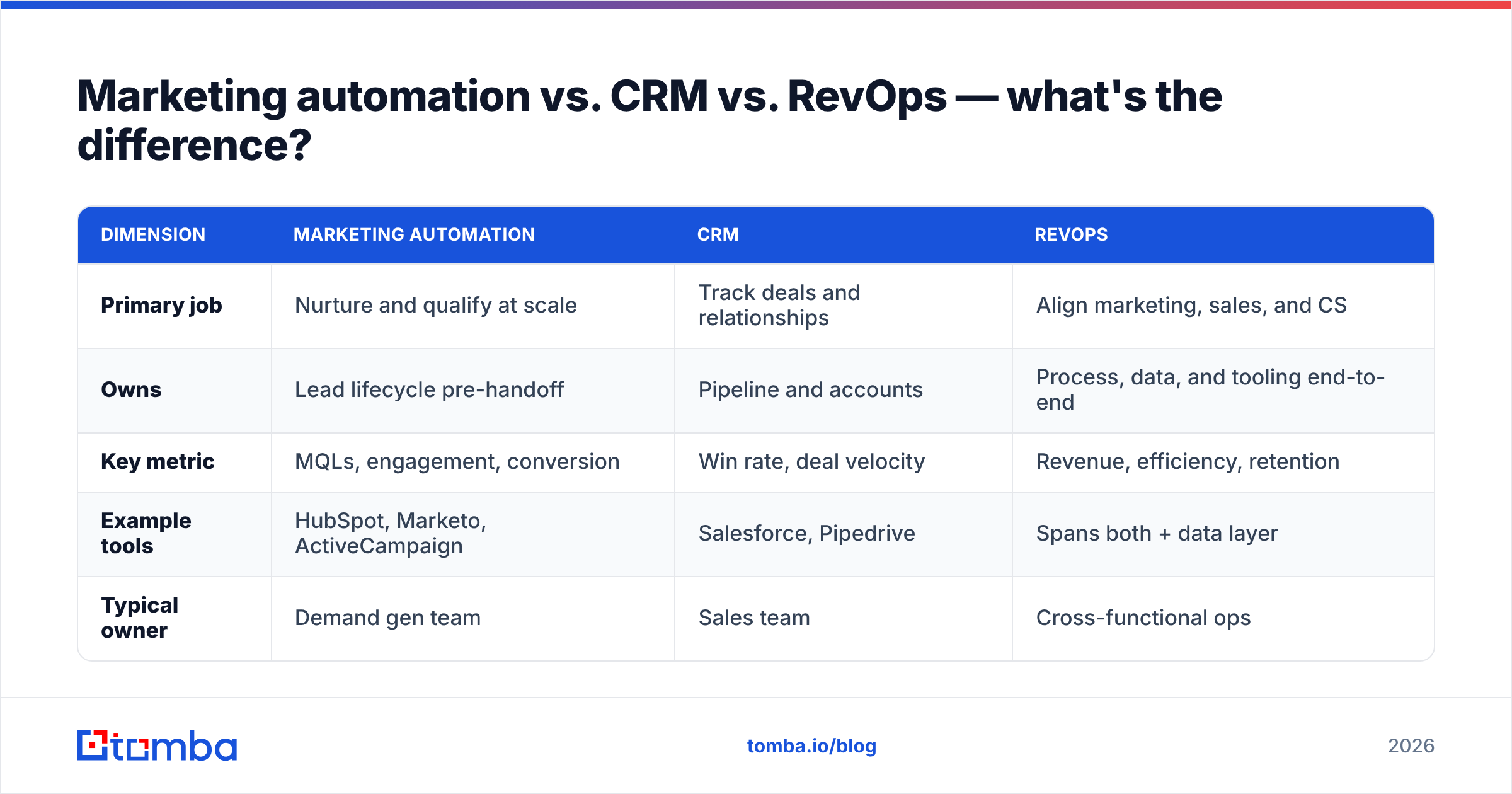
These overlap, and the confusion costs companies money when they buy redundant tools. Here is the clean separation:
| Dimension | Marketing automation | CRM | RevOps |
|---|---|---|---|
| Primary job | Nurture and qualify at scale | Track deals and relationships | Align marketing, sales, and CS |
| Owns | Lead lifecycle pre-handoff | Pipeline and accounts | Process, data, and tooling end-to-end |
| Key metric | MQLs, engagement, conversion | Win rate, deal velocity | Revenue, efficiency, retention |
| Example tools | HubSpot, Marketo, ActiveCampaign | Salesforce, Pipedrive | Spans both + data layer |
| Typical owner | Demand gen team | Sales team | Cross-functional ops |
Marketing automation hands qualified leads to the CRM. Revenue operations is the connective tissue making sure that handoff does not leak. If your automation strategy ignores the CRM handoff, you have built a very efficient machine for generating leads that nobody calls.
What does a 2026 automation stack look like?#
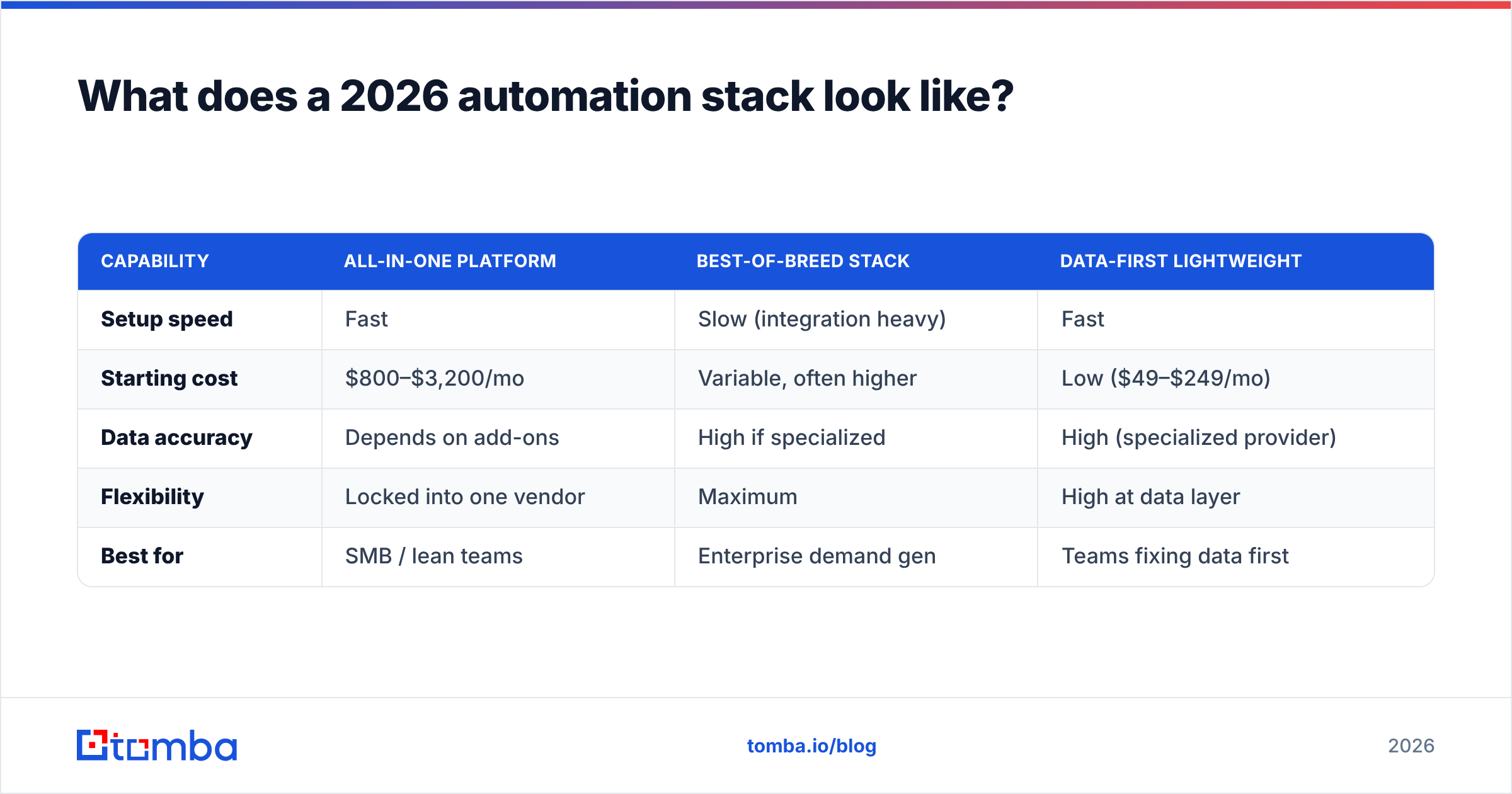
The market consolidated. You no longer need fifteen point solutions — you need a clean spine of four to six tools that share data well. Here is a representative comparison of approaches at the platform layer.
| Capability | All-in-one platform | Best-of-breed stack | Data-first lightweight |
|---|---|---|---|
| Setup speed | Fast | Slow (integration heavy) | Fast |
| Starting cost | $800–$3,200/mo | Variable, often higher | Low ($49–$249/mo) |
| Data accuracy | Depends on add-ons | High if specialized | High (specialized provider) |
| Flexibility | Locked into one vendor | Maximum | High at data layer |
| Best for | SMB / lean teams | Enterprise demand gen | Teams fixing data first |
For most teams the smart 2026 move is to fix the data layer cheaply before committing to a five-figure platform contract. A specialized provider like Tomba supplies verified emails, enrichment, and firmographics at predictable pricing — Free (25 searches/mo), Starter at $49/mo, Growth at $99/mo, and Pro at $249/mo — so your automation platform receives clean records from day one. You can compare platform reviews on G2 before locking in the orchestration layer.
How do you keep automated data clean over time?#
Data hygiene is not a project, it is a recurring chore — like changing the oil. Bake it into the strategy or your bounce rate climbs until your domain lands on a blocklist.
- Verify on entry. Run every new email through an email verifier before it enters a workflow. Catching a typo or dead address at the form saves a hard bounce.
- Re-enrich quarterly. Job changes are constant. Refresh titles, company data, and contact validity on a schedule, not when something breaks.
- Suppress aggressively. Cold, bounced, and complained contacts should be auto-suppressed by a workflow, not left to drag down sender reputation.
- Bulk-clean before campaigns. Before any large send, push the list through a bulk verify pass.
A team that automates outreach to an unverified list is automating its own deliverability problems. The cheapest insurance policy in your entire stack is verification.
How do you measure if the strategy is working?#
Tie every automation to a downstream revenue metric, not a vanity one. Open rates feel good and predict nothing. Track these instead:
- MQL-to-SQL conversion rate — Are your scored leads actually qualifying? If sales rejects most MQLs, your scoring model is miscalibrated.
- Pipeline influenced by automation — Dollar value of opportunities touched by an automated workflow.
- Speed to lead — Median time from threshold-cross to first human contact.
- Cost per qualified lead — Total spend divided by SQLs, trending down as automation matures.
- Database health — Percentage of records verified and enriched, bounce rate, suppression growth.
Run a quarterly review where every active workflow must justify itself against one of these. Workflows that cannot show their contribution get archived. A bloated automation account full of zombie workflows is a liability, not an asset.
What's changing in B2B automation for 2026?#
Three shifts are reshaping strategy this year.
AI-assisted personalization at scale. Generative models now draft segment-specific copy and subject lines, but they amplify data problems just as fast as good data — personalization is worthless if the underlying record is wrong. The data layer matters more, not less.
Privacy-first data sourcing. With tightening regulation and the decline of third-party cookies, first-party and verified, compliant contact data is the durable foundation. Knowing exactly where your data comes from is now a compliance requirement, not a nice-to-have.
Consolidation over sprawl. Teams are cutting redundant tools and standardizing on a lean spine. The winning stacks are smaller and better integrated than the bloated 20-tool stacks of a few years ago.
The throughline across all three: automation is only as good as the data and process beneath it. The flashy AI layer sits on top of the same plumbing.
Putting it together#
Build bottom-up. Get your data accurate and enriched, segment honestly, score on fit and intent, ship three solid workflows, then measure against pipeline. Resist the urge to start with elaborate branching on top of a dirty database — that is the single most common, most expensive mistake in B2B marketing automation.
The platforms get the attention, but the data layer decides the outcome. If your records are verified and complete, almost any decent automation tool will perform. If they are not, the most expensive platform on the market will just help you waste money faster.
Start where the leverage is. Tomba's email finder, verifier, and enrichment give your automation strategy the clean, accurate foundation it needs — find and verify the right contacts, enrich them with the firmographics your scoring model requires, and feed your CRM and marketing platform data they can actually act on. Begin free with 25 searches a month, then scale into a plan that matches your pipeline goals. Fix the data, and the automation finally does what the brochure promised.
// get started
Find, verify and enrich your first contacts today
Start on the free plan with 25 searches a month, then scale when your team is ready.
Free plan · No credit card required · GDPR & CCPA
// about the author