B2B Marketing Challenges in 2026 and How to Solve Them
The biggest B2B marketing challenges in 2026 aren't budget or headcount — they're bad data, long buying committees, and proving ROI. Here's how to beat each one.
TL;DR
- The hardest B2B marketing challenges in 2026 are structural, not budgetary: dirty contact data, buying committees of 6–10 people, broken attribution, and sales-marketing misalignment.
- Bad data quietly wrecks everything downstream — bounce rates, deliverability, and CAC all trace back to the list you started with.
- Long, non-linear buying cycles mean you market to a committee, not a lead. Account-level coverage beats single-contact targeting.
- Proving ROI is now a survival skill. If you can't tie pipeline to spend, your budget is the first thing cut.
- Most of these problems are fixable this quarter with cleaner data, tighter ICP definition, and a shared revenue dashboard — not a bigger team.
What are the biggest B2B marketing challenges in 2026?#
The short version: the work got harder while the tolerance for waste got lower. Boards want efficient growth, buyers ignore generic outreach, and the channels that worked in 2020 are saturated. But if you strip away the noise, the same handful of problems show up in almost every B2B marketing team I talk to.
Think of it like running a restaurant. You can have a brilliant chef (your creative), a great location (your brand), and a full reservation book (your pipeline) — but if the ingredients are spoiled (your data), every plate that leaves the kitchen is a complaint waiting to happen. Most B2B marketing failures are spoiled-ingredient problems disguised as something fancier.
Here are the seven that matter most right now:
- Bad and decaying contact data — B2B data degrades 2–3% per month as people change jobs. A list you bought in January is meaningfully wrong by summer.
- Long, committee-driven buying cycles — the average B2B purchase now involves 6–10 stakeholders, and deals stall when you only know one of them.
- Attribution and proving ROI — multi-touch journeys across 8+ channels make it genuinely hard to say what worked.
- Sales and marketing misalignment — leads get passed, ignored, and blamed in both directions.
- Content saturation and AI sameness — everyone now publishes the same AI-assisted blog posts, so differentiation is harder.
- Rising acquisition costs — paid channels are more expensive and less trusted than they were two years ago.
- Privacy, deliverability, and cookie loss — third-party cookies are gone and inbox providers are stricter than ever.
The rest of this post tackles the ones you can actually move this quarter.
Why is bad data the root B2B marketing challenge?#
Because every other metric inherits its errors. Your open rate, bounce rate, sender reputation, cost per lead, and even your sales team's morale all sit downstream of the contact list you started with.
Here's the chain reaction. You buy or scrape a list. Twenty percent of it is stale. You send a campaign, hit a wall of hard bounces, and your domain's email deliverability drops. Now even your good emails land in spam. Sales calls the leads, half the numbers are wrong, and they conclude "marketing leads are garbage." None of that was a creative problem. It was a data problem wearing four different costumes.

The fix is unglamorous but decisive: build your lists from verified, real-time sources instead of static databases, and re-verify before every send. A good email verifier catches the dead addresses before your mail server does. When you need to find net-new contacts, an email finder that pulls from live public sources will out-perform any list you can buy, because it's checking the data at the moment you ask for it — not the moment someone scraped it 14 months ago.
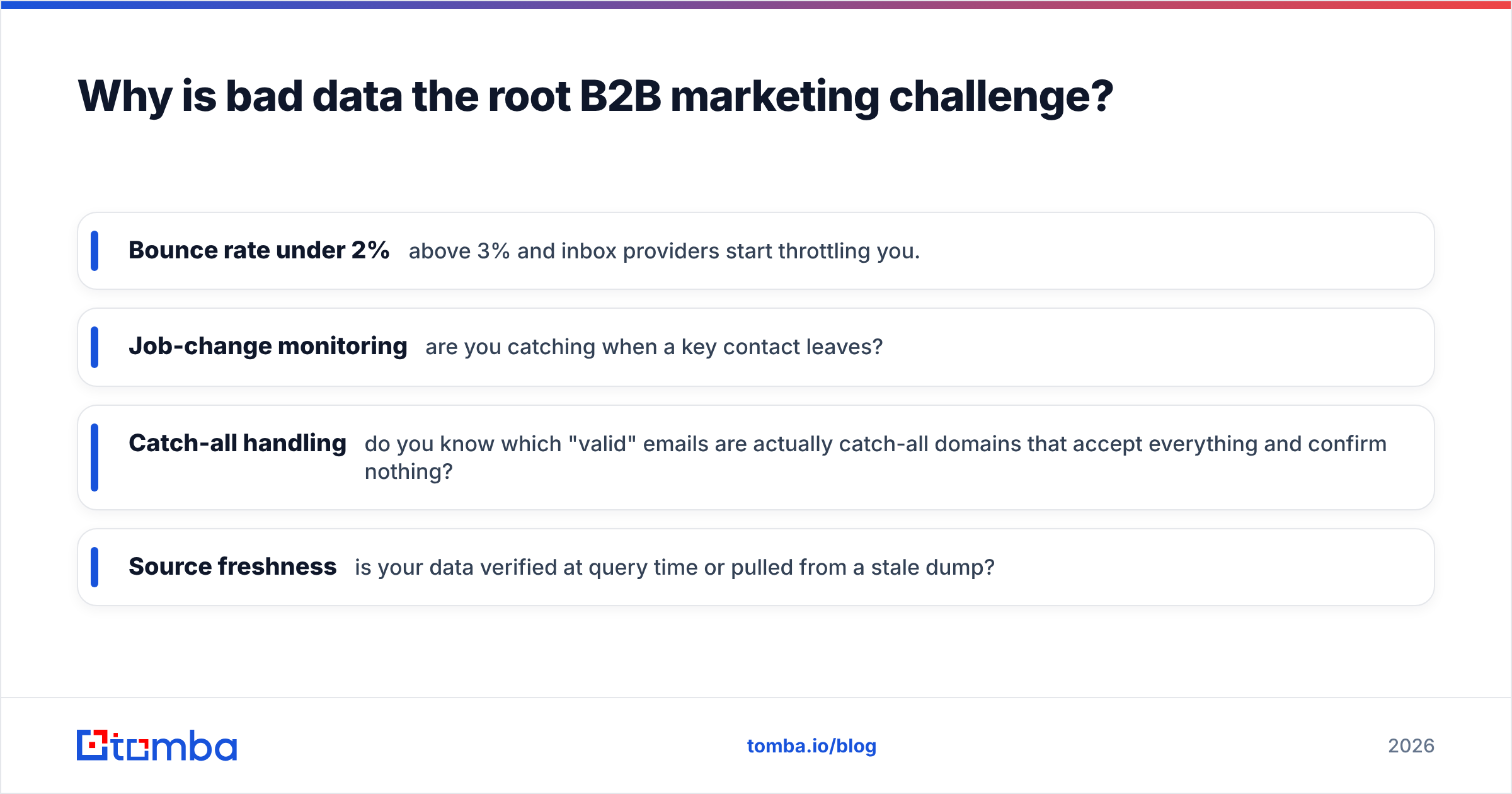
A quick gut check on data quality:
- Bounce rate under 2% — above 3% and inbox providers start throttling you.
- Job-change monitoring — are you catching when a key contact leaves?
- Catch-all handling — do you know which "valid" emails are actually catch-all domains that accept everything and confirm nothing?
- Source freshness — is your data verified at query time or pulled from a stale dump?
How do you market to a buying committee instead of a lead?#
Stop optimizing for the individual and start optimizing for account coverage. The single biggest shift in B2B over the last five years is that you're no longer selling to a person — you're selling to a committee that has to agree internally before anything happens.
Gartner's research puts the typical B2B buying group at six to ten decision-makers, each arriving with their own information and often their own agenda. (See Gartner's well-known B2B buying journey research.) If your campaign reaches the champion but never touches the CFO who controls budget or the IT lead who can veto, the deal stalls in a place your funnel report can't even see.
Practically, that means:
- Map the committee per target account — champion, economic buyer, technical evaluator, and the inevitable skeptic.
- Find every relevant contact in the account, not just the one whose email you happened to have. A domain search returns the full roster of reachable people at a company so you can build genuine account coverage.
- Tailor messaging by role — the CFO cares about payback period; the practitioner cares about whether it'll break their existing stack.
- Sequence the touches so the champion gets equipped to sell internally, because most of the buying happens in rooms you'll never be in.
This is where marketing and lead generation stop being a volume game and become a coverage game.
How do you prove B2B marketing ROI in 2026?#
Pick one attribution model, make it shared, and defend pipeline — not vanity metrics. The goal isn't perfect attribution (it doesn't exist); it's a defensible, consistent story that survives a CFO's questions.
The trap is reporting on leads and MQLs that never become revenue. A marketing qualified lead that sales never works is a cost, not an asset. Tie your reporting to pipeline created and pipeline closed, and the conversation with finance changes completely.
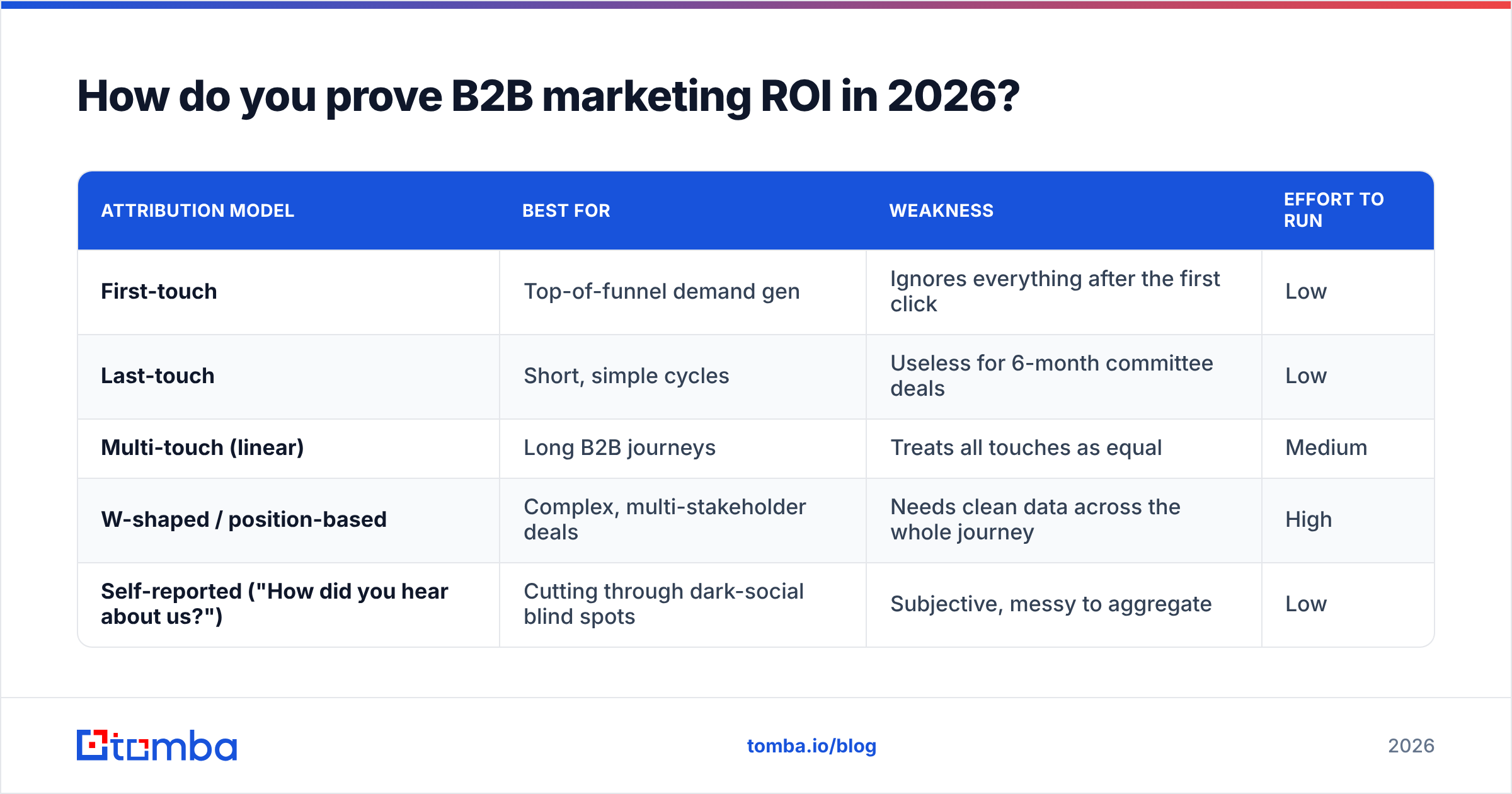
Here's how the common attribution approaches stack up:
| Attribution model | Best for | Weakness | Effort to run |
|---|---|---|---|
| First-touch | Top-of-funnel demand gen | Ignores everything after the first click | Low |
| Last-touch | Short, simple cycles | Useless for 6-month committee deals | Low |
| Multi-touch (linear) | Long B2B journeys | Treats all touches as equal | Medium |
| W-shaped / position-based | Complex, multi-stakeholder deals | Needs clean data across the whole journey | High |
| Self-reported ("How did you hear about us?") | Cutting through dark-social blind spots | Subjective, messy to aggregate | Low |
Most B2B teams should run position-based attribution as the system of record and self-reported as the sanity check. The two together catch both the trackable journey and the untrackable "I heard you on a podcast" reality. Whatever you pick, the data feeding it has to be clean — which loops back to challenge number one.
How do you fix sales and marketing misalignment?#
Agree on definitions and share one dashboard. Misalignment is almost never about effort; it's about two teams using the same words to mean different things.
Marketing says "lead." Sales hears "someone ready to buy." Marketing means "someone who downloaded a PDF." That gap is where trust dies. The fix is a written, shared definition of what qualifies a lead, plus a single source of truth both teams look at. HubSpot's research on sales and marketing alignment consistently links this kind of "smarketing" SLA to higher revenue growth.
A workable alignment checklist:
- Shared ICP and lead definition, signed off by both leaders.
- A service-level agreement — marketing commits to N qualified leads, sales commits to working them within X hours.
- Closed-loop reporting so marketing sees which leads actually closed and can double down on what works.
- Clean handoff data — every lead arrives with verified contact info and enrichment, not a half-empty CRM record. Pushing enriched, verified contacts straight into your CRM through data enrichment removes the "this lead is missing half its fields" friction that sales loves to complain about.
How do you stand out when everyone uses AI to write the same content?#
Lead with proprietary data, real customer stories, and a point of view — the three things a generic AI prompt can't produce. The flood of AI-assisted content didn't lower the bar; it raised it, because table-stakes "ultimate guide" posts are now infinitely cheap and therefore worthless.
What still cuts through:
- Original data — your own benchmarks, survey results, or product usage trends. Nobody else has your numbers.
- Specific customer narratives — named (or anonymized-but-concrete) stories with real before/after metrics.
- An actual opinion — a defensible stance that some readers will disagree with. Fence-sitting content gets ignored.
- Distribution discipline — a great post nobody sees loses to a mediocre post with a real promotion plan.
If you want a quick read on whether your content is differentiated, ask: could a competitor publish this exact piece by swapping their logo for yours? If yes, it's commodity content.
Which B2B marketing challenges should you tackle first?#
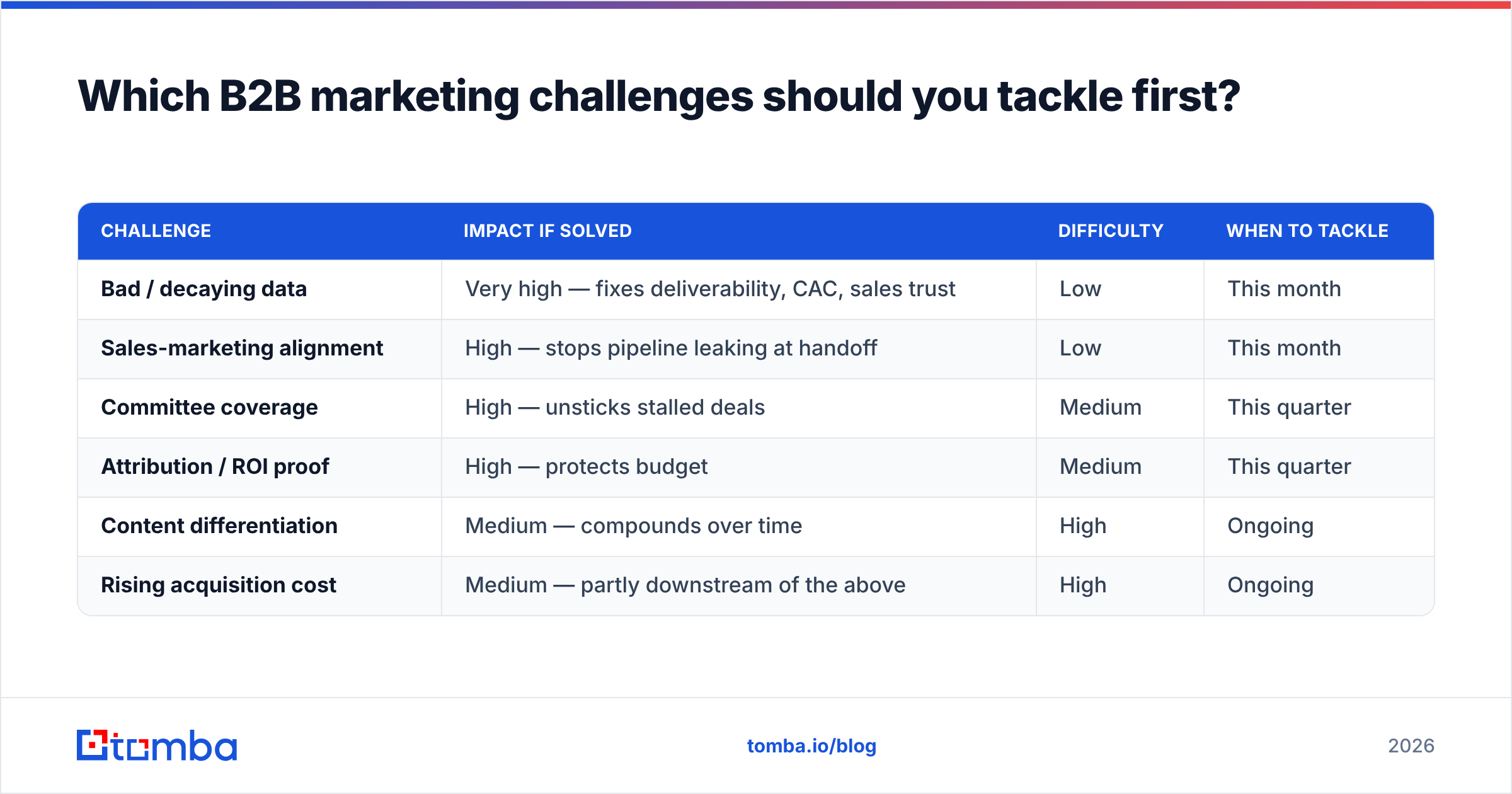
Sequence them by leverage. Some of these problems unlock the others, so order matters. Here's how I'd prioritize for a team that can't fix everything at once:
| Challenge | Impact if solved | Difficulty | When to tackle |
|---|---|---|---|
| Bad / decaying data | Very high — fixes deliverability, CAC, sales trust | Low | This month |
| Sales-marketing alignment | High — stops pipeline leaking at handoff | Low | This month |
| Committee coverage | High — unsticks stalled deals | Medium | This quarter |
| Attribution / ROI proof | High — protects budget | Medium | This quarter |
| Content differentiation | Medium — compounds over time | High | Ongoing |
| Rising acquisition cost | Medium — partly downstream of the above | High | Ongoing |
Notice that the two highest-leverage, lowest-difficulty fixes are both about foundations — clean data and shared definitions. They're unglamorous, which is exactly why most teams skip them and then wonder why their expensive campaigns underperform. Start there. You can compare what a foundation-first toolset costs on the Tomba pricing page, and most of the data fixes above start on the free tier.
What does a 90-day fix plan look like?#
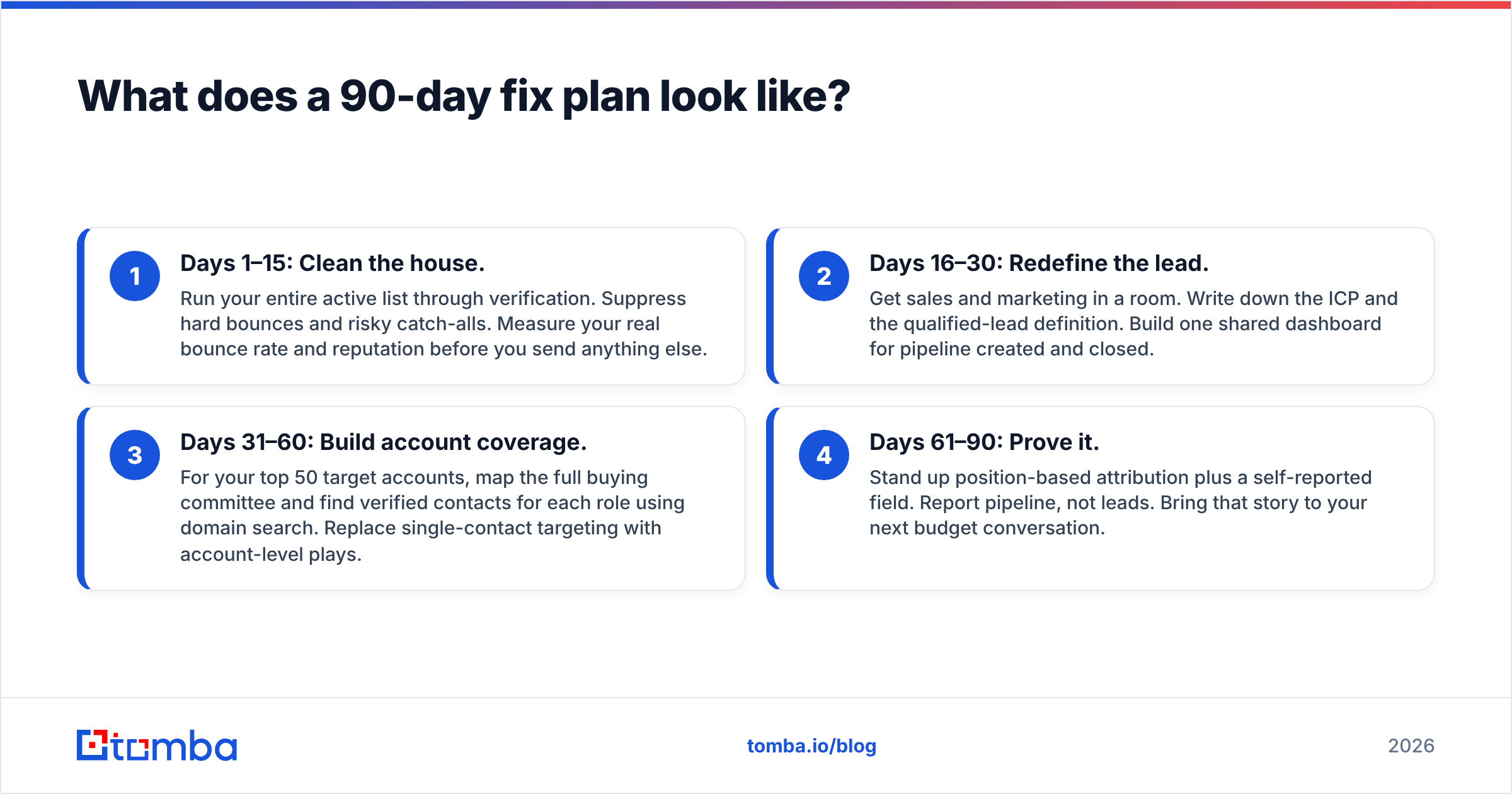
A concrete, do-it-now sequence so this doesn't stay theoretical:
- Days 1–15: Clean the house. Run your entire active list through verification. Suppress hard bounces and risky catch-alls. Measure your real bounce rate and reputation before you send anything else.
- Days 16–30: Redefine the lead. Get sales and marketing in a room. Write down the ICP and the qualified-lead definition. Build one shared dashboard for pipeline created and closed.
- Days 31–60: Build account coverage. For your top 50 target accounts, map the full buying committee and find verified contacts for each role using domain search. Replace single-contact targeting with account-level plays.
- Days 61–90: Prove it. Stand up position-based attribution plus a self-reported field. Report pipeline, not leads. Bring that story to your next budget conversation.
None of these steps require a bigger team or a new platform migration. They require treating data quality and alignment as the foundation they are, rather than the afterthought they usually become.
The bottom line#
The B2B marketing challenges of 2026 reward the boring disciplines: clean data, clear definitions, full account coverage, and honest measurement. The teams that win aren't the ones with the cleverest campaigns — they're the ones whose campaigns are built on contacts that actually exist and reach the people who actually decide.
Start with the data, because everything else inherits its quality. If you want to fix the root cause this week, try the Tomba Email Finder to build verified, real-time contact lists for your target accounts — free for your first 25 searches, then $49/mo on the Starter plan when you're ready to scale. It's the cheapest, fastest lever you have, and it makes every other part of your marketing work harder.
Ready to find emails that actually work?
Join 150,000+ professionals who stopped guessing and started sending. Free credits on signup — no credit card required.
Get the Tomba newsletter
Practical outbound tactics and product updates — once every two weeks.
About the author