B2B Marketing Channels in 2026: Which Ones Actually Work
A neutral, data-backed breakdown of the B2B marketing channels that drive pipeline in 2026 — ranked by cost, intent, and time-to-revenue, with a side-by-side comparison.
You have a finite budget and roughly a dozen places to spend it. Pick wrong and you burn a quarter; pick right and you build a pipeline engine that compounds. This guide ranks the B2B marketing channels that actually move revenue in 2026 — not by hype, but by cost, buyer intent, and how long each one takes to pay back.
TL;DR#
- No single channel wins. The best-performing B2B teams in 2026 run a portfolio: one or two demand-capture channels (SEO, paid search) plus one or two demand-creation channels (LinkedIn, content, events).
- Intent beats volume. A channel that reaches 500 in-market buyers outperforms one that reaches 50,000 cold contacts. Match channel to buying stage.
- Outbound is back — but only with clean data. Cold email and LinkedIn outreach work again in 2026 when targeting is tight and contact data is verified.
- Attribution is the real bottleneck. Most teams underspend on the channels that influence deals because they only measure last-click.
- Start narrow. Two channels done well beat six done poorly. Add channels only after the first ones hit payback.
What are B2B marketing channels?#
A B2B marketing channel is any repeatable path you use to reach business buyers and move them toward a purchase. Think of channels like fishing spots: some are crowded lakes where everyone casts (paid search), some are quiet streams that take patience but pay off (SEO, community), and some require you to walk up and start a conversation (outbound).
Channels split cleanly into two jobs:
- Demand capture — catching buyers who are already looking. Search engines, review sites like G2, and retargeting all harvest existing intent. Fast to convert, limited by how many people are searching.
- Demand creation — making buyers aware they have a problem worth solving. Content, social, events, and outbound build pipeline that does not exist yet. Slower, but it sets the ceiling on everything else.
Most teams over-invest in capture (because it is easy to measure) and under-invest in creation (because it is not). The channels below are tagged by which job they do best.
Which B2B marketing channels matter most in 2026?#
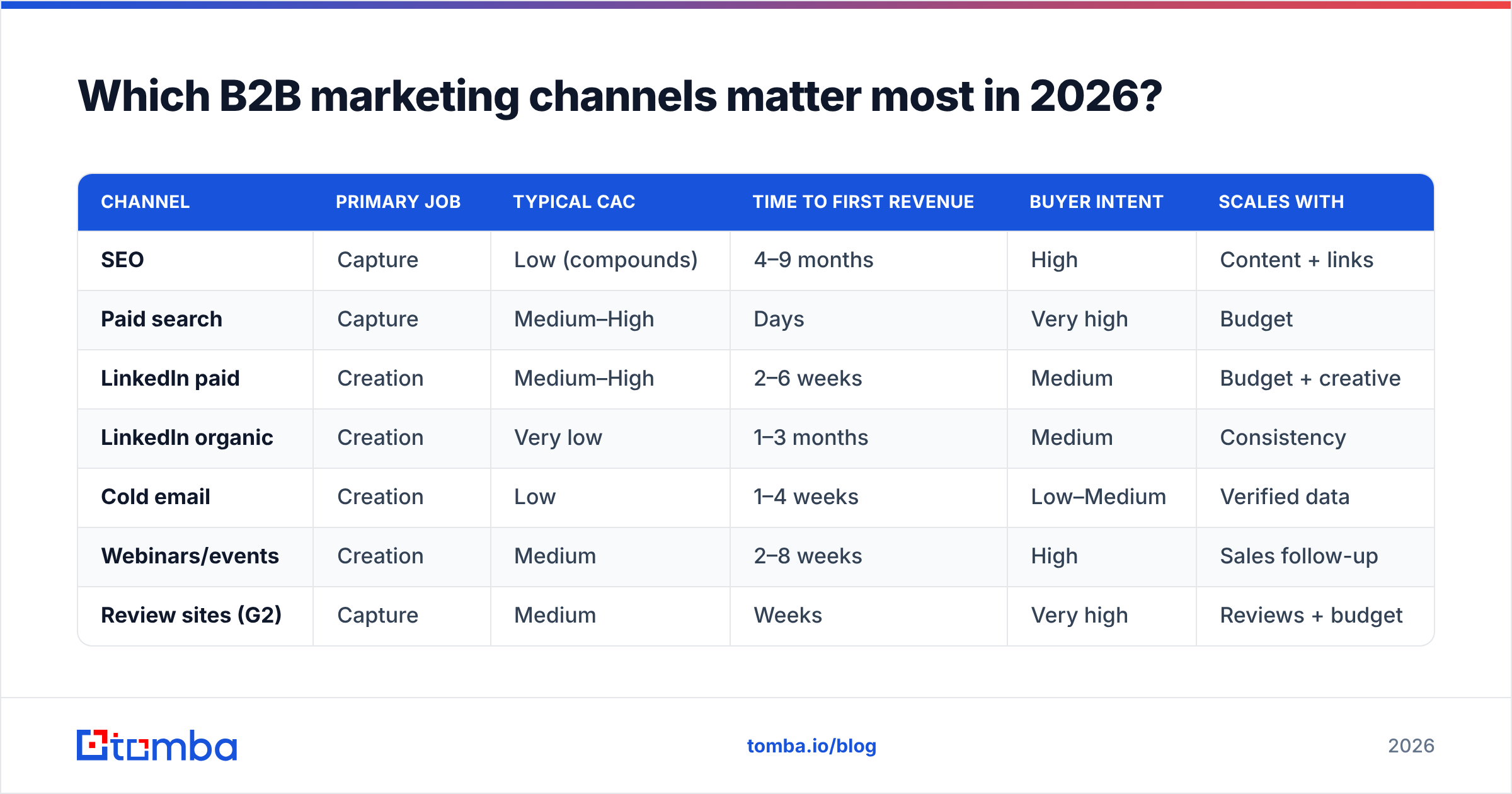
Here is the practical shortlist. Each entry includes the job it does, the realistic cost profile, and the time-to-first-revenue so you can sequence them.
- Search engine optimization (SEO) — Demand capture. The highest-compounding channel in B2B. A ranking page works while you sleep and the cost per lead drops every month. Downside: 4–9 months to traction. Best for categories where buyers actively research solutions.
- Paid search (Google Ads, Bing) — Demand capture. Instant intent, instant spend. You rent the top of the funnel. Works the day you turn it on, stops the day you turn it off. Watch CPCs in competitive categories — bottom-funnel keywords can exceed $40 per click.
- LinkedIn (organic + paid) — Demand creation. The default B2B social network. Organic founder/employee posting builds trust cheaply; paid lets you target by title, company, and seniority with precision no other ad platform matches.
- Cold email outreach — Demand creation. Direct, scalable, and cheap per contact — but only as good as your list. Deliverability and targeting decide everything. This is where verified contact data separates winners from spammers.
- Content marketing — Demand creation + capture. The fuel for SEO, social, and nurture. Comparison guides, original data, and product-led content earn links and rankings while educating buyers.
- Webinars and events — Demand creation. High-intent, high-effort. A 40-person webinar of the right titles beats a 4,000-person list of the wrong ones. Field events and conferences remain the fastest way to source enterprise deals.
How the channels compare#
| Channel | Primary job | Typical CAC | Time to first revenue | Buyer intent | Scales with |
|---|---|---|---|---|---|
| SEO | Capture | Low (compounds) | 4–9 months | High | Content + links |
| Paid search | Capture | Medium–High | Days | Very high | Budget |
| LinkedIn paid | Creation | Medium–High | 2–6 weeks | Medium | Budget + creative |
| LinkedIn organic | Creation | Very low | 1–3 months | Medium | Consistency |
| Cold email | Creation | Low | 1–4 weeks | Low–Medium | Verified data |
| Webinars/events | Creation | Medium | 2–8 weeks | High | Sales follow-up |
| Review sites (G2) | Capture | Medium | Weeks | Very high | Reviews + budget |
The pattern: capture channels convert faster but cap out; creation channels are slower but lift the whole funnel. A healthy mix runs at least one of each.
Is paid or organic better for B2B?#
Neither — they solve different problems, and the right answer is "both, sequenced correctly." Paid is a faucet: turn it on for instant flow, turn it off and it stops. Organic is a well: it takes months to dig, then delivers water for years at near-zero marginal cost.
Use paid when you need pipeline now — a launch, a quarter-end push, a new market test. Use organic when you are building a durable cost-per-lead advantage that competitors cannot outspend. The mistake is treating them as either/or. The strongest 2026 playbook funds organic for the long game while running enough paid to keep the pipeline alive during the build.
A simple sequencing rule:
- Months 0–3: Paid search + cold outreach for immediate pipeline. Start publishing SEO content now.
- Months 3–9: SEO and LinkedIn organic begin contributing. Reallocate paid budget toward your best-converting segments.
- Months 9+: Organic carries baseline pipeline; paid becomes a targeted accelerant, not life support.
How do you pick the right channel mix?#
Match the channel to three things: your buyer, your sales motion, and your payback window. A $99/month self-serve product cannot afford a six-month field-sales channel; a $250k enterprise contract cannot be closed by a retargeting ad alone.
Score each candidate channel against these questions:
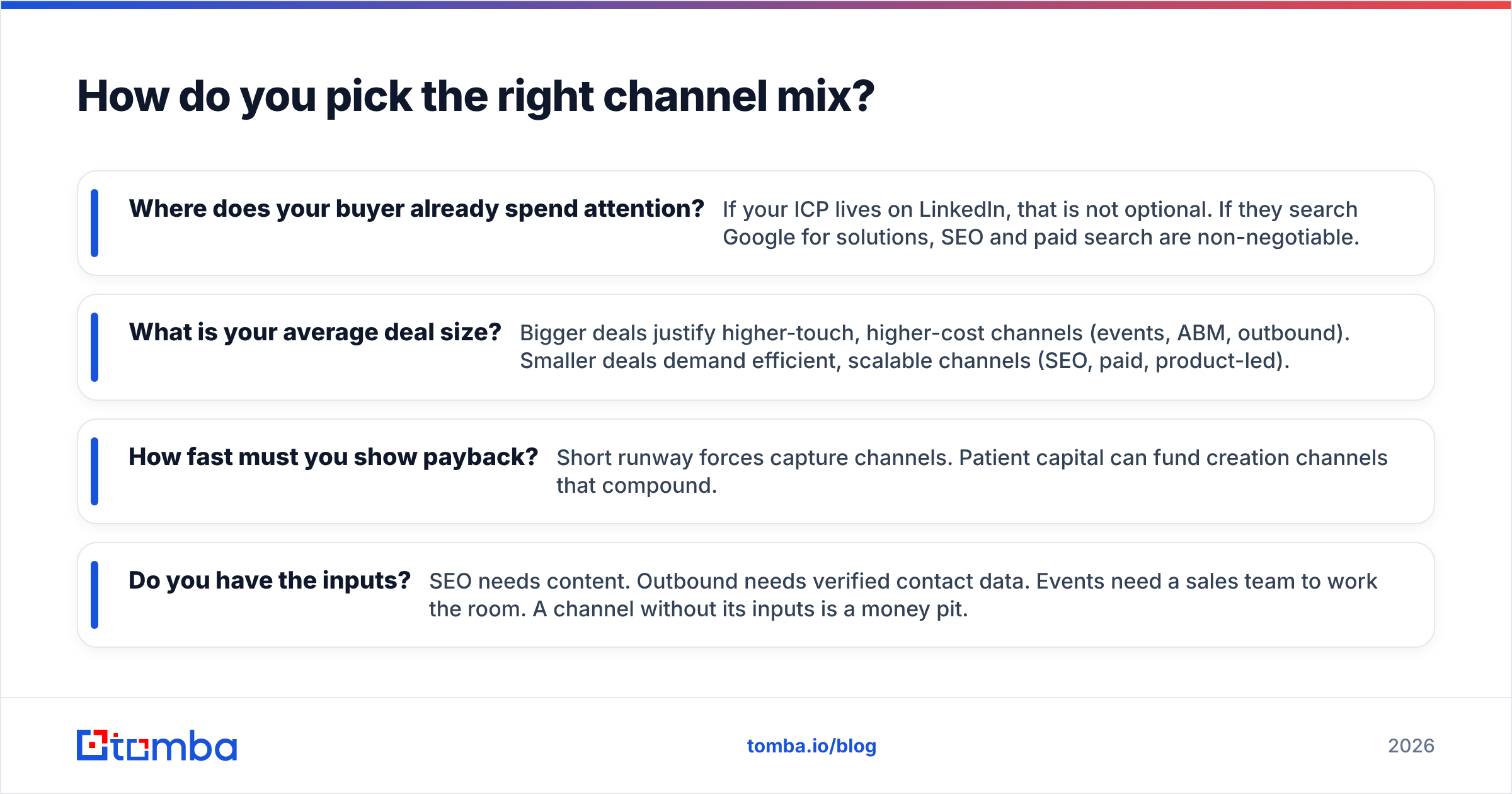
- Where does your buyer already spend attention? If your ICP lives on LinkedIn, that is not optional. If they search Google for solutions, SEO and paid search are non-negotiable.
- What is your average deal size? Bigger deals justify higher-touch, higher-cost channels (events, ABM, outbound). Smaller deals demand efficient, scalable channels (SEO, paid, product-led).
- How fast must you show payback? Short runway forces capture channels. Patient capital can fund creation channels that compound.
- Do you have the inputs? SEO needs content. Outbound needs verified contact data. Events need a sales team to work the room. A channel without its inputs is a money pit.
This last point is where most outbound programs quietly fail. You can have a perfect ICP and great copy, but if half your contacts bounce, your sender reputation tanks and the whole channel collapses. Before scaling any outbound channel, confirm your list is accurate — run it through an email verifier and build the list with a real email finder instead of guessing patterns. Clean inputs are not a nice-to-have; they are the channel's load-bearing wall.
What does a balanced B2B channel portfolio look like?#
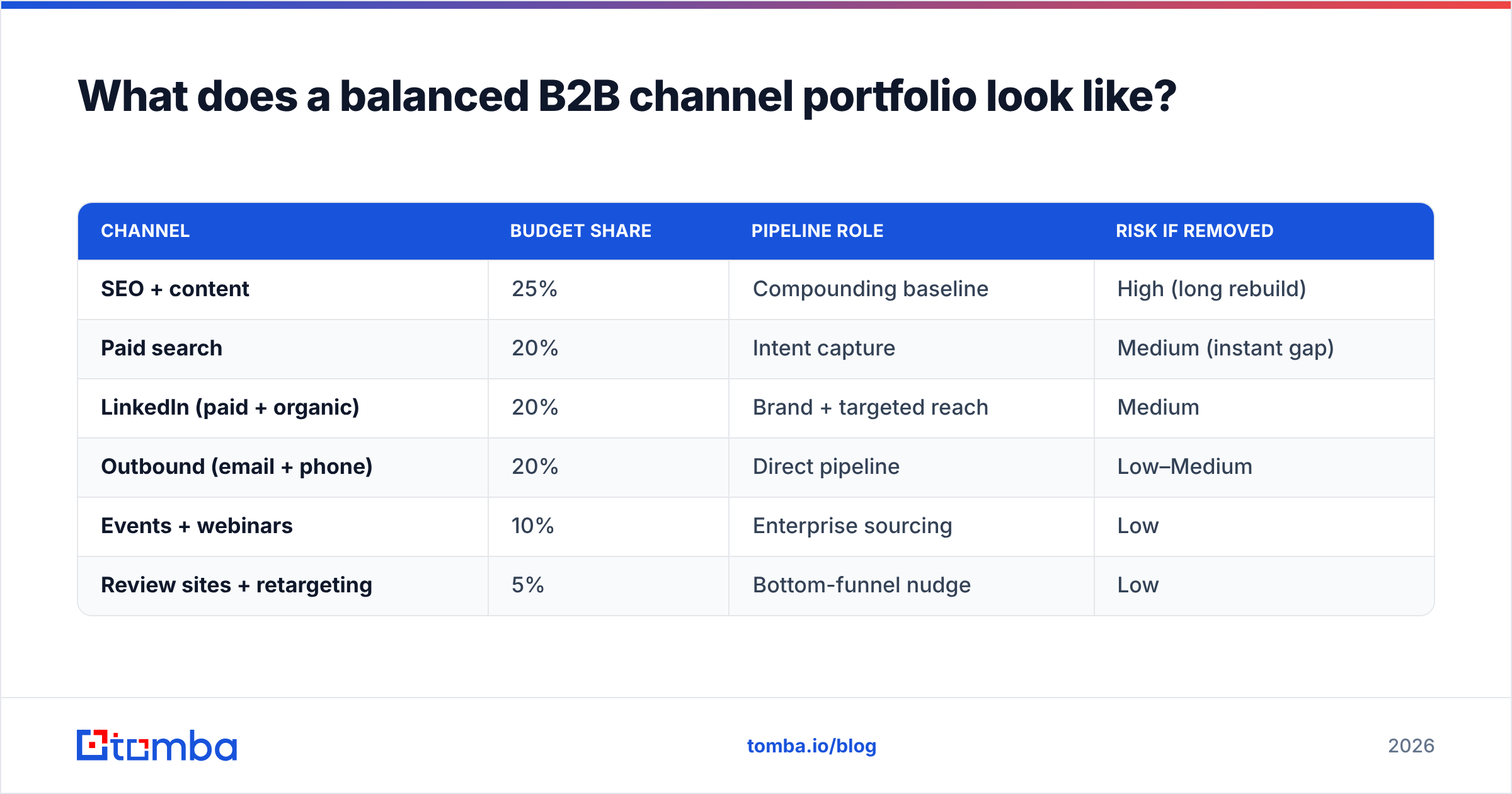
A balanced portfolio looks like an investment fund: a few stable compounders, a couple of higher-risk growth bets, and nothing over-concentrated. If one channel is more than ~50% of your pipeline, you have a single point of failure — an algorithm update or a rising CPC can erase a quarter overnight.
Here is a reference allocation for a mid-market B2B team in 2026. Treat it as a starting point, not gospel — your ICP and deal size shift the weights.
| Channel | Budget share | Pipeline role | Risk if removed |
|---|---|---|---|
| SEO + content | 25% | Compounding baseline | High (long rebuild) |
| Paid search | 20% | Intent capture | Medium (instant gap) |
| LinkedIn (paid + organic) | 20% | Brand + targeted reach | Medium |
| Outbound (email + phone) | 20% | Direct pipeline | Low–Medium |
| Events + webinars | 10% | Enterprise sourcing | Low |
| Review sites + retargeting | 5% | Bottom-funnel nudge | Low |
The outbound slice punches above its budget weight because its inputs are cheap — the cost is data and copy, not media spend. That is also why it is the easiest channel to scale efficiently once your data enrichment and verification are dialed in. Pair email with a phone finder for multi-touch sequences and your reply rates climb without raising spend.
How do you measure channel performance?#
Stop measuring channels by last-click alone — it systematically defunds the channels that create demand. A buyer might discover you through a LinkedIn post, read three SEO articles, attend a webinar, then convert on a branded search. Last-click hands all the credit to search and zero to the channels that did the real work.
Use a layered measurement approach:
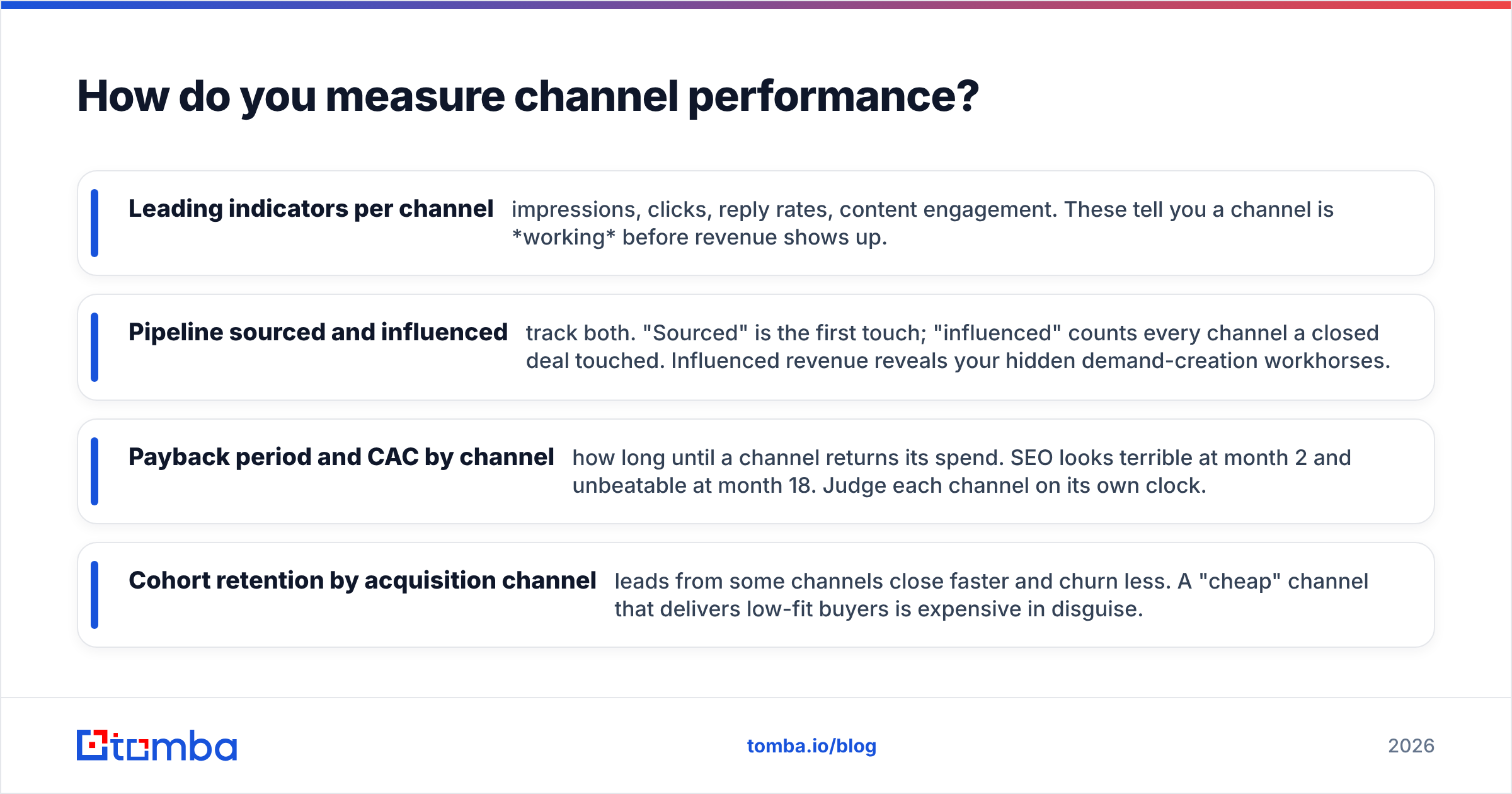
- Leading indicators per channel — impressions, clicks, reply rates, content engagement. These tell you a channel is working before revenue shows up.
- Pipeline sourced and influenced — track both. "Sourced" is the first touch; "influenced" counts every channel a closed deal touched. Influenced revenue reveals your hidden demand-creation workhorses.
- Payback period and CAC by channel — how long until a channel returns its spend. SEO looks terrible at month 2 and unbeatable at month 18. Judge each channel on its own clock.
- Cohort retention by acquisition channel — leads from some channels close faster and churn less. A "cheap" channel that delivers low-fit buyers is expensive in disguise.
For deeper definitions of the funnel metrics behind these, the marketing qualified lead and response rate glossary entries are a useful baseline for aligning marketing and sales on what each channel is actually producing. And if you want a vendor-neutral benchmark for B2B channel performance, HubSpot's annual State of Marketing report is one of the most cited public data sources.
What are the most common B2B channel mistakes?#
The failures repeat across companies and are almost always avoidable:
- Spreading too thin. Running six channels at 15% effort each beats none of them. Two channels at full effort win. Concentrate, prove payback, then expand.
- Ignoring data quality on outbound. A great sequence to a stale list damages your domain reputation and wastes the channel. Verify before you send, every time.
- Measuring creation channels with capture-channel math. Demanding immediate ROI from SEO or brand kills the very channels that lower your long-term CAC.
- Copy-pasting a competitor's mix. Their deal size, sales team, and runway are not yours. Borrow ideas, not allocations.
- Never killing a channel. Sunk-cost loyalty keeps dead channels on the budget. Set a payback deadline; if a channel misses it twice, cut it.
How does data quality affect every channel?#
Data quality is the multiplier that sits underneath all of them — get it wrong and even your best channel underperforms. Outbound needs accurate emails and phone numbers. Paid and LinkedIn need clean account lists to target and exclude. SEO and content need real customer language, which comes from talking to real, correctly-identified buyers. Retargeting and ABM need matched, deduplicated records.
Garbage data does not just hurt one channel; it leaks into all of them. A misidentified ICP skews your ad targeting, your content angles, and your sales follow-up at the same time. This is why teams serious about channel ROI invest in their contact foundation first. Building lists by company with a domain search, keeping records fresh with enrichment, and verifying before every send turns "spray and pray" into a precision instrument — and it is exactly the difference the memes above are poking at.
For pricing and where each tool fits, the full Tomba pricing breakdown shows the tiers, from the free plan to Enterprise.
The bottom line#
The best B2B marketing channels in 2026 are not a fixed list — they are the two or three that match your buyer, your deal size, and your payback window, run well enough to actually compound. Capture channels (SEO, paid search) convert the demand that exists; creation channels (LinkedIn, content, outbound, events) build the demand that doesn't. You need both, sequenced so paid and outbound fund the pipeline while organic digs the well.
Whatever mix you choose, every channel that touches a human buyer runs on contact data — and bad data quietly taxes all of them at once. Start there. Build accurate, verified lists with the Tomba Email Finder, keep them clean, and your channels stop fighting your data and start compounding. Spin up a free account, find your first 25 verified contacts this week, and let the channel mix do what it is supposed to: turn budget into pipeline you can predict.
// get started
Find, verify and enrich your first contacts today
Start on the free plan with 25 searches a month, then scale when your team is ready.
Free plan · No credit card required · GDPR & CCPA
// about the author