B2B Marketing Communication Strategy: A 2026 Playbook
Build a B2B marketing communication strategy that aligns sales and marketing, picks the right channels, and turns clean contact data into pipeline. A practical 2026 playbook with frameworks, a channel comparison table, and metrics.
A B2B marketing communication strategy is the plan that decides what you say, who you say it to, where you say it, and how you measure whether anyone cared. Most teams have tactics — a newsletter, a LinkedIn account, a cold email tool — but no spine connecting them. This playbook gives you the spine.
TL;DR#
- A B2B marketing communication strategy is one connected plan covering message, audience, channel, and measurement — not a pile of disconnected tactics.
- Start with positioning and buyer segments, then map channels to buying stages. Reverse that order and you waste budget broadcasting to people who never raise a hand.
- Sales–marketing alignment is the single biggest multiplier; misaligned teams burn 10–20% of pipeline on duplicate or contradictory touches.
- Your strategy is only as good as your contact data — bad emails and stale records quietly cap every channel's performance.
- Track a short metric stack (reach, engagement, pipeline influenced, win rate) and kill anything that doesn't move pipeline within a quarter.
What is a B2B marketing communication strategy?#
A B2B marketing communication strategy is the documented set of decisions about how your company talks to other businesses across every touchpoint — website, email, ads, events, social, sales calls — so the message stays consistent and the spend stays accountable.
Think of it like a city's road system. Anyone can pave a road (run an ad, send an email). But without a plan for where roads connect, which ones are highways and which are side streets, you get traffic jams and dead ends. The strategy is the map that makes each road lead somewhere useful.
In practice it answers five questions:
- Who are we talking to? Specific segments, not "decision-makers."
- What is the core message and proof for each segment?
- Where do those buyers actually pay attention?
- When in their buying journey does each message land?
- How do we know it worked?
B2B differs from B2C here because the buying group is larger (Gartner pegs the typical B2B buying group at 6–10 stakeholders), the sales cycle is longer, and the purchase is rational-with-emotional-cover rather than impulse. Your communication has to serve a committee over months, not a shopper over minutes.
Why do most B2B communication strategies fail?#
They fail because teams pick channels before they pick a message and an audience. Buying a sequencing tool does not give you something worth sequencing.
The common failure patterns:
- Spray-and-pray volume. More sends, lower relevance, faster list burnout. Volume without targeting trains buyers to ignore you.
- Channel silos. The ads team, content team, and SDR team each optimize their own number while the buyer experiences three disconnected messages.
- No shared definition of a lead. Marketing celebrates form fills; sales complains they're junk. Both are right because nobody agreed on what qualifies.
- Dirty data. Bounced emails, wrong titles, and duplicate records silently degrade every metric downstream.
That last point is underrated. You can have perfect positioning and still fail if 30% of your contact list bounces. Validating your list with an email verifier before a campaign is the cheapest performance gain most teams ignore.
How do you build the strategy step by step?#
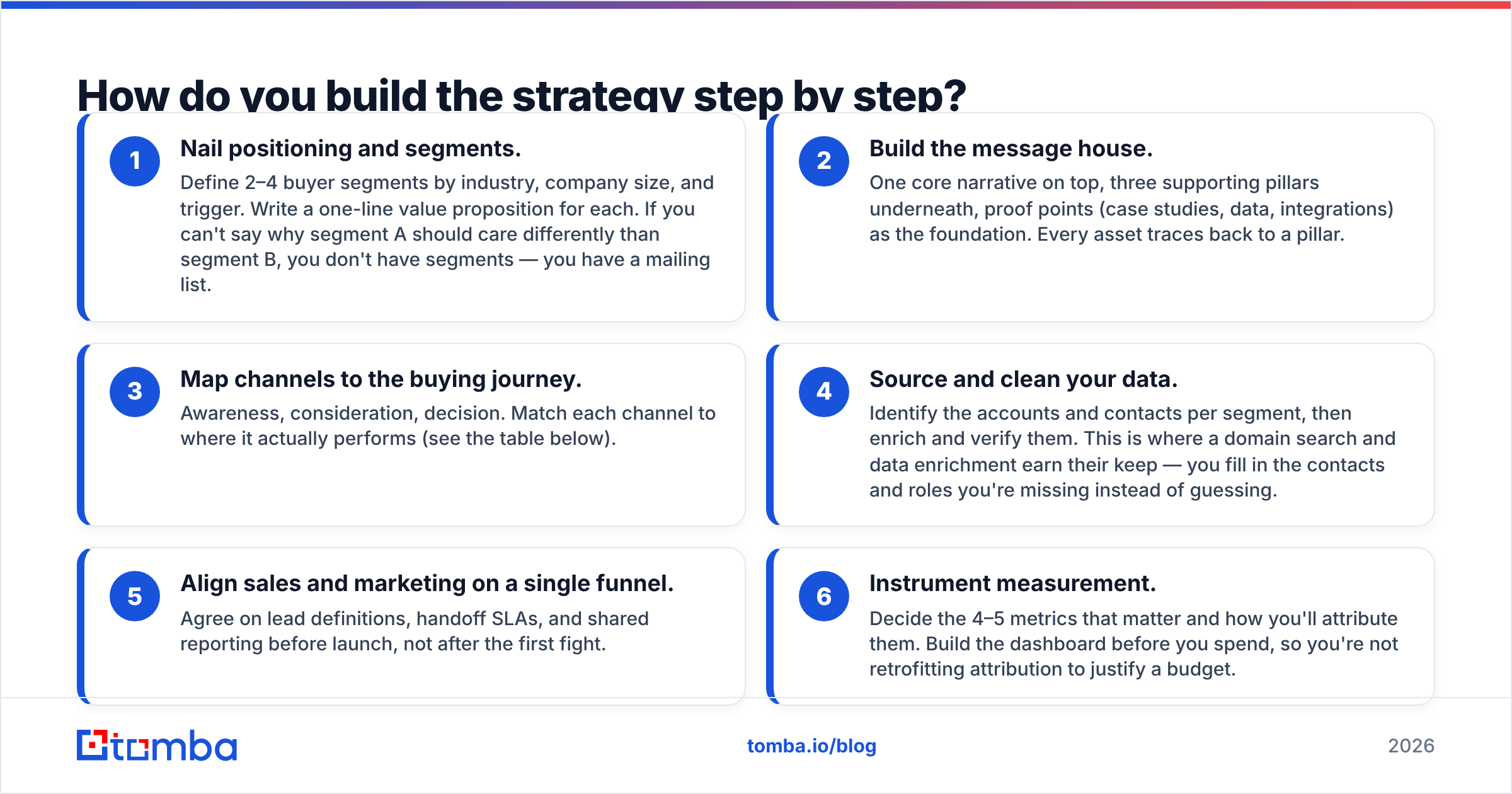
Work outside-in: positioning first, data and measurement last. Here is the sequence.
- Nail positioning and segments. Define 2–4 buyer segments by industry, company size, and trigger. Write a one-line value proposition for each. If you can't say why segment A should care differently than segment B, you don't have segments — you have a mailing list.
- Build the message house. One core narrative on top, three supporting pillars underneath, proof points (case studies, data, integrations) as the foundation. Every asset traces back to a pillar.
- Map channels to the buying journey. Awareness, consideration, decision. Match each channel to where it actually performs (see the table below).
- Source and clean your data. Identify the accounts and contacts per segment, then enrich and verify them. This is where a domain search and data enrichment earn their keep — you fill in the contacts and roles you're missing instead of guessing.
- Align sales and marketing on a single funnel. Agree on lead definitions, handoff SLAs, and shared reporting before launch, not after the first fight.
- Instrument measurement. Decide the 4–5 metrics that matter and how you'll attribute them. Build the dashboard before you spend, so you're not retrofitting attribution to justify a budget.
A quick gut check: if a new hire read your strategy doc, could they write an on-brand email to the right segment without asking you? If not, the doc isn't finished.
Which channels belong in a B2B communication mix?#
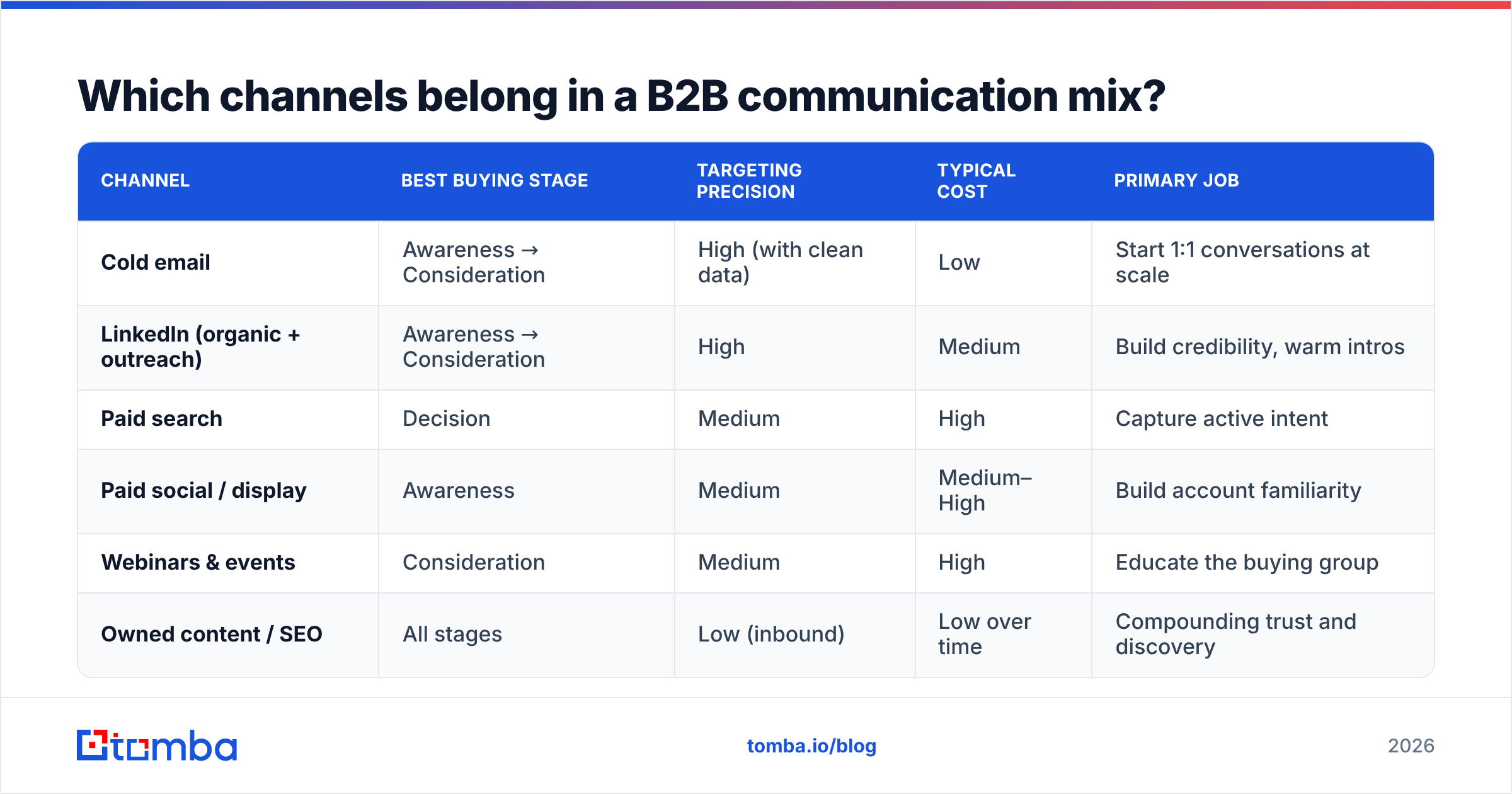
It depends on your segments and cycle length, but the channel's job changes by buying stage. Here's how the main B2B channels compare on the attributes that decide where they fit.
| Channel | Best buying stage | Targeting precision | Typical cost | Primary job |
|---|---|---|---|---|
| Cold email | Awareness → Consideration | High (with clean data) | Low | Start 1:1 conversations at scale |
| LinkedIn (organic + outreach) | Awareness → Consideration | High | Medium | Build credibility, warm intros |
| Paid search | Decision | Medium | High | Capture active intent |
| Paid social / display | Awareness | Medium | Medium–High | Build account familiarity |
| Webinars & events | Consideration | Medium | High | Educate the buying group |
| Owned content / SEO | All stages | Low (inbound) | Low over time | Compounding trust and discovery |
Notice cold email's targeting precision is gated on "clean data." That dependency runs through the whole mix — every outbound channel degrades when the underlying contact records are wrong. According to HubSpot research on B2B trends, personalization and data quality are consistently among the strongest predictors of campaign performance, which is why the unglamorous data layer deserves a line item.
For most B2B teams in 2026, the highest-leverage combination is owned content for compounding inbound, plus precise cold email and LinkedIn for outbound — with paid used surgically to capture decision-stage intent rather than as a top-of-funnel firehose.
How do you align sales and marketing communication?#
Define the funnel together and report on it together — that one move fixes more than any tool. Misalignment isn't a personality problem; it's a definitions problem.
Build alignment on four agreements:
- Shared lead definitions. Write down exactly what makes a contact an MQL versus an SQL. Reference a common standard like the marketing qualified lead definition so both teams use the same words.
- Handoff SLAs. Marketing commits to lead quality and volume; sales commits to follow-up speed and feedback. Put numbers on both.
- Closed-loop feedback. Sales tells marketing which leads converted and which were junk, monthly. That signal retrains targeting.
- One dashboard. Pipeline influenced and win rate, visible to both teams, sourced from the same CRM. When the revenue operations team owns a single source of truth, the finger-pointing stops.
Forrester and others have long argued that tightly aligned revenue teams grow meaningfully faster than misaligned ones; whatever the exact figure, the mechanism is obvious — fewer dropped leads, consistent messaging, and faster cycle times.
What role does data play in the strategy?#
Data is the floor your entire strategy stands on. Every channel decision, every personalization line, every attribution report assumes the underlying contact data is accurate. When it isn't, you optimize on noise.
Three data jobs your strategy must specify:
- Coverage. Do you have the right contacts at the right accounts? An email finder and LinkedIn finder close the gaps where you have a company but not the people.
- Accuracy. Are those records still valid? Verify before every major send to protect sender reputation and keep your deliverability healthy.
- Enrichment. Do you have the context — title, seniority, tech stack — to personalize? Enrichment turns a bare email into a segment-aware message.
This is the difference between a strategy that scales and one that stalls. Clean, enriched data lets you run precise 1:1 communication at the volume B2B pipeline demands. You can validate the size and quality of your reachable audience using a B2B database and connect it to your stack through the Tomba API so the data layer feeds every channel automatically.
How do you measure a B2B communication strategy?#
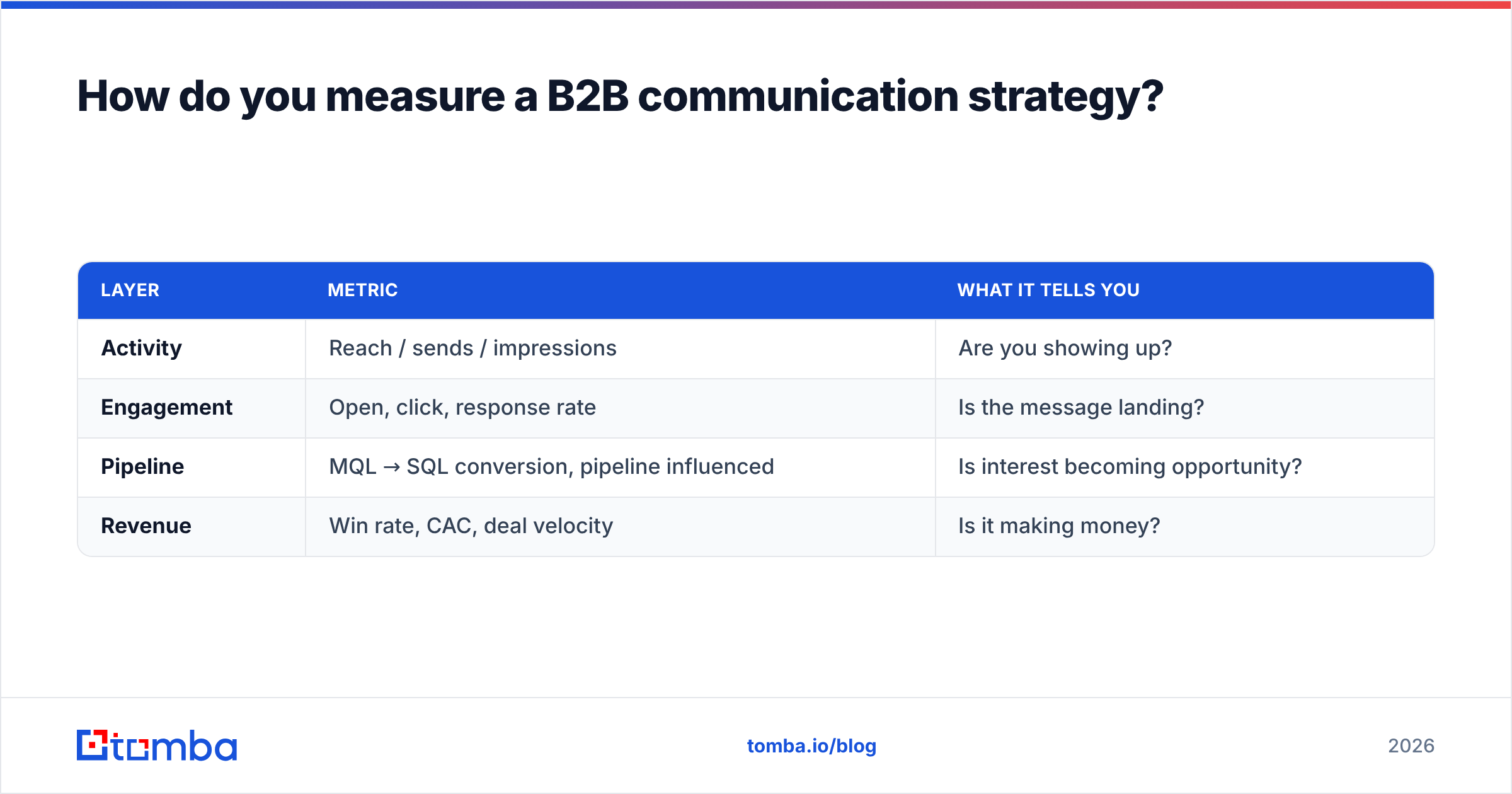
Track a short stack of metrics that ladders from activity to revenue — and ruthlessly ignore vanity numbers in between.
| Layer | Metric | What it tells you |
|---|---|---|
| Activity | Reach / sends / impressions | Are you showing up? |
| Engagement | Open, click, response rate | Is the message landing? |
| Pipeline | MQL → SQL conversion, pipeline influenced | Is interest becoming opportunity? |
| Revenue | Win rate, CAC, deal velocity | Is it making money? |
The discipline is to read these as a chain. High reach but low engagement means your targeting or message is off. Strong engagement but weak pipeline means a sales-handoff or qualification problem. Healthy pipeline but poor win rate means you're attracting the wrong accounts. Each break points to a different fix, and you can't see the break without the full ladder.
Review the stack quarterly. Any channel that hasn't influenced pipeline in a quarter gets cut or fixed — no sentimental budget.
How is AI changing B2B communication in 2026?#
AI is compressing the cost of personalization and research, not replacing strategy. The teams winning with it use AI to do the tedious 80% — drafting variants, summarizing account research, scoring intent — while humans own positioning and judgment.
Practical, defensible uses today:
- Research at scale. Summarize an account's recent news, hiring, and tech stack before outreach.
- Message variants. Generate first-draft email and ad variants per segment, then edit for voice.
- Lead scoring. Rank contacts by fit and intent so reps work the best ones first.
- Data hygiene. Automate enrichment and verification on every new record entering the CRM.
What AI does not do is decide who you're for or why you win. Feed a model a vague strategy and it will produce vague output faster. The advantage still goes to teams with crisp positioning and clean data — AI just lets them execute that advantage at higher volume.
Common mistakes to avoid#
- Buying tools before writing the strategy. A sequencer can't fix a missing message.
- Treating all segments the same. One generic narrative insults everyone equally.
- Skipping data validation. Bounces and dead records cap every channel.
- Measuring activity, not pipeline. Sends feel productive; revenue is the point.
- Setting it and forgetting it. Markets, lists, and competitors move. Review quarterly.
Where Tomba fits#
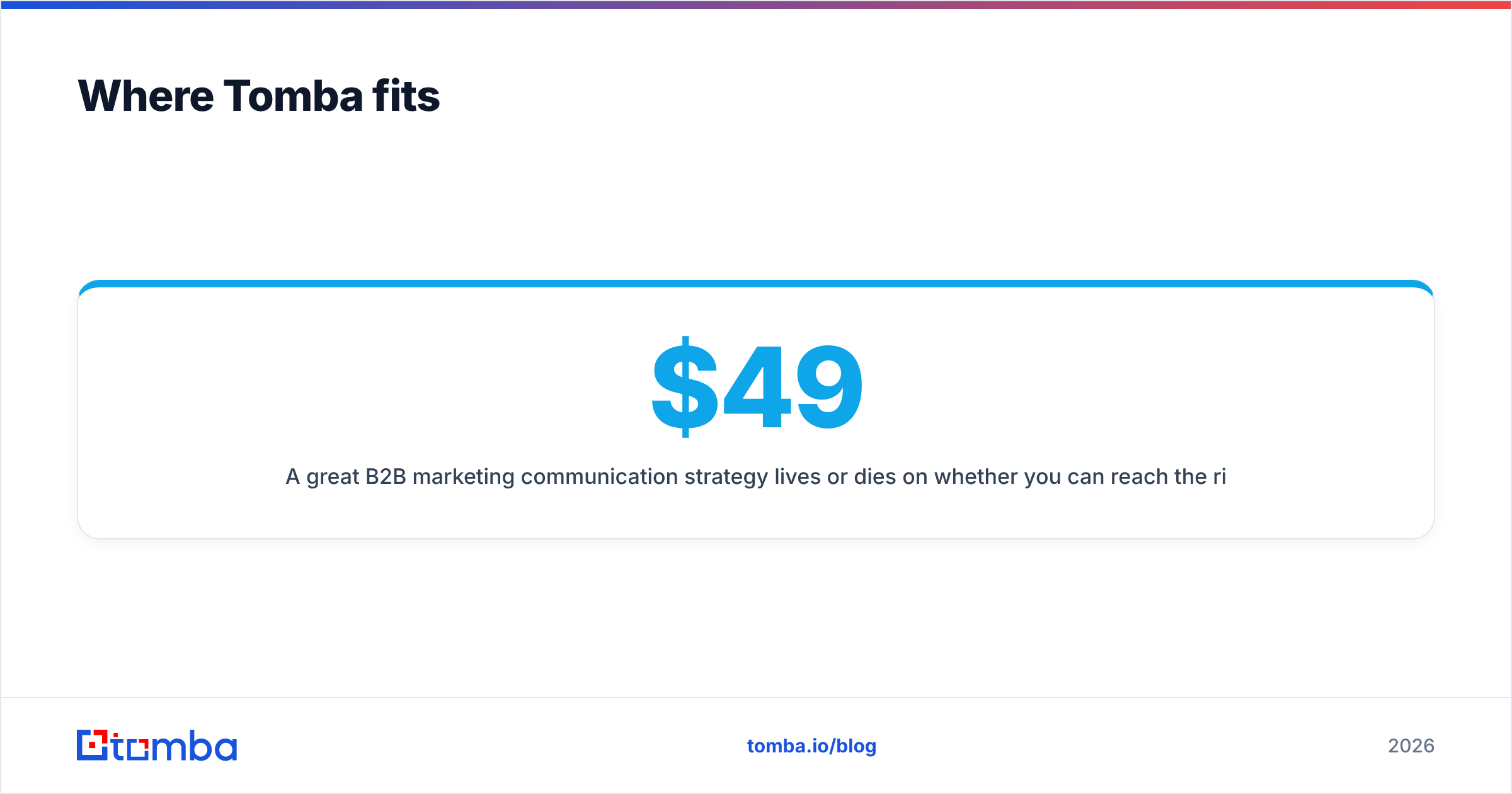
A great B2B marketing communication strategy lives or dies on whether you can reach the right people with accurate, enriched contact data — and that's exactly the layer Tomba handles. Use the Tomba Email Finder to find verified professional emails by name, company, or domain, then verify and enrich those records before they enter your campaigns. Plans start with a free tier (25 searches/month) and scale through Starter at $49/mo, Growth at $99/mo, and Pro at $249/mo — see full Tomba pricing for details. Get your data layer right, and every channel in your strategy starts performing closer to its ceiling.
Ready to find emails that actually work?
Join 150,000+ professionals who stopped guessing and started sending. Free credits on signup — no credit card required.
Get the Tomba newsletter
Practical outbound tactics and product updates — once every two weeks.
About the author