B2B Marketing Data in 2026: Sources, Accuracy & Buyer Guide
What B2B marketing data actually is, where it comes from, why it decays, and how to buy accurate, compliant data in 2026 without burning your sender reputation.
B2B marketing data is the fuel behind every outbound campaign, ABM play, and revenue forecast you run. It is also the single most under-managed asset in most go-to-market teams: bought in bulk, loaded once, and left to rot. This guide breaks down what the data actually is, where it comes from, how fast it decays, and how to buy it in 2026 without torching your deliverability or your compliance posture.
TL;DR#
- B2B marketing data = the contact, company, and intent records you use to target, segment, and reach business buyers. It splits into firmographic, contact, technographic, and intent layers.
- Accuracy is the whole game. A list that is 80% deliverable beats a "10M record" dump that bounces half the time and gets your domain blocklisted.
- It decays fast — roughly 22–30% of B2B contact data goes stale every year as people change jobs. Treat data as a subscription, not a purchase.
- Compliance is non-negotiable in 2026: GDPR, CCPA/CPRA, and CAN-SPAM all shape what you can collect and how you can use it.
- Verify before you send. Pair a sourcing tool with an email verifier so you only contact addresses that actually resolve.
What is B2B marketing data?#
B2B marketing data is information about businesses and the people who work at them, used to find, qualify, and contact potential buyers. Think of it like a contact book for an entire market — except a contact book you wrote yourself stays accurate, while a market-wide one is being rewritten every day as people get promoted, switch companies, and rebrand.
It is not one thing. It is four distinct layers that you assemble depending on what you are trying to do:
- Firmographic data — company-level attributes: industry, employee count, revenue, location, funding stage. This is how you build a target account list.
- Contact data — the people: name, title, work email, phone, LinkedIn URL. This is how you actually reach a human.
- Technographic data — the tools a company runs (CRM, cloud provider, analytics stack). This is how you find accounts that already use a complementary or competing product.
- Intent data — behavioral signals that an account is researching a problem you solve, sourced from content consumption and search activity.
A healthy B2B database blends all four so you can move from "10,000 companies in our TAM" to "37 accounts showing buying intent, with verified contacts for the economic buyer."
Where does B2B marketing data come from?#
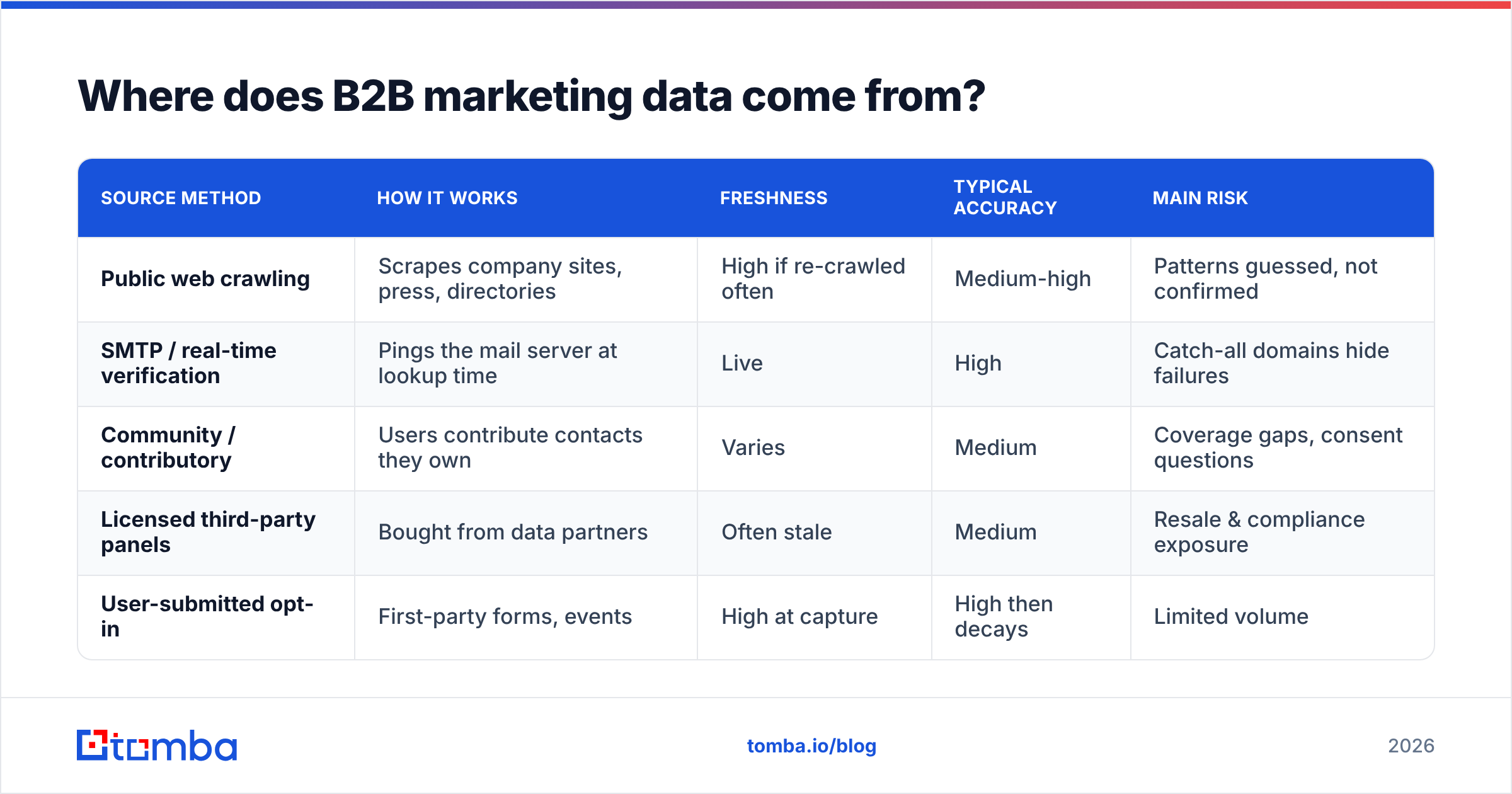
Providers assemble data from a handful of repeatable sources, and the mix matters more than the marketing copy on the pricing page. Here is how the common sourcing methods compare.
| Source method | How it works | Freshness | Typical accuracy | Main risk |
|---|---|---|---|---|
| Public web crawling | Scrapes company sites, press, directories | High if re-crawled often | Medium-high | Patterns guessed, not confirmed |
| SMTP / real-time verification | Pings the mail server at lookup time | Live | High | Catch-all domains hide failures |
| Community / contributory | Users contribute contacts they own | Varies | Medium | Coverage gaps, consent questions |
| Licensed third-party panels | Bought from data partners | Often stale | Medium | Resale & compliance exposure |
| User-submitted opt-in | First-party forms, events | High at capture | High then decays | Limited volume |
The strongest providers combine crawling for coverage with real-time verification for accuracy, then re-check records on a schedule. If a vendor cannot tell you when a record was last verified, treat the "accuracy %" on their homepage as marketing, not measurement. You can read how Tomba approaches this on its data sources page.
Why does B2B marketing data decay so fast?#
Because the people in it keep moving. The headline number cited across the industry — popularized by vendors like ZoomInfo and echoed in HubSpot's research — is that B2B databases degrade by roughly 22.5% to 30% per year. Average job tenure in many sales and marketing roles is under three years, and every departure breaks the work email, the direct dial, and often the reporting line you targeted.
The practical consequences:
- A list bought 12 months ago is already ~25% wrong. Sending to it produces hard bounces.
- Hard bounces wreck sender reputation. Mailbox providers read a high bounce rate as a spam signal, which drags down inbox placement for your good contacts too.
- Segmentation rots silently. A VP you tagged as a decision-maker may have left; the title is now held by someone who never heard of you.
This is why mature teams treat data as a flow, not a stock. They re-verify before each major send and enrich on an ongoing basis rather than buying one giant file. If you want the mechanics of how stale addresses hurt you, the glossary entry on email deliverability is a good primer.
How do you measure B2B data quality?#
Conclusion first: judge a dataset on five dimensions, and weight accuracy and deliverability above raw volume every time.
- Accuracy — does the record match reality right now? Verified work email, correct current title.
- Coverage — what share of your target market does the provider actually have?
- Completeness — how many fields are filled per record (email + phone + LinkedIn beats email-only)?
- Freshness — when was each record last confirmed?
- Compliance — is the data lawfully sourced and usable for outreach in your regions?
A 50,000-record list at 95% deliverability is worth far more than a 500,000-record list at 60%. The big list looks better in a spreadsheet and performs worse in every metric that matters: bounce rate, reply rate, and domain health. Run new data through an email verifier and check catch-all domains with a catch-all verifier before it ever touches your sequencer.
Build vs. buy: should you source your own B2B data?#
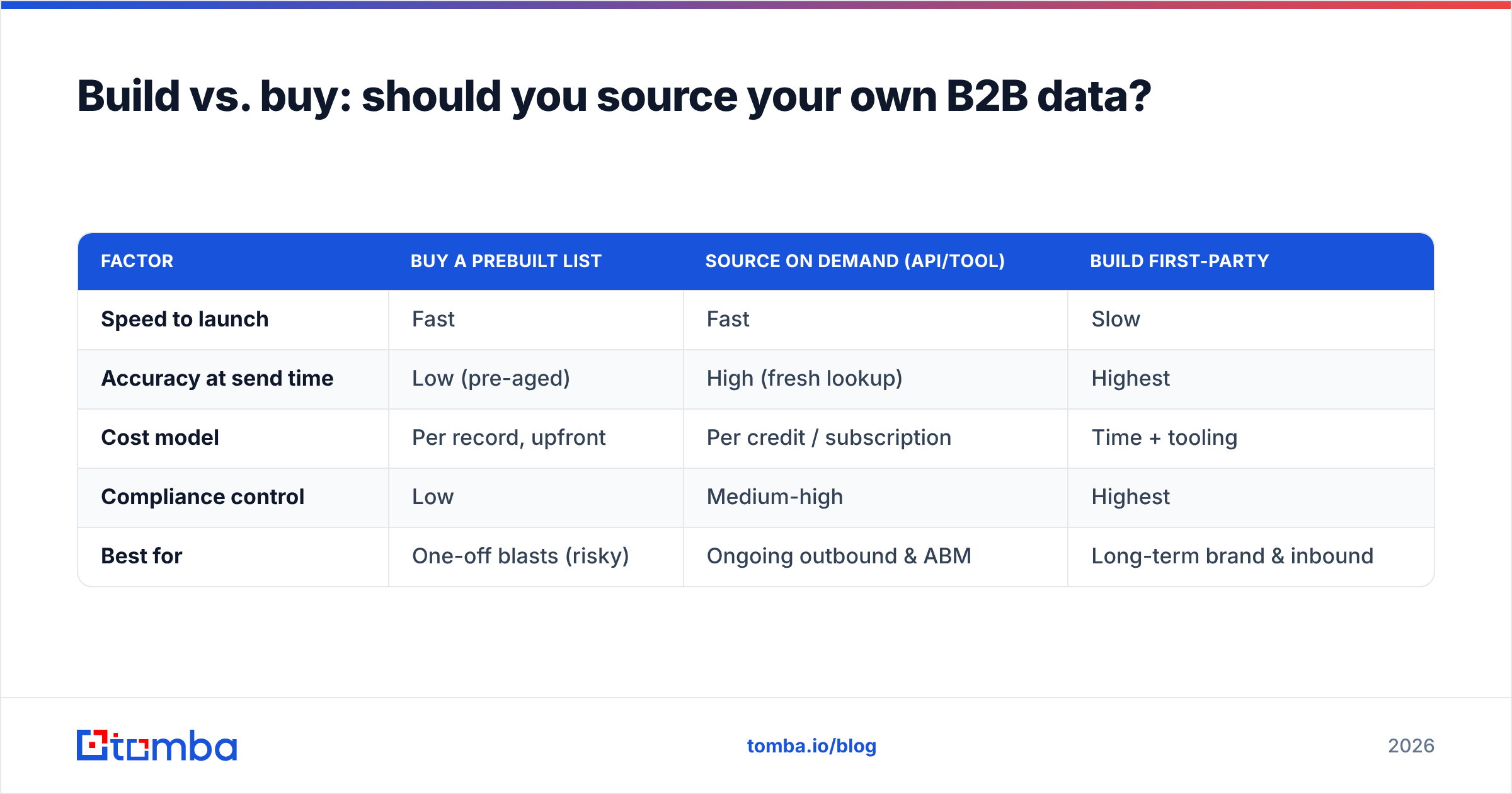
You will end up doing both, but the split depends on your motion. Here is the honest trade-off.
| Factor | Buy a prebuilt list | Source on demand (API/tool) | Build first-party |
|---|---|---|---|
| Speed to launch | Fast | Fast | Slow |
| Accuracy at send time | Low (pre-aged) | High (fresh lookup) | Highest |
| Cost model | Per record, upfront | Per credit / subscription | Time + tooling |
| Compliance control | Low | Medium-high | Highest |
| Best for | One-off blasts (risky) | Ongoing outbound & ABM | Long-term brand & inbound |
For most teams running continuous outbound, on-demand sourcing wins. You pull verified contacts as you need them — by company, by role, by domain search — instead of betting on a static file that ages from the moment you download it. Prebuilt lists make sense only when the source is reputable and recently verified, and even then you re-check before sending.

How do you stay compliant with B2B marketing data in 2026?#
Compliance is not optional, and the rules differ by region. You do not need a law degree, but you do need to know which regime applies to each contact.
- GDPR (EU/UK) — you generally need a lawful basis (often legitimate interest for B2B prospecting) and must honor opt-outs and data-subject requests. Document why you hold each record.
- CCPA / CPRA (California) — gives consumers rights to know, delete, and opt out of "sale/sharing." B2B contacts are increasingly in scope.
- CAN-SPAM (US email) — requires a clear sender identity, a real physical address, and a working unsubscribe in every commercial email.
Two practical rules keep you safe: only contact people for genuinely relevant business reasons, and make opt-out effortless. A provider that can show lawful sourcing reduces your exposure — you inherit some of their compliance posture. The U.S. Federal Trade Commission's CAN-SPAM compliance guide is the canonical reference for the email side, and G2's category reviews are a useful sanity check on how vendors handle consent in practice.
How do you turn B2B data into pipeline?#
Data is inert until it is wired into a workflow. The repeatable loop that high-performing teams run looks like this:
- Define the ICP in firmographic terms — industry, size, region, tech stack. This becomes your filter.
- Pull target accounts, then layer intent so you work the accounts that are actually in-market.
- Find verified contacts for each buying-committee role with an email finder, capturing email, phone, and LinkedIn.
- Verify and dedupe before loading — bounce-prone records never reach the sequencer.
- Enrich and sync to CRM so reps see complete records, not half-empty rows. Tomba's HubSpot integration and Salesforce integration push clean data straight into the pipeline.
- Re-verify on a cadence — monthly for active lists — to fight the decay curve.
Run this loop continuously and your data quality compounds instead of degrades. For larger pulls, a bulk email finder lets you process whole account lists at once rather than one contact at a time, and the Tomba API lets you bake the same steps into your own product or RevOps stack.
What does good B2B marketing data cost?#
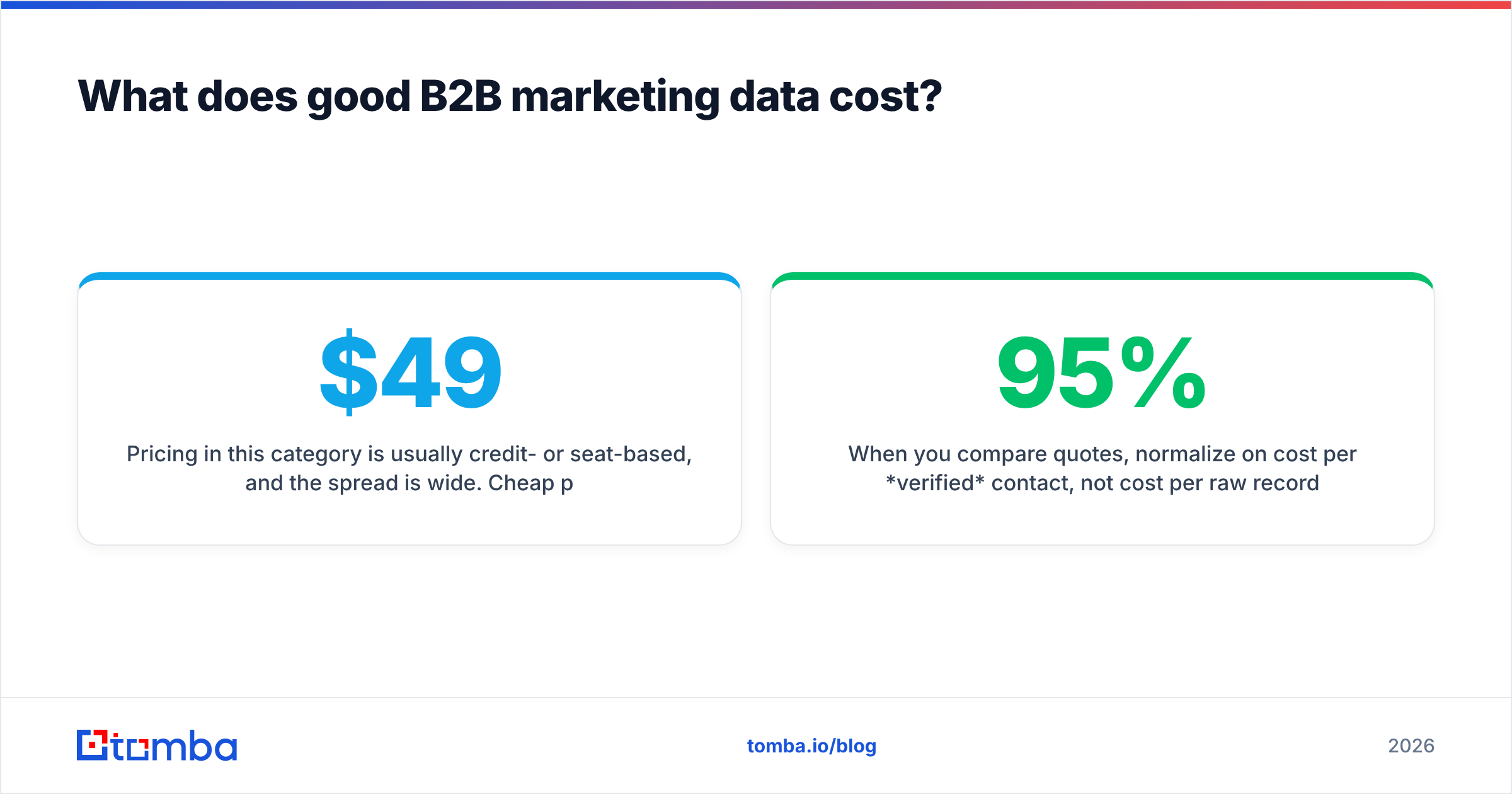
Pricing in this category is usually credit- or seat-based, and the spread is wide. Cheap providers tend to be cheap because the data is old or unverified — you pay the real cost later in bounces and blocklisting. As a reference point, Tomba pricing runs a Free tier (25 searches/month), Starter at $49/mo, Growth at $99/mo, Pro at $249/mo, and custom Enterprise plans, with verification included rather than billed as a separate add-on.
When you compare quotes, normalize on cost per verified contact, not cost per raw record. A provider charging more per credit but delivering 95% accuracy is usually cheaper per usable contact than a "bulk" vendor at a fraction of the price.
What should you look for in a B2B data provider?#
- Real-time verification, not a stale snapshot.
- Transparent sourcing you can explain to your legal team.
- Coverage in your specific market — test it with your own ICP before committing.
- Native CRM and tooling integrations so data flows without CSV gymnastics.
- A free tier or trial so you can measure deliverability on your data before you pay.
- Multiple data types — email, phone, and enrichment from one source beats stitching three vendors together.
The bottom line#
B2B marketing data wins or loses on accuracy and freshness, not volume. Buy for deliverability, verify before every send, and treat your database as a living system you maintain — not a file you download once. The teams that do this keep their sender reputation intact and their pipeline full; the teams that chase the biggest record count end up in the spam folder.
Ready to build lists that actually land? Start with the Tomba Email Finder — search by name, company, or domain, get verified work emails with confidence scores, and push them straight into your CRM. Spin up the free tier (25 searches a month, no card) and measure the deliverability against whatever you are using now. Let the bounce rate decide.
// get started
Find, verify and enrich your first contacts today
Start on the free plan with 25 searches a month, then scale when your team is ready.
Free plan · No credit card required · GDPR & CCPA
// about the author