B2B Marketing for Software Companies: 2026 Channel Playbook
A concrete 2026 playbook for B2B marketing at software companies: which channels pay back, how to build pipeline, and the data layer that makes it all work.
TL;DR
- B2B marketing for software companies is different from generic B2B: long buying committees, free trials and PLG motions, and a product that sells itself only after the right people see it.
- The channels that pay back in 2026 are narrower than the menu most teams chase. Content + SEO, founder-led social, integrations/partnerships, and tightly targeted outbound beat broad paid spend for most SaaS at sub-$50M ARR.
- Demand generation (creating awareness) and lead generation (capturing intent) are not the same job. You need both, sequenced correctly.
- Every channel breaks without a clean contact-data layer. Bad emails sink deliverability, waste SDR hours, and corrupt attribution.
- Pipeline is a math problem: traffic → MQL → SQL → opportunity → win. Fix the worst-converting stage first, not the loudest one.
What makes B2B marketing for software companies different?#
Software is bought by committees, not people. The conclusion first: your marketing has to reach 6–10 stakeholders per deal, each with a different question, and your job is to give the champion enough ammunition to sell internally on your behalf.
Think of it like equipping a lawyer for a trial you can't attend. You hand your champion the evidence — ROI numbers, security docs, a reference customer — and they argue the case in rooms you'll never enter. Generic "thought leadership" doesn't win that trial; specific proof does.
Three structural traits separate SaaS marketing from the rest of B2B:
- Product-led motions exist. Free trials, freemium tiers, and self-serve checkout mean the product is a marketing channel. A confused onboarding flow costs you more pipeline than a bad ad.
- The buying committee is large and technical. A developer, a VP, a security reviewer, and a finance gatekeeper all touch the deal. Each needs different content.
- Switching costs and integrations dominate. Buyers ask "does it connect to my stack?" before "is it cheap?" Your integrations page is a sales asset.
If you treat a software buyer like a one-person impulse purchase, you optimize the wrong things. The whole funnel has to assume a group decision made over weeks.
Which marketing channels actually pay back for SaaS?#
Start with the conclusion: for most software companies under $50M ARR, owned channels (content, SEO, product, community) and partnerships out-earn broad paid media. Paid works, but as an amplifier on a message that already converts organically — not as the thing that finds product-market fit for you.
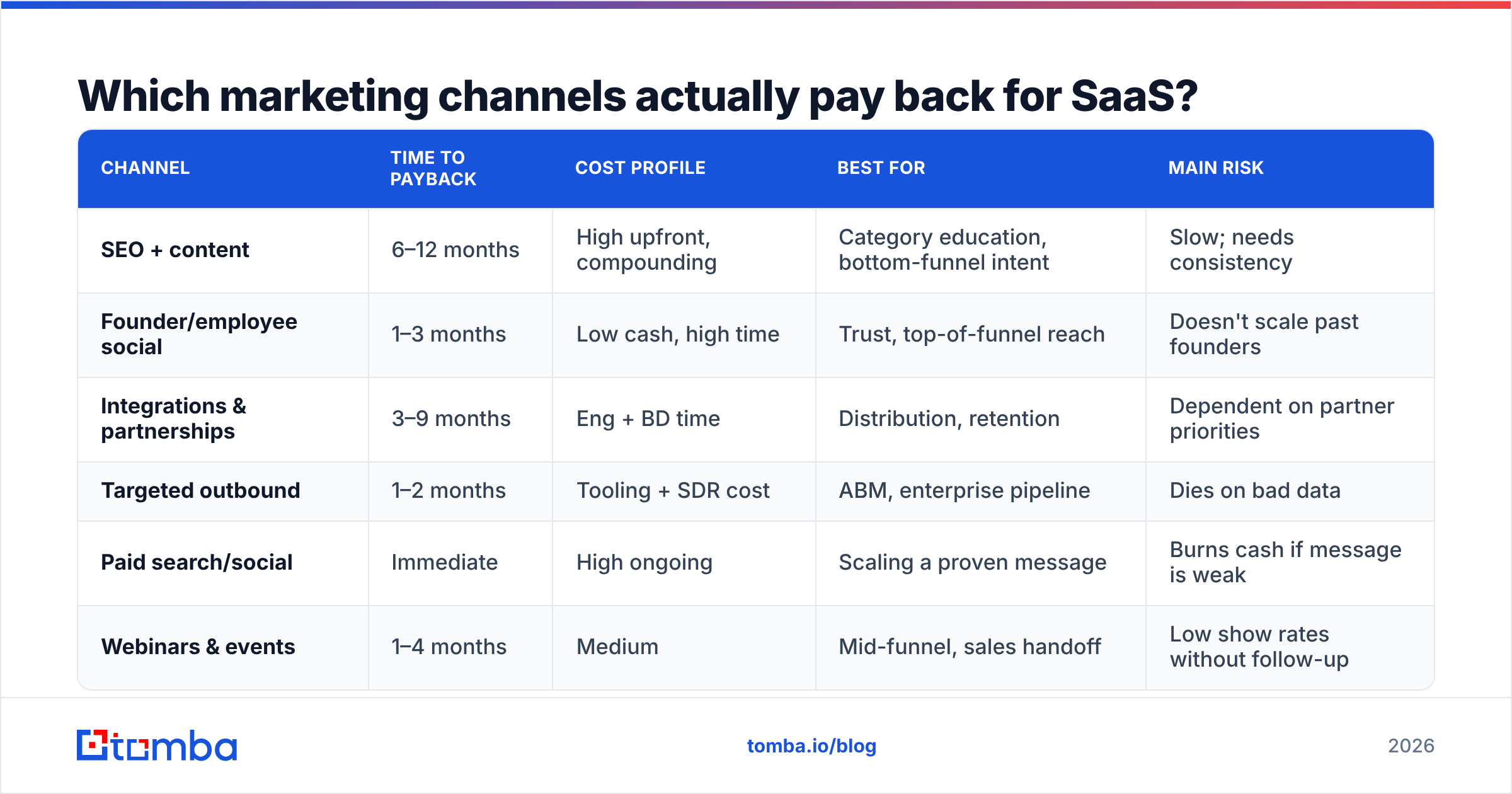
Here's how the main channels compare on the dimensions that matter for a 2026 SaaS budget.
| Channel | Time to payback | Cost profile | Best for | Main risk |
|---|---|---|---|---|
| SEO + content | 6–12 months | High upfront, compounding | Category education, bottom-funnel intent | Slow; needs consistency |
| Founder/employee social | 1–3 months | Low cash, high time | Trust, top-of-funnel reach | Doesn't scale past founders |
| Integrations & partnerships | 3–9 months | Eng + BD time | Distribution, retention | Dependent on partner priorities |
| Targeted outbound | 1–2 months | Tooling + SDR cost | ABM, enterprise pipeline | Dies on bad data |
| Paid search/social | Immediate | High ongoing | Scaling a proven message | Burns cash if message is weak |
| Webinars & events | 1–4 months | Medium | Mid-funnel, sales handoff | Low show rates without follow-up |
The pattern: cheap-to-start channels (social, outbound) give you fast signal on messaging, while compounding channels (SEO, partnerships) build a moat that paid spend can't replicate. Sequence them — use fast channels to learn what resonates, then pour content and paid behind the winners.
A practical rule for 2026: if you can't explain in one sentence why a prospect should care, no channel will save you. Channels distribute clarity; they don't create it.
Demand generation vs lead generation: what's the difference?#
The short version: demand generation makes people want what you sell; lead generation captures the ones who already do. Conflating them is the most common reason SaaS pipelines stall.
- Demand gen is the podcast, the LinkedIn post, the free tool, the comparison guide. It's measured in reach, branded search lift, and "how did you hear about us." It rarely fills a form today.
- Lead gen is the gated report, the demo request, the trial signup, the outbound sequence. It's measured in MQLs and meetings booked.
Most teams over-invest in lead gen forms and under-invest in demand. The result is a small pool of in-market buyers fought over by every competitor, while the 95% who aren't ready yet never hear your name. Flip it: spend enough on demand that your branded search and direct traffic grow quarter over quarter, then let lead gen harvest the demand you created.
A useful gut check borrowed from the revenue operations discipline: if your "leads" are all bottom-funnel and your pipeline is still flat, you have a demand problem, not a conversion problem.
How do you build a SaaS pipeline that converts?#
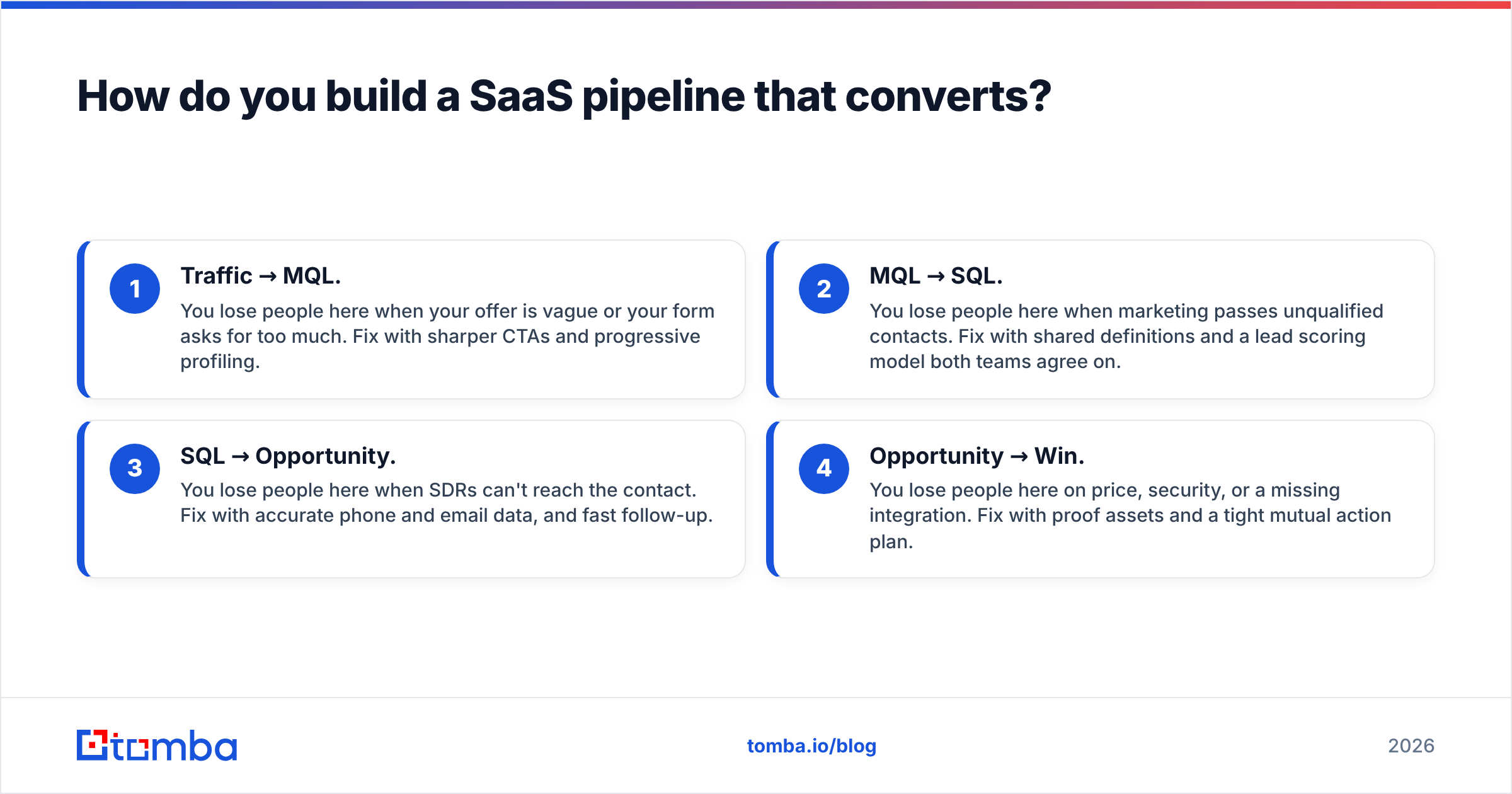
Pipeline is arithmetic. Conclusion first: find your worst-converting stage and fix that one, because the funnel is only as strong as its leakiest joint.
A simplified SaaS funnel and where teams typically lose deals:
- Traffic → MQL. You lose people here when your offer is vague or your form asks for too much. Fix with sharper CTAs and progressive profiling.
- MQL → SQL. You lose people here when marketing passes unqualified contacts. Fix with shared definitions and a lead scoring model both teams agree on.
- SQL → Opportunity. You lose people here when SDRs can't reach the contact. Fix with accurate phone and email data, and fast follow-up.
- Opportunity → Win. You lose people here on price, security, or a missing integration. Fix with proof assets and a tight mutual action plan.
The discipline that ties this together is making each handoff measurable. Marketing should know its SQL-acceptance rate. Sales should know which campaigns produce closed revenue, not just clicks. That feedback loop is what separates a SaaS team that compounds from one that reruns the same campaign hoping for a different number.
According to widely cited benchmarks from firms like Gartner and peer-review data on G2, the average B2B software buyer spends only a sliver of their journey talking to vendors — most of it is self-directed research. That means your public, ungated content is doing the early selling whether you measure it or not.
Why does data quality decide your marketing ROI?#
Plainly: every channel above runs on contact data, and bad data taxes all of them at once. It's like building a high-end kitchen and piping in dirty water — the equipment doesn't matter if the input is contaminated.
Here's how data quality silently drains a software marketing budget:
- Deliverability collapse. Send to stale or invalid addresses and your bounce rate spikes, your domain reputation drops, and even your good emails land in spam. Protect it with proper email verification before any send.
- Wasted SDR capacity. A rep who spends half their day hunting for a working email is a rep not booking meetings. Accurate data is the cheapest productivity gain available.
- Broken attribution. Duplicate and mismatched records make it impossible to know which campaign actually drove revenue, so you keep funding the wrong channel.
- ABM that misfires. Account-based plays depend on reaching named people at named accounts. Miss the contact and the whole motion is theater.
This is the unglamorous layer that compounds. Two software companies can run identical campaigns; the one with clean, verified, enriched contact data will see double the reply rates and far better email deliverability — not because their copy is better, but because their messages actually arrive at real inboxes belonging to real buyers.
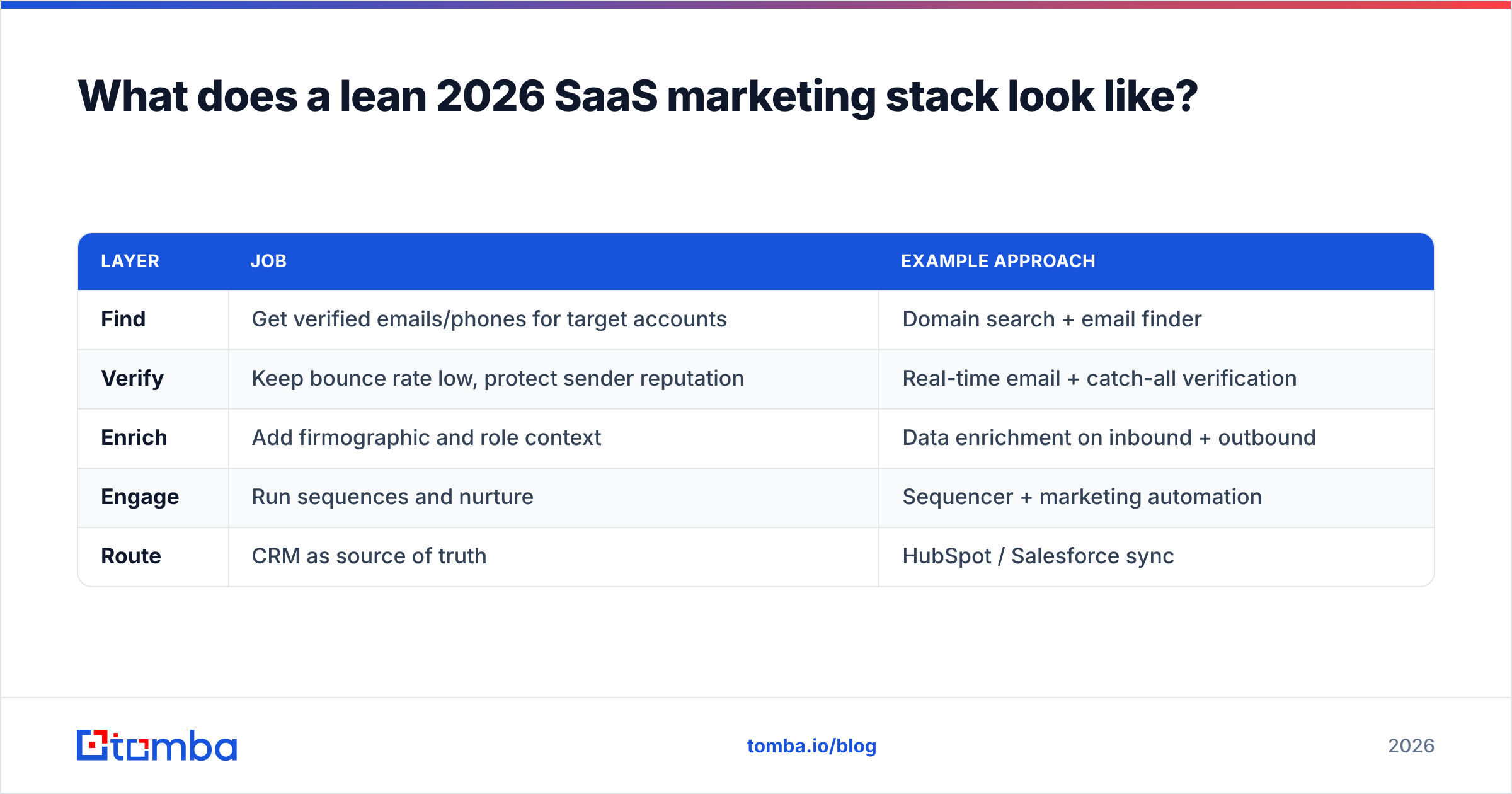
What does a lean 2026 SaaS marketing stack look like?#
You don't need 40 tools. You need a clean spine: a way to find buyers, verify you can reach them, enrich what you know, and route it into your CRM and sequencer. Here's a minimal stack and what each layer does.
| Layer | Job | Example approach |
|---|---|---|
| Find | Get verified emails/phones for target accounts | Domain search + email finder |
| Verify | Keep bounce rate low, protect sender reputation | Real-time email + catch-all verification |
| Enrich | Add firmographic and role context | Data enrichment on inbound + outbound |
| Engage | Run sequences and nurture | Sequencer + marketing automation |
| Route | CRM as source of truth | HubSpot / Salesforce sync |
The principle is "many small reliable pieces over one bloated platform." Each layer should do one job well and hand clean data to the next. When the find-and-verify layer is solid, everything downstream — sequencing, scoring, attribution — gets easier and cheaper. When it's weak, you spend the rest of the year patching symptoms.
For software teams especially, wire this spine directly into the product. A trial signup should trigger enrichment so sales sees the account's size and stack before the first call. An anonymous visitor on your pricing page is a signal worth identifying. The companies that win in 2026 close the loop between product behavior and marketing data, instead of treating them as separate systems.
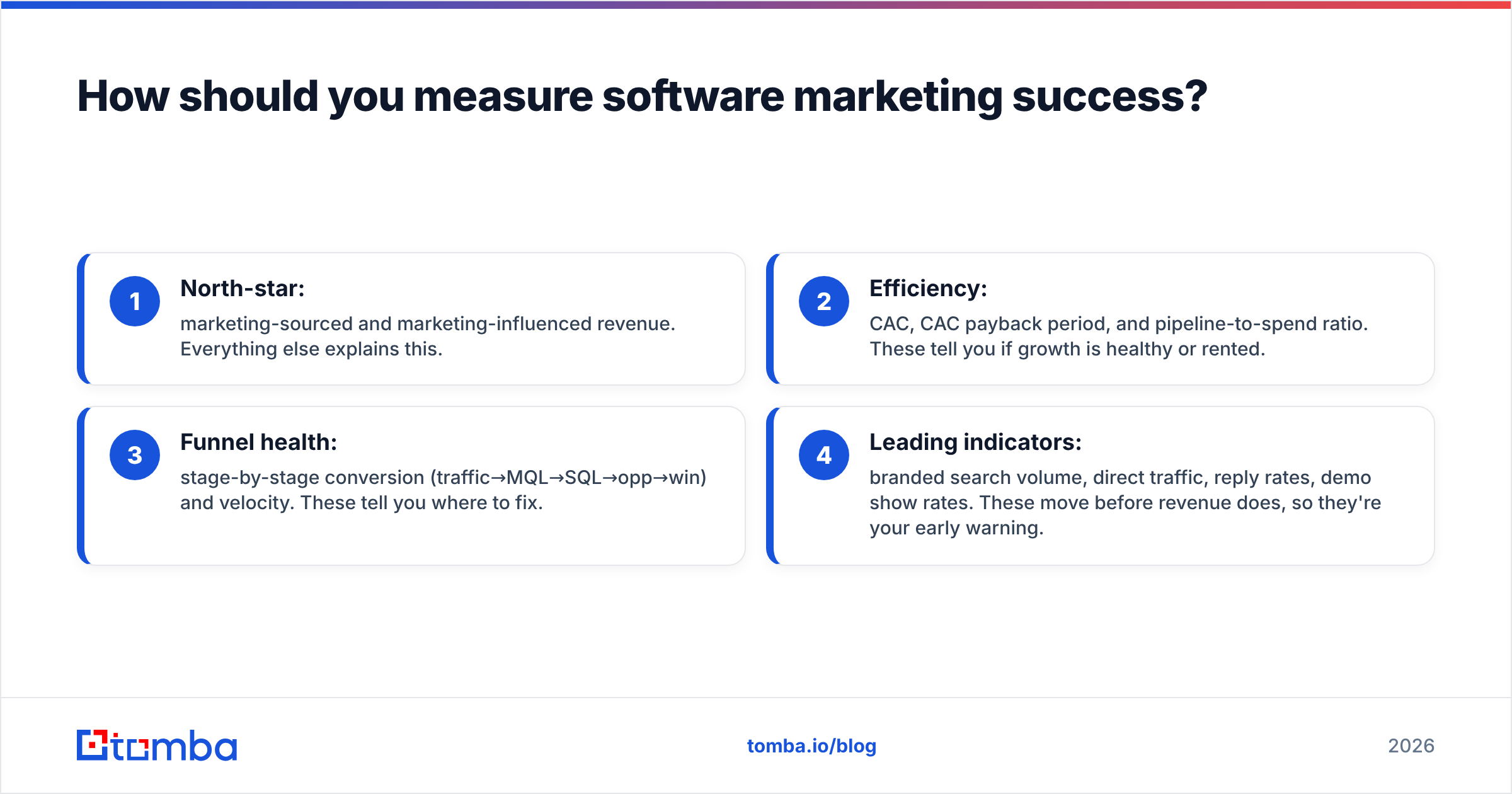
How should you measure software marketing success?#
Lead with the number that pays salaries: pipeline and revenue influenced, not vanity reach. Conclusion first, then the supporting metrics.
Track these in tiers so you can diagnose, not just report:
- North-star: marketing-sourced and marketing-influenced revenue. Everything else explains this.
- Efficiency: CAC, CAC payback period, and pipeline-to-spend ratio. These tell you if growth is healthy or rented.
- Funnel health: stage-by-stage conversion (traffic→MQL→SQL→opp→win) and velocity. These tell you where to fix.
- Leading indicators: branded search volume, direct traffic, reply rates, demo show rates. These move before revenue does, so they're your early warning.
A common 2026 mistake is optimizing for MQL volume because it's easy to grow and easy to report. But MQLs that never become revenue are a cost, not a win. Tie marketing's scorecard to the same outcomes sales is measured on — pipeline created and revenue closed — and the channel debates resolve themselves. If a channel doesn't move pipeline within its expected payback window, cut it and reallocate.
One operational tip: instrument your outbound and nurture with verified contact data from day one. You can't trust a reply-rate metric if you don't know how many of your sends ever reached a valid inbox. Clean data isn't just an input to your campaigns — it's a prerequisite for trusting your own numbers.
Putting it together: a 90-day starting plan#
If you're a software company building or rebuilding marketing in 2026, sequence it like this. In month one, nail the message and the data spine — one sentence on why you matter, plus a verified list of your top 200 target accounts. In month two, turn on your two cheapest-to-learn channels (founder social + targeted outbound) and measure reply and meeting rates. In month three, pour content and paid behind whatever message won, and formalize the marketing-to-sales handoff with shared definitions. Resist the urge to launch six channels at once; depth beats breadth until you know what converts.
Where Tomba fits#
All of the above runs on one quiet dependency: reaching the right people at the right accounts with data you can trust. That's exactly what the Tomba Email Finder is built for — find verified professional emails by domain, name, or company, then verify and enrich them before they ever hit your sequencer or CRM. The free tier gives you 25 searches a month to test it, and paid plans start at $49/mo with bulk and API access as you scale (see Tomba pricing for the full breakdown). Build your message first — then let clean, verified data make every channel in this playbook actually pay back.
// get started
Find, verify and enrich your first contacts today
Start on the free plan with 25 searches a month, then scale when your team is ready.
Free plan · No credit card required · GDPR & CCPA
// about the author