B2B Marketing Funnel in 2026: Stages, Metrics, and Fixes
A no-fluff breakdown of the B2B marketing funnel in 2026 — every stage, the metrics that matter, the leaks that kill pipeline, and how to fix them.
(rendered separately)
TL;DR
- The B2B marketing funnel is the staged path a buyer takes from first touch to closed deal — awareness, interest, consideration, intent, evaluation, and purchase — mapped to measurable handoffs between marketing and sales.
- Most funnels don't leak at the bottom; they leak at the MQL-to-SQL handoff, where bad contact data and weak qualification quietly burn budget.
- Benchmarks matter less than your own stage-to-stage conversion trend. Track movement, not vanity volume.
- A funnel is only as good as the data feeding it: invalid emails, missing roles, and stale phone numbers cap your ceiling before a single email sends.
- Fix the funnel in this order: data quality, stage definitions, qualification rules, then content — not the reverse.
What is a B2B marketing funnel?#
A B2B marketing funnel is the staged model of how a business buyer moves from "never heard of you" to "signed the contract." Think of it like an airport: every passenger passes through check-in, security, the gate, and boarding in order, and you can measure exactly how many people drop off at each checkpoint. The funnel does the same for revenue — it turns a fuzzy buying journey into countable stages you can diagnose.
Unlike B2C, the B2B funnel is rarely one person. A typical purchase involves 6–10 stakeholders, multiple touchpoints across months, and a handoff from marketing to sales somewhere in the middle. That handoff is where the funnel earns or loses its money.
The modern funnel isn't a clean linear cone, either. Buyers loop back, go dark, and re-enter. But you still need defined stages — because without them you can't tell a healthy pipeline from a stalled one, and you can't run revenue operations with any rigor.
What are the stages of the B2B marketing funnel?#
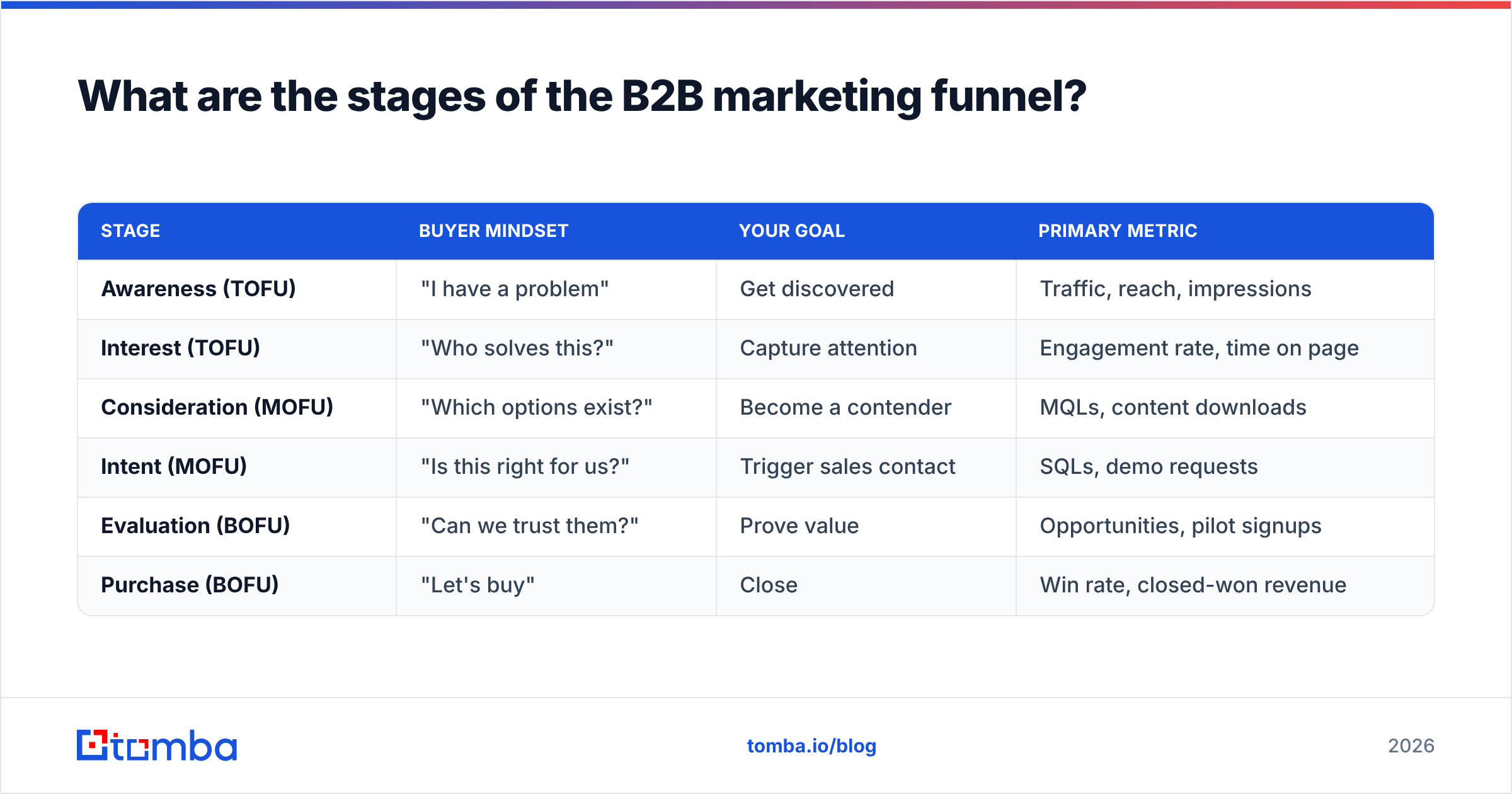
The classic split is top, middle, and bottom of funnel (TOFU, MOFU, BOFU). Here's how each stage maps to buyer intent, the goal, and the metric that tells you it's working.
| Stage | Buyer mindset | Your goal | Primary metric |
|---|---|---|---|
| Awareness (TOFU) | "I have a problem" | Get discovered | Traffic, reach, impressions |
| Interest (TOFU) | "Who solves this?" | Capture attention | Engagement rate, time on page |
| Consideration (MOFU) | "Which options exist?" | Become a contender | MQLs, content downloads |
| Intent (MOFU) | "Is this right for us?" | Trigger sales contact | SQLs, demo requests |
| Evaluation (BOFU) | "Can we trust them?" | Prove value | Opportunities, pilot signups |
| Purchase (BOFU) | "Let's buy" | Close | Win rate, closed-won revenue |
Notice the metric shifts from volume at the top to value at the bottom. A funnel reported only in traffic is a funnel nobody can fix. You need the conversion rate between stages, because that ratio is where the leaks hide.
A practical way to instrument each stage:
- Awareness — track organic and paid reach, but tag the source so you can trace which channels feed quality leads later.
- Interest — measure return visits and content depth, not just clicks. A bounce isn't interest.
- Consideration — define exactly what makes a marketing qualified lead. A vague MQL definition poisons everything downstream.
- Intent — score behavior (pricing page visits, demo views) and enrich the contact before routing to sales.
- Evaluation — give reps verified phone and email so the first outreach actually lands.
- Purchase — measure win rate by source to learn which top-of-funnel channels produce real revenue.
How is the B2B funnel different from the sales funnel?#
The marketing funnel and the sales funnel are two halves of one pipeline, joined at the handoff. Marketing owns the top — generating and nurturing demand until a lead is qualified. Sales owns the bottom — working qualified leads into opportunities and revenue.
The seam between them is the single most expensive point in B2B. When marketing throws unqualified or badly-enriched leads "over the wall," reps waste hours chasing dead contacts and stop trusting marketing-sourced leads entirely. That distrust is what kills funnels — not a lack of blog posts.
A shared definition fixes it. Marketing and sales must agree, in writing, on:
- What an MQL is — specific firmographic and behavioral thresholds, not "seems interested."
- What an SQL is — the criteria a rep uses to accept or reject the lead.
- The SLA — how fast a lead gets worked, and what happens to rejected leads (recycled, not deleted).
Get this right and your funnel stops being two teams pointing at each other. For a deeper split between the two motions, our take on the sales process and pipeline ties the qualification logic back into CRM stages.
Where do B2B marketing funnels leak the most?#
The biggest leak is almost never where teams look. Everyone obsesses over the close rate, but the data says the worst drop-off is the MQL-to-SQL conversion — the moment a marketing lead becomes a sales-accepted one.
According to widely cited industry benchmarks (HubSpot, Salesforce reporting), only a fraction of MQLs ever convert to SQLs, and a major reason is mundane: the contact data is wrong. The lead filled out a form with a personal Gmail, a typo'd work email, or a role that changed three months ago. The rep can't reach them, marks them dead, and the funnel reports a "conversion problem" that's really a data problem.
Common leaks, ranked by how much pipeline they quietly destroy:
- Invalid or unverifiable emails — outreach bounces, sender reputation drops, and the lead is unreachable. Run every captured email through an email verifier before it enters the funnel.
- Missing decision-maker context — you have one contact at a 9-person buying committee. Domain search surfaces the rest of the org so you're not selling to a single dead end.
- Stale data — people change jobs every ~2 years. A lead that converted last quarter may not exist at that company today.
- Slow handoff — speed-to-lead collapses after the first hour. If enrichment is manual, you've already lost.
- Undefined stages — if "MQL" means something different to every team, your conversion math is fiction.
How do you measure B2B marketing funnel performance?#
Measure movement between stages, not the size of any single stage. A funnel with 100,000 visitors and a 0.1% stage conversion is worse than one with 5,000 visitors converting at 3%. Volume flatters; conversion tells the truth.
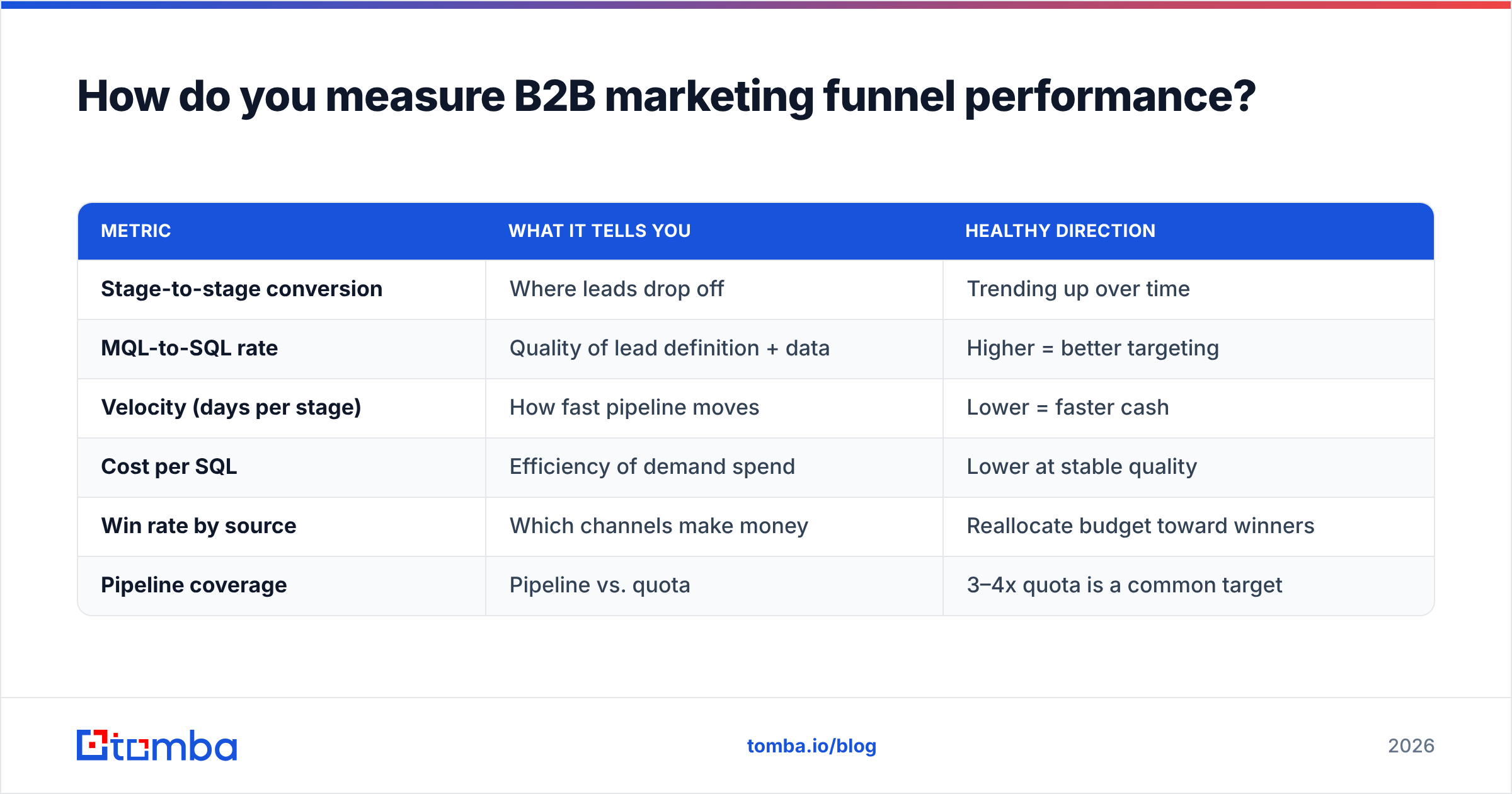
The metrics that actually drive decisions:
| Metric | What it tells you | Healthy direction |
|---|---|---|
| Stage-to-stage conversion | Where leads drop off | Trending up over time |
| MQL-to-SQL rate | Quality of lead definition + data | Higher = better targeting |
| Velocity (days per stage) | How fast pipeline moves | Lower = faster cash |
| Cost per SQL | Efficiency of demand spend | Lower at stable quality |
| Win rate by source | Which channels make money | Reallocate budget toward winners |
| Pipeline coverage | Pipeline vs. quota | 3–4x quota is a common target |
Two rules keep this honest. First, always segment by source — an aggregate funnel hides that one channel is carrying the whole number while three others lose money. Second, watch response rate as an early-warning signal: when replies fall while volume holds, your data or targeting has decayed, even if downstream metrics look fine for another few weeks.
For benchmarking your numbers against the market, G2's research and vendor reports from Gartner are more reliable than blog folklore — but treat any benchmark as a loose reference, not a target. Your own trend line is the real scoreboard.
How does data quality fix the funnel?#
Data quality is the lever with the highest leverage, because every other improvement multiplies against it. Better content sent to invalid emails is still zero. A faster handoff to an unreachable contact is still zero. Fix the inputs first.
Concretely, a data-first funnel does three things at the point of capture:
- Verify before routing. Every email entering the funnel gets validated, so reps never burn a sequence on a bounce. This protects your sender reputation too — bounces are a deliverability tax.
- Enrich before scoring. A raw email plus a name isn't enough to qualify. Append company size, role, and seniority so your MQL scoring reflects fit, not guesses. Tomba's data enrichment fills those gaps automatically.
- Expand the account. One inbound lead is a thread to pull. Find the rest of the buying committee with the email finder so a single MQL becomes a full account play.
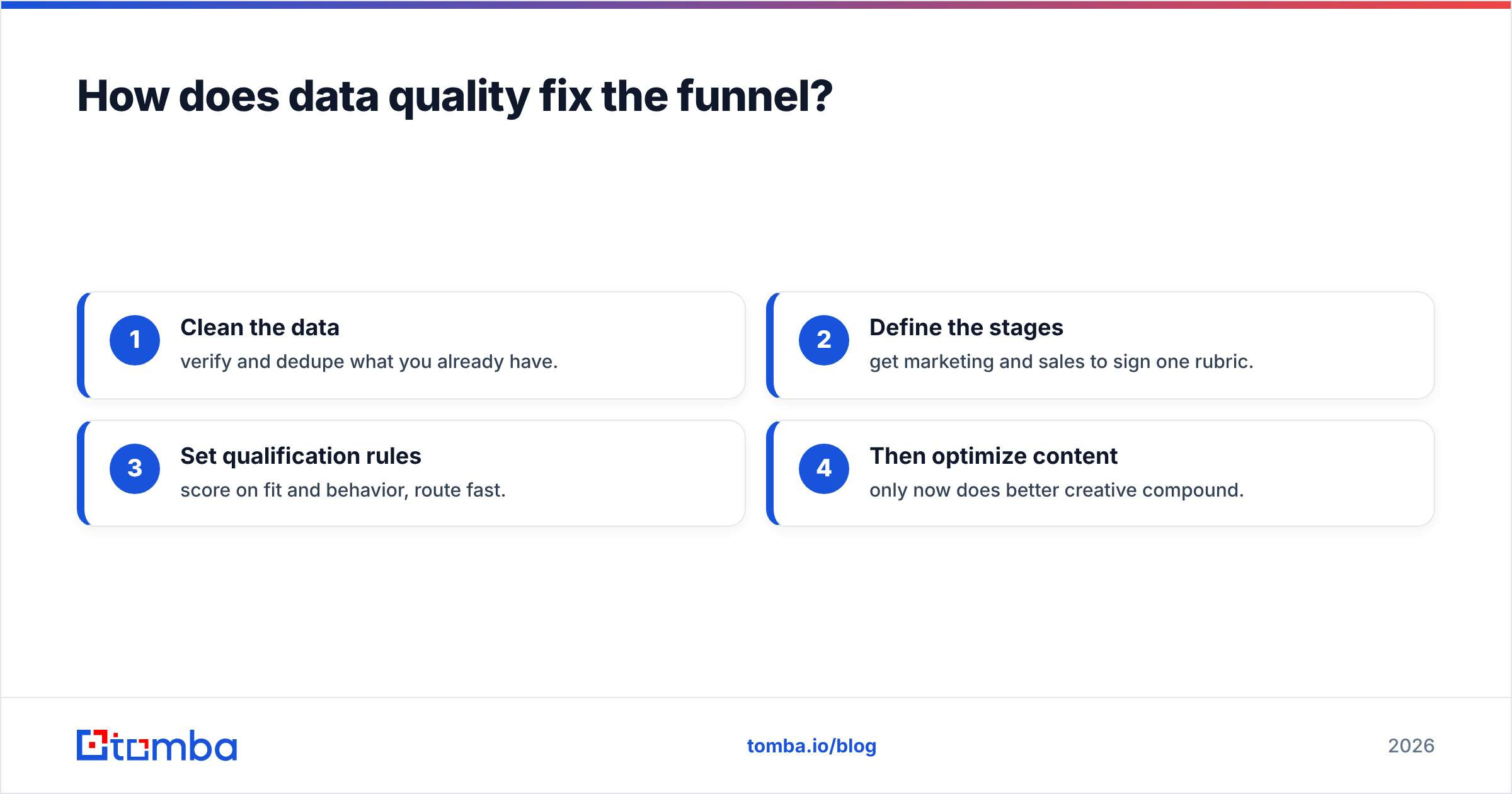
Here's the order of operations that fixes a leaky B2B marketing funnel, highest-impact first:
- Clean the data — verify and dedupe what you already have.
- Define the stages — get marketing and sales to sign one rubric.
- Set qualification rules — score on fit and behavior, route fast.
- Then optimize content — only now does better creative compound.
Teams reverse this constantly. They A/B test subject lines while half their list bounces. The subject line isn't the problem.
How does Tomba fit into the marketing funnel?#
Tomba is the data layer underneath the funnel — it makes sure the contacts moving through every stage are real, reachable, and complete. It doesn't replace your CRM or your nurture flows; it stops them from running on garbage.
- Top of funnel: turn anonymous interest into named contacts and find the right person at target accounts.
- Middle of funnel: verify and enrich every captured lead so MQL scoring reflects reality and the handoff to sales is clean.
- Bottom of funnel: hand reps verified emails and phone numbers so first-touch outreach lands instead of bouncing.
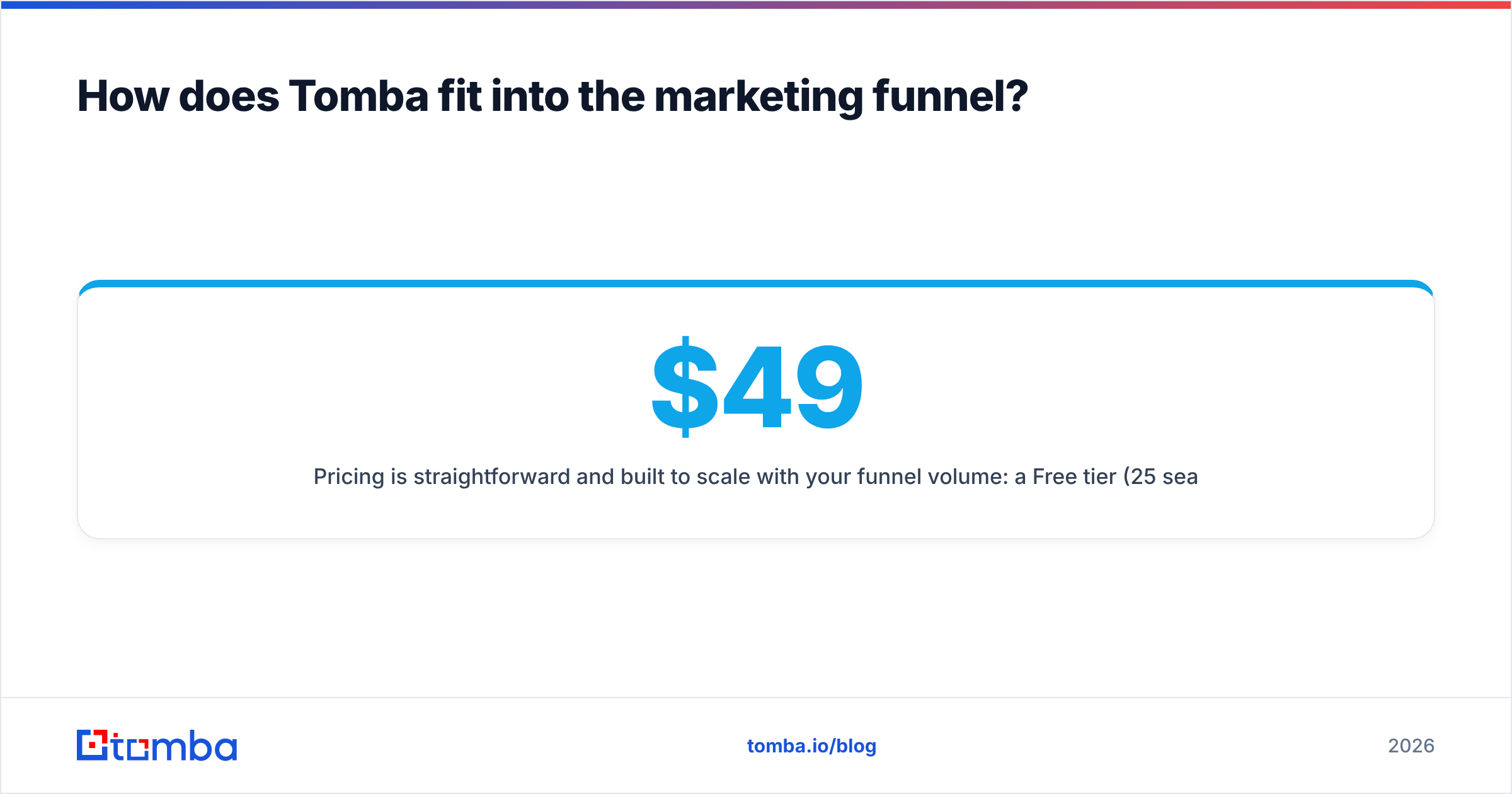
Pricing is straightforward and built to scale with your funnel volume: a Free tier (25 searches/month) to test it, then Starter at $49/mo, Growth at $99/mo, and Pro at $249/mo, with Enterprise custom. Full Tomba pricing is on the site, and it connects to your stack through native integrations including HubSpot, Salesforce, and Pipedrive.
If your funnel reports a "conversion problem" that's really an unreachable-contact problem, start at the source. Spin up a free account, run your existing MQL list through the Tomba Email Finder and verifier, and watch how many of your "lost" leads were never reachable in the first place. Fix the data, and every stage below it gets cheaper — that's the funnel math that actually moves pipeline in 2026.
// get started
Find, verify and enrich your first contacts today
Start on the free plan with 25 searches a month, then scale when your team is ready.
Free plan · No credit card required · GDPR & CCPA
// about the author