B2B Marketing Goals in 2026: A SMART Framework That Works
Most B2B marketing goals die in a slide deck. Here's how to set SMART, revenue-linked goals for 2026 — with KPI benchmarks, a framework table, and the metrics that actually move pipeline.
(rendered separately)
TL;DR
- B2B marketing goals only work when they ladder up to revenue. A goal that can't be traced to pipeline or retention is a vanity metric in disguise.
- Use a SMART structure (Specific, Measurable, Achievable, Relevant, Time-bound) and tie every goal to one of five tiers: awareness, demand, pipeline, revenue, and retention.
- Pick 3–5 goals per quarter — not 15. Focus beats coverage.
- Benchmark against real numbers: SQL-to-opportunity conversion, CAC payback, and pipeline coverage ratio matter far more than raw lead volume.
- Clean contact data is the unglamorous lever behind almost every goal. Bad emails wreck deliverability, distort attribution, and inflate your "MQL" count with noise.
What are B2B marketing goals, really?#
B2B marketing goals are the measurable outcomes your marketing team commits to in a defined period — and the good ones read like a promise to the revenue org, not a wish list for the brand team.
Think of it like a thermostat versus a thermometer. A thermometer tells you the room is cold (impressions are down). A thermostat commits to a target and changes the system until it's hit (pipeline will reach $4M sourced this quarter). Most teams set thermometer goals and wonder why nobody in sales takes them seriously.
The shift over the last few years has been brutal but healthy: CMOs are now measured on revenue contribution, not activity. According to Gartner research on marketing budgets, marketing leaders are under sustained pressure to prove financial impact, which means your 2026 goals need a direct line to bookings, revenue operations, and net revenue retention.
How do you set SMART B2B marketing goals?#
Conclusion first: write every goal so a skeptical CFO could audit it in five minutes. The SMART framework is old, but it's old the way a hammer is old — still the right tool.
Here's the structure applied to B2B specifically:
- Specific — Name the exact metric and segment. Not "grow leads" but "grow mid-market SQLs in North America."
- Measurable — Attach a number and a source of truth. If it isn't in your CRM or analytics tool, it isn't measurable.
- Achievable — Anchor to last period's actuals plus a defensible growth rate. A 4x target with the same budget is a fantasy, not a stretch.
- Relevant — Tie it to a company objective. If revenue wants logo expansion, a brand-awareness goal in a new vertical is misaligned.
- Time-bound — Quarter or half, never "this year, vaguely." Long horizons hide slippage.
A weak goal: "Improve our email marketing." A SMART version: "Increase marketing-sourced pipeline from email from $300K to $450K (+50%) among existing mid-market accounts by the end of Q3 2026, measured in HubSpot."
The second one tells everyone what to do, what success looks like, and when to check.
What are the 5 tiers of B2B marketing goals?#
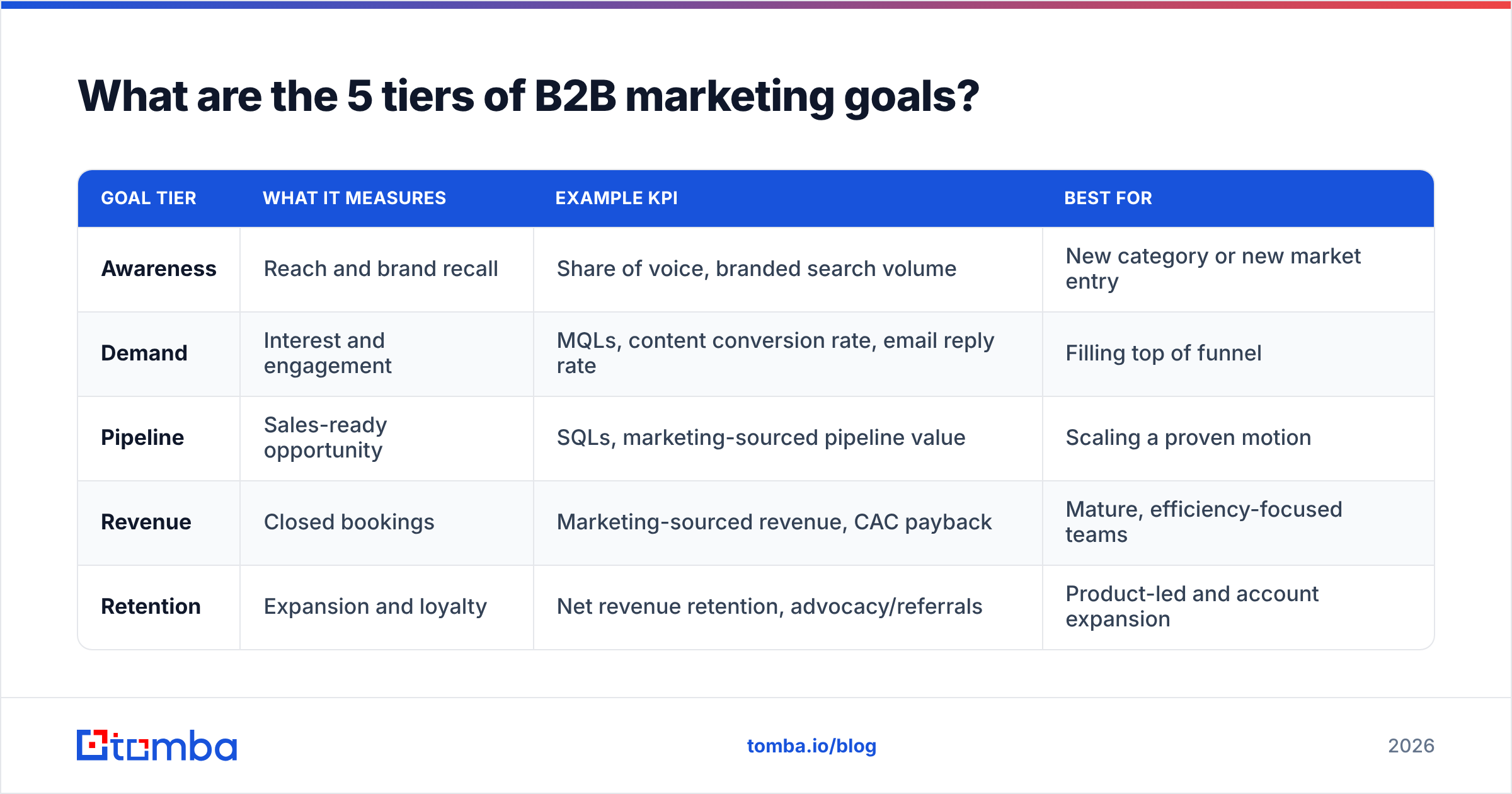
Most goal confusion comes from mixing altitudes — comparing a brand metric to a bookings metric as if they were peers. Separate them into five tiers, and set goals at the tiers that match your stage.
| Goal tier | What it measures | Example KPI | Best for |
|---|---|---|---|
| Awareness | Reach and brand recall | Share of voice, branded search volume | New category or new market entry |
| Demand | Interest and engagement | MQLs, content conversion rate, email reply rate | Filling top of funnel |
| Pipeline | Sales-ready opportunity | SQLs, marketing-sourced pipeline value | Scaling a proven motion |
| Revenue | Closed bookings | Marketing-sourced revenue, CAC payback | Mature, efficiency-focused teams |
| Retention | Expansion and loyalty | Net revenue retention, advocacy/referrals | Product-led and account expansion |
The mistake is living entirely in the top two tiers. Awareness and demand goals are easy to hit and easy to fake — you can always buy more clicks. Pipeline, revenue, and retention goals are where credibility is earned. A healthy 2026 plan picks at least one goal from the pipeline tier or below, so marketing is on the hook for money, not just motion.
Which B2B marketing KPIs actually matter in 2026?#
Short answer: the ones that survive contact with a finance review. Here are the KPIs worth defending, grouped by what they reveal.
- Pipeline coverage ratio — Pipeline value divided by quota. Below 3x and you're already behind; this is the earliest warning signal you have.
- SQL-to-opportunity conversion — Exposes whether your "qualified" leads are actually qualified, or just MQLs wearing a costume.
- CAC payback period — Months to recoup the cost of acquiring a customer. The single best efficiency metric for a board deck.
- Marketing-sourced revenue — The number that ends every "does marketing drive revenue?" argument.
- Net revenue retention (NRR) — Expansion minus churn. In a tight market, keeping and growing accounts beats chasing new logos.
- Email reply and deliverability rate — Unsexy, but it gates every outbound and nurture goal you set. Dead inboxes mean wasted spend.
Notice what's missing: raw impressions, follower counts, and total leads. Those aren't forbidden — they're just inputs, not goals. A useful rule from peer reviews on G2 and similar communities: if a metric can go up while revenue goes down, it's a diagnostic, not a goal.
How does data quality quietly decide your goals?#
Here's the uncomfortable truth: most missed B2B marketing goals are data problems wearing a strategy costume.
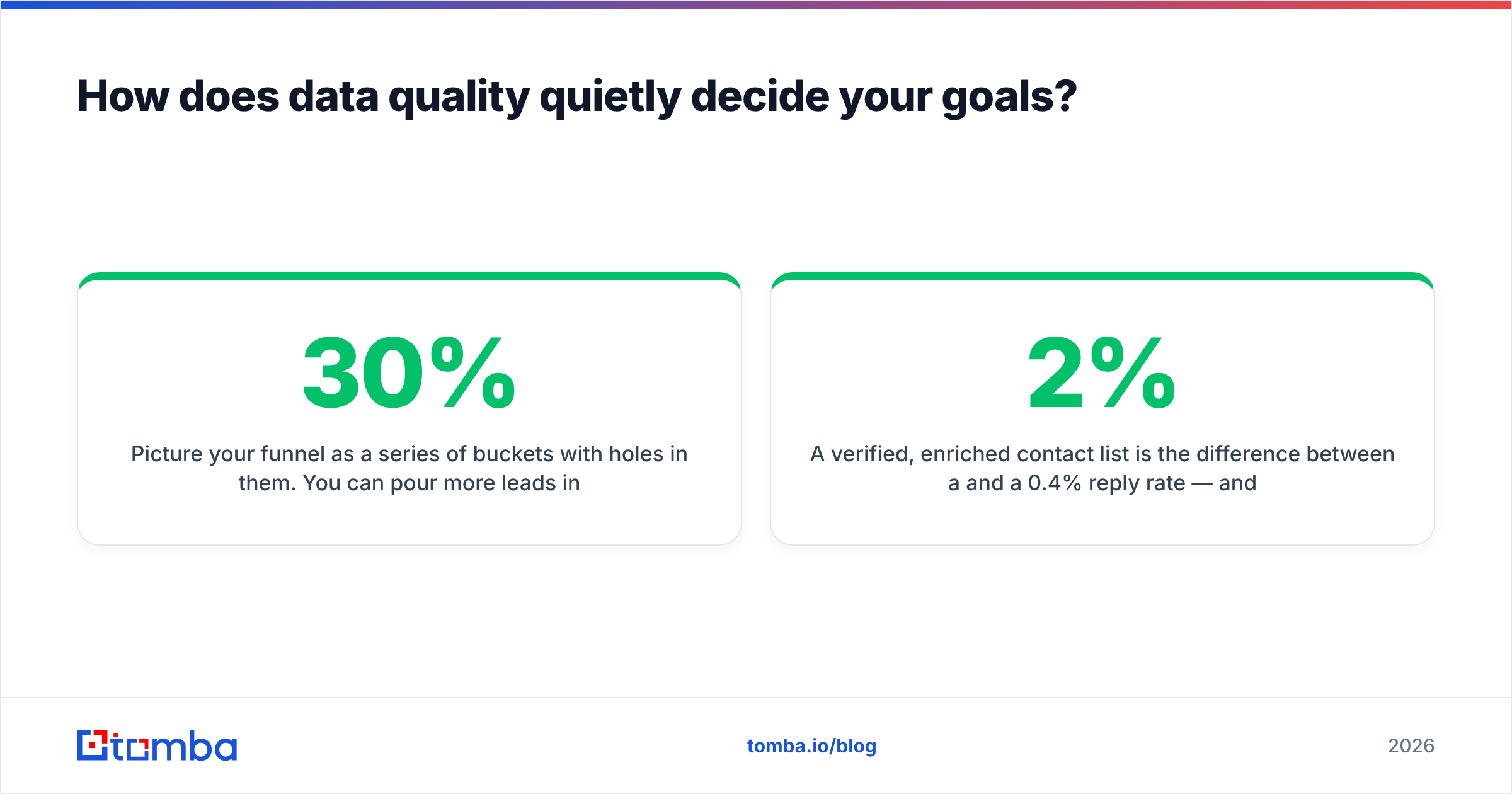
Picture your funnel as a series of buckets with holes in them. You can pour more leads in the top (more budget, more campaigns), but if 30% of your contact emails bounce, your nurture sequences never land, your "MQL" count is inflated with junk, and your sender reputation degrades until even your good emails go to spam. You hit your lead goal on paper and miss your pipeline goal in reality.
This is why goal-setting and data hygiene are the same conversation. Before you commit to a demand or pipeline goal, you need to trust three things:
- The contact data is real and reachable (valid, deliverable emails).
- Records are enriched enough to segment and route correctly.
- Duplicates and dead accounts aren't padding your numbers.
A verified, enriched contact list is the difference between a 2% and a 0.4% reply rate — and that gap is the difference between hitting and missing your quarter. Tools like the Tomba Email Finder and data enrichment exist precisely to close it, so your goals are measured against clean inputs instead of noise. If you're setting an outbound goal on top of a list you haven't verified, you're forecasting on sand.
How many B2B marketing goals should you set?#
Three to five per quarter. That's it.
The instinct is to set a goal for every channel, every funnel stage, and every stakeholder's pet project. The result is a scorecard nobody reads and a team that's busy everywhere and effective nowhere. Focus is the whole game.
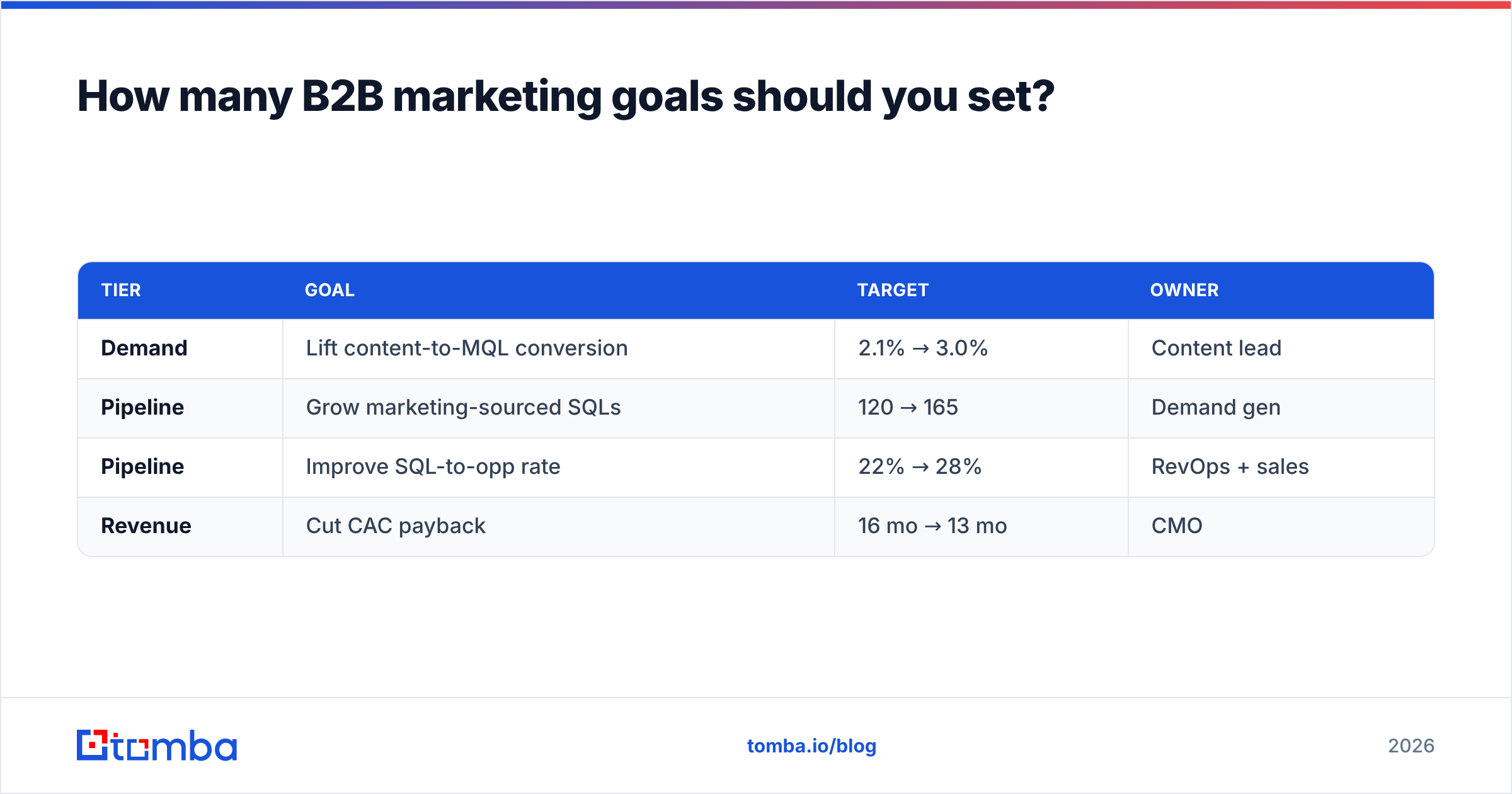
A clean quarterly slate might look like:
| Tier | Goal | Target | Owner |
|---|---|---|---|
| Demand | Lift content-to-MQL conversion | 2.1% → 3.0% | Content lead |
| Pipeline | Grow marketing-sourced SQLs | 120 → 165 | Demand gen |
| Pipeline | Improve SQL-to-opp rate | 22% → 28% | RevOps + sales |
| Revenue | Cut CAC payback | 16 mo → 13 mo | CMO |
Four goals. Each has a number, a baseline, and an owner. Each ladders to revenue. You could brief this to your CEO in two minutes, and any of these slipping would trigger a real, specific intervention — not a vague "we need more leads."
How do you align marketing goals with sales?#
Make the handoff a shared definition, not a thrown-over-the-wall ticket. The classic failure mode: marketing celebrates 500 MQLs, sales says 480 of them were unqualified, and the next QBR turns into a blame session.
Fix it with three agreements written down before the quarter starts:
- A shared lead definition. What exactly is an MQL versus an SQL? Get sales to sign off on the criteria, not just receive them.
- A speed-to-lead standard. Research from vendors like HubSpot consistently shows that contacting a lead within the first few minutes dramatically outperforms waiting hours. Make response time a joint goal.
- A feedback loop. Sales rates lead quality weekly; marketing adjusts targeting. Without this, marketing optimizes for volume and sales drowns in noise.
When marketing and sales share a marketing qualified lead definition and a pipeline number, the goals stop competing and start compounding. That's the entire promise of go-to-market alignment.
What's the difference between leading and lagging goals?#
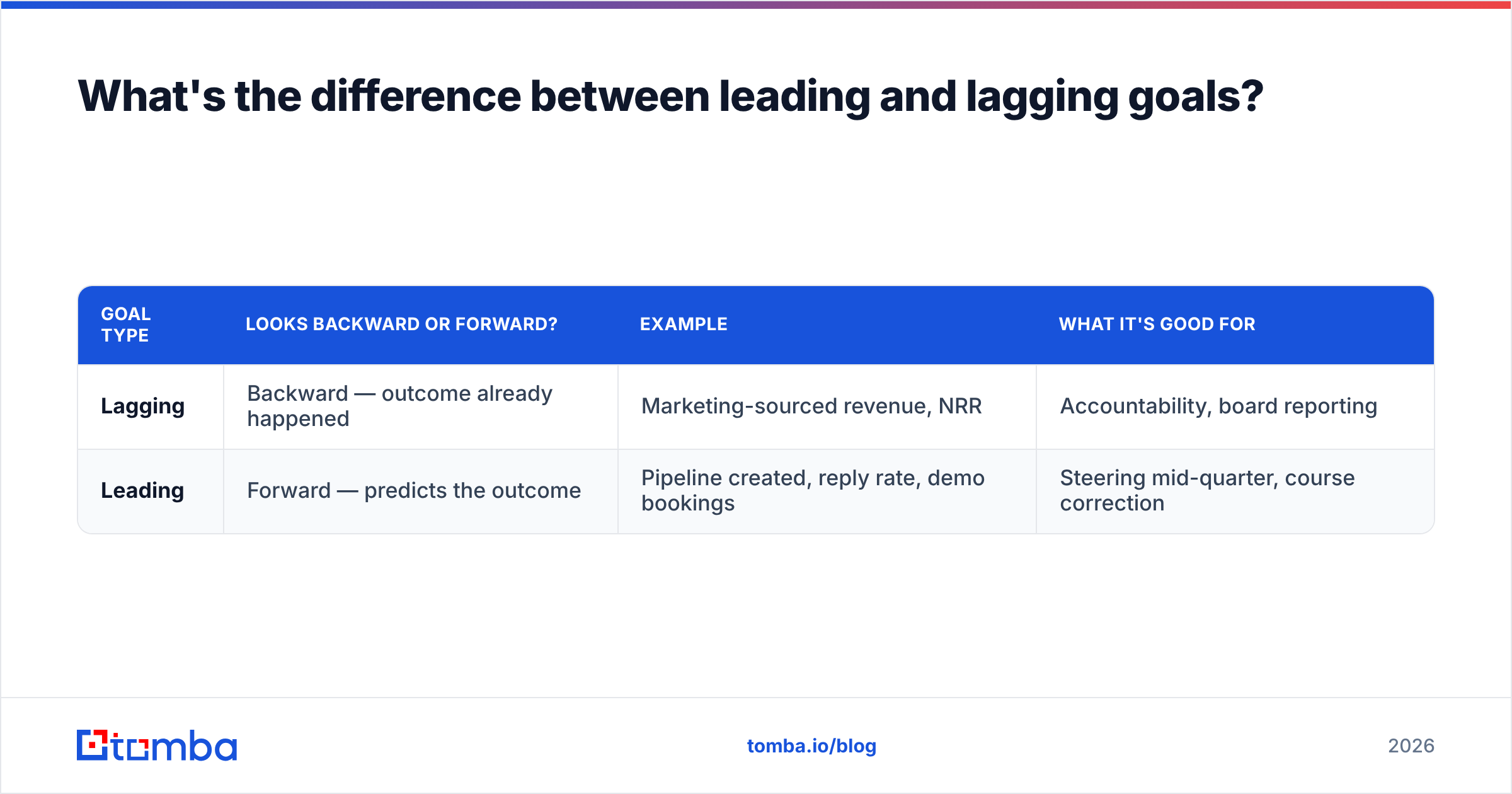
Lagging goals are the scoreboard; leading goals are the plays that change it. You need both, and you need to know which is which.
| Goal type | Looks backward or forward? | Example | What it's good for |
|---|---|---|---|
| Lagging | Backward — outcome already happened | Marketing-sourced revenue, NRR | Accountability, board reporting |
| Leading | Forward — predicts the outcome | Pipeline created, reply rate, demo bookings | Steering mid-quarter, course correction |
The trap is setting only lagging goals. Marketing-sourced revenue is the right thing to be measured on, but you can't do anything to it directly in week three of the quarter — it's downstream of everything. So you pair it with leading goals you can influence daily: opportunities created, qualified meetings booked, reply rates on a verified list.
Run the leading goals weekly and the lagging goals quarterly. When a leading indicator dips, you have weeks to react instead of discovering the miss at quarter-end when it's too late to fix.
A simple 2026 goal-setting process you can copy#
Strip it to five steps and run it every quarter:
- Pull last quarter's actuals. Real baselines, not aspirations. Every goal starts from a number you actually hit.
- Map company objectives to tiers. If the company wants efficiency, weight toward revenue and retention goals. If it wants growth, weight toward demand and pipeline.
- Write 3–5 SMART goals with explicit baselines, targets, owners, and a source of truth for the metric.
- Audit your data inputs. Verify and enrich the contact lists those goals depend on before you commit. A goal built on a 30%-bounce list is already failing.
- Set the review cadence. Leading goals weekly, lagging goals at quarter close. Put the dates on the calendar now.
This process is deliberately boring. Boring is what survives contact with a busy quarter. The teams that hit their numbers aren't the ones with the cleverest goals — they're the ones who picked a few, measured honestly, and fixed the inputs.
For the budget side of planning, map your goal targets against the cost of the tooling that supports them; transparent Tomba pricing makes it easy to model data costs into your CAC math instead of treating tooling as an untracked line item.
Common B2B marketing goal mistakes to avoid#
- Setting volume goals with no quality gate. "Generate 1,000 leads" rewards garbage. "Generate 200 leads that convert to SQL at 25%" rewards results.
- Ignoring deliverability. If your sender reputation is shot, no campaign goal is reachable. Verify lists and protect the domain first.
- Confusing activity with progress. "Publish 12 blog posts" is a task, not a goal. The goal is the outcome those posts produce.
- Goal sprawl. Fifteen goals means zero priorities. Cut to five.
- No owner. A goal everyone owns is a goal no one owns. Single-thread it.
Closing: build goals on data you can trust#
The best B2B marketing goals in 2026 share one trait — they're traceable to revenue and built on inputs you've actually verified. You can copy the SMART framework, the five tiers, and the KPI list above in an afternoon. The harder, more valuable work is making sure the contact data underneath every goal is real, reachable, and clean.
That's where to start before the quarter does. Use the Tomba Email Finder to source verified, deliverable contacts and enrich them so your segmentation, routing, and attribution reflect reality instead of noise. Set fewer goals, measure them honestly, and feed them clean data — and your 2026 scorecard will read like a promise you kept, not a wish list you outgrew.
Ready to find emails that actually work?
Join 150,000+ professionals who stopped guessing and started sending. Free credits on signup — no credit card required.
Get the Tomba newsletter
Practical outbound tactics and product updates — once every two weeks.
About the author