B2B Marketing Measurement in 2026: A Practical Guide
Stop reporting clicks and start reporting pipeline. A practical 2026 framework for B2B marketing measurement: attribution models, the metrics that matter, and the data hygiene behind them.
B2B marketing measurement is the discipline of connecting what marketing does to the revenue it produces. Get it right and budget conversations stop being arguments. Get it wrong and you spend 2026 defending click-through rates to a CFO who only cares about closed-won.
This guide gives you a working framework: what to measure, which attribution model fits your motion, and the data hygiene that quietly decides whether any of it is trustworthy.
TL;DR#
- Measure pipeline and revenue, not activity. Impressions and MQLs are inputs; sourced and influenced pipeline are the outcomes leadership funds.
- Pick an attribution model that matches your sales cycle — first-touch and last-touch lie in long B2B cycles; multi-touch or data-driven models are closer to the truth.
- Your measurement is only as good as your contact data. Bad emails and duplicate records break attribution before any model runs.
- Standardize a small metric set (CAC, pipeline velocity, win rate, marketing-sourced revenue) so every team reads the same scoreboard.
- Instrument the full path: anonymous visit → known contact → opportunity → revenue. Gaps anywhere collapse the chain.
What is B2B marketing measurement?#
B2B marketing measurement is the practice of quantifying how marketing contributes to pipeline and revenue across a long, multi-stakeholder buying cycle. Think of it like a relay race: marketing rarely crosses the finish line alone, so measurement is about proving which legs of the race marketing actually ran — and how fast.
That framing matters because B2B is not e-commerce. A purchase can involve 6 to 10 stakeholders, span months, and touch dozens of channels before a deal closes. A single "conversion" metric can't capture that. Good measurement instead tracks a chain of states and attributes credit along it.
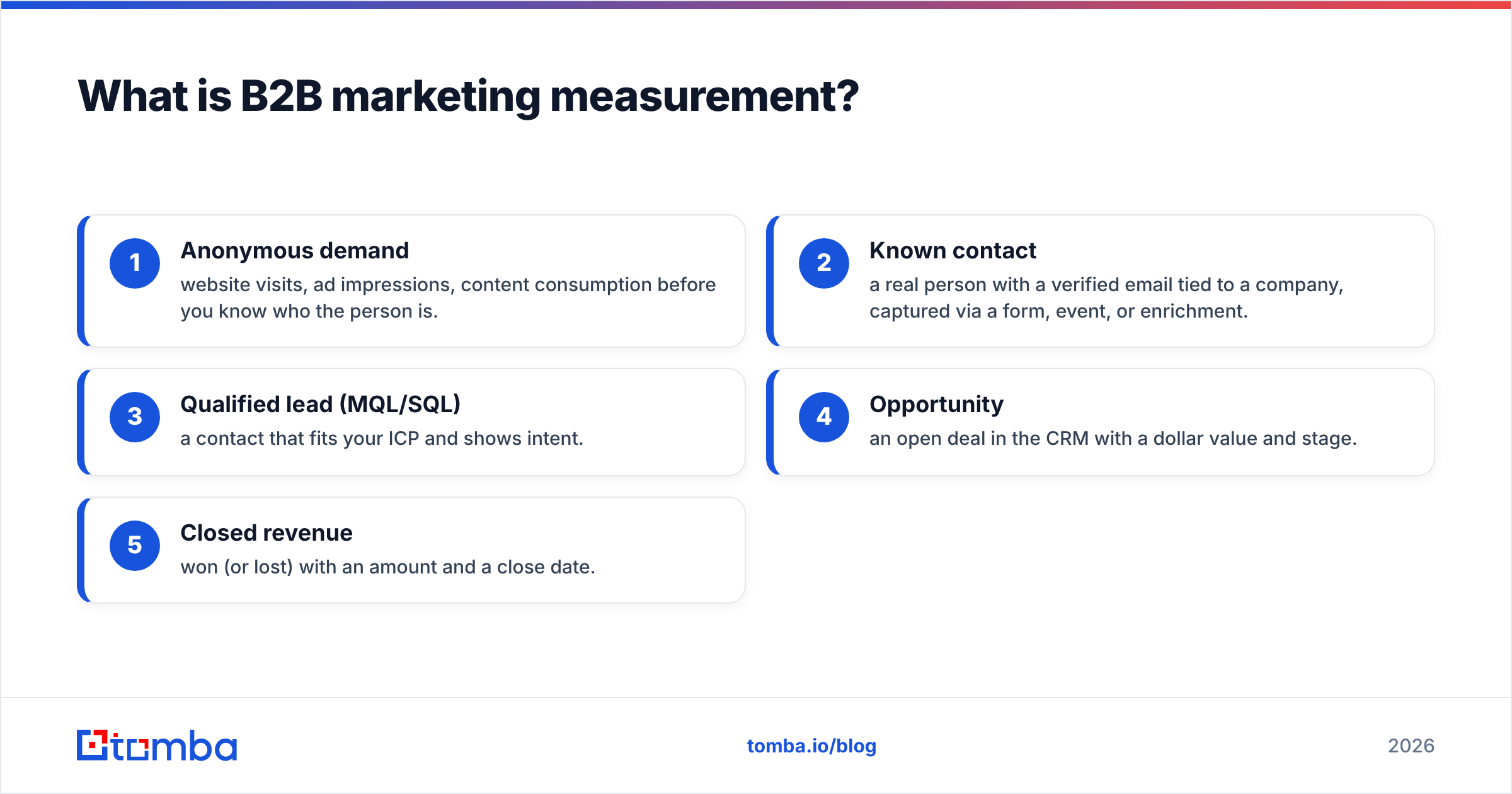
The core states you need to instrument:
- Anonymous demand — website visits, ad impressions, content consumption before you know who the person is.
- Known contact — a real person with a verified email tied to a company, captured via a form, event, or enrichment.
- Qualified lead (MQL/SQL) — a contact that fits your ICP and shows intent.
- Opportunity — an open deal in the CRM with a dollar value and stage.
- Closed revenue — won (or lost) with an amount and a close date.
Every measurement decision — which model, which metric, which dashboard — is ultimately about how credit flows across those five states. If you can't reliably move a person from state 2 (known contact) to state 4 (opportunity), no attribution model will save you. That is why data quality sits underneath everything else here.
Which metrics actually matter in B2B?#
Conclusion first: report the metrics a CFO would fund, then keep the diagnostic metrics for your own team. Mixing the two is how marketing reports get ignored.
Here is a tiered set that works for most B2B teams in 2026:
- Revenue metrics (board-level): marketing-sourced revenue, marketing-influenced revenue, customer acquisition cost (CAC), and CAC payback period. These answer "did we make money?"
- Pipeline metrics (leadership-level): sourced pipeline, influenced pipeline, pipeline velocity, and average deal size. These predict revenue before it lands.
- Funnel metrics (team-level): MQL→SQL conversion, SQL→opportunity rate, and stage-to-stage win rate. These tell you where the funnel leaks.
- Activity metrics (diagnostic only): clicks, opens, form fills, email response rate. Useful for optimization, dangerous as headline numbers.
The trap is reporting activity metrics upward. A 40% open rate feels great until someone asks how much revenue it produced. Anchor every report on the top two tiers and use the bottom two to explain why the top moved.
What are the main B2B attribution models?#
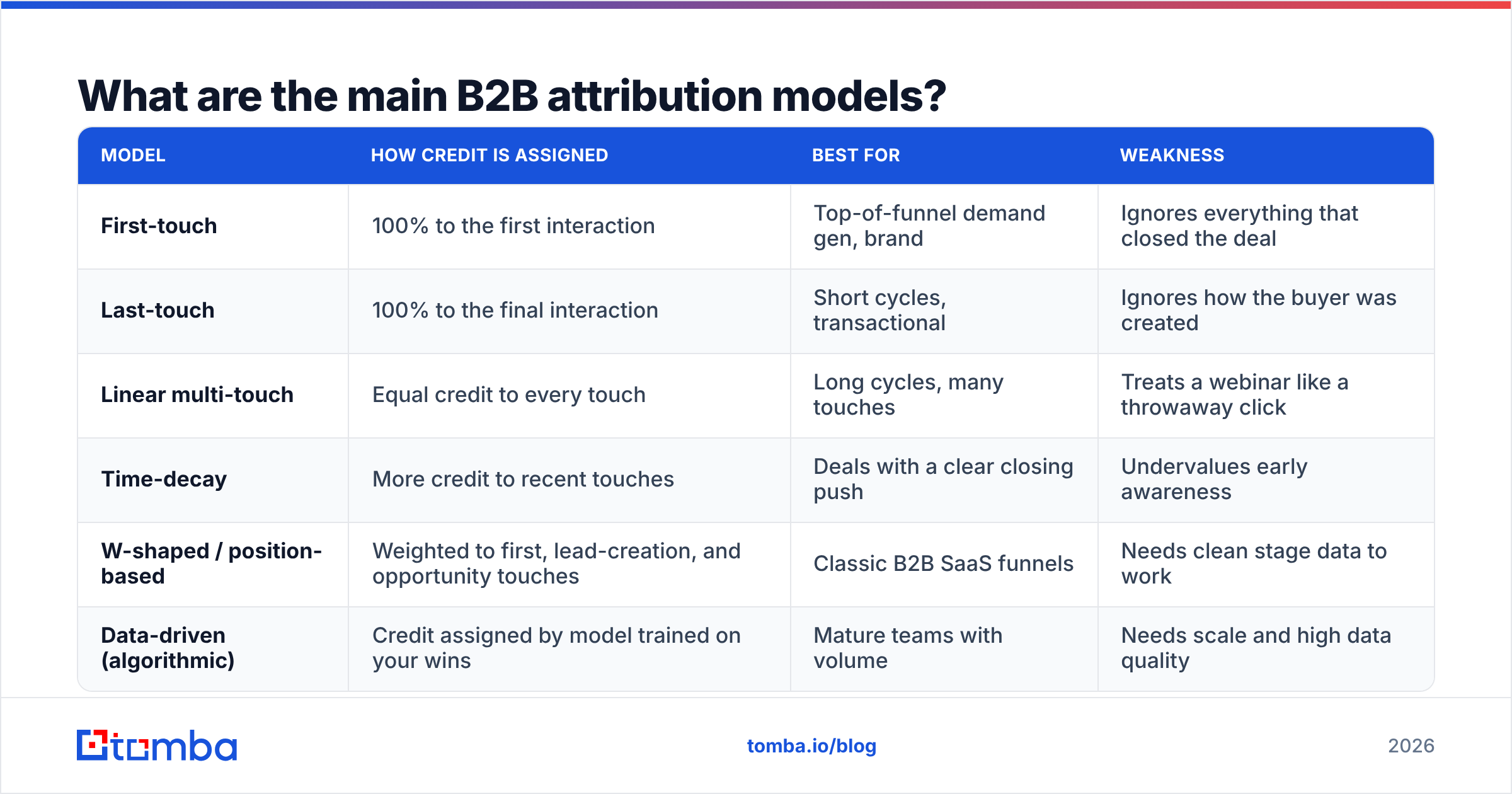
Attribution is how you assign credit for a deal to the marketing touches that preceded it. The model you choose changes the story your data tells — sometimes dramatically — so this is a strategic decision, not a technical default.
| Model | How credit is assigned | Best for | Weakness |
|---|---|---|---|
| First-touch | 100% to the first interaction | Top-of-funnel demand gen, brand | Ignores everything that closed the deal |
| Last-touch | 100% to the final interaction | Short cycles, transactional | Ignores how the buyer was created |
| Linear multi-touch | Equal credit to every touch | Long cycles, many touches | Treats a webinar like a throwaway click |
| Time-decay | More credit to recent touches | Deals with a clear closing push | Undervalues early awareness |
| W-shaped / position-based | Weighted to first, lead-creation, and opportunity touches | Classic B2B SaaS funnels | Needs clean stage data to work |
| Data-driven (algorithmic) | Credit assigned by model trained on your wins | Mature teams with volume | Needs scale and high data quality |
A practical rule: the longer and more complex your sales cycle, the more multi-touch you need. If your average deal closes in 9 months across 7 stakeholders, last-touch attribution will tell you "the demo request closed it" — true and useless. A W-shaped or data-driven model shows you the webinar, the comparison guide, and the retargeting that actually built the deal.
For a deeper grounding in how the broader function ties together, revenue operations is the team that usually owns this model choice, because attribution spans marketing, sales, and finance.
You do not need to pick one forever. Many teams run two models in parallel — first-touch to judge demand generation and a multi-touch model to judge the full funnel — and reconcile the gap as a learning exercise. G2's research on buyer behavior is a useful external reference point for how non-linear modern B2B journeys have become (g2.com).
Why does data quality decide your measurement accuracy?#
Because attribution is arithmetic on top of your contact records — and garbage records produce confident, wrong answers.
Here is the failure mode in practice. Marketing captures a lead with a typo'd or role-based email (info@, sales@). The record never matches the real buyer in the CRM. The deal closes under a different contact. Your model now shows that lead source produced zero pipeline, so you cut its budget. You just defunded a working channel because of a dirty email field.
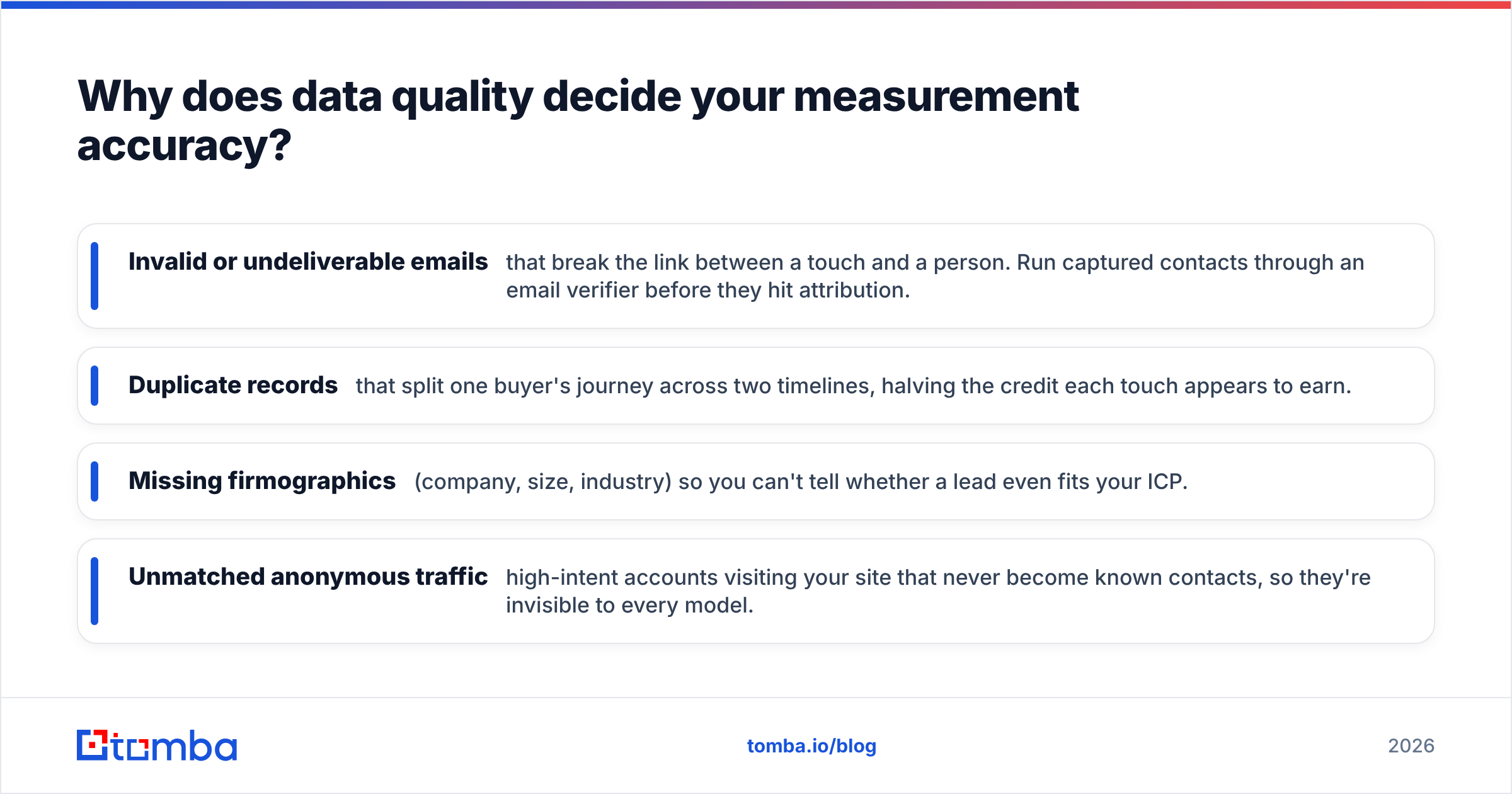
The most common data problems that silently corrupt B2B measurement:
- Invalid or undeliverable emails that break the link between a touch and a person. Run captured contacts through an email verifier before they hit attribution.
- Duplicate records that split one buyer's journey across two timelines, halving the credit each touch appears to earn.
- Missing firmographics (company, size, industry) so you can't tell whether a lead even fits your ICP.
- Unmatched anonymous traffic — high-intent accounts visiting your site that never become known contacts, so they're invisible to every model.
Fixing this is not glamorous, but it has higher ROI than swapping attribution models. Clean, verified, deduplicated contact data is the foundation; the model is just the lens. If you're enriching incomplete records, data enrichment fills in the firmographic and contact gaps that let attribution actually match a person to an account.
A reasonable hygiene cadence: verify on capture, dedupe weekly, and enrich any record that enters an opportunity stage. HubSpot's data on CRM hygiene and lead decay is a solid external benchmark for why this matters (hubspot.com).
How do you build a B2B measurement framework step by step?#
Conclusion first: start from revenue and work backward, not from channels and work forward. A channel-first framework optimizes for whatever is easiest to measure, which is rarely what matters.
A five-step build that holds up:
- Define the revenue questions leadership actually asks. "What's our CAC by segment?" "Which channels source pipeline that closes?" Write them down — they are your measurement requirements.
- Map the buyer journey to your five states. Document how a person moves from anonymous visit to closed revenue in your business, including the offline touches (events, sales calls) most tools miss.
- Instrument each transition. UTM discipline on inbound, form capture with verified emails, CRM stage definitions everyone agrees on, and closed-loop reporting from CRM back to marketing.
- Choose your attribution model(s) from the table above based on cycle length and touch count. Document the assumptions so the model is auditable.
- Standardize the scoreboard. One dashboard, the same metric definitions for marketing, sales, and finance. Disagreements about numbers are usually disagreements about definitions.
The hardest step is #3, and it usually fails at the known-contact boundary — turning anonymous interest into a matched, verified person. This is where prospecting and capture tooling earns its keep. If you're identifying accounts on your site, pair website visitor reveal with verified contact lookup so an anonymous session becomes a measurable record instead of a dead end.
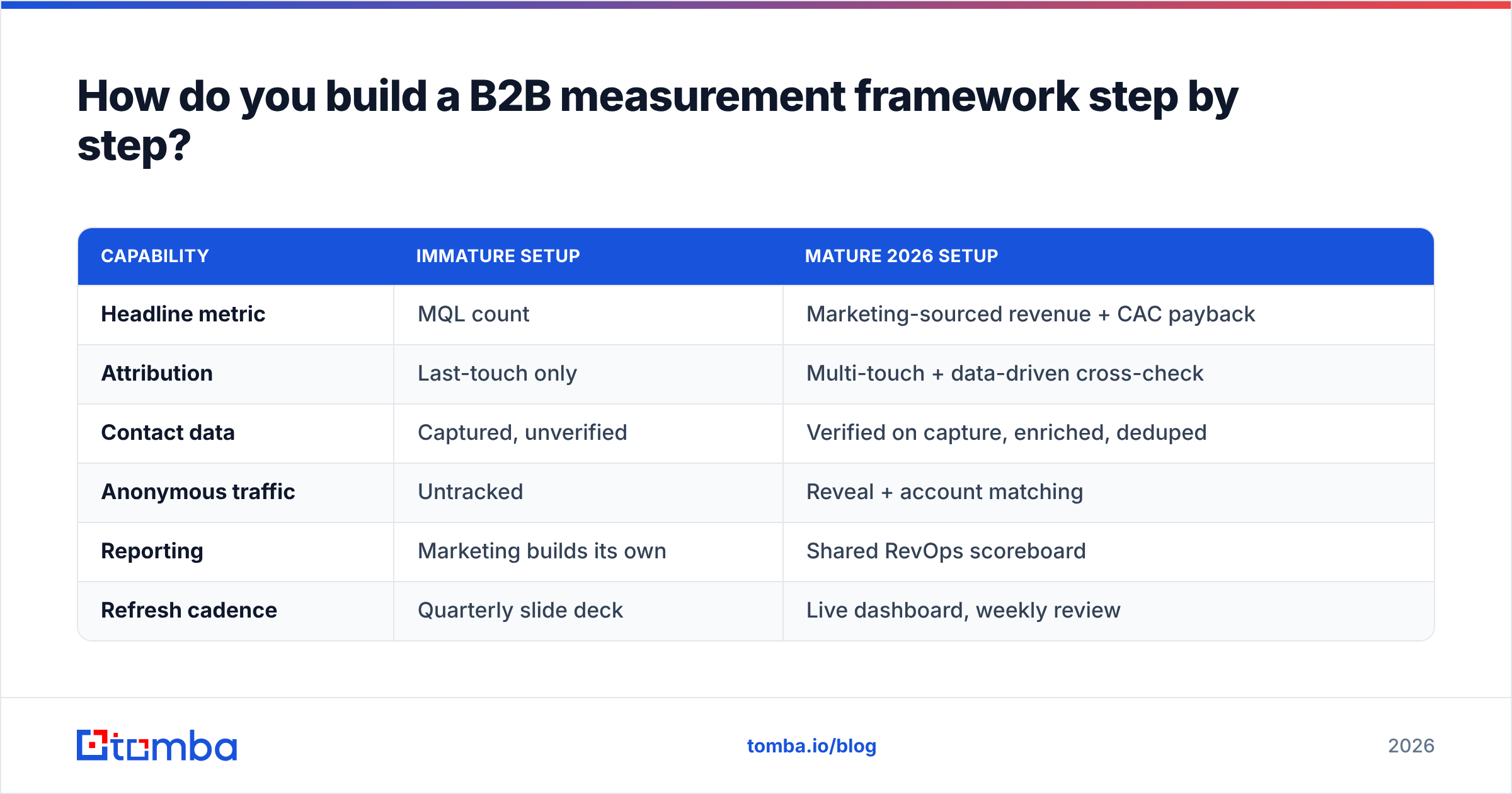
Compare the two ends of the maturity spectrum so you know what "good" looks like:
| Capability | Immature setup | Mature 2026 setup |
|---|---|---|
| Headline metric | MQL count | Marketing-sourced revenue + CAC payback |
| Attribution | Last-touch only | Multi-touch + data-driven cross-check |
| Contact data | Captured, unverified | Verified on capture, enriched, deduped |
| Anonymous traffic | Untracked | Reveal + account matching |
| Reporting | Marketing builds its own | Shared RevOps scoreboard |
| Refresh cadence | Quarterly slide deck | Live dashboard, weekly review |
What tools do you need for B2B marketing measurement?#
You need four layers, and most teams already have two of them.
- Analytics + attribution platform — where touches get stitched into journeys (your marketing automation platform, a dedicated attribution tool, or your CRM's native reporting).
- CRM — the system of record for opportunities and revenue. Salesforce and HubSpot dominate here; your attribution is only as honest as your CRM stage discipline (salesforce.com).
- Data quality + enrichment — the layer that keeps contact records matchable. This is the most neglected and the highest leverage.
- Capture + identification — forms, find email addresses workflows, and visitor reveal that turn interest into known, measurable contacts.
Tools like Tomba sit in those last two layers. The email finder and verifier keep the contact records clean enough that attribution can actually match a touch to a person, and the enrichment fills the firmographic gaps that let you segment CAC and pipeline by ICP. You can see how the credit tiers map to volume on the Tomba pricing page if you're scoping cost against your contact volume. None of this replaces your CRM or attribution platform — it feeds them the clean data they assume they already have.
How often should you review and refresh the numbers?#
Match cadence to the decision the number drives. Activity metrics can move daily and you should ignore most of that noise. Pipeline and revenue metrics deserve a weekly review with sales, and a deeper monthly or quarterly look at attribution and CAC trends where the larger patterns live.
Two practical guardrails:
- Don't re-decide budget on weekly noise. Channel performance is volatile week to week; make allocation calls on rolling 90-day windows.
- Audit your data before every quarterly review. A 20-minute dedupe and verification pass prevents the "why did this channel die?" panic that's actually just a data artifact.
The bottom line#
B2B marketing measurement in 2026 is less about finding a clever attribution model and more about feeding any model clean, complete, matchable data. Pick the model that fits your cycle, standardize a small revenue-anchored scoreboard, and invest in the contact hygiene that quietly determines whether any of it is true.
If your measurement keeps breaking at the known-contact boundary — leads that don't match, emails that bounce, accounts you can't identify — start there. Tomba's Email Finder turns names and domains into verified, enrichable contact records, so the people in your funnel actually connect to the revenue in your CRM. Start on the free tier (25 searches/month), and scale into Starter at $49/mo when your measurement depends on data you can trust.
// get started
Find, verify and enrich your first contacts today
Start on the free plan with 25 searches a month, then scale when your team is ready.
Free plan · No credit card required · GDPR & CCPA
// about the author