11 B2B Marketing Mistakes Killing Your Pipeline in 2026
Most B2B marketing budgets leak through the same predictable holes. Here are the 11 B2B marketing mistakes draining pipeline in 2026 — and the concrete fix for each.
Most B2B marketing teams don't fail because they lack effort. They fail because they pour budget into the same handful of leaks every quarter, then blame the channel, the economy, or the sales team. The leaks are predictable — and so are the fixes.
TL;DR#
- The most expensive b2b marketing mistakes are upstream: bad data, fuzzy ICP, and no feedback loop with sales. Fix those before touching ad creative.
- Buying or scraping unverified contact lists tanks deliverability and burns your domain reputation faster than any single campaign can recover.
- Vanity metrics (impressions, MQL counts) hide a broken pipeline. Measure pipeline influenced and revenue, not activity.
- Misalignment between marketing and sales quietly wastes 20–30% of generated leads that never get worked.
- Every mistake below has a low-cost fix you can start this week.
What counts as a B2B marketing mistake in 2026?#
A B2B marketing mistake is any repeatable decision that costs you pipeline you could have kept. Not a one-off bad ad — a systemic habit. Think of it like a boat with a slow leak: you can bail water (spend more on ads) all day, but until you patch the hull (data, targeting, alignment), you're just buying time.
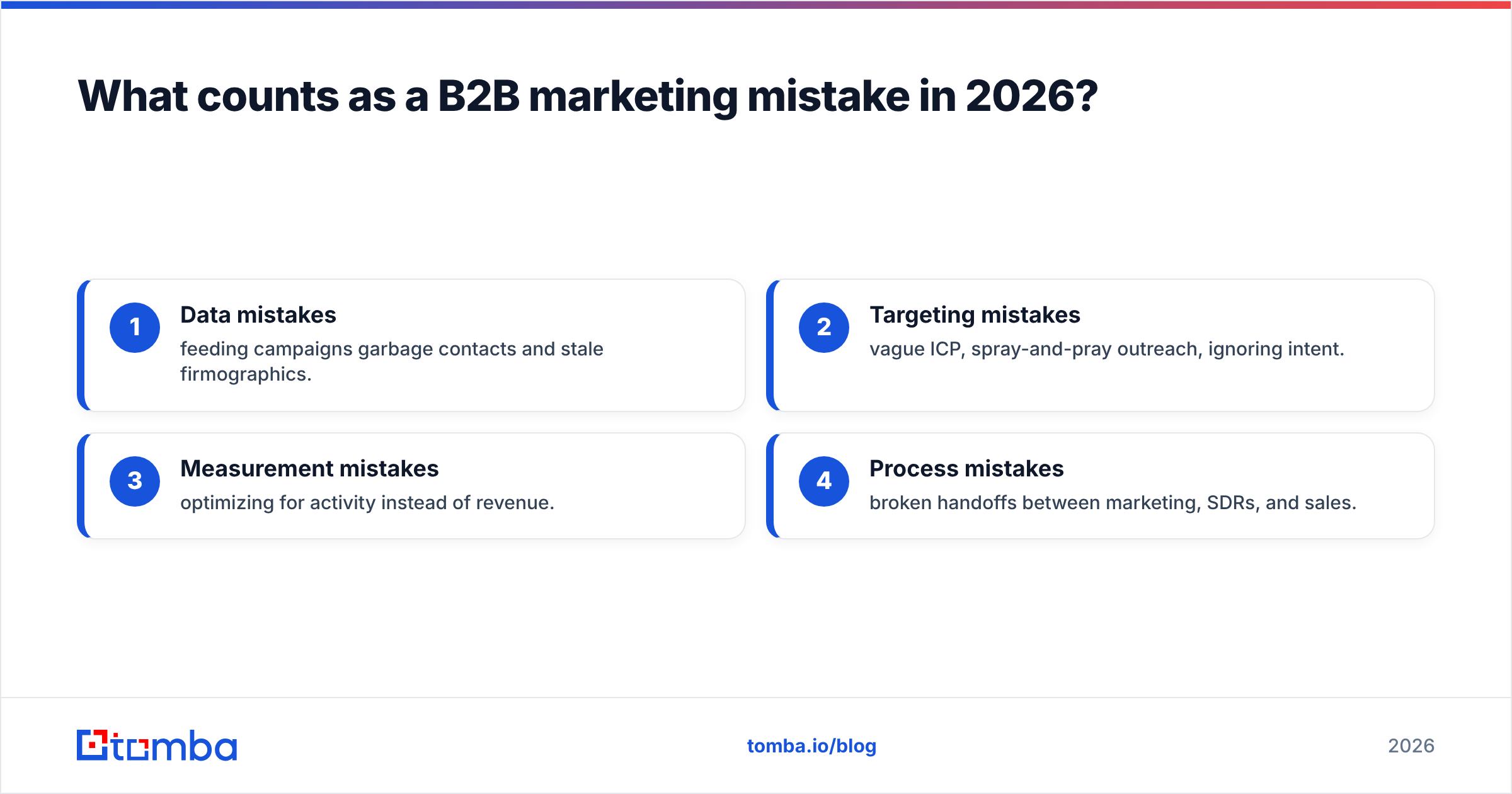
The mistakes cluster into four buckets:
- Data mistakes — feeding campaigns garbage contacts and stale firmographics.
- Targeting mistakes — vague ICP, spray-and-pray outreach, ignoring intent.
- Measurement mistakes — optimizing for activity instead of revenue.
- Process mistakes — broken handoffs between marketing, SDRs, and sales.
The rest of this guide walks each one with a fix you can implement without a new six-figure tool contract.
Why does bad data cause the most expensive mistakes?#
Bad data is the root cause behind most other failures. If your contact records are wrong, every downstream dollar — ads, sequences, SDR time — is spent reaching people who don't exist, don't fit, or never opted in.
Here's what bad data actually does to a campaign:
- Bounces wreck deliverability. A bounce rate above 3% signals mailbox providers that you're a careless sender. Your good emails start landing in spam, and recovery takes weeks of warming.
- Wrong firmographics misroute leads. A 12-person startup tagged as "enterprise" gets routed to your AE team, wastes a discovery call, and churns from the funnel.
- Duplicate records inflate your numbers. You think you have 40,000 contacts; you have 22,000 with three copies each.
The single highest-leverage move most teams skip: verify before you send. Run every list through an email verifier and quarantine catch-all and risky addresses. According to HubSpot's research on database decay, B2B contact data degrades roughly 22–30% per year as people change jobs — so even a clean list rots if you never re-validate.
Mistake: buying or scraping unverified lists#
Buying a list feels efficient. It is the fastest way to destroy a sending domain. Purchased lists are shared, stale, and full of spam traps — addresses planted specifically to catch senders who didn't earn their contacts.
The fix isn't "never prospect." It's sourcing contacts you can stand behind. Use a domain search to find real, current addresses at companies that match your ICP, then verify each one. You end up with a smaller list that actually converts instead of a giant one that gets you blocklisted.
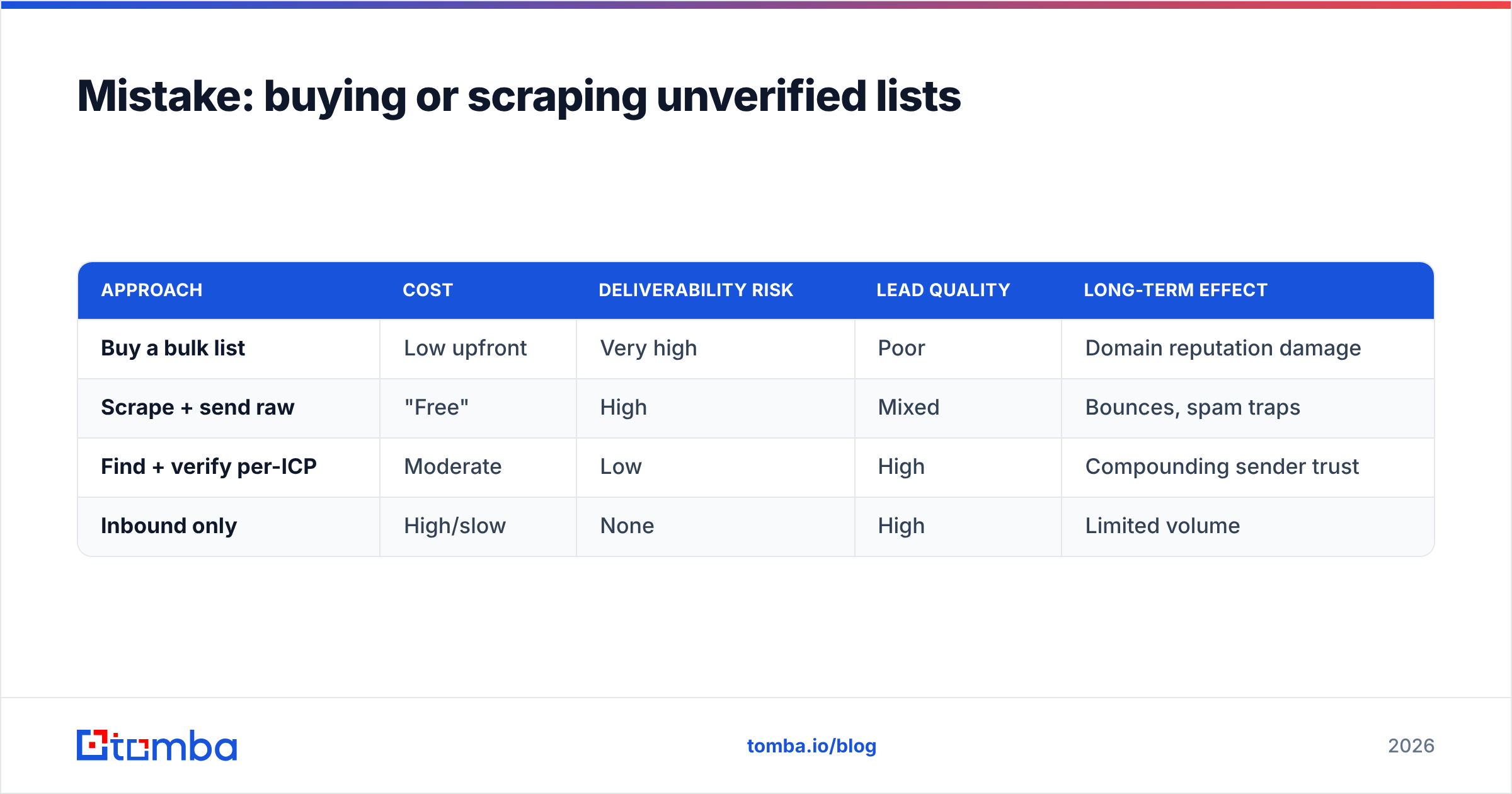
| Approach | Cost | Deliverability risk | Lead quality | Long-term effect |
|---|---|---|---|---|
| Buy a bulk list | Low upfront | Very high | Poor | Domain reputation damage |
| Scrape + send raw | "Free" | High | Mixed | Bounces, spam traps |
| Find + verify per-ICP | Moderate | Low | High | Compounding sender trust |
| Inbound only | High/slow | None | High | Limited volume |
Is your ICP actually specific enough?#
If your ideal customer profile is "B2B companies that need our product," you don't have an ICP — you have a wish. Vague targeting is the mistake that makes every other channel underperform, because broad targeting means broad messaging, and broad messaging converts nobody.
A usable ICP names:
- Firmographics — industry, headcount band, revenue band, region.
- Technographics — tools they already run that signal fit (a CRM, a specific cloud, a competitor product).
- Trigger events — funding, new hires in a relevant role, expansion.
- Persona — the exact title that feels the pain and the title that signs the check.
Once the ICP is sharp, enrichment makes it actionable. Pull missing firmographic and technographic fields with data enrichment so your segmentation is based on facts, not guesses. This is also where a clear definition of a marketing qualified lead earns its keep — without it, "MQL" just means "filled out a form."
Why do vanity metrics keep teams busy and broke?#
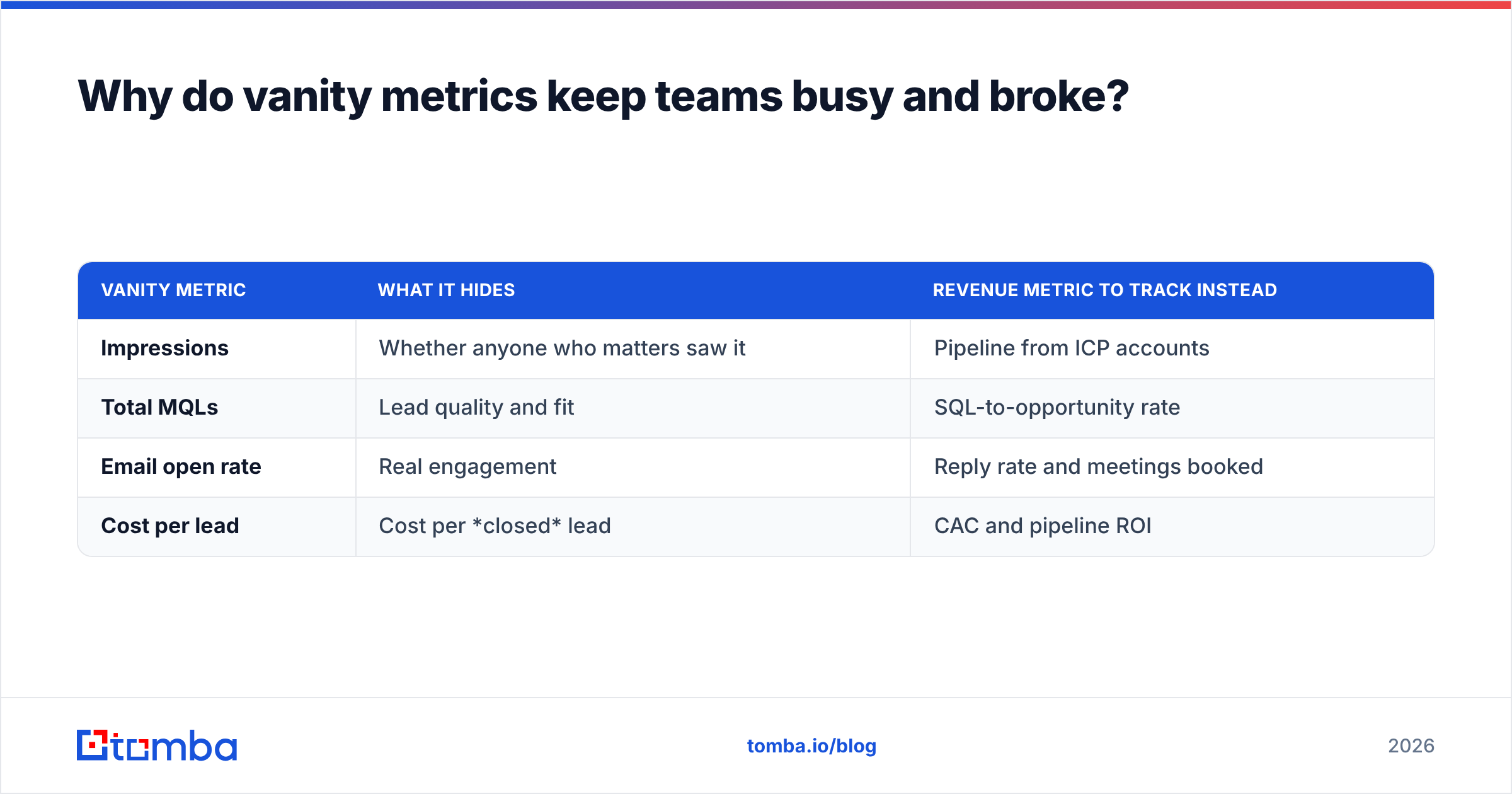
Because they go up. Impressions, clicks, follower counts, and raw MQL totals all rise when you spend more — whether or not you make money. They're activity metrics dressed up as outcome metrics.
The reframe: tie every marketing report to pipeline and revenue.
| Vanity metric | What it hides | Revenue metric to track instead |
|---|---|---|
| Impressions | Whether anyone who matters saw it | Pipeline from ICP accounts |
| Total MQLs | Lead quality and fit | SQL-to-opportunity rate |
| Email open rate | Real engagement | Reply rate and meetings booked |
| Cost per lead | Cost per closed lead | CAC and pipeline ROI |
Marketing teams that report on revenue operations metrics get budget. Teams that report on impressions get questioned. The data is the same campaign — only the framing changes what leadership believes.
Are marketing and sales actually aligned, or just polite?#
Misalignment is the silent pipeline killer. Marketing generates leads; sales says the leads are bad; marketing says sales doesn't work them. Both are usually a little right, and 20–30% of generated demand evaporates in the gap.
Three fixes that cost nothing but a recurring meeting:
- Shared definition of a qualified lead. Write it down. Both teams sign off.
- Closed-loop feedback. Sales tags why a lead was rejected; marketing uses those tags to fix sourcing.
- A single source of truth. Sync lead and account data into your CRM so nobody argues about whose spreadsheet is correct.
The Gartner research on B2B buying is blunt about this: buyers spend only a fraction of their journey talking to any vendor, so the few touches you get have to be coordinated. A buyer who gets a polished ad and then a confused sales call notices the seam immediately.

Mistake: ignoring intent and timing#
You can have the perfect ICP and still lose by reaching out at the wrong moment. Most outbound treats every account as equally ready to buy. They aren't. The accounts researching your category this week convert at multiples of cold accounts.
The fix is prioritization, not more volume. Identify accounts showing signals — website visits, job changes, funding — and work those first. Even a lightweight version helps: use website visitor reveal to see which companies are already on your site, then enrich and route the in-market ones to sales the same day. A timely email to a warm account beats a hundred cold ones, and it protects your sender reputation because engaged recipients don't mark you as spam.
Mistake: treating content as a checkbox#
Publishing a blog post a week is not a content strategy if none of it maps to a buyer question or a stage of the funnel. The mistake is producing volume to feel productive instead of producing the three pieces that actually move deals: a comparison page for the evaluation stage, a proof asset (case study, benchmark) for the validation stage, and a clear pricing/ROI explainer for the decision stage.
A practical content audit:
- Awareness — does anything rank for the problem your buyer searches before they know your category exists?
- Evaluation — do you have an honest comparison vs. the alternatives, including "do nothing"?
- Decision — can a champion forward one link that sells you internally?
If you can't point to an asset for each, that's the gap to fill next — not another listicle.
Mistake: no nurture, just a contact form#
Capturing a lead and immediately routing it to a hard sales pitch wastes most of the demand you paid to create. Plenty of leads are real but not ready. With no nurture track, they go cold and you re-buy the same audience next quarter.
The fix is unglamorous and effective: a short, useful email sequence keyed to the action that captured them, sent from a verified, deliverable domain. Five emails over three weeks beats one aggressive "let's hop on a call" every time. And before you load any nurture list, run it through verification so you're not nurturing typos and dead inboxes.
How do you fix these mistakes without a bigger budget?#
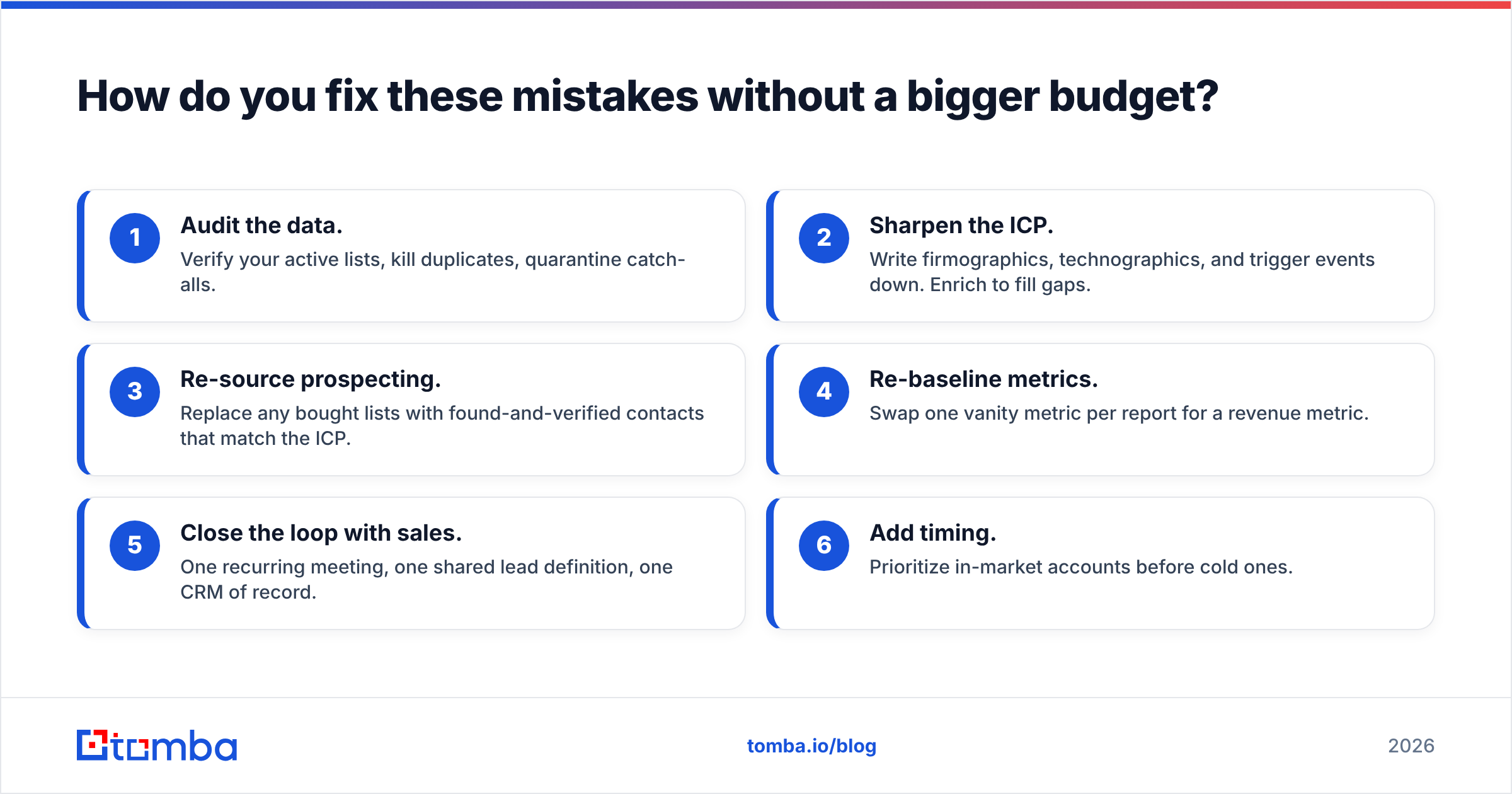
You fix them in order of leverage — data first, because everything sits on top of it. Here's the sequence most teams can run in 30 days:
- Audit the data. Verify your active lists, kill duplicates, quarantine catch-alls.
- Sharpen the ICP. Write firmographics, technographics, and trigger events down. Enrich to fill gaps.
- Re-source prospecting. Replace any bought lists with found-and-verified contacts that match the ICP.
- Re-baseline metrics. Swap one vanity metric per report for a revenue metric.
- Close the loop with sales. One recurring meeting, one shared lead definition, one CRM of record.
- Add timing. Prioritize in-market accounts before cold ones.
Notice that none of these require a new platform — they require discipline and clean inputs. The cost of a good email finder and verifier is trivial next to the ad spend you're currently wasting on contacts who bounce.
Common questions#
Which mistake should I fix first? Data. A sharp ICP and clever creative aimed at wrong or dead contacts still fails. Verify and enrich before anything else.
Is buying a list ever okay? Practically, no — for cold outreach. Shared, unverified lists carry spam traps and stale records that damage deliverability. Find and verify your own contacts instead.
How often should I clean my database? Quarterly at minimum, given 20–30% annual decay. High-volume senders should re-verify before every major send.
What's the cheapest high-impact fix? Closing the marketing-sales loop. It costs one recurring meeting and recovers leads you've already paid to generate.
The fix starts with data you can trust#
Every mistake on this list compounds when your contact data is wrong, and shrinks when it's right. Before your next campaign, replace bought lists and guesswork with real, verified contacts that match your ICP. Start free with the Tomba Email Finder — find professional emails by domain, name, or company, verify them in the same workflow, and feed your funnel inputs it can actually convert. The free tier gives you 25 searches a month to test it; if it pays off, Tomba pricing starts at $49/mo for serious volume. Patch the hull first. Then turn the ad spend back on.
// get started
Find, verify and enrich your first contacts today
Start on the free plan with 25 searches a month, then scale when your team is ready.
Free plan · No credit card required · GDPR & CCPA
// about the author