B2B Marketing Mix in 2026: The 7 Ps Framework That Wins
The B2B marketing mix isn't the same 4 Ps you learned in school. Here's the 7-P framework modern revenue teams actually use to win in 2026.
The B2B marketing mix is the set of controllable levers — product, price, place, promotion, and three service-era additions — that you tune together to move a buying committee from "never heard of you" to "signed." In 2026, treating those levers as one coordinated system, not seven separate budgets, is what separates teams that hit pipeline targets from teams that just spend.
TL;DR#
- The classic 4 Ps (Product, Price, Place, Promotion) still hold, but B2B now demands 7 Ps — adding People, Process, and Physical Evidence because you sell trust and outcomes, not shelf items.
- B2B buying is a committee sport: 6–10 stakeholders, long cycles, and a mix that must serve every role from champion to CFO.
- Data quality is the silent eighth P. A perfect promotion strategy fails if your contact data is stale — accurate targeting starts with a reliable email finder.
- Budget benchmarks for 2026 land around 10–14% of revenue for B2B, weighted toward digital, content, and ABM.
- Build your mix backward from the buying committee and the funnel stage, not forward from last year's channel list.
What is the B2B marketing mix?#
The marketing mix is the recipe. Each "P" is an ingredient you control, and the dish only works when the proportions match who you're feeding.
In consumer marketing, the original 4 Ps — coined by E. Jerome McCarthy and popularized through Philip Kotler's work — were enough because the buyer was usually one person making a fast, emotional choice. B2B breaks that model. You're selling to a committee, the price is negotiated, the "product" is often a service or platform with no physical form, and the purchase carries career risk for the buyer.
So B2B marketers extended the model to 7 Ps. Here's the full set and what each one actually means when your buyer is a procurement-savvy committee:
- Product — Not just features, but the outcome and the roadmap. In B2B, "product" includes onboarding, integrations, SLAs, and how well you solve a job-to-be-done.
- Price — Rarely a sticker. Tiered plans, usage-based billing, annual contracts, and ROI justification all live here. Transparent pricing reduces friction for self-serve buyers.
- Place — Where and how the deal happens: direct sales, self-serve PLG, channel partners, marketplaces, or a hybrid.
- Promotion — Demand gen, content, ABM, events, paid, SEO, and sales enablement. The loudest P, and the one most often mistaken for the whole mix.
- People — Your SDRs, AEs, CSMs, and the buyer-facing experts. In B2B, people frequently are the product experience.
- Process — How a lead becomes a customer: routing, qualification, demos, trials, and handoffs. Friction here quietly kills good demand.
- Physical Evidence — Proof. Case studies, security badges, G2 reviews, ROI calculators, and the polish of your site and collateral.

Wait — that image doesn't belong here, so ignore it. The point of the meme below is simpler: nobody serious still runs a B2B mix on four ingredients.
Why is the B2B marketing mix different from B2C?#
Because the buyer isn't a person — it's a panel. According to Gartner research, a typical B2B purchase involves six to ten decision-makers, each arriving with their own information and priorities. Your mix has to satisfy all of them at once.
| Dimension | B2C marketing mix | B2B marketing mix |
|---|---|---|
| Decision unit | 1 person, often impulsive | 6–10 person committee |
| Sales cycle | Minutes to days | Weeks to 12+ months |
| Price model | Fixed sticker price | Negotiated, tiered, usage-based |
| Core "Product" | Physical good or app | Outcome, service, platform, roadmap |
| Promotion focus | Reach + emotion | Trust, ROI proof, education |
| Key extra Ps | Optional | People, Process, Evidence mandatory |
| Data dependency | Broad demographics | Precise firmographic + contact data |
The practical consequence: a B2C team can win with a great Promotion P alone. A B2B team that nails Promotion but fumbles Process (slow lead routing) or Physical Evidence (no case studies for the CFO) will watch deals stall in the committee. The mix is only as strong as its weakest P.
How do you build a B2B marketing mix in 2026?#
Start from the buying committee and work backward. Don't start with "we should do more LinkedIn ads." Map who needs convincing, then assign Ps to each.
Step 1 — Define the ICP and the committee. Name the roles: economic buyer, champion, end user, technical evaluator, and blocker. Each needs different evidence and a different message.
Step 2 — Audit your current Ps honestly. Score each P 1–5. Most teams over-invest in Promotion and starve Process and Physical Evidence.
Step 3 — Fix the data layer first. Every P that touches outreach depends on knowing who to contact and reaching them. If 30% of your contact list bounces, your Promotion budget is lighting money on fire. Run lists through an email verifier before any campaign, and use domain search to map every reachable contact at a target account.
Step 4 — Sequence the channels by funnel stage. Awareness, consideration, and decision each demand a different P-weighting.
Step 5 — Instrument and re-balance quarterly. The mix is not set-and-forget. Track CAC, win rate, and response rate per channel and shift budget toward what compounds.
Which channels belong in a B2B promotion mix?#
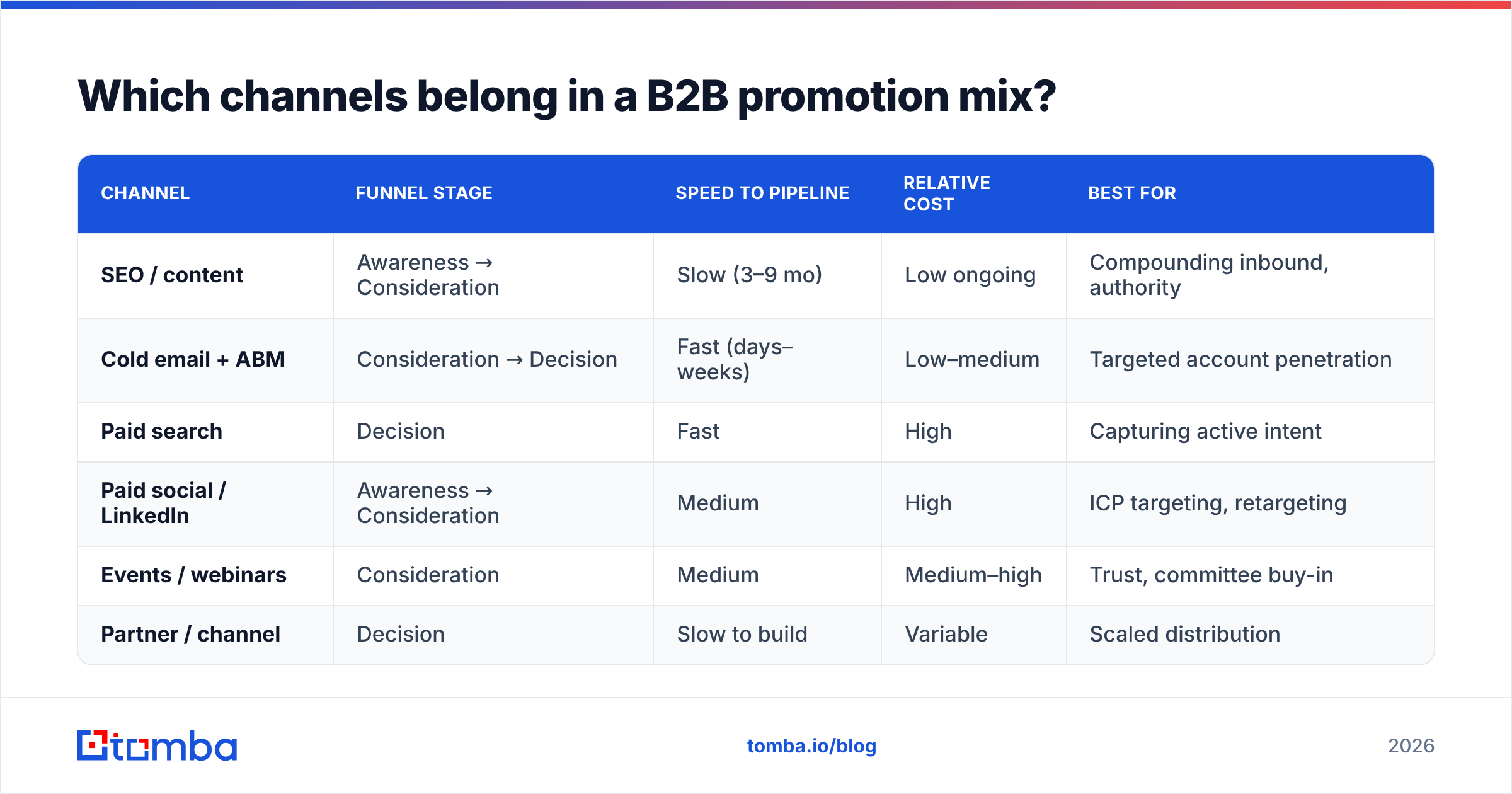
The Promotion P is where most budget goes, so it deserves its own breakdown. Here's how the major B2B channels compare on cost, speed, and best-fit funnel stage in 2026:
| Channel | Funnel stage | Speed to pipeline | Relative cost | Best for |
|---|---|---|---|---|
| SEO / content | Awareness → Consideration | Slow (3–9 mo) | Low ongoing | Compounding inbound, authority |
| Cold email + ABM | Consideration → Decision | Fast (days–weeks) | Low–medium | Targeted account penetration |
| Paid search | Decision | Fast | High | Capturing active intent |
| Paid social / LinkedIn | Awareness → Consideration | Medium | High | ICP targeting, retargeting |
| Events / webinars | Consideration | Medium | Medium–high | Trust, committee buy-in |
| Partner / channel | Decision | Slow to build | Variable | Scaled distribution |
Notice that cold email and ABM punch above their weight on speed-to-pipeline at a low cost — but only when targeting is precise. That precision is a data problem, not a copy problem. The best cold email templates still fail against bad addresses. Pair tight targeting with sales automation so your SDRs spend time on conversations, not list cleanup.
For the awareness end, SEO and content remain the highest-ROI long game. They feed every other channel: a strong content library gives ABM something to share, gives paid a landing destination, and builds the Physical Evidence P over time.
How much should you budget for the B2B marketing mix?#
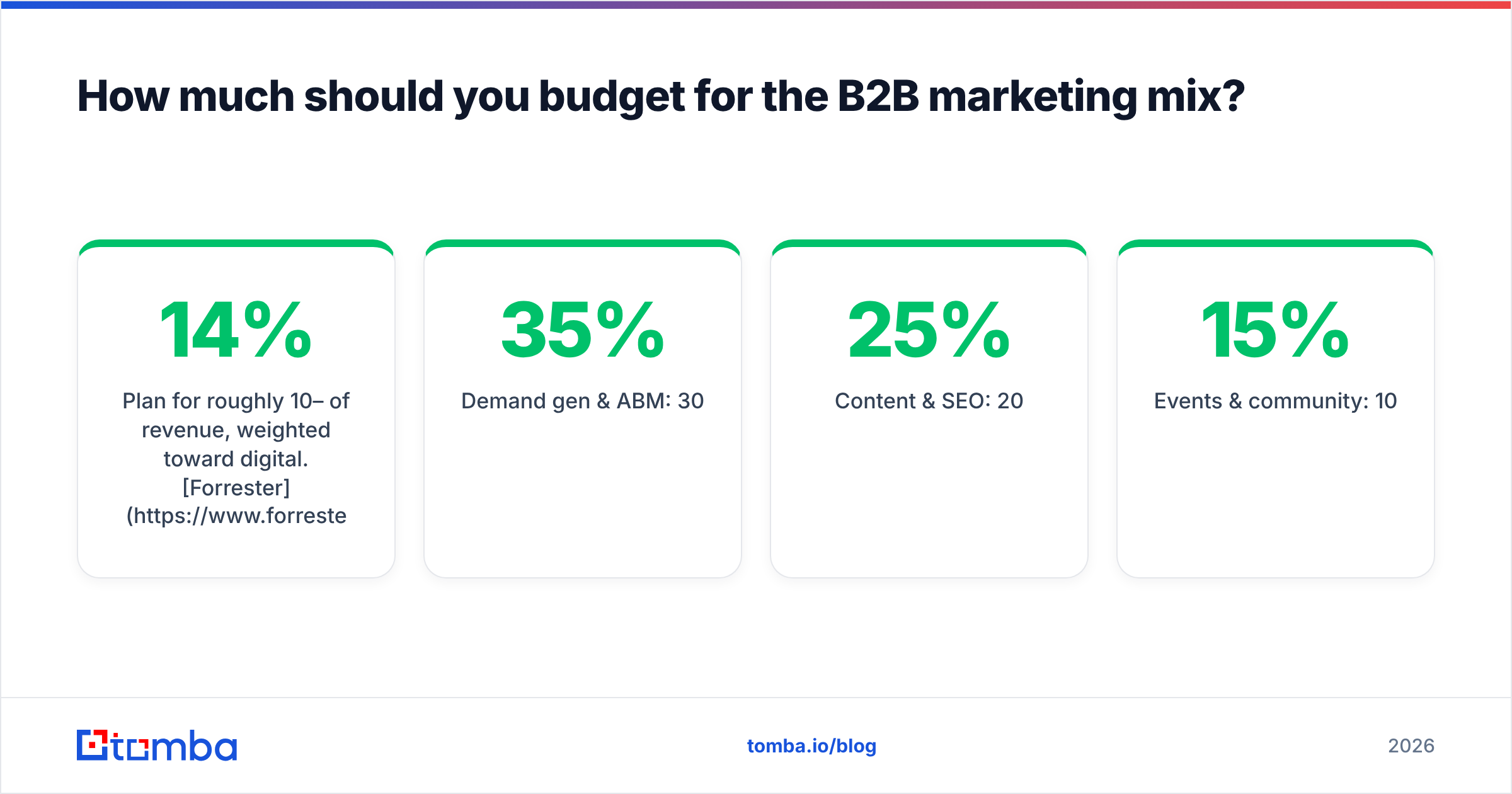
Plan for roughly 10–14% of revenue, weighted toward digital. Forrester and industry surveys consistently put B2B marketing spend in that band, with growth-stage companies pushing higher to capture share.
A workable 2026 allocation for a growth-stage B2B company:
- Demand gen & ABM: 30–35%
- Content & SEO: 20–25%
- Events & community: 10–15%
- Data, tooling & RevOps: 10–15%
- Brand & creative: 10%
- Experiment budget: 5–10%
That "Data, tooling & RevOps" line is the one teams cut first and regret most. Your revenue operations stack — including contact data, enrichment, and routing — is the connective tissue that makes every other dollar work. Underfund it and the rest of the mix degrades.
What's the most overlooked P in B2B?#
Data quality — the silent eighth P. You can perfect Product, Price, Place, Promotion, People, Process, and Physical Evidence, and still miss quota because your contact data is wrong.
Think of it like a world-class kitchen with spoiled ingredients. The technique doesn't matter if the inputs are bad. In B2B, "spoiled ingredients" means bounced emails, wrong job titles, contacts who left the company two quarters ago, and accounts with no verified decision-maker.
The fix is unglamorous but decisive: build verification and enrichment into the workflow, not as an afterthought. Use data enrichment to fill firmographic gaps, bulk verify before sends, and confirm sender reputation so your carefully-built Promotion P actually lands in inboxes. Teams that treat data as a first-class P see materially higher win rates because every downstream action targets a real, reachable human.
How do the 7 Ps work together in practice?#
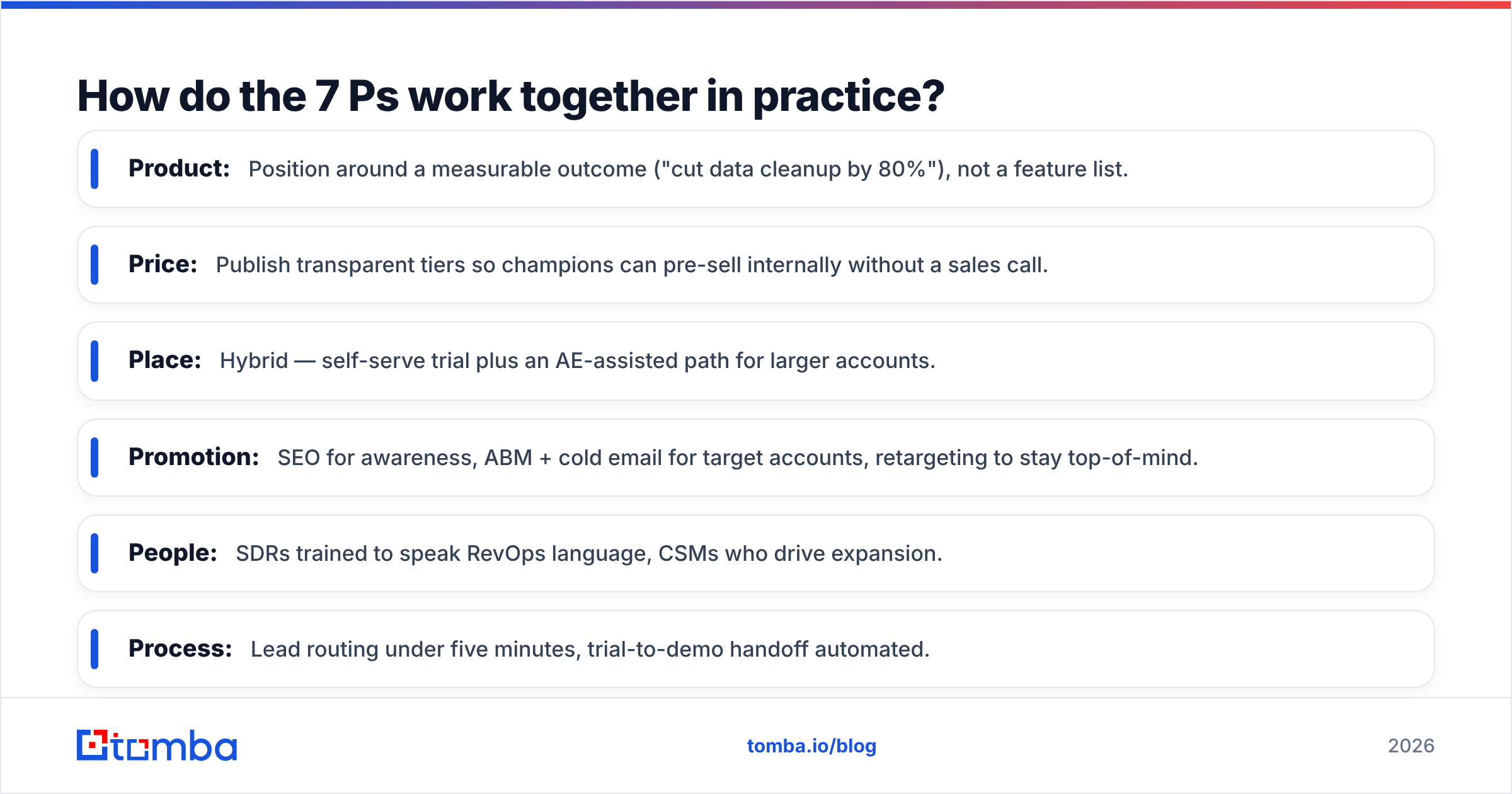
They compound — or they cancel out. A worked example makes it concrete. Say you're a Series B SaaS company selling to mid-market RevOps leaders:
- Product: Position around a measurable outcome ("cut data cleanup by 80%"), not a feature list.
- Price: Publish transparent tiers so champions can pre-sell internally without a sales call.
- Place: Hybrid — self-serve trial plus an AE-assisted path for larger accounts.
- Promotion: SEO for awareness, ABM + cold email for target accounts, retargeting to stay top-of-mind.
- People: SDRs trained to speak RevOps language, CSMs who drive expansion.
- Process: Lead routing under five minutes, trial-to-demo handoff automated.
- Physical Evidence: Three role-specific case studies, a security page, live G2 reviews.
Each P reinforces the next. Transparent Price makes the champion's job easier, which shortens Process, which raises the conversion of your Promotion spend. Pull one P out and the chain weakens. That interdependence is the whole point of thinking in a mix rather than a list.
Common mistakes when building the mix#
- Treating Promotion as the entire mix. It's one of seven. The flashiest budget can't rescue a broken Process.
- Copying a competitor's channel list. Their committee, ICP, and Place strategy differ from yours. Borrow frameworks, not budgets.
- Ignoring the data layer. Covered above — it's the most common silent killer.
- Setting the mix annually and forgetting it. Re-balance quarterly against real CAC and win-rate data.
- One message for the whole committee. The CFO and the end user need different evidence. Segment your Physical Evidence.
Conclusion: tune the mix, starting with the data#
The B2B marketing mix in 2026 is a 7-P system where every lever depends on the others — and all of them depend on knowing exactly who to reach. You can debate channel allocation and pricing tiers all quarter, but if your contact data is stale, every other P loses leverage.
Start at the foundation. Tomba's Email Finder gives your team verified, accurate professional emails by name, company, or domain — so your Promotion, People, and Process Ps all act on real, reachable contacts instead of a decaying list. Get the data right first, and the rest of the mix finally compounds the way the framework promises. Try the free tier with 25 searches a month and put accurate targeting under your entire marketing mix.
Ready to find emails that actually work?
Join 150,000+ professionals who stopped guessing and started sending. Free credits on signup — no credit card required.
Get the Tomba newsletter
Practical outbound tactics and product updates — once every two weeks.
About the author