B2B Marketing Plan: The 2026 Framework That Drives Pipeline
A practical, no-fluff B2B marketing plan template for 2026 — set goals, pick channels, build the data layer, and tie every dollar to pipeline.
B2B Marketing Plan: The 2026 Framework That Drives Pipeline
A B2B marketing plan is a written commitment to which buyers you will pursue, how you will reach them, what you will spend, and how you will measure whether it worked. Most "plans" fail because they are calendars of activity, not engines for pipeline. This guide fixes that.
TL;DR
- A real B2B marketing plan ties every channel and dollar to pipeline and revenue — not impressions, followers, or "brand awareness."
- Start with one number (pipeline target), work backward through conversion rates, and only then choose channels.
- Your data layer — clean account lists, verified contacts, enrichment — is the foundation. Bad data sinks good strategy.
- Budget by expected return per channel, then protect 15–20% for experiments.
- Review monthly against leading indicators (MQL→SQL, reply rate, cost per opportunity), not just lagging revenue.
What Is a B2B Marketing Plan?#
A B2B marketing plan is the document that translates a revenue goal into a sequence of marketing decisions: who you target, what you say, where you say it, what it costs, and how you'll know it worked. Think of it like a flight plan. The pilot doesn't just point the plane "toward the destination" — they file a route, fuel calculation, and checkpoints. If wind shifts, they adjust against the plan rather than improvising blind.
The difference between B2B and B2C planning is the buying committee. In B2B you rarely sell to one person. Gartner's research consistently shows buying groups of six to ten stakeholders for a typical complex purchase. Your plan has to reach an economic buyer, a champion, and several skeptics — often across months. That changes everything: longer nurture, multi-threaded outreach, and content built for different roles.
A plan that ignores this reality produces lots of activity and little pipeline.
What Are the Core Components of a B2B Marketing Plan?#
Every effective plan covers the same building blocks. Skip one and the others wobble.
- Goals and targets — A single pipeline or revenue number, broken into quarterly milestones. Everything else serves this.
- Ideal Customer Profile (ICP) and segments — The firmographic and technographic definition of accounts worth pursuing, plus the personas inside them.
- Positioning and messaging — Why you, why now, why not the status quo — written per persona, not one generic pitch.
- Channel strategy — The specific mix (outbound, content/SEO, paid, events, partnerships) chosen by where your buyers actually are.
- Budget and resourcing — Money and people allocated by expected return, with a reserve for experiments.
- Measurement framework — Leading and lagging metrics, the dashboard, and the cadence for reviewing them.
The components are sequential for a reason. You cannot pick channels before you know the ICP, and you cannot set a budget before you know the goal. Plans go wrong when teams jump straight to "let's run LinkedIn ads" before answering the first three questions.
How Do You Set Goals That Tie to Revenue?#
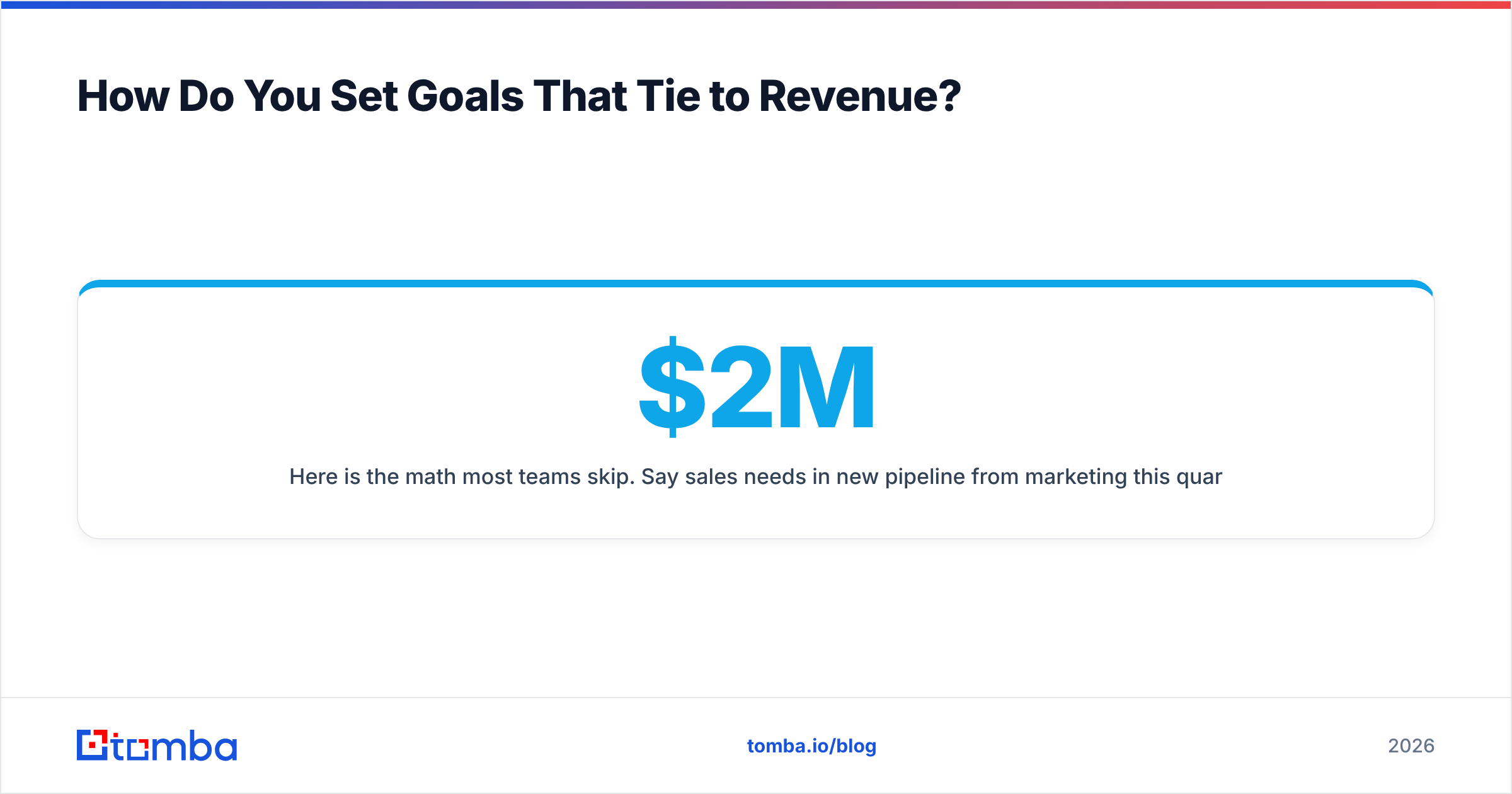
Work backward from one number. Pick the pipeline you need to generate, then divide by your historical conversion rates until you reach the activity you must produce.
Here is the math most teams skip. Say sales needs $2M in new pipeline from marketing this quarter, your average deal is $20K, and your opportunity-to-close rate is 25%. You need 100 closed-won, which means 400 qualified opportunities. If 20% of SQLs become opportunities, you need 2,000 SQLs. If 30% of MQLs become SQLs, you need roughly 6,600 MQLs. Now you know the top-of-funnel volume your channels must deliver — and whether your current plan is realistic or fantasy.
This is also where you separate leading from lagging indicators. Revenue is lagging; you find out months later. Reply rates, MQL→SQL velocity, and cost per opportunity are leading — they tell you in week two whether the quarter is on track. A good revenue operations function lives in these leading numbers.
Who Are You Targeting? Building the ICP and Data Layer#
Targeting is the highest-leverage decision in the entire plan, and it depends entirely on data quality. You can have brilliant positioning and a generous budget, but if you're emailing the wrong 10,000 people — or the right people at addresses that bounce — none of it matters.
Define your ICP across three layers:
- Firmographics — industry, company size, revenue, geography, growth stage.
- Technographics — the tools they already use (a strong buying signal for integrations and replacements).
- Persona triggers — job changes, funding rounds, hiring spikes, or new tech adoption that signal intent.
Then build the actual list. This is where most plans quietly break: a marketer exports a stale CRM segment, runs it, and watches deliverability collapse. Before any campaign, run your contacts through an email verifier to strip dead addresses, and use domain search to find the right people at your target accounts rather than guessing at generic info@ inboxes. If you're scaling, a bulk email finder turns an account list into verified, multi-threaded contacts in one pass.
Clean data is not a nice-to-have. It's the difference between a plan that compounds and one that burns your sending reputation in week one. For more on why bounce rates wreck campaigns, see this primer on email deliverability.
Which Channels Belong in a 2026 B2B Marketing Plan?#
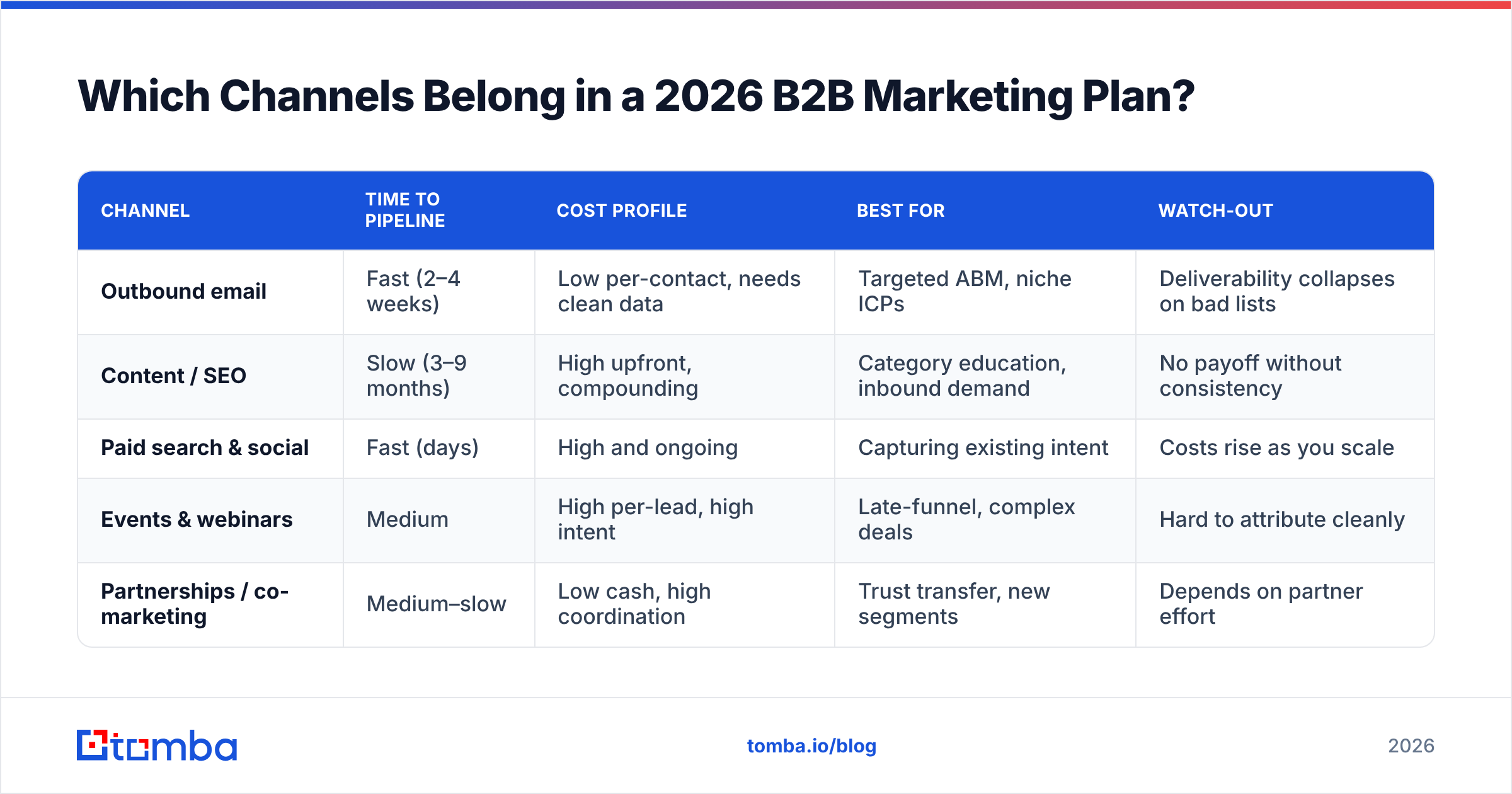
Pick channels by where your buyers spend attention and how fast you need results — not by what's trendy. Here's how the major options compare on the dimensions that matter for planning.
| Channel | Time to pipeline | Cost profile | Best for | Watch-out |
|---|---|---|---|---|
| Outbound email | Fast (2–4 weeks) | Low per-contact, needs clean data | Targeted ABM, niche ICPs | Deliverability collapses on bad lists |
| Content / SEO | Slow (3–9 months) | High upfront, compounding | Category education, inbound demand | No payoff without consistency |
| Paid search & social | Fast (days) | High and ongoing | Capturing existing intent | Costs rise as you scale |
| Events & webinars | Medium | High per-lead, high intent | Late-funnel, complex deals | Hard to attribute cleanly |
| Partnerships / co-marketing | Medium–slow | Low cash, high coordination | Trust transfer, new segments | Depends on partner effort |
The right answer is almost never one channel. A durable plan pairs a fast channel (outbound or paid) to fill the pipeline now with a slow channel (content/SEO) to lower acquisition cost over time. The fast channel buys you time; the slow channel buys you margin.
For 2026 specifically, two shifts matter. First, AI-generated content has flooded search, so generic blog posts no longer rank — original data, expert POV, and depth do. Second, buyers self-educate further before talking to sales, which means your outbound has to add value, not just "check in." Both push toward better targeting and better content, which both depend on better data.
How Should You Allocate the Budget?#
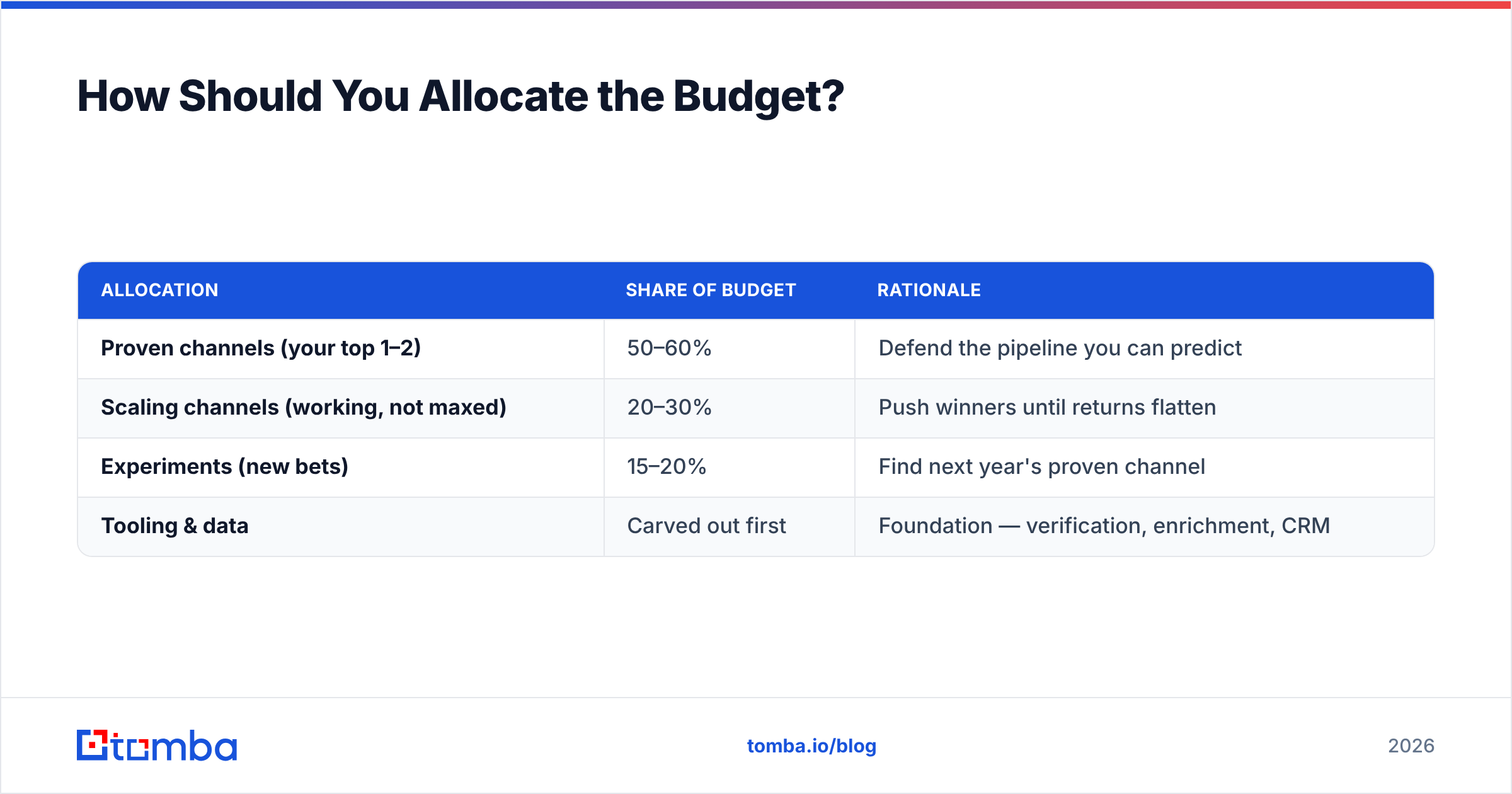
Allocate by expected return per channel, then carve out a fixed slice for experiments. A common starting split for a growth-stage B2B company:
| Allocation | Share of budget | Rationale |
|---|---|---|
| Proven channels (your top 1–2) | 50–60% | Defend the pipeline you can predict |
| Scaling channels (working, not maxed) | 20–30% | Push winners until returns flatten |
| Experiments (new bets) | 15–20% | Find next year's proven channel |
| Tooling & data | Carved out first | Foundation — verification, enrichment, CRM |
Notice tooling and data come out first, off the top. Treating your data layer as discretionary is the most common budgeting mistake in B2B. A few hundred dollars a month on verified contacts protects tens of thousands in wasted ad spend and sales time. Tomba's plans scale from a free tier (25 searches/mo) through Starter at $49/mo and Growth at $99/mo — see full Tomba pricing — which slots into the "tooling & data" line for most teams rather than competing with channel spend.
The experiments slice is non-negotiable. Without it, your plan ossifies: you keep funding last year's winners until they decay, with nothing tested to replace them. Protect that 15–20% even in lean quarters.
How Do You Measure Whether the Plan Works?#
Measure leading indicators weekly and lagging indicators monthly, against the targets you set in step one. A plan you don't review is just a wish.
Build a dashboard with three tiers:
- Activity metrics (daily/weekly) — emails sent, content published, ad spend, reply rates. These confirm the plan is running.
- Pipeline metrics (weekly/monthly) — MQLs, SQLs, opportunities created, cost per opportunity, MQL→SQL conversion. These confirm the plan is working.
- Revenue metrics (monthly/quarterly) — closed-won, pipeline influenced, marketing-sourced revenue, CAC payback. These confirm the plan is profitable.
The trap is reporting only activity ("we sent 40,000 emails!") or only revenue ("we closed $1.8M"). Activity without pipeline is busywork; revenue without leading indicators gives you no steering wheel mid-quarter. You need all three tiers so you can diagnose where the funnel leaks. If reply rates are healthy but MQL→SQL is collapsing, your targeting is fine and your qualification is broken — a completely different fix than if replies themselves are weak.
Tools like G2 and review platforms also feed your measurement loop: buyer intent signals there can become a leading indicator for outbound timing.
What Does a 30-60-90 Day Rollout Look Like?#
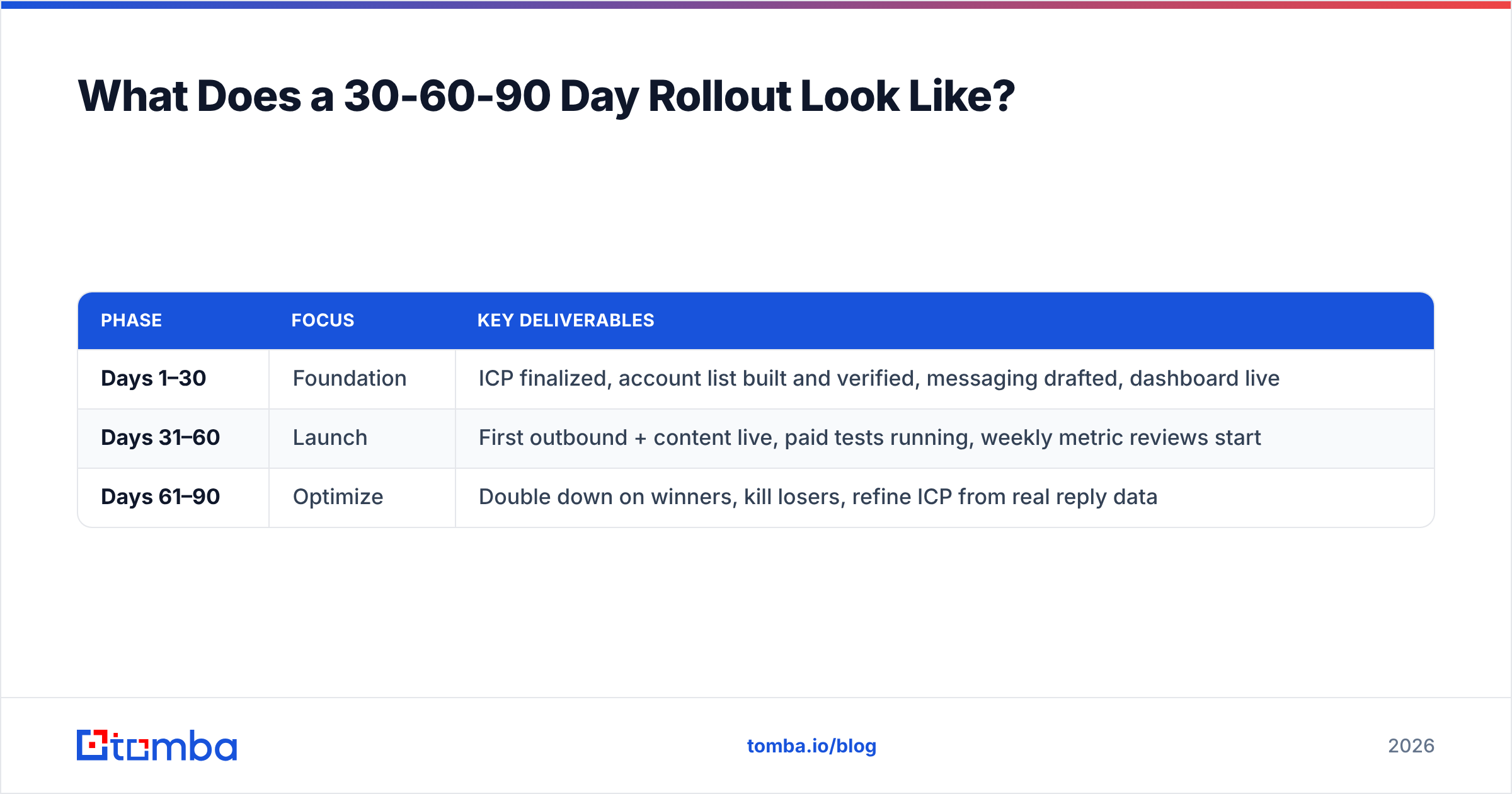
Don't launch everything at once. Sequence the plan so each phase de-risks the next.
| Phase | Focus | Key deliverables |
|---|---|---|
| Days 1–30 | Foundation | ICP finalized, account list built and verified, messaging drafted, dashboard live |
| Days 31–60 | Launch | First outbound + content live, paid tests running, weekly metric reviews start |
| Days 61–90 | Optimize | Double down on winners, kill losers, refine ICP from real reply data |
The first 30 days produce no pipeline, and that's correct. Teams that skip the foundation phase — who launch outreach against an unverified list on day three — spend the next 60 days cleaning up deliverability damage instead of optimizing. Slow is smooth, smooth is fast.
By day 90 you should have enough real data to rewrite the plan with confidence rather than assumptions. The first version of any B2B marketing plan is a hypothesis; the second version, informed by 90 days of evidence, is where the real returns start.
How Is B2B Marketing Planning Changing With AI?#
AI is compressing the research and personalization steps that used to gate B2B marketing, but it raises the bar on data and originality. Anyone can now generate a thousand "personalized" emails in an hour — which means generic personalization is worthless, and prospects have learned to ignore it. The advantage shifts to teams with proprietary signals: who changed jobs, who's hiring, who just adopted a competing tool.
That's why the data layer keeps coming up. AI makes execution cheap and abundant; the scarce input is accurate, enriched, intent-rich data about real accounts. Plans built on that foundation get sharper with AI. Plans built on stale lists just produce more spam, faster. Platforms like HubSpot are baking AI into the workflow layer, but the quality ceiling is still set by the contact data you feed it.
Putting It All Together#
A B2B marketing plan is not a content calendar and not a budget spreadsheet — it's the connective tissue between a revenue goal and the daily decisions that get you there. Set one pipeline number, work backward to your activity targets, define your ICP precisely, build a clean and verified data layer, choose channels by buyer behavior, allocate budget by expected return, and review leading indicators relentlessly. Do those seven things and you have a plan that compounds.
The cheapest, highest-leverage place to start is your data. Before you spend a dollar on ads or write a single sequence, make sure you're reaching real decision-makers at real addresses. Spin up the Tomba Email Finder on your target account list — find verified, role-specific contacts in minutes — and build your 2026 plan on a foundation that won't collapse the moment you hit send. Start free, then scale into a paid plan as your pipeline grows.
// get started
Find, verify and enrich your first contacts today
Start on the free plan with 25 searches a month, then scale when your team is ready.
Free plan · No credit card required · GDPR & CCPA
// about the author